
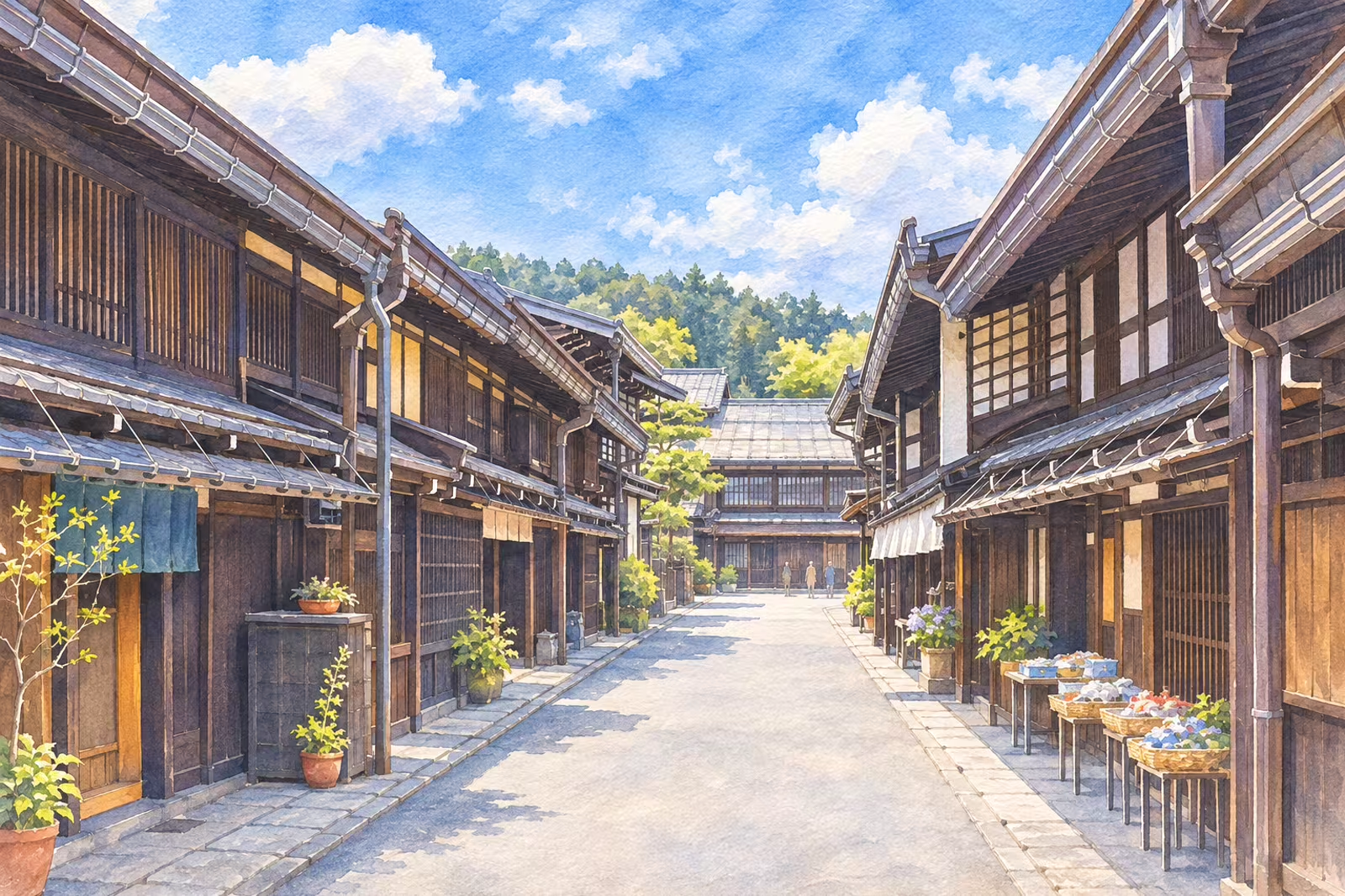
Takayama Old Town, in Takayama, Gifu Prefecture, is a preserved merchant quarter in the heart of the Hida region. It grew from a castle town laid out at the end of the sixteenth century by the warlord Kanamori Nagachika. The castle has long since vanished, but the merchant streets survived and now form one of the best-preserved townscapes of traditional townhouses in Japan, often called the "Little Kyoto of Hida."
01The Kanamori castle town
In 1585 Kanamori Nagachika conquered Hida on the orders of Toyotomi Hideyoshi and was then made its lord. He built Takayama Castle on the hill now called Shiroyama and planned a town below it: samurai residences on the higher ground, a merchant quarter on the lower land between, and temples gathered along the eastern hills. The three parallel north–south streets, Ichinomachi, Ninomachi and Sannomachi, were the spine of that merchant quarter. The Kanamori ruled Hida for about a century.
02Shogunal rule and merchant wealth
In 1692 the Kanamori were transferred to Dewa and Hida became land under direct shogunal control; Takayama Castle was dismantled soon after. The shogunate’s intendants governed from the Takayama Jin’ya, the only shogunal regional office in Japan whose main buildings survive, now a National Historic Site. With the castle gone, merchants grown rich on timber, sake brewing and moneylending became the leading figures of the town. They paid for the ornate floats of the Takayama Festival, held in spring by Hie Shrine and in autumn by Sakurayama Hachimangū. Hida had long been famous for its carpenters, and that craft tradition shows in both the townhouses and the floats.
03The old town today
The Sanmachi area was selected as an Important Preservation District for Groups of Traditional Buildings in 1979, and the Shimo-Ninomachi and Ōshinmachi area was later added. Low two-story townhouses with dark latticed fronts, continuous eaves and roadside water channels give the streets their uniform look; many were rebuilt after fires in the Meiji era. Merchant residences such as the Yoshijima House and the Kusakabe House are Important Cultural Properties, and balls of cedar leaves hanging outside breweries announce the new sake. The festival floats are designated Important Tangible Folk Cultural Properties, and as of 2016 the festival is inscribed on UNESCO’s intangible heritage list as part of the Yama, Hoko, Yatai float festivals.