
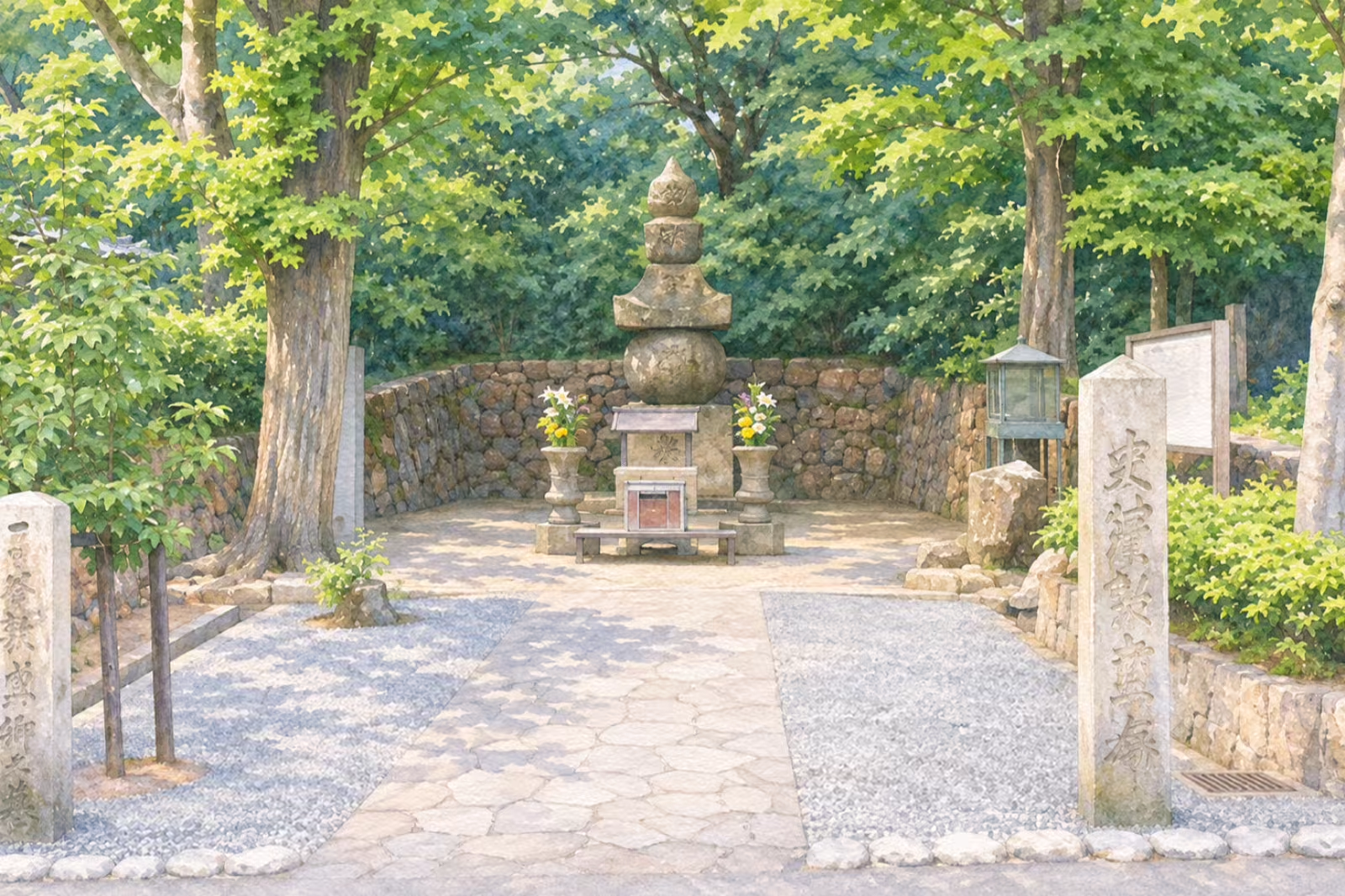
The Ichi-no-Tani battlefield lies in Suma Ward, Kōbe, Hyōgo Prefecture, where one of the best-known battles of the Genpei War was fought. On the seventh day of the second month of Juei 3 (March 20, 1184 in the Julian calendar), Minamoto forces defeated the Taira, who were holding the area around Fukuhara. The Taira lost any realistic hope of retaking Kyoto and fell back to Yashima on Shikoku. Minamoto no Yoshitsune’s descent down the slopes of Hiyodori-goe and the encounter between Kumagai Naozane and Taira no Atsumori both come from this battle, and The Tale of the Heike has kept them alive ever since.
01The Battle
In 1183 the Taira abandoned Kyoto, taking the child emperor Antoku with them. They later regrouped around their old capital at Fukuhara and set up defenses from the Ikuta Wood in the east to Ichi-no-Tani at Suma in the west. Here the Rokkō mountains come close to the sea and the coastal plain is narrow, and the Taira, with hills behind them and the sea in front, considered the position strong. Minamoto no Yoritomo sent his brother Minamoto no Noriyori with the main army against Ikuta from the east. Yoshitsune took a route through Tanba, overran a Taira outpost at Mikusayama, and approached from the mountains to the northwest. According to The Tale of the Heike, he led a small band of horsemen straight down a steep slope into the rear of the Taira camp. The Taira broke and fled to their ships. Taira no Tadanori and Atsumori were among the dead, and Taira no Shigehira was captured.
Where Hiyodori-goe actually was, and whether Yoshitsune really charged down the cliffs behind Ichi-no-Tani, are still debated. Some historians think Yoshitsune himself attacked Ichi-no-Tani while a different force operated on the Hiyodori-goe side.
02What Can Be Seen Today
The battlefield is now part of the city, and no extensive site survives. Around Sumaura Park, the meeting of mountain and sea still conveys how narrow the coastal passage was, and a memorial stone marks the battlefield. Nearby stands Atsumori-zuka, a large five-tier stone pagoda traditionally regarded as a memorial to Atsumori. Suma-dera temple keeps the Aoba flute said to have belonged to him, along with a mound said to hold his head and other memorials. To the east, the grounds of Ikuta Shrine preserve the name of the Ikuta Wood. Most of these places were established later on the basis of tradition, and their link to specific events of 1184 should be taken loosely.