
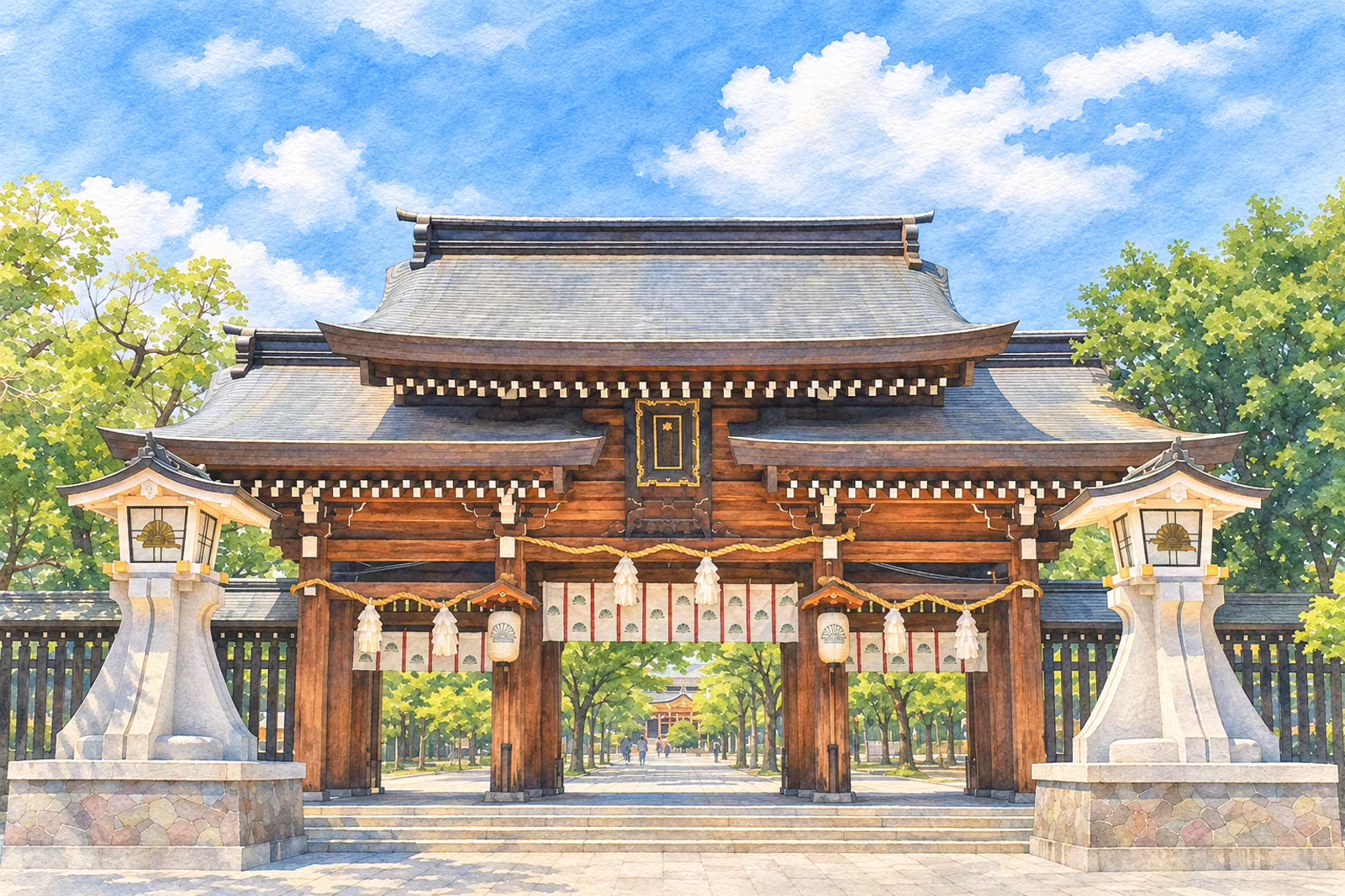
Minatogawa Shrine stands in Chūō Ward, Kōbe, in Hyōgo Prefecture, and is dedicated to Kusunoki Masashige, a fourteenth-century commander who died fighting for Emperor Go-Daigo. Masashige fell nearby at the Battle of Minatogawa in 1336, and the shrine grounds hold both his grave and the spot where, by tradition, he took his own life. The site is a battlefield, and also the center of a long effort to turn Masashige into Japan’s model of loyalty.
01The Battle of Minatogawa, 1336
In the fifth month of 1336, Ashikaga Takauji marched east after regrouping in Kyūshū, sailing with his fleet while his brother Ashikaga Tadayoshi led an army along the coast road. Go-Daigo’s side sent Nitta Yoshisada and Masashige to stop them. According to the Taiheiki, Masashige had urged a temporary withdrawal from Kyoto to draw the enemy in, but his advice was rejected and he went into battle with a small force. The fighting took place around the Minato River, in what is now central Kōbe. After a hard struggle, the chronicle says, Masashige and his brother Masasue vowed to be reborn seven times to fight the emperor’s enemies, and died together. Takauji then entered Kyoto and set up a rival emperor, opening the era of the Northern and Southern Courts.
02From grave to shrine
Masashige’s grave was already a place of pilgrimage in the Edo period. In 1692 Tokugawa Mitsukuni, lord of Mito, had a monument raised over it, inscribed in his own hand "Ah, the grave of the loyal subject Lord Kusunoki." The reverse carries a eulogy by the Ming loyalist scholar Zhu Shunshui. Late-Edo imperial loyalists came here in numbers. In 1872 the Meiji government founded Minatogawa Shrine, ranked as a special government shrine (bekkaku kanpeisha), with grounds that took in both the grave and the death site. Locals still call it "Nankō-san."
03What can be seen today
The grave and the death site are both designated National Historic Sites. The shrine buildings burned in the 1945 air raids on Kōbe, and the present main sanctuary and worship hall were rebuilt in reinforced concrete in 1952. The battlefield itself has been absorbed into the city, with the coastline and river course both changed; scattered markers, such as the monument to Masashige’s headquarters on Egeyama hill, help locate the fighting.