
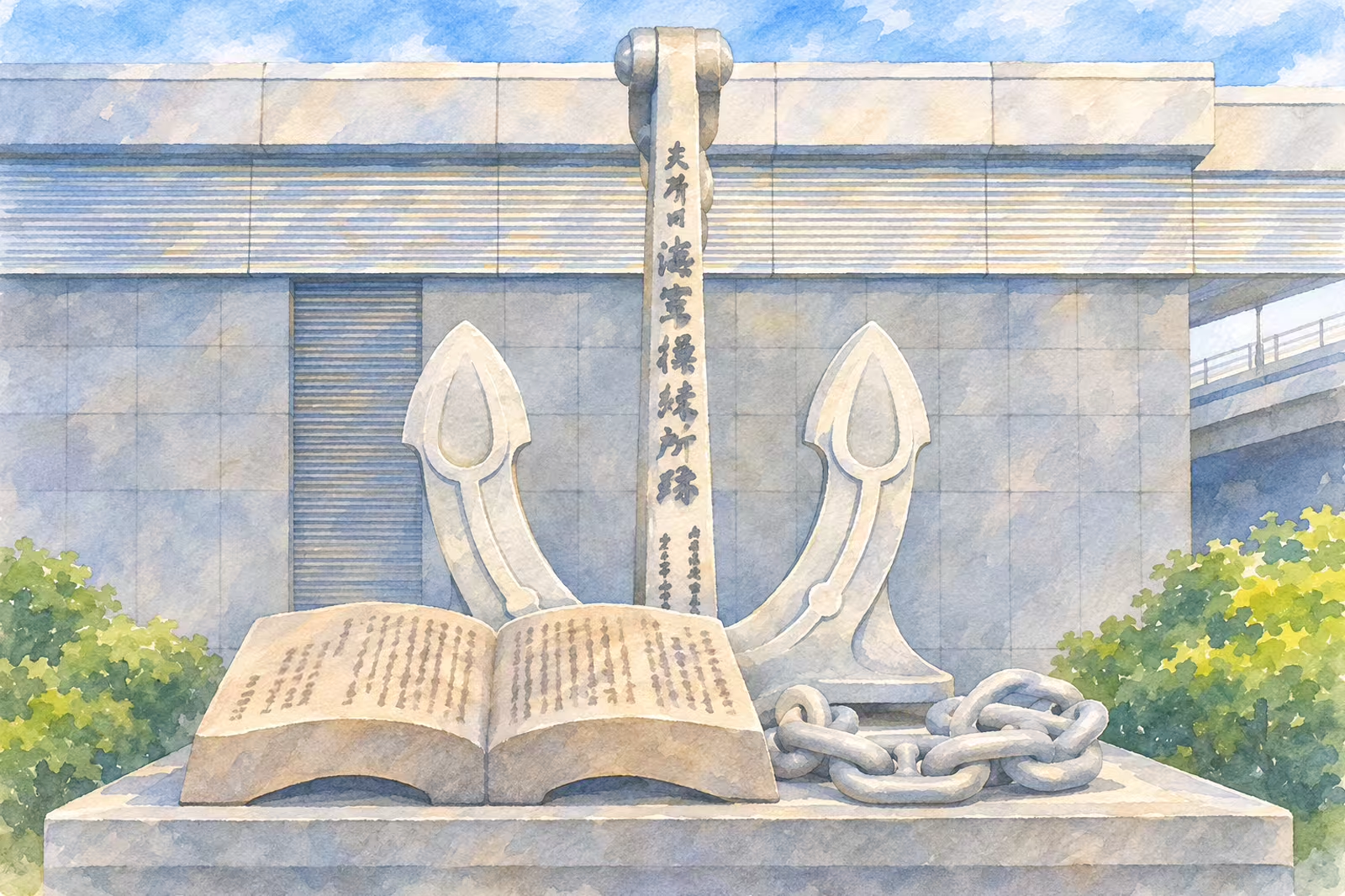
The Kōbe Naval Training Center site lies in the harbor district of Chūō Ward, Kōbe, Hyōgo Prefecture. It marks where the Tokugawa shogunate set up a naval training institution at the end of the Edo period. Run under Katsu Kaishū, the center lasted less than a year, yet it was one of the earliest attempts at modern naval education in Japan. Because Sakamoto Ryōma and others studied seamanship at Katsu’s private academy nearby, the place often appears in accounts of the Bakumatsu years.
01Founding and Closure
In 1863 the shogun Tokugawa Iemochi inspected Ōsaka Bay by ship, with Katsu Kaishū in attendance. Katsu proposed a naval training center at Kōbe, and the plan was approved. The center formally opened in the fifth month of 1864, taking in shogunal retainers and young men from the domains to learn navigation, gunnery and related skills. At the same time Katsu ran a private academy nearby that accepted motivated students regardless of background, among them Sakamoto Ryōma and Mutsu Munemitsu, then known as Yōnosuke. Katsu’s idea was to build a navy for the whole country that would cut across the divisions between the shogunate and the domains.
Around the time of the Kinmon Incident of 1864, however, some of the students were found to have links with anti-shogunate loyalists. The shogunate grew suspicious of Katsu, recalled him to Edo late that year and removed him from his post as commissioner of warships. The training center closed in the third month of 1865, and the private academy broke up with it. Ryōma and several others later moved to Nagasaki, where they formed the Kameyama Shachū.
02What Can Be Seen Today
None of the center’s buildings survive. From the Meiji period the area was covered by port construction, and the shoreline has changed considerably. In 1968 an anchor-shaped monument was erected near the site; it marks the location only approximately and is not an original object. The Kaigun’ei monument, whose inscription Katsu composed, was later moved to Kinseidai on Mount Suwa. In recent years, construction work in the harbor area has uncovered stone walls and other remains generally thought to be connected with the training center and the harbor facilities around it. As of 2026, investigation and conservation work is still under way.