
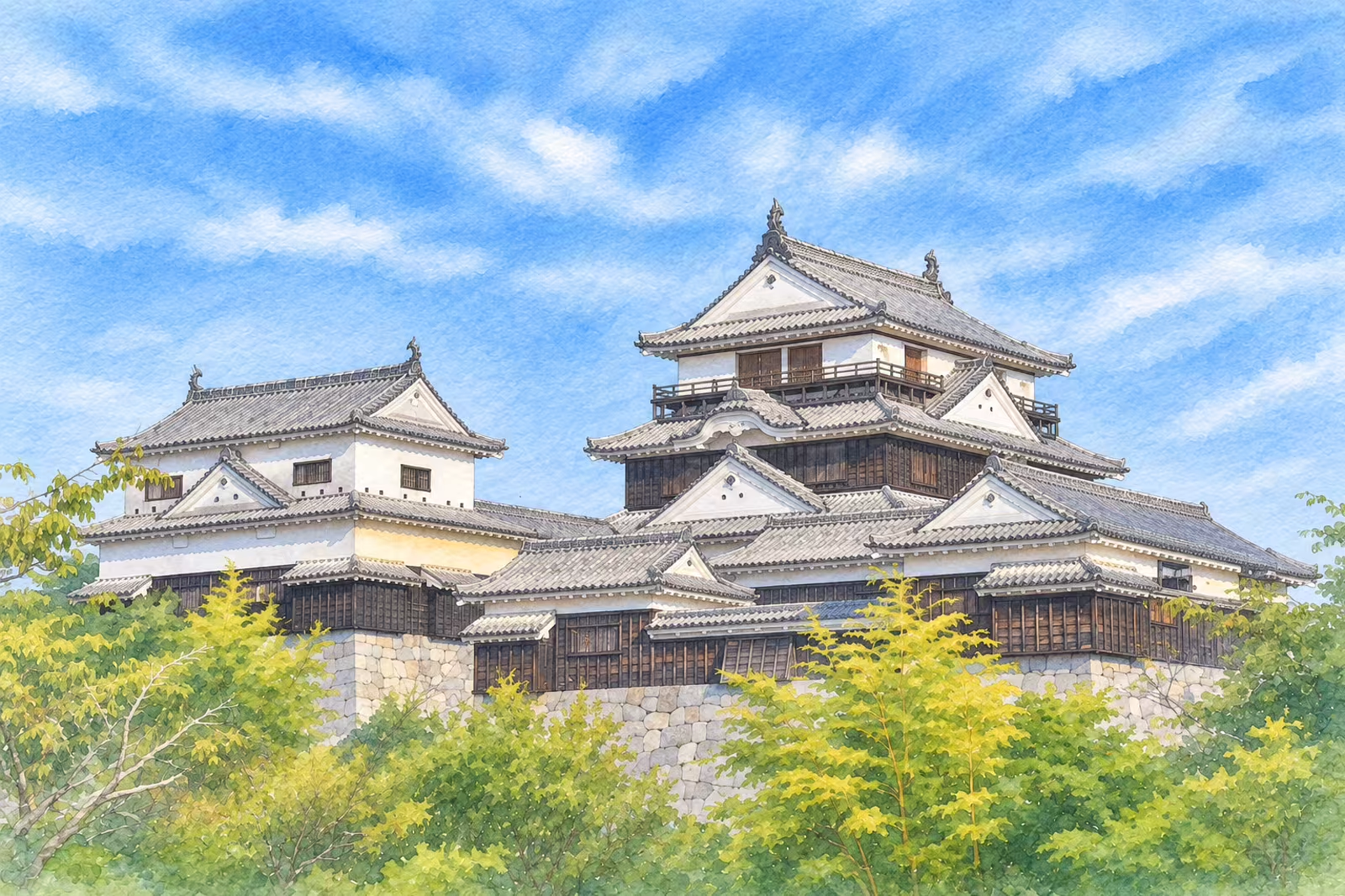
Matsuyama Castle stands on Katsuyama, a hill about 132 meters high in the middle of Matsuyama, Ehime Prefecture. It is one of only 12 castles in Japan that still have a keep built before the end of the Edo period, and its main keep, completed in 1854, is the youngest of them. The hilltop honmaru, the ninomaru on the slope and the sannomaru at the foot of the hill were planned as one complex, so the whole hill is part of the castle.
01Founding and the lords of Matsuyama
Katō Yoshiaki, lord of Masaki Castle in Iyo Province, began building on Katsuyama in 1602 and gave the area the name Matsuyama. The work went on for years. When Yoshiaki was transferred to Aizu in 1627 the castle was still unfinished, and his successor Gamō Tadachika carried on with the ninomaru. Tadachika died without an heir in 1634, and the next year Matsudaira Sadayuki took over the domain. The Matsudaira (Hisamatsu) family then ruled Matsuyama until the Meiji Restoration. Sadayuki is generally thought to have rebuilt the original five-story keep as a three-story one in the 1640s.
02Lightning, rebuilding and modern losses
In 1784 lightning struck the keep and it burned down. The domain was short of money, and rebuilding took about 70 years; the present keep was finished only in 1854. After the Meiji Restoration the castle passed to the army and the state, and in 1923 the Hisamatsu family gave it to the city of Matsuyama. An arson fire in 1933 destroyed the small keep and other buildings, and air raids in 1945 burned several more turrets and gates.
03What survives today
The keep and the turrets, gates and walls around it, 21 structures in all, are original and are designated Important Cultural Properties; the castle site as a whole is a National Historic Site. The main keep, the small keep and corner turrets are joined by connecting corridors into a single cluster, a layout known as renritsu-shiki. The "climbing walls" (nobori-ishigaki) that run down from the summit toward the ninomaru are a rare feature among Japanese castles. From the 1960s onward, the lost small keep, turrets and gates were rebuilt in traditional timber construction, so original and reconstructed buildings now stand side by side. The former ninomaru at the foot of the hill has been laid out as a historic garden.
Matsuyama Castle (Ehime)
01A Castle That Named a City
Matsuyama is the largest city on Shikoku, and from almost anywhere downtown you can see why it has the name it does. In the middle of the plain rises Mount Katsuyama, a wooded hill about 130 meters high, and on its summit sits a cluster of white-walled, black-roofed towers. The city of Matsuyama ("pine mountain") did not exist before the castle; the name was given to the new castle town in the early 1600s by the lord who built it.
Matsuyama Castle is a hirayamajiro, a "flatland-mountain castle": the main defenses crowned the hill, while residences, offices and retainers’ houses spread out around its foot. What makes it special today is that the summit still carries an original keep (tenshu, the main tower of a Japanese castle). Only twelve keeps built before the end of the Edo period (1603–1868) survive in Japan, and Matsuyama’s is the youngest of them. It was completed in 1854, the same year Commodore Perry returned to Japan to sign the treaty that ended the country’s long seclusion.
So a visit here layers two eras. The stone walls, the terraced enclosures and the winding approach were laid out in the first decades of the seventeenth century. The keep and many of the summit buildings date from the mid-nineteenth century. And several of the gates and turrets you pass were rebuilt in wood, by traditional methods, in the second half of the twentieth.
02Katō Yoshiaki, One of the "Seven Spears"
The castle’s founder, Katō Yoshiaki (1563–1631), came from Mikawa province and rose in the service of Toyotomi Hideyoshi. At the Battle of Shizugatake in 1583, where Hideyoshi defeated his rival Shibata Katsuie, Yoshiaki was one of a group of young retainers whose charge won lasting fame as the "Seven Spears of Shizugatake." Fukushima Masanori and Katō Kiyomasa (no relation) were others.
Much of Yoshiaki’s career was spent at sea. He commanded naval forces for Hideyoshi, took part in the campaigns in Kyūshū and against Odawara, and served as a fleet commander during the invasions of Korea in the 1590s. In 1595 he was given a fief at Masaki (also called Matsumae) in Iyo province, the old name for present-day Ehime, and his connection with this coast began.
At the Battle of Sekigahara in 1600, Yoshiaki fought for Tokugawa Ieyasu. His reward was an increase to 200,000 koku (a measure of a domain’s rice yield, and so of its lord’s rank). His seaside castle at Masaki was too small and too low for a lord of that size, and he looked inland for a better site.
03Building on Katsuyama
In 1602 Yoshiaki began building on Katsuyama, a hill in the middle of the Dōgo plain. The works were directed by his retainer Adachi Shigenobu, who had already tamed the local rivers; the Shigenobu River still carries his name. Tradition holds that the hill originally had two peaks and that the saddle between them was filled in to create the long, narrow summit enclosure that exists today.
In 1603 Yoshiaki moved in and named the place Matsuyama. Streets and districts of the castle town were laid out in these years, and many neighborhood names in the modern city go back to them.
The project dragged on for a quarter of a century. Terraces had to be cut and faced with stone on the summit (the honmaru, or main enclosure), on the middle slope (the ninomaru, or second enclosure) and on the flat ground below (the sannomaru, or third enclosure). Yoshiaki’s keep is said to have been five stories tall, but no reliable picture of it survives.
04Walls That Climb the Hill
The most distinctive feature from Yoshiaki’s time is not a building but a pair of stone walls. Known as nobori-ishigaki, "climbing stone walls," they run straight down the hillside from the summit enclosure to the middle enclosure, one on the north slope and one on the south. They tied the hilltop and the lower castle into a single defended unit and blocked attackers from working their way sideways around the slope.
Climbing walls are rare in Japan. They were, however, a standard feature of the wajō, the fortresses that Japanese armies built along the southern coast of Korea during Hideyoshi’s invasions. Yoshiaki and other veterans of those campaigns are generally thought to have brought the idea home. Only a handful of Japanese castles have them, including Hikone, and Sumoto on Awaji Island; among the twelve castles with original keeps, only Matsuyama and Hikone do. At Matsuyama the southern wall is almost intact, while only parts of the northern one remain.
Look too at the high walls of the summit enclosure. Their corners are built of long rectangular blocks laid alternately lengthwise and endwise, a technique that gives them their sharp, steep lines and marks them as work of the early 1600s.
05The Gamō Interlude
In 1627 Yoshiaki was transferred to Aizu in northern Japan, with a domain of 400,000 koku. The castle he had worked on for twenty-five years was reportedly still not quite finished.
His successor was Gamō Tadatomo, grandson of the famous general Gamō Ujisato, who came from Kaminoyama in Dewa province with 240,000 koku (200,000 in Iyo plus 40,000 in Ōmi). Tadatomo is generally credited with completing the second enclosure. In 1634 he died in Kyoto on his way to Edo, aged about thirty and without an heir, and the Gamō house was extinguished. His seven years left few traces beyond the shape of the second enclosure.
06The Hisamatsu Matsudaira and the Three-Story Keep
In 1635 Matsudaira Sadayuki, lord of Kuwana in Ise, was moved to Matsuyama with 150,000 koku. His family would rule the domain for the rest of the Edo period.
Sadayuki’s line was closely tied to the shoguns. Tokugawa Ieyasu’s mother, Odai no Kata, remarried into the Hisamatsu family after her divorce, and her son by that marriage, Matsudaira Sadakatsu, was Sadayuki’s father. Ieyasu granted his half-brothers the Matsudaira surname, and the branch is known as the Hisamatsu Matsudaira. That kinship is why the roof tiles of Matsuyama’s keep bear the triple-hollyhock crest of the Tokugawa.
In 1642 Sadayuki rebuilt the keep, reducing it from five stories to three. Two explanations are commonly given: that the summit’s filled ground could not carry the weight of a five-story tower, or that a smaller keep was a gesture of deference to the shogunate. Neither rests on contemporary evidence.
07Lightning, and Seventy Years Without a Keep
On New Year’s Day 1784, lightning struck the keep. The fire destroyed it along with the main buildings on the hondan, the raised inner platform at the top of the summit enclosure. The domain was in financial trouble and rebuilding was postponed again and again.
A start was made in 1820 but soon abandoned. Work resumed in 1847 under the twelfth lord, Matsudaira Katsuyoshi, and the new keep was completed in 1854; the rebuilt keep is sometimes dated to 1852, when the main structure was going up. Because the shogunate generally forbade new keeps, the project was approved as a restoration, and the new tower is thought to follow the old design closely.
The result is a "connected" keep complex (renritsu-shiki). On the hondan, the main keep, a small keep and two corner turrets are linked by roofed corridor-turrets into a closed rectangle around a small courtyard, so that an enemy breaking in would find itself surrounded. The main keep has three stories and a basement level. Its exterior is restrained and regular.
08A Tokugawa Kinsman on the Losing Side
As a branch of the Tokugawa family, Matsuyama supported the shogunate to the end. In the Second Chōshū Expedition of 1866 its troops landed on Ōshima, an island off the coast of Suō, and fought Chōshū forces.
When the Boshin War broke out in 1868, Matsuyama was branded an enemy of the court and troops from Tosa occupied the town. The lord, Matsudaira Sadaaki, stepped down and the domain paid a large indemnity. The family later returned to its old surname, Hisamatsu.
The lower enclosures did not last: the third enclosure burned in 1870 and the second in 1872. In 1873, when the new government decided which castles to keep, Matsuyama was abandoned as a military site, but the summit buildings survived and the hill opened as a public park the following year. In 1923 Hisamatsu Sadakoto, head of the former lords’ family, bought the castle from the state and donated it, with funds for its upkeep, to the city of Matsuyama.
09Fires, Bombs and Rebuilding in Wood
The twentieth century was hard on the castle. In 1933 an arsonist set fire to the small keep and the corridors and turrets connected to it. In 1945 American air raids destroyed further buildings, including the Inui Gate and the Taiko and Tenjin turrets. In 1949 fire took the Tsutsui Gate; accounts differ on whether it was arson or a bonfire that spread.
The city began rebuilding in 1958 with the Bagu turret, in reinforced concrete, the usual choice of that era. After that it changed course: the lost buildings were rebuilt in timber with traditional joinery, based on old drawings, photographs and surveys. In 1968 the small keep, the corner turrets and the connecting corridors went back up, closing the ring around the main keep again. The Tsutsui Gate (1971), Taiko Gate (1972), Tenjin turret (1979), Inui Gate (1982) and others followed, with work continuing to around 1990.
Today 21 structures, including the main keep, the Nohara and Inui turrets and several gates and walls, are designated Important Cultural Properties, and the castle site is a National Historic Site. The designated structures are the Edo-period originals. Many of the other gates and turrets look just as old but are postwar reconstructions; the fresher color of their timber usually gives them away.
10Shiki, Sōseki and Botchan
Matsuyama Castle also belongs to modern Japanese literature. The poet Masaoka Shiki, born in Matsuyama in 1867, wrote one of the best-known haiku about any castle: "Matsuyama ya / aki yori takaki / tenshukaku" — "Matsuyama: higher than the autumn sky, the castle keep."
In 1895 the novelist Natsume Sōseki came to Matsuyama to teach English at the local middle school. He stayed only a year, but the experience became Botchan (1906), his comic novel about a hot-tempered young Tokyo teacher in a provincial town. That same year Shiki, back from covering the Sino-Japanese War, lodged for about fifty days in Sōseki’s house, and the two spent their days writing and discussing poetry.
11Walking the Castle
Most visitors ride the ropeway or the single-seat chairlift up to Chōja-ga-Naru, a level area just below the summit. Others walk up one of the paths from the city below.
From Chōja-ga-Naru the path climbs beneath the tall stone walls of the summit enclosure and passes through a sequence of gates. The Tonashi Gate ("gate without doors") is an original. The Tsutsui Gate beyond it is a reconstruction, but the small Kakure Gate ("hidden gate") tucked behind it is original; it lay in the shadow of the Tsutsui Gate’s stone wall so that defenders could slip out and strike attackers from behind. The Taiko Gate leads onto the broad main terrace, with views south over the city to the Inland Sea.
At the north end of the terrace stands the hondan. Its approach doubles back through a series of gates before you enter the corridors of the keep complex and climb the main keep. From the top floor the whole plain lies spread out around the hill.
On the way down, look for the climbing walls on the slopes, and for the Nohara turret at the northwest corner of the summit enclosure. This two-story turret, with a small lookout story set on a broad lower roof, is the only surviving example of its archaic type and, with the Inui turret, is counted among the oldest buildings in the castle. The Inui turret on the west side is original and, by tradition, was moved here from Masaki Castle; the neighboring Inui Gate is a 1982 reconstruction.
At the southwest foot of the hill, the Ninomaru Historical Garden occupies the site of the lord’s residence in the second enclosure. Its floor plan is marked out on the ground with gravel, planting and water, and excavations uncovered a great well. Beyond it, the Horinouchi area, the former third enclosure, is now an open park still ringed by its moat.