
Spend a morning at a large Japanese shrine and you will see two kinds of people in old-fashioned dress. One is the priest: a tall black hat, a flat wooden baton held at the chest, wide trousers in pale blue, purple or white. The other is the miko, the shrine maiden: white top, bright red skirt-trousers, long hair tied at the nape and wrapped in white paper. Both outfits look as if they had stepped out of a Heian-period scroll, and in a sense they did. But nothing about them is costume. The colour of a priest’s trousers tells you his grade, the shape of his hat tells you how important the ceremony is, and the miko’s white and red are standard across thousands of shrines. This guide explains who these people are, how to read their clothes, what they dance and chant, how they spend an ordinary day, and how someone becomes one.
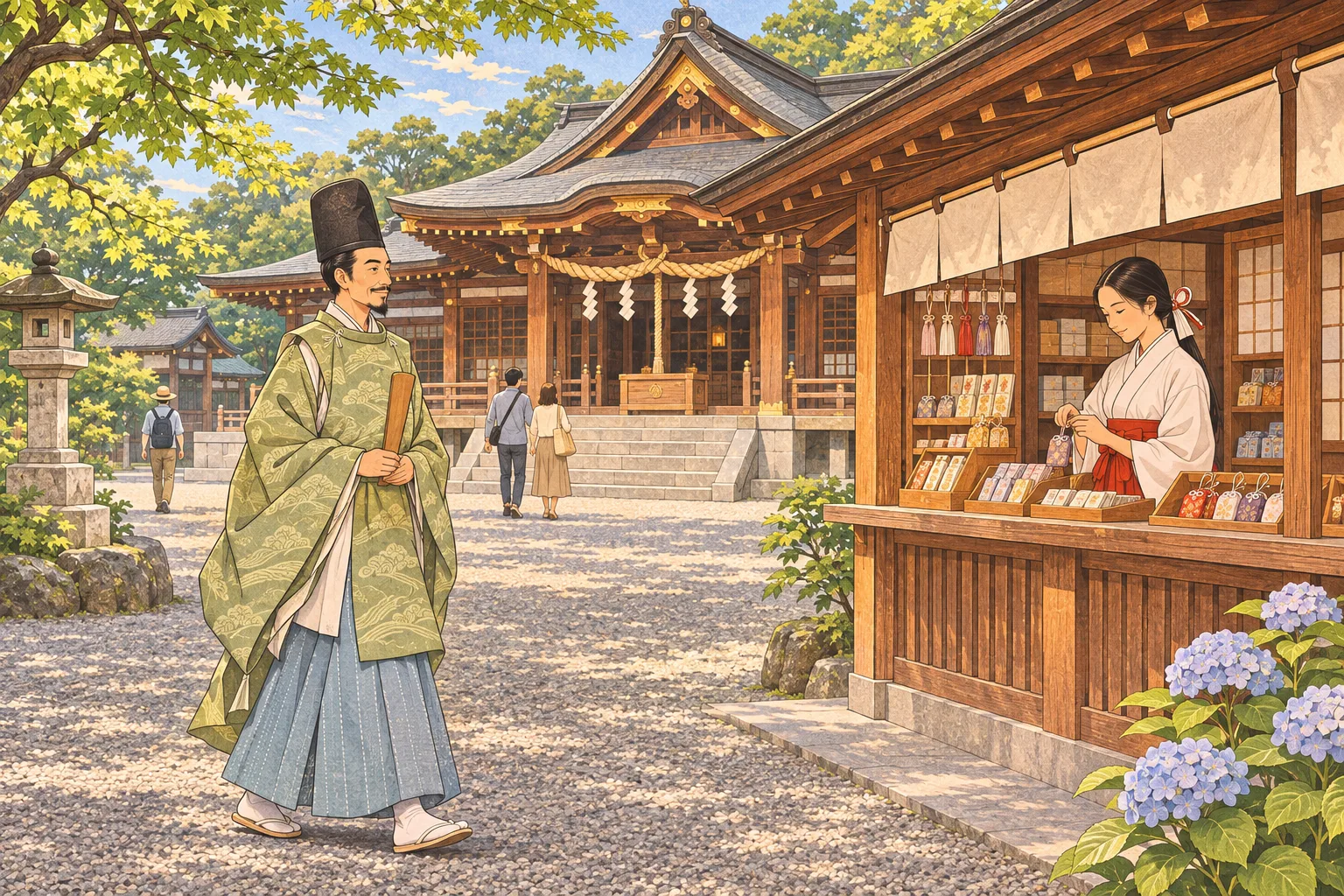
The two kinds of people at a shrine: a priest in kariginu and eboshi with a shaku in his hand, and a miko in white and scarlet at the amulet counter.
01Who Works at a Shrine
The head of a shrine is the gūji, the chief priest. Every shrine has exactly one, whether it is a vast complex like Meiji Jingū in Tokyo or a wooden box of a shrine at the edge of a rice field. In practice the small ones rarely have a resident priest. Japan has tens of thousands of shrines but only about 21,000 priests in the Jinja Honchō system, so a single gūji in the countryside may be responsible for a dozen or more shrines, visiting each for its festivals.
Some large shrines add a gon-gūji, a deputy chief priest; the prefix gon means "secondary" or "acting". Below them come the negi, senior priests who run the rituals and the shrine’s departments, and the gon-negi, junior priests who make up the bulk of the staff and handle most of the prayer ceremonies, office work and amulet counters. At the bottom is the shusshi, a trainee who sweeps, carries offerings and learns the movements by watching.
Ise Jingū has its own hierarchy, headed by a saishu, a ceremonial high priestess. Since the war it has been filled from members or former members of the imperial family, recently always women. Nothing comparable exists at ordinary shrines.
Two other ranking systems run alongside these job titles and are easy to confuse with them. One is a priest’s licence level, granted by the Association of Shinto Shrines (Jinja Honchō), which governs most shrines in Japan; it determines which size of shrine a priest is qualified to lead. The other is a personal grade based on seniority and service, running from special grade through first, second-upper, second, third and fourth. The grade is the one a visitor can actually see, because it sets the colour of the priest’s hakama trousers.
Today’s priests are employees of private religious corporations. From the Meiji era until the end of the Second World War they were treated as quasi-state officials; that arrangement ended after the war.
02The Priest’s Wardrobe
Priestly dress descends from the clothes of the Heian court aristocracy, who had different outfits for audiences at the palace, formal rites and informal outings. Shrines adopted several of these and ranked them by formality.
The most formal is ikan, court dress. Its main garment is the hō, a voluminous robe with a round collar, enormous sleeves and a hem that falls to the ankles. The robe’s colour follows grade: black for special and first grade, red tones for second-upper and second grade, and a blue-green shade for third and fourth grade, described variously as pale blue, green or navy. Underneath are sashinuki, called nubakama in the shrine regulations: baggy trousers gathered at the ankle so they balloon like lanterns. On the head sits the kanmuri, a stiff black lacquered cap with a long, thin, flat tail called the ei rising from the back and arching down. The priest holds a shaku, a flat wooden baton, and wears asagutsu, black lacquered wooden clogs. Ikan is the dress for the taisai, the great festivals of the year, such as a shrine’s annual grand festival, the spring prayer for the harvest and the autumn harvest rite.
Next is saifuku, a robe of the same cut, with the same cap, baton and clogs, but entirely white: a white robe over straight white hakama, no pattern, no indication of grade. White stands for purity in Shinto. Saifuku is the dress for the chūsai, the middle-ranking festivals such as the New Year’s Day rite, and it may also be worn in place of ikan at a great festival. Ise Jingū has its own rules and uses white saifuku for many of its ceremonies.
The everyday ritual outfit is the kariginu, literally "hunting robe", once the casual wear of Heian nobles riding out to hunt. It is lighter and looser than the hō: round collar, sides left open from armpit to hem, and sleeves attached to the body only at the back of the shoulder. A cord runs through the edge of each sleeve so it can be drawn tight. Colours and patterns are fairly free: pale green, lavender, yellow-green, white, sheer gauze in summer. With it the priest usually wears sashiko, straight hakama that are not gathered at the ankle, in his grade colour, and an eboshi, a tall black cap of lacquered paper or gauze with no tail. This is the everyday ritual dress, worn for the shōsai, minor festivals such as the monthly rite, for the prayer ceremonies held throughout the day, and usually for groundbreakings and weddings too. It is what you see most often.
Jōe is a kariginu-shaped garment made of plain white cloth, the same for every grade, and it counts as everyday dress like the kariginu. It shares its whiteness with saifuku but not its form, and it goes with an eboshi rather than a kanmuri. Priests often wear it for rites centred on purification.
For cleaning, office work and walking the grounds, a priest simply wears a white kimono-style top with hakama. The young man in white and pale blue sweeping the approach at seven in the morning is a trainee or junior priest in work clothes, not dressed for a ritual.
The hakama colour is the quickest way to read rank. Under Jinja Honchō rules, as generally described, third- and fourth-grade priests wear asagi, a greenish pale blue. Second grade wears plain purple. Second-upper grade wears purple with a wisteria-crest pattern in lighter purple. First grade wears purple with the same crest in white. Special grade wears white with the same pattern woven in white. In a large shrine’s procession you will see pale blue at the front, purple in the middle, and perhaps a single figure in white-on-white near the end, very likely the chief priest.
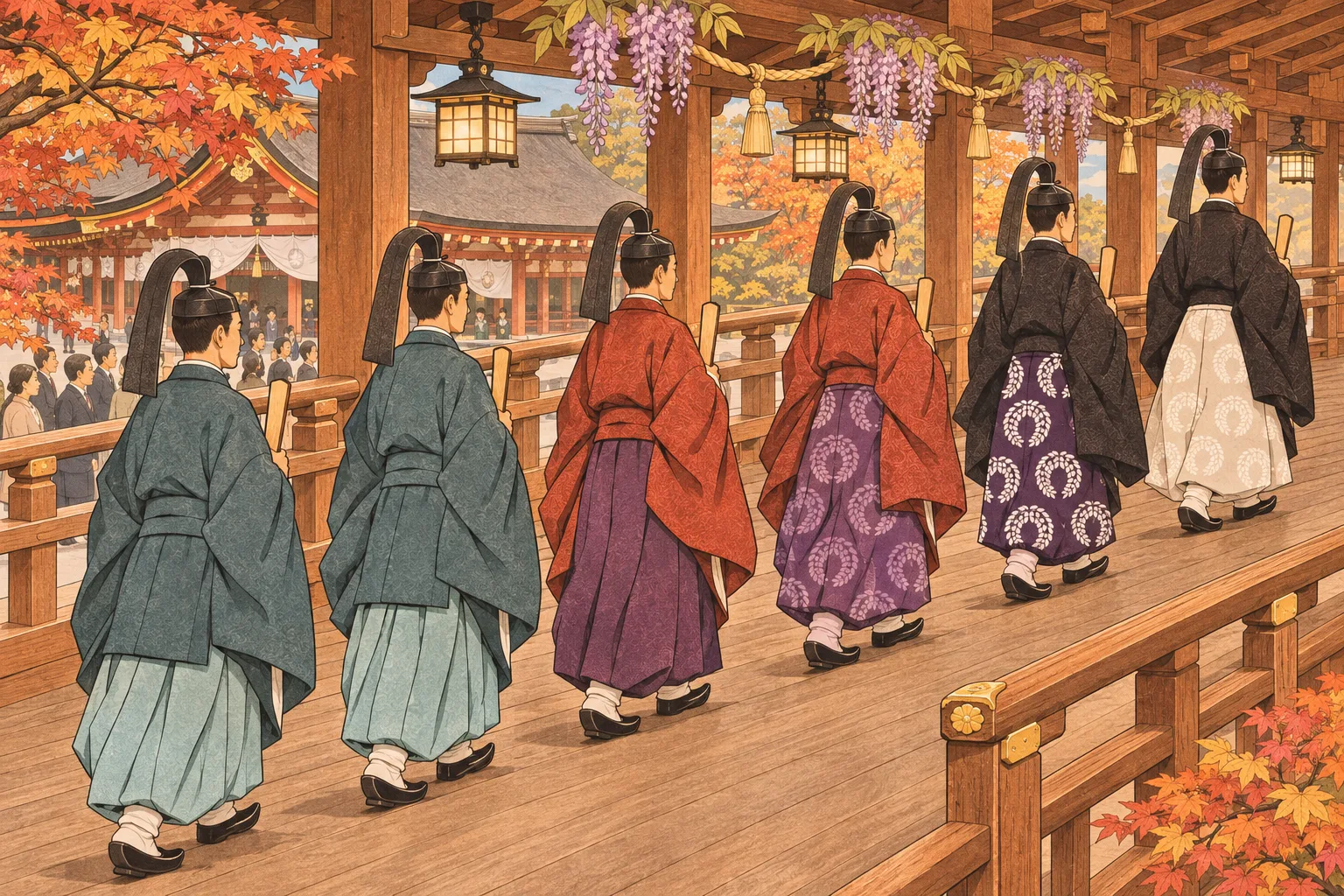
A procession seen from behind; read the hakama. From left: pale blue-green on two priests (third and fourth grade), plain purple (second), purple with a lighter purple pattern (second-upper), purple with a white pattern (first), white on white (special grade).
The shaku, about forty centimetres long, slightly wider at the top and often made of yew, was originally a cue card: court officials pasted notes of the ceremony’s order on the back. Now it mainly keeps the posture straight and the hands occupied. Female priests carry a fan instead: a hiōgi, made of thin cypress slats, with formal dress, and a bonbori-ōgi, a fan that stays slightly open when folded, with everyday dress. The asagutsu are carved from paulownia, or built up from layers of paper over a mould, and lacquered black. They look like small boats and force the wearer into short, sliding steps, with a soft click on stone. They come off at the hall entrance.
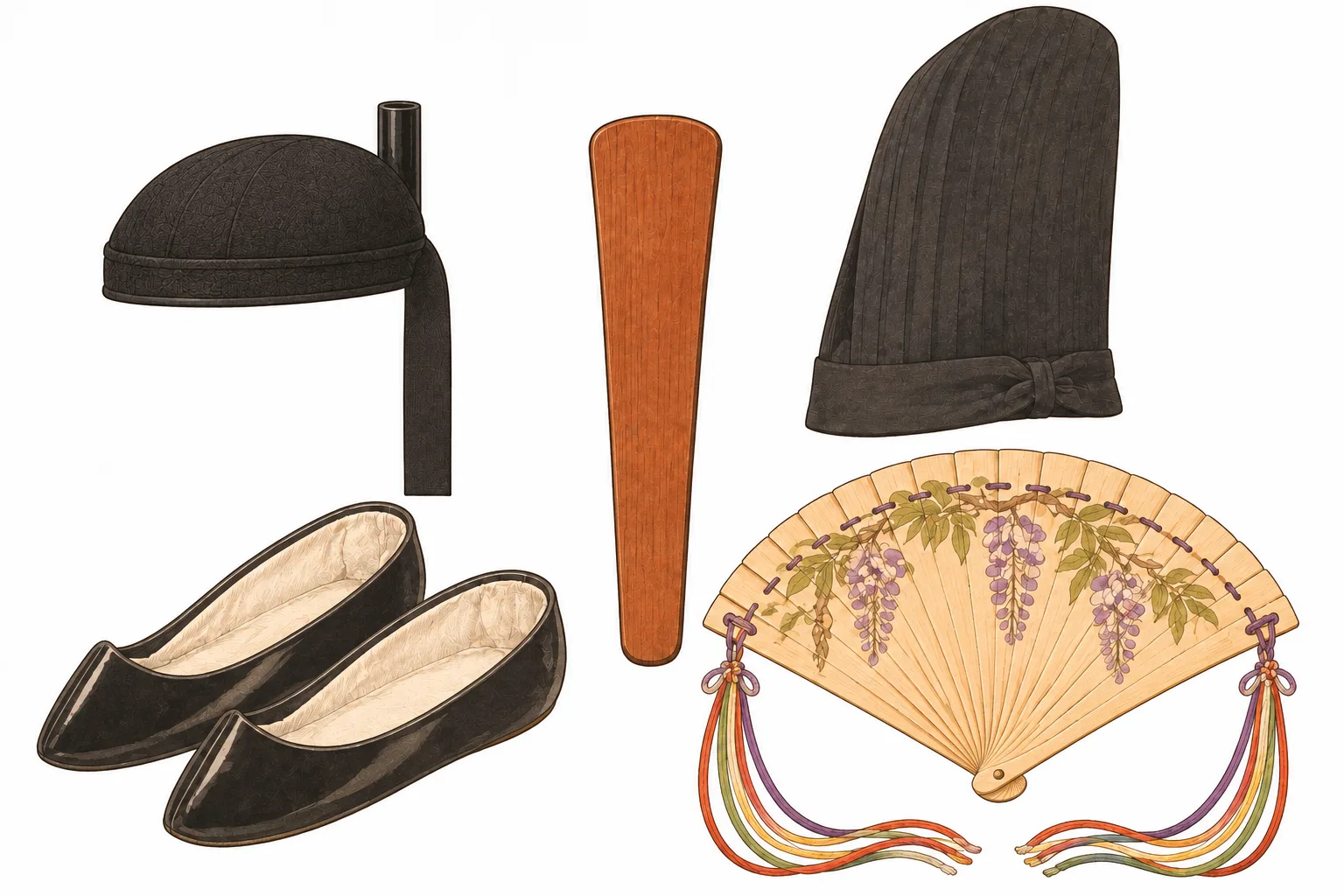
Top row, from left: kanmuri, shaku, eboshi. Bottom row, from left: asagutsu, and the hiōgi fan carried by female priests in formal dress.
A simple rule for headgear: the hō robe takes the kanmuri, the kariginu takes the eboshi.
03The Miko
The miko’s basic outfit is a white kosode-style top called hakui, often with a flash of red at the inner collar, and hibakama, scarlet hakama tied at the waist with a neat bow at the front. Many shrines use the undivided, skirt-like version. White tabi socks and zōri sandals complete it.
The hair is the most distinctive part. It is gathered at the nape into a single tail, wrapped in thick white paper and tied with mizuhiki, cords of twisted paper. The paper wrap is called takenaga, a flat paper hair tie made from heavy white paper such as danshi; coloured versions, red and white among them, appeared in modern times. Miko with short hair often wear a clip-on hairpiece to keep the look.
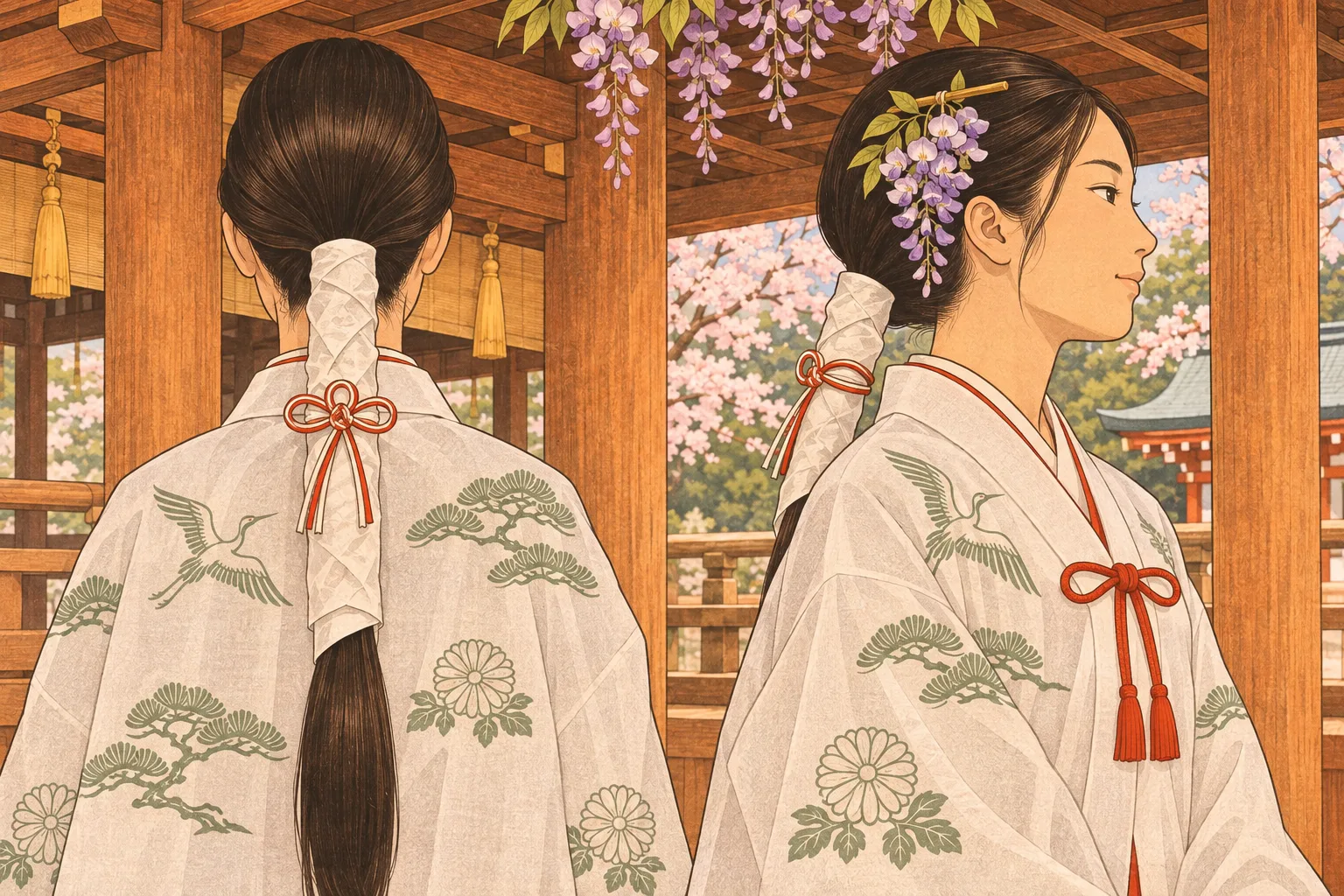
A miko’s hair: gathered at the nape, wrapped in white takenaga paper and tied with cord. The miko on the right wears a wisteria hanakanzashi, and both are in chihaya.
For dances and formal rites, the miko puts on a chihaya over the top: an unlined white overgarment with wide sleeves, closed at the front by a red cord and usually printed in blue-green with motifs such as cranes, pine and chrysanthemums. On her head she wears either hanakanzashi, a spray of artificial flowers such as wisteria fixed at the crown, changed with the seasons at some shrines, or a maetenkan, a gold metal diadem with small dangling ornaments at the brow, seen at larger shrines.
Most miko today are not clergy. They hold no licence, do not lead rituals and do not recite norito prayers. Some are full-time staff, often young women who work the amulet counter, assist at prayer ceremonies and perform the dances; some are daughters of priestly families. Around New Year, big shrines hire dozens or even hundreds of students as temporary miko, give them a few days of training in posture and etiquette, and set them to work selling amulets and arrows to the crowds. Many shrines are said to have an unwritten custom that a miko leaves when she marries or reaches her late twenties.
The role itself is far older than the red and white. In the myth recorded in the Kojiki, when the sun goddess Amaterasu shut herself in a cave and the world went dark, the goddess Ame-no-Uzume overturned a tub before the cave mouth and danced on it until the assembled gods roared with laughter and Amaterasu peeked out. This scene is traditionally cited as the origin of kagura, and Ame-no-Uzume is regarded as the ancestral miko.
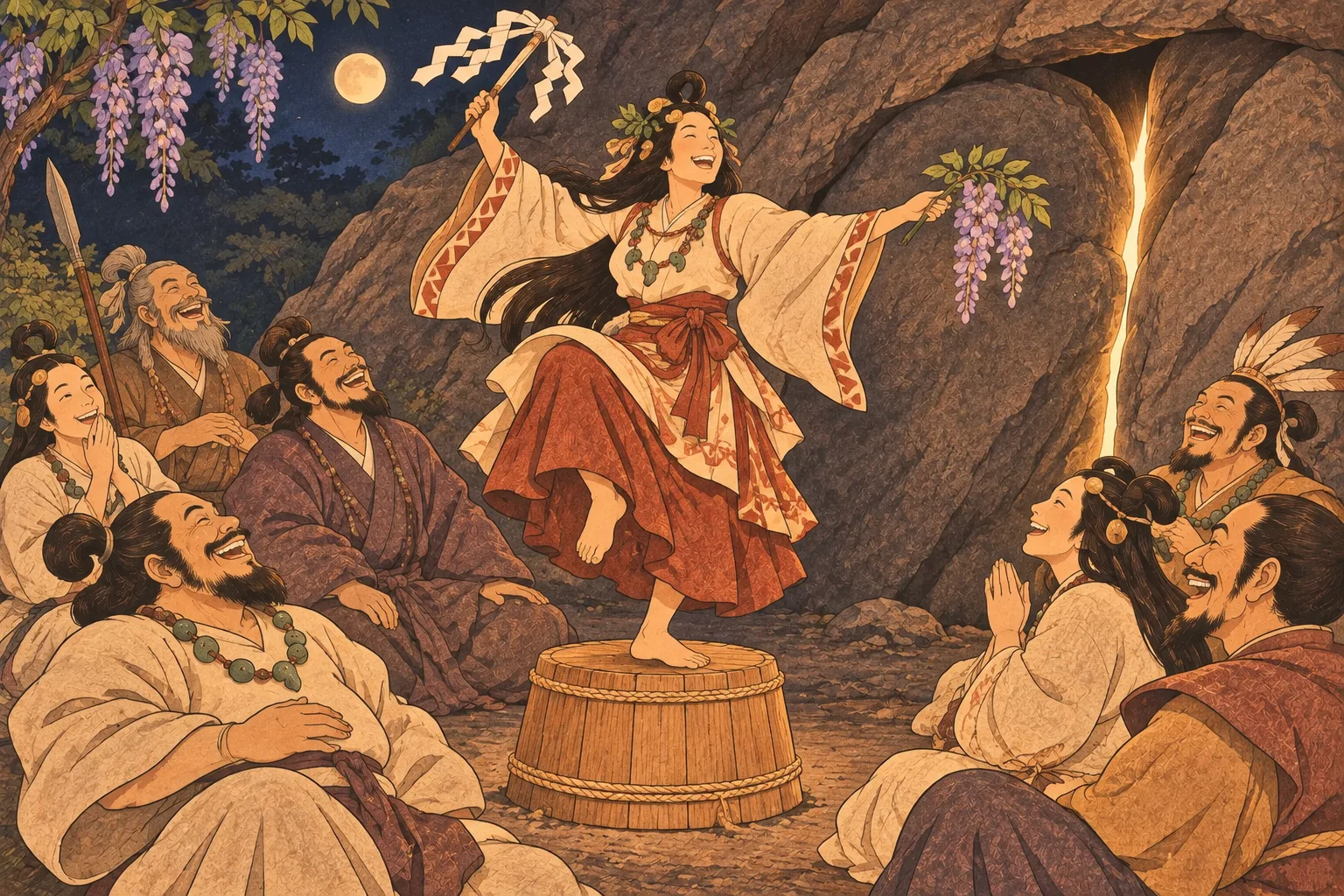
Ame-no-Uzume dances on an overturned tub before the cave, the gods roar with laughter, and a crack of light shows at the rock door. (artist’s impression)
In early Japan, the women who served the gods were mediums. The gods spoke through them. At the court level this tradition produced the saiō, an unmarried imperial princess sent to serve at Ise, and her counterpart at the Kamo shrines in Kyoto. At the village level there were wandering miko who told fortunes and passed on messages from gods and the dead. The itako of northern Japan, most of them blind women, who still channel the voices of the dead at Mount Osore, are one surviving branch. In the early Meiji period the government banned miko from working as mediums and diviners, and from then on their role narrowed to dance and assistance, producing the figure you see today.
04Side by Side: Telling the Outfits Apart
Three clues do most of the work: colour, headgear and silhouette.
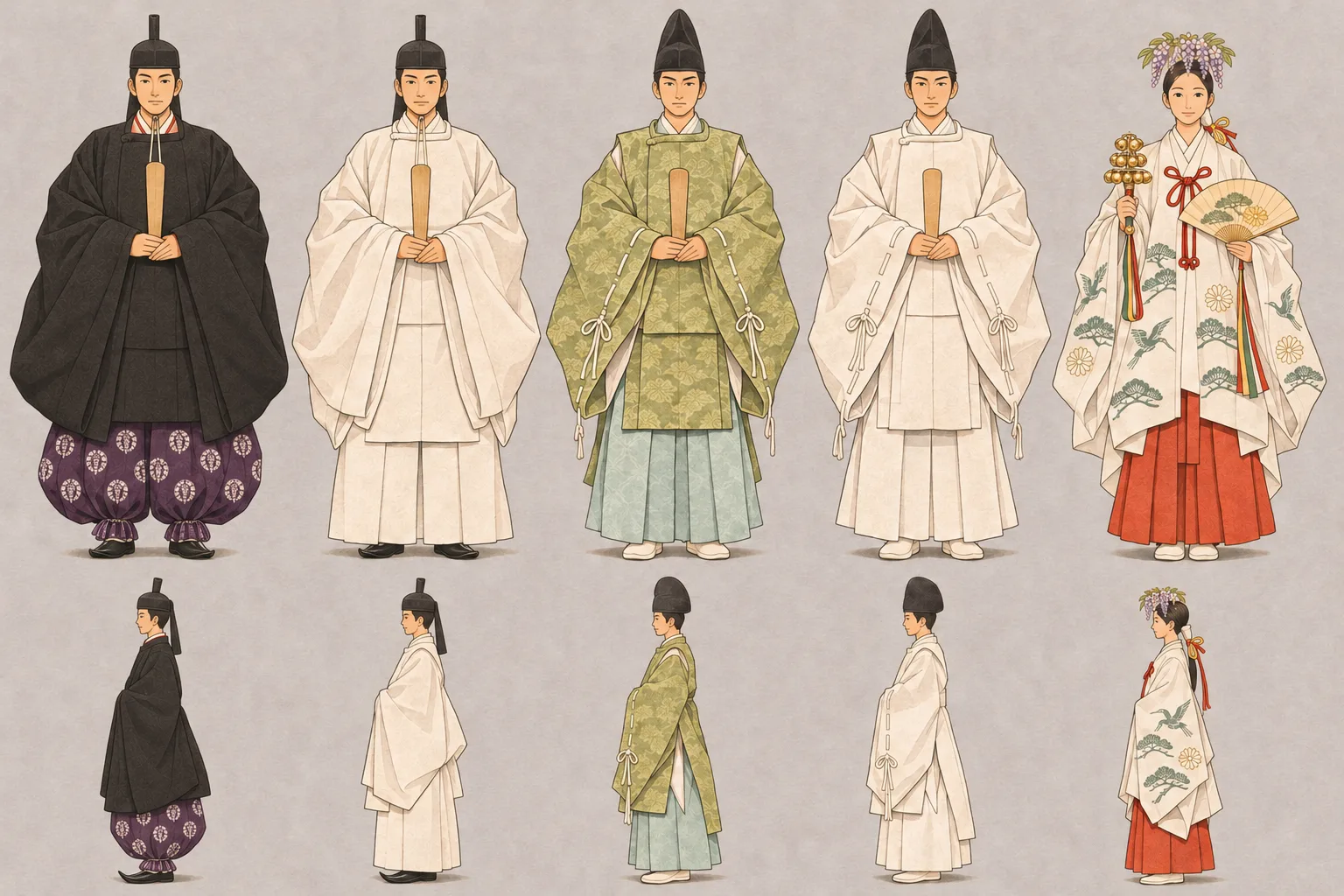
From left: ikan (black hō robe, purple sashinuki, kanmuri), saifuku (all white, kanmuri), kariginu (eboshi), jōe (all white, kariginu cut, eboshi), and a miko in chihaya over white and scarlet. The lower row shows the same five from the side.
Colour first. All white with a tailed kanmuri cap is saifuku. All white with a tall eboshi is jōe. Both are white, but one is a court robe and the other is a hunting robe, and the hat follows the robe. A deep single colour such as black, red or blue, in a robe that swallows the whole body, is ikan. Lighter colours, often patterned, with open sides through which you can see the under-layer, is kariginu. White top and scarlet trousers is a miko; add a sheer printed overgarment and she is dressed to dance.
Headgear next. A kanmuri has a tail; an eboshi does not. Miko wear no hat, only the white-wrapped hair tail, with flowers or a gold diadem for dances.
Then silhouette. The hō robes of ikan and saifuku hang from the shoulders as a single wide block with no visible waist. Below the ikan, the trousers balloon at the ankle; the white trousers of saifuku fall straight. The kariginu and jōe are looser and airier, open at the sides, sleeves flapping slightly free of the body. The miko’s outfit is split cleanly in two at the waist, white over red.
Finally, the trousers and what the hands are holding. Priests’ hakama come in pale blue, purple (plain or patterned) or white; a miko’s are red. Priests carry a shaku or a purification wand, female priests a fan, a miko a bell tree and fan when dancing.
One last clue: a woman in a kariginu-style robe leading a prayer ceremony is a priest, not a miko.
05Kagura: Miko Dance and Village Theatre
Kagura means sacred music and dance offered to the gods. It falls into two broad families. Mikagura is performed by court musicians at the Imperial Palace and is not open to the public. Everything visitors see at shrines belongs to sato-kagura, "village kagura", and that in turn covers two very different things: miko dance, and the masked theatre performed by local men.
Miko dance is the kind you are most likely to see, often during a prayer ceremony or a wedding. One to four miko in chihaya dance before the main hall or on the kagura stage, holding a kagura suzu, a short handle hung with small bells in three tiers, commonly fifteen arranged seven, five and three from the bottom (twelve-bell versions exist too), with streamers in five colours trailing from the grip, and sometimes a fan with long coloured cords. The movements are slow: circling, turning, lifting the bells, bowing. There are no leaps. Accompaniment is flute, drum and the shō mouth organ, or sometimes a single drum. The bells make a bright, rippling sound, like light rain on a roof.
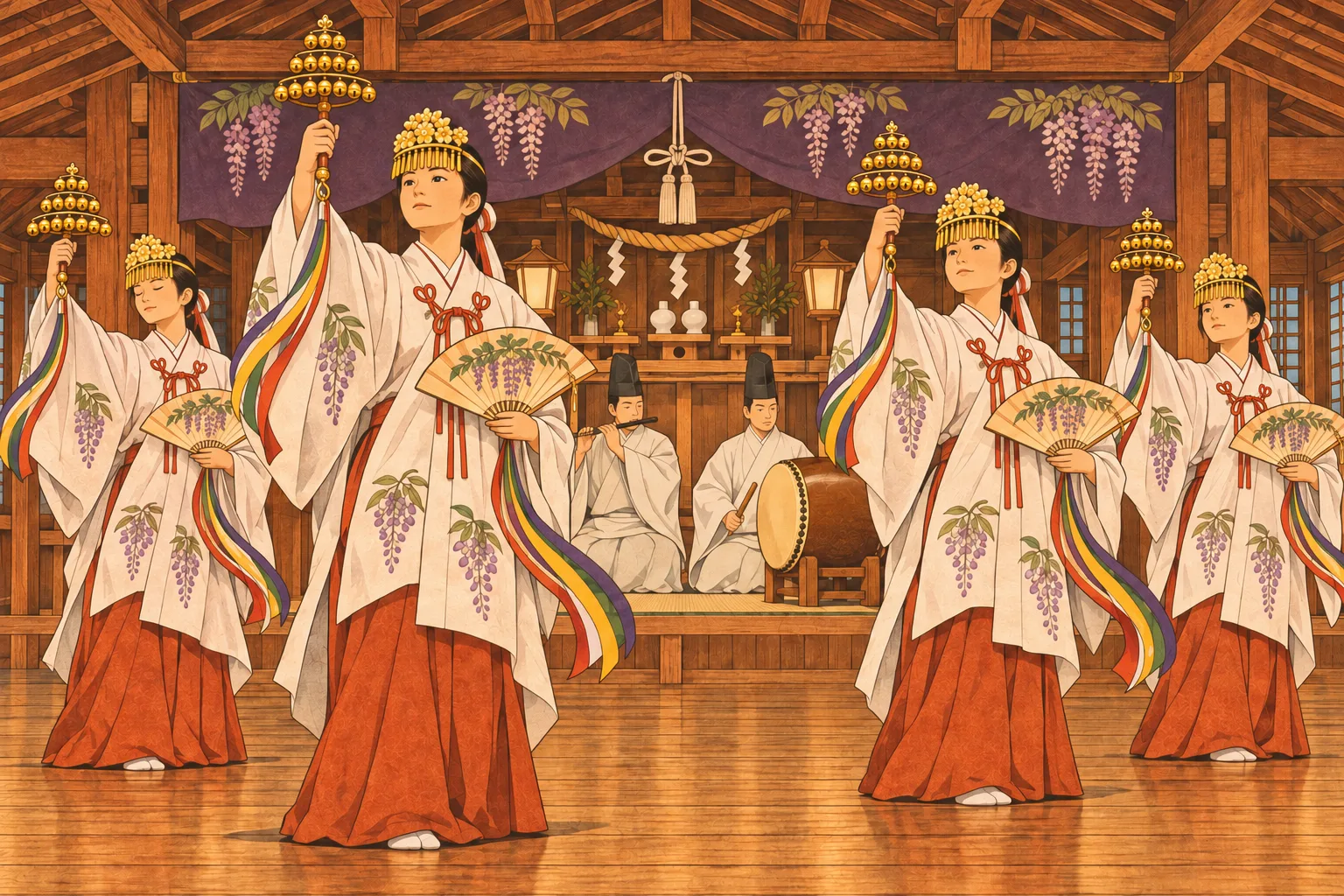
Miko dance: four miko in chihaya and gold maetenkan, a kagura suzu raised in one hand and a fan in the other, five-coloured streamers trailing from the bell handles.
At some shrines the bells have a second job. At the end of a prayer ceremony a miko walks slowly along the row of kneeling worshippers and shakes the bell tree above each bowed head, a gesture known as suzu-barai, purification by bells. The sound is meant to carry the deity’s blessing to each person in turn, and for many visitors it is the most memorable moment of the ceremony: the hall is silent except for the shiver of bells passing overhead, left to right, row by row.
The two dances performed at more shrines than any others are surprisingly modern. Urayasu-no-mai was created in 1940 for celebratory rites held at shrines nationwide, with lyrics from a 1933 poem by Emperor Shōwa praying for a world at peace, and music and choreography by Ōno Tadatomo, head of the Imperial Household Ministry’s music department. It was performed at shrines across the country at the same hour on 10 November that year. It has a fan section and a bell section and can be danced by one, two or four miko, four being the formal version. Toyosaka-mai was established by Jinja Honchō in 1950, set to a melody built from the court piece Etenraku and Kazaguruma, a song by the first head of the court music department, with words by Usuda Jingorō. It is sometimes called otome-mai. A few shrines keep much older miko dances of their own, such as the shrine kagura of Kasuga Taisha in Nara.
The other branch of sato-kagura is something else entirely: village troupes of men in masks and brocade, acting out myths with drums and flutes, often all night long, passed down by local preservation societies. Iwami kagura in Shimane, famous for its eight-headed serpent, and the night kagura of Takachiho in Miyazaki, thirty-three dances performed through winter nights in private homes, are the best-known examples.
06Norito and Purification
The words a priest recites before the gods are called norito. They are written in archaic Japanese, in long sentences heavy with honorifics, following a fixed pattern: praise the deity, state the occasion and the offerings, ask for protection. The text is written on folded white paper; the priest unfolds it with both hands and reads in a slow, level chant, stretching the final syllables. The script itself is old: main words in kanji, with grammatical endings in small phonetic characters squeezed between them, a style used since the eighth century.
The oldest norito survive in the Engishiki, a tenth-century law code. The most famous is the Ōharae-no-kotoba, the Great Purification prayer, recited at the purification rites held on 30 June and 31 December. It lists the kinds of offence and pollution and then describes, in vivid images, how they are swept by rivers into the sea, swallowed by a goddess at the meeting of the currents, and blown away into the underworld until nothing remains. At the summer rite many shrines set up a large ring of reeds for worshippers to walk through.
Everyday ceremonies open with a far shorter text, the haraekotoba, which recalls the god Izanagi bathing in a river mouth after returning from the land of the dead, and asks the deities born from that cleansing to remove impurity. Anyone who has sat through a prayer ceremony has heard it.
Then the priest sweeps the haraegushi, a purification wand of paper streamers and hemp, left, right and left again while worshippers bow their heads. Before any formal rite there is a dedicated purification step, with one priest reading the haraekotoba and another wielding the wand over everyone and everything present.
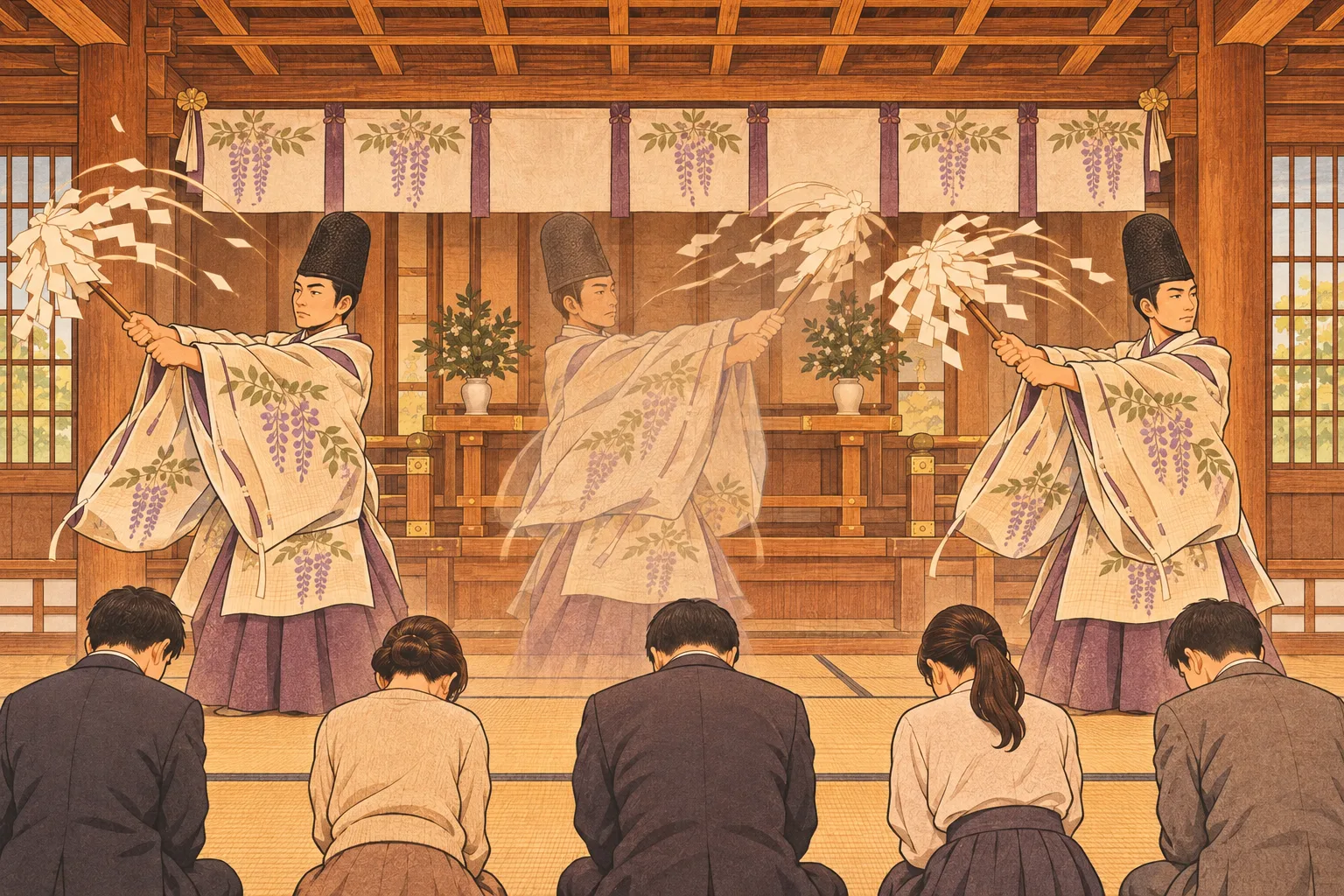
The three sweeps of the haraegushi, with one priest drawn three times: left, right, then left again, while the worshippers keep their heads bowed.
Two other sounds belong to Shinto ritual. When the inner doors of the main hall are opened, a priest lets out a long, low "ohhh", called keihitsu, a call for silence as the deity draws near. It is also heard in the dark when a deity is transferred from the hall into a portable shrine before a festival procession. And priests, like worshippers, bow twice, clap twice and bow once. A few shrines, including Izumo Taisha, clap four times.
07A Day at the Shrine
The day begins early. The gates open and the grounds are swept: bamboo brooms on the gravel approach, damp cloths on the worship hall floor, the purification basin cleaned. In autumn, leaf-clearing can take the whole morning. Cleaning is treated as part of serving the deity, so even a chief priest is often seen with a broom.
Then comes the nikkusai, the daily food offering, a small rite most visitors never see. In a kitchen set aside for the purpose, priests prepare washed rice, salt, water and sake, with seaweed, vegetables or fruit on some days, arranged on sanbō, small stands of unpainted cypress. These are carried to the main hall, a short prayer is read, and later the offerings are withdrawn. At a large shrine several priests take part; at a small one the chief priest may do it alone. At Ise Jingū, the morning and evening food offering has been made every day, by the shrine’s account, for about 1,500 years, cooked over fire kindled with a fire drill.
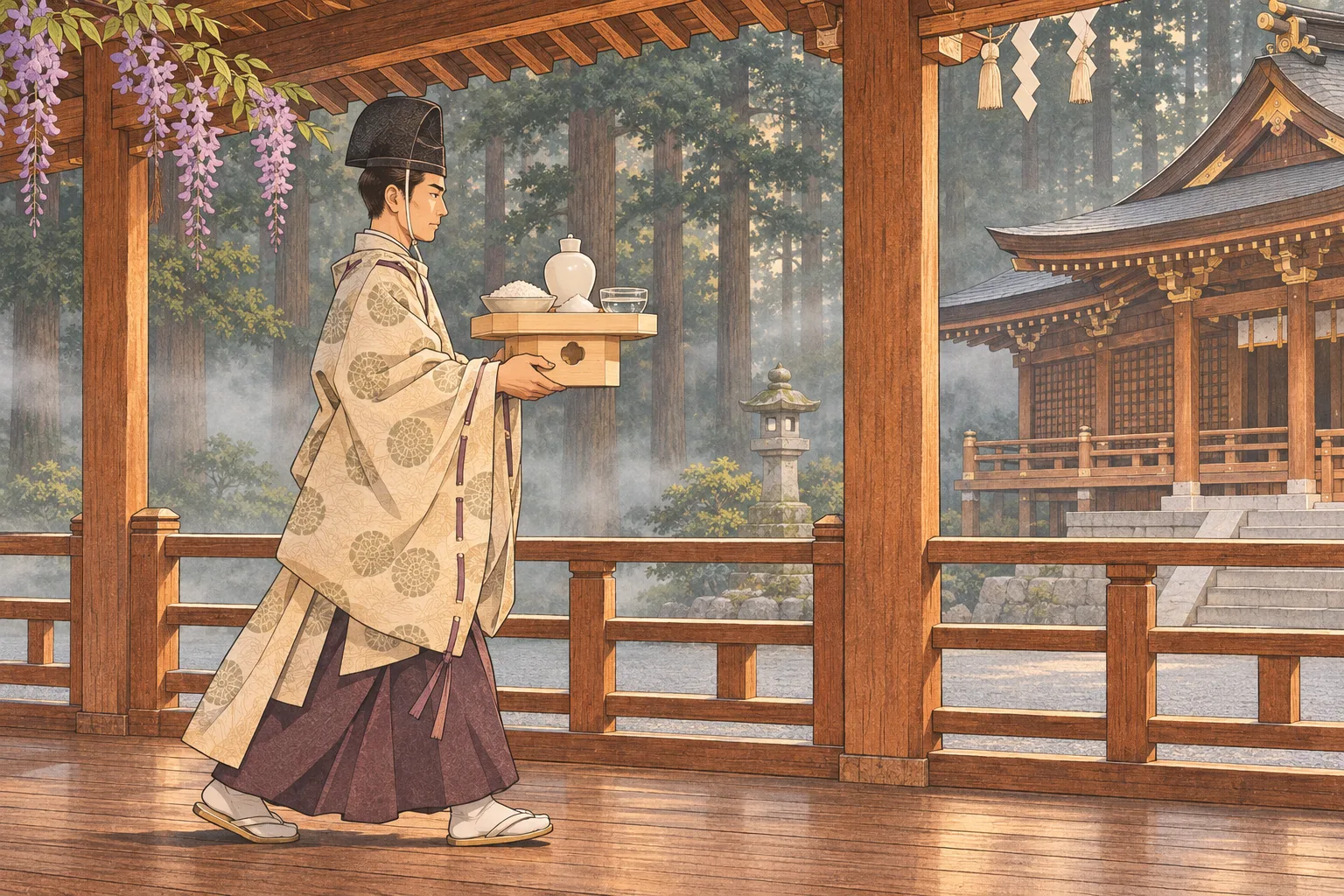
The nikkusai: early in the morning a priest carries the day’s offerings toward the main hall on a sanbō of unpainted wood.
Once the shrine is open, the amulet counter is staffed, usually by miko, who also brush the ink-and-stamp shrine seals that visitors collect and call a priest when a question goes beyond them.
The core of a priest’s working day is the kitō, a formal prayer ceremony requested by visitors. They fill out a form with name, address and wish, such as safe childbirth, road safety, exam success or warding off an unlucky year, and are led into the worship hall. The ceremony takes twenty to thirty minutes: purification; presentation of offerings; the priest’s norito, in which the visitors’ names and addresses are read out; each visitor offering a tamagushi, a sprig of the evergreen sakaki tied with paper; the bows and claps; and withdrawal of the offerings. The visitors leave with a talisman, sometimes a small sip of sacred sake. Around New Year and the children’s festival of Shichi-Go-San in November, a big shrine runs dozens of these a day, priests rotating in and out of the hall.
Many shrines also bless cars. The owner drives into a marked bay, the priest recites, waves the wand and walks round the vehicle, and a talisman goes inside.
Priests also travel for ceremonies off site. The most common is the jichinsai, the groundbreaking ceremony. On an empty building plot, four green bamboo poles are set at the corners with sacred rope strung between them. In the middle stands an altar with offerings and a cone of sand. The priest, usually in a kariginu and sometimes in white jōe, calls the deity of the land. Then, in the usual division of roles, the architect makes a mock cut at the grass stuck in the sand cone with a wooden sickle, the owner breaks the sand three times with a wooden hoe (kuwa), and the builder levels it with a wooden spade (suki), each motion accompanied by a call of "ei, ei, ei". Who holds which tool varies by region and shrine. The owner’s family and the contractors stand in suits under a tent. Similar rites mark the raising of a roof beam, the completion of a building, the blessing of a house, a factory or a ship.
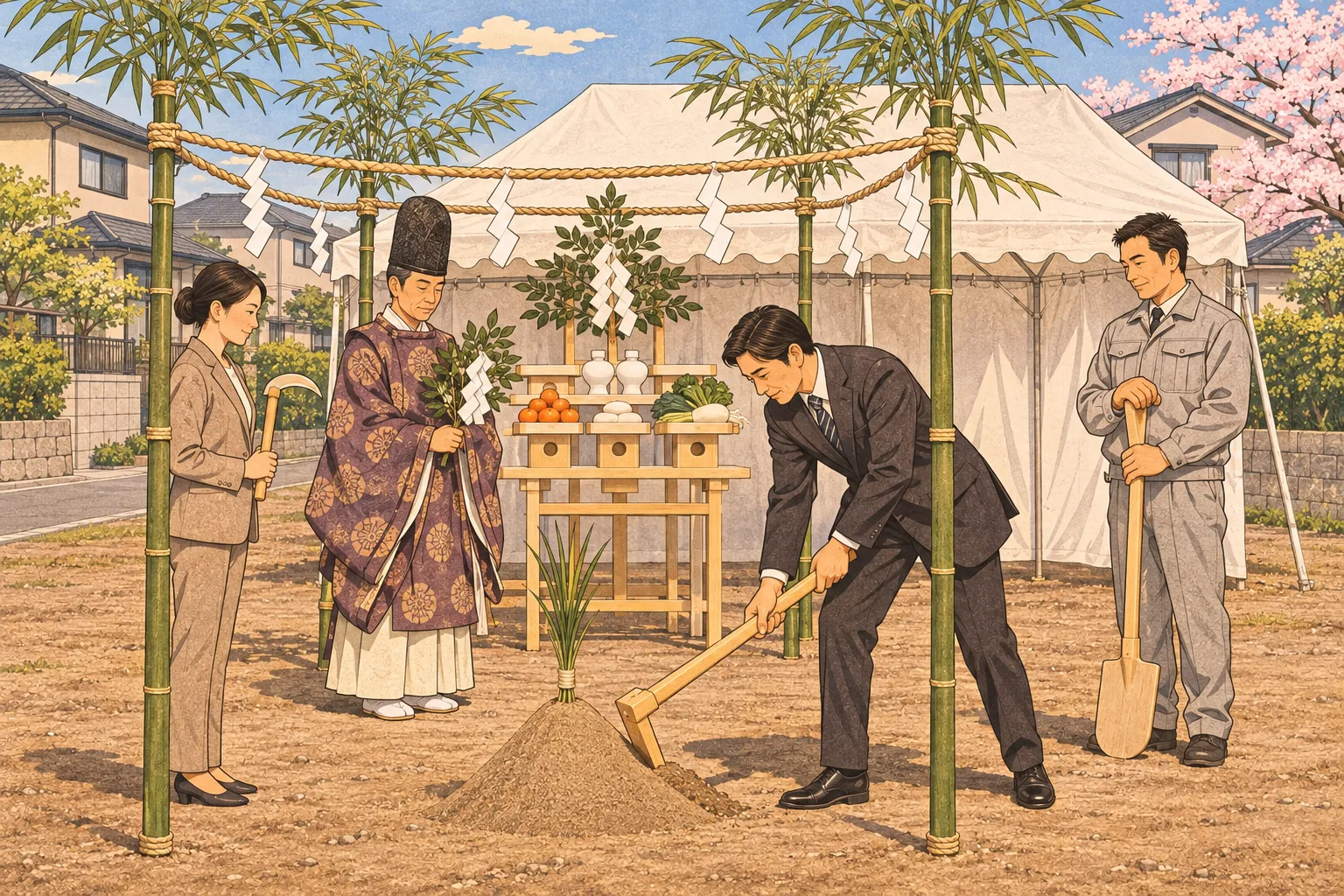
A jichinsai: green bamboo at the four corners, a rope strung between them, an altar with offerings in the middle, and a cone of sand in front into which the client strikes a wooden hoe.
In the evening the gates close and the next day’s offerings are prepared. Beyond the daily round come the great festivals of the year, monthly rites that many shrines hold on the 1st and 15th, and after a festival the naorai, when priests and parish representatives share the sake and food that were offered, as a way of eating with the deity and returning to ordinary life.
08Becoming a Priest
To serve as a priest you need a licence issued by Jinja Honchō. The main route runs through two universities: Kokugakuin University in Shibuya, Tokyo, and Kōgakkan University in Ise. Both offer four-year programmes in Shinto studies, covering ritual, classical texts and history, with practical training at shrines. Students practise holding the shaku, walking in asagutsu, waving the wand and chanting norito until the movements are automatic. At Kokugakuin, graduates of the priestly course usually receive the seikai licence along with a pass in the exam for the higher meikai, which they can take up after two years of shrine service and further training. Regional training schools offer one-year courses for the lower gon-seikai licence and two-year courses for seikai, and the heirs of shrines who urgently need a qualification can attend short courses.
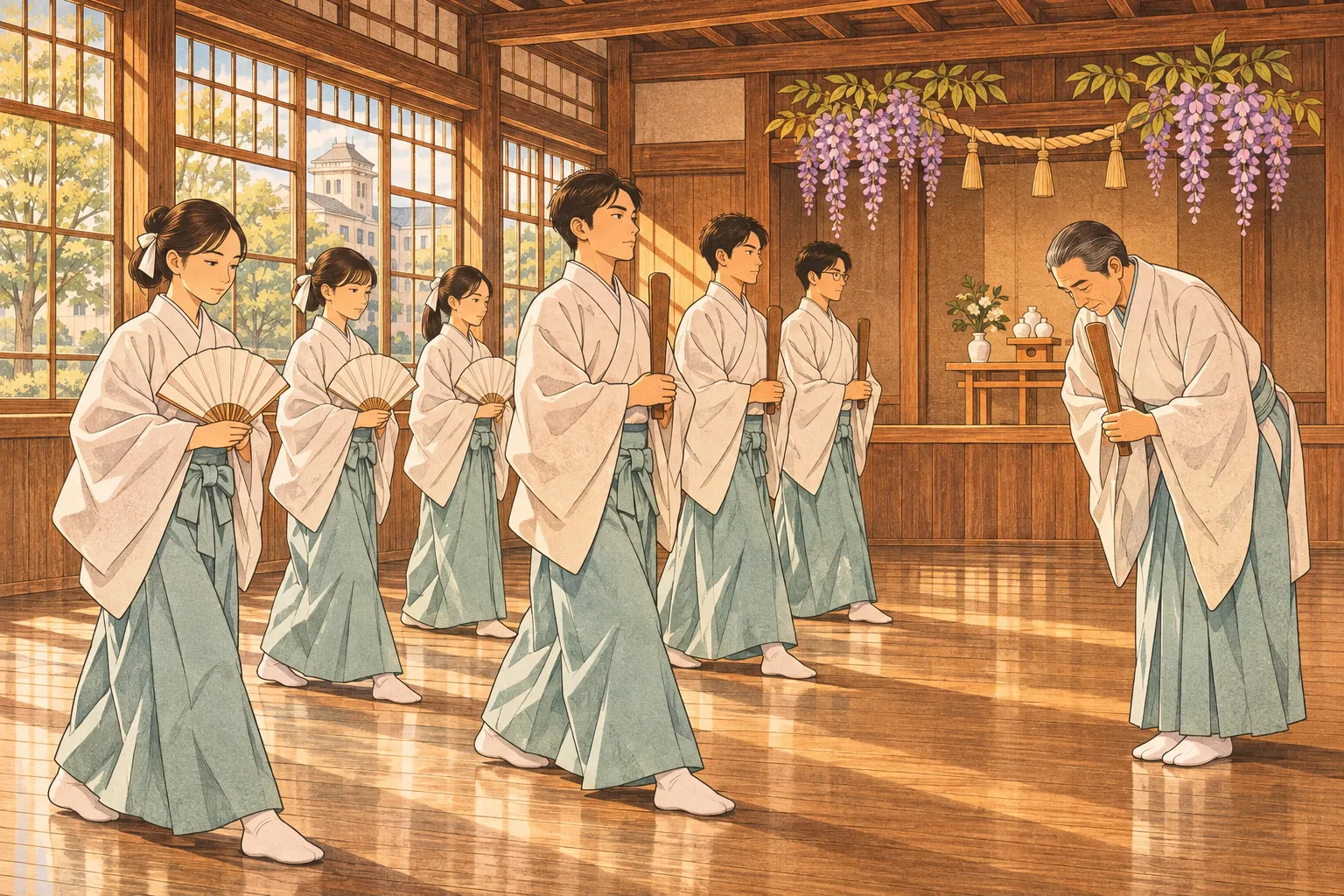
Ritual practice at university: students in white tops and pale blue-green hakama, the men with shaku and the women with fans, learn to bow from their teacher.
Traditionally many shrines were run by hereditary priestly families, known as shake. The Senge family has held the chief priesthood of Izumo Taisha for generations, tracing its line to the ancient governors of Izumo; the Aso family has served Aso Shrine in Kumamoto in the same way. The Meiji government formally abolished hereditary priesthood in 1871, but in practice small shrines still pass from father to child. Many priests grew up in the grounds, studied at Kokugakuin or Kōgakkan, and came home. Others come from ordinary families and enter out of interest in Japanese tradition.
Women priests are a more recent development. During the war many male priests were conscripted and their wives or daughters kept the shrines running; after Jinja Honchō was founded in 1946 it recognised women as priests. By the mid-2010s they made up about 15 percent of the total. They conduct rituals, read norito and wave the wand like their male colleagues. Their dress follows separate rules, revised in 1987: for formal rites an uchiki robe with hakama, an ornamental hairpiece called saishi and a cypress fan; for everyday rites a suikan, a robe much like the kariginu, with a black gauze forehead band and a bonbori fan. Their hakama colours follow the same grades as the men’s.
More deep dives on this topic
 ToriiA torii is two posts and one or two crossbeams, with no doors, no walls and no lock.
 Divine Messengers and KomainuWalk into almost any Shinto shrine and an animal meets you before anything else does.
 Shrine ArchitectureMost visitors to a Shinto shrine photograph the torii gate, the vermilion pillars and the bell rope in front of the hall, and leave thinking they have seen the shrine.
 Shimenawa, Shide and GoheiWalk into almost any Shinto shrine in Japan and you will pass under a rope.
 Reading Shrine NamesWalk up to almost any Shinto shrine in Japan and look at the wooden plaque hanging from the torii gate or the main entrance.
 OmikujiNext to the counter where a Japanese shrine sells its charms, there is usually a wooden box or a hexagonal canister and a small slot for coins.
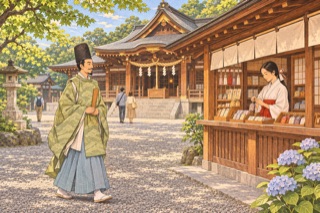 Shinto Priests and MikoSpend a morning at a large Japanese shrine and you will see two kinds of people in old-fashioned dress.
 Shikinen Sengū and ZōtaiWalk up to the main sanctuary of the Inner Shrine at Ise and you will notice, just beside it, an empty plot exactly the same size.
 Sacred Trees and StonesWalk into almost any Shinto shrine and something older than the buildings is usually waiting for you.
- Back to the main article: Shinto →