
Walk up to the main sanctuary of the Inner Shrine at Ise and you will notice, just beside it, an empty plot exactly the same size. It is covered in fist-sized white pebbles, and in the middle stands a single tiny wooden hut, lower than a person. Most visitors assume it is a construction site. In a sense it is: this is where the previous sanctuary stood, and where the next one will be built. Ise is the most famous example of a practice found at a number of Japanese shrines, where the sacred buildings are rebuilt, or thoroughly renewed, on a fixed cycle. The practice goes by two names, shikinen sengū and shikinen zōtai, and it takes very different forms at Ise, Izumo, Kasuga, Kyoto’s Kamo shrines, Sumiyoshi and Suwa. This deep-dive looks at each of them, then lines them up side by side.
01The vocabulary of renewal
Shikinen means "the appointed year": the work happens when the calendar says so, not when something breaks. Zōtai (rebuilding and replacing) refers to the construction work itself. Sengū or senza (moving the shrine, moving the seat) refers to the ritual transfer of the deity from the old building to the new one. The two usually go together, which is why Ise speaks of shikinen sengū while Kasuga Taisha speaks of shikinen zōtai; the emphasis differs, the subject is the same.
In practice there are three models. At Ise, a complete new building goes up on an adjacent plot, the deity moves across, and the old building is taken down. At Izumo, Kasuga and most other shrines today, the main hall stays where it is: the deity moves temporarily to a substitute hall, the main hall gets a new roof, new lacquer and new fittings, and the deity moves back. At Suwa, the halls are largely left alone, but the four great tree-trunk pillars standing at the corners of each precinct are replaced.
The idea is old. The Engishiki, a body of court regulations compiled in the early tenth century, already lays down that the main sanctuary, the treasure houses and the outer offering hall of the Grand Shrine at Ise are to be rebuilt every twenty years. Other great shrines of the period, among them Sumiyoshi, Katori and Kashima, also rebuilt on a cycle of about twenty years. Early shrines used posts sunk straight into the ground and roofs of thatch or bark, materials that would not last indefinitely in any case. Buddhist temples, introduced from the continent in the same era, took the opposite route: stone footings, tiled roofs, and buildings like Hōryūji that have stood for 1,300 years. Shrines largely kept to their own way of building and accepted the consequence, which was to start again periodically. When the court’s power faded in the medieval period, most of these cycles lapsed or were converted into repairs. Only a handful survived.
02Ise: eight years, thirty-odd ceremonies
Ise rebuilds every twenty years. Tradition dates the first rebuilding to 690, under Empress Jitō; the cycle was broken for more than a century during the civil wars of the Sengoku period; the 62nd rebuilding took place in 2013, and the 63rd is planned for 2033. What the summary figures hide is how long the process takes. The sengū is not a single day but a chain of some thirty ceremonies and construction milestones over roughly eight years. The 2013 cycle began in spring 2005.
It opens with the Yamaguchi-sai, a rite at the entrance to the forest behind the shrine, asking the mountain deities for safe felling. A night ceremony held around the same time, the Konomoto-sai, concerns the timber for the shin no mihashira, the "heart pillar" that will stand beneath the new sanctuary. It is not open to the public.
Next comes the Misoma-hajime-sai, the ceremonial first felling. Since the mid-Edo period most of Ise’s cypress (hinoki) has come from the Kiso forests on the border of today’s Nagano and Gifu prefectures, and this rite is held in the national forest at Agematsu in Nagano, with a second felling ceremony soon after in the Ura-Kiso forest near Nakatsugawa in Gifu. Woodsmen cut into the trunk with axes from three directions in turn, a technique called mitsuo-giri, which keeps the trunk from splitting and makes the great tree fall exactly where intended. The first logs are destined for the mihishiro, the container that holds the sacred object. Dressed in white cloth and red-and-white cords, they travel to Ise with communities along the way turning out to greet them.
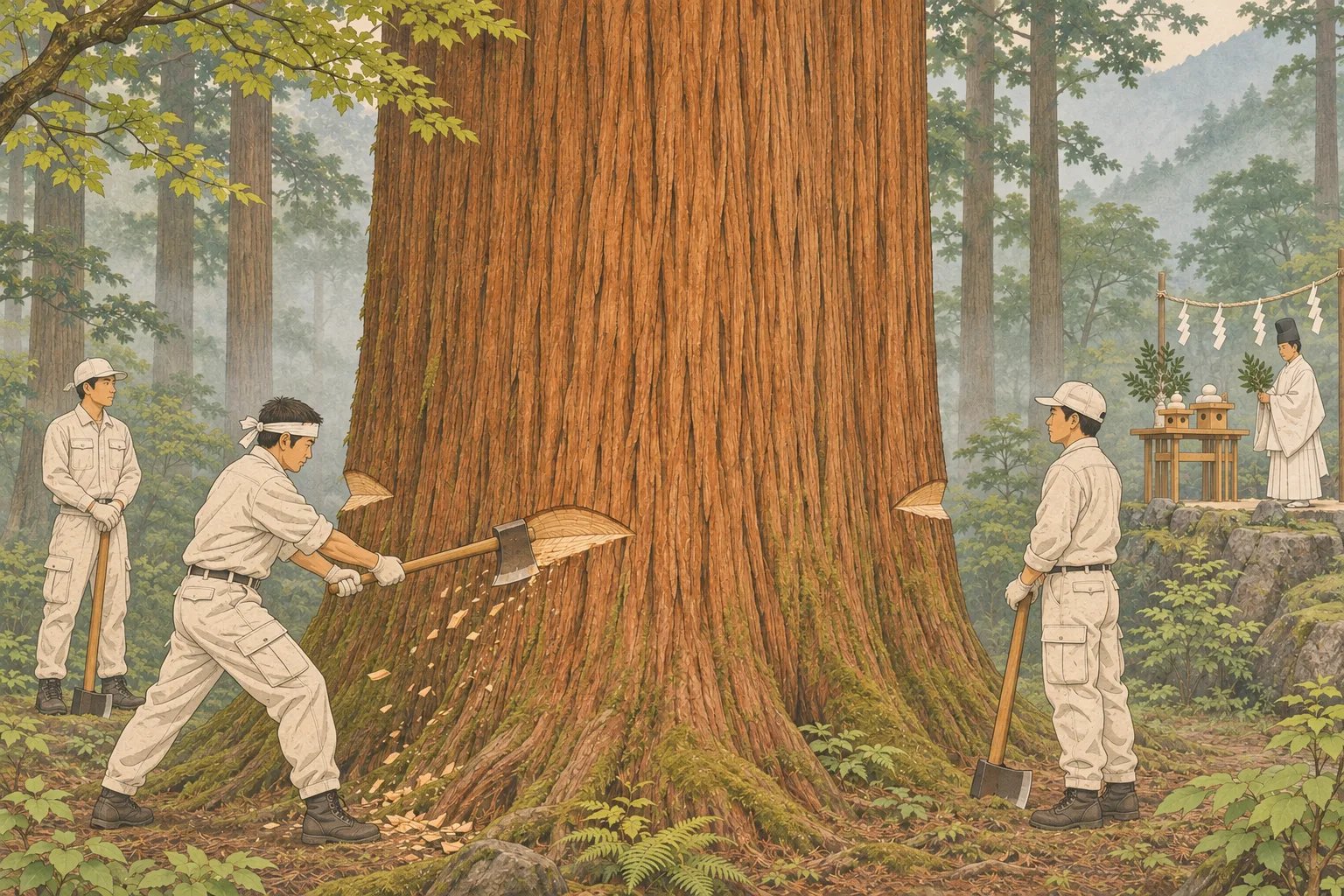
The Misoma-hajime-sai in the Kiso forest: woodsmen cut into a great cypress with axes from three directions in turn, the technique called mitsuo-giri.
In 2006 and 2007 came the Okihiki, the timber-hauling festival, and for the people of Ise these are the liveliest years of the cycle. Teams of residents in happi coats and headbands haul the logs into the shrine by rope. For the Inner Shrine the logs are loaded onto sledges and dragged through the shallow water of the Isuzu River, hundreds of people wading and chanting; for the Outer Shrine they ride on huge wooden-wheeled carts through the streets. Each neighborhood has its own work song. Locals have long called themselves shinryōmin, people of the shrine’s domain, and visitors can sign up as "one-day shinryōmin" to pull alongside them.
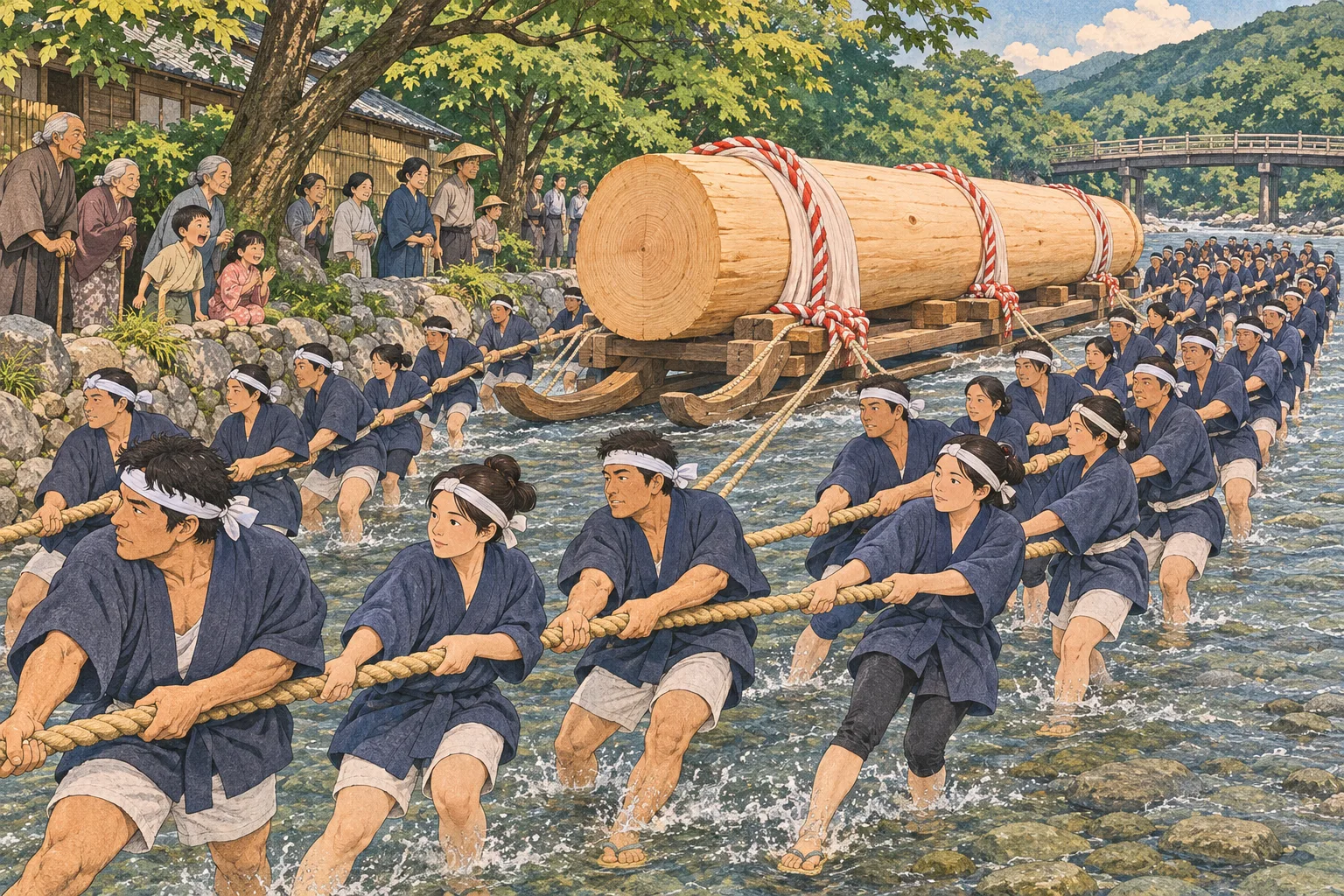
The Okihiki for the Inner Shrine: residents in happi coats and headbands wade through the Isuzu River, hauling a great log on a sledge by rope.
Ground-purification on the new plot followed in 2008. In spring 2012 the Ritchū-sai (pillar-raising) saw carpenters tap the new posts with wooden mallets, and the Jōtō-sai (ridgepole-raising) saw long white cloths let down from the roof, held taut by priests and carpenters below while they called out in unison. Smaller rites followed for the eaves and the ridge ornaments; the rite for the doors waits until the autumn of the transfer year.
In summer 2013 came the Shiraishi-mochi, the carrying of white stones. Residents gathered white pebbles from the bed of the Miya River, loaded them into wooden buckets and brought them into the shrine on decorated carts or small boats. Each participant then walked into the courtyard of the new sanctuary carrying one or two stones wrapped in white cloth and set them on the ground by hand. On a normal visit, ordinary worshippers stand outside the outer fence; this is a rare chance to step inside the sanctuary courtyard, and only before it is in use.
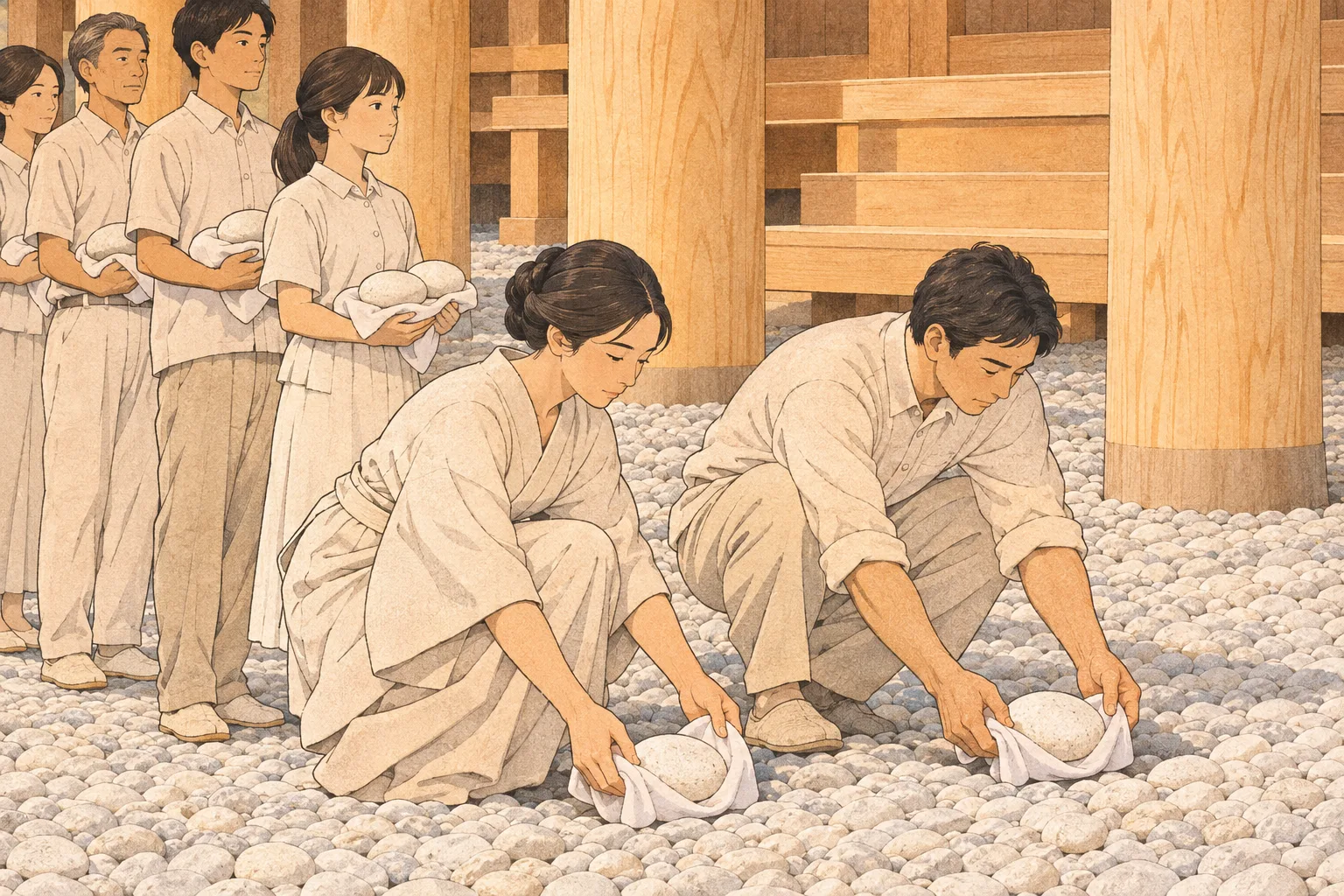
The Shiraishi-mochi: residents carry white pebbles on white cloth into the courtyard of the new sanctuary and set them down by hand.
The climax is the sengyo, the transfer of the deity. In 2013 it took place at 8 p.m. on 2 October at the Inner Shrine and 5 October at the Outer Shrine. All lights are put out. A priest imitates a cockcrow three times. Then priests in white carry the sacred object, hidden inside a moving enclosure of white silk, from the old sanctuary along a passage to the new one, while court music plays. Invited guests sit on the gravel some distance away and experience it mostly as sound in the dark: footsteps, music, the rustle of cloth. Offerings and further rites over the following days complete the cycle.
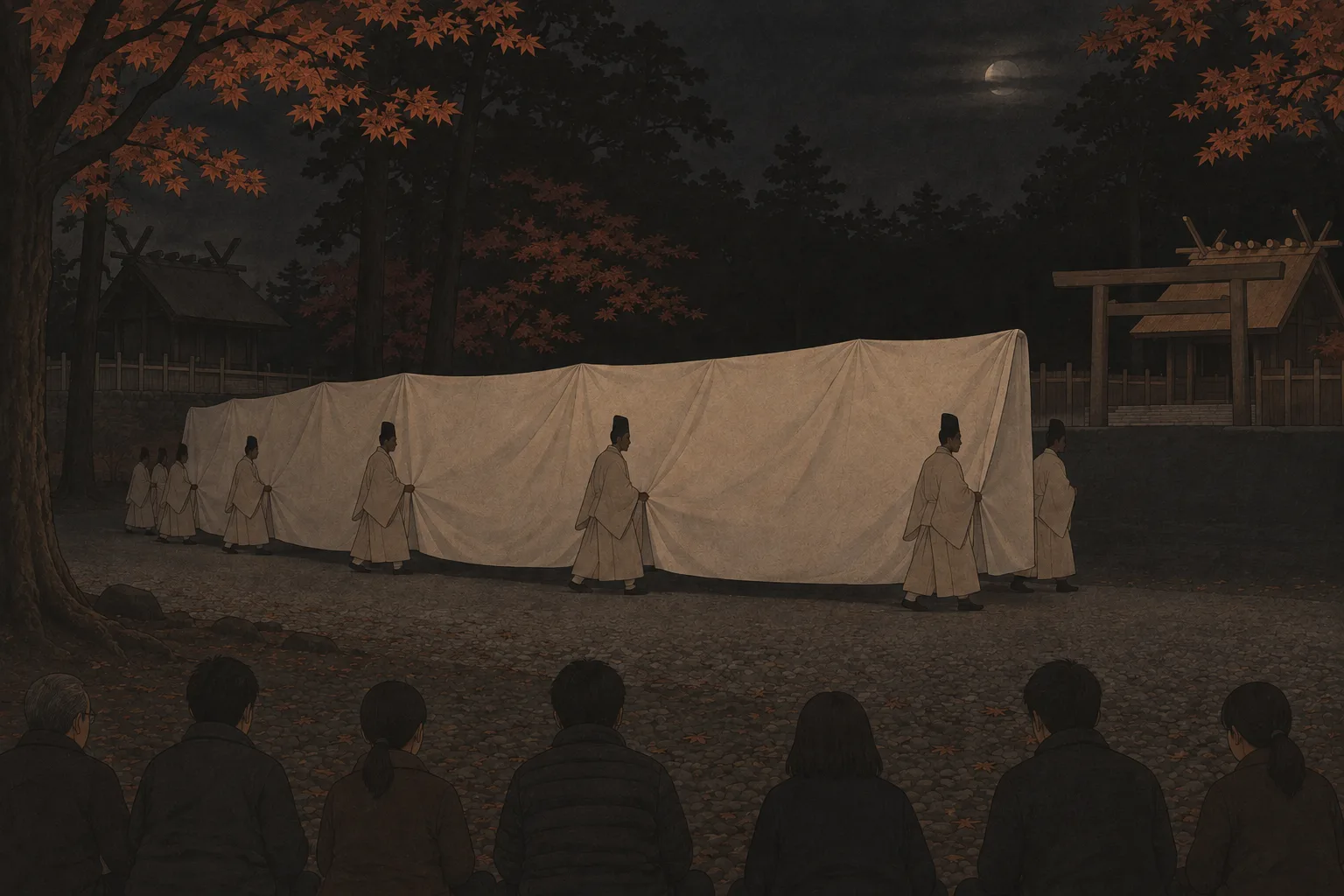
The night of the sengyo: with every light out, priests move from the old sanctuary to the new inside a walking enclosure of white silk, while guests sit in the dark. (artist’s impression)
Along with the buildings, the shrine remakes the deity’s entire wardrobe and possessions, the goshōzoku shinpō: around 700 kinds of objects, more than 1,500 items in all, including garments, textiles, mirrors, swords, bows and arrows, musical instruments and writing tools. Each is reproduced to the old pattern by specialist craftsmen. Swords are forged by swordsmiths; textiles are woven in ancient designs that only a few workshops in Japan can still produce.
03Two plots, a hut, and a bridge
Each of Ise’s two main sanctuaries has two identical sites side by side, east and west, called mishikichi. The new building always goes up on the empty site; the deity moves; the old building is then dismantled. The vacated site is called the kodenchi, the "old sanctuary site."
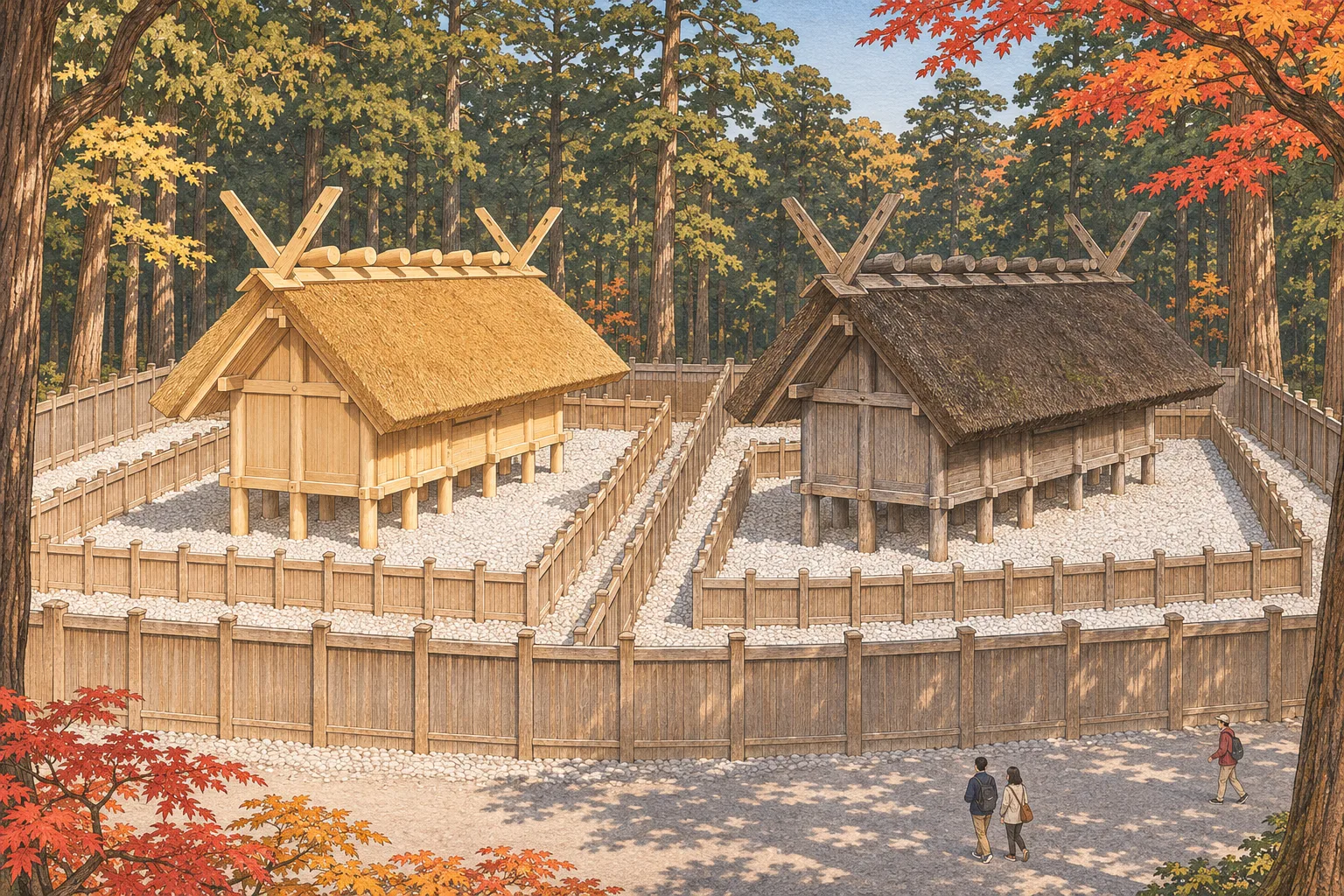
The two plots at Ise’s Inner Shrine just after a rebuilding: the new sanctuary in pale cypress on the left, the old one, grey after twenty years, on the right. (artist’s impression)
The kodenchi is not left bare. It stays covered in white stones, and at its center sits the small hut, the ōiya, that so many visitors notice. It shelters the heart pillar, which is left standing in place. The heart pillar is a post set in the ground at the very center beneath the sanctuary floor; it carries no structural load, but it is regarded as the most sacred element of the building, and it is erected in secret at night. When the old sanctuary is taken down, the pillar stays: the hut stands over it for twenty years until the next sanctuary rises there. For a short time after each rebuilding, both sanctuaries stand next to each other, one in fresh pale cypress, the other weathered gray-brown by twenty years of rain. It is a sight that comes around once a generation.
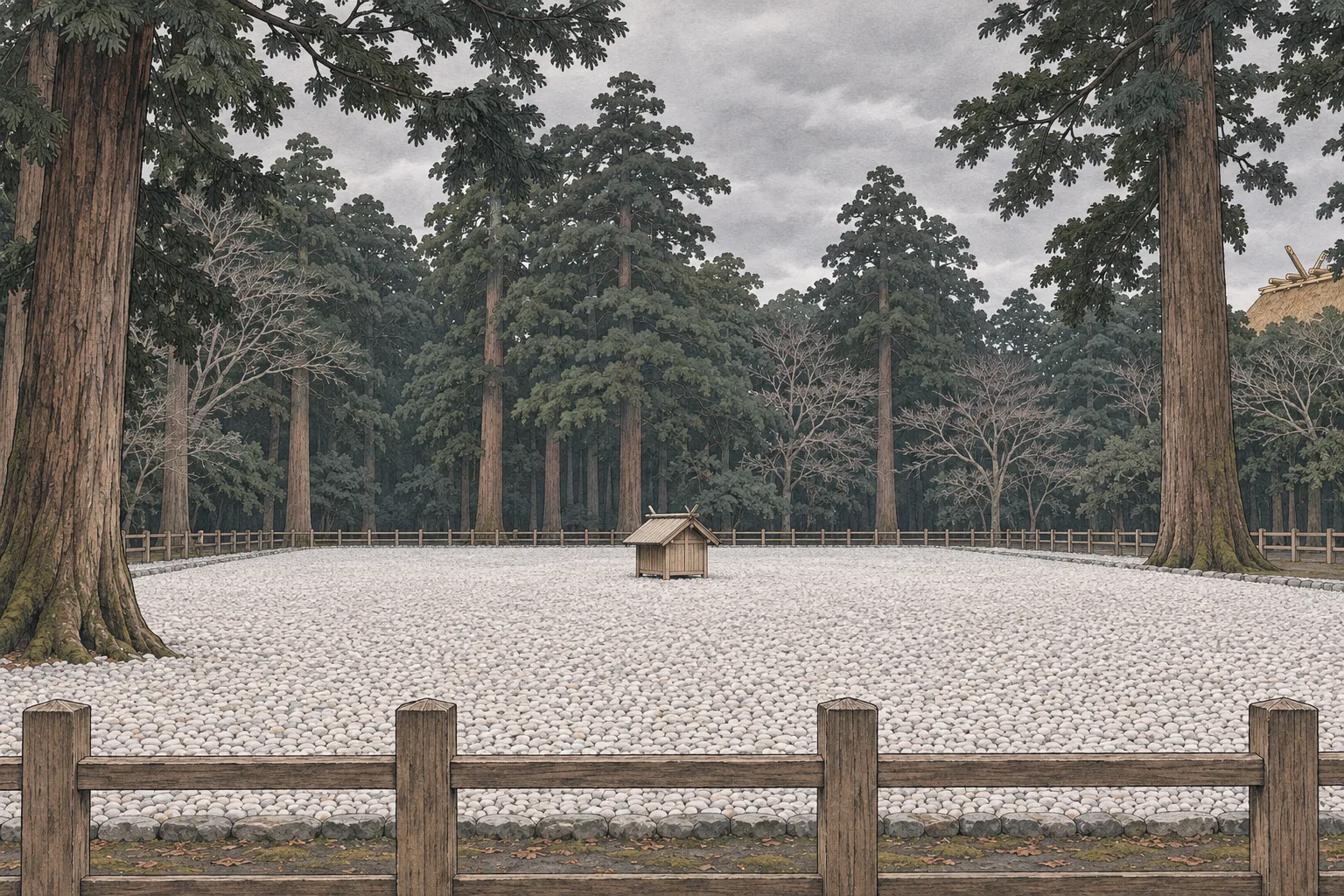
The kodenchi after the old sanctuary has gone: white stones still cover the ground, and the small hut at the centre, the ōiya, shelters the heart pillar left in place.
Ise’s buildings use earth-fast posts and deep thatched roofs, with no tiles, no paint and no stone footings. That is the practical reason for the twenty-year rhythm: buried timber and thatch simply do not last much longer without major work. (The architectural style itself, shinmei-zukuri, is a subject of its own.)
The Uji Bridge, the long wooden bridge over the Isuzu River at the entrance to the Inner Shrine, is also rebuilt every twenty years, but four years ahead of the sanctuaries; the current bridge opened on 3 November 2009, and the next is due in November 2029. It is roughly 100 meters long, with a Kiso cypress deck, zelkova piles in the river and jewel-shaped giboshi finials on the railings. At its opening the procession is led by a woman chosen as the watarime, followed by married couples from three-generation families selected from all over Japan, and only then by the general crowd.
The large torii at each end of the bridge are made from recycled timber: the ridge-supporting pillars of the old sanctuaries, the Inner Shrine’s for the torii on the shrine side and the Outer Shrine’s for the one on the town side. A pillar that held up a sanctuary roof for twenty years then spends twenty more years as a gateway. When the bridge is next rebuilt, the torii move on again. The inner one goes to the Higashi-no-oiwake junction at Seki-juku in Kameyama, where the Tōkaidō highway meets the road to Ise; the outer one to the old Shichiri-no-watashi ferry landing at Kuwana. A single piece of cypress can be in service for sixty years.
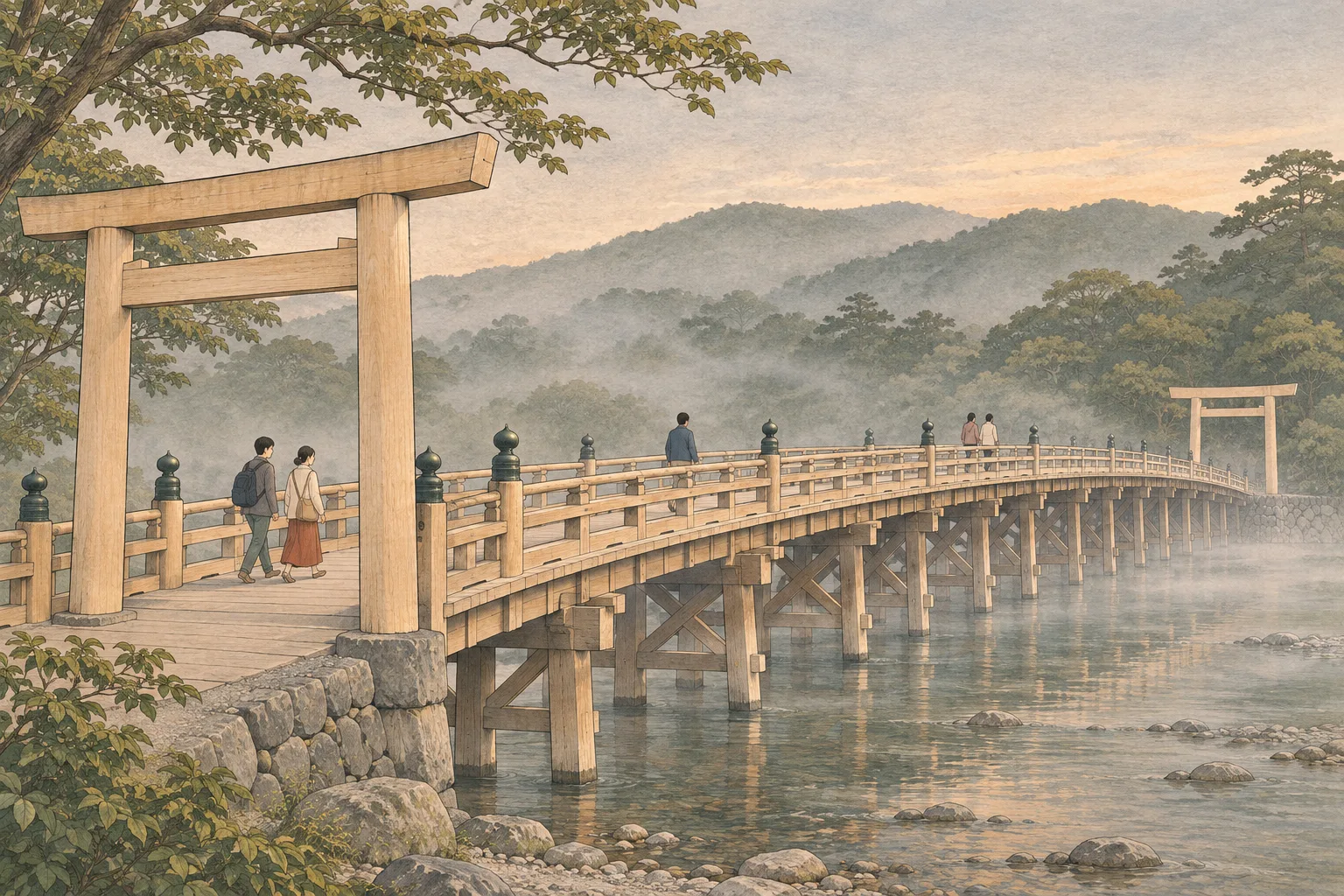
The Uji Bridge over the Isuzu River, with a large torii at each end made from the ridge-supporting pillars of the previous sanctuaries.
The rest of the dismantled timber is not thrown away either. The shrine distributes it to shrines across Japan for main halls, torii and other buildings, and requests far exceed supply. After the 2011 Great East Japan Earthquake, a share went to shrines in the devastated northeast.
04Izumo: one building, renewed about every sixty years
Izumo Taisha does it completely differently. There is no second plot and no new building; the same main hall is thoroughly renovated roughly every sixty years. The present hall dates from 1744 and stands about 24 meters tall, the tallest surviving shrine sanctuary in Japan. Its major renovations fell around 1809, 1881, 1953 and 2013, irregular intervals of sixty to seventy-odd years.
The most recent, the Heisei Great Sengū, began in 2008, when the deity was moved to a temporary hall. Scaffolding and a protective cover then enclosed the sanctuary. The heart of the work was the roof. Izumo’s roof is not thatch but hiwadabuki, layer upon layer of cypress bark, and on a building this size it consumed some 640,000 to 700,000 pieces. The bark is stripped from living trees, which survive and can be stripped again about a decade later. The bark-gatherers, motokawashi, climb the trunks with a looped rope and slip a spatula between bark and wood to peel it off in long strips. Roofers then trim it into thin sheets and lay them in overlapping courses, each exposing only a centimeter or so, fixed with bamboo nails. Seen at the eaves, the finished roof looks like the edge of a tightly packed book. The crossed chigi finials and the horizontal katsuogi logs on the ridge were recoated in a black finish called chan-chan-nuri, following a method recorded in old shrine documents.
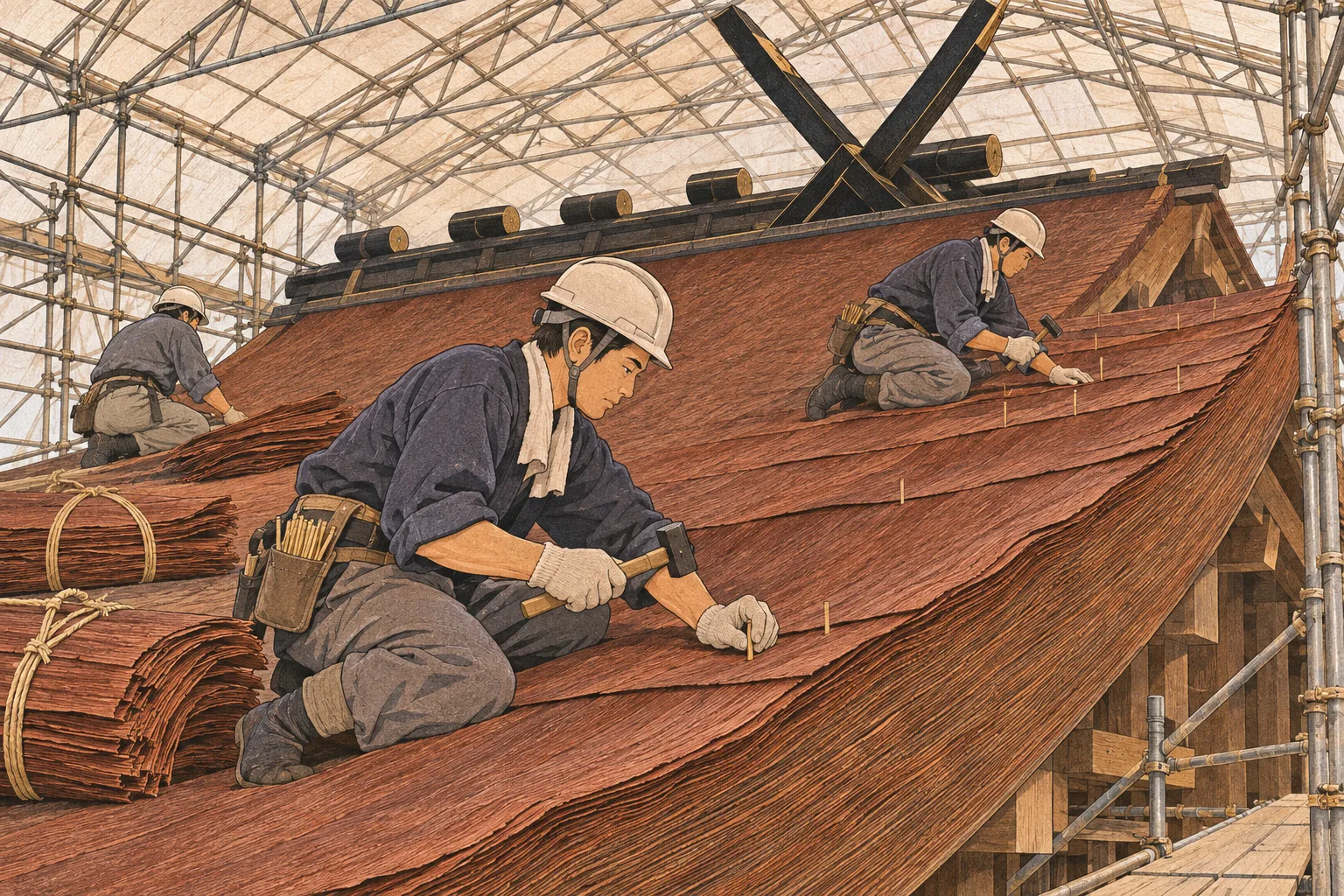
Izumo Taisha during the Heisei Great Sengū: under scaffolding and a protective cover, roofers lay cypress bark in overlapping courses and fix it with bamboo nails.
On the night of 10 May 2013 the deity returned to the renovated hall. Ise completed its 62nd rebuilding that autumn, and the coincidence of both great shrines renewing in the same year drew a great deal of public attention; Izumo reported a record of around eight million visitors that year.
What Izumo is preserving, in other words, is not newness but a specific mid-Edo building. The giant bundled pillar bases excavated in front of the hall in 2000, now marked by circles on the ground, show that in the Middle Ages the sanctuary was rebuilt outright, and on a different scale. The rebuilding of 1667 stripped away Buddhist elements, 1744 was the last complete rebuilding, and only after that did the pattern settle into repeatedly renewing one surviving hall.
05Kasuga, the Kamo shrines, Sumiyoshi, Katori and Kashima
At Kasuga Taisha in Nara, the main sanctuary is four small vermilion halls in a row, one for each deity. Kasuga holds its shikinen zōtai about every twenty years; by the shrine’s own account the custom reaches back to its early years, and the 2016 renewal was the 60th. Today it takes the form of renovation in place. The deities move to a temporary hall just to the west, the utsushidono (in March 2015 for the last cycle), while the four halls are re-roofed in cypress bark, repainted vermilion and have their metal fittings restored. The outer shrines and the Wakamiya are renovated in turn, and ancient treasures such as armor and mirrors are conserved or copied. The deities returned to the main halls on a night in November 2016, again in darkness.
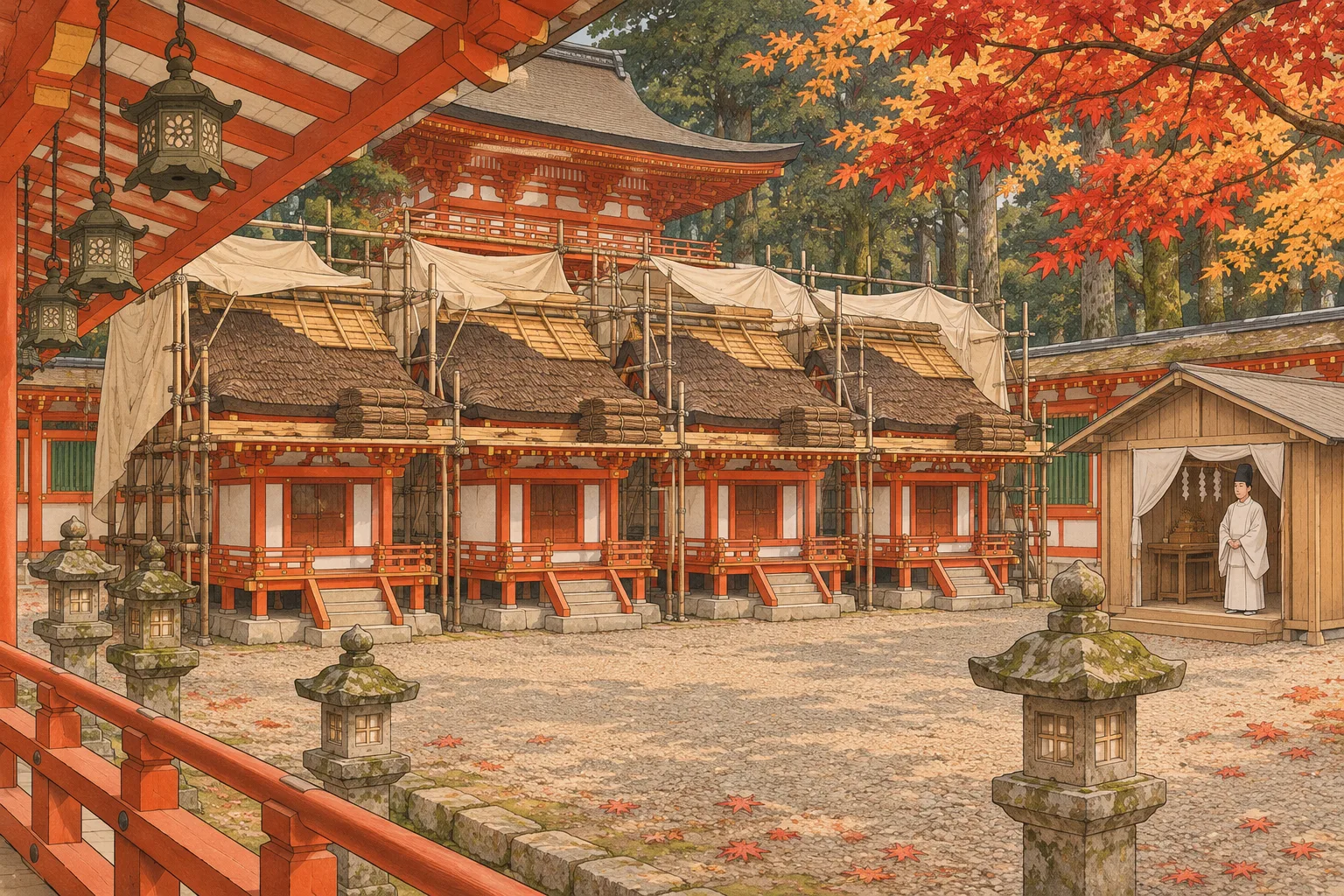
Kasuga Taisha’s shikinen zōtai: the four halls in a row are re-roofed in cypress bark while the deities lodge in the plain utsushidono on the right. (artist’s impression)
In earlier centuries Kasuga did replace its halls outright, and the old ones were given to other shrines and temples. The Kasuga-dō and Hakusan-dō at Enjōji, a temple on the outskirts of Nara, are said to be former Kasuga sanctuaries handed on during the rebuilding of 1228; both are National Treasures and the oldest surviving buildings in the Kasuga style, though their size and details differ from Kasuga’s halls and some scholars doubt the story. Quite a few small shrines around Nara claim a Kasuga hall as their own.
In Kyoto, Kamigamo Shrine and Shimogamo Shrine hold a shikinen sengū roughly every twenty-one years, a cycle that Shimogamo traces to its first recorded sengū in 1036. Both completed their most recent one in 2015, Kamigamo’s 42nd and Shimogamo’s 34th; the next falls around 2036. Their main halls date from the 1860s and are National Treasures, so they can no longer be demolished and rebuilt; the work is renovation, re-roofing in cypress bark and renewing the furnishings, while the subsidiary shrines in the precinct are repaired as well. Kamigamo keeps a neat echo of Ise’s two-plot logic: next to its main hall stands an identical gonden, a reserve hall, empty most of the time, where the deity stays while the main hall is under repair. Why twenty-one years rather than twenty is not settled.
Sumiyoshi Taisha in Osaka has four main halls, three in a line one behind the other and the fourth beside them, in the Sumiyoshi-zukuri style: straight gabled roofs, entrance in the gable end, vermilion posts and white walls. People often say the line of halls looks like a fleet putting out to sea, appropriate for deities of seafaring. In ancient times Sumiyoshi pulled down and rebuilt its four halls about every twenty years; the custom broke off in the wars of the sixteenth century and gave way to periodic repairs. The present halls date from 1810 and are National Treasures, so recent cycles have been renovations; the 49th was completed around 2011, the shrine’s 1,800th anniversary.
In the Kantō region, Katori Jingū and Kashima Jingū once rebuilt about every twenty years as well. Medieval warfare cut off the funding and the cycle died out. Both shrines’ present halls were paid for by the Tokugawa shogunate: Kashima’s in 1619 by the second shogun, Tokugawa Hidetada, and Katori’s in 1700 under the fifth, Tokugawa Tsunayoshi, a hall of black lacquer and gilt fittings that could hardly be further from Ise’s bare wood. Kashima offers a fine example of reuse: when the 1619 hall was built, the previous main hall, dedicated by Tokugawa Ieyasu in 1605, was not demolished but moved deep into the forest, where it now serves as the Okunomiya, the inner shrine, at the end of a long cedar-lined path. In place of rebuilding, both shrines now hold a grand festival every twelve years in the Year of the Horse. At Katori’s Shikinen Jinkōsai in April, the deity’s palanquin rides an ornate royal barge on the Tone River. At Kashima’s Ofunesai in September, the palanquin boards its barge on the shore of Lake Kitaura and a fleet of more than a hundred decorated boats sails into the Hitachi-Tone River, where priests from Katori come aboard to greet it. 2026 is a Year of the Horse: Katori’s festival was held on 15–16 April and Kashima’s on 2 September.
06Suwa’s Onbashira: replacing the pillars
Suwa Taisha, around Lake Suwa in Nagano, consists of four sites: the Upper Shrine’s Honmiya and Maemiya, and the Lower Shrine’s Harumiya and Akimiya. At the four corners of each stands a tall bare tree trunk, an onbashira or "sacred pillar." That makes sixteen in all, every one a single fir. In each Year of the Tiger and Year of the Monkey, that is every six years, all sixteen are replaced. Because local reckoning counts the starting year too, people call it the festival held "every seven years." The last was in 2022; the next is due in 2028.
The festival comes in two parts. In April is the yamadashi, bringing the logs out of the mountains. Trees chosen and felled in advance are stripped of bark, roped, and dragged out by thousands of parishioners. The largest, the "first pillar," is about 17 meters long and weighs in the region of ten tons. At the Upper Shrine, which district pulls which pillar is decided by lottery in February of the festival year, and drawing the Honmiya’s first pillar is an honour; the Lower Shrine’s assignments are largely fixed by custom. The best-known moment is the kiotoshi, when young men ride a pillar down a steep slope; at the Lower Shrine the run is about 100 meters long and close to 35 degrees at its steepest. The Upper Shrine adds a river crossing, hauling the pillars through the cold Miya River. In May comes the satobiki, hauling the pillars into the shrines with processions and work songs. The top of each pillar is cut into a three-sided point, the kanmuri-otoshi, and then the pillar is raised upright with ropes and pulleys while men stand on top, singing and waving wands. The festival is boisterous and has seen injuries over the years; safety management has tightened considerably in recent decades.
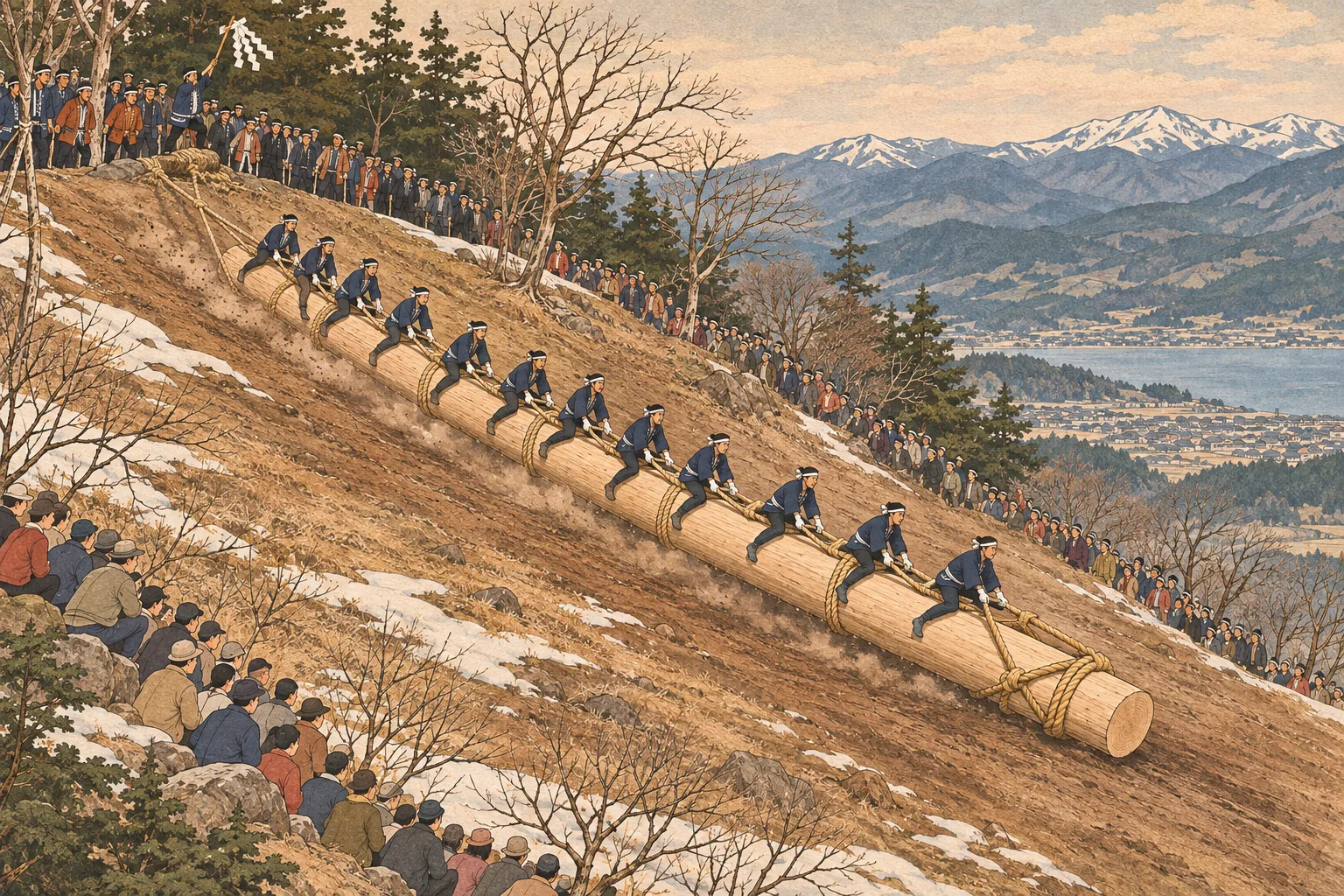
The kiotoshi at Suwa’s Onbashira festival: men ride a stripped log down a steep slope.
Nobody knows for certain why the pillars are there. Some say they mark the boundary of sacred ground; some see them as a simplified, ancient form of renewing the shrine; others connect them with mountain and tree worship.
The Onbashira year is also a rebuilding year in the narrower sense. The Upper Shrine’s Honmiya and both Lower Shrine sites each have a pair of identical treasure halls, hōden, one in use and one empty. In each Onbashira year the empty one is rebuilt and the sacred object is moved into it from the other; next time, the other is rebuilt. It is Ise’s paired-plot system in miniature, on a six-year rather than twenty-year clock. And in an Onbashira year, mostly in autumn, small shrines all over the Suwa region, even household shrines, raise little pillars of their own. Drive through the valley and you will see tiny shrines with four freshly peeled poles at their corners.
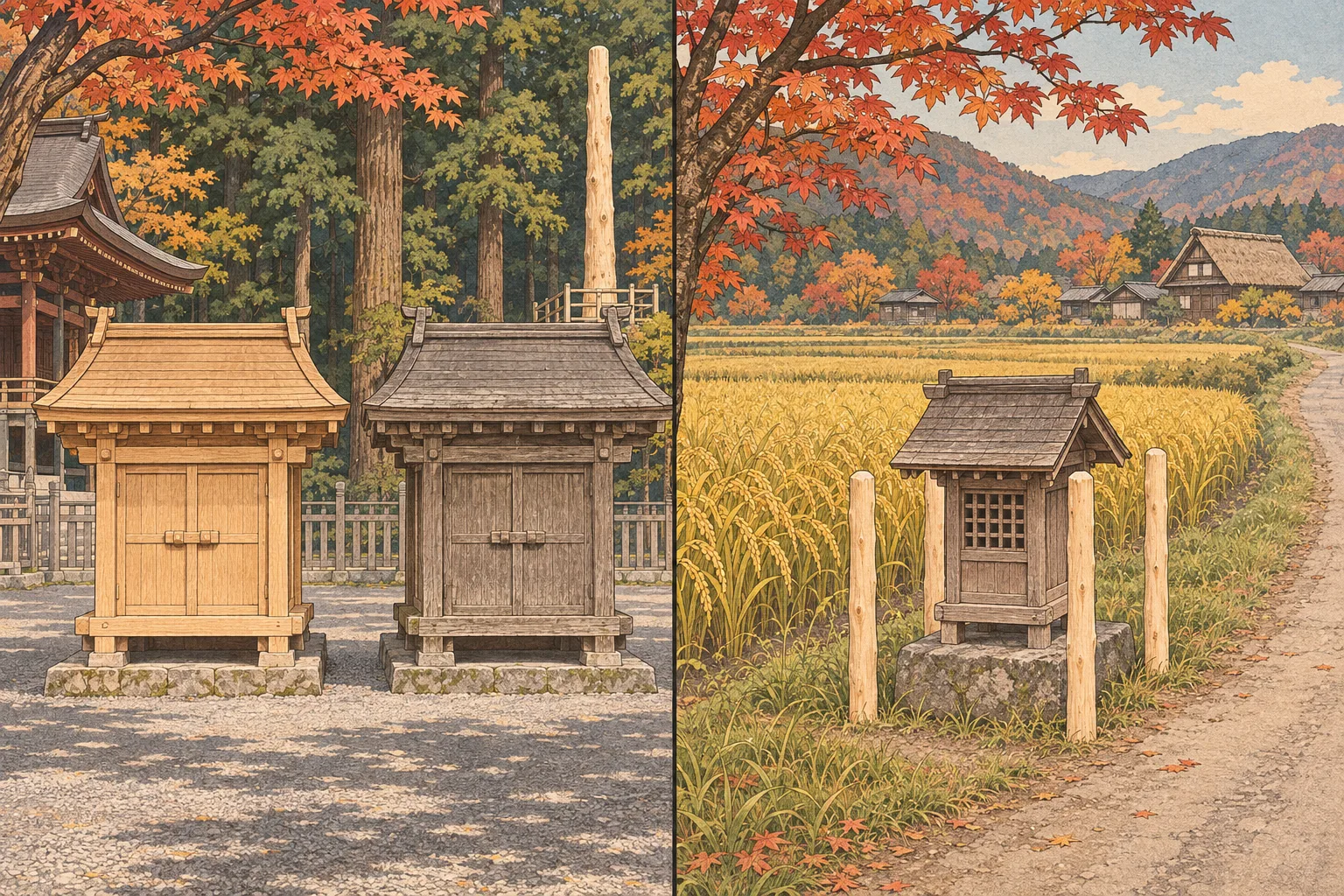
Left: Suwa’s paired treasure halls, one new and one old, with an onbashira standing behind. Right: a small roadside shrine in the Suwa valley with four freshly peeled poles at its corners.
07Side by side: four ways to renew a shrine
The clearest way to tell these practices apart is to ask what gets replaced.
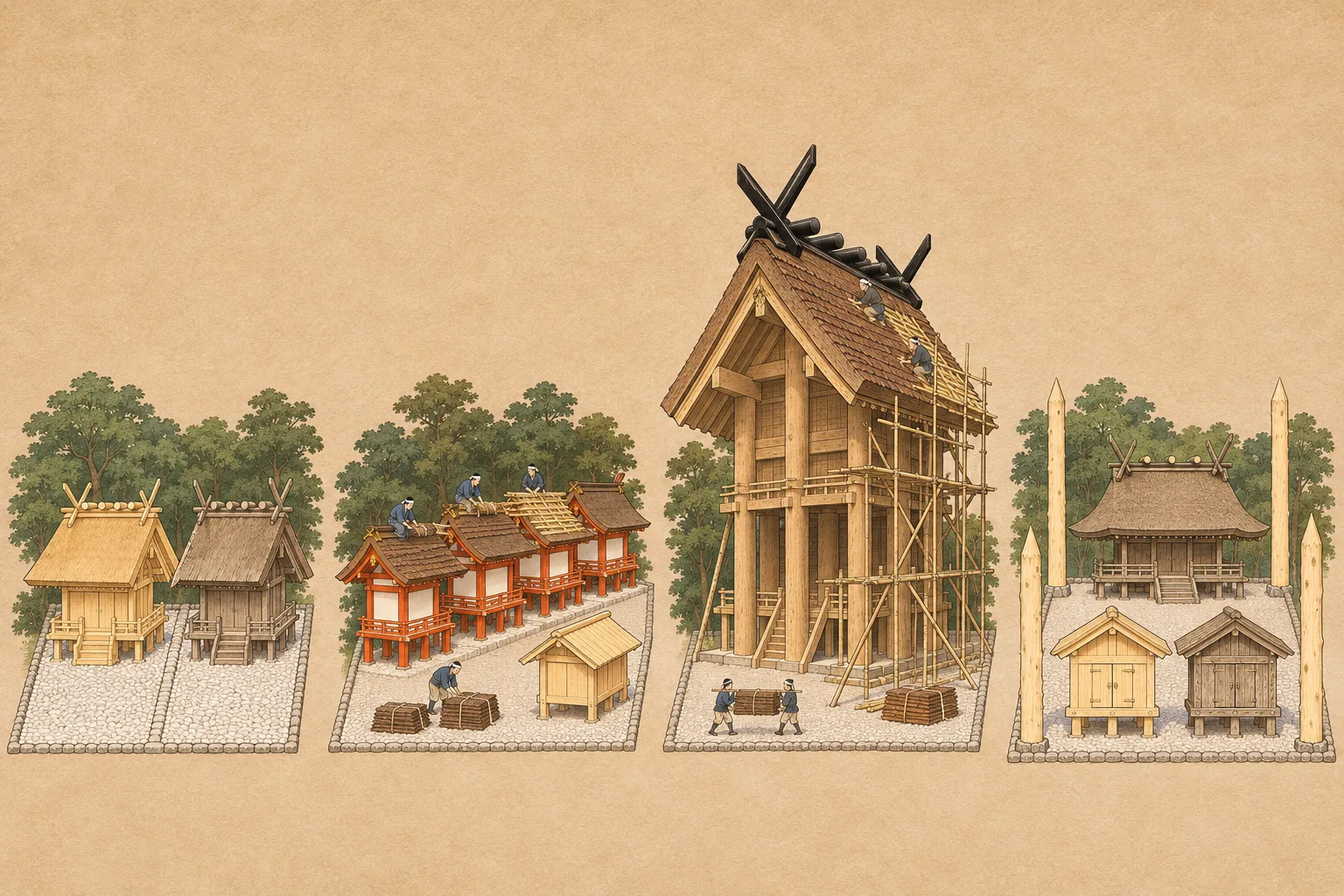
From left: Ise, new and old sanctuaries on twin plots; Kasuga, four halls being re-roofed, with the small temporary hall in front; Izumo, one tall hall under scaffolding for a new roof; Suwa, pillars at the four corners and a pair of treasure halls, one new and one old.
At Ise, it is the whole building, and the location changes too. Two identical plots alternate; the new sanctuary rises next door, the deity walks across, the old one comes down, leaving white stones and the little hut over the heart pillar’s spot. Cycle: twenty years.
At Kasuga, it is the surface. The four halls stay put while the deities lodge in a temporary hall; the bark roofs and vermilion paint are completely renewed. Cycle: about twenty years. The Kamo shrines (about twenty-one years) and Sumiyoshi (about twenty) work in a similar way today.
At Izumo, it is chiefly the roof. The same Edo-period hall disappears under scaffolding every sixty years or so while craftsmen relay hundreds of thousands of sheets of cypress bark and blacken the ridge timbers.
At Suwa, it is the pillars, plus one of each pair of treasure halls. Cycle: six years.
Katori and Kashima have left the system altogether and hold a festival every twelve years instead.
On the ground, a few signs tell you what you are looking at. A pebble-covered empty plot the same size as the sanctuary, with a hut in the middle: Ise-style paired sites. Two identical halls side by side, one empty: Kamigamo’s main hall and reserve hall, or Suwa’s paired treasure halls. Peeled tree trunks at the four corners of a precinct: a Suwa shrine. Renovation-in-place leaves no visible trace most of the time; only during the work itself do you see a main hall wrapped entirely in scaffolding, with the deity lodged in a hall alongside.
08Why rebuild at all?
The first reason is material. Earth-fast posts rot, thatch and bark roofs need replacing within decades, and unpainted wood weathers and cracks. Rather than waiting for failure, a fixed date ensures renewal happens. That explains why Ise, with the oldest and plainest building method, is the shrine that most needs rebuilding.
The second is an idea, often summed up in the word tokowaka, "ever young." Keeping the deity’s dwelling and possessions fresh is felt to keep the deity’s power fresh too. After a sengū people speak of the deity moving into a new home, not of a new shrine being built. Each sanctuary is copied precisely from the previous one, so the building of 2013 is thought to be close in form to its predecessors of more than a thousand years ago. The wood is new; the design is old. Japanese commentators like to use Ise to make the point that "ancient" need not mean "old material."
The third is skill. Twenty years is roughly one working generation. A young shrine carpenter, a miyadaiku, works on his first rebuilding as an apprentice, his second as a seasoned hand, his third as the master teaching others. With a fifty-year gap, techniques would die between cycles. The same goes for the sacred treasures: weavers, lacquerers, metalworkers and swordsmiths know a defined commission comes every twenty years, and some nearly lost crafts survive because of it. At Izumo, with sixty years between renovations, much depends on older craftsmen’s memories and on written records to bridge the gap.
The fourth is the forest. A single Ise rebuilding uses more than ten thousand cypress logs, and some parts call for trees two or three centuries old. Since the mid-Edo period much of this timber has come from Kiso, where the Owari domain guarded the cypress so jealously that a saying held "one tree, one head." In modern times the Kiso forests became imperial estate, with a Jingū reserve forest set aside in 1906; after the war they became national forest, and the former reserve, renamed the Kiso Hinoki reserve, still supplies the rebuilding. At Ise the logs soak in a storage pond to leach out resin and reduce later cracking, before carpenters shape them in the shrine’s workshops, jointing almost everything without nails. Since 1923 the shrine has also been planting cypress in its own forest at Ise, aiming to raise trees to two hundred years of age. In 2013 part of the timber came from that forest, the first time in about seven hundred years, according to the shrine.
Money matters too. The 2013 rebuilding cost about 55 billion yen. Since the Second World War the state no longer pays; the 59th rebuilding in 1953 and every one since has been funded by the shrine’s own resources and private donations from across Japan.
How Japanese people see all this varies. For some it is a religious event, and they sit in the dark on the night of the transfer. For others it is a living architectural tradition, and they worry about whether there will be enough shrine carpenters and bark-gatherers in the next generation. For the people of Ise, twenty years is a measure of a life: pulling a rope as a child, carrying a bucket of white stones into the new courtyard in middle age, watching grandchildren haul the logs in old age. The 63rd cycle is already under way. It opened, as always, with the Yamaguchi-sai and the night-time Konomoto-sai on 2 May 2025; the first felling followed in Kiso that June; and in 2026 the people of Ise hauled the first round of timber, overland in May and June and through the Isuzu River in July and August. The second round is due in 2027.
More deep dives on this topic
 ToriiA torii is two posts and one or two crossbeams, with no doors, no walls and no lock.
 Divine Messengers and KomainuWalk into almost any Shinto shrine and an animal meets you before anything else does.
 Shrine ArchitectureMost visitors to a Shinto shrine photograph the torii gate, the vermilion pillars and the bell rope in front of the hall, and leave thinking they have seen the shrine.
 Shimenawa, Shide and GoheiWalk into almost any Shinto shrine in Japan and you will pass under a rope.
 Reading Shrine NamesWalk up to almost any Shinto shrine in Japan and look at the wooden plaque hanging from the torii gate or the main entrance.
 OmikujiNext to the counter where a Japanese shrine sells its charms, there is usually a wooden box or a hexagonal canister and a small slot for coins.
 Shinto Priests and MikoSpend a morning at a large Japanese shrine and you will see two kinds of people in old-fashioned dress.
 Shikinen Sengū and ZōtaiWalk up to the main sanctuary of the Inner Shrine at Ise and you will notice, just beside it, an empty plot exactly the same size.
 Sacred Trees and StonesWalk into almost any Shinto shrine and something older than the buildings is usually waiting for you.
- Back to the main article: Shinto →