
Walk up to almost any Shinto shrine in Japan and look at the wooden plaque hanging from the torii gate or the main entrance. It usually carries three or four characters, and they split neatly into two parts. The first part names the deity or the place. The second part is the shrine’s title, called a shagō, and it tells you how the shrine sees its own standing. Learn to read both halves and a plaque stops being decoration: it tells you who is worshipped inside, where that worship came from, and often how many thousands of sister shrines share the same name across the country.
Japan has roughly 80,000 registered shrines, but nowhere near 80,000 names. There are Hachiman shrines in Tokyo and in Kagoshima, Tenjin shrines in Kyoto and in Hokkaido. This guide explains the titles, the "credentials" that never appear on the plaque, the main shrine families and what marks each one, and finally the old practice that scattered the same names over the whole archipelago.
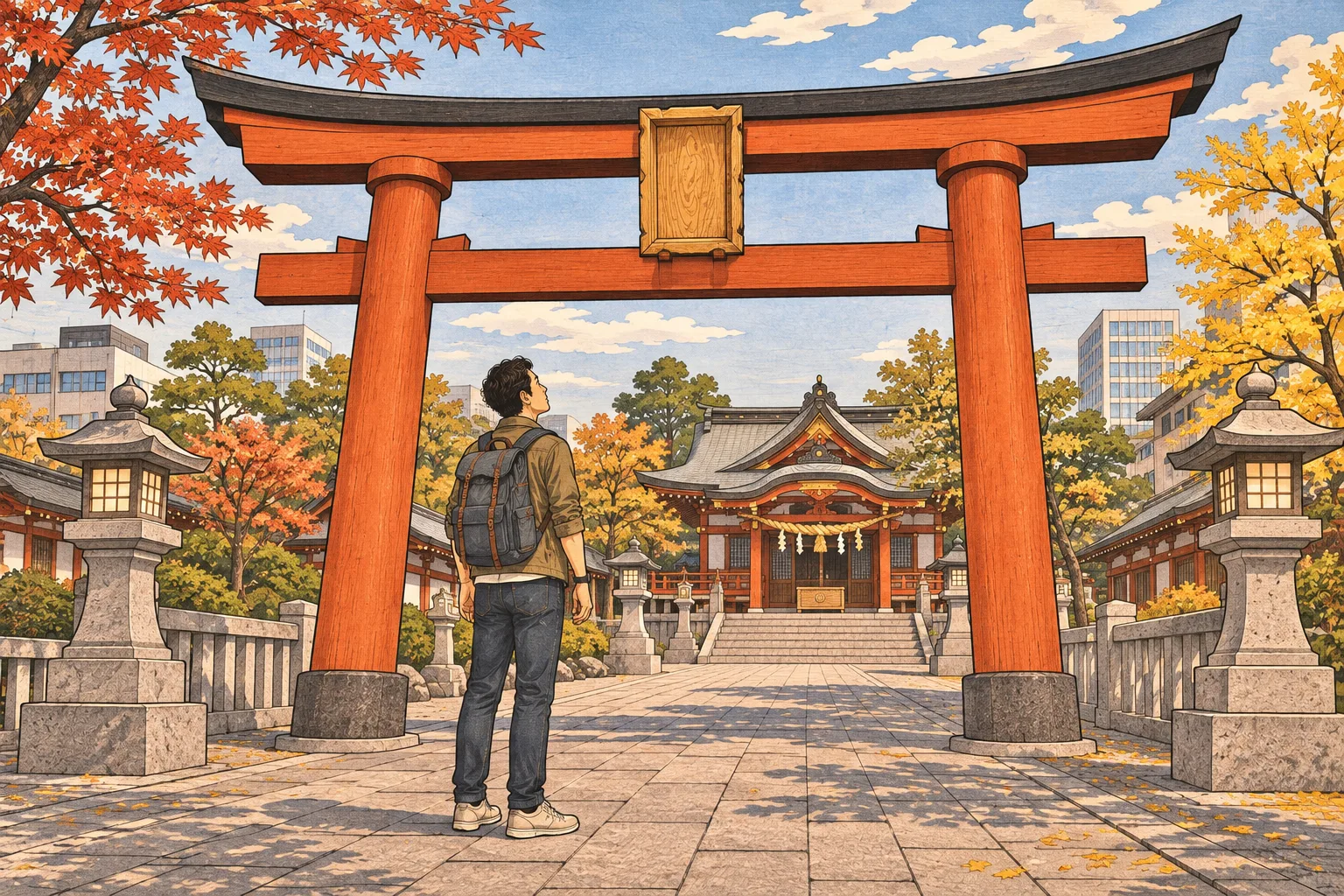
The first thing to read at a shrine is the plaque at the centre of the torii: a few characters giving the family name and the title.
01The last character on the plaque: shrine titles
Before the titles, a word on the first half of the name. It comes in two kinds. Some shrines are named after their place: Hikawa, Kanda, Atsuta, Kashima. Others are named after a deity or a cult that travelled: Hachiman, Inari, Kumano, Suwa. A place name tells you where you are; a cult name tells you where the god came from. Many village shrines combine the two, putting the village name in front of a cult name to make "the Hachiman shrine of such-and-such."
Six titles cover almost every shrine you will meet: jingū, gū, daijingū, taisha, jinja and sha. There is no agreed ladder running from top to bottom. When the Meiji government regulated shrines, it treated jingū and gū as a step above jinja and required permission to use them, and it allowed taisha to only one shrine. After the war the state stopped regulating shrine names, and many of today’s titles date from then. For the rest, each title’s weight depends on its history.
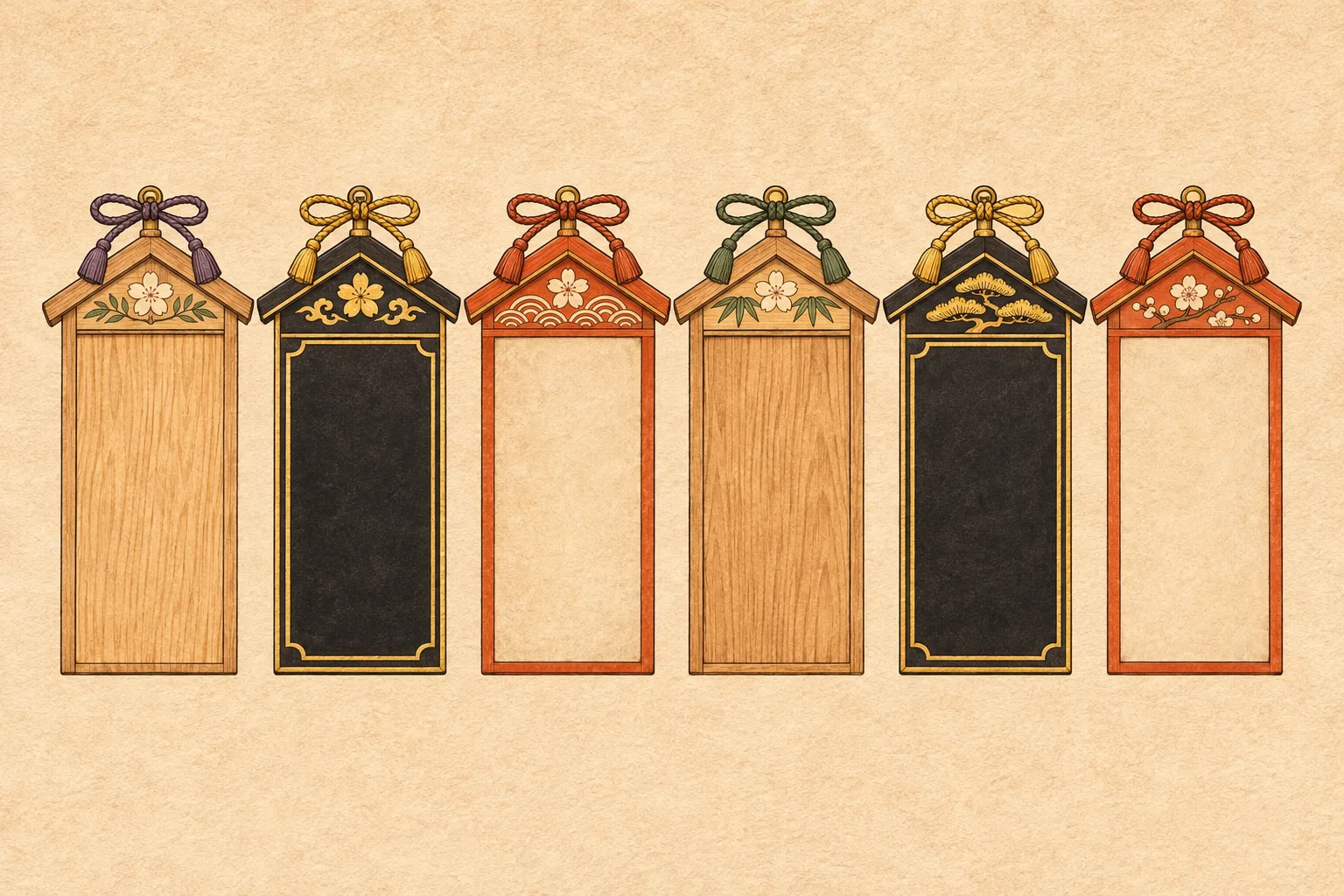
The six common titles: jingū, gū, daijingū, taisha, jinja and sha. The six plaques are drawn the same size because no agreed ranking runs through all of them.
Jingū (神宮), "divine palace." The most exclusive title. Ise’s official name is simply Jingū, and the reason is its deity: Amaterasu, the sun goddess claimed as ancestor of the imperial house. For centuries Ise was the court’s own shrine, where only the emperor could make offerings and private offerings were forbidden; it needed no place name because there was nothing to distinguish it from. Only in the medieval period did ordinary pilgrims begin to pour in. "Ise Jingū" is what people say to be clear, but within the shrine world "the Jingū" means Ise, and the formal names of its two main shrines, Kōtai Jingū and Toyouke Daijingū, carry the same word.
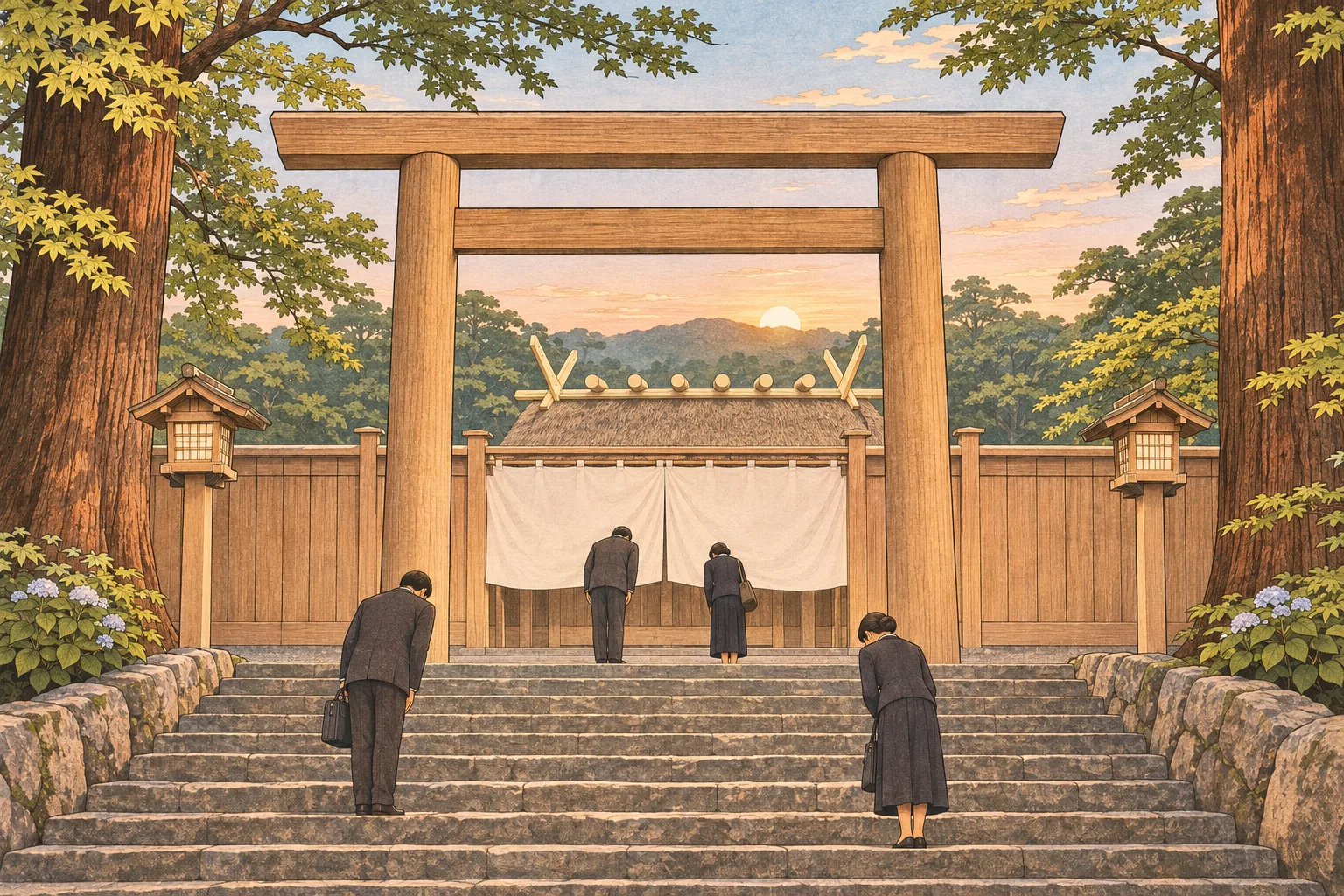
The main sanctuary of Ise’s Inner Shrine: worshippers bow on the steps before a white curtain, and only the thatched roof and chigi show above the fence. Its official name is simply Jingū.
A 10th-century register of officially recognised shrines, the Engishiki list of deities, uses jingū for only three: Ise, and the Kashima and Katori shrines in the east, which honour two warrior gods who, in myth, subdued the land for Amaterasu’s line. In the modern era, using the title required imperial approval, and it went mainly to shrines honouring emperors or deeply tied to imperial myth. Atsuta Jingū in Nagoya, said to hold the sacred sword Kusanagi, is one; Isonokami Jingū in Nara is another. Some jingū are modern foundations, such as Heian Jingū in Kyoto and Meiji Jingū in Tokyo.
Gū (宮), "palace." Traditionally used for shrines to members of the imperial family, or for shrines with a special history. Hachimangū shrines qualify because the god Hachiman is identified with Emperor Ōjin. Two famous exceptions honour men who were never royal: Tenmangū shrines, dedicated to the scholar-official Sugawara no Michizane, and Tōshōgū shrines, dedicated to the shogun Tokugawa Ieyasu. Nikkō’s shrine to Ieyasu was called Tōshōsha until the court formally granted it the title gū in 1645.
Daijingū (大神宮). Usually marks a shrine to Amaterasu with close ties to Ise; Ise’s own two main shrines carry it in their formal names. The best known elsewhere is Tokyo Daijingū near Iidabashi, nicknamed "the Ise of Tokyo." Far more common are the humble Shinmeisha or Shinmeigū, village shrines that also enshrine Amaterasu. If you see shinmei on a plaque, think Ise.
Taisha (大社), "grand shrine." Before the Second World War this meant one place: Izumo Taisha in Shimane, formally Kizuki Taisha until 1871 and the only shrine officially styled taisha. After the war, ancient head shrines adopted the title one by one: Kasuga in Nara and Sumiyoshi in Ōsaka in 1946, Suwa in 1948, and Fushimi Inari and Hiyoshi also in the postwar years, while Fujisan Hongū Sengen waited until 1982. So a taisha today is usually the fountainhead of a shrine family or a regional giant, but the name itself may be younger than your grandparents, and it says nothing about rank relative to a jingū or gū.
Jinja (神社). The ordinary, rank-neutral word for a shrine. A vast urban shrine and a single-room hut at the edge of a rice field can both be jinja.
Sha (社). The plainest form, often used for small shrines and for the subsidiary shrines inside a larger precinct. Those little side halls, known as sessha and massha, usually carry a sign reading simply "X-sha."
Two older words still turn up in everyday speech: myōjin and gongen. Tokyo’s Kanda Myōjin is officially Kanda Jinja; locals still call Nezu Jinja "Nezu Gongen." Gongen means "provisional manifestation," the idea that a Buddha or bodhisattva appears in Japan in the form of a native god. When the Meiji government forcibly separated Buddhism from Shinto in the late 1860s, many gongen shrines were told to rename themselves jinja. If older people call a shrine by a gongen name, it was almost certainly a mixed Buddhist-Shinto site before the 1870s.
02Credentials the plaque doesn’t show: shikinaisha, ichinomiya, sōja
Some of a shrine’s proudest claims never appear on the plaque. Look instead at stone markers by the entrance or the wooden information board.
Shikinaisha (式内社) are shrines listed in the Engishiki, a body of administrative regulations compiled in the early 10th century. Two of its volumes list 2,861 shrines housing 3,132 deities that received offerings from the court or provincial governments. A stone carved "Shikinai" announces that the shrine existed and was officially recognised over a thousand years ago. Because many shrines moved or changed names since, two or three modern shrines sometimes claim the same ancient entry; these rival claimants are called ronsha, "disputed shrines."
Ichinomiya (一宮), "first shrine," was the top-ranked shrine of an old province. The ranking took shape province by province between the mid-Heian period and the early medieval era, rather than by any decree. Why a particular shrine came first is not settled; one common explanation is that a new provincial governor toured the major shrines in order, and the first stop became the ichinomiya, followed by the ninomiya and sannomiya. Because records disagree, some provinces have two claimants. Examples include Izumo Taisha for Izumo, Ōmiwa Jinja for Yamato, Sumiyoshi Taisha for Settsu, Suwa Taisha for Shinano and the Sengen shrine at the foot of Mount Fuji for Suruga. Place names preserve the system: the city of Ichinomiya in Aichi is named after Owari’s first shrine, and Sannomiya, Kobe’s busiest district, after its local third shrine.
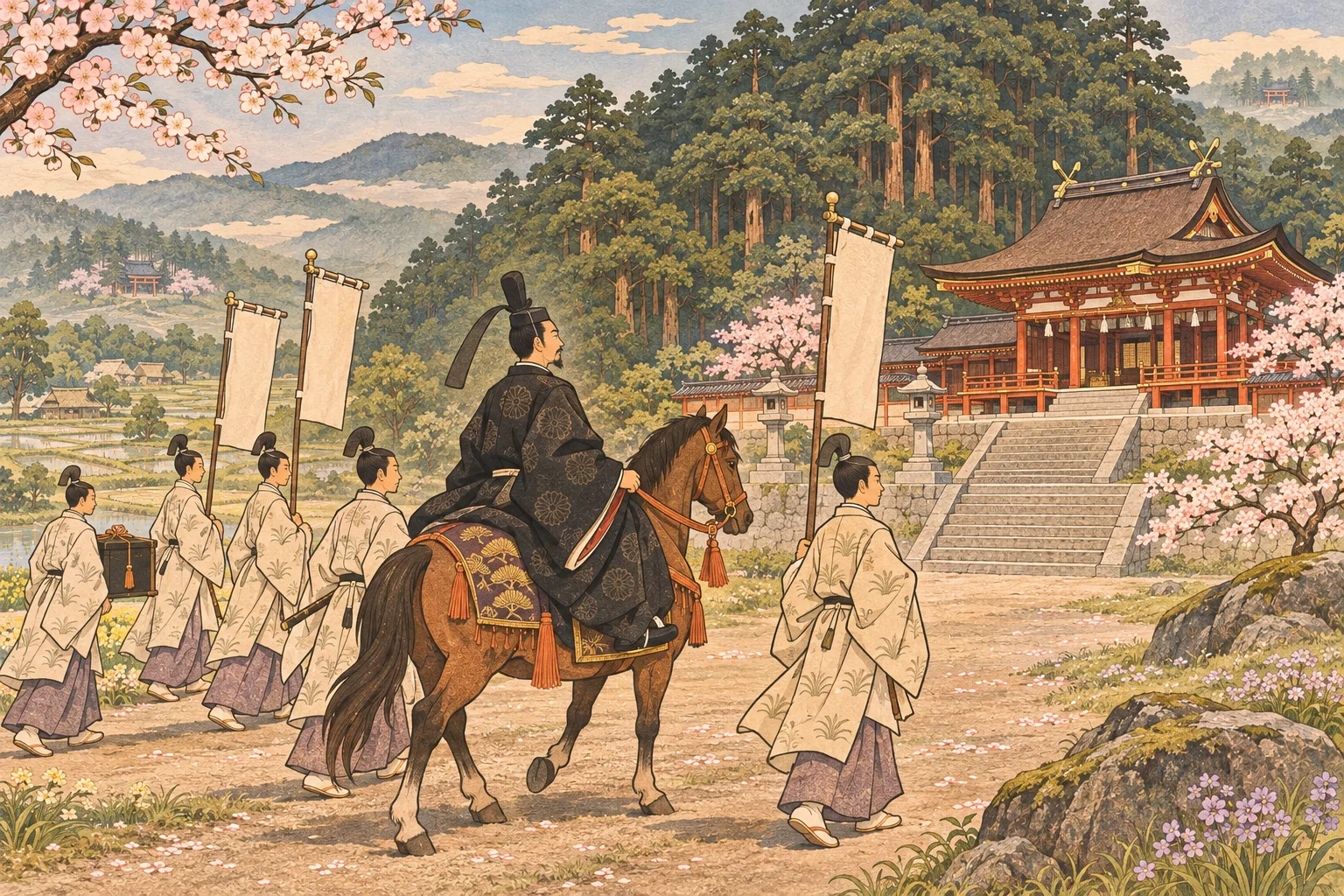
One common explanation of ichinomiya: a new provincial governor toured the major shrines in order, and the first stop became the first shrine. (artist’s impression)
Sōja (総社), "combined shrine," solved a practical problem. Touring every shrine in a province was exhausting, so governors built a shrine near the provincial capital where all the province’s deities were enshrined together. Ōkunitama Jinja in Fuchū, western Tokyo, is the sōja of old Musashi and is nicknamed Rokushogū, "shrine of the six places," because it brings together the gods of Musashi’s first through sixth shrines. Don’t confuse sōja with sōhonsha, the head shrine of a family: one gathers a region, the other heads a lineage.
A modern ranking system graded shrines from 1871 until it was abolished in 1946; old ranks carved on gateposts are relics of it.
03Why the same names are everywhere
The reason a single name repeats thousands of times is a practice called kanjō, "invitation." A community asks an established shrine to share its deity, and a portion of the god’s spirit, called bunrei, is carried to a new shrine. Shinto explains this with the image of a flame: light one candle from another and the first loses nothing. A head shrine can therefore send its god to ten thousand places without being diminished. The spirit is housed in a sacred object and transferred in a night-time rite.
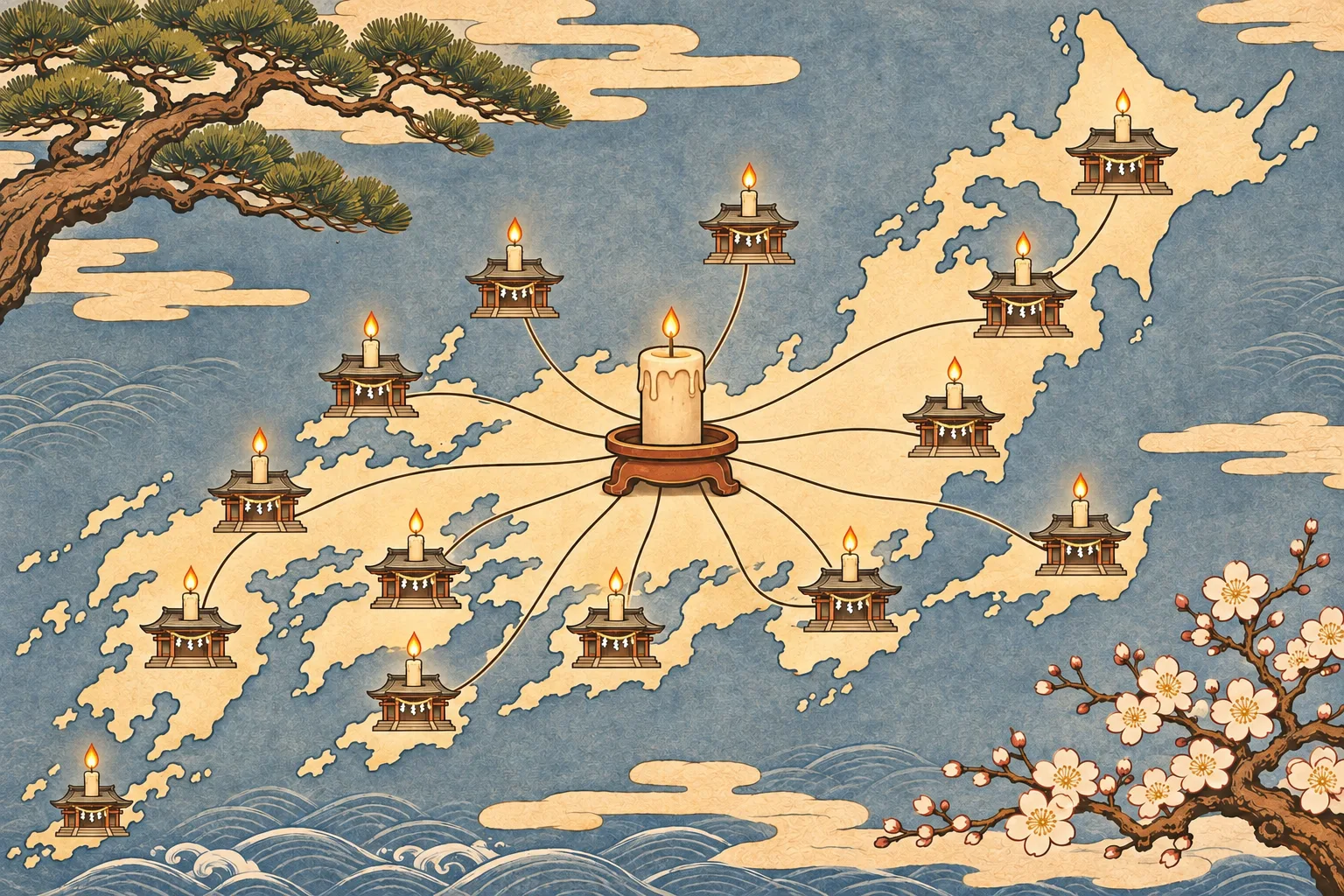
Bunrei as a flame: the candle in the middle lights small candles across the country and loses nothing. Each small candle stands on a branch shrine.
Different groups did the inviting. Warrior families posted to distant estates in the Kamakura period carried their protector gods with them; the Minamoto clan’s devotion to Hachiman spread his shrines across eastern and northern Japan. Villagers opening new rice land needed a guardian and often asked a famous shrine for one. City merchants did the same, and many an Edo shop kept a tiny Inari shrine in its back yard or on its roof. Pilgrim associations returning from Kumano, Mount Fuji or Konpira built local copies of the shrines they had visited, bringing a distant holy place to the village.
The transfer itself is a solemn affair. At the head shrine, priests perform a rite to divide the spirit, which is placed in a small container or wrapped object. It travels to the new site, sometimes carried by a delegation of villagers, and is installed in the new sanctuary at night, usually in darkness. The new shrine then records the date and origin of its god, and many shrine information boards begin exactly this way: "In such-and-such a year, the deity was invited from..."
So a name is often a family tree. A Kumano Jinja suggests someone once brought the gods of the Kii Peninsula to that spot; a Suwa Jinja points back to the lakeside shrines of Nagano. Branch shrines are independent, though; there is no chain of command, only a shared deity. Counts of how many shrines belong to each family vary widely: some include only independent shrines, others add every subsidiary hall and rooftop shrine. The figures below are the usual claims for each family, made on different bases, and shouldn’t be compared with one another. Walk around the precinct of any large shrine and you’ll find the same names again in miniature. Rows of small subsidiary shrines line the paths, each with its own little plaque: an Inari here, a Tenjin there, a Konpira or an Akiba by the back fence. Some were invited by the shrine’s own patrons. Many arrived in the early 20th century, when the government pressed villages to merge their small shrines, and dozens of local gods were moved into a single precinct. Reading those small plaques is one of the quickest ways to see which cults mattered to a neighbourhood.
Some families stay regional, like the 200-plus Hikawa shrines of Saitama and Tokyo, whose head shrine is generally said to have given the city of Ōmiya its name.
04Hachiman: the warrior god from Usa
Hachiman shrines are among the most numerous in Japan, said to number in the tens of thousands; one common figure is over 40,000. You’ll see Hachimangū, Hachiman Jinja, Hachimansha, and variants like Wakamiya Hachiman.
Hachiman is generally identified with Emperor Ōjin and worshipped together with his mother, Empress Jingū, and a goddess called Himegami. His origins are older and more local: he began as a god of the Usa area in northern Kyūshū. In the 8th century he burst onto the national stage when an oracle from Usa promised to help with the casting of the Great Buddha at Tōdaiji in Nara, and his sacred palanquin was welcomed into the capital. Late in the 8th century the court titled him Hachiman Daibosatsu, "Great Bodhisattva Hachiman," one of the earliest examples of a native god given a Buddhist title.
The head shrine is Usa Jingū in Ōita Prefecture, where worshippers clap four times instead of the usual two, as at Izumo. Around 860 a monk named Gyōkyō brought Hachiman to Otokoyama south of Kyoto, founding Iwashimizu Hachimangū, which guarded the capital’s southwest. In the 11th century Minamoto no Yoriyoshi brought him to the shore at Kamakura, and in 1180 Minamoto no Yoritomo moved the shrine to its present site as Tsurugaoka Hachimangū, the spiritual centre of his new shogunate. Samurai swore oaths "by Hachiman Daibosatsu" for centuries afterwards.
Hachiman shrines are everywhere in eastern Japan for a simple reason: wherever a Kamakura-era warrior family settled, it tended to found a Hachiman shrine as its guardian. In many towns the Hachiman shrine stands on a rise near the site of an old castle or manor house, and its autumn festival, sometimes with mounted archery, still recalls those samurai patrons. Kamakura’s own festival in September features yabusame, archers shooting at targets from galloping horses along the shrine’s approach.
At the gate, look for the mitsudomoe, three comma-shaped swirls chasing each other in a circle, on lanterns and curtains. It isn’t exclusive to Hachiman, but it’s his most common crest. At Tsurugaoka the character 八 (hachi) on the gate plaque is drawn as two facing doves, the god’s messengers. The paired-hall Hachiman style of architecture is covered elsewhere.
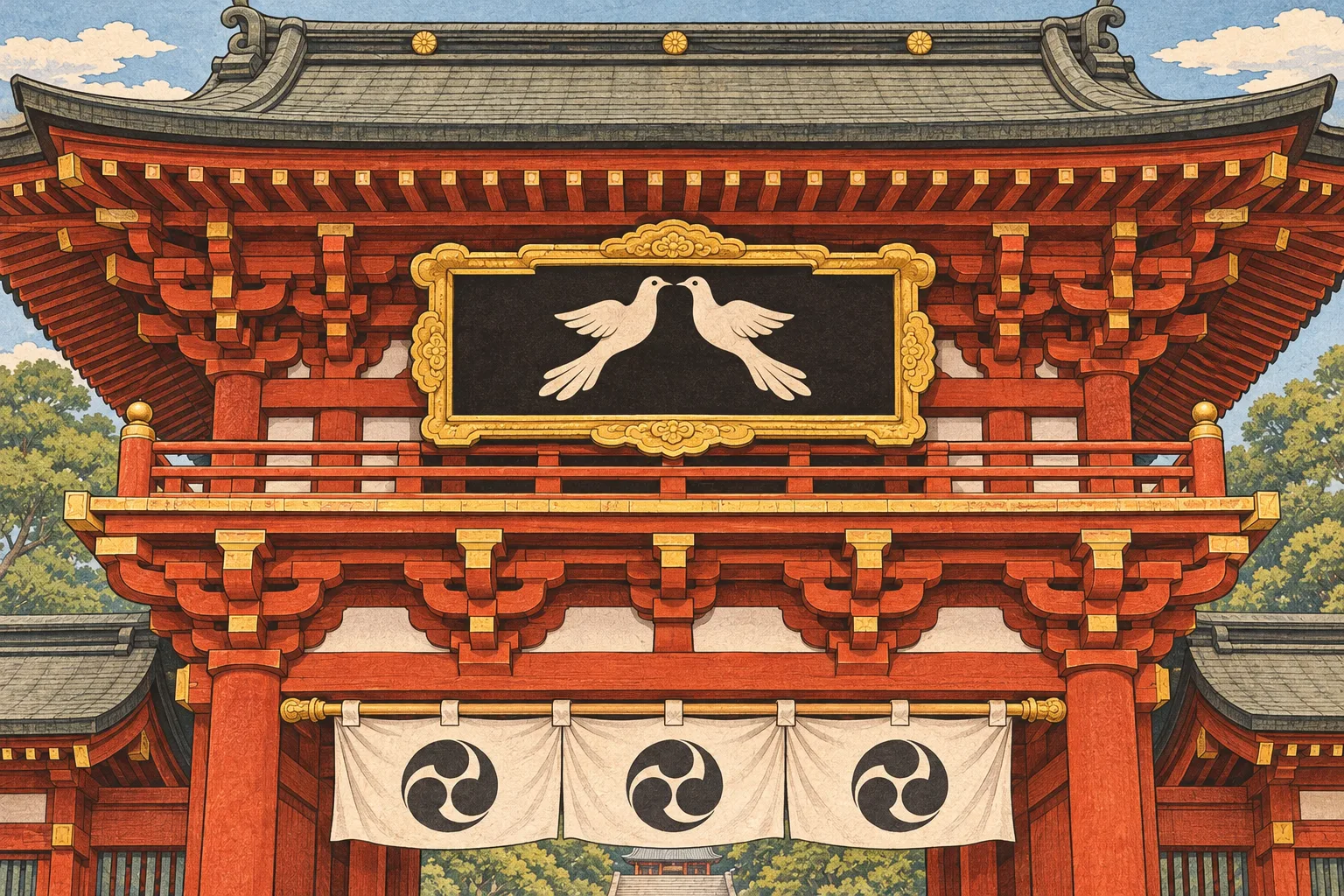
At a Hachiman gate: the first character on the plaque is drawn as two facing doves, the god’s messengers, and the curtain below carries the mitsudomoe crest.
05Tenjin: Kitano and Dazaifu
Tenmangū, Tenjinsha, Sugawara Jinja, Kitano Jinja: nearly all of these honour one man, Sugawara no Michizane (845–903). About 12,000 shrines are usually credited to this family.
Michizane was a brilliant scholar and poet who rose to Minister of the Right. In 901 rivals had him demoted to a post in Dazaifu in Kyūshū, in effect exile, and he died there two years later. Disasters followed in the capital: his chief rival died young, lightning struck the palace and killed several courtiers, and crown princes died one after another. The court concluded that Michizane’s angry spirit was responsible, restored his rank, and enshrined him to turn a vengeful ghost into a protector.
The two head shrines have distinct stories. Dazaifu Tenmangū in Fukuoka stands over his grave; tradition says the ox pulling his funeral cart lay down and refused to move, so he was buried on the spot. Kitano Tenmangū in Kyoto was founded in 947 on a field already associated with a thunder god, and in popular belief Michizane and thunder merged. That’s why the word tenjin, "heavenly deity," is older than his cult, and some shrines called Tenjinsha actually honour other gods.
Every Tenmangū tells a version of the same story in its decorations. Plaques and lanterns show plum blossoms. Votive pictures show Michizane in court dress, a tall black cap on his head and a wooden baton in his hands, sometimes riding an ox. In Dazaifu, umegae mochi, flat rice cakes stamped with a plum blossom, are grilled and sold along the approach, and the smell of toasted bean paste follows you to the gate.
Over time the ghost faded and the scholar took over. By the Edo period, temple schools hung his portrait, and today, in January and February, Tenmangū votive racks are thick with wooden ema plaques bearing the names of the schools students hope to enter.
At the gate, three signs together are almost conclusive: plum trees, a reclining bronze or stone ox, and the umebachi crest, five round petals around a centre. Legend says a plum tree Michizane loved flew overnight from Kyoto to join him in Dazaifu; a white plum called Tobiume still grows before the main hall. Visitors rub the ox’s head, and the corresponding part of their own body is supposed to heal. Famous branches include Yushima Tenjin and Kameido Tenjin in Tokyo and Ōsaka Tenmangū, home of the July Tenjin Festival.
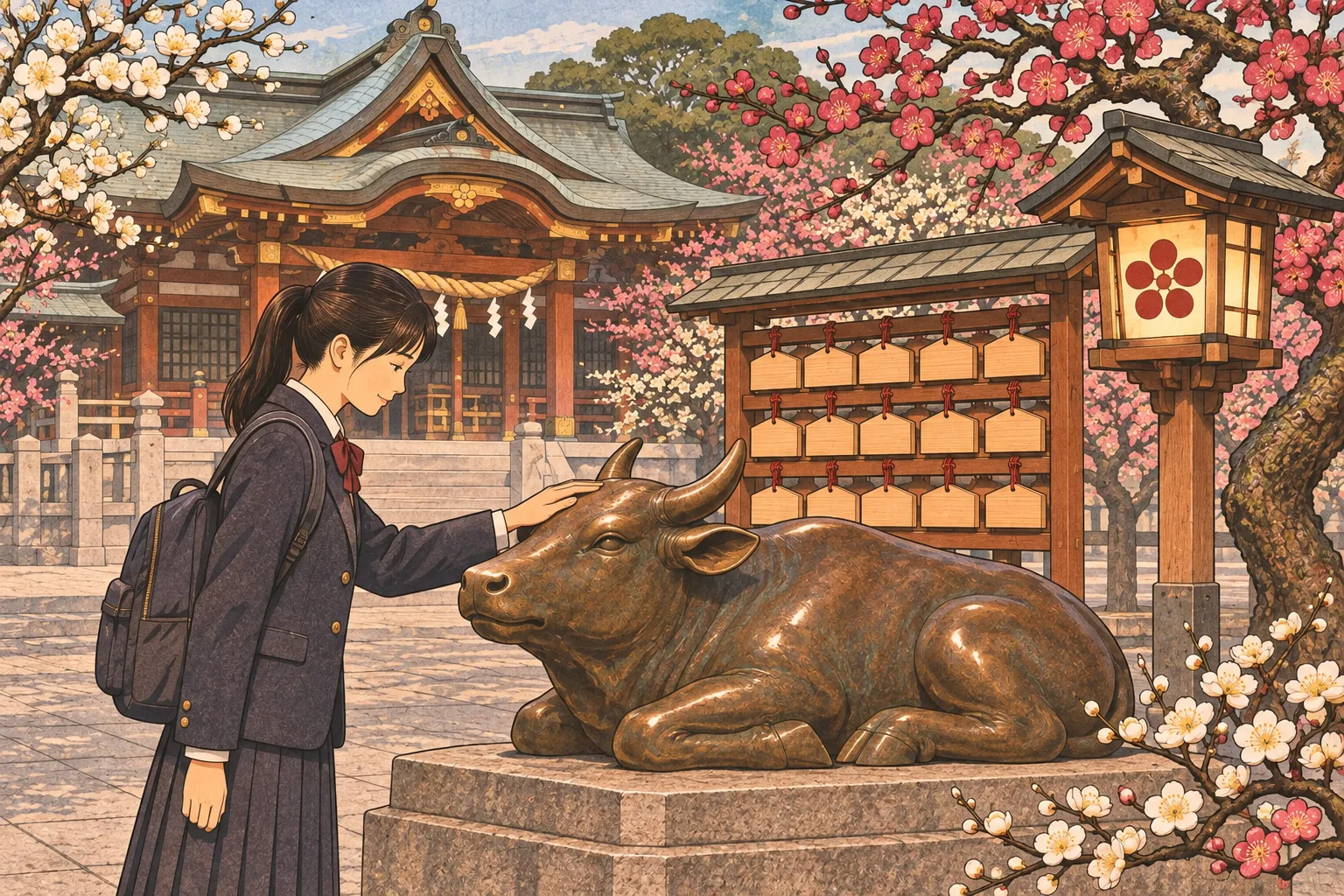
The three Tenjin signs together: plum trees in bloom, a reclining bronze ox and the umebachi crest on the lantern. A student rests her hand on the ox’s head.
06Inari and the other great families
Inari. Often described as the largest family, commonly counted at around 30,000 shrines (some tallies put Hachiman ahead), Inari is centred on Fushimi Inari Taisha in Kyoto, founded according to shrine tradition in 711 and dedicated to a deity of rice who became a patron of business. Look for tunnels of vermilion torii, fox statues holding a jewel or key in their mouths, and red banners reading Shōichii Inari Daimyōjin.
Kumano. The three Kumano shrines on the Kii Peninsula, Hongū, Hayatama and Nachi, together called the Kumano Sanzan, each enshrine all three of the family’s deities: Ketsumiko, Hayatama and Fusumi. Hongū’s main deity, Ketsumiko, is sometimes identified with Susanoo. Under Buddhist-Shinto fusion they were the Kumano Gongen, linked to Amida, Yakushi and the Thousand-Armed Kannon. Retired emperors made the long pilgrimage again and again in the late Heian period; Go-Shirakawa is said to have gone over thirty times. Over 3,000 branch shrines exist, sometimes as Jūnisho Jinja or Nyakuichi Ōji Jinja; Tokyo’s Ōji district takes its name from one. The sign to look for is the three-legged crow, Yatagarasu, especially on goō hōin talismans whose design is made up of dozens of tiny crows. Hongū stood on a river sandbar until a flood in 1889; a torii about 34 metres tall now marks the old site.
Hiyoshi / Sannō. The head shrine, Hiyoshi Taisha in Ōtsu, sits at the foot of Mount Hiei, and the great monastery of Enryakuji adopted its gods as protectors under the name Sannō Gongen, "mountain king." Its two main gods are Ōyamakui, the old god of Mount Hiei, and Ōnamuchi, brought from Miwa in Nara. Wherever Enryakuji’s influence went, Sannō followed. Branches are written Hiyoshi, Hie or Sannō; Hie Jinja in Akasaka was the guardian shrine of Edo Castle. The giveaway is the Sannō torii: an ordinary torii with a triangular gable perched on top, like hands pressed together in prayer. Monkeys serve as messengers.
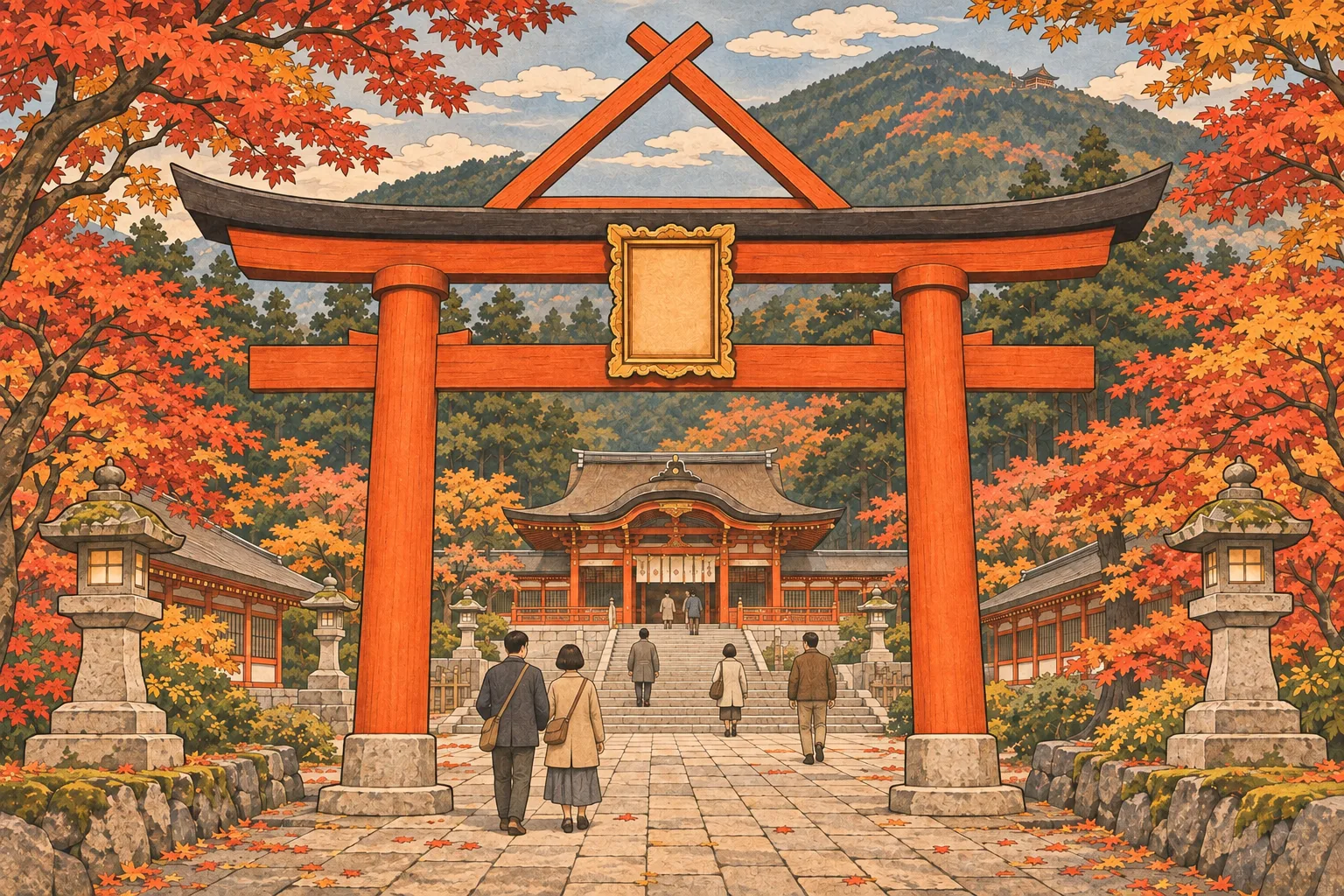
The Sannō torii at Hiyoshi Taisha: an ordinary torii with a triangular gable perched on top, the giveaway of the Hiyoshi and Sannō family.
Kasuga. Kasuga Taisha in Nara, traditionally founded in 768, was the clan shrine of the Fujiwara, whose estates spread its branches, often counted at a thousand or more. Its gods include two brought from Kashima and Katori. The precinct has about 3,000 stone and bronze lanterns, all lit in February and August. The crest is sagari-fuji, two drooping wisteria sprays curving into a circle, the Fujiwara emblem. Deer are the messengers.
07Mountains and seas: Sengen, Suwa, Hakusan, Sumiyoshi, Konpira, Akiba, Atago
Sengen (Asama). These shrines honour Mount Fuji through the goddess Konohanasakuya-hime, who in myth gave birth inside a burning hut and so came to be seen as a calmer of volcanoes. The head shrine is Fujisan Hongū Sengen Taisha in Fujinomiya, and the summit of Fuji above the eighth station belongs to its precinct. In the Edo period, Fuji pilgrimage clubs flourished, and those who couldn’t make the climb built Fujizuka inside local shrines: miniature Fujis a few metres high, often made with lava rock brought from the mountain. Climbing one counted as climbing the real mountain; Tokyo still has a good number. Around 1,300 Sengen shrines exist. Cherry trees count as the goddess’s sacred tree, and some 500 grow in the head shrine’s grounds.
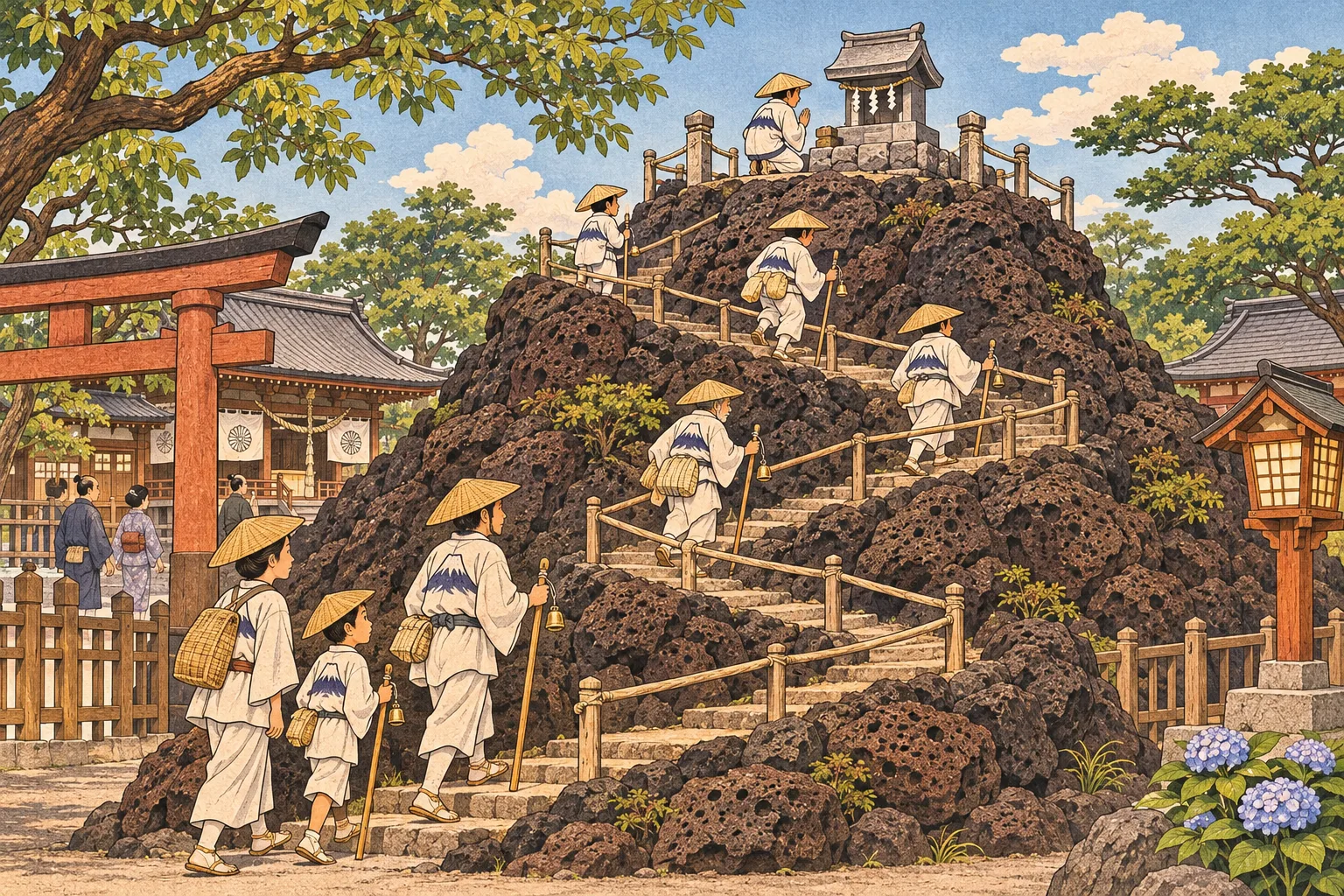
A Fujizuka in Edo: a miniature Fuji of black lava rock inside a shrine, climbed by pilgrims in white, for whom it counted as climbing the real mountain. (artist’s impression)
Suwa. Suwa Taisha in Nagano consists of four shrines around Lake Suwa, honouring Takeminakata and his consort. Three of the four have no main sanctuary at all; the Upper Shrine’s Honmiya is usually said to worship Mount Moriya behind it, and the two Lower Shrines a cedar and a yew. Suwa is famous for the Onbashira festival, held in the years of the tiger and monkey (called "every seven years" by inclusive counting, actually every six). Sixteen huge fir trunks are hauled down from the mountains, some ridden down steep slopes, and raised at the four corners of each shrine. Many branch Suwa shrines also have four pillars at their corners, the surest sign at the gate. The crest is a kaji (paper mulberry) leaf.
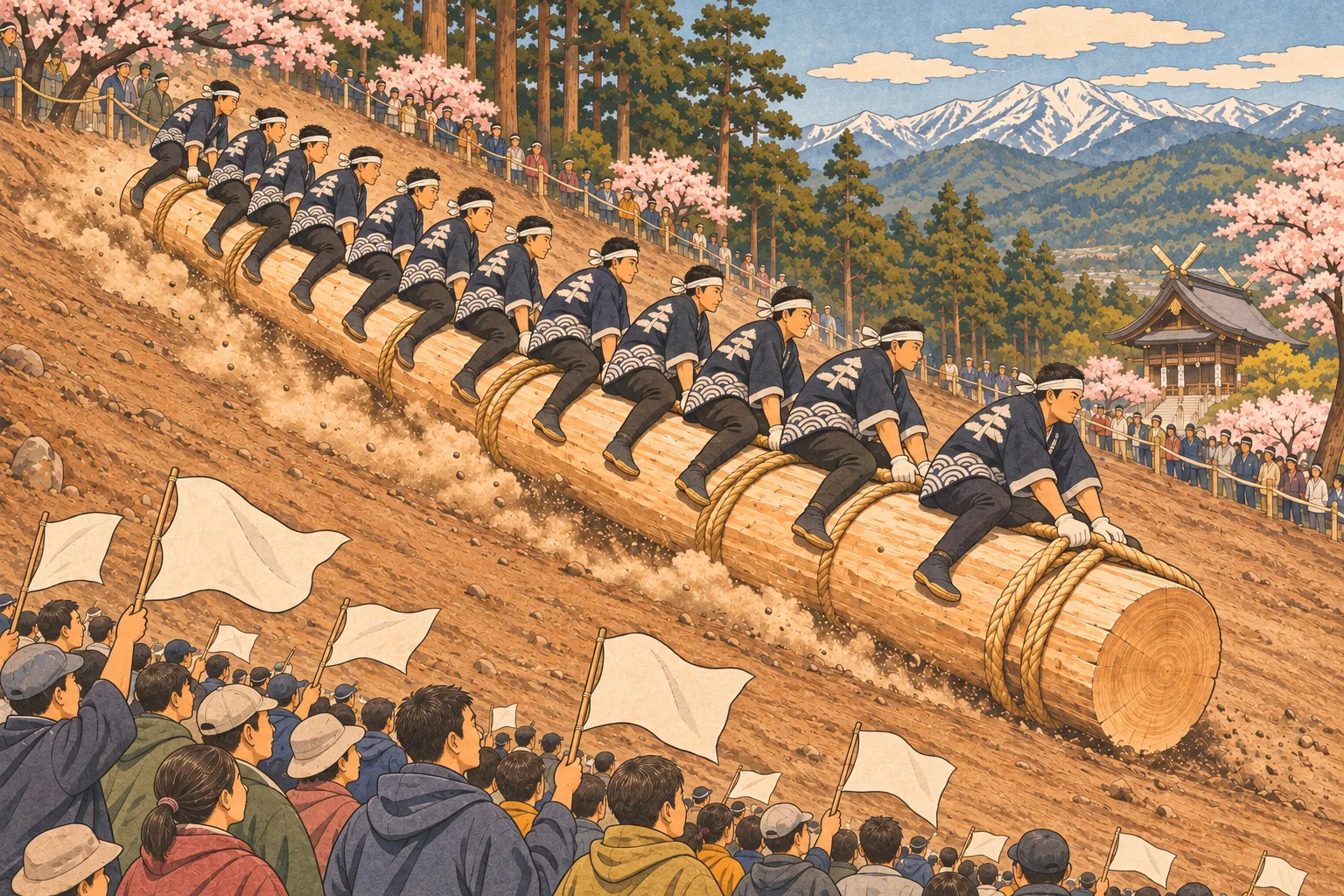
Suwa’s Onbashira festival: men ride a huge fir trunk down a steep slope. The trunks end up standing at the four corners of each shrine.
Hakusan. Mount Haku, 2,702 metres, straddles Ishikawa and Gifu and is named for its white snow. Shirayama Hime Jinja in Hakusan City is the head shrine, honouring a goddess usually identified as Kukurihime. Tradition says the monk Taichō first climbed the mountain in 717, and it became a major centre of mountain asceticism. More than 2,700 branches are scattered through mountain villages, especially in central Japan. They have no single visual signature like the Sannō torii; look for the name Hakusan on the plaque, often on a rise at the mountain edge of a village.
Sumiyoshi. Sumiyoshi Taisha in Ōsaka honours three sea gods who protect sailors, and later also became a patron of poetry. Its arched vermilion Sorihashi bridge is so steep you’ll want the handrail. Its torii have square pillars, a style named after the shrine. About 2,000 branches cluster along coasts.
Konpira. Kotohira-gū in Kagawa sits 785 steps up Mount Zōzu (1,368 to the inner shrine). Before 1868 it was Konpira Daigongen, Konpira being Kumbhira, a crocodile deity of the Ganges taken into Buddhism as a guardian. After 1868 the shrine was reassigned to the deity Ōmononushi, with the spirit of Emperor Sutoku alongside. Sailors and fishermen made it their patron. Edo-period devotees who couldn’t travel tied coins and a note to a dog, which strangers passed along the road to Kotohira; others set barrels of sake adrift for a passing boat to deliver. Branches are called Kotohira, Konpira or Kotohira-gū; the usual emblem is the character 金 in a circle.
Akiba. A fire-prevention cult based at Akihasan Hongū Akiha Jinja in the hills above Hamamatsu, which enshrines Kagutsuchi, the fire god. In the Edo period its focus was Sanjakubō, a mountain ascetic said to command fire and depicted much like a tengu. Villages along the Tōkaidō highway raised stone lanterns to Akiba at crossroads. Tokyo’s Akihabara is named after a fire-protection shrine set up after an 1869 blaze, which people called "Akiba-sama."
Atago. Atago Jinja on Mount Atago, 924 metres, northwest of Kyoto, is the other great fire cult. Its main hall honours Izanami among others, and its Wakamiya hall is generally said to honour her son Kagutsuchi, the fire god whose birth killed her, an apt pairing for fire prevention. Kyoto kitchens display its paper talisman reading "beware of fire." On the night of 31 July, a climb is said to earn the merit of a thousand days, and some parents are said to carry children under three up in the dark. Akechi Mitsuhide held a poetry gathering here just before attacking Oda Nobunaga in 1582; his opening line is often read as hinting at his plan, though that is a later interpretation. Tokyo’s Atago Jinja stands on a 26-metre hill reached by brutally steep "steps of success," which a samurai supposedly rode up on horseback.
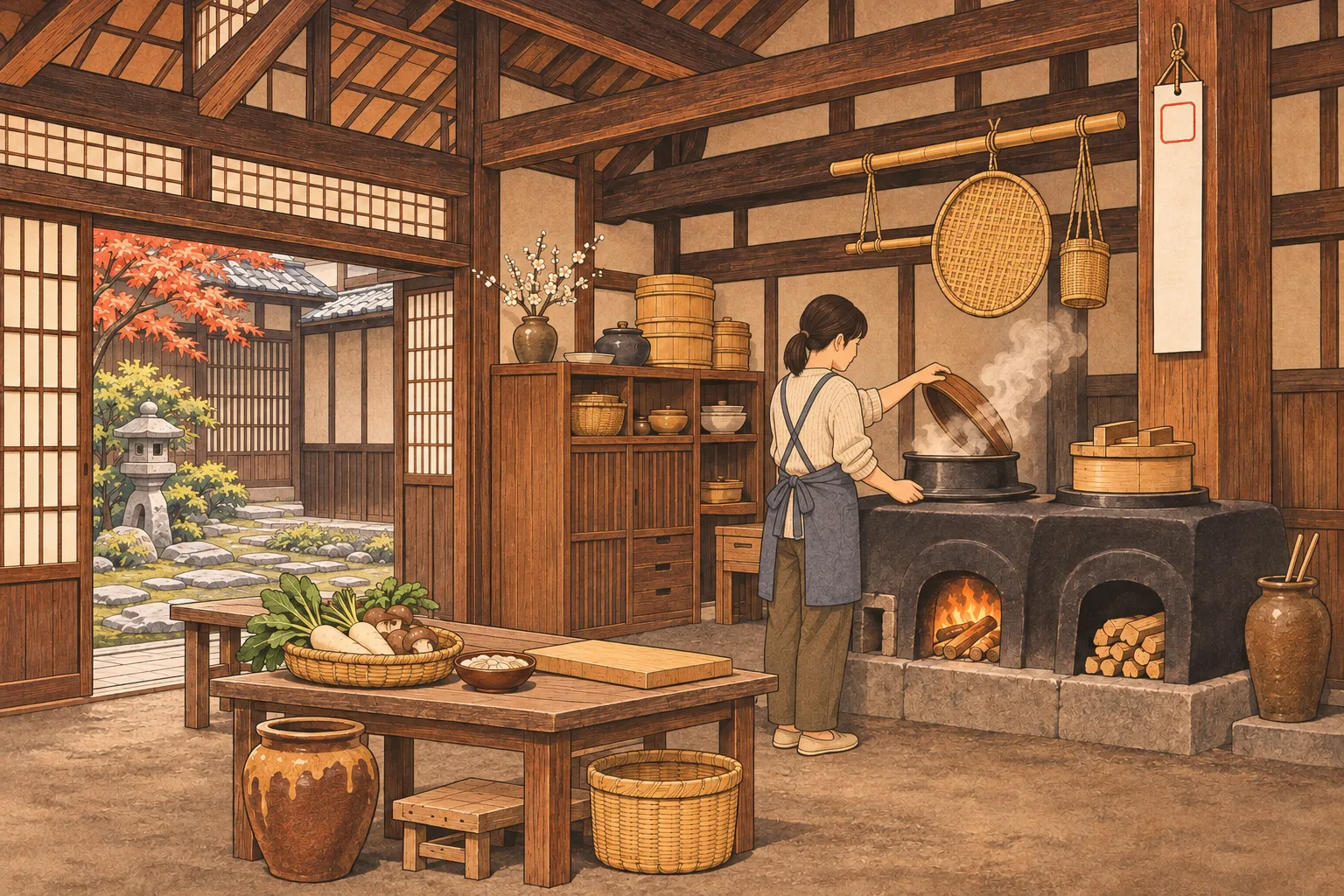
A Kyoto kitchen: the white paper slip on the pillar at upper right is the fire-prevention talisman from Atago Jinja.
Shrines to Ebisu and Daikoku, such as Nishinomiya Shrine, head shrine of Ebisu worship, belong to the world of the Seven Lucky Gods, a topic of their own.
08Side by side: telling them apart at the gate
When a plaque is high, worn or bears only a place name, combine clues: the usual plaque wording, crest, torii and animals.
Ise (Shinmei): plaques read Shinmeisha, Shinmeigū or Daijingū; plain unpainted torii with straight round posts, a straight top beam and no second beam beneath it.
Hachiman: Hachimangū, Hachiman Jinja or Wakamiya Hachiman; vermilion torii with an upswept top beam; mitsudomoe swirls; perhaps doves on the plaque.
Tenjin: Tenmangū, Tenjinsha, Sugawara Jinja or Kitano Jinja; plum trees, a reclining ox, the five-petal umebachi.
Inari: Inari Jinja or Inarisha; rows of red torii, a pair of foxes, red banners.
Kumano: Kumano Jinja, Jūnisho Jinja or Nyakuichi Ōji Jinja; three-legged crows on banners and talismans.
Hiyoshi/Sannō: Hiyoshi, Hie or Sannōsha; a triangular gable on top of the torii; monkeys.
Kasuga: Kasuga Jinja; ranks of stone lanterns, drooping wisteria crest.
Sengen: Sengen Jinja; a mound of black lava with a spiral path; cherry trees.
Suwa: Suwa Jinja; four great pillars at the corners of the shrine; mulberry-leaf crest.
Hakusan: Hakusan Jinja; no fixed form, usually on high ground at a village’s mountain edge.
Sumiyoshi: Sumiyoshi Jinja; near coasts and river mouths, torii with square pillars.
Konpira: Kotohira Jinja or Konpira-gū; a circled 金 emblem, often near harbours, lanterns painted with ships or anchors.
Akiba and Atago: Akiba Jinja, Atago Jinja; stone night-lanterns at village crossroads and fire talismans in kitchens.
None of these is exclusive. Mitsudomoe appears at many shrines, red torii are everywhere, and a shrine named after its locality may enshrine Hachiman inside. Look for two or three clues together, then check the plaque.
More deep dives on this topic
 ToriiA torii is two posts and one or two crossbeams, with no doors, no walls and no lock.
 Divine Messengers and KomainuWalk into almost any Shinto shrine and an animal meets you before anything else does.
 Shrine ArchitectureMost visitors to a Shinto shrine photograph the torii gate, the vermilion pillars and the bell rope in front of the hall, and leave thinking they have seen the shrine.
 Shimenawa, Shide and GoheiWalk into almost any Shinto shrine in Japan and you will pass under a rope.
 Reading Shrine NamesWalk up to almost any Shinto shrine in Japan and look at the wooden plaque hanging from the torii gate or the main entrance.
 OmikujiNext to the counter where a Japanese shrine sells its charms, there is usually a wooden box or a hexagonal canister and a small slot for coins.
 Shinto Priests and MikoSpend a morning at a large Japanese shrine and you will see two kinds of people in old-fashioned dress.
 Shikinen Sengū and ZōtaiWalk up to the main sanctuary of the Inner Shrine at Ise and you will notice, just beside it, an empty plot exactly the same size.
 Sacred Trees and StonesWalk into almost any Shinto shrine and something older than the buildings is usually waiting for you.
- Back to the main article: Shinto →