
Walk into almost any Shinto shrine and an animal meets you before anything else does. At an Inari shrine it is a pair of foxes, each holding something in its mouth. In Nara it is a deer that bows its head at you, hoping for a cracker. At a Tenmangū shrine it is a bronze ox lying on a plinth, its head rubbed to a golden shine. And at the entrance to nearly every shrine in the country, it is a pair of stone beasts, one with its mouth open and one with its mouth shut. These animals fall into two groups. Some are the messengers of one particular god, and change from shrine to shrine. Others are gate guardians, and look much the same everywhere. This guide takes them one at a time: what they look like, where they came from, and what to look for when you are standing in front of them.
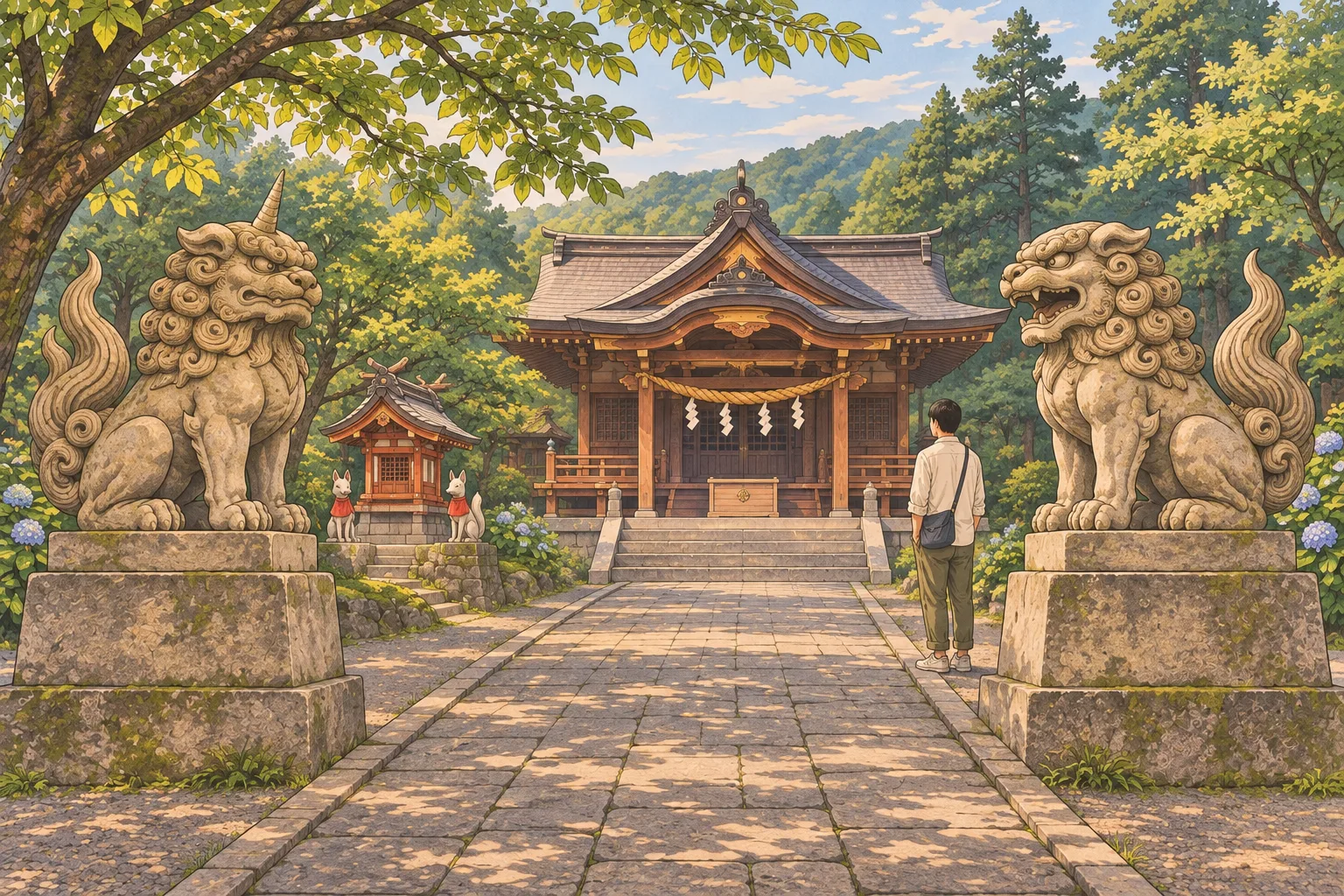
A stone pair flanks the approach: the open-mouthed lion on the right, the horned, closed-mouthed komainu on the left. In the distance a pair of Inari foxes sits before a small sub-shrine.
01Messengers, not gods
The Japanese term is shinshi (divine messenger), also called tsukawashime. A related word, kenzoku (retinue), was originally Buddhist, describing the attendants who surround a buddha or bodhisattva, and later came to cover the animal followers of the kami (Shinto gods) as well. In everyday speech the two overlap: both mean, roughly, "the god’s staff."
The point that trips people up is that the messenger is not the god. At Fushimi Inari Taisha in Kyoto, the deity is Inari Ōkami; the foxes are its servants. At Kasuga Taisha in Nara, the gods are Takemikazuchi and his companions; the deer are their mounts and attendants. Visitors to an Inari shrine are praying to Inari, not to a fox, even if the sheer number of fox statues makes it easy to forget, and even if many Japanese people casually call such places "fox shrines."
How did particular animals end up attached to particular gods? Usually through one of four routes, often several at once. Some come from myth and founding legends: a god arrived riding an animal, or an animal guided a legendary hero, as with the deer, the crow and the wolf. Some come from observation of nature: foxes come down from the hills to the rice fields in spring and retreat in autumn, matching the old belief that the god of the fields arrives each spring and leaves after harvest. Some come from wordplay: the word for monkey, saru, can be read as masaru, which sounds like "to excel" and "demons leave." And some come from the life story of a deified person, the clearest case being the scholar Sugawara no Michizane and the ox.
Because the animal’s holiness is borrowed from its god, the same creature can be revered in one place and ignored in the next. Deer in Nara enjoy near-sacred protection; deer in a mountain village may just be crop pests. The crow guides emperors at Kumano and raids rubbish bags in Tokyo.
The stone guardians at the shrine gate, the komainu, are a different thing. They belong to no single god and guard the threshold of any shrine. But many shrines put their own messenger animal in the guardian’s spot, posed in the same paired way, which is why you meet guardian foxes, guardian wolves, guardian rabbits and even guardian boars. Telling "whose messenger is this?" apart from "this is the gatekeeper" is the first step in reading a shrine’s animals.
02The fox and the deer
The fox is by far the most common messenger, because Inari shrines are among the most numerous in Japan, often said to number around thirty thousand if you count every small roadside shrine and rooftop altar. Inari’s foxes are called byakko, "white foxes," which means invisible, spiritual foxes rather than literally white-furred ones. Statues are usually bare stone, sometimes painted white, and often wear a red bib. They are easy to recognise: tall pointed ears, a long narrow muzzle, a slim body, and a big tail held high, sometimes ending in a flame or jewel shape.
Why the fox serves Inari (the seasonal field god, the mouse-hunting guardian of the rice, the fox-riding Buddhist deity Dakiniten) is covered in our article on Inari belief. What is worth adding here is how varied the statues are. Foxes sit upright, crouch as if about to spring, or look back over their shoulders. Old Edo-period foxes tend to have lean cheeks and sharply upturned eyes; modern ones are rounder and softer. In front of small shrines you often find rows of palm-sized white porcelain foxes, left one by one by worshippers. Foxes almost always come in pairs at Inari shrines, each holding a different object, which is covered in Section 7.
Deer are the messengers of Kasuga Taisha in Nara and of Kashima Jingū in Ibaraki Prefecture. Kasuga is traditionally said to have been founded in 768. One of its gods, Takemikazuchi, was originally enshrined at Kashima, and legend says he travelled from Kashima to Mount Mikasa in Nara on the back of a white deer. Medieval paintings known as Kasuga mandalas show this vividly: a white deer standing on a cloud, a saddle on its back holding a sprig of sacred sakaki evergreen, and a round mirror hanging from the branch, the mirror standing in for the god himself.
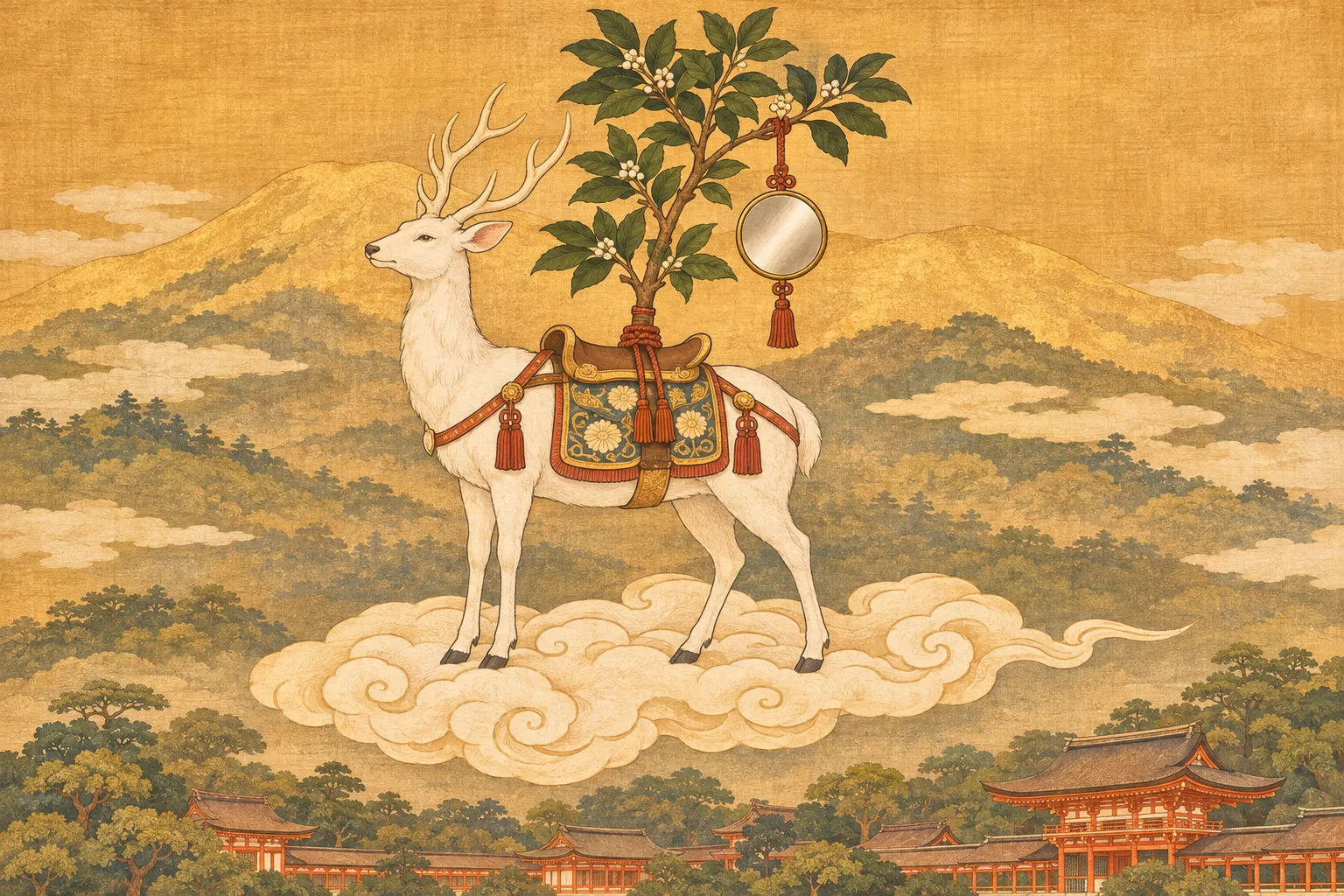
In the manner of a Kasuga mandala: a white deer on a cloud, a sprig of sakaki rising from its saddle and a round mirror, standing in for the god, hanging from the branch. (artist’s impression)
The deer of Nara Park and the Kasuga woods are wild animals, protected as a national Natural Monument, and their population usually stands at somewhat over a thousand. In the Edo period, harming one was severely punished; stories circulate of people executed for killing a deer by accident, though how many are true is hard to say. The tradition never died out at the Kashima end either. Kashima Jingū still keeps deer in an enclosure on its grounds, and the shrine tells its own version of the story, in which the god’s spirit was carried to Kasuga on a deer’s back.
The famous bow is the thing every visitor sees. Hold up a shika-senbei (deer cracker) and stand still, and a deer will dip its head, sometimes several times in a row. One common explanation is that it resembles the head-lowering deer make before butting each other, and that visitors rewarding it with food have turned it into a begging habit; it is learned behaviour rather than an innate courtesy. Each autumn the bucks’ antlers are sawn off in a ceremony called shika no tsunokiri, which dates back to the Edo period and was meant to stop the animals injuring people.
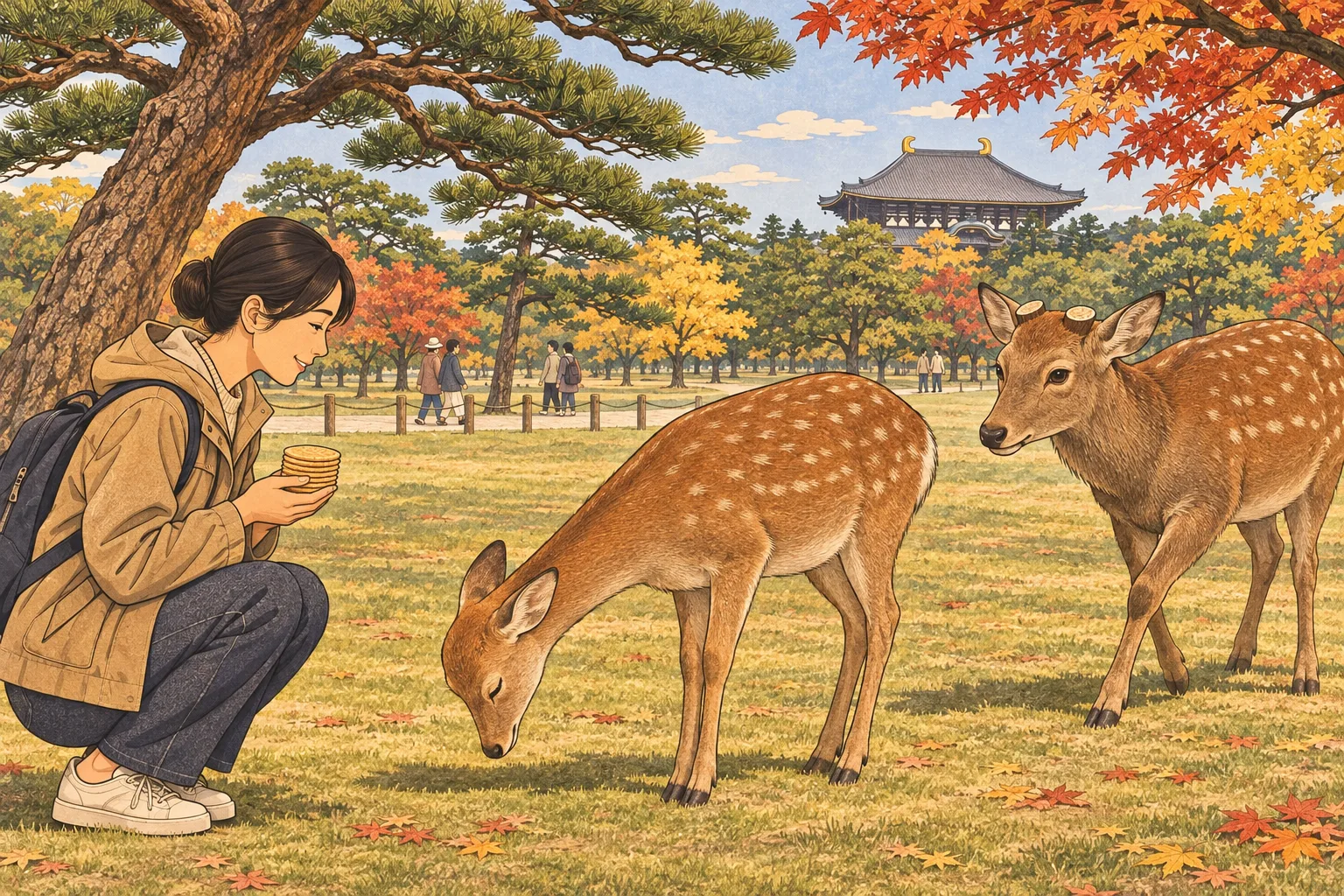
The Nara bow: a visitor stops with a stack of shika-senbei and the deer dips its head.
03Doves, monkeys and crows
Doves belong to Hachiman, a god associated with Emperor Ōjin who became the guardian deity of the samurai class and has one of the largest shrine networks in Japan. In 859 the monk Gyōkyō received an oracle at Usa in Kyushu and brought Hachiman to Mount Otoko south of Kyoto that same year; the shrine buildings of Iwashimizu Hachimangū were completed in 860. The dove connection goes back to legends from Usa, where Hachiman’s messenger is said to have first appeared as a golden hawk that soon turned into a golden dove. Many Hachiman shrines therefore count the dove as their messenger. At Tsurugaoka Hachimangū in Kamakura, the character for "eight" (八) in "Hachimangū" on the plaque of the two-storey Rōmon gate before the main sanctuary is formed by two doves facing each other, and Kamakura’s well-known dove-shaped butter biscuit is said to have been inspired by it. The doves worth finding at a Hachiman shrine are the carved and painted ones, not the flocks of park pigeons.
Monkeys serve the gods of Hiyoshi Taisha, at Sakamoto on the eastern foot of Mount Hiei near Lake Biwa. It is the head shrine of some 3,800 Hiyoshi, Hie and Sannō shrines across the country. Here the monkey is called masaru, "the divine monkey," and the name carries the lucky double meaning of "driving out evil" and "winning." Look up at the corners of the gate of the Western Main Shrine and you will find four carved wooden monkeys crouched under the eaves, each in a different pose, watching the worshippers below. Monkeys have been kept at the shrine for a long time, already appearing in records of the Muromachi period, and there is a monkey house in the grounds.
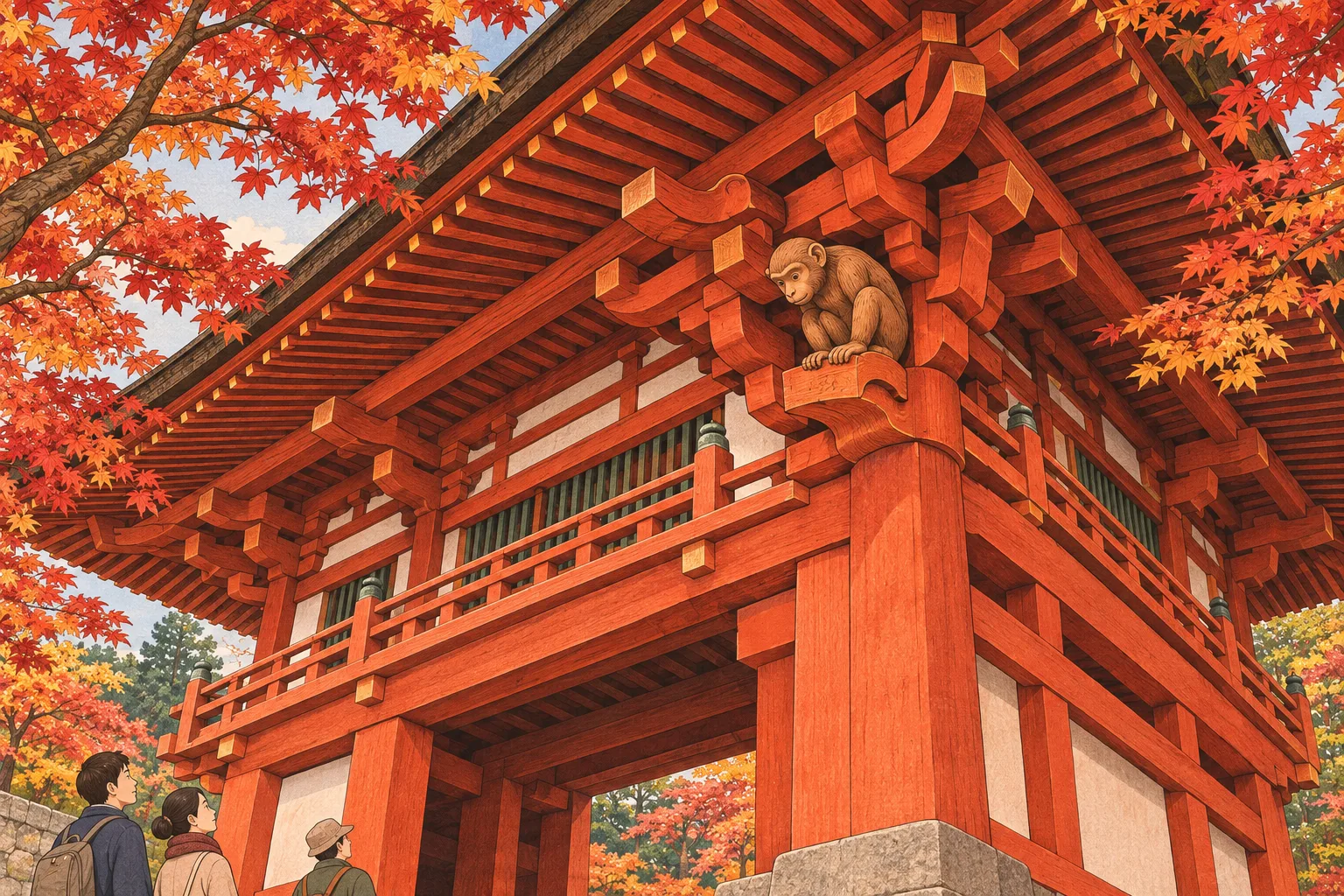
The divine monkey of Hiyoshi Taisha: look up at the corner of the gate and a carved wooden monkey crouches under the eaves.
The monkey’s link to Mount Hiei matters. Hiei lies to the northeast of Kyoto, the direction that yin-yang geomancy calls the "demon gate," and the monkey became a guardian against what comes from that direction. At the northeast corner of the Kyoto Imperial Palace wall there is a recessed corner called Saru-ga-tsuji, where a small wooden monkey in a court cap, holding a ritual wand, sits under the eaves behind wire netting. The story goes that it used to slip out at night and make mischief, so it was caged.
Don’t confuse these with the "see no evil, hear no evil, speak no evil" monkeys at Nikkō Tōshōgū. Those are carved on the sacred stable, because monkeys were believed to keep horses healthy; they are the second of eight monkey panels on the stable that together show the cycle of life, and they come from a different strand of belief.
Crows lead back to the founding myth of the imperial line. Both the Kojiki and the Nihon Shoki, Japan’s earliest chronicles from the early eighth century, say that when the legendary Emperor Jinmu was lost in the mountains of Kumano on his way to Yamato, heaven sent a great crow, the Yatagarasu, to guide him. Yata simply means very large. The Yatagarasu is now always drawn with three legs, but the chronicles do not mention this; the three-legged form is usually thought to have been borrowed later from the Chinese three-legged sun crow. The three great Kumano shrines, Hongū Taisha, Hayatama Taisha and Nachi Taisha, all treat it as their messenger.
The most striking thing to look for at Kumano is the Kumano Goō Hōin, a paper talisman whose characters are made entirely of tiny crows: from a distance it reads as writing, close up it is a flock of birds. From the medieval period people wrote oaths on the back of these sheets, and it was said that breaking such an oath would kill one of Kumano’s crows and bring punishment on the oath-breaker. Warlords of the Sengoku period used them for sworn pledges. Each of the three shrines issues its own design. The Japan Football Association has a three-legged crow in its emblem, and the Kumano connection is often cited in Japan.
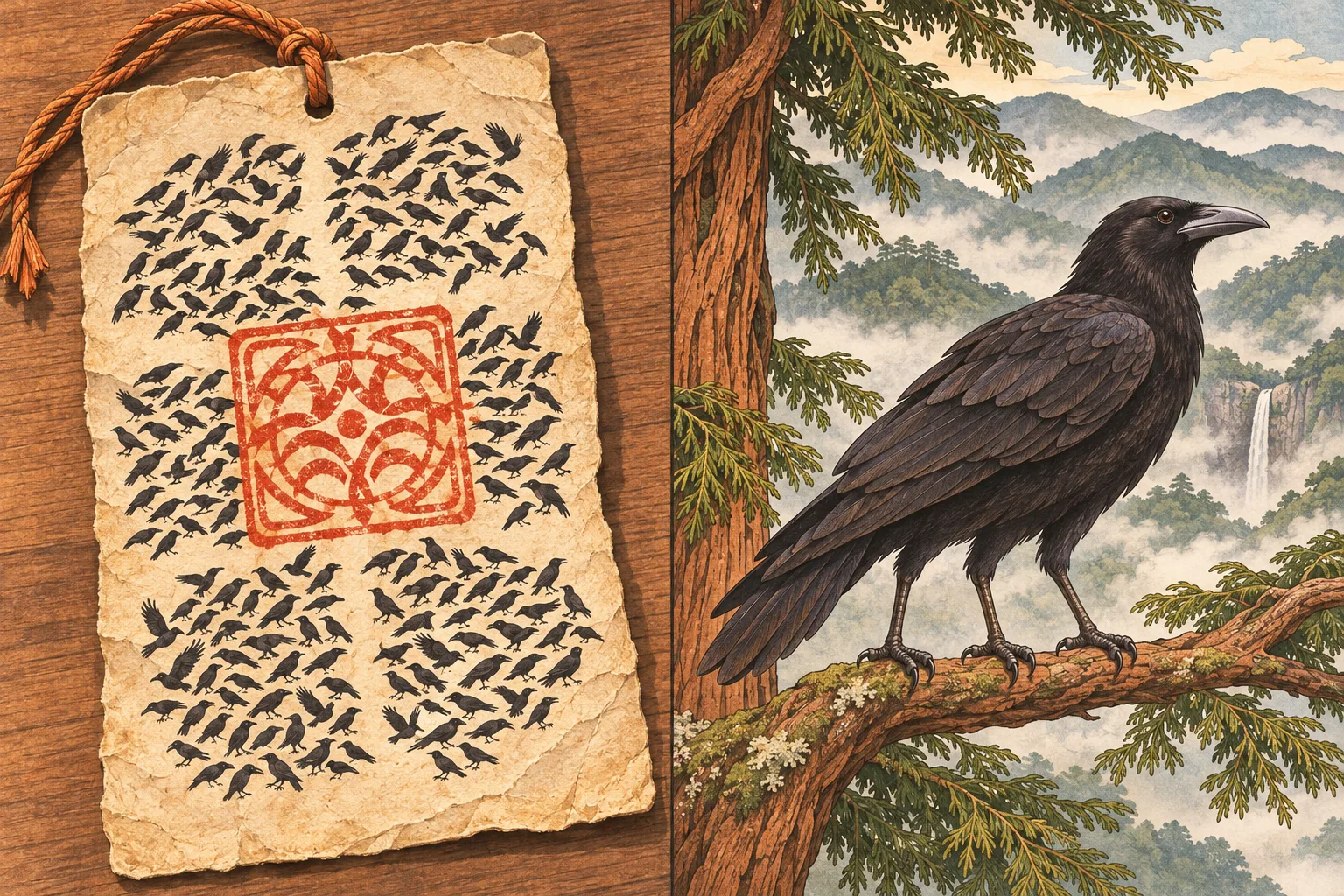
Left: a Kumano Goō Hōin, its "characters" made entirely of tiny crows. Right: a crow in the Kumano mountains.
04The ox, the wolf, the rabbit and the snake
The ox belongs to Tenmangū shrines, which enshrine Sugawara no Michizane, a ninth-century scholar and statesman who was exiled to Dazaifu in Kyushu and died there in 903, later to be worshipped as the god of learning. Several stories explain the ox. One says he was born in a year of the ox. Another, the best known, says that when his body was being carried in an ox cart after his death, the ox lay down and refused to go any further, so he was buried on that spot, which became Dazaifu Tenmangū. Whatever the origin, every Tenmangū has ox statues, and they are almost always lying down, legs tucked under the body, head slightly raised. The pose is the legend: the ox that would not get up. Kitano Tenmangū in Kyoto has a number of them scattered around its grounds, in stone and bronze, large and small.
The wolf is the messenger of mountain shrines in the Kantō region, above all Mitsumine Shrine in Chichibu, Saitama Prefecture, and Musashi Mitake Shrine in the hills west of Tokyo. Both call the wolf Ōkuchi-no-Magami, "the great-mouthed true god," and refer to it respectfully as oinu-sama. Both trace the connection to the legendary prince Yamato Takeru, who was said to have lost his way in the mountains during his eastern campaign until a white wolf, or a pack of wolves, guided him out. In the guardian position at these shrines stand wolves instead of lion-dogs.
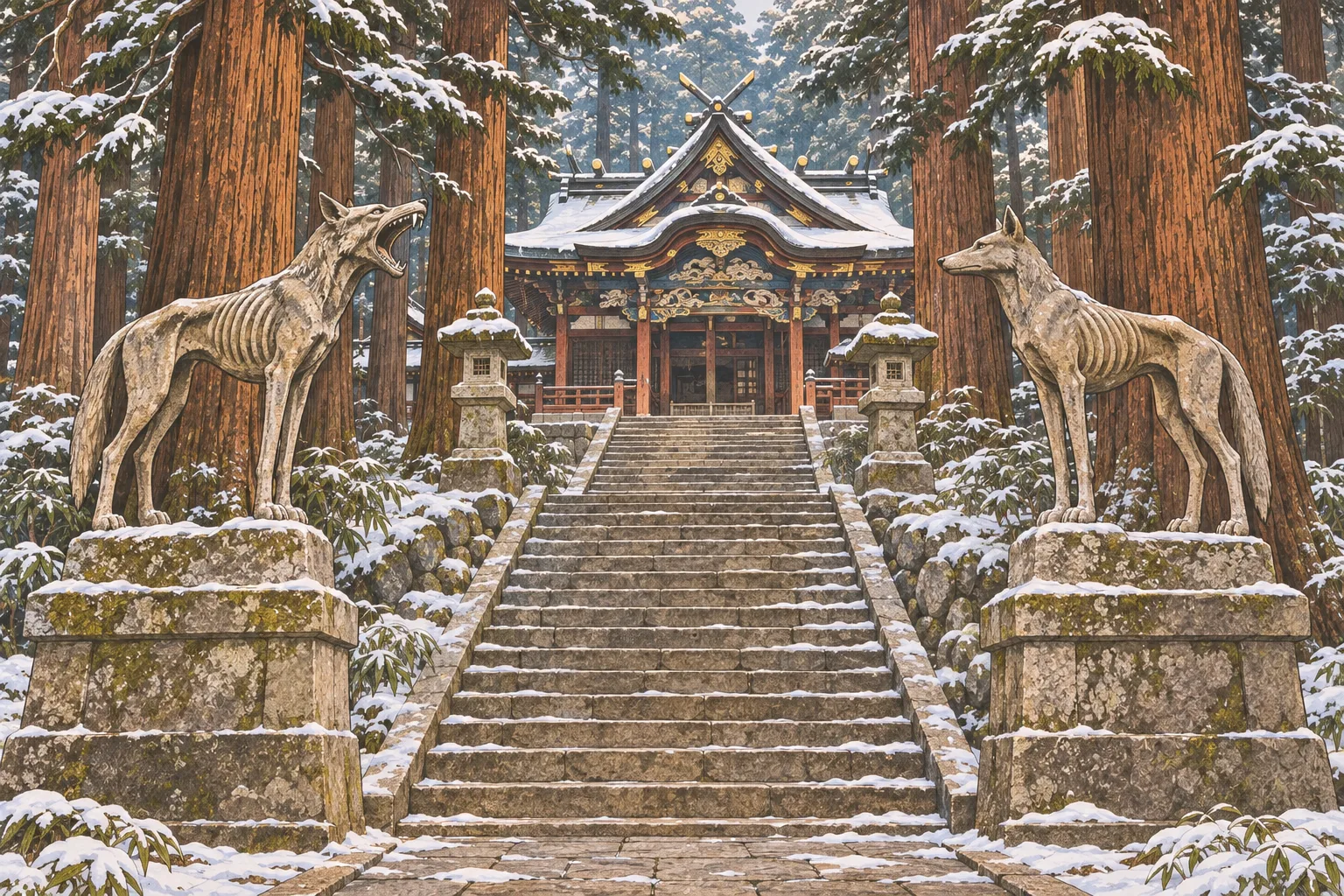
At mountain shrines such as Mitsumine, wolves stand in the guardian position instead of lion-dogs: lean bodies with every rib carved.
Mountain farmers had a practical reason to honour wolves: wolves ate the deer and wild boar that wrecked their crops. Mitsumine has a custom called go-kenzoku haishaku, "borrowing the god’s retinue," in which worshippers take home a talisman bearing a wolf, post it at the door or the storehouse to ward off thieves, fire and pests, and return it a year later for a new one. The Japanese wolf is extinct; the last confirmed specimen is generally said to have been taken in Nara Prefecture in 1905. It survives in the stone statues and paper charms of these shrines.
Rabbits have a scattering of origins. Okazaki Shrine in Kyoto has rabbits in place of guardian lion-dogs and a rabbit at its water basin; the area is said to have once been full of wild hares, and because rabbits breed prolifically, it became a place to pray for children and safe childbirth. At Sumiyoshi Taisha in Osaka, the rabbit comes from the founding date, traditionally said to have fallen in the year, month and day of the rabbit; a stone rabbit at the purification basin spouts water. In the Izumo region the rabbit recalls the myth of the White Hare of Inaba, which the god Ōkuninushi healed after it had been skinned by crocodiles (or sharks, in some readings), and in recent decades many small rabbit statues have appeared in the grounds of Izumo Taisha. Tsuki Shrine in Urawa, Saitama, also has guardian rabbits, apparently because its name sounds like tsuki, moon, and in East Asian tradition a rabbit lives on the moon.
Snakes are closely tied to Ōmiwa Shrine in Nara, which has no main sanctuary because Mount Miwa itself is the god’s body. Its deity, Ōmononushi, appears in the Nihon Shoki as a small snake coiled in a box. An old cedar in the grounds is said to house a white snake, and worshippers leave eggs and sake at its foot, since snakes are believed to love eggs. Snakes also attend Benzaiten, the goddess of music and wealth, through Ugajin, a deity with a man’s head and a snake’s coiled body often perched on her crown. Shrines linked to money, such as Kanahebi Suijin Shrine in Miyagi, connect snakes with prosperity, and some people keep a piece of shed snakeskin in their wallet. At snake shrines you rarely find a large statue; you find offered eggs, white snakes painted on votive plaques, and small coiled carvings tucked among roots and stones.
Local examples go on and on. Chickens wander freely at Ise Jingū and at Isonokami Jingū in Nara, recalling the cocks whose crowing helped lure the sun goddess Amaterasu out of her cave. Goō Shrine in Kyoto has guardian wild boars, from the story that when the courtier Wake no Kiyomaro, his leg tendons cut, made a detour to Usa Hachiman on his way into exile, three hundred boars surrounded his palanquin and escorted him some 40 kilometres, shielding him from the monk Dōkyō’s assassins. Ōtoyo Shrine, beside the Philosopher’s Path in Kyoto, has a pair of guardian mice in front of a small sub-shrine, recalling a myth in the Kojiki in which mice saved Ōkuninushi from a fire. At Mishima Taisha in Shizuoka, eels in the sacred pond are said to have been treated as the god’s messengers and could not be caught, and the townspeople reportedly avoided eating eel until around the Meiji Restoration; today Mishima is known for its eel restaurants. There is no official list: each shrine’s messenger grows out of its own myths.
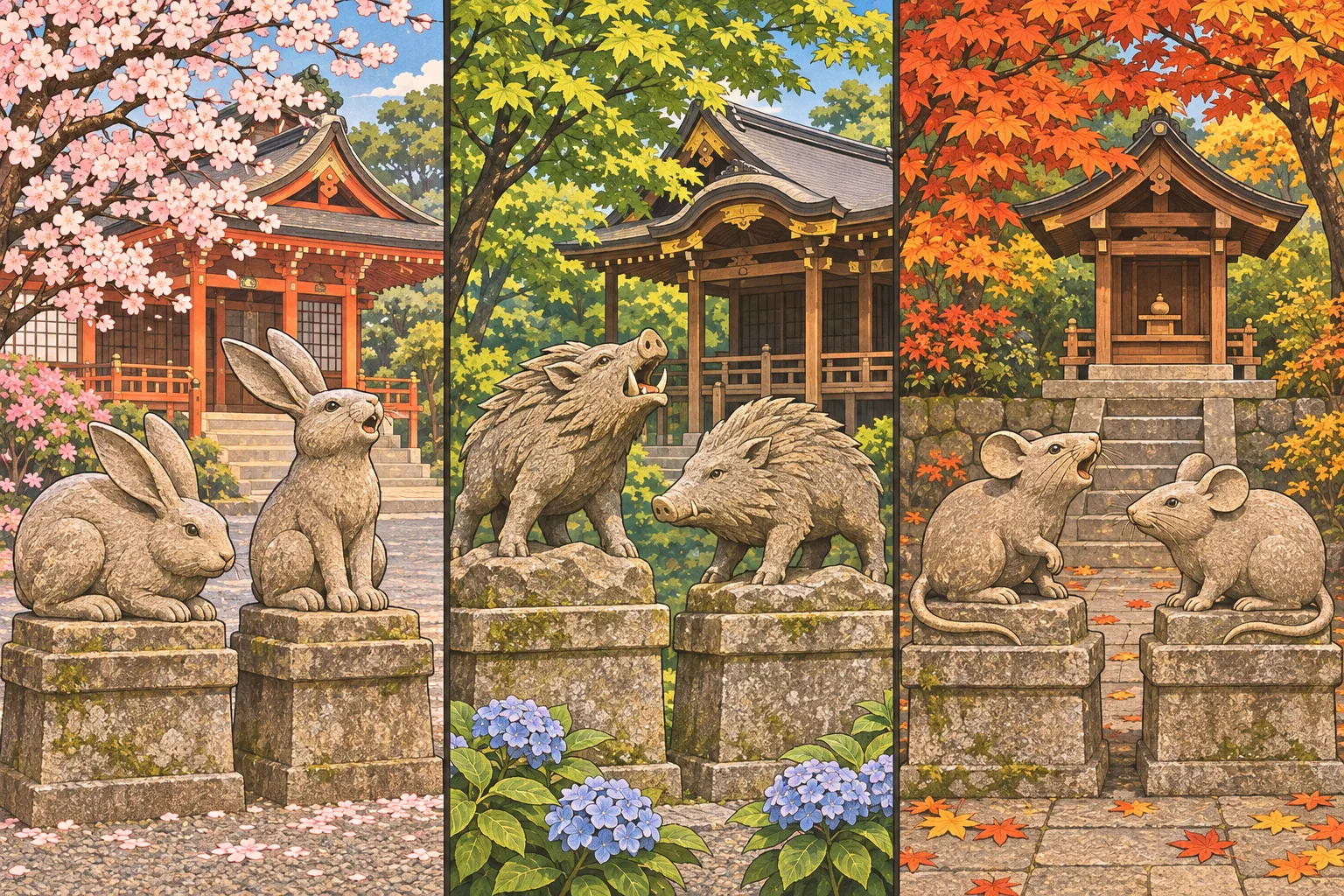
Messengers in the guardian position, each as a pair. From left: the rabbits of Okazaki Shrine, the wild boars of Goō Shrine and the mice of Ōtoyo Shrine.
05Komainu: the lion and the horned dog
Komainu is the general name for the pair of guardians at the shrine entrance, but strictly speaking only one of the pair is a komainu. Standing on the approach and facing the shrine, the one on your right usually has its mouth open and no horn: this is the shishi, the lion. The one on your left has its mouth closed and a single horn on its head: this is the komainu proper. Together they are called shishi-komainu, and in everyday speech both are just "komainu."
Neither animal is native to Japan. The lion image has its roots in Persia and India and reached Japan by way of China, where stone lions stood before Tang-dynasty palaces and tombs. Koma is an old word for Goguryeo, a kingdom on the Korean peninsula, and was used loosely for things from overseas, so komainu means something like "foreign dog." The horned komainu is sometimes traced to the xiezhi, a mythical Chinese beast that could tell right from wrong and gored the guilty, and sometimes to Chinese tomb guardians; there is no agreed answer. By the Heian period (794–1185) the lion-and-komainu pair, with one open mouth and one closed, was already established at court.
The open-and-closed pairing is called a-un. "A" is the first sound of the Sanskrit alphabet, made with the mouth open; "un" (hūṃ) is the last, made with it closed. Together they stand for beginning and end, and so for everything. The idea is Buddhist: the two fierce Niō guardian kings at temple gates follow the same pattern. When two people work together without needing to speak, Japanese calls it a-un no kokyū, "a-un breathing."
Real statues bend the rules often. Many Edo-period and modern pairs have no horn at all and are told apart only by their mouths, and a few shrines swap the sides or put the horn on the open-mouthed one. These are not mistakes so much as reminders that the conventions were never strict.
06From indoor wood to roadside stone, and regional styles
Komainu began indoors. In the Heian period, carved wooden or metal pairs sat inside palace rooms and shrine sanctuaries, holding down the edges of curtains and screens as well as guarding them. They were small, painted or gilded, and placed just inside the sanctuary doors. Some old shrines still keep Heian- or Kamakura-period wooden pairs in their treasure halls, their paint mostly flaked away, the curled manes and muscular forelegs still clear.
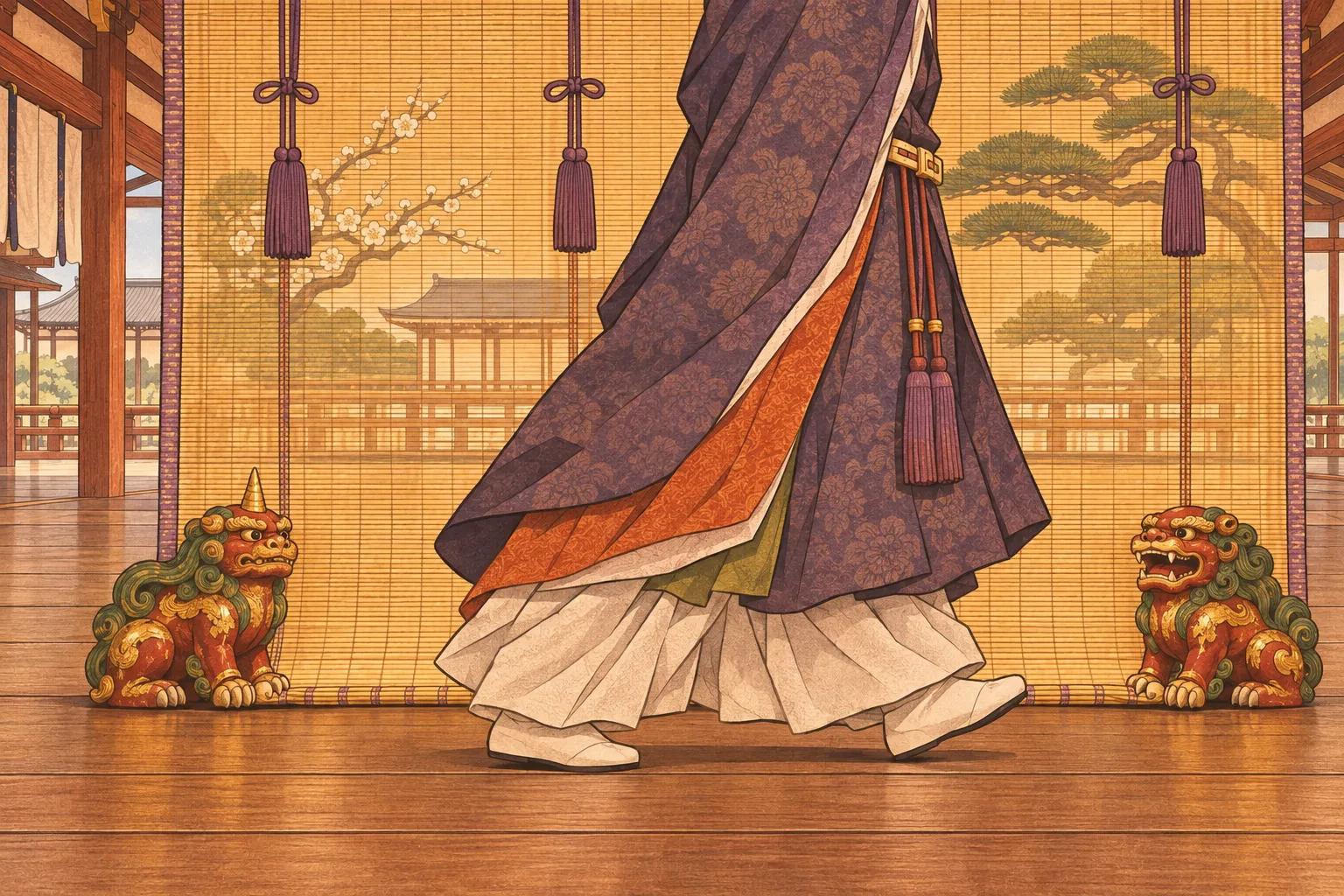
In the Heian period the pair lived indoors: small painted figures holding down the corners of a blind, the one on the left with a horn. (artist’s impression)
Stone guardians outdoors came later. Temples had them earlier: the stone lions inside the Great South Gate of Tōdai-ji in Nara are generally attributed to stonemasons from Song China working in the early Kamakura period. But it was the Edo period (1603–1868) that filled shrine approaches with stone komainu. As commoners grew more prosperous, villages and neighbourhoods pooled money to donate a pair to their local shrine, carving the date and the donors’ names into the plinth. Walk round to the side of an old pair and you will often find an Edo-era date and a list of villagers. A komainu is a guardian and a community’s donation record at the same time.
Once local stonemasons took over, regional styles grew. The two most often discussed are the Edo style and the Izumo style. Edo-style komainu, common in Edo (Tokyo) and the Kantō region, sit upright with straight forelegs, oversized heads, and deeply carved, abundant curls in the mane and tail; late Edo examples can be wildly expressive, with bulging eyes and drooping ears, each workshop with its own hand. Izumo-style komainu, from Shimane Prefecture, are mostly carved in a soft, easily worked local sandstone called kimachi-ishi, and the best-known type takes a striking pose: front legs braced low, hind legs stretched, hindquarters raised high, like a cat about to pounce. This crouching kamae ("ready") type spread along the Sea of Japan coast with coastal shipping.
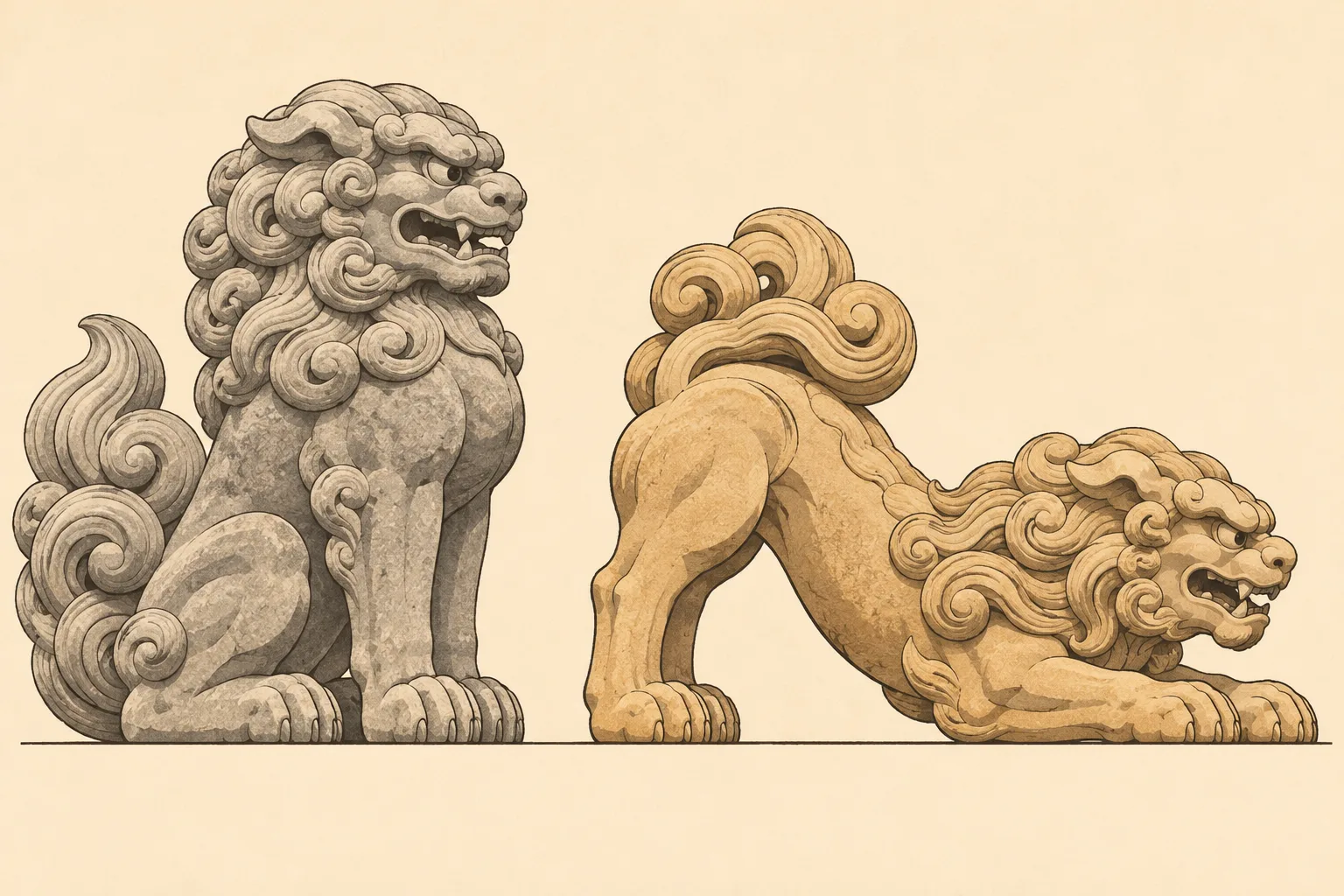
Left: the Edo style, sitting upright on straight forelegs with deep, abundant curls. Right: the Izumo style, front legs braced low and hindquarters raised, as if about to spring.
Other regions have their own touches. The Naniwa (Osaka) style is said to have a tail spread like a many-ribbed fan; the Kanazawa area is said to have handstand komainu balanced on their forepaws with their hind legs in the air. Many pairs have one beast resting a paw on a ball and the other sheltering a cub. The common explanation is that the ball-holder is male and the cub-holder female, the ball standing for a jewel or power and the cub for descendants, though practice varies by region.
In the twentieth century the shape standardised again. Okazaki in Aichi Prefecture is a granite-producing centre of stonework, long known for stone lanterns, and in the modern era its masons settled on a granite komainu design: tidy, symmetrical, crisply cut. This "Okazaki style" spread quickly and now dominates, especially among newer statues, and for many people it simply is what a komainu looks like.
In Okinawa, the shīsā, a lion-like guardian perched in pairs on roofs and gateposts, follows the same open-and-closed pattern but guards ordinary homes rather than shrines.
07Telling them apart, and what to look for
The animals most easily confused are the paired guardians on the approach. They share a position and a pose, but they are different creatures.
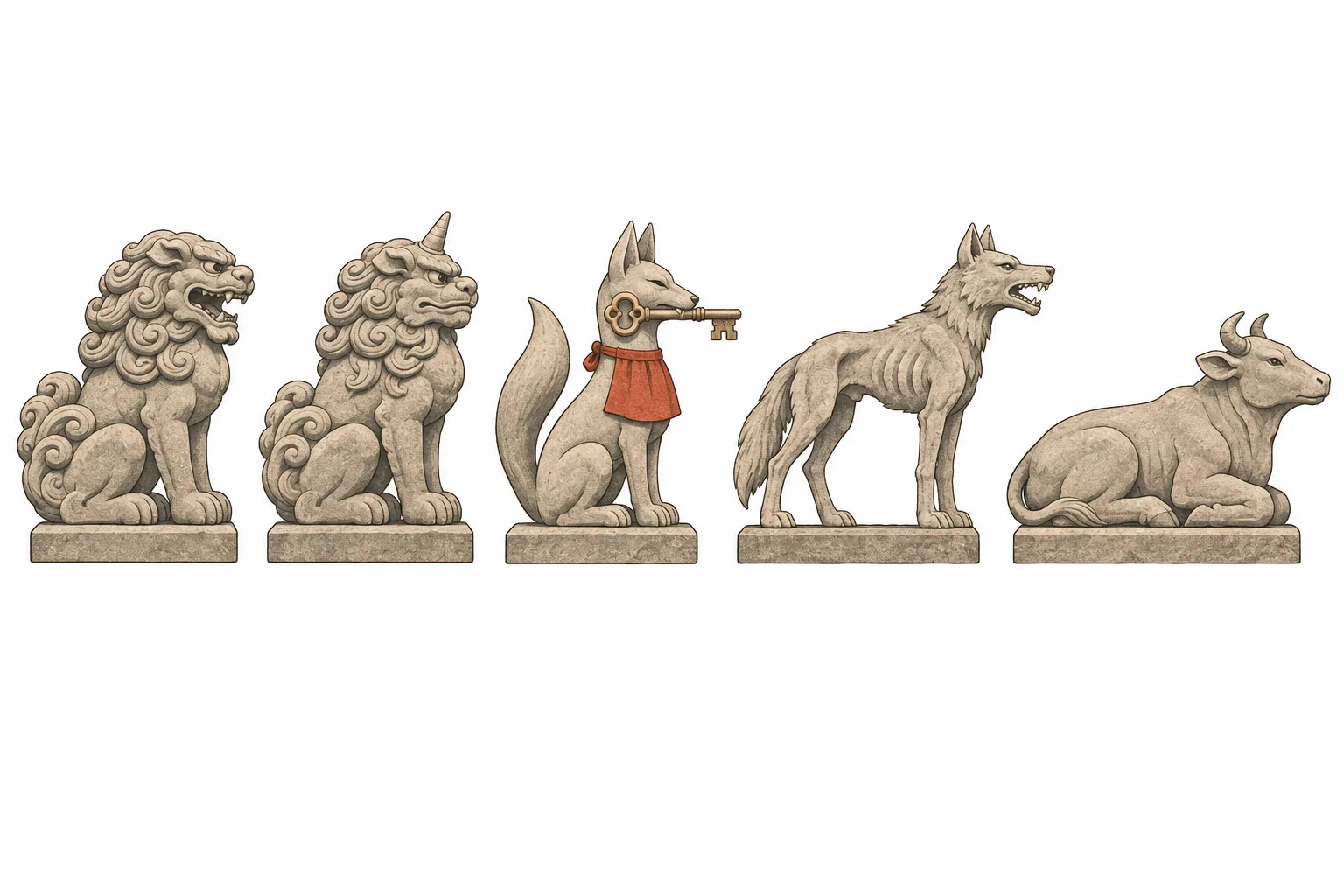
From left: lion (mouth open, no horn), komainu (mouth closed, one horn), Inari fox (pointed ears, tail raised, a key in its mouth), Mitsumine-type wolf (ribs showing, jaws open, tail down) and the reclining Tenmangū ox, which sits alone and does not guard a gate.
The lion and komainu are the baseline: big round heads, flat faces, bulging eyes, manes curled into spirals, stocky bodies and a flame-like tail rising behind. Ears lie flat or droop. To tell the two apart, look for a horn and check the mouth.
Inari’s fox differs most in ears and build: two tall triangular ears, a long pointed snout, a slender body with no curled mane, and a thick tail held high, often more eye-catching than the body. It frequently wears a red bib, and it nearly always holds something in its mouth or under a paw.
Mitsumine-type wolves are easiest to confuse with foxes. Look at the ribs and the mouth: wolves are lean, with ribs carved one by one, jaws gaping to show fangs, and tails hanging down rather than raised. Their ears stand up but are shorter and thicker than a fox’s, and they rarely wear bibs or hold anything.
Other paired guardians are easy because they look like their animals: long-eared rabbits, tusked and stocky boars, round-eared mice. What they share is the borrowed format: a pair, usually with one open mouth and one closed.
The Tenmangū ox and the Nara deer don’t belong to this group. The ox is usually single and lying down, set in front of the hall or in a corner of the grounds. The deer are alive, or appear on plaques and charms, and are rarely made into gate statues.
A quick order works: ears first (pointed and upright means fox or wolf; flat or drooping means lion-dog), then body (curly mane means lion-dog, visible ribs means wolf, slim with a raised tail means fox), then mouth and paws (holding something usually means fox; a paw on a ball means lion-dog).
As for what the foxes hold, the four usual objects are a jewel, a key, a sheaf of rice and a scroll (their meanings are in the Inari article). To recognise them: the hōju jewel is a ball drawing up to a point, often with flame patterns; the key is an old-fashioned long key with a thin shaft and a hooked end, usually carved crosswise so both ends stick out of the corners of the mouth; the rice is a drooping sheaf; the scroll is a short cylinder. The usual pairing is jewel on one side and key on the other. Some foxes press the jewel under a paw instead, or carry a cub in their jaws. Where komainu are told apart by open and closed mouths, a pair of Inari foxes is often told apart by what each one holds.
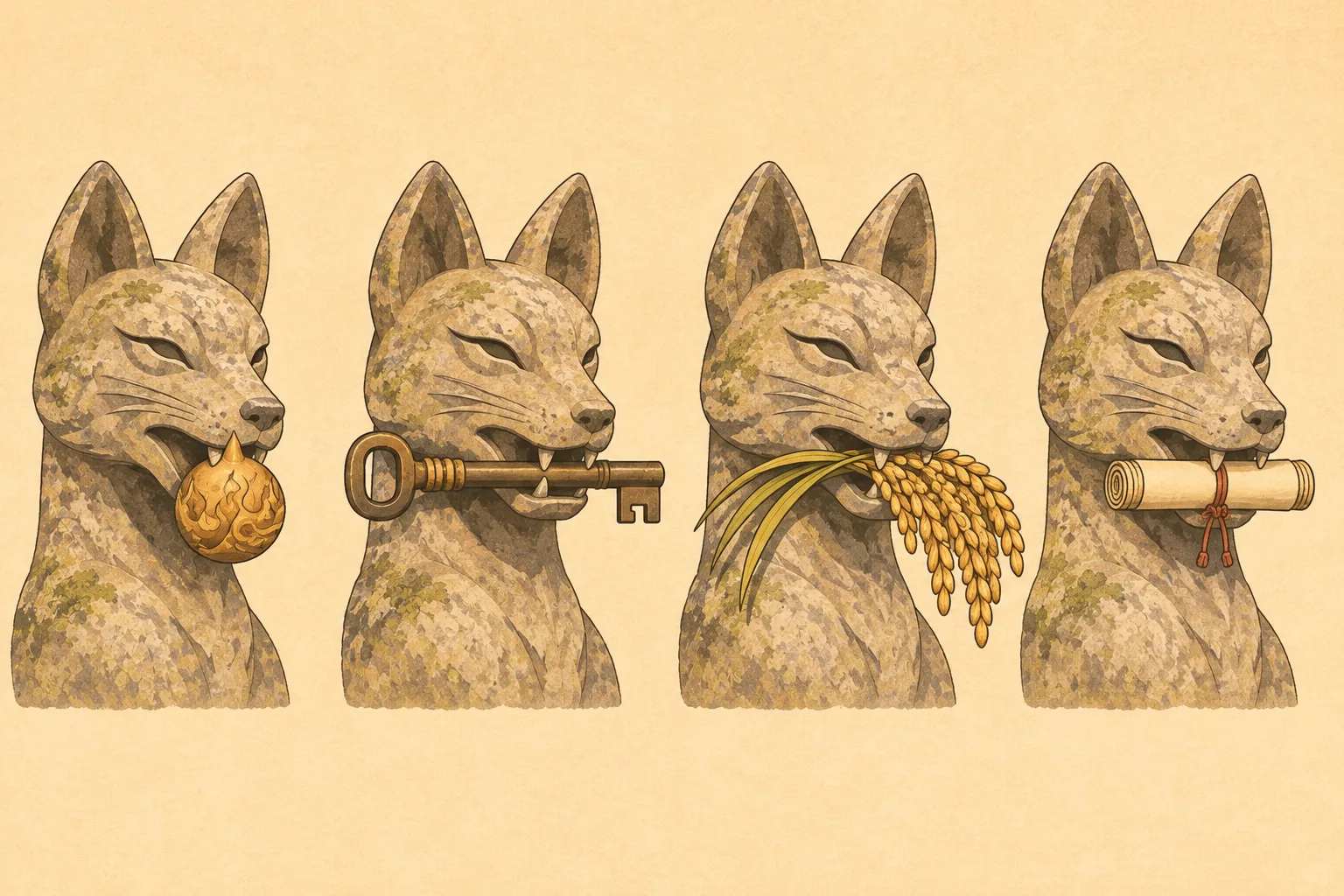
The four things an Inari fox may hold, from left: the hōju jewel, a key, a sheaf of rice and a scroll.
The Tenmangū oxen are there to be touched. Rub the part of the ox that matches the part of you that aches and it is supposed to heal; rub the head and you will get cleverer, which is why exam candidates queue for the head. At Dazaifu and Kitano the bronze heads and backs have been polished golden by countless hands, and the brightest spots show you what people pray for most.
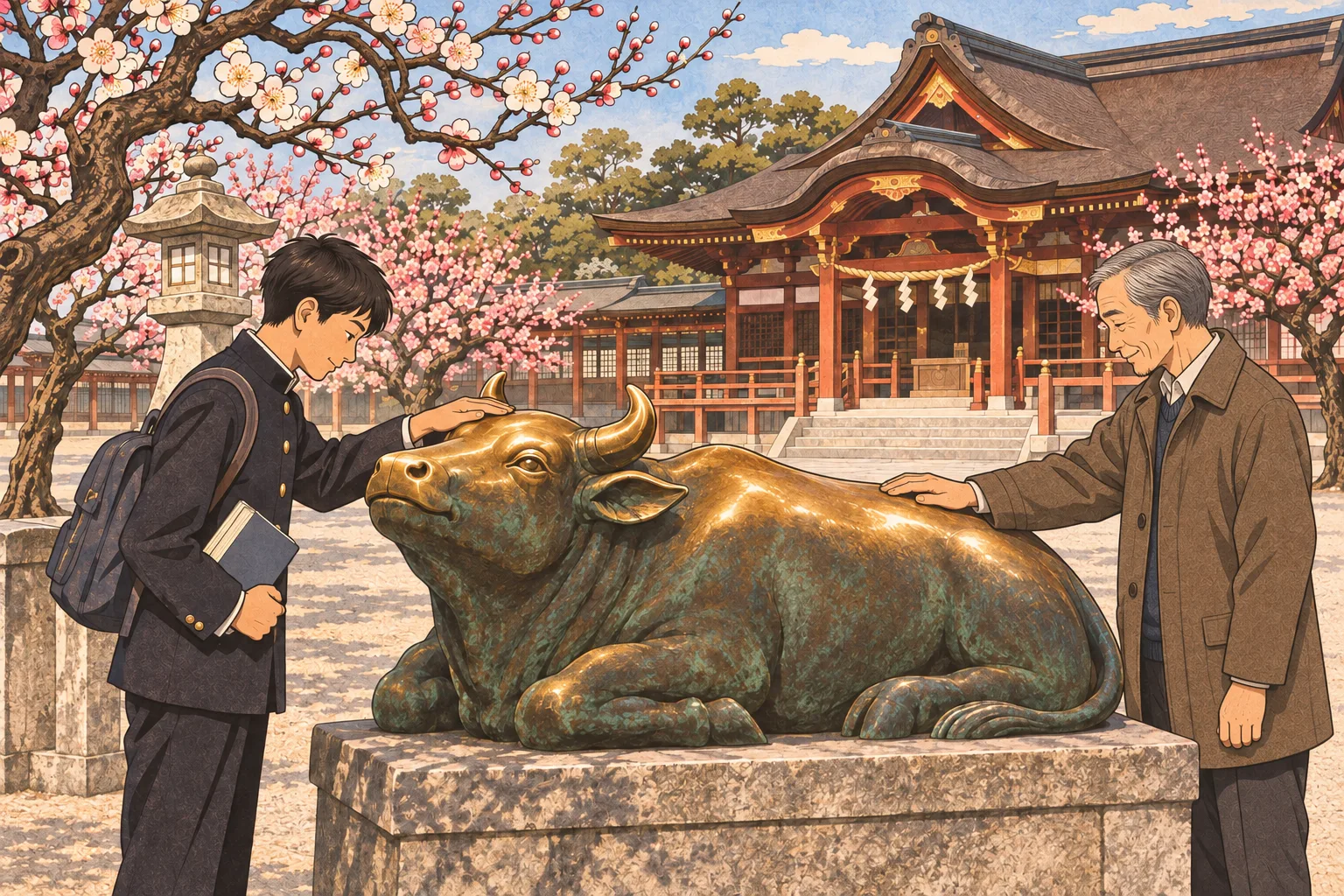
The reclining ox at a Tenmangū shrine is there to be touched: a student rubs the head, and the bronze shines where many hands have passed.
In Nara, the deer are wild. Bucks are short-tempered in the autumn rut and does are protective after giving birth in early summer, and both will butt or kick. When the crackers are gone, show your empty hands.
Finally, the messengers appear on things you can take home. Kasuga Taisha offers a fortune slip rolled up in the mouth of a small carved wooden deer. Fushimi Inari has its fox-face plaques for visitors to decorate. Kumano has Yatagarasu plaques and amulets; Tenmangū plaques show a reclining ox; Tsurugaoka Hachimangū uses doves; Mitsumine and Musashi Mitake print black wolves on their charms; Okazaki Shrine’s plaques and fortunes come in rabbit shapes. Each design tells you which animal that shrine’s god sends out to meet people.
More deep dives on this topic
 ToriiA torii is two posts and one or two crossbeams, with no doors, no walls and no lock.
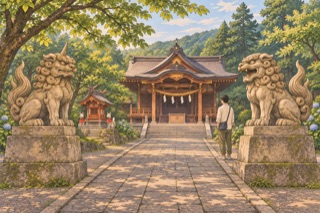 Divine Messengers and KomainuWalk into almost any Shinto shrine and an animal meets you before anything else does.
 Shrine ArchitectureMost visitors to a Shinto shrine photograph the torii gate, the vermilion pillars and the bell rope in front of the hall, and leave thinking they have seen the shrine.
 Shimenawa, Shide and GoheiWalk into almost any Shinto shrine in Japan and you will pass under a rope.
 Reading Shrine NamesWalk up to almost any Shinto shrine in Japan and look at the wooden plaque hanging from the torii gate or the main entrance.
 OmikujiNext to the counter where a Japanese shrine sells its charms, there is usually a wooden box or a hexagonal canister and a small slot for coins.
 Shinto Priests and MikoSpend a morning at a large Japanese shrine and you will see two kinds of people in old-fashioned dress.
 Shikinen Sengū and ZōtaiWalk up to the main sanctuary of the Inner Shrine at Ise and you will notice, just beside it, an empty plot exactly the same size.
 Sacred Trees and StonesWalk into almost any Shinto shrine and something older than the buildings is usually waiting for you.
- Back to the main article: Shinto →