
Next to the counter where a Japanese shrine sells its charms, there is usually a wooden box or a hexagonal canister and a small slot for coins. Pay a little, shake out a number or pick a folded slip, and you are holding an omikuji (sacred lot), a strip of paper that tells you whether your luck is great, middling or bad. Most visitors glance at the one big character at the top, laugh or groan, and tie the paper to a wire rack. That misses most of what is printed there: a poem, a short reading of your situation, and a column of predictions on everything from lost property to house moves. The slips started life in Buddhist temples, took on their present shape between the 1870s and the early twentieth century, and now come out of fishing games, lion-shaped vending machines and tiny carved animals. This is a guide to where they came from and how to read one.
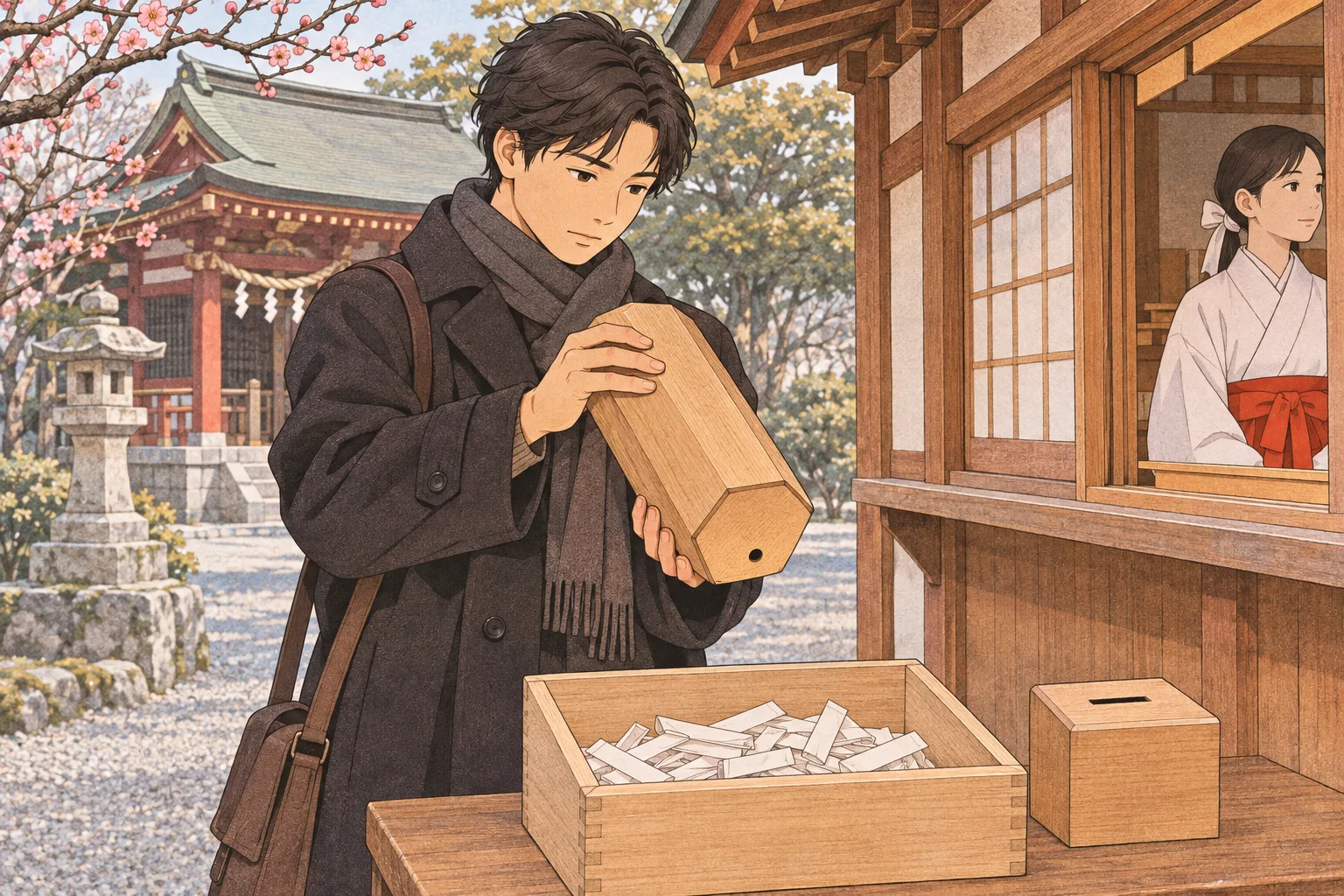
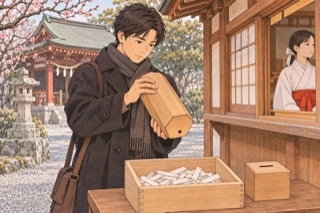
Beside the shrine counter, a visitor tips a hexagonal wooden canister; the open box holds folded slips, with a coin box next to it.
01Lots Before Fortunes
Drawing lots to learn the will of the gods is old in Japan. In its early form, kuji (lots) were a way of settling a specific question: options or names were written on slips of paper twisted into spills, and after prayers one was picked before a deity. In one variant a priest waved a gohei, a wand hung with paper streamers, over the spills, and whichever stuck to it was the god’s choice. Some local festivals still choose the household that will host the year’s rites this way. The most famous case came in 1428. The fourth Ashikaga shogun, Yoshimochi, was dying and refused to name an heir. His senior retainers sealed the names of four candidates and drew one before the god at Iwashimizu Hachimangū, a major shrine south of Kyoto. The winner was the shogun’s brother, then a Buddhist abbot, who left the priesthood to become the sixth shogun, Ashikaga Yoshinori. People later called him the "shogun chosen by lot."
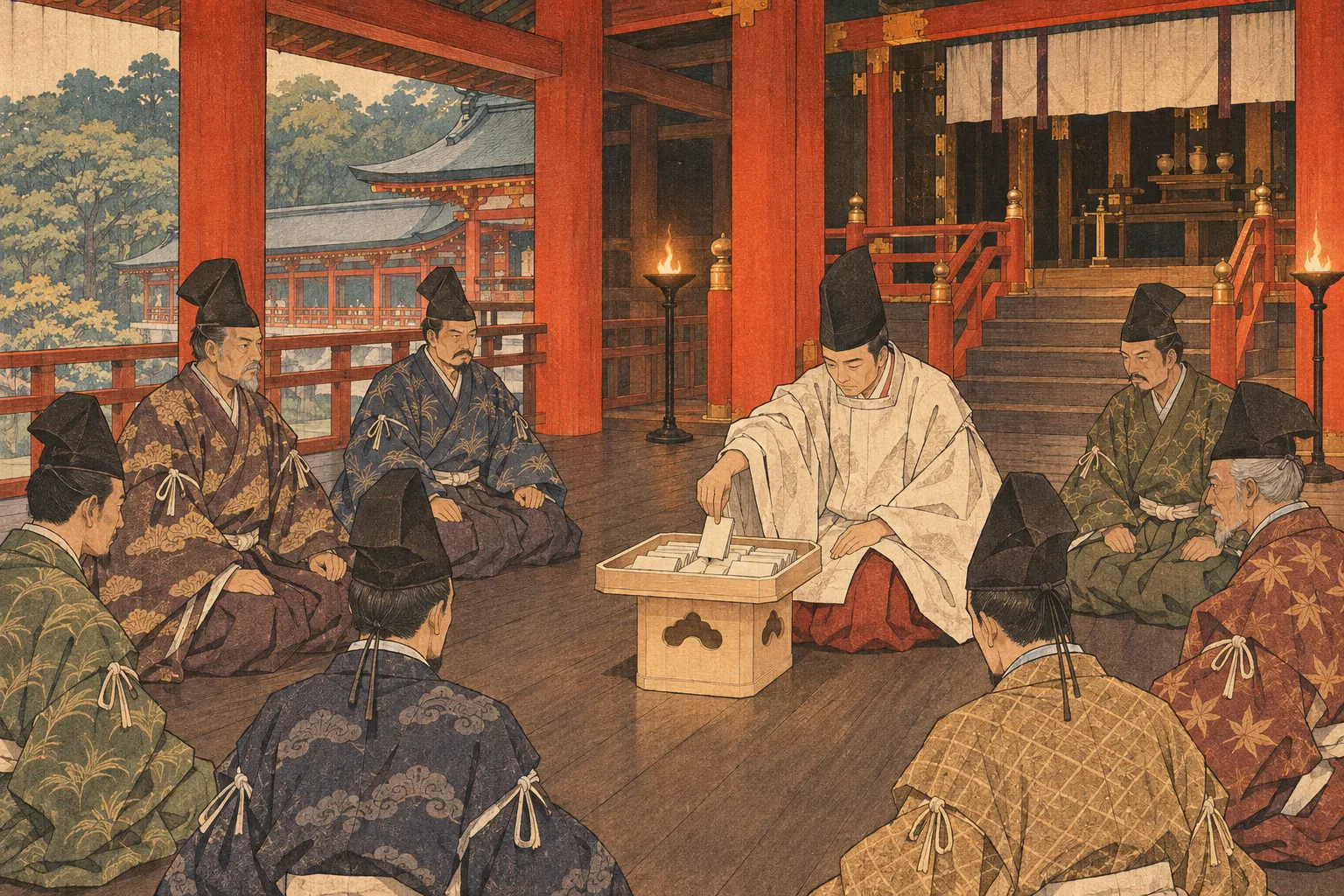
Iwashimizu Hachiman Shrine, 1428: senior retainers watch as one sealed lot is drawn before the god to choose the next shogun. (artist’s impression)
That was a decision, not a fortune. The printed fortune slip with a poem and a verdict has a different ancestor: the Chinese temple lot. From the Song dynasty onward, Chinese temples kept canisters of numbered bamboo sticks. A worshipper shook one out, and its number pointed to a four-line poem in a book, with a verdict of good or bad and a commentary. The most widespread set had one hundred poems and was associated with the bodhisattva Guanyin (Kannon in Japanese). Each poem had four lines of five characters and was presented as an oracle of Kannon. The oldest surviving set, the illustrated Tenjiku reisen (Indian Oracle Lots), was printed in China under the Southern Song. The lots reached Japan in the fourteenth century and were taken up by temples; a set of bamboo lot sticks at Tendaiji in Iwate is said to have a canister inscribed with a date equivalent to 1409.
02The Monk Who Got the Credit
In Japan the hundred Kannon poems came to carry the name of a Heian-period monk: Ryōgen (912–985), the eighteenth head abbot of Enryakuji on Mount Hiei, the great Tendai monastery overlooking Kyoto. Ryōgen rebuilt the mountain after fires and is remembered as its restorer. Because he died on the third day of the New Year, he is popularly called Ganzan Daishi, "the Great Master of the Third of the First Month." Stories gathered around him; one says he took the form of a horned demon to drive away a plague god, and a stark print of that horned, skeletal figure is still pasted over doorways in parts of Japan.
In the Edo period (1603–1868) the lots were attached to him. The Tendai prelate Tenkai, adviser to the first Tokugawa shoguns, was a devoted follower of Ryōgen. According to a temple history compiled in 1679, more than thirty years after Tenkai’s death, he dreamed that the Kannon lots kept before the god of Togakushi, in the mountains of Shinano, should be placed before an image of Ryōgen so that believers could learn their fortunes. Tenkai sent word to Togakushi, had the four-line verses copied onto bamboo sticks and put them in a canister to be shaken. From then on the set was known as the Ganzan Daishi lots. Scholars regard the poems as the Chinese Kannon lots, joined to Ryōgen’s name through Tenkai’s devotion rather than written by the monk. The name stuck all the same, and from the 1660s Edo publishers issued edition after edition of handbooks explaining each poem. Sensōji still tells visitors that fortune lots spread in Japan through Ryōgen of Mount Hiei.
A Ganzan Daishi slip is easy to recognise. At the top are the number and the verdict; in the middle, in large characters, a four-line Chinese poem; below, short verdicts on wishes, the sick, lost things, awaited visitors, building, moving, travel and marriage. Some editions add a small woodblock picture of a scene from the poem: an official on horseback, a traveller in a boat, a mountain under the moon. The imagery is Chinese and proverbial: a carp turning into a dragon, clouds parting to reveal the moon, a dead tree flowering in spring.
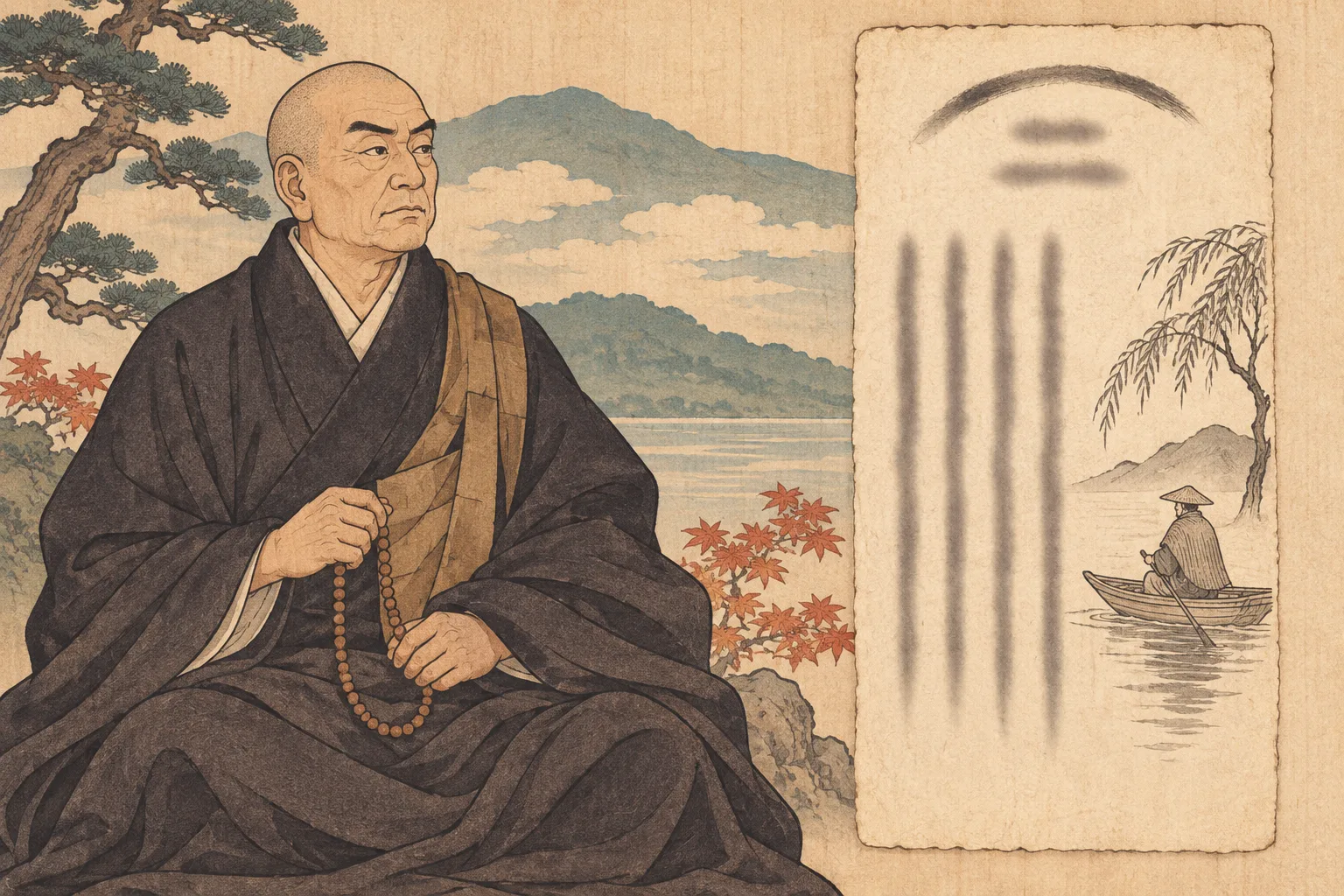
Left: the monk Ryōgen. Right: a Ganzan Daishi slip, with number and verdict at the top, four lines of Chinese verse in the middle and a small picture beside them. (artist’s impression)
So the first fortune slips most Japanese people knew were Ganzan Daishi lots: one hundred Chinese poems of four lines each, five characters to a line, each marked with a verdict. A monk would look up your number and explain the poem. Until the 1860s the same set was used at many shrines too. Many Tendai temples and large temples such as Sensōji in Asakusa, which calls it the Kannon hyakusen (Kannon’s hundred lots), still use it today.
03How the Lots Moved to Shrines
Before 1868, shrines and temples were tangled together. Many shrines were run by monks from an attached temple, and a canister of Kannon lots at a shrine was nothing unusual. That changed with the Meiji government’s separation of Shinto and Buddhism, which stripped Buddhist images and objects from shrines. A set of Buddhist poems in classical Chinese no longer fit.
Shrines replaced the Chinese verse with waka, the 31-syllable Japanese poem. It was a natural choice: waka had long been tied to the gods, and a poem by the storm god Susanoo in Japan’s oldest chronicle, composed as he built a palace in Izumo, was hailed in the preface to the tenth-century Kokinshū anthology as the start of 31-syllable verse. Waka fortune-telling already existed: a book of 64 oracle poems attributed to the deified scholar Tenjin was in print by 1754, and in 1859 a shrine priest in Takasaki compiled a set of waka lots drawn from Japanese myth. The preface to a lot book published in 1870 put the new mood plainly: shrines had been using "Buddhist lots in a hundred numbers," and now that the gods and Buddhas had been separated, that would no longer do. Over the following decades most shrines dropped the Ganzan Daishi set. Some were slow: Togakushi Shrine, the very place of the Tenkai legend, kept the old Kannon lots until 1932. Shrine lots now carried a waka about cherry blossoms after rain, a boat waiting for the tide, or the moon behind clouds, and the reader was meant to find their own situation in the image.
Much of the work of supplying shrines fell to an unlikely publisher. In 1906 Miyamoto Shigetane, chief priest of Nisho Yamada Shrine in Yamaguchi Prefecture, devised a set of waka lots. The shrine published Joshidō (The Way of Women), a magazine for the moral education of women, and the lots are generally thought to have been meant both to fund it and to spread Shinto teaching. The shrine’s publishing arm, Joshidōsha, based in Kano in what is now Shūnan city, still prints omikuji for shrines across the country. Its share is often said to be 60–70 percent of all the fortune slips in Japan. That is why slips at shrines hundreds of kilometres apart can look almost identical.
Some shrines write their own. Meiji Jingū in Tokyo offers a slip called Ōmigokoro (the Imperial Heart) that has no luck rating at all; each carries one of 30 waka chosen from the many thousands composed by Emperor Meiji and Empress Shōken, with a short commentary and an English translation. Ise Jingū, Japan’s most important shrine, offers no omikuji. A popular explanation is that a visit to Ise is itself the best possible fortune, though that is folk reasoning rather than an official position.
A quick way to tell the two traditions apart: a slip with a four-line Chinese poem is probably from a temple; a slip with a single Japanese waka is probably from a shrine.
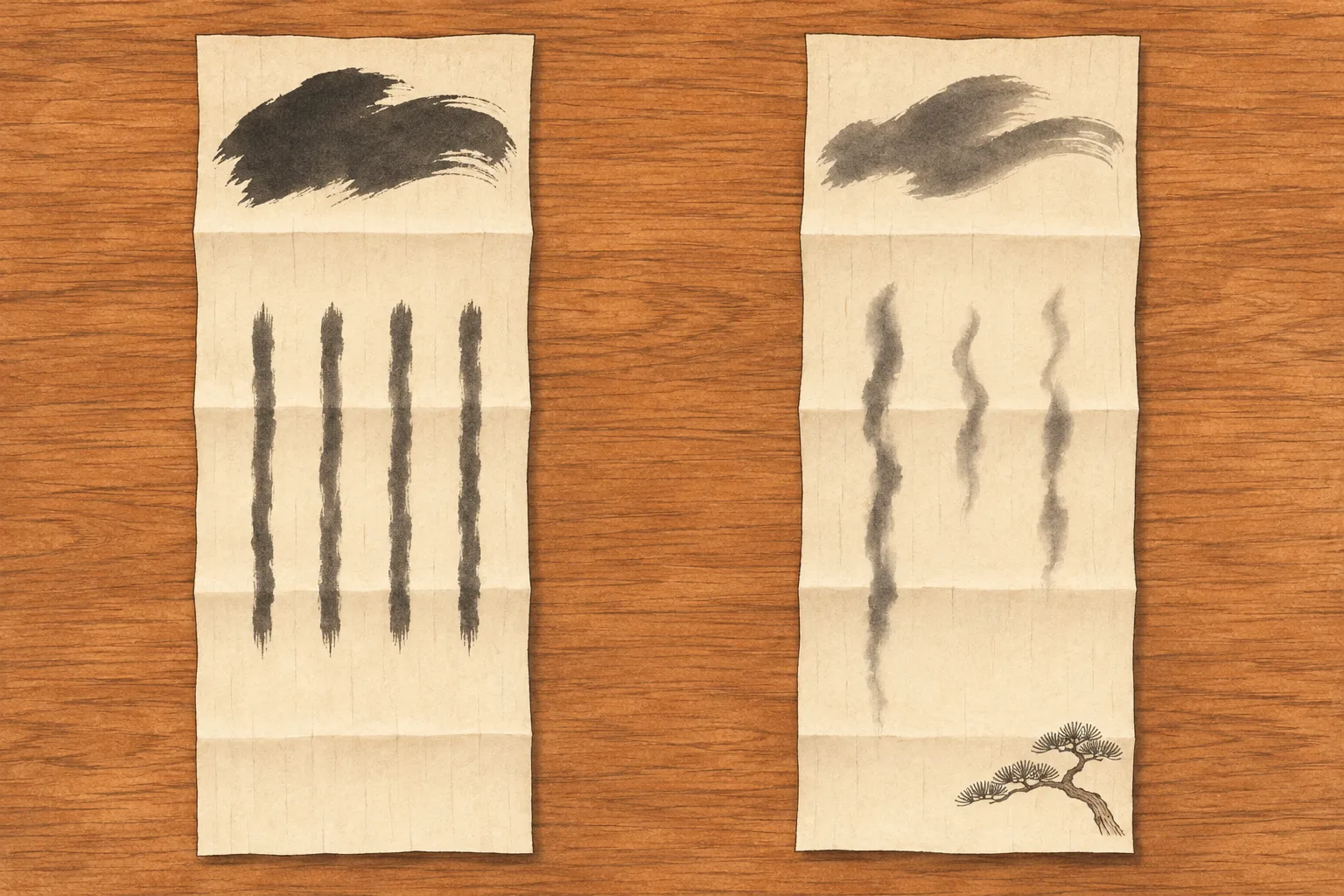
Left: a temple slip with four even lines of Chinese verse. Right: a shrine slip with a waka in uneven lines and a small pine in the corner. Both carry the verdict in large characters at the top.
04Great Blessing to Great Misfortune: The Ranks
The verdict is printed in the largest characters on the slip. The basic terms are daikichi (great blessing), kichi (blessing), chūkichi (middle blessing), shōkichi (small blessing), suekichi (future blessing), kyō (bad luck) and daikyō (great misfortune). Many shrines add finer grades such as hankichi (half blessing), sueshōkichi (small future blessing) or shōkyō (small bad luck). Some shrines use only three or four grades; others print a dozen.
There is no national standard, and the order of the middle grades is a genuine source of argument. Everyone agrees daikichi is best and daikyō worst. But does plain kichi come second, as an unqualified blessing, or does it sit below chūkichi and shōkichi, as a bare minimum? Two orders are commonly cited: daikichi, kichi, chūkichi, shōkichi, suekichi, kyō; and daikichi, chūkichi, shōkichi, kichi, suekichi, kyō. Suekichi means things are ordinary now and will improve later, and some people value it above a plain kichi for that reason. Asked about this, the Association of Shinto Shrines, the national body for most shrines, replied that the first order is the more common but some shrines put chūkichi above kichi, and neither is wrong. The Kannon lots at Sensōji have no chūkichi at all; when shrines switched to waka lots after the 1870s, each shrine and printer set its own grades. Each shrine decides its own order, and some print it on the back of the slip or post it beside the box. If you want to know where your slip ranks, the only reliable answer is the shrine’s own.
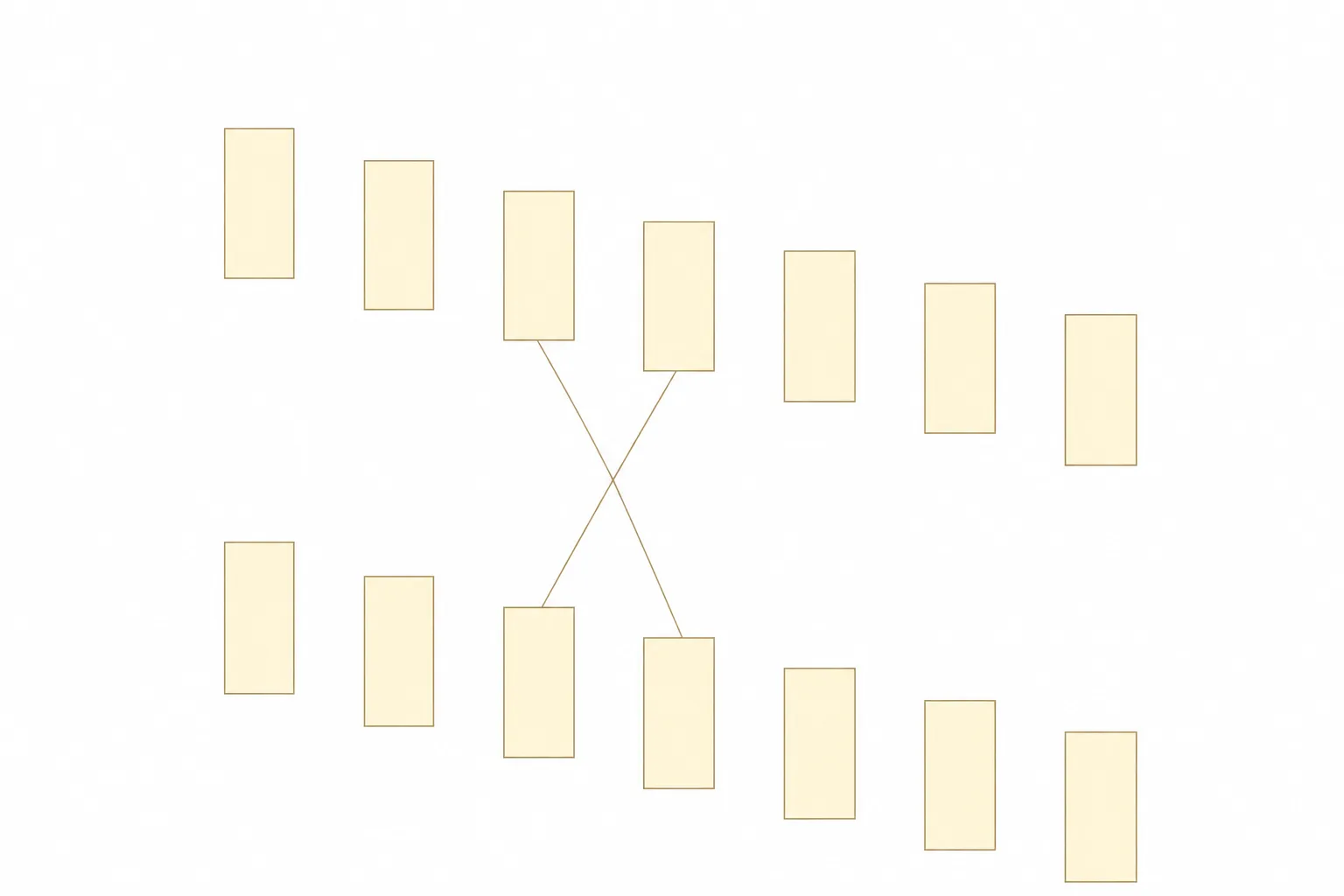
Two ways of ranking the verdicts. Both rows step down from daikichi on the left to kyō on the right; they differ only in the middle grades, where the crossed lines mark the swap.
The proportion of bad fortunes varies too, and is rarely published. The example people cite most is Sensōji, a temple rather than a shrine. By the usual count, its hundred lots break down as 17 daikichi, 35 kichi, 5 hankichi, 4 shōkichi, 3 sueshōkichi, 6 suekichi and 30 kyō, so three draws in ten are bad. The temple’s own answer to the complaint is that these are the old lots, unchanged; those who draw kyō are asked to pray for Kannon’s protection and tie the slip at the designated place to keep the bond. Many shrines go the other way and do not stock kyō slips at all, so the worst you can draw is suekichi. Beyond that, only the printers and the shrines know the real mix.
A bad fortune is not a sentence. Temples and shrines commonly tell those who draw kyō that careful, patient conduct will turn it to good, and in Japan a kyō slip is generally read as a warning rather than a doom.
05Reading the Slip
Unfolded, a typical shrine slip is about a hand’s width across and twenty-odd centimetres long, printed vertically and read from right to left. In order, you usually find:
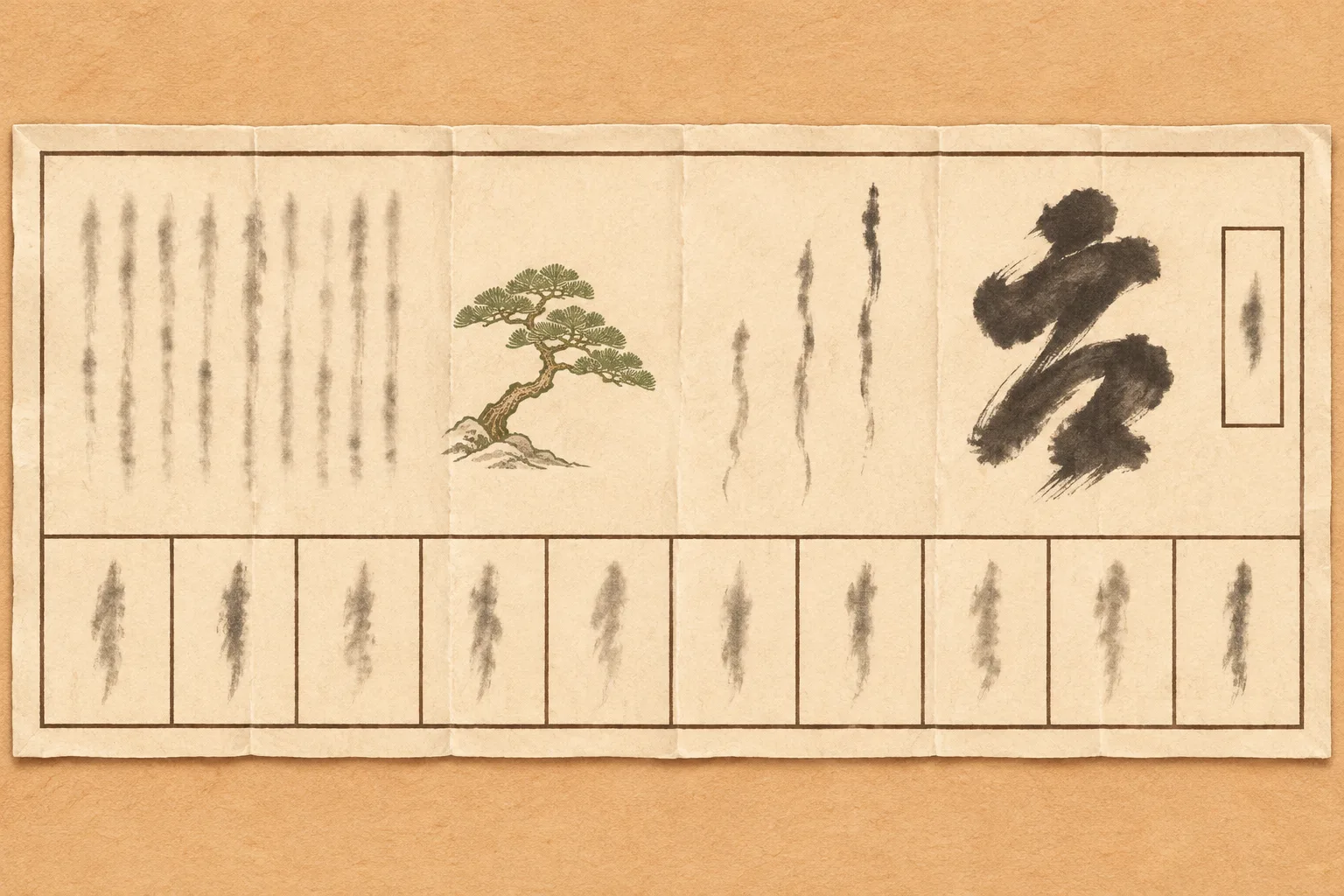
An unfolded shrine slip, read from right to left: the number, the verdict in large characters, the waka, a small illustration and the general reading. The row of boxes below holds the categories.
The number, such as "No. 18." The verdict in large characters. The waka, in two or three vertical lines, sometimes with a tiny drawing of a pine, a boat or the moon. A general reading in plain language explaining what the poem means for you now: whether to push ahead or hold back, wait or act.
Then comes the part many Japanese readers study most closely, the list of categories. They vary by shrine, but a dozen or so are common, each with a line or two. Negai (wishes): will what you hope for come true? Machibito (the person you are waiting for): a lover, a guest, a helper; typical answers are "comes late" or "news arrives." Usemono (lost articles): "found low down" or "hard to find." Ryokō (travel): "west is good" or "be cautious." Shōbai (business): "buy now, wait to sell." Gakumon (study): "succeeds with focus." Arasoigoto (disputes and lawsuits): "give way" or "you win." Ren’ai (love): "this person is the best" or "do not waver." Tenkyo (moving house): "good" or "wait." Byōki (illness): "recovers slowly" or "trust your doctor." Others include marriage prospects, childbirth, markets and lucky directions.
The traditional way to read a slip is poem first, general reading second, categories third, and the verdict last. A daikichi slip may still warn you against pride; a kyō slip may tell you your wish will come true with patience. Many slips close with a reminder that the words are guidance and matter more than the rank. Imagine drawing No. 7, suekichi. The waka shows a small boat moored on the shore, waiting for the tide to rise. The general reading says the moment has not come: set out now and you will struggle; prepare patiently and the tide will carry you. Below, wishes read "granted, but late," the person you await "comes, but late," business "hold steady," moving house "wait for spring," illness "lingers, but heals." The whole slip says one thing: not bad luck, just wait. The poem gives an image, the general reading turns it into a situation, and the categories apply it to particular parts of life.
The terse, slightly vague phrasing is part of the charm: "Lost item: in an unexpected place" works for nearly anyone.
06Getting a Slip: Canisters, Boxes and Machines
There are three common ways to draw, and a single shrine may offer more than one.
The canister is the oldest and inherited from temples. It is a hexagonal wooden box, twenty to thirty centimetres tall, with a small hole in one end and dozens of thin numbered sticks inside. You pay, hold the canister in both hands, think of your question, shake it, and tip it until one stick slides out of the hole. The sticks make a dry clatter that is one of the characteristic sounds of a shrine or temple. You note the number, return the stick, and take the matching slip from a cabinet of small numbered drawers, or tell the number to the shrine attendant, who hands you the slip.
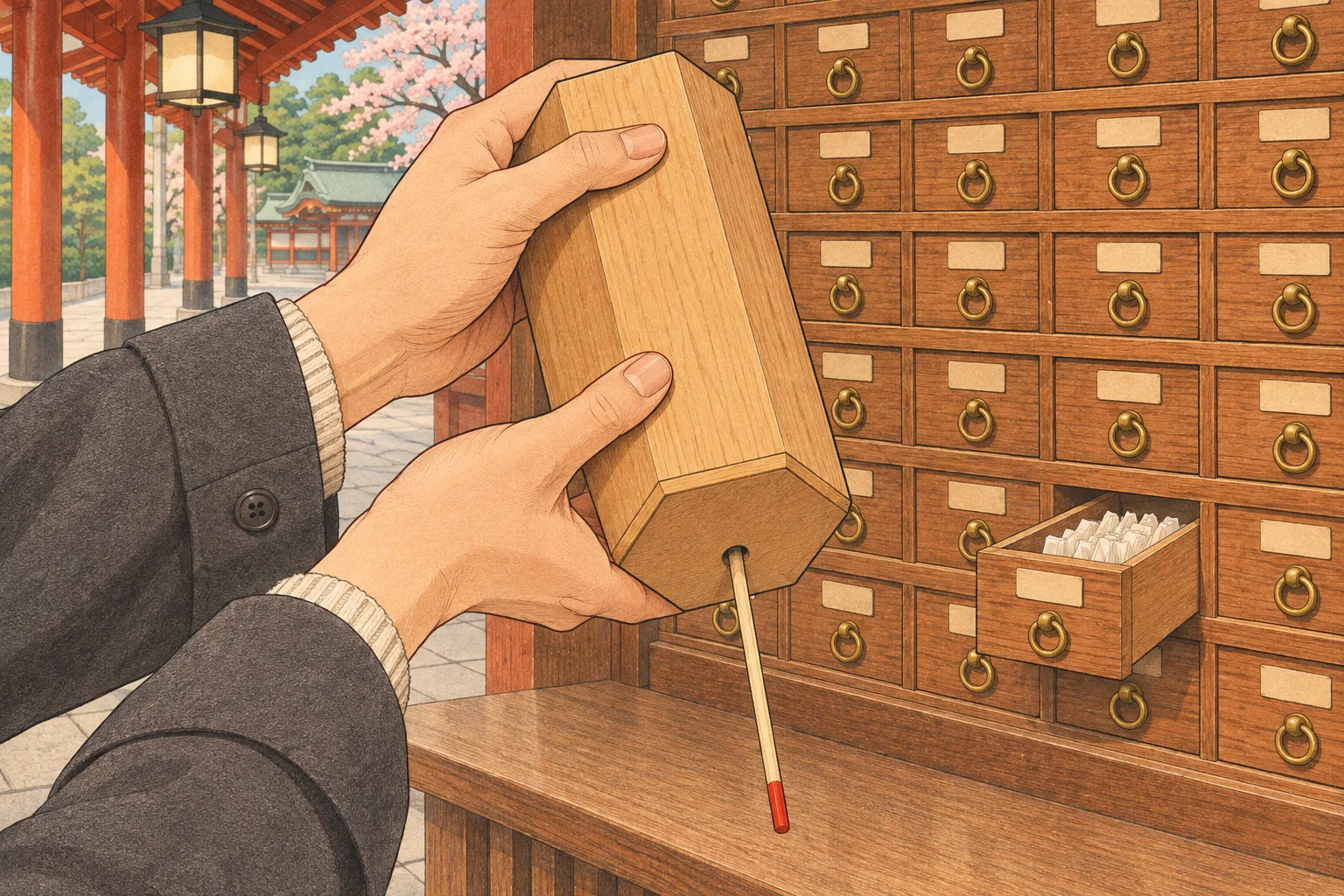
Tip the canister and one numbered stick slides out of the hole; the matching slip waits in the chest of small drawers, one of which stands half open.
The self-service box is now the most common method. A wooden box or basket is filled with folded slips, sometimes sealed with a paper band, next to a coin box. You drop in your offering and pick one.
The vending machine lets even unstaffed shrines offer fortunes. The automatic omikuji dispenser was first devised by Joshidōsha, and the fortunes sold from its machines are the most numerous in Japan. The machines themselves vary: some are shaped like miniature shrine buildings; a well-known type is topped with a red lion-dance head that nods and sways when you insert a coin, then delivers a rolled slip from its mouth. Mechanical machines of this kind are also custom-built by other makers and even designed by individual shrines.
Etiquette is loose. The usual advice is to pray at the main hall first, hold one specific question in mind while drawing, and draw only once rather than trying again for a better result. Shrines rarely enforce any of this.
07After You Read It
Walk through a shrine at New Year and you will see racks of white paper knots, sometimes so dense they look like snow. These racks are called mikuji-kake (fortune hangers), usually a wooden frame strung with ropes or wires, sometimes shaped like a small torii gate.
Several reasons are given for tying the slip. The verb musubu (to tie) also means to form a bond, so tying your fortune at the shrine links you to the god. Another view holds that a bad fortune should be left behind for the god to deal with rather than carried home. A third says that tying a slip to a living branch entrusts your wish to the tree’s vigour, to grow with it. Some also point to the pun between matsu (pine) and matsu (to wait), though accounts differ on what it means. People once tied slips to branches in the shrine grounds; the trees suffered, so many shrines set up racks, and where there is a rack you are asked to use it rather than the trees.
Tying is simple. Fold the slip lengthwise two or three times into a strip about a finger wide, loop it over the rope or wire, and tie a single knot, pulling both ends tight so the paper stands upright. First-timers tend to fold too wide and end up with a lopsided lump; some shrines post a diagram beside the rack.
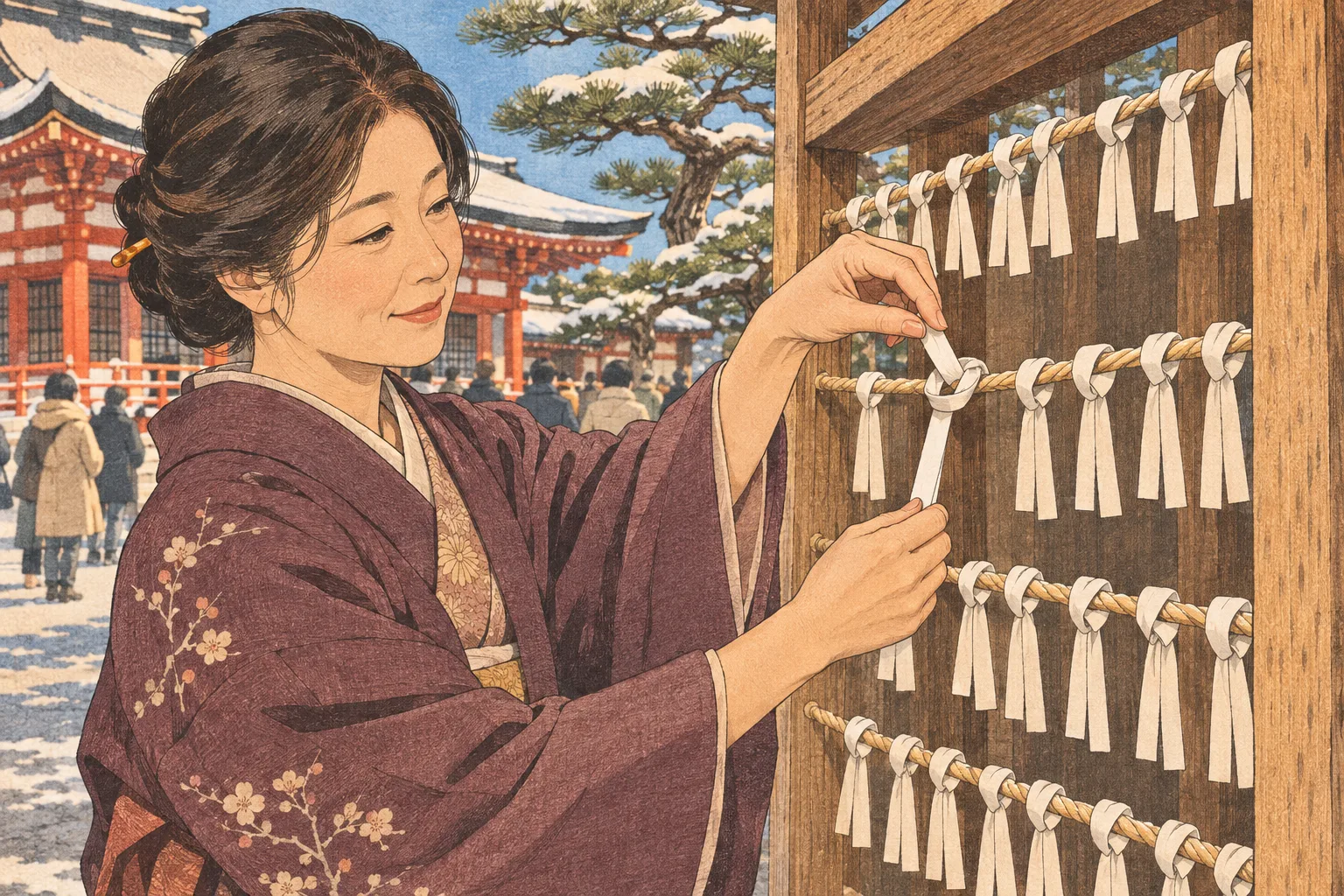
A mikuji-kake at New Year: each slip is folded into a narrow strip, looped over the rope and tied in a single knot.
You are also free to keep it. A common rule of thumb is to take good fortunes home, in a wallet or diary, and leave bad ones at the shrine. Others keep every slip and reread it through the year, on the view that the advice is the message and the rank is incidental. Practice varies and shrines generally leave it to you.
One widely repeated piece of folk advice concerns bad fortunes: tie a kyō slip using your non-dominant hand. The awkward effort is treated as a small act of discipline that turns bad luck to good. It has no single authoritative source, but you will see visitors fumbling with their left hands.
A slip you no longer want can be brought back on a later visit and tied to the rack. Shrines clear the racks from time to time and burn the knots.
08Fish, Lions and Love: Novelty Fortunes
Over recent decades shrines have competed with ever more inventive containers. The slip inside is much the same; what changes is the object and the gesture.
Tai-mikuji (sea bream fortunes) are the most photogenic. A rolled slip is tucked into the tail of a palm-sized papier-mâché sea bream, painted with scales and fins. You use a small bamboo rod to fish one out of a tank full of identical fish. Tai rhymes with medetai (auspicious), which is why sea bream are a celebratory food. Kawagoe Hikawa Shrine in Saitama is famous for them: red Ichinen Antai fish for the year ahead, pink Ai-tai fish for love.
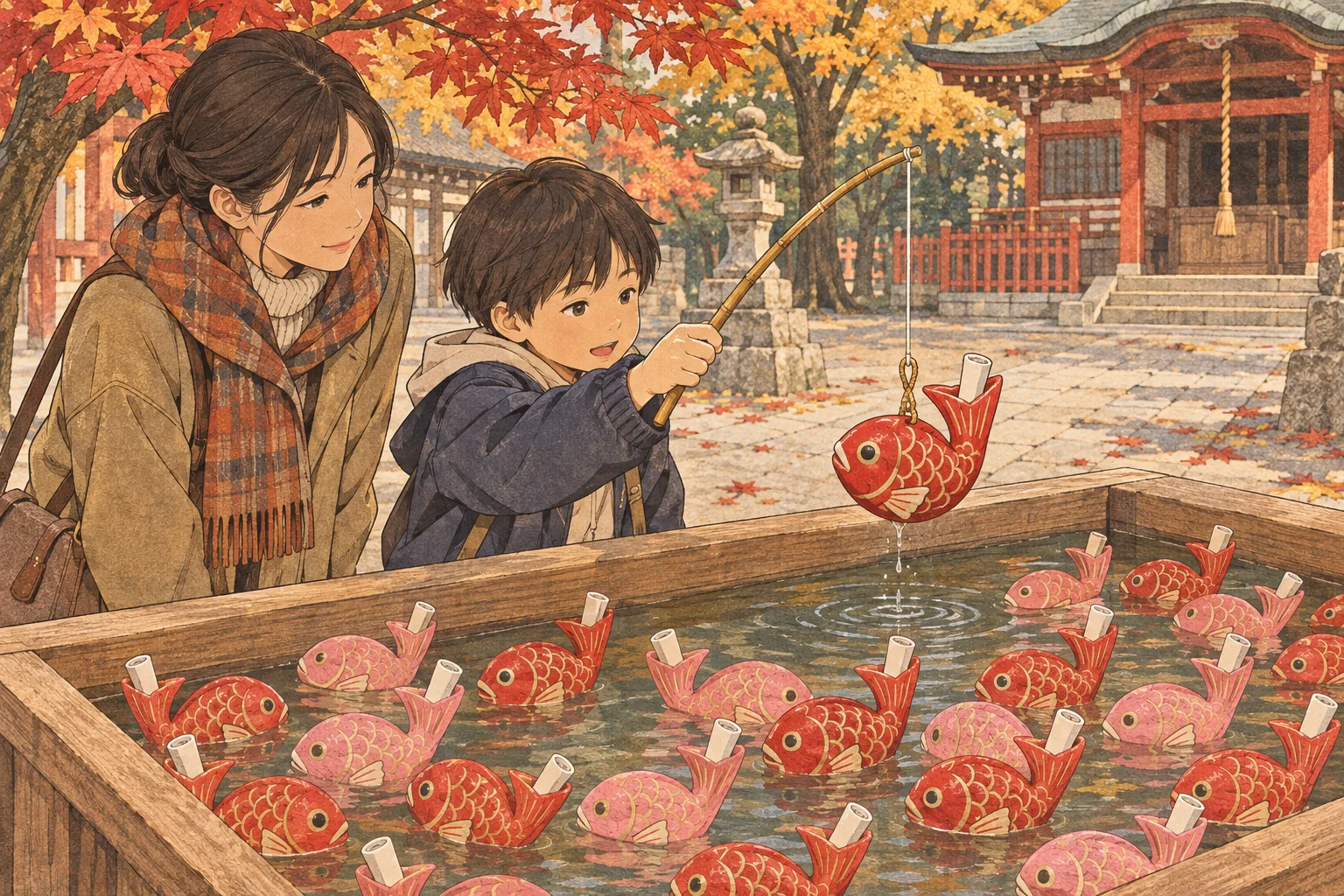
Tai-mikuji: a child hooks a papier-mâché sea bream from the tank with a small bamboo rod. The rolled slip sits in the upturned tail.
Shishi-mikuji (lion fortunes) come inside a thumb-sized red lion-dance head with gilded eyes and an open mouth, the slip rolled into a hole underneath. Afterwards the little lion becomes an ornament. Shrines vary the animal to suit their legends: foxes at Inari shrines, owls, rabbits, doves or Daruma dolls elsewhere.
Koi-mikuji (love fortunes) are printed on pink or cherry-coloured paper and cover only romance: how the other person feels, when you will meet, whether to act or wait. Tokyo Daijingū, known for matchmaking, is a well-known source; its love fortune even lists the blood type, zodiac animal and age gap of your future partner. Jishu Shrine beside Kiyomizudera in Kyoto is another famous place for love.
English fortunes are stocked at places with many foreign visitors, including Sensōji and Meiji Jingū, and some places also offer Chinese and Korean versions. They keep the rank and the categories ("The person you are waiting for," "Lost articles") and usually paraphrase the poem in prose.
Children’s fortunes use simple kana script, swap business and lawsuits for school, friends and sports, and often feature cartoon animals.
Temples have their own versions. Katsuōji in Minoh, north of Osaka, a temple associated with winning, hides its fortunes inside small red Daruma dolls; visitors leave the dolls behind on ledges, steps and stone walls, so that whole corners of the grounds are crowded with little red figures.
Some fortunes are tied to a single place. At Kifune Shrine in the hills north of Kyoto, an ancient shrine to a water god, the mizuura mikuji (water-divination fortune) is a blank sheet until you lay it on the sacred spring water that wells from the stone wall of the main sanctuary, when the text slowly appears.
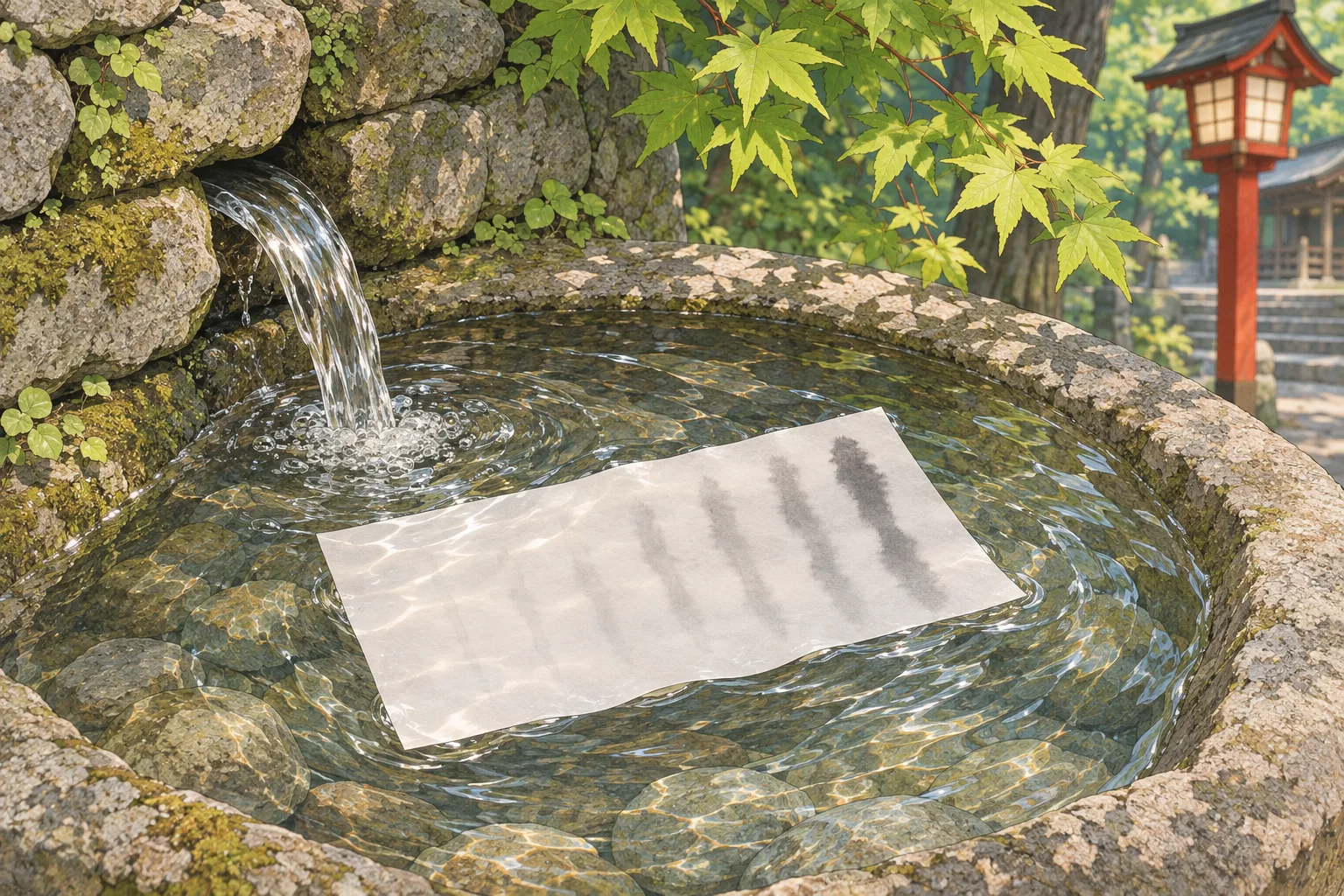
The mizuura mikuji at Kifune Shrine: a blank sheet laid on the spring water, with the text slowly coming up from faint to dark.
09Side by Side
Seen together, the common forms are easy to tell apart.
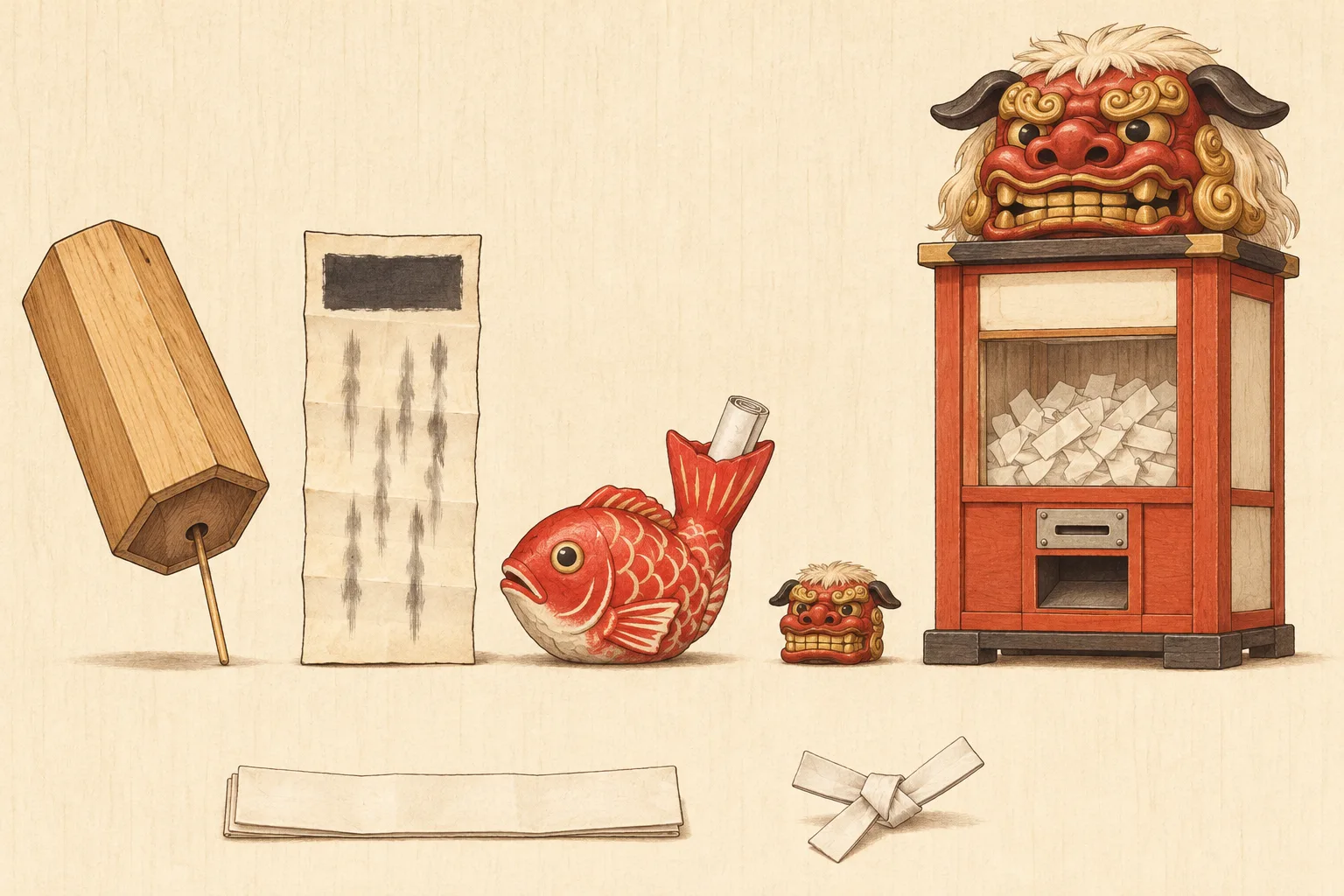
Top row, from left: canister with a stick sliding out, unfolded slip, sea bream fortune, lion fortune, lion vending machine. Bottom row, from left: a slip folded into a strip, and a tied knot.
The canister is a hexagonal wooden column with a hole at one end. What comes out is a numbered stick, not a slip, and it usually stands beside a cabinet of numbered drawers. The gesture is shake, then match.
The unfolded slip is a long, narrow white sheet printed vertically, with the number and the large verdict at the top and the poem, general reading and categories below. Folded, it is a thin strip; tied, a small white knot.
The sea bream fortune is a palm-sized papier-mâché fish with the slip in its tail, sitting in a tank of identical fish, with small rods propped beside it. The gesture is fishing.
The lion fortune is a thumb-sized red lion head packed with dozens of others in an open box. The gesture is picking.
The lion vending machine is a box-shaped machine crowned with a much larger lion head that moves when you pay and delivers the slip from its mouth: a machine, not a keepsake.
The ranks cannot be laid out as a single table, because each shrine sets its own. What can be compared are the common systems: a simple three-grade scale; daikichi–kichi–chūkichi–shōkichi–suekichi–kyō; daikichi–chūkichi–shōkichi–kichi–suekichi–kyō; and Sensōji’s seven grades inherited from the Kannon lots. Under all the variety the slip itself stays recognisable: a number, a verdict, a poem, and some plain advice on how to carry on.
More deep dives on this topic
 ToriiA torii is two posts and one or two crossbeams, with no doors, no walls and no lock.
 Divine Messengers and KomainuWalk into almost any Shinto shrine and an animal meets you before anything else does.
 Shrine ArchitectureMost visitors to a Shinto shrine photograph the torii gate, the vermilion pillars and the bell rope in front of the hall, and leave thinking they have seen the shrine.
 Shimenawa, Shide and GoheiWalk into almost any Shinto shrine in Japan and you will pass under a rope.
 Reading Shrine NamesWalk up to almost any Shinto shrine in Japan and look at the wooden plaque hanging from the torii gate or the main entrance.
 OmikujiNext to the counter where a Japanese shrine sells its charms, there is usually a wooden box or a hexagonal canister and a small slot for coins.
 Shinto Priests and MikoSpend a morning at a large Japanese shrine and you will see two kinds of people in old-fashioned dress.
 Shikinen Sengū and ZōtaiWalk up to the main sanctuary of the Inner Shrine at Ise and you will notice, just beside it, an empty plot exactly the same size.
 Sacred Trees and StonesWalk into almost any Shinto shrine and something older than the buildings is usually waiting for you.
- Back to the main article: Shinto →