
Walk into almost any Shinto shrine and something older than the buildings is usually waiting for you. It might be a camphor tree so wide that a dozen people could not link arms around it, or a cedar whose crown disappears overhead, or a boulder fenced off with stone posts and a straw rope. Visitors bow to these things, circle them, sometimes touch them. They are not decoration. In many places the tree or the rock came first, and the shrine was built beside it. This guide explains what you are looking at: sacred trees and paired "married" trees, the small evergreen branch on every altar, the forests that surround shrines, the great rocks and mountains treated as seats of the gods, the stones said to pin down earthquakes, and the stones you are actually allowed to lift, rub and walk on.
01Where a god comes down
The older Japanese idea of a kami (a god or spirit) is not quite "a deity who lives in the shrine." In early practice, kami were invited to a place for a ritual and then sent back. To arrive, a kami needed something to descend into: a yorishiro, or "approach object." Tall evergreens, oddly shaped boulders and cleanly profiled mountains were the obvious candidates. The pine-and-bamboo kadomatsu set beside doorways at New Year works on the same principle, as a landing place for the god of the year.
Two old words describe these places. A himorogi was originally a sacred space marked out with evergreens; today it usually means a single branch of sakaki set upright as a temporary seat for a kami. An iwakura, literally "rock seat," is a boulder or rock outcrop where a kami is believed to sit. You can still see a himorogi before construction in Japan: at a groundbreaking ceremony (jichinsai), four green bamboo poles mark a small square on the building site, and in the middle stands a sakaki branch hung with white paper streamers. When the ritual is over, it is taken down.
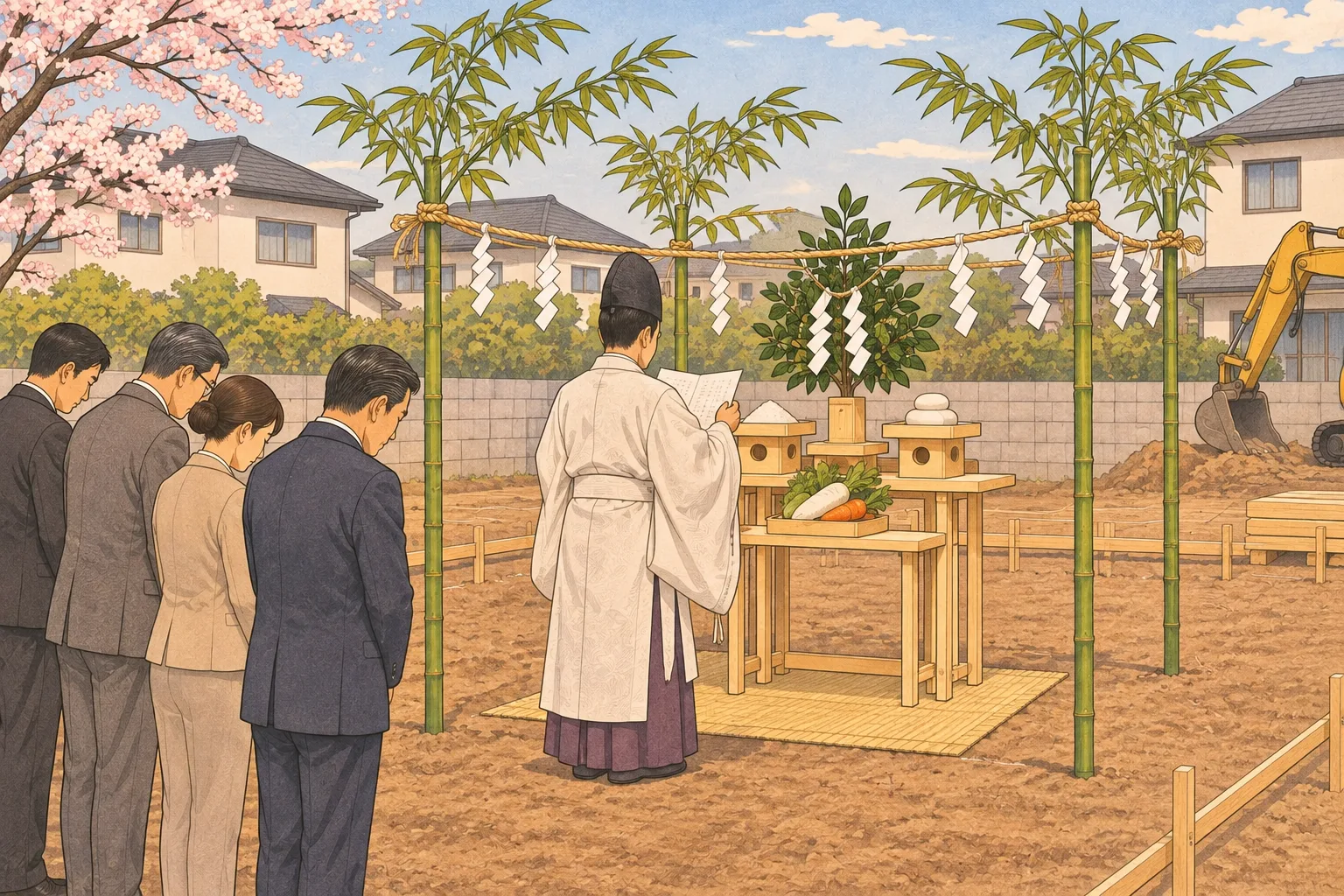
A himorogi you can still see today: at a jichinsai, four green bamboo poles mark a small square and a sakaki branch hung with white paper streamers stands in the middle until the ritual is over.
Archaeology supports the sense that trees and rocks came before buildings. On Okinoshima, an island in the strait between Kyūshū and Korea, offerings left from roughly the 4th to the 9th century were first placed on top of huge rocks, then in the shelter beneath them, and only later in open-air ritual areas. At Ōmiwa Shrine in Nara there is still no main sanctuary at all: the worship hall faces Mount Miwa itself. Permanent shrine buildings are generally thought to have become normal later, influenced in part by Buddhist temple architecture. But the trees and rocks were never retired. When you see a tree fenced and roped beside a hall, with a wooden sign reading goshinboku (sacred tree), it is often the heir to exactly this kind of ancient spot.
02Giants: cedar, camphor and ginkgo
Three kinds of tree account for most shinboku, or sacred trees, and they look so different that you can tell them apart from across a shrine courtyard.
Japanese cedar (sugi, Cryptomeria japonica) is a conifer found naturally only in Japan. It grows ramrod straight, with reddish-brown bark that peels away in long vertical strips and foliage made of short, stiff needles. Old sugi can reach 40 or 50 meters. They dominate shrines in the mountains and in eastern Japan. At Mount Haguro in Yamagata, a stone-stepped path climbs through centuries-old cedars, past one known as the Jijisugi ("grandfather cedar"), traditionally said to be about a thousand years old. At the inner shrine of Togakushi in Nagano, an avenue of cedars about half a kilometer long is generally said to have been planted in the early 17th century, which makes the trees more than 400 years old. At Ōmiwa Shrine, a cedar in front of the worship hall called the Mi-no-kamisugi is said to house a white snake, a form of the mountain’s god; people leave raw eggs at its base, the snake’s favorite food, and some add sake.
Camphor (kusunoki) is the opposite shape. Its trunk is short and enormously thick, splitting low into great limbs that spread sideways into a broad, rounded crown like a green cloud. The bark is dark and deeply furrowed; crush a leaf and it smells of camphor. Kusunoki love warmth, so the giants are in western Japan, Shikoku and especially Kyūshū. Japan’s two most famous camphors both stand in shrine grounds. The Ōkusu of Kinomiya Shrine in Atami, Shizuoka, is about 24 meters around the trunk and over 20 meters tall, a national Natural Monument since 1933 and ranked second in Japan in the Environment Ministry’s giant-tree surveys; the shrine describes it as more than 2,000 years old. Local custom says that walking once around it adds a year to your life, and a path loops around the tree for exactly that purpose. The camphor at Kamō Hachiman Shrine in Aira, Kagoshima, came out as the largest tree in Japan in the national giant-tree survey the Environment Agency began in 1988, at 24.22 meters around the trunk (measured 1.3 meters above the ground) and about 30 meters tall. It is a Special Natural Monument, its age of about 1,500 years is an estimate, and its trunk is hollow, with a space inside said to be the size of an eight-mat room.
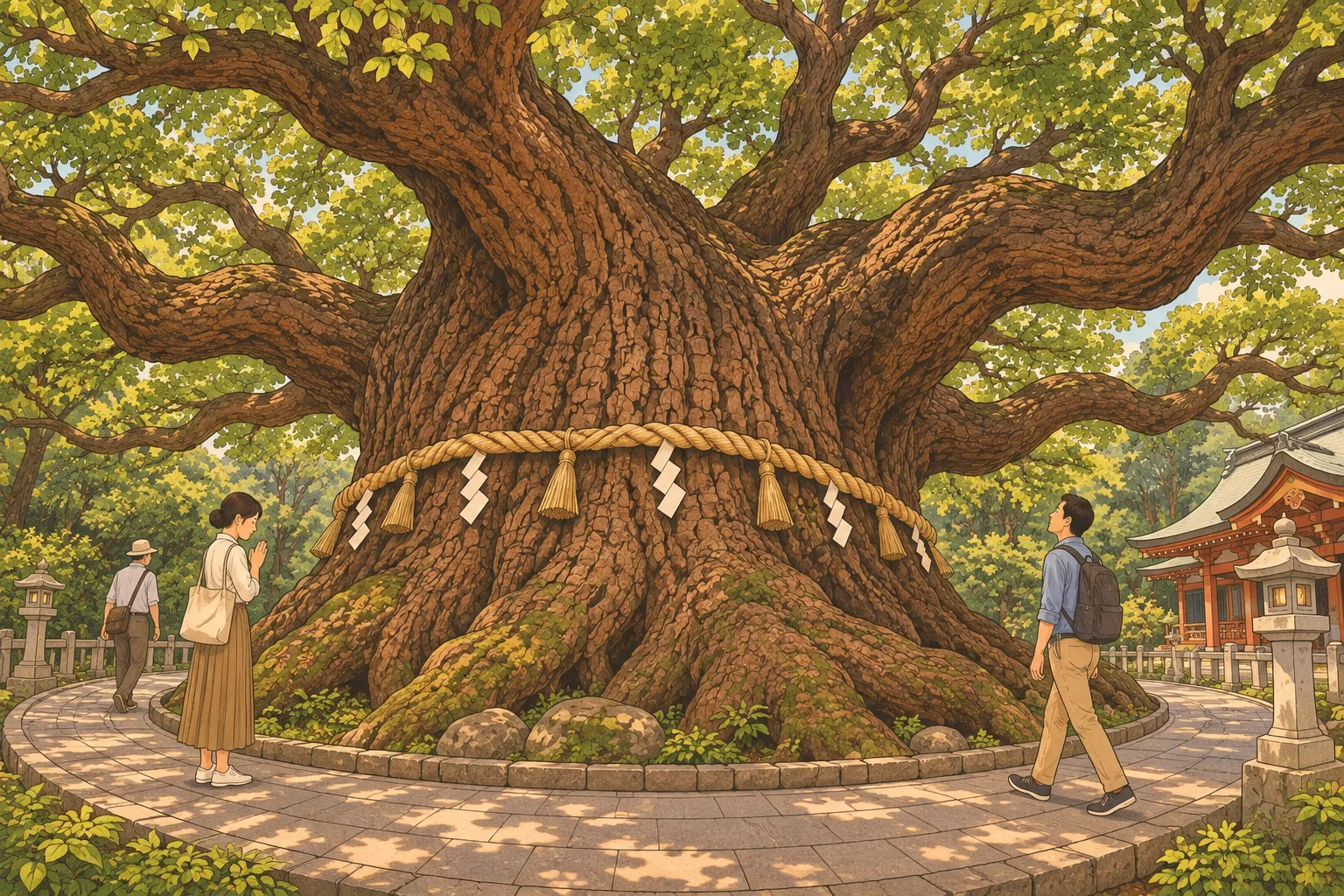
The Ōkusu of Kinomiya Shrine in Atami: about 24 meters around, with a short, enormously thick trunk splitting low into great limbs. A path loops around it for visitors to walk.
A word about those ages. Old cedars and camphors are often hollow at the core, so their rings cannot be counted. The "1,000 years" or "3,000 years" on a shrine signboard usually comes from legend, from the founding date of the shrine, or from a rough estimate based on girth. Where scientific dating has been done, the result is usually much younger than the tradition. Read the numbers as "extremely old," not as measurements.
Ginkgo (ichō) is the easiest to recognize: fan-shaped leaves that turn a brilliant yellow in late autumn and carpet the ground. Very old ginkgos grow hanging lumps, like stalactites, called chichi ("breasts"), and women once prayed to them for a good supply of milk. Ginkgo is not native to Japan; it is generally thought to have arrived from China, though when is debated, with proposals ranging from the 7th to the 16th century and recent studies favouring the 13th or 14th. The most famous shrine ginkgo stood beside the stone steps of Tsurugaoka Hachimangū in Kamakura. In 1219 the shōgun Minamoto no Sanetomo was murdered near those steps by his nephew Kugyō, and a later retelling, popular enough to reach the kabuki stage, had the assassin hiding behind the tree. The ginkgo came down in a night of wet snow and strong wind in March 2010. The lower part of the stump was replanted beside the old spot, and a shoot from the original roots has grown into a healthy young tree.
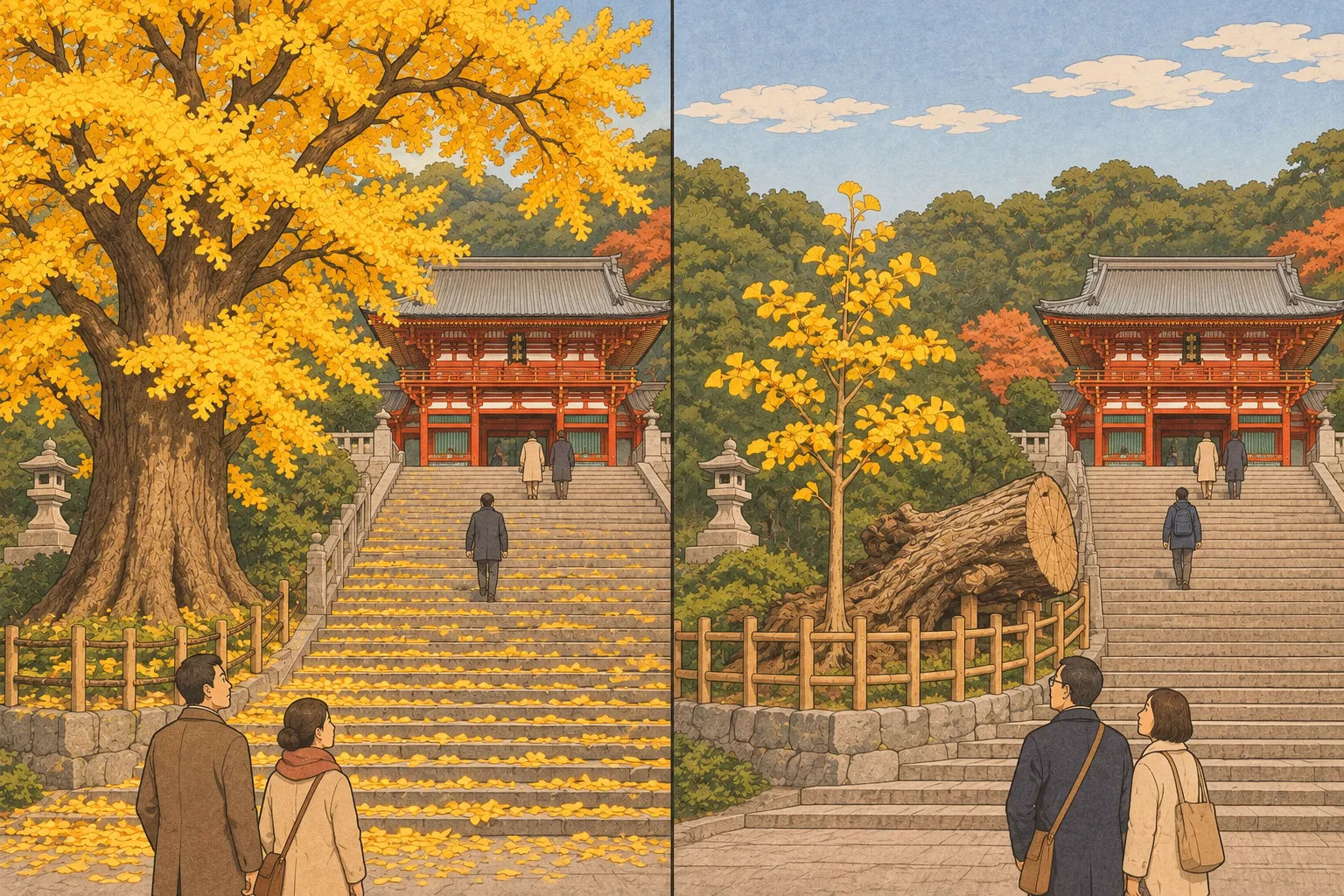
The great ginkgo beside the steps of Tsurugaoka Hachimangū. Left: before it fell in 2010. Right: today, a young tree grown from the old roots, with the replanted stump beside it. (artist’s impression)
03Married trees
Some sacred trees come in pairs. Meoto-sugi, "husband-and-wife cedars," are two trunks rising from one root, or two trees growing so close they seem joined. The largest pair is the Sugi no Ōsugi at Yasaka Shrine in Ōtoyo, Kōchi Prefecture: two colossal cedars fused at the base, called the South and North trees, designated a national Natural Monument. Local tradition says the storm god Susanoo planted them and puts their age at around 3,000 years, which belongs to the category of legend described above. At Takachiho Shrine in Miyazaki, another pair of cedars sharing one root system draws couples and friends, who are told to hold hands and walk around the trees three times for a lasting bond and a happy family.
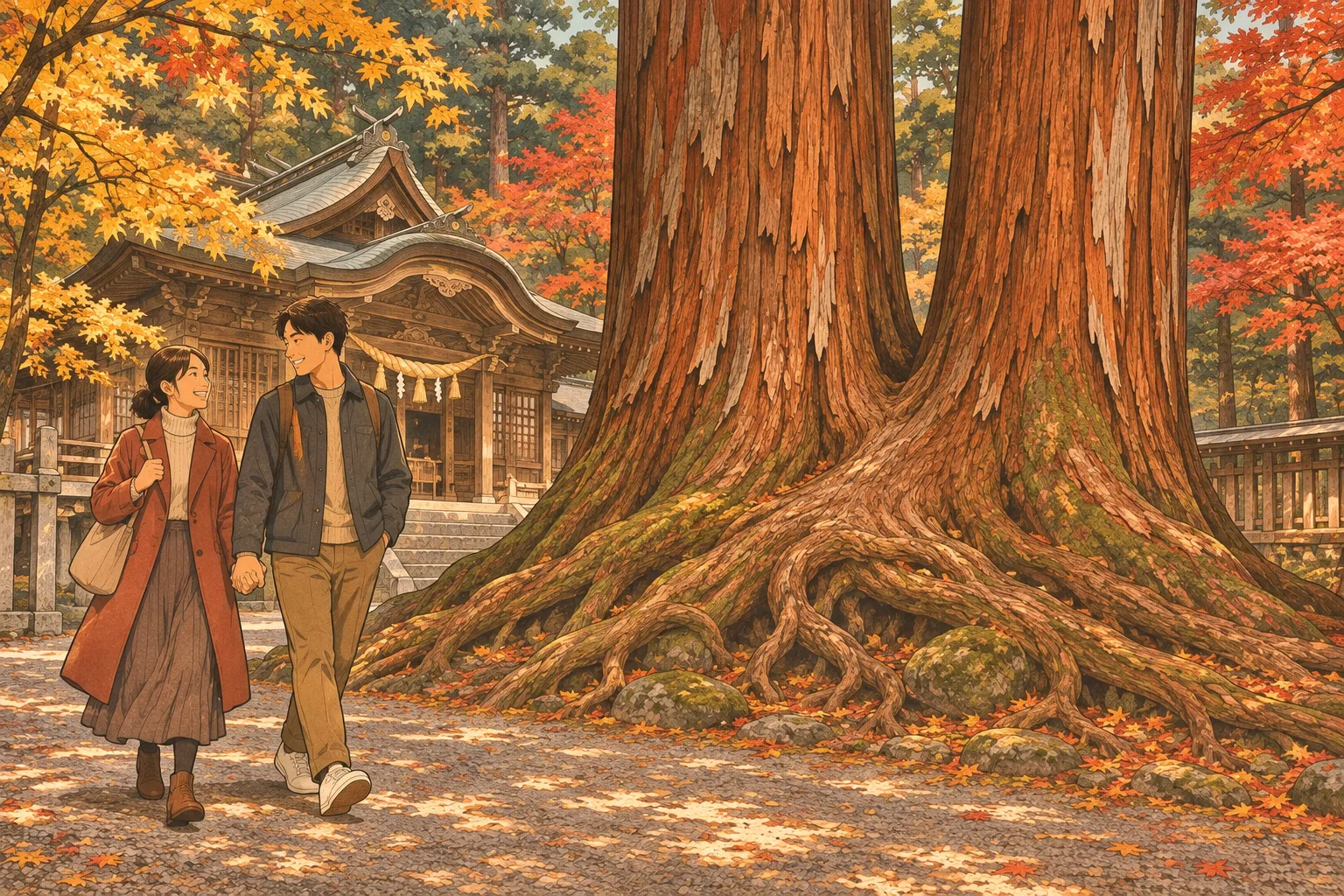
The married cedars of Takachiho Shrine, two trunks sharing one root system. The base is where to look: one root, two trunks.
Related to these are renriboku, "joined-branch trees": two separate trees whose branches or trunks have grown together into one. In China and Japan alike, this was long treated as a good omen and a symbol of a couple united, which is why renriboku are often called en-musubi no ki, trees for "tying the knot" of a relationship. At Shimogamo Shrine in Kyoto, the small Aioi Shrine stands beside a renriboku formed from two trees joined in the middle, counted among the "Seven Wonders of Kyoto." Tradition says that whenever the old pair is dying, a new joined tree appears somewhere in the shrine’s Tadasu Forest to replace it; the present one is said to be the fourth. The visitors here are mostly young people hoping for a good match.
How do you know a tree is sacred? You do not need to know your botany. Look for three things: a straw rope around the trunk, a fence or stone railing, and a sign saying 御神木 (goshinboku). Most shrines ask you to stay outside the fence; a few have built paths so you can walk around or touch the bark. Climbing, carving or peeling is never acceptable, and some shrines have recently pushed visitors farther back to protect the roots.
04Sakaki: the branch on every altar
The tree you will see most often in a shrine is not a giant at all. Look at any altar and you will find green branches standing in vases on either side. That is sakaki (Cleyera japonica), and the character for it, 榊, was invented in Japan by combining "tree" and "god."
Sakaki is a small evergreen with glossy, dark green, oval leaves with smooth edges and a slightly stiff, leathery feel. The bud at the tip of each shoot curves like a tiny hook. It is used constantly in ritual. The tamagushi offered by priests and worshipers is a sakaki branch tied with white paper streamers; you hold it level, turn it so the stem points toward the altar, and lay it down. Tall branches called masakaki, hung with five-colored silk and with a mirror, jewel or sword attached, often flank the altar. Their form echoes a story in the Kojiki: when the sun goddess Amaterasu hid in a cave, the gods dug up a thriving sakaki from Mount Kagu and hung jewels, a mirror and cloth on its branches to lure her out. Household altars, too, get fresh sakaki, traditionally on the 1st and 15th of each month.
Sakaki needs a mild climate; on Honshu it grows wild from roughly Ibaraki and Ishikawa prefectures westward. In Kantō and farther north, and in cold uplands, shrines use substitutes. The most common is hisakaki (Eurya japonica), used in place of sakaki for rituals in much of eastern Japan; its leaves are smaller and have finely toothed edges. Farther north, branches of cedar, cypress, pine or other evergreens may stand in. Today much of the ritual greenery sold in Japanese supermarkets is imported; domestic hisakaki in particular has long been in short supply, and about 90 percent of what is sold comes from China.
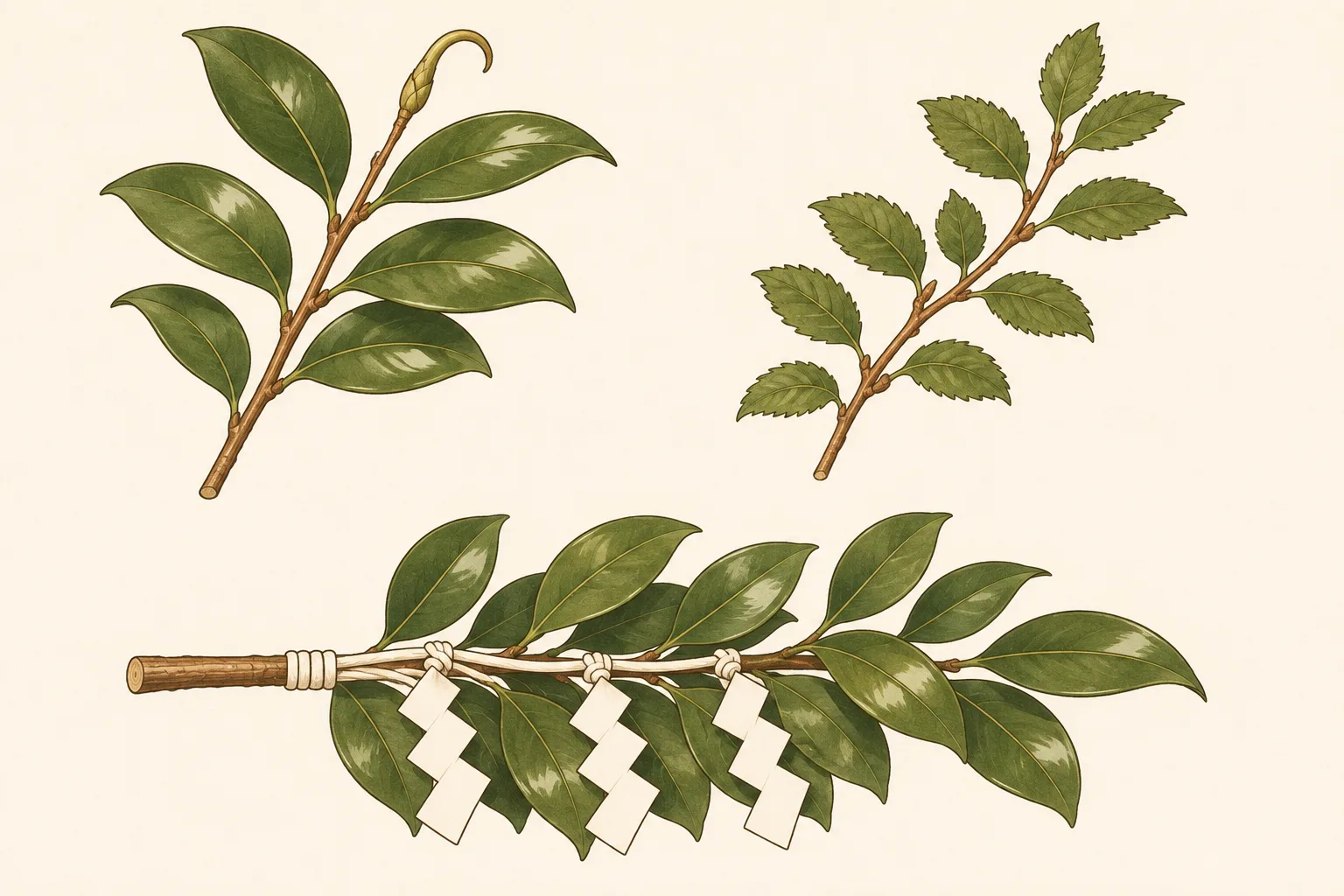
Upper left: sakaki, with smooth-edged leaves and a hooked bud at the tip. Upper right: hisakaki, with smaller, finely toothed leaves. Below: a tamagushi, a sakaki branch tied with white paper streamers.
05The shrine forest
Ride a train through rural Japan and you will see it: flat rice fields, and then, rising out of them, a dark, dense knot of trees. There is almost always a shrine inside. The grove is called a shasō or, more affectionately, chinju no mori, "the forest of the guardian god."
These groves stand out because they have not been cut. Trees within a shrine’s precinct belong, in a sense, to the kami, and many shrines forbade felling or even removing fallen branches. The result is that where farms and towns have covered the lowlands, the shrine grove often preserves the original vegetation. In warmer Japan that means broadleaf evergreen forest: chinquapin, evergreen oak, camphor and bay, with glossy leaves and a cool, dim understory. Many groves are now protected as natural monuments and used by ecologists as references for what the land once looked like.
The chinju no mori was also the village’s commons, its playground and its festival ground. When the government merged thousands of small shrines in the late Meiji period, many groves were felled. The naturalist Minakata Kumagusu protested fiercely in Wakayama, arguing among other things that destroying the groves would wipe out rare plants. It was one of the first times in Japan that a shrine forest was defended for ecological reasons.
The most remarkable shrine forest in Japan was planted from scratch. In 1915, work began on Meiji Jingū in Tokyo, on land at Yoyogi that was largely open fields. Prime Minister Ōkuma Shigenobu wanted cedar avenues like those at Ise or Nikkō, but the forestry scholars in charge, Honda Seiroku, Hongō Takanori and Uehara Keiji, argued that cedar needs moist valleys and would struggle in Tokyo’s dry soil and smoky air. Instead they designed a succession plan. Fast-growing pines would form the first canopy; cypress and cedar would fill in beneath; and evergreen broadleaf trees such as oak, chinquapin and camphor would be planted in the understory. Over decades the broadleaves would overtake the pioneers, leaving a forest that renewed itself without human replanting. Their plan sketched what the forest should look like after roughly 50, 100 and 150 years. Around 100,000 trees were donated from all over Japan; in all, some 120,000 trees of 365 species went into the inner precinct. Youth groups did the planting and path-building as volunteer labor, a cumulative total of about 110,000 young men. The shrine was completed in 1920.
A century on, the forest has largely become what they predicted: a dense broadleaf woodland. A centennial survey, reported in 2013, recorded about 3,000 species of plants and animals, including new species and endangered ones. Fallen leaves are said to be left on the forest floor to return to the soil. Step off the platform at Harajuku and through the great gate, and the city noise drops away within a few hundred meters. Few visitors realize the "ancient" forest is a planned one.
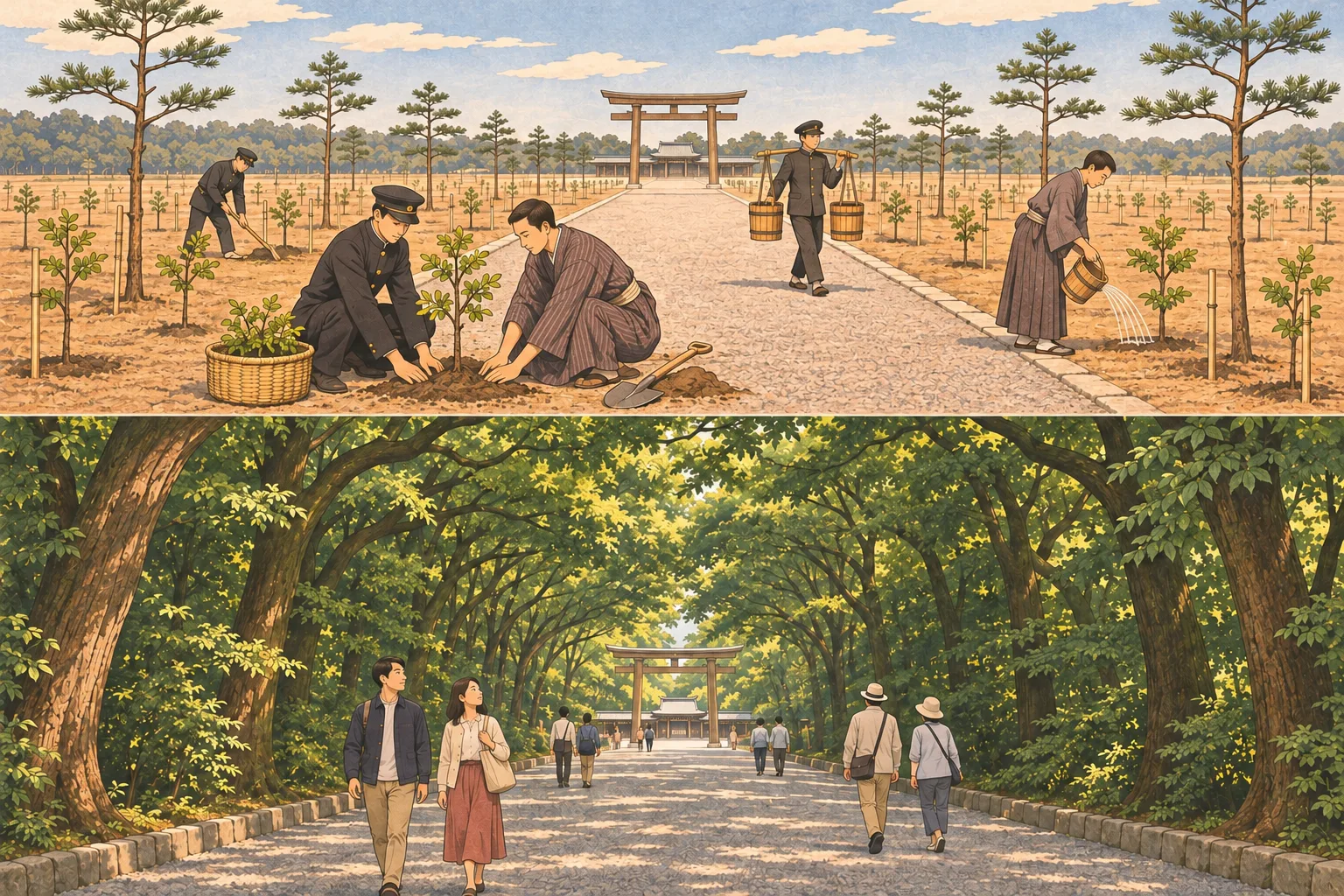
The forest of Meiji Jingū. Top: around 1920, saplings and thin pines on open ground. Bottom: a century on, the same approach runs under a canopy of evergreen broadleaf trees. (artist’s impression)
06Rock seats and sacred mountains
Trees grow and die; rocks seem to last forever. Across Japan, large boulders serve as iwakura, and some mountains are treated as the kami itself, a shintaizan or "god-body mountain."
Mount Miwa, behind Ōmiwa Shrine, is the classic shintaizan. It is about 467 meters high, with iwakura at the summit, on the middle slopes and at the foot, usually called the Okitsu, Nakatsu and Hetsu iwakura. For centuries it was closed to ordinary people. Today worshipers may climb, but only after registering, wearing a cloth sash that marks them as pilgrims, and agreeing not to eat (water excepted) or take photographs; nothing, not even a pebble, may be carried down.
The Kumano region in the south of the Kii Peninsula is full of rock worship. At Hana-no-Iwaya Shrine in Kumano, Mie, the object of worship is a gray cliff of rock about 45 meters high, facing the sea, with no sanctuary building in front of it. According to one variant recorded in the Nihon shoki, the goddess Izanami was buried at Arima in Kumano and honoured with flowers; this rock is identified as her grave. In nearby Shingū, Kamikura Shrine, a subsidiary of Kumano Hayatama Taisha, sits on a hilltop under a boulder called Gotobiki-iwa, usually explained as "toad rock" in the local dialect. Every February 6th, during the Otō Matsuri, crowds of men in white with straw rope around their waists pour down the steep stairway of more than 500 stone steps with flaming torches, a river of fire visible from the town below.
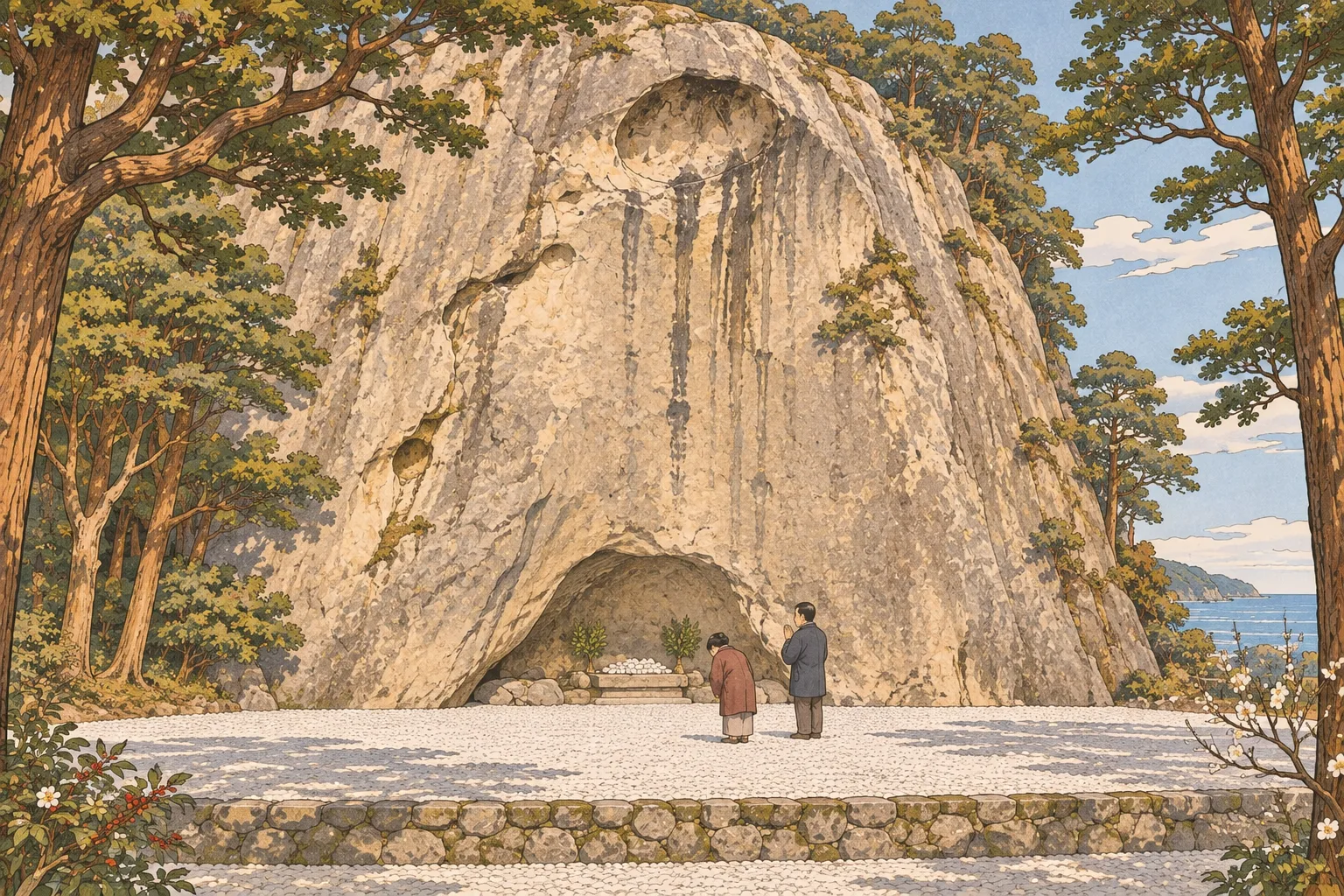
Hana-no-Iwaya Shrine in Kumano, Mie: the object of worship is a gray cliff about 45 meters high, with no sanctuary building in front of it. Worshipers pray at its foot.
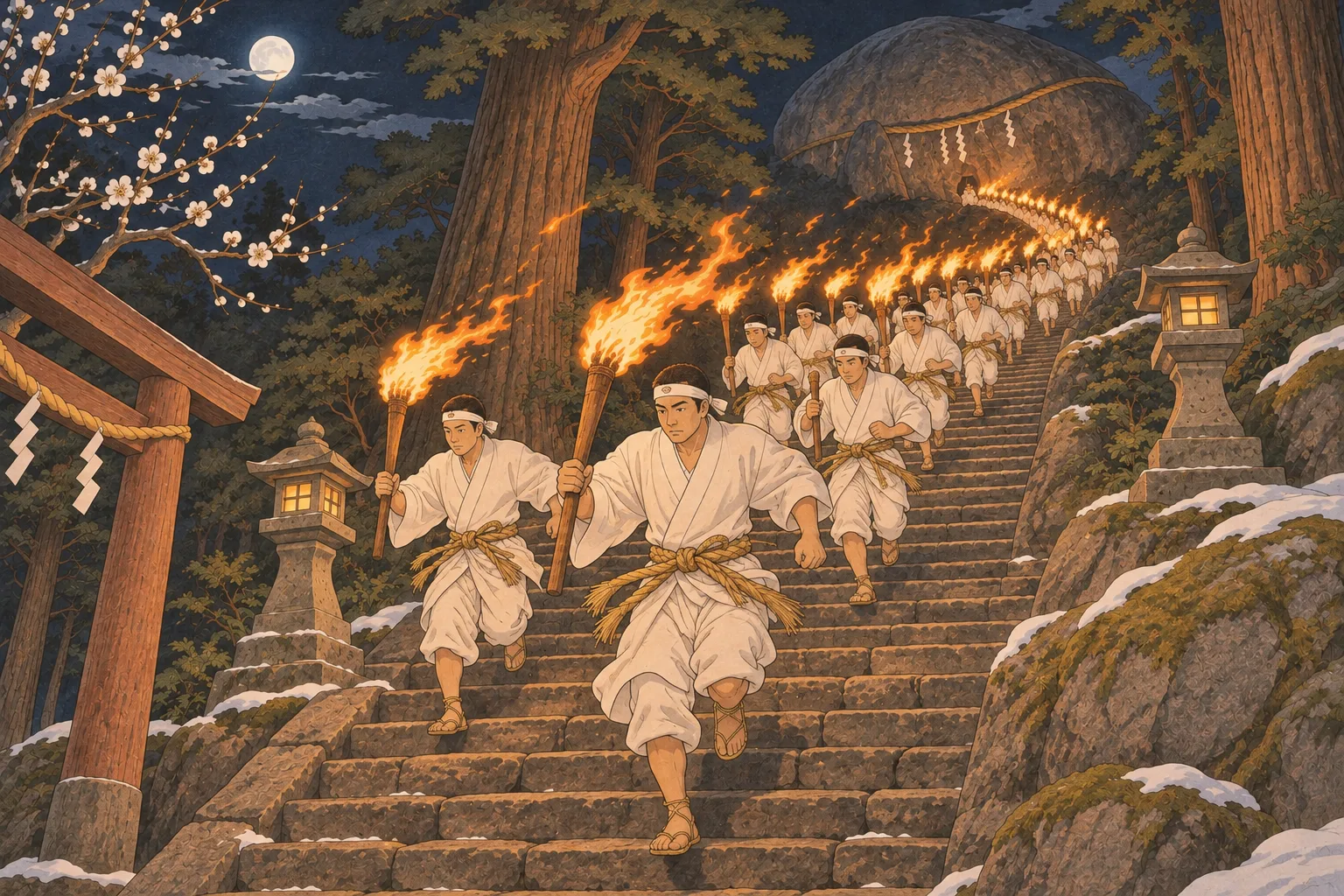
The Otō Matsuri at Kamikura Shrine: on the night of February 6th, men in white with straw rope around their waists pour down the steep stone steps from the boulder, torches blazing.
Near Osaka, Iwafune Shrine in Katano worships a boat-shaped boulder about 12 meters high, lying across the Amano River, said to be the heavenly vessel in which the god Nigihayahi descended. Koshikiiwa Shrine in Nishinomiya worships a granite rock about 10 meters high, likened to a rice steamer. Okinoshima, mentioned above, remains closed in its entirety: traditionally women were barred, men had to purify themselves in the sea before landing, and the annual festival on May 27, when about 250 laymen were allowed to land, stopped admitting the public after the island became a World Heritage site in 2017. Today a single priest of Munakata Taisha stays on the island, relieved every ten days.
Why these rocks? There is no single answer. Some overlook plains and sea; some sit by springs; some have shapes that invite stories. What they share is the belief that a kami sits there, and the buildings, if any, were added later to face it.
07Stones with stories: kanameishi, Meoto Iwa and standing stones
Not every sacred stone is huge. The kanameishi, or "pivot stones," at Kashima Jingū in Ibaraki and Katori Jingū in Chiba are almost comically small above ground: a rounded nub a few tens of centimeters across, inside a little stone fence with a miniature torii. Kashima’s is usually described as slightly concave on top, Katori’s as slightly convex. Legend says a giant catfish (namazu) lies under Japan, causing earthquakes when it thrashes, and that the two shrines’ gods drove these stones down to pin it, one version having Kashima hold the head and Katori the tail. Another story says that Tokugawa Mitsukuni, lord of Mito, had men dig around the Kashima stone for seven days and nights and gave up when they had not found its bottom and workers kept getting hurt. After the Ansei Edo earthquake of 1855, cheap woodblock prints called namazu-e, showing the Kashima god sitting on the catfish or townspeople beating it, sold in huge numbers.
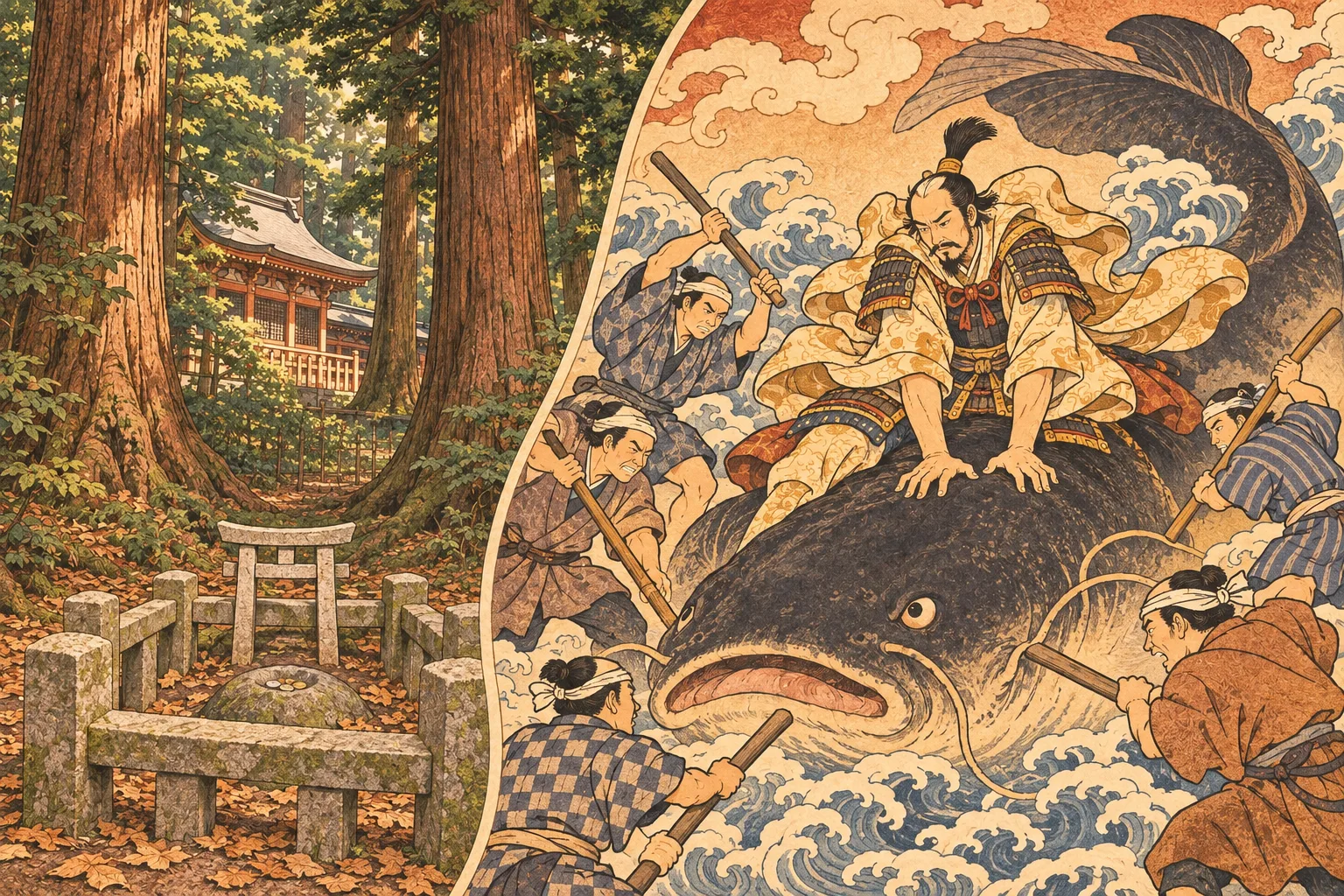
Left: the kanameishi at Kashima Jingū, a rounded nub inside a small stone fence. Right: in the manner of a namazu-e, the Kashima god sits on the giant catfish while townspeople beat it. (artist’s impression)
The Meoto Iwa, "Wedded Rocks," at Futami in Ise are Japan’s most famous pair of stones. They stand in the surf in front of Futami Okitama Shrine: the larger, "husband" rock about 9 meters tall, the smaller "wife" rock about 4 meters. They function as a kind of gateway. Out to sea, roughly 700 meters beyond them, lies a sacred rock linked to the god Sarutahiko, now a submerged reef. From May to July the sun rises between the two rocks, dead center around the summer solstice; on clear days in that season, Mount Fuji, some 200 kilometers away, can appear on the horizon behind the sunrise. The shrine is full of frog statues left by worshipers. Frogs are sometimes described as Sarutahiko’s messengers, and kaeru (frog) sounds like "to return": people pray for lost things and travelers to come back safely.
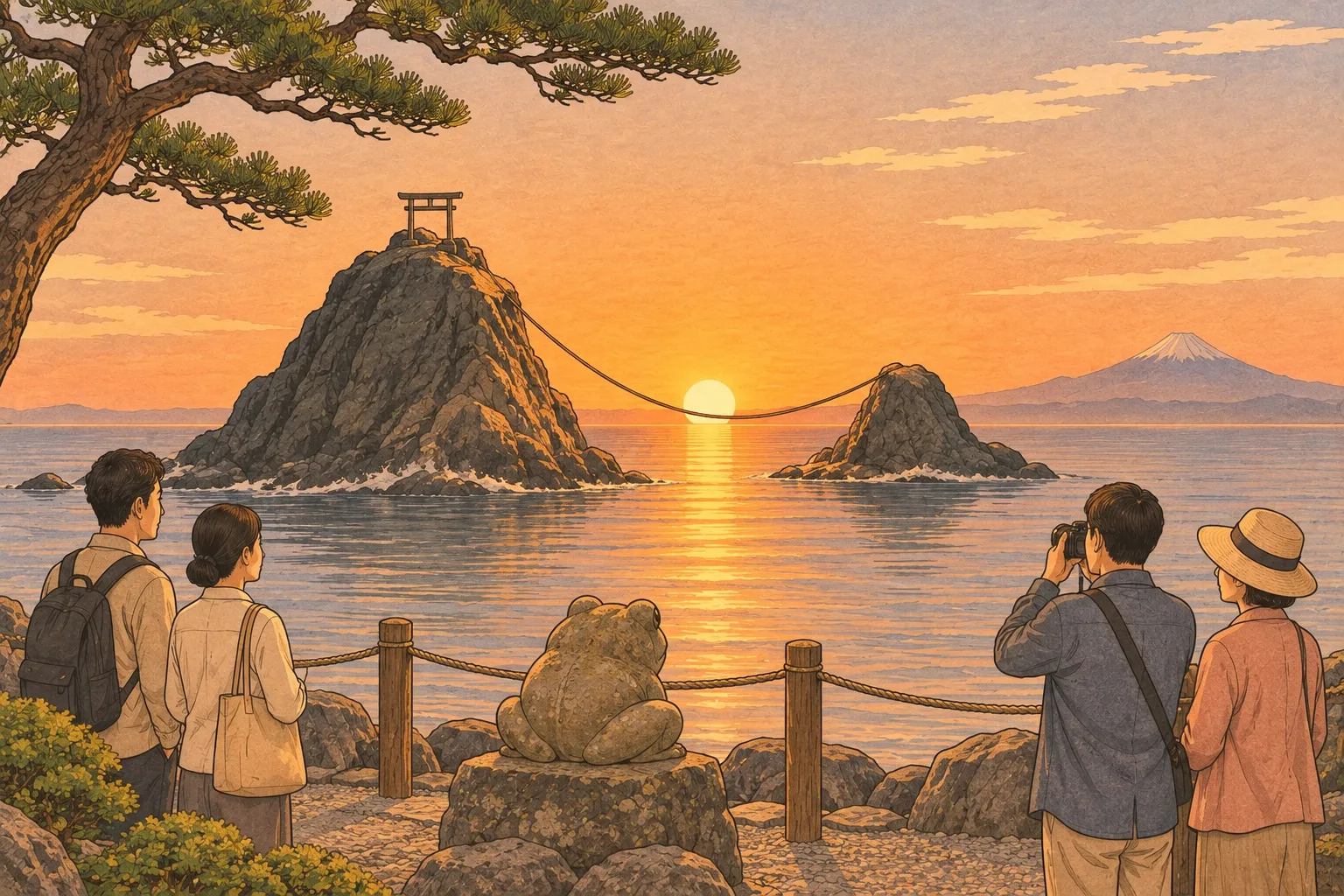
The Meoto Iwa at Futami: around the summer solstice the sun rises dead center between the rocks, and on a clear day Mount Fuji shows on the horizon. A frog statue left by worshipers sits on the shore.
Then there are the humbler stones of the countryside. Tateishi, standing stones, mark sacred spots and village boundaries. Dōsojin, guardian deities of roads and borders, stand at crossroads to block disease and evil from entering; Azumino in Nagano, with more than 400, is said to have more than any other municipality in Japan, and many are carved as a man and woman side by side, holding hands or with the woman pouring sake into the man’s cup. Shakujin or ishigami, "stone gods," are stones worshipped in themselves; the Tokyo district of Shakujii is said to take its name from a stone sword or rod found while digging a well. Fertility stones, frankly phallic or vulvar, are also found and celebrated without embarrassment in some villages. In Takasago, Hyōgo, Ōshiko Shrine worships the Ishi no Hōden, a carved block of rock about 5.7 meters high and weighing some 450 tons that appears to float above a pool of water; who cut it, and why, is still debated. Shrine legend credits the gods Ōnamuchi and Sukunahikona, the eighth-century Harima Fudoki names Mononobe no Moriya, and some archaeologists see an unfinished stone coffin or burial chamber.
08Stones you can touch
Most sacred trees and rocks are to be looked at from behind a fence. A few stones are meant to be handled.
Chikara-ishi, "strength stones," sit in corners of many shrines: oval boulders inscribed with their weight in kan (one kan is about 3.75 kg). In the Edo period, young men competed at festivals to lift them to the chest or over the head, and some stones carry the names of successful lifters; one of three at Teppōzu Inari Shrine in Tokyo’s Chūō Ward is inscribed as the stone lifted by one Kyūsuke of the Odawaraya. Today they are mostly on display, though a few communities still hold contests.
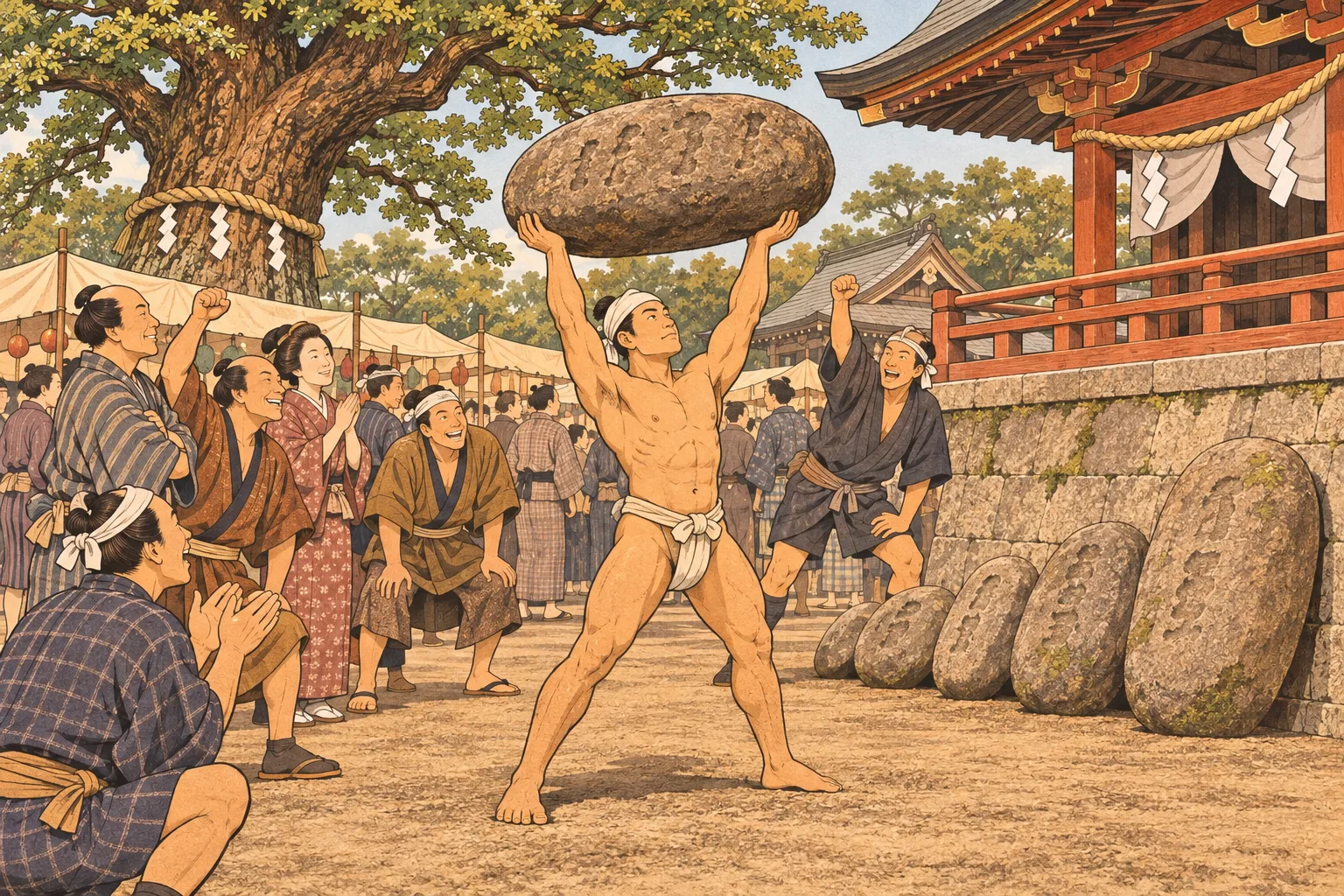
At an Edo-period shrine festival, young men compete to lift chikara-ishi, and this one has his over his head. More stones wait along the wall. (artist’s impression)
At Fushimi Inari in Kyoto, by the Okusha prayer hall, stand two stone lanterns topped with round stones called omokaru-ishi, the "heavy-or-light stones." Make a wish, then lift: if the stone feels lighter than you expected, your wish is likely to come true; if heavier, it will be hard to achieve. At Jishu Shrine in Kyoto, two "love-fortune stones" stand about ten meters apart; walk from one to the other with your eyes closed, and if you make it unaided, so will your romance. Statues of reclining oxen at Tenmangū shrines are rubbed for help with exams. Elsewhere, nade-ishi or "rubbing stones" are stroked and then the hand is placed on an aching part of the body. You can usually spot a stone that people are allowed to touch: decades of hands polish it smooth, dark and shiny.
Finally, the stones beneath your feet. Shrine approaches are covered with tamajari, small rounded white or gray pebbles that crunch with every step. Common explanations are that the white stone signifies purity, that the sound slows and quiets visitors and announces them to the kami, and that gravel drains rain quickly. At Ise, during the rebuilding of the shrines every twenty years, local residents take part in the Oshiraishi-mochi ceremony: over the preceding years they gather white stones 5 to 7 centimeters across from the Miya River, haul them in barrels to the shrines by cart or along the Isuzu River, and then each person carries a stone into the fenced grounds of the newly built main sanctuary and lays it there by hand, the only time ordinary people may enter that enclosure.
09Side by side
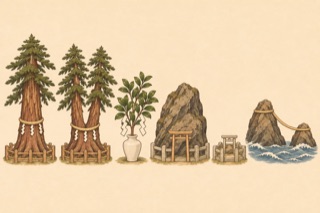
Six of these are easily confused, so here they are together.
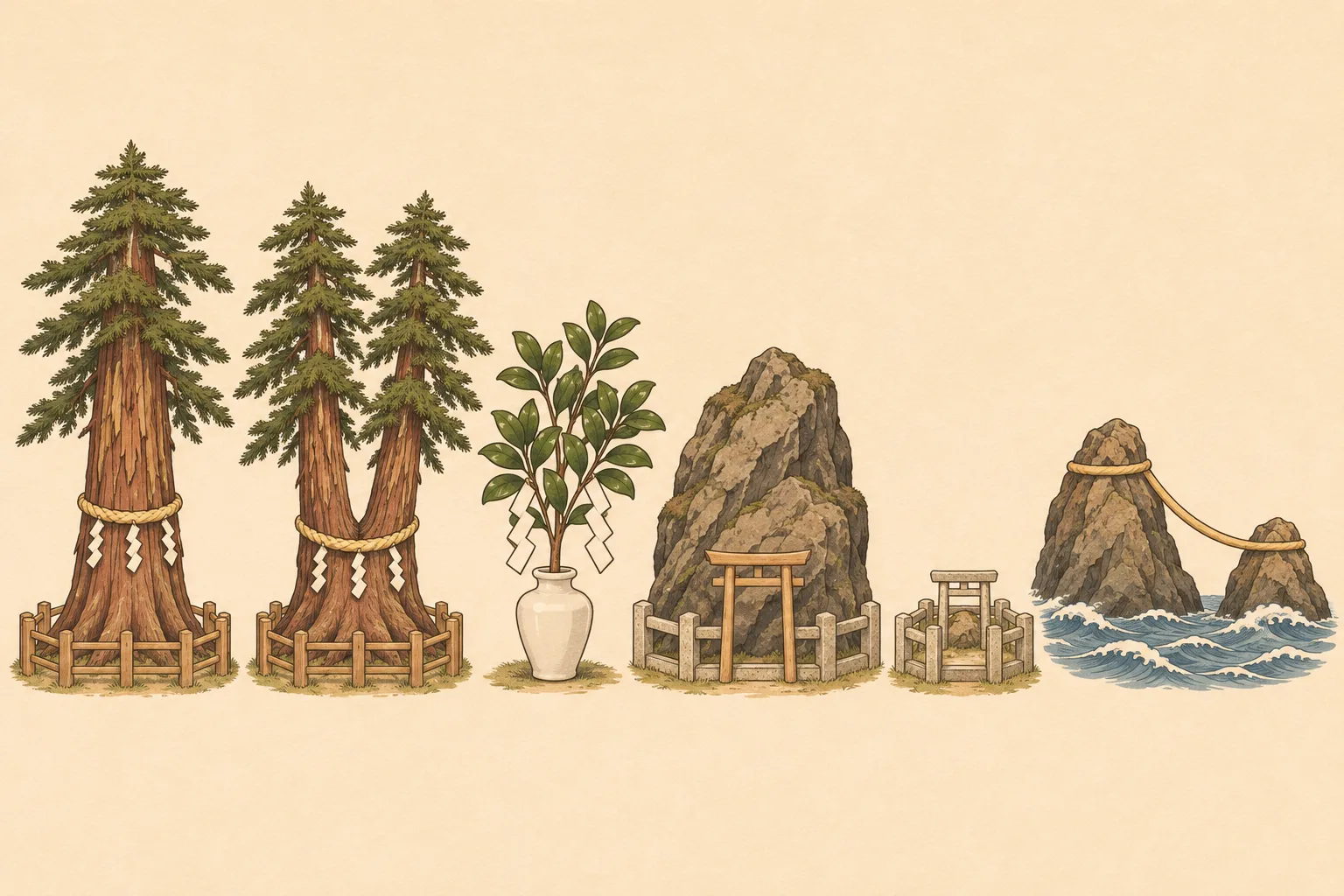
From left: a sacred cedar (one trunk, roped), married cedars (one root, two trunks), a sakaki branch in a vase, an iwakura (a boulder with a small torii and no sanctuary), a kanameishi (a rounded nub inside a stone fence) and the Meoto Iwa in the sea.
A sacred cedar is a single straight conifer with peeling red-brown bark and a narrow crown, roped and fenced, standing alone. It marks where a kami comes down; you bow to it.
Married cedars look similar, but check the base: one root, two trunks, or two trees pressed together. People ask them for relationships, and often walk around them.
Sakaki is not a tree you visit but a branch you use: glossy, smooth-edged leaves in a vase or in a worshipper’s hands, often with white paper streamers, replaced regularly.
An iwakura is a large natural boulder or rock face, often on a hillside or in woods, fenced and roped, with perhaps a small torii but no sanctuary. You worship it from a distance and never stand on it.
A kanameishi is the smallest of all: a rounded nub barely above the ground inside a little fence. It looks like nothing, but it carries the biggest story, holding down the earthquake catfish.
The Meoto Iwa are two rocks of unequal size standing in the sea. They are revered, but they act as a gate: you look between them toward the hidden sacred rock and the rising sun.
Put simply, the cedar and the iwakura are seats where a kami arrives; the married cedars and the Wedded Rocks have taken on meanings of union because they come in pairs; sakaki is the tree in human hands, an offering; and the kanameishi is a stone made almost entirely of story.
More deep dives on this topic
 ToriiA torii is two posts and one or two crossbeams, with no doors, no walls and no lock.
 Divine Messengers and KomainuWalk into almost any Shinto shrine and an animal meets you before anything else does.
 Shrine ArchitectureMost visitors to a Shinto shrine photograph the torii gate, the vermilion pillars and the bell rope in front of the hall, and leave thinking they have seen the shrine.
 Shimenawa, Shide and GoheiWalk into almost any Shinto shrine in Japan and you will pass under a rope.
 Reading Shrine NamesWalk up to almost any Shinto shrine in Japan and look at the wooden plaque hanging from the torii gate or the main entrance.
 OmikujiNext to the counter where a Japanese shrine sells its charms, there is usually a wooden box or a hexagonal canister and a small slot for coins.
 Shinto Priests and MikoSpend a morning at a large Japanese shrine and you will see two kinds of people in old-fashioned dress.
 Shikinen Sengū and ZōtaiWalk up to the main sanctuary of the Inner Shrine at Ise and you will notice, just beside it, an empty plot exactly the same size.
 Sacred Trees and StonesWalk into almost any Shinto shrine and something older than the buildings is usually waiting for you.
- Back to the main article: Shinto →