
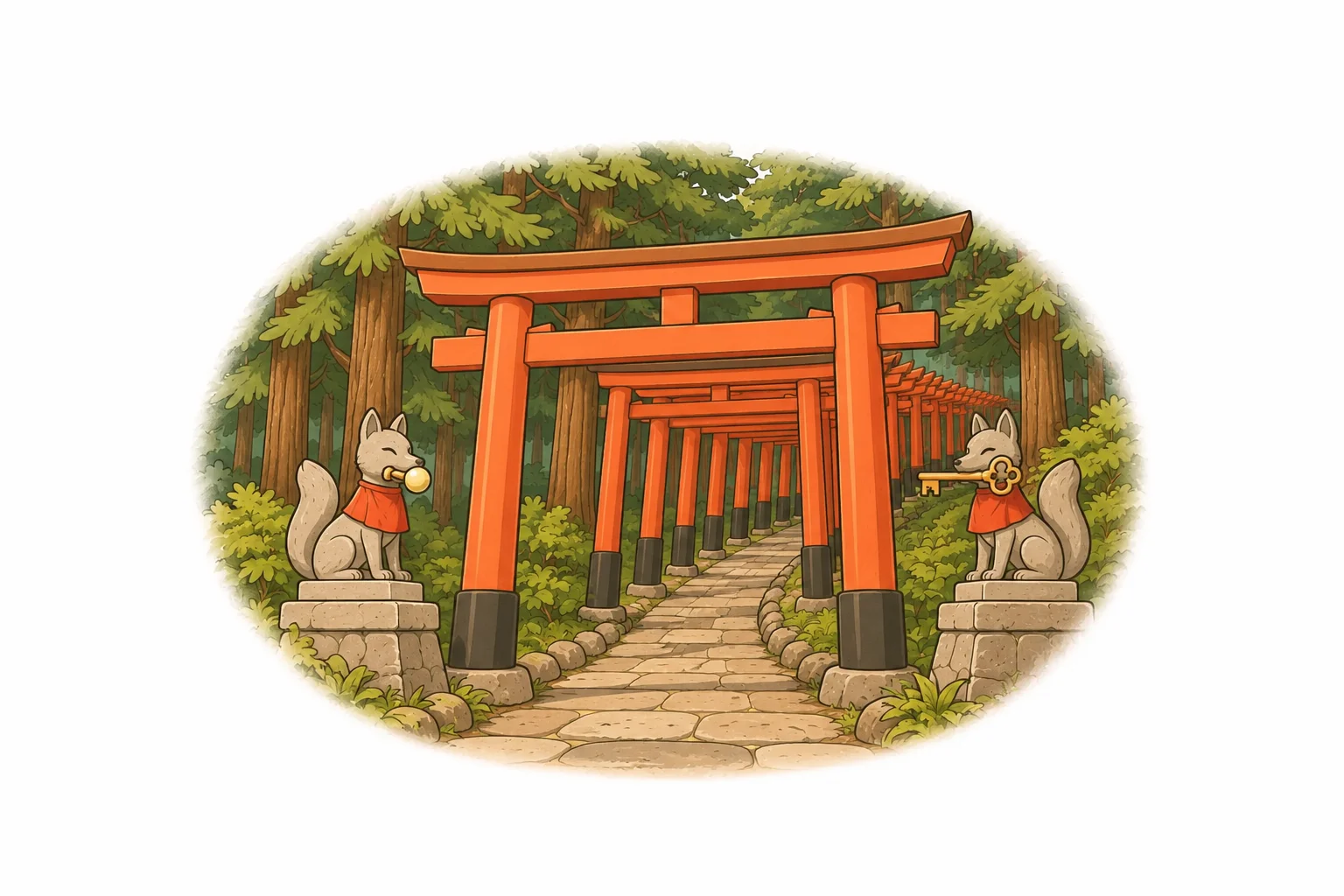
Many Japanese say they have no religion, yet they visit a shrine at New Year and are sent off by a Buddhist temple when they die. The easiest way to understand that arrangement is not to start with doctrine but to walk into particular places. The ten below follow, roughly, the order in which each layer of belief took root: a shrine rooted in myth, the first true Buddhist temple, a shrine and temple that merged into one, the two new schools of the early Heian period, the four movements of the Kamakura era, and finally the mountain of the rice god, where the nineteenth-century separation of gods and buddhas can still be traced.
For the bigger picture, keep Shinto and Japanese Buddhism at hand.
01Izumo Taisha: A Palace for the God Who Gave Away the Land
Izumo Taisha is dedicated to Ōkuninushi. In the Kojiki and Nihon Shoki, he yields his realm to the descendants of the sun goddess Amaterasu on condition that he receive a palace whose pillars reach bedrock and whose roof touches the heavens. That is myth, not a founding record, but the Izumo Fudoki of 733 shows the shrine was already famous. A primer of 970, the Kuchizusami, ranked its hall the tallest building in Japan, and pillars of three cedar trunks bound together, excavated from 2000, are generally dated to the hall completed in 1248.
Izumo is also a reminder that the line between gods and buddhas kept moving. In the Middle Ages the shrine was closely tied to Buddhism and its deity was for a time identified as Susanoo. When the hall was rebuilt with shogunate funds in 1667, the Buddhist buildings were removed and Ōkuninushi restored, about two centuries before the Meiji government’s separation, as the HO Guide to Izumo Taisha notes. The stories themselves are told in Japanese Mythology.
02Asuka-dera: Where Buddhism Took Root
Buddhist images and scriptures reached the Yamato court from the Korean kingdom of Baekje in either 538 or 552; the two dates are weighed in Buddhism Arrives from Baekje. According to the Nihon Shoki, Soga no Iname argued for worshipping the new Buddha while Mononobe no Okoshi opposed it. In 587 Soga no Umako vowed to build a temple before fighting Mononobe no Moriya. In 588 Baekje sent monks, relics and craftsmen, and work began on what was then called Hōkō-ji, essentially finished by 596. This was Asuka-dera, Japan’s first full-scale Buddhist temple.
In 605 Empress Suiko ordered a large Buddha image, which Tori Busshi cast and installed the next year (another source gives 609). Badly damaged in a fire in 1196 and heavily repaired, the Asuka Buddha is generally thought never to have left its original spot. The Ishibutai Tomb, generally thought to be Umako’s grave, lies about 1.5 kilometers away; the HO Guide to Asuka-dera and Ishibutai covers both.
03Kasuga Taisha: When Gods and Buddhas Became One
Kasuga Taisha was the clan shrine of the Fujiwara. Shrine tradition holds that around the move to Heijō-kyō the god Takemikazuchi was brought from Kashima and enshrined on Mount Mikasa, and that in 768, by order of Empress Shōtoku, Fujiwara no Nagate built sanctuaries on the hillside. Takemikazuchi is said to have arrived on a white deer, the origin of Nara’s sacred deer.
Kōfuku-ji, the Fujiwara clan temple, stands just to the west. From the late Heian period the two were treated as one under the idea of honji suijaku: buddhas and bodhisattvas are the original forms, and native gods are the forms they take in Japan. Each Kasuga deity was paired with a Buddhist figure, many of them the main images in Kōfuku-ji’s halls, so for a monk, praying at the shrine and in the temple were the same act, as the HO Guide to Kasuga Taisha explains. Kōfuku-ji controlled the shrine for centuries until the separation of 1868. Why such a partnership felt natural is the subject of Kami and Buddhas Under One Roof.
04Enryaku-ji: Tendai and the Mother Mountain
After full ordination at Tōdai-ji, Saichō returned to Ōmi and in 788 built a small hall on Mount Hiei with a Healing Buddha he had carved himself, the origin of the main hall of Enryaku-ji. He studied at Mount Tiantai in Tang China in 804, and the Tendai school was recognized in 806. He spent his last years campaigning for an ordination platform independent of Nara; permission came, according to the record, seven days after his death in 822, and the temple received its name the following year.
The mountain became a place where Tendai doctrine, esoteric ritual, meditation, precepts and the nenbutsu were all practiced, and several founders of the Kamakura schools studied there, which is why it is called the "mother mountain" of Japanese Buddhism (see Tendai Buddhism). It also kept armed monks, who carried the sacred palanquins of Hiyoshi Shrine into the capital to press their demands. Oda Nobunaga burned the mountain in 1571. The "inextinguishable lamp" in the main hall is described in the HO Guide to Enryaku-ji.
05Tō-ji: Esoteric Buddhism Enters the Capital
When the capital moved to Heian-kyō in 794, the court built two official temples on either side of Rashōmon, the main gate. In 823 Emperor Saga handed the unfinished eastern one, Tō-ji, to Kūkai, a moment traced in Saga Entrusts Tō-ji to Kūkai. Earlier official temples mixed several schools, but Tō-ji was set aside for 50 Shingon monks, and Kūkai asked that monks of other schools not live there. With that, Shingon Buddhism had a complete institutional form, and Tō-ji and Mount Kōya became its two centers.
In the Lecture Hall, 21 statues centered on Dainichi Nyorai form a "three-dimensional mandala," many of them ninth-century originals; the set Kūkai planned was consecrated only in 839. The five-story pagoda, about 55 meters tall, is the tallest wooden pagoda in Japan; Tokugawa Iemitsu donated the present one, the fifth according to records, in 1644. A market is still held on the 21st of each month, the day of Kūkai’s death.
06Chion-in: Hōnen and the Name of Amida
In 1175 Hōnen, after reading Shandao’s commentary on the Contemplation Sutra, committed himself to calling Amida’s name, left Mount Hiei and settled at Yoshimizu in the eastern hills of Kyoto. The Jōdo school dates its founding to that year. His message was that people who could not keep the precepts or read scripture could be reborn in the Pure Land simply by saying "Namu Amida Butsu," relying on Amida’s vow.
The practice was banned in 1207 and Hōnen was exiled. Pardoned in 1211, he lived at Ōtani and died there in 1212, at 78 (80 by the traditional count). In 1234 his disciple Genchi rebuilt the halls, usually treated as the founding of Chion-in. The Tokugawa were followers of the Jōdo school, and Ieyasu made Chion-in his family temple; the Sanmon gate was completed in 1621 and the Founder’s Hall in 1639, both National Treasures. On New Year’s Eve, 17 monks together ring its great bell. For the wider tradition, see Pure Land Buddhism in Japan and the HO Guide to Chion-in.
07Nishi Hongan-ji: From a Grave to a Great Head Temple
Shinran, a disciple of Hōnen, took the nenbutsu a step further, stressing that rebirth depends on sincerely entrusting oneself to Amida’s vow. Stripped of his clerical status and exiled to Echigo in 1207, he lived as "neither monk nor layman," married and raised a family, which became the most visible mark of the True Pure Land school.
Shinran died in Kyoto in 1263, and in 1272 his daughter Kakushinni built a memorial chapel for his remains and image at Ōtani. That chapel grew into Hongan-ji. Rennyo, the eighth head, turned the community into a mass movement in the later fifteenth century, and the temple moved several times before Toyotomi Hideyoshi granted it land at Rokujō Horikawa in Kyoto in 1591. In 1602 Tokugawa Ieyasu gave Kyōnyo land to the east, creating a rival temple, and the original became known as Nishi Hongan-ji. Its Founder’s Hall is larger than the Amida Hall, a feature of Shin temples; the HO Guide to Nishi Hongan-ji tells the full story.
08Eihei-ji: Dōgen and Just Sitting
Dōgen was ordained on Mount Hiei, studied Zen under Myōzen, and in 1223 sailed to Song China, where he trained under Rujing at Mount Tiantong before returning in 1227. After teaching in Kyoto and at Fukakusa, under growing pressure from Mount Hiei, he accepted an invitation from Hatano Yoshishige in 1243 and moved to Echizen. A temple named Daibutsu-ji was built there in 1244, and in 1246 he renamed it Eihei-ji, after the Later Han era name under which Buddhism was said to have reached China.
Dōgen taught "just sitting," meditation pursued not as a means to enlightenment but as practice itself. At Eihei-ji he composed many chapters of the Shōbōgenzō and set down rules for monastic life. He died in Kyoto in 1253, at 53 (54 by the traditional count). One to two hundred young monks still train here. Zen in Japan divided into the Rinzai, Sōtō and Ōbaku schools; see Zen and the HO Guide to Eihei-ji.
09Minobusan Kuon-ji: Nichiren’s Last Nine Years
Nichiren held that the Lotus Sutra was the Buddha’s final and highest teaching. In 1253 he began preaching the chant "Namu Myōhō Renge Kyō" and denouncing the nenbutsu. He presented the Risshō Ankoku Ron in 1260 and was exiled more than once; by his own later account he narrowly escaped beheading at Tatsunokuchi in 1271 before being sent to Sado, as told in Nichiren’s Arrest, Tatsunokuchi Tradition and Sado Exile.
Pardoned in 1274, he failed once more to persuade the shogunate and accepted an invitation from the steward Hakii Sanenaga to settle in a hut in Nishidani on Mount Minobu. Over nine years he lectured, wrote and trained disciples, and the hut grew into a temple; the name Kuon-ji is generally thought to date from this period. In 1282, ill, he left the mountain and died on the way at Ikegami in Musashi, aged 60 (61 by the traditional count). His remains were brought back to Minobu, and his grave in Nishidani is still the heart of pilgrimage. For the school itself, see Nichiren Buddhism.
10Fushimi Inari Taisha: The Gates After the Separation
The last stop is the most familiar god in Japan. Shrine tradition dates Fushimi Inari Taisha to 711, when Hata no Irogu of the immigrant Hata clan enshrined the deity on the peaks of Mount Inari. A god of the rice harvest, Inari became the guardian deity of Tō-ji after the founding of Heian-kyō, binding the shrine to Shingon. In the Edo period merchants spread the cult and began donating torii in the hope that their wishes would "go through"; as of 2026, some 10,000 are said to stand on the mountain.
In 1868 the new government ordered the separation of Shinto and Buddhism, and the Buddhist halls and images on the mountain and in the precinct were removed. Buddhist Inari did not vanish, though: Toyokawa Inari in Aichi Prefecture is in fact a Sōtō Zen temple. And when Inari’s sacred palanquin heads back to the shrine during the spring Inari Festival, it still stops at Tō-ji’s gate to receive offerings from the temple’s monks, as the HO Guide to Fushimi Inari Taisha describes. For foxes, gates and some 30,000 shrines across the country, see Inari Worship.
11Closing
Two threads run through these ten places. One is the growth of Buddhism: a gift from Baekje that became the Soga clan’s temple, then the two great Heian schools on Mount Hiei and at Tō-ji, and finally the Kamakura founders, Hōnen, Shinran, Dōgen and Nichiren, all of whom had studied on Mount Hiei before carrying chanting and sitting to a far wider public. The other is the partnership of gods and buddhas: Kasuga and Kōfuku-ji ran as one for nearly a thousand years, Hiei’s monks marched behind a shrine’s palanquin, and Inari guarded a Shingon temple. Izumo cleared out its Buddhist buildings in 1667; the order of 1868 split shrines from temples across the country. Yet the offerings at Tō-ji’s gate and a Zen temple called Toyokawa Inari show the cut was never clean. At the next shrine or temple you enter, ask what it enshrines, which school it belongs to, and what stands next door.