
01A Mountain Before a Shrine
Stand anywhere on the long approach to Kasuga Taisha and look east. Behind the vermilion buildings rises a low, rounded hill thick with evergreen trees. This is Mt. Mikasa, sometimes written Mikasayama, and it is the reason the shrine is here. It is not the grassy Mt. Wakakusa that most visitors to Nara photograph; that lies a little to the north. Mt. Mikasa is smaller and quieter, and the whole mountain is treated as sacred. There is no trail, and ordinary people are not allowed to climb it.
The hill was holy long before any shrine buildings stood at its foot. The Shoku Nihongi, the official chronicle of the eighth century, records that in 717 an embassy about to sail for Tang China made offerings to the gods of heaven and earth at the southern foot of Mt. Mikasa, praying for a safe crossing. One young member of that embassy was Abe no Nakamaro, who rose to high office at the Tang court and never managed to return home. A poem attributed to him, later included in the Kokinshū anthology and in the famous One Hundred Poets collection, imagines him gazing at the moon from China and recognizing it as the same moon that rose over Mt. Mikasa at Kasuga. For centuries afterward, the hill stood in Japanese memory for home seen from far away.
So when the Fujiwara family chose this place for their gods, they were building on an older sense that the eastern hills of the capital were where the divine came close.
02The God Who Rode a Deer
The shrine tells its own founding story this way. Around the time the capital moved to Heijō-kyō in 710, the warrior god Takemikazuchi was invited from Kashima, in Hitachi Province on the far eastern coast of Honshū, to protect the new capital. He was enshrined at a spot on the summit of Mt. Mikasa. According to legend, he made the long journey riding a white deer.
In 768, on the order of Empress Shōtoku, the minister of the left Fujiwara no Nagate built proper sanctuaries on the western slope of the hill, where the shrine stands today. Kasuga Taisha counts 768 as its founding year, and it marked its 1,250th anniversary in 2018.
Four deities were enshrined, each in its own small hall. The first is Takemikazuchi of Kashima. The second is Futsunushi, brought from Katori in Shimōsa Province, not far from Kashima. In the myths recorded in the Nihon shoki, these two are the divine generals sent down to subdue the land and persuade its earthly ruler to hand it over to the descendants of the sun goddess. The third is Ame-no-Koyane, and the fourth is a goddess known simply as Himegami, generally understood as his consort. Both came from the Hiraoka shrine in Kawachi Province. In myth, Ame-no-Koyane is the god who recited prayers before the cave where the sun goddess hid, and the Nakatomi family, hereditary ritual specialists at the court, claimed him as their ancestor.
That last detail explains the whole arrangement. The founder of the Fujiwara was Nakatomi no Kamatari, who received the new surname Fujiwara on his deathbed in 669. His son Fujiwara no Fuhito turned the family into the most powerful at court, played a leading role in building Heijō-kyō, and moved the family temple, Kōfuku-ji, to its present site just west of here. The Nakatomi had close ties to the Kashima and Katori region, and a widely repeated story, found in the late Heian Ōkagami, holds that Kamatari himself was born at Kashima, though this cannot be proven; the Fujiwara family biography Tōshi kaden places his birth at Fujiwara in Yamato. By bringing together the two warrior gods of the east and the ritual ancestor of the Nakatomi, Kasuga expressed what the Fujiwara believed about themselves: a priestly lineage that was also the loyal protector of the throne.
03Clan Shrine of the Regents
Aristocratic families of the Nara period each had an ujigami, a clan deity, and many had a clan temple as well. For the Fujiwara, the god was Kasuga and the temple was Kōfuku-ji, side by side on the eastern edge of the capital.
When the capital moved to Heian-kyō, modern Kyoto, at the end of the eighth century, Nara became the "southern capital," a city of great temples rather than government. Kasuga’s importance did not fade, however, because its patrons were the family that came to dominate the Heian court as regents and chancellors. Fujiwara births, coming-of-age ceremonies and promotions were reported to the Kasuga gods. The head of the clan made formal pilgrimages to Nara, known as Kasuga mōde, which were large processions of nobles, guards and musicians traveling several days from Kyoto. Leaders such as Fujiwara no Michinaga and Fujiwara no Yorimichi made the journey.
The shrine also became part of state ritual. The Kasuga Festival, attended by an envoy from the emperor, is said to date from the mid-ninth century, and it came to be counted with the Aoi Festival in Kyoto and the Iwashimizu Festival as one of the three great festivals attended by imperial envoys. It was originally held twice a year on a day of the monkey in the zodiac cycle, which is why it was also called the Saru Matsuri, or Monkey Festival. Since the Meiji period it has been held every year on March 13. It is still attended by an imperial envoy, though the rites take place within the shrine buildings and are not a public spectacle.
Emperors also came in person. The first imperial visit to Kasuga is generally dated to the third month of 989, by Emperor Ichijō. Ichijō’s maternal grandfather was the regent Fujiwara no Kaneie, who pressed for the visit, and an emperor worshipping at the shrine of his mother’s family made the bond between the throne and the Fujiwara plain for all to see.
04Kasuga-zukuri and the Renewal of the Halls
The four main sanctuaries stand in a row facing south, behind a vermilion fence. Each is tiny: a single bay wide and a single bay deep, with a roof of layered cypress bark and a projecting eave over the front steps. The pillars are vermilion, the walls white, and the woodwork is touched with green pigment and metal fittings. This form is called Kasuga-zukuri, the Kasuga style, and it became one of the basic types of shrine architecture, used for many small shrines across the Kinai region around Nara and Kyoto.
The four halls are designated National Treasures. The present buildings date from a rebuilding in 1863, near the end of the Edo period. Kasuga has long followed a custom called shikinen zōtai, the periodic renewal of the sanctuaries, roughly every twenty years, so that the gods always dwell in fresh, pure buildings. The shrine traces the practice back to its founding, and until the Edo period the halls are generally said to have been rebuilt outright in most cycles. Since the Meiji period, when the buildings came under cultural-property protection, the renewal has been carried out mainly as restoration: replacing the bark roofs, repainting the vermilion, and repairing damaged timber rather than tearing everything down. The most recent renewal, counted as the sixtieth, was completed in 2016.
That is why the sanctuaries look almost new. Their structure is from 1863, but their roofs and paint are recent. Keeping them bright is not a modern restoration choice; it is the point of the tradition.
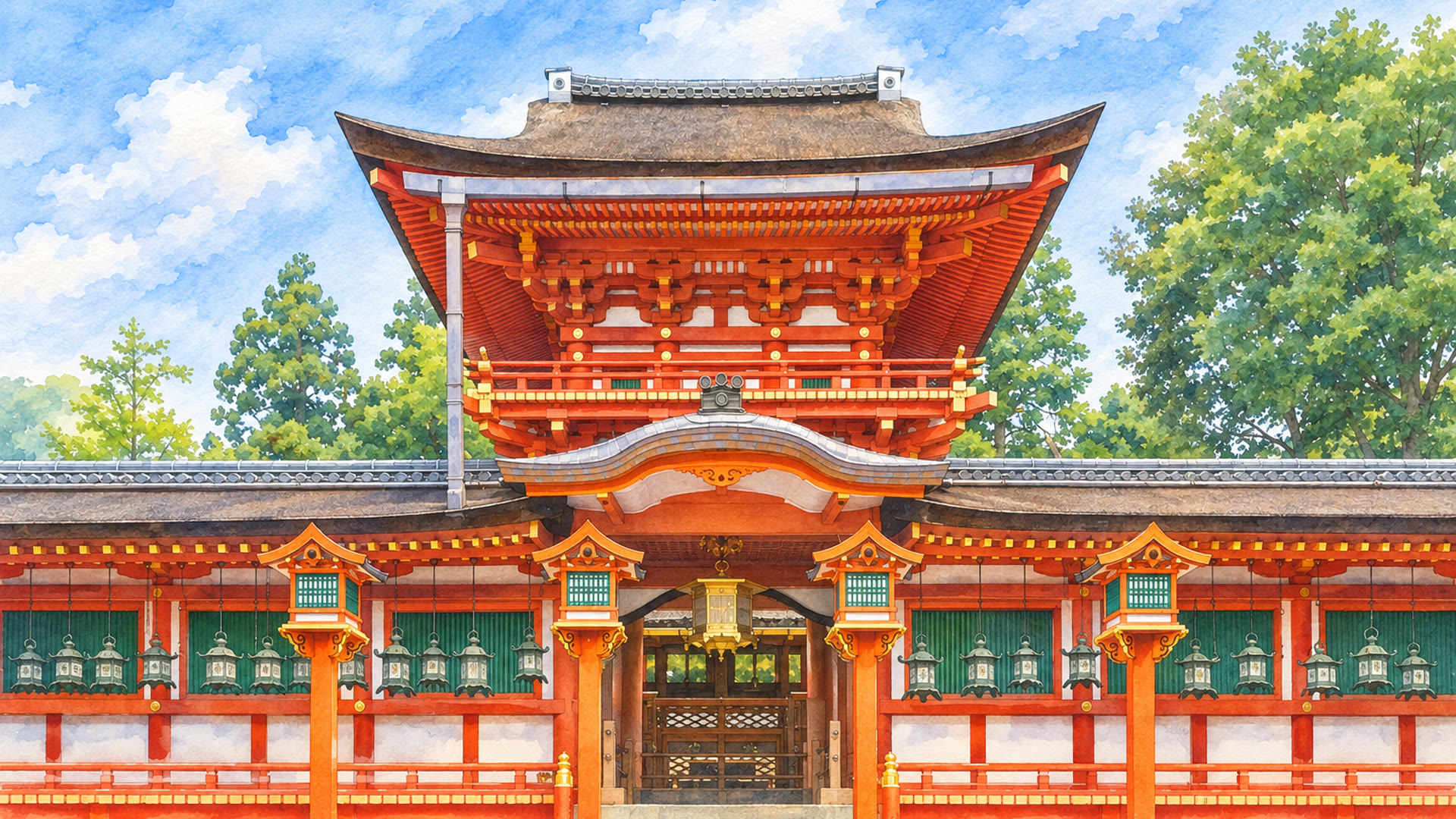
Around the sanctuaries, the middle gate and its galleries were rebuilt in 1613 and the corridors in the same Keichō era; the offering hall, dance pavilion and naorai hall date from the mid-seventeenth century; the south gate is older, rebuilt in the 1380s. The Wakamiya sanctuary, like the main halls, dates from 1863. All are Important Cultural Properties, among 27 structures at the shrine with that designation.
05Gods and Buddhas
For most of its history, Kasuga was inseparable from Kōfuku-ji. Today they are separate institutions, one a shrine and one a temple, but for close to a thousand years they functioned almost as one.
From the Heian period, Japanese religion was shaped by the idea known as honji suijaku: buddhas and bodhisattvas are the original forms, and the native gods are the traces they leave, the forms they take to reach the people of Japan. Each of the Kasuga deities was paired with a Buddhist figure. A common set of pairings links Takemikazuchi with Shaka (the historical Buddha) or the bodhisattva Fukūkenjaku Kannon, Futsunushi with Yakushi, the Buddha of healing, Ame-no-Koyane with Jizō, Himegami with the Eleven-Headed Kannon, and the later Wakamiya deity with Monju, though different periods and sources give different lists. Many of these were the main images in Kōfuku-ji’s halls, so for a Kōfuku-ji monk, worshipping at the shrine and praying in the temple were the same act.
This belief produced a distinctive kind of painting, the Kasuga mandala. From the Kamakura period onward, artists painted bird’s-eye views of the shrine, its torii gates, approach and sanctuaries, with Mt. Mikasa and the Kasuga hills behind. Some showed the corresponding buddhas floating above the mountain; others showed a single deer carrying a sacred mirror on a sakaki branch on its back. These paintings hung in Kyoto households and temples, allowing devotees who could not travel to Nara to worship from afar. Many survive in museum collections.
From the late Heian period, Kōfuku-ji took over effective control of the shrine. Its monks held shrine offices, and shrine rites and temple ceremonies were woven together. The hereditary priests came from families descended from the Nakatomi, but the temple held the real authority. The combined institution owned vast estates and could call on large numbers of men.
The great artistic statement of this combined faith is the Kasuga Gongen Genki-e, a set of twenty illustrated handscrolls completed in 1309. It was commissioned by the powerful courtier Saionji Kinhira and painted by the court artist Takashina Takakane. Its scenes tell of miracles in which the Kasuga deity protected Fujiwara nobles and Kōfuku-ji monks. The scrolls were presented to the shrine, later passed to the Takatsukasa family, and were given by them to Emperor Meiji. In 1989 they were donated to the state with other works from the imperial collection; they are now held at the Museum of the Imperial Collections, Sannomaru Shōzōkan, and were designated a National Treasure in 2021.
06The Sacred Tree Comes to Kyoto
The union of shrine and temple also gave Kōfuku-ji a formidable political weapon.
In the late Heian period, great temples defended their estates and privileges by sending armed monks to Kyoto to press their demands on the court, a practice known as gōso, forceful appeal. The monks of Enryaku-ji on Mt. Hiei carried down the portable shrines of the Hie gods. The monks of Kōfuku-ji carried the shinboku, the sacred tree of Kasuga: a sakaki branch hung with sacred mirrors, believed to hold the presence of the Kasuga deity itself.
The first march of the sacred tree into Kyoto is usually dated to 1093; some records place an earlier entry in the late tenth century, but 1093 is the conventional starting point. Once the tree reached Kyoto and was installed in a temple there, every courtier of Fujiwara descent was bound to stay home in ritual seclusion, since his own clan god had come to the capital in anger. With most of the court absent, government could grind to a halt until the demands were met and the tree was escorted back to Nara. Retired Emperor Shirakawa is said to have complained that only three things in the realm defied his will: the waters of the Kamo River, the fall of the dice, and the monks of Mt. Hiei. The monks of Nara were just as troublesome. The phrase "Yamashina logic," after Kōfuku-ji’s old name, came to mean an unreasonable demand pressed through religious authority.
Such appeals recurred for more than two centuries, continuing into the late fourteenth century. Neither the Kamakura nor the Muromachi shogunate fully mastered the southern capital, and Yamato Province effectively had no ordinary military governor; Kōfuku-ji and Kasuga held the dominant authority there.
At the end of 1180 by the Japanese calendar (January 1181), early in the Genpei War, Taira no Shigehira, acting for Taira no Kiyomori, attacked the hostile monks of Nara and set the city ablaze. Tōdai-ji’s Great Buddha Hall and nearly all of Kōfuku-ji burned. Kasuga is generally thought to have escaped serious damage, and its rites continued while the temples were rebuilt in the early Kamakura period.
07The Wakamiya and the On-matsuri
A short walk south of the main sanctuaries stands a small shrine called the Wakamiya, the "young shrine." Its deity, Ame-no-Oshikumone, is regarded as the divine child of Ame-no-Koyane and Himegami. According to the shrine’s tradition, he first appeared in 1003 and was at first worshipped within the main sanctuary; in 1135 a separate hall, as grand as those of the main shrine, was built for him on the present site, generally credited to the chancellor Fujiwara no Tadamichi.
The following year, 1136, after years of famine and epidemic, Tadamichi sponsored a great festival to pray for relief and good harvests. The Wakamiya deity was carried out to a temporary lodging, the otabisho, and entertained there with performances. This was the first Kasuga Wakamiya On-matsuri, and the festival is said to have been held every year since without a break, close to nine centuries.
Today the On-matsuri takes place in mid-December, with its main day on the 17th. Around midnight at the start of that day, in the rite of transfer, every light in the shrine is put out. Priests surround the deity with sakaki branches and, chanting a long, low "oh," move through the darkness and the smoke of torches to the temporary shrine. In the afternoon a costumed procession sets out from the city: officials, mounted warriors, dengaku field-music troupes and sarugaku performers, often described as a living picture scroll of Japanese costume history. Before the temporary shrine, on a stage of turf, come kagura sacred dance, azuma-asobi, dengaku, the mysterious hosoo dance, sarugaku and bugaku court dance, some of them forms that have vanished elsewhere. Before midnight the deity is returned to the Wakamiya. The temporary shrine, built of pine branches and unbarked timber, is made new each year and dismantled afterward.
The On-matsuri is designated an Important Intangible Folk Cultural Property. For historians of medieval performing arts it is something close to a living museum. Sarugaku, the forerunner of Noh, was performed here, and the Yamato sarugaku troupes, including those that became the Konparu and Kanze schools, had deep ties to Kōfuku-ji and Kasuga.
08The Deer
The first residents of Kasuga most visitors meet are the deer. They stroll the approach, nudge people for the special crackers sold for them, and sometimes bow.
The deer are regarded as messengers of the Kasuga gods, an idea rooted in the legend of Takemikazuchi’s white deer. In the medieval period, Kōfuku-ji and the shrine protected them fiercely, and harming or killing one could bring severe punishment. Nara folklore tells of a child who accidentally killed a deer and was buried alive with it as punishment; such stories are later legends that cannot be verified, but they show how seriously the animals were taken. Another popular saying holds that people in Edo-period Nara rose early to check whether a deer had died in front of their house, since that would bring trouble, though this too is folk explanation.
The deer population fell sharply in the upheavals of the early Meiji period and again during and after World War II, and recovered under protection. In 1957 the "deer of Nara" were designated a Natural Monument. They are wild animals, not livestock, and are not owned by the shrine; a local preservation foundation looks after them. Each autumn the antlers of the stags are cut so they will not injure people, a custom that began in the Edo period.
09Three Thousand Lanterns
The other unforgettable feature of Kasuga is its lanterns. Moss-covered stone lanterns line the approach from the first torii all the way to the shrine, and inside the corridors hang rows of bronze and iron lanterns. The shrine counts about 3,000 in all, roughly 2,000 stone and 1,000 hanging.
Every one was a gift. From the Heian period onward, Fujiwara nobles, shoguns and daimyo, merchants and ordinary townspeople donated lanterns to make a vow or give thanks for a prayer answered. One stone lantern is said to date back to the late Heian period, but most were given in the Edo period, and many still bear the donor’s name and the date. Reading them on the approach, you will find the names of merchants from across Japan.
Lanterns were once lit with oil paid for by donors. Today they are lit all together only on special occasions called Mantōrō, the Ten Thousand Lanterns, held at the Setsubun festival in early February and on August 14 and 15.
The shrine’s treasures go far beyond lanterns. Kasuga holds a large collection of Heian and Kamakura armor, swords, musical instruments and decorative art, including many National Treasures, among them a Kamakura-period suit of armor laced with red silk and a Heian-period ceremonial sword decorated with gold and mother-of-pearl. Because these gifts from the Fujiwara and later patrons were kept at the shrine for centuries, the collection is sometimes called the "Shōsōin of the Heian period," after the famous eighth-century imperial storehouse at Tōdai-ji. The shrine’s museum, the Kokuhōden, shows the collection in rotation.
10After Meiji
In 1868 the new Meiji government ordered the separation of Shinto and Buddhism, stripping shrines of Buddhist elements. For Kasuga and Kōfuku-ji it was the greatest change in a thousand years. Most Kōfuku-ji monks returned to lay life, and many of them became Kasuga priests. The temple lost its lands, many of its buildings were neglected or pulled down, and its five-story pagoda is said to have come close to being sold. Kasuga, now a purely Shinto institution, was ranked in 1871 among the highest grade of government-supported shrines.
For a time in the modern period the shrine was known as Kasuga Jinja; it took the name Kasuga Taisha in 1946. As Nara Park was developed and modern tourism grew, it became a fixture of school trips and sightseeing.
The Kasuga hills behind the shrine are recorded as having been protected from hunting and logging since 841 because of their sacred status, and they preserve a rare stand of primeval broadleaf evergreen forest at the edge of a city. The Kasugayama Primeval Forest was designated a Special Natural Monument in 1955. In 1998 Kasuga Taisha and the forest were inscribed on the World Heritage List together with Tōdai-ji, Kōfuku-ji, Gangō-ji, Yakushi-ji, Tōshōdai-ji and the Heijō Palace site as the Historic Monuments of Ancient Nara.
By the shrine’s own count, about 3,000 Kasuga shrines across Japan carry its gods, and Kasuga Taisha is their head shrine.
11A Walk Through the Grounds
Coming east from Nara Park, you pass first under the great vermilion first torii, where the approach begins and the stone lanterns start to crowd in. To the south opens a wide lawn called Tobihino, where the deer gather to graze.
The approach continues east under tall cedars and evergreen oaks, lanterns on both sides; it is worth stopping to read the dates carved on them. Near the shrine you reach the second torii and the small Haraedo shrine beside it, where worshippers once purified themselves before going on.
Through the vermilion south gate you enter the corridors. Ahead are the offering hall and the dance pavilion, where ordinary visitors pray. Bronze lanterns hang all along the eaves. In the courtyard grows a famous old wisteria, the Sunazuri-no-Fuji, whose long flower clusters nearly brush the ground when it blooms; it is said to be more than 700 years old. Wisteria, fuji, is the emblem of the Fujiwara, and the shrine’s crest is a wisteria flower.
The four sanctuaries stand behind the middle gate, and most visitors worship from in front of it, glimpsing the roofs of the four Kasuga-zukuri halls behind the fence. Special admission areas, when open, allow a closer look at the vermilion and gold.
Leaving the main precinct, a path leads south to the Wakamiya and a string of smaller shrines that can be visited in turn. In December, this is where preparations for the On-matsuri unfold.
Finally, turn east toward Mt. Mikasa. There is no path to its summit. The Kasuga god first descended there, and for more than a thousand years people have worshipped from the foot of the hill without disturbing it. A last look at that quiet mountain shows you the true center of the shrine.