
01A Town with a Famous Name
Ashikaga is a modest city in the southwest of Tochigi Prefecture, on the Watarase River at the edge of the Kantō plain. Its name, however, carries great weight in Japanese history. The Ashikaga shoguns, who ruled from Kyoto for more than two centuries from the 1330s, took their family name from this place.
In the twelfth century Minamoto no Yoshiyasu, a member of the Seiwa Genji warrior lineage, held estates here and adopted the local name. His son Ashikaga Yoshikane fought for Minamoto no Yoritomo and became a prominent vassal of the Kamakura shogunate. The family residence was later turned into a temple, Banna-ji, which still stands a few minutes’ walk north of the school, ringed by its earthen bank and moat. Yoshikane’s descendant Ashikaga Takauji overthrew the Kamakura regime and founded the Muromachi shogunate in the fourteenth century. Although the shoguns lived in Kyoto, Ashikaga remained the family’s ancestral home.
The Ashikaga School grew up in this setting. Its survival and its fame in the Middle Ages owed much to the prestige of the place.
02Who Founded It?
The school is commonly called the oldest in Japan, but its beginnings are obscure. Three accounts have come down.
The first credits Ono no Takamura, a ninth-century courtier and poet famous for his learning and his defiant temper, and the subject of a legend that he traveled at night to the court of the king of the underworld. He is said to have founded the school while serving as a provincial official in Shimotsuke, the old province that included Ashikaga. A statue of him is still honored at the school. No contemporary record supports the story, and it is usually treated as a later embellishment.
The second credits Ashikaga Yoshikane, who is said to have established a place of study near his residence in the late twelfth century. This is more plausible but equally undocumented.
The third view holds that whatever existed earlier, the school as a functioning institution really begins with Uesugi Norizane in the fifteenth century, whether he revived a declining school or effectively created a new one. On this, at least, the records are firm.
03Uesugi Norizane and the Revival
In the early fifteenth century the Muromachi shogunate governed eastern Japan through a regional government at Kamakura. Its head, the Kamakura kubō, came from a branch of the Ashikaga family; his chief deputy, the Kantō kanrei, came from the Uesugi family.
Norizane served as kanrei under the kubō Ashikaga Mochiuji, an ambitious man who resented the authority of the shogun in Kyoto, Ashikaga Yoshinori. Norizane repeatedly urged restraint and in turn fell under suspicion. In 1438 the conflict broke into open war, known as the Eikyō Rebellion. Norizane, with great reluctance, sided with the shogun; Mochiuji was defeated and took his own life at Kamakura early in 1439, and the Kamakura government was destroyed for a time.
It was in these same years that Norizane turned his attention to the school at Ashikaga. The standard account is that around 1439 he donated Song-dynasty printed editions of the Confucian classics with their commentaries, and invited Kaigen, a Zen monk from Engaku-ji in Kamakura, to serve as the first headmaster, or shōshu. Some accounts instead date the start of the revival to 1432, when Norizane became lord of the Ashikaga estate. A few years later, in 1446 according to the usual dating (some sources give 1447), he issued three regulations that limited instruction to the Confucian classics and selected Chinese works, including the Liezi, the Zhuangzi, the Records of the Grand Historian and the Wenxuan anthology; Buddhist scriptures were to be studied in Zen monasteries, not at the school.
Why Norizane did this is not stated in the sources. Two explanations are often offered. Ashikaga was the ancestral seat of the shogun’s family, so a school there had symbolic value for bringing order to a troubled region. And Norizane, having taken up arms against his own lord, sought again and again to resign, eventually took Buddhist vows at Kokusei-ji in Izu and spent his last years wandering, dying in 1466 at Tainei-ji in Nagato, at the western end of Honshū. Later writers linked his patronage of learning to this remorse, but that connection is interpretation, not record.
Some of the books he gave are still held by the school, and they bear his inscriptions forbidding their removal from the premises. His son Uesugi Noritada gave a Song edition of the Book of Changes with commentary, and other members of the Uesugi family added further donations. Four of the school’s Song editions are now designated National Treasures of Japan: the Shangshu zhengyi, the Liji zhengyi, the Zhouyi zhushu and the Wenxuan. Some of them preserve texts that became rare or were lost in China, which makes them important to scholars of Chinese books as well as to Japanese historians.
04Monks, Students and the Classics
The Ashikaga School did not look like a modern school. The headmasters were Zen monks, and the institution had the form of a temple. Students, called gakuto, shaved their heads and wore monks’ robes for the duration of their studies, whatever their background. Many came from warrior families, and after their training some returned home while others entered the service of regional lords.
Medieval Chinese learning in Japan was carried largely by Zen monks of the great Five Mountains temples of Kyoto and Kamakura, and the Ashikaga School belonged to that tradition while developing its own character far from the capital. Students copied texts, attended lectures and studied together. A good number of surviving manuscripts at the school are lecture notes and annotated copies made by students in this period.
The school was supported by donations and land revenues, and the line of headmasters continued without a break from Kaigen until the end of the Edo period.
05The Book of Changes and the Art of War
Among the classics, the school gave pride of place to the Book of Changes (Yijing, known in Japanese as Ekikyō). This was at once a canonical text and a manual of divination, in which yarrow stalks were cast to produce hexagrams that indicated good or ill fortune. Medieval warriors believed that the day, direction and rituals of a campaign could decide its outcome, and they wanted experts who could read the signs.
The school therefore taught divination, military lore and medicine alongside the classics. In the Sengoku period, the age of warring states in the fifteenth and sixteenth centuries, warlords across Japan engaged graduates of Ashikaga as gunbaisha: advisers who divined auspicious days for setting out, chose favorable directions and presided over the rituals of departure. This is why the school is sometimes described as a "school for military advisers."
That phrase needs care. The gunbaisha were specialists in divination and ritual, not field commanders. The brilliant strategist trained at Ashikaga who appears in later novels and dramas is largely a creation of fiction.
06Kyūka and Xavier: The "University of the Bandō"
The school reached its height in the mid-sixteenth century under its seventh headmaster, Kyūka, a learned monk from Ōsumi in southern Kyūshū who enjoyed close ties with the Later Hōjō, the clan that then dominated the Kantō. In 1560 he met Hōjō Ujiyasu and his son Ujimasa, and with their backing the school was refurbished. Tradition says the school had as many as 3,000 students in his time. The figure comes from later accounts and may be inflated, but it reflects a school of real size and reputation.
In 1549 the Jesuit missionary Francis Xavier landed at Kagoshima. In a letter sent from Kagoshima later that year he described several great centers of learning in Japan and wrote that the largest and most famous, with the most students, was in the Bandō, an old name for the Kantō region. This is generally taken to mean the Ashikaga School, and the passage gave rise to the description of it as the "university of the Bandō." Xavier never visited Ashikaga himself and was relying on what Japanese informants told him, but the letter made the school one of the first Japanese institutions known by name in Europe.
07From the Hōjō to Tokugawa Ieyasu
The Later Hōjō lords of Odawara, including Hōjō Ujiyasu and Hōjō Ujimasa, protected the school and gave it books. The Song edition of the Wenxuan now designated a National Treasure is generally said to have been a gift from Ujimasa, who had obtained it from the old Kanazawa Bunko library.
In 1590 Toyotomi Hideyoshi besieged Odawara and destroyed the Later Hōjō, and the Kantō changed hands. The school went through a period of disruption. According to the usual account, Toyotomi Hidetsugu took the headmaster, Kanshitsu Genkitsu, and part of the library to Kyoto; after Hidetsugu’s forced suicide in 1595, Tokugawa Ieyasu arranged for the books to be returned. The details vary between sources.
Genkitsu, the ninth headmaster, was also known as Sanyō. His learning and skill in divination won the favor of Tokugawa Ieyasu, and he became one of Ieyasu’s advisers. Ieyasu set up a school at Fushimi under his direction and had him print Chinese works such as the Kongzi jiayu (School Sayings of Confucius) and the Zhenguan zhengyao (Essentials of Government of the Zhenguan Era) with wooden movable type. These "Fushimi editions" are landmarks of early printing in Japan. Genkitsu later founded the temple Enkō-ji in Kyoto. There are stories that he performed divinations for Ieyasu before the Battle of Sekigahara in 1600, but these belong to tradition.
08The Edo Period: Annual Divinations and Slow Decline
The Tokugawa shogunate granted the school lands and protection. Each year the school prepared a divination for the coming year and presented it to the shogun, a ritual that became a fixed link between the school and the shogun’s house.
In 1668, with the shogunate’s support, the school built its Confucian shrine, the Taiseiden, together with the Gakkō Gate and the Kyōdan Gate. These buildings form the core of the site today. Shrines to Confucius were still rare in Japan, and this one is generally considered the oldest that survives.
Yet the school’s golden age was over. Learning in the Edo period moved toward the Neo-Confucianism promoted by the Hayashi family, the shogunate maintained its own academy in Edo, and domains founded schools of their own. The Ashikaga School, with its emphasis on divination and medieval textual traditions, fell out of step with the new scholarship, and in an age of peace there was no longer much call for battlefield diviners. Student numbers dwindled, and the school became more a repository of books and a place of Confucian ritual than a teaching institution. Its library, however, still drew scholars, and textual critics of the Edo period came to consult its old manuscripts and Song editions.
09Closure and Preservation
After the Meiji Restoration the old institutions were reorganized, and in 1872 the Ashikaga School was formally abolished. Its lands were taken back and some buildings were removed or put to other uses. The Confucian shrine and the books were saved through the efforts of local people. In 1903 the Ashikaga Gakkō Iseki Library was opened on the site to house the school’s old collection and make it available to the public; it was the first public library in Tochigi Prefecture.
In 1921 the site was designated a national Historic Site. From the later Shōwa period the city of Ashikaga undertook a systematic restoration, using Edo-period plans and archaeological investigation, and by 1990 it had reconstructed the abbot’s hall, kitchen quarters, study hall and gardens in approximately their mid-Edo form.
In 2015 the Agency for Cultural Affairs began recognizing "Japan Heritage" stories, and the Ashikaga School was included in the first group, alongside the Kōdōkan in Mito, the Shizutani School in Okayama Prefecture and the Kangien academy in Hita, under the theme of early modern Japan’s educational heritage.
10Walking the Grounds
Coming from the street, you first pass through the Nyūtoku Gate, the "gate of entering virtue." This gate is said to have been rebuilt over the years and is not among the oldest structures. Next comes the Gakkō Gate, whose plaque bearing the two characters for "school" is the emblem of the site and appears in countless photographs. The Gakkō Gate and the Confucian shrine date from 1668, as does the original construction of the Kyōdan Gate beyond, and they are the oldest parts of the complex.
Through the Kyōdan Gate stands the Taiseiden. Inside is a seated statue of Confucius, generally dated to the late Muromachi period, and beside it an image of Ono no Takamura, a reminder of the legend of the school’s founding. The building follows Chinese temple style and contrasts with the Japanese buildings around it.
To one side are the reconstructed abbot’s hall, kitchen quarters and study hall. The abbot’s hall, where the headmaster lived and taught, now displays material on the school’s history. A popular feature on the grounds is a replica of the yūza no ki, a vessel that tilts when empty, sits upright when filled to a moderate level and overturns when full. It illustrates a lesson attributed to Confucius in the Xunzi, that fullness leads to overturning, and visitors can try it for themselves.
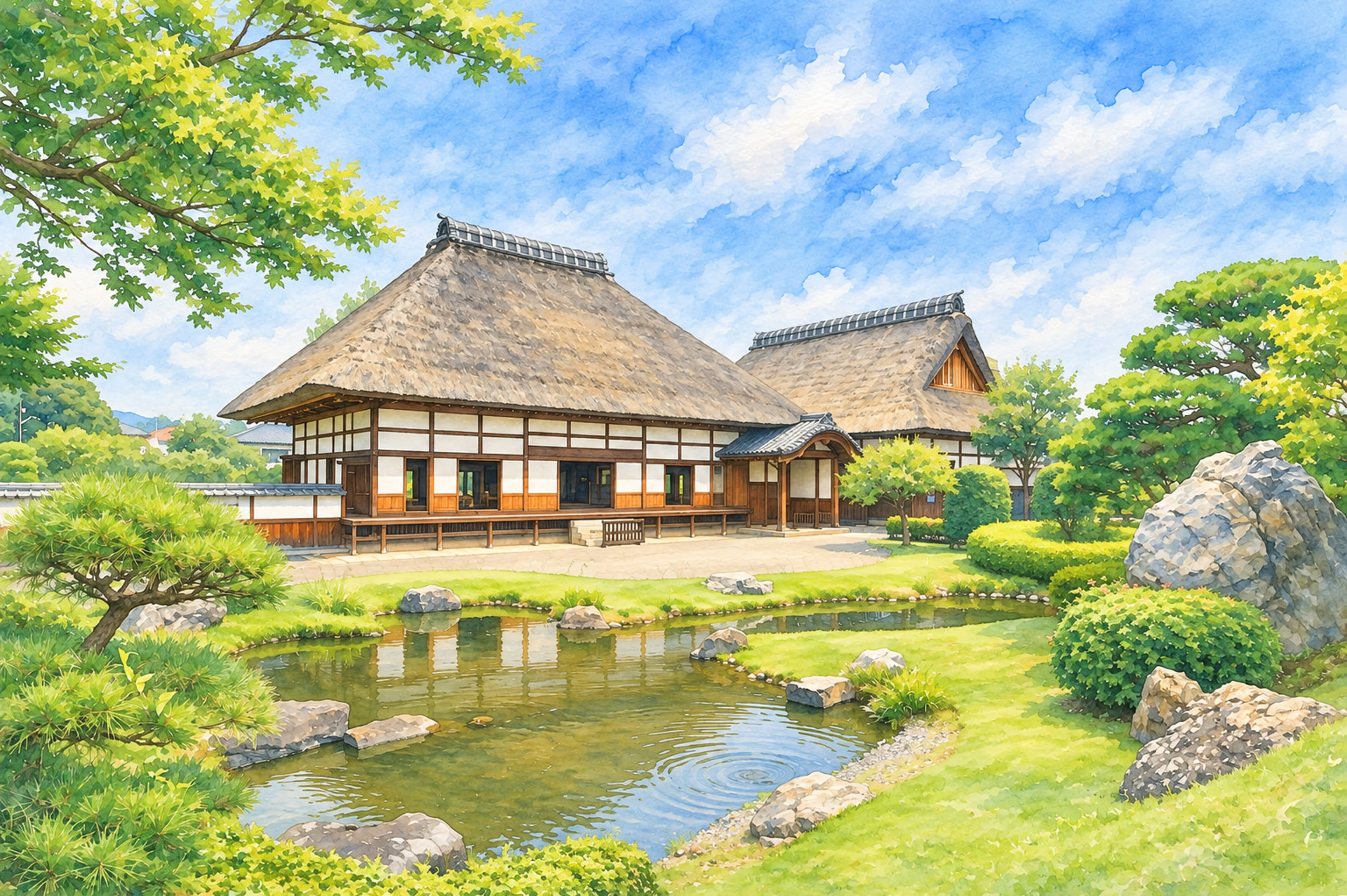
The restored gardens lie to the south and north of the abbot’s hall: the southern one open and spacious, the northern one built around a pond and trees, best enjoyed from the veranda. A reconstructed dormitory shows where students lived and studied.
The school’s real treasures, the Song editions and medieval manuscripts, are kept in a dedicated facility and the National Treasures are not normally on view. Their pages still carry the inscriptions Uesugi Norizane wrote more than 500 years ago when he gave them to the school.
From the school, a short walk north brings you to Banna-ji, the former Ashikaga residence. Seen together, the family home and the school explain why this small town mattered so much in medieval Japan.