
01A Monastery, Not a Monument
Eihei-ji sits in a steep, wooded valley a short way east of the city of Fukui, on the Sea of Japan side of central Honshū. The approach climbs past souvenir shops and then, quite suddenly, into a stand of enormous cedars. Beyond them, wooden halls step up the hillside, joined by roofed corridors and long flights of stairs. What strikes most visitors first is not a particular building but the people: young men in black robes with shaved heads, moving quickly and silently through the corridors, polishing floors on their knees, or carrying firewood.
Eihei-ji is a working monastery. It is one of the two head temples of the Sōtō school of Zen Buddhism, the other being Sōji-ji in Yokohama, and it has trained monks almost continuously since the 1240s. The trainees are called unsui, "clouds and water," after the Chinese image of the wandering monk who drifts like a cloud and flows like water. Most stay a year or a few years and then go back to run temples of their own, many of them family temples elsewhere in Japan.
None of the buildings here is medieval; they date from the 18th century onward. What has lasted for nearly eight hundred years is the site, the name and a way of life laid down by the temple’s founder, Dōgen. To understand the place you have to start with him.
02Dōgen’s Question
Dōgen was born in Kyoto in 1200 into the high aristocracy. His father is usually identified with the Koga branch of the Murakami Genji, though scholars disagree over whether it was Koga Michichika or his son Michitomo. His mother is traditionally said to have been a daughter of the regent Fujiwara no Motofusa. Both parents died while he was a child. Later biographies say that watching incense smoke rise and vanish at his mother’s funeral made him resolve to become a monk; like many such details, the story comes from accounts written well after his death.
As a young teenager he was ordained on Mount Hiei, the great monastic center of the Tendai school northeast of Kyoto. According to the traditional biographies, he was troubled by a question the Tendai teachers could not answer to his satisfaction: if all beings already possess Buddha-nature, as the scriptures say, why have all the buddhas and patriarchs had to strive so hard for awakening? The question would shape everything he later taught.
He left Mount Hiei and went to Kennin-ji in Kyoto, the temple founded by Eisai, who had brought Rinzai Zen back from China. Eisai had died in 1215, two years before Dōgen arrived in 1217, and Dōgen studied for about six years under Eisai’s disciple Myōzen.
03China and Rujing
In 1223 Dōgen and Myōzen sailed together for Song China. Dōgen visited several monasteries in the region around Ningbo and was not impressed by most of the teachers he met. Then, at the monastery on Mount Tiantong, he found Rujing, a master of the Caodong line (Sōtō in Japanese) known for his insistence on long hours of seated meditation.
Dōgen later recalled that during a meditation session Rujing scolded a dozing monk, saying that practice meant "dropping off body and mind." On hearing this, Dōgen had his breakthrough. Rujing confirmed his understanding, and Dōgen became an heir to the Caodong lineage. Myōzen died at Tiantong in 1225, and Dōgen carried his teacher’s ashes home.
Two stories from the China years are told at Eihei-ji to this day. Dōgen himself recorded meeting an elderly monk who served as tenzo, the head cook, drying seaweed in the full summer sun at Tiantong. When Dōgen asked why he did not let a younger monk do it, the old man said that others were not himself; when asked why he did not wait for a cooler hour, he replied that if not now, then when? The second story concerns Dōgen’s return in 1227. He is said to have declared that he came home "empty-handed," bringing no scriptures or images, only the plain fact that "the eyes are horizontal and the nose is vertical." The phrase comes from a later record of his talks and sums up his insistence that awakening is found in ordinary reality, not in something added to it.
04Ten Years in Kyoto
Back in Japan, Dōgen stayed for a time at Kennin-ji and wrote Fukan zazengi, "A Universal Recommendation for Seated Meditation," a short text arguing that zazen is the true gate of Buddhism and is open to everyone. A copy in Dōgen’s own hand survives at Eihei-ji and is designated a National Treasure.
In 1233 he founded the temple at Fukakusa later known as Kōshō-ji, just south of Kyoto, and began to gather a community. Here he built what is often described as one of the first proper monks’ halls in Japan, where monks sat, ate and slept together in the Chinese manner. Here, too, he began giving the talks that became the Shōbōgenzō, "Treasury of the True Dharma Eye," the long and difficult collection of essays written in Japanese rather than Chinese that is now his best-known work. Koun Ejō, the disciple who would succeed him, joined him in these years.
Teaching Zen in the capital was not easy. The monks of Mount Hiei regarded new schools with suspicion, and Dōgen’s insistence on "just sitting," together with his sharp criticism of other forms of practice, did nothing to calm them.
05The Move to Echizen
In 1243 Dōgen left Kyoto with his followers and went north to Echizen Province, the area of modern Fukui. His patron was Hatano Yoshishige, a warrior who served in the shogunate’s Kyoto office at Rokuhara and held the post of steward over the Shihi estate in Echizen.
Why Dōgen left the capital has been debated ever since. One explanation stresses pressure from Mount Hiei. Another points to Rujing’s advice, as Dōgen reported it, to stay away from kings and ministers and live deep in the mountains, raising even a single true student. Probably both played a part. Dōgen spent his first months in Echizen at small mountain temples, including Kippō-ji, where he gave many of the Shōbōgenzō talks while a new monastery was built for him.
That monastery was finished in 1244 and named Daibutsu-ji. In 1246 Dōgen renamed it Eihei-ji, with the mountain name Kichijō-zan. "Eihei" is the Japanese reading of Yongping, the reign name of the Later Han emperor Ming, under whom Buddhism was traditionally said to have first reached China. The choice of name was a statement: here, Dōgen suggested, the authentic Dharma would make a new beginning in Japan.
06Rules for Daily Life
At Eihei-ji Dōgen concentrated on training a small number of monks thoroughly. He wrote detailed guidelines for every part of monastic life, later collected as the Eihei shingi, "Pure Standards of Eihei." Tenzo kyōkun, "Instructions for the Cook," treats the preparation of meals as a form of practice equal to meditation. Other texts lay down how to enter the meditation hall, how to receive and eat food from nested bowls, how to wash the face, brush the teeth and use the latrine. For Dōgen none of this was trivial. Practice and awakening were not separate, so the way a monk washed rice was itself the expression of the Way.
In 1247 Dōgen accepted an invitation from Hōjō Tokiyori, the regent who effectively ran the Kamakura shogunate, and spent about half a year in Kamakura. Tokiyori is said to have wanted him to found a temple there, but Dōgen returned to Echizen in 1248. A later story tells that a disciple who accepted the gift of an estate from Tokiyori on Dōgen’s behalf was expelled from the monastery, and that the floor where he had sat was dug out. The tale is better read as an illustration of Dōgen’s distance from worldly power than as a documented event.
In 1253 Dōgen fell seriously ill. He handed Eihei-ji over to Ejō and went to Kyoto for treatment, and he died there in the eighth month of that year, at the age of 53 (54 by the traditional count). His remains were later brought back to Eihei-ji.
07Division and Revival
Ejō, who was older than Dōgen and had served him devotedly for two decades, became the second abbot. He recorded his teacher’s informal talks in the Shōbōgenzō zuimonki, still the most approachable introduction to Dōgen’s thought.
The third abbot, Tettsū Gikai, had been sent to China to study monastery buildings and ritual. He wanted to give Eihei-ji a fuller set of halls and ceremonies and was more open to the needs of local patrons. Others in the community insisted on keeping Dōgen’s ways unchanged. Doctrinal disagreement and personal rivalry combined in what is usually called the sandai sōron, the "third-generation dispute," and Gikai eventually left for Daijō-ji in Kaga.
The split shaped the whole later history of Sōtō Zen. Gikai’s disciple Keizan Jōkin founded Sōji-ji on the Noto Peninsula, and monks of Keizan’s line carried Sōtō teaching to provincial warriors and farmers, adding prayer rituals and funerals to its practice. Their temples multiplied across Japan and soon far outnumbered those connected to Eihei-ji. Keizan came to be honored as the school’s second founder, alongside Dōgen.
Eihei-ji, meanwhile, declined after Gikai’s departure. It was revived by the line of Jakuen, a Chinese monk said to have been a disciple of Rujing who followed Dōgen to Japan and later founded Hōkyō-ji in Ōno, Echizen. Jakuen’s disciple Giun became the fifth abbot of Eihei-ji in 1314, restored the buildings and preserved Dōgen’s writings. For a long time afterwards Eihei-ji’s abbots came from this line.
08Fire and War
From the 14th century Eihei-ji gained recognition from the court and the warrior government. According to the temple, Emperor Go-En’yū granted it a plaque in 1372 naming it "the foremost Sōtō training center in Japan," and later emperors confirmed its standing in the 16th century. The same centuries brought disaster: the halls were destroyed in fighting in 1340.
In the age of civil war, Echizen was ruled by the Asakura family from their castle town at Ichijōdani. In 1473 the halls burned again amid the wars of the Ōnin era. Some accounts add that the temple was caught up in the Ikkō uprising that swept through Echizen in 1574 after the fall of the Asakura, but the standard temple chronologies do not record such a burning, and its date and extent are uncertain. After Oda Nobunaga’s forces reconquered the province in 1575, Echizen passed to new lords, among them Shibata Katsuie. Further fires followed in the Edo period. That is why no building from Dōgen’s or even the Muromachi period survives today.
09Two Head Temples
The Tokugawa shogunate regulated Buddhist schools through formal codes. In 1615 it issued separate codes for the two temples, recognizing both Eihei-ji and Sōji-ji as head temples of the Sōtō school. Eihei-ji had the prestige of its founder; Sōji-ji had the vast network of branch temples. The two quarreled for centuries over precedence, over the right to grant the purple robe, and over the ceremonies by which monks qualified as abbots.
The Edo period also brought a revival of interest in Dōgen’s own writings. The Shōbōgenzō had circulated only in manuscript among a few insiders; scholar-monks now edited it. Around 1690 the 35th abbot, Hangyō Kōzen, arranged the work in 95 fascicles, and the 50th abbot, Gentō Sokuchū, revised that text into the Eihei-ji edition, printed from 1795 and completed in the 1810s. The temple’s identity became ever more closely tied to Dōgen and his texts.
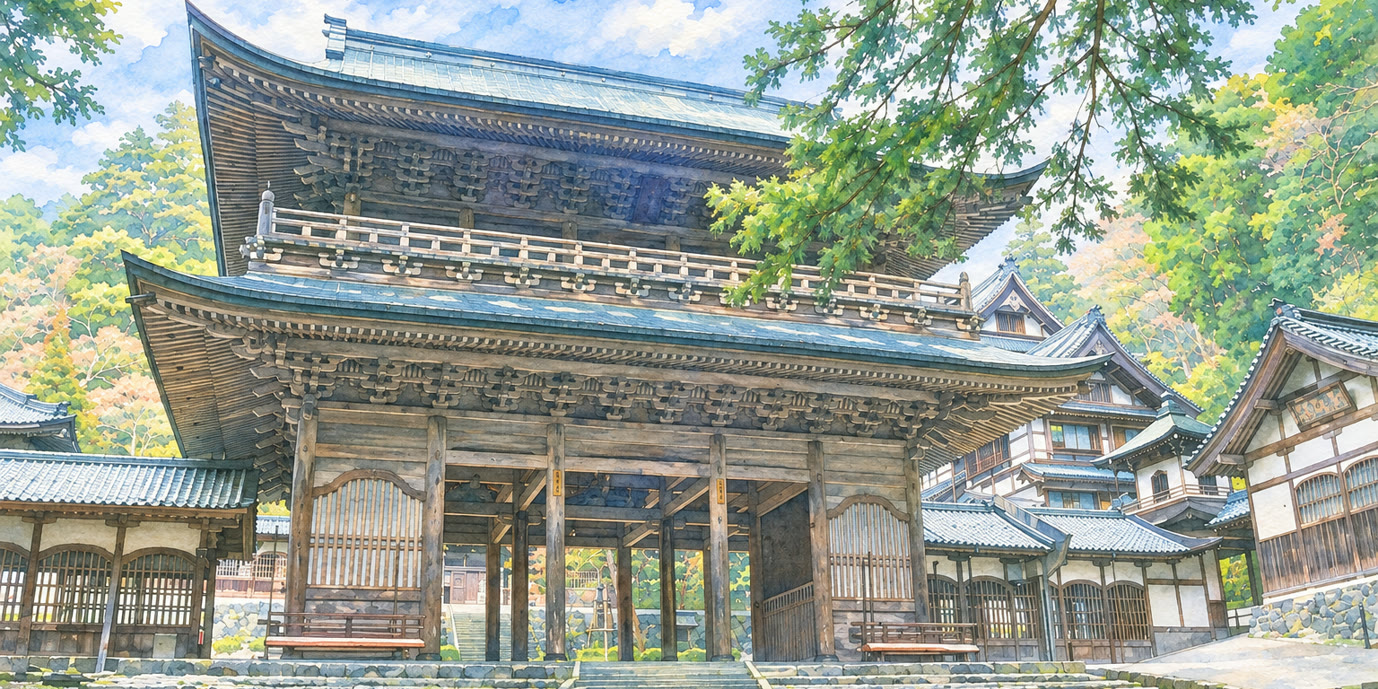
The oldest building on the site today dates from this era. The Sanmon, the great two-story gate, was completed in 1749; its upper floor houses images of the five hundred arhats, and statues of the Four Heavenly Kings stand on either side of the passage below. The Dharma Hall followed in 1843.
10Modern Times
The Meiji Restoration hit Buddhist institutions hard. Temple lands were confiscated and an anti-Buddhist movement swept parts of the country. In the reorganization that followed, the Sōtō school confirmed Eihei-ji and Sōji-ji as joint head temples, with their abbots taking turns as head of the school. Despite further disputes and agreements between the two, that framework still stands. In 1879 Emperor Meiji gave Dōgen the posthumous title Jōyō Daishi, and the founder’s hall that holds his remains, rebuilt in 1881, is called the Jōyō-den.
In 1898 Sōji-ji was largely destroyed by fire, and in 1911 it moved from Noto to Tsurumi in Yokohama. Since then one head temple has stood in the mountains of Hokuriku and the other on the edge of a modern city.
Much of present-day Eihei-ji took shape in the early 20th century. The Buddha Hall and the monks’ hall were rebuilt in 1902, in time for the 650th anniversary of Dōgen’s death by the Japanese reckoning, and the kitchen hall and the Sanshōkaku reception hall followed in 1930; the Sanshōkaku was moved and rebuilt in 1995 ahead of the 750th memorial, held in 2002. In 2019 nineteen buildings, including the Sanmon, the Buddha Hall, the Dharma Hall, the monks’ hall, the Jōyō-den, the kitchen hall and the corridors, were designated Important Cultural Properties (as of 2026). The complex is usually said to include more than seventy buildings on about 33 hectares.
11A Day in the Life
The monastery’s routine still follows Dōgen’s standards. A monk who wishes to train here must first wait at the gate for permission to enter, traditionally for a long time, and the first months inside are the hardest, as newcomers learn the exact form of every action.
The day begins before dawn with zazen in the monks’ hall, followed by sutra chanting in the Dharma Hall and a silent breakfast eaten from nested bowls according to a strict sequence. The day is filled with work: cleaning, chopping wood, carrying supplies, cooking. Evening brings more meditation before sleep. The monks sleep in the same hall where they sit, each with the space of a single tatami mat, which gave rise to the saying "half a mat to sit, one mat to sleep."
The monks’ hall, the bathhouse and the latrine are called the "three halls of silence," where no talking is allowed. If the corridors shine, it is because monks scrub them by hand every day.
12Walking Through the Temple
Visitors usually enter through the Kichijōkaku, a modern building used for reception and lay training. From there the corridors lead up to the Sanshōkaku, whose great ceiling is divided into 230 panels of birds and flowers, painted by 144 artists for the original hall of 1930. Popular lore says a few unusual motifs are hidden among them and bring luck to whoever spots them.
The main halls are laid out on the slope in the classic Zen arrangement. On the central axis rise the Sanmon gate, the Buddha Hall and, at the top, the Dharma Hall. The monks’ hall and the kitchen hall stand on either side, with the bath and latrine below. The covered corridors that link them follow the lie of the land, so walking through the complex you feel the mountain under your feet.
The Sanmon bears a tablet with the name Kichijō-zan. It is not used casually; a monk is said to pass through it only twice, on entering the monastery and on completing his training. The Buddha Hall, rebuilt in the style of a Song-dynasty Chinese Zen hall, enshrines the Buddhas of past, present and future. The Dharma Hall, the highest of the main buildings, is where the morning service is held and the abbot gives formal talks. Beside it stands the Jōyō-den, the founder’s hall, which enshrines Dōgen and the memorial tablets of the abbots who followed him.
At the kitchen hall a huge wooden pestle hangs by the entrance; visitors say that touching it improves one’s cooking, a bit of folklore that nonetheless echoes Dōgen’s view that the cook’s work is practice. The monks’ hall itself can only be seen from outside.
On the way out, look back at the cedars lining the approach. Some are several centuries old. Together with the halls and the monks in their black robes, they make a scene that has changed less over the centuries than almost anywhere else in Japan.