
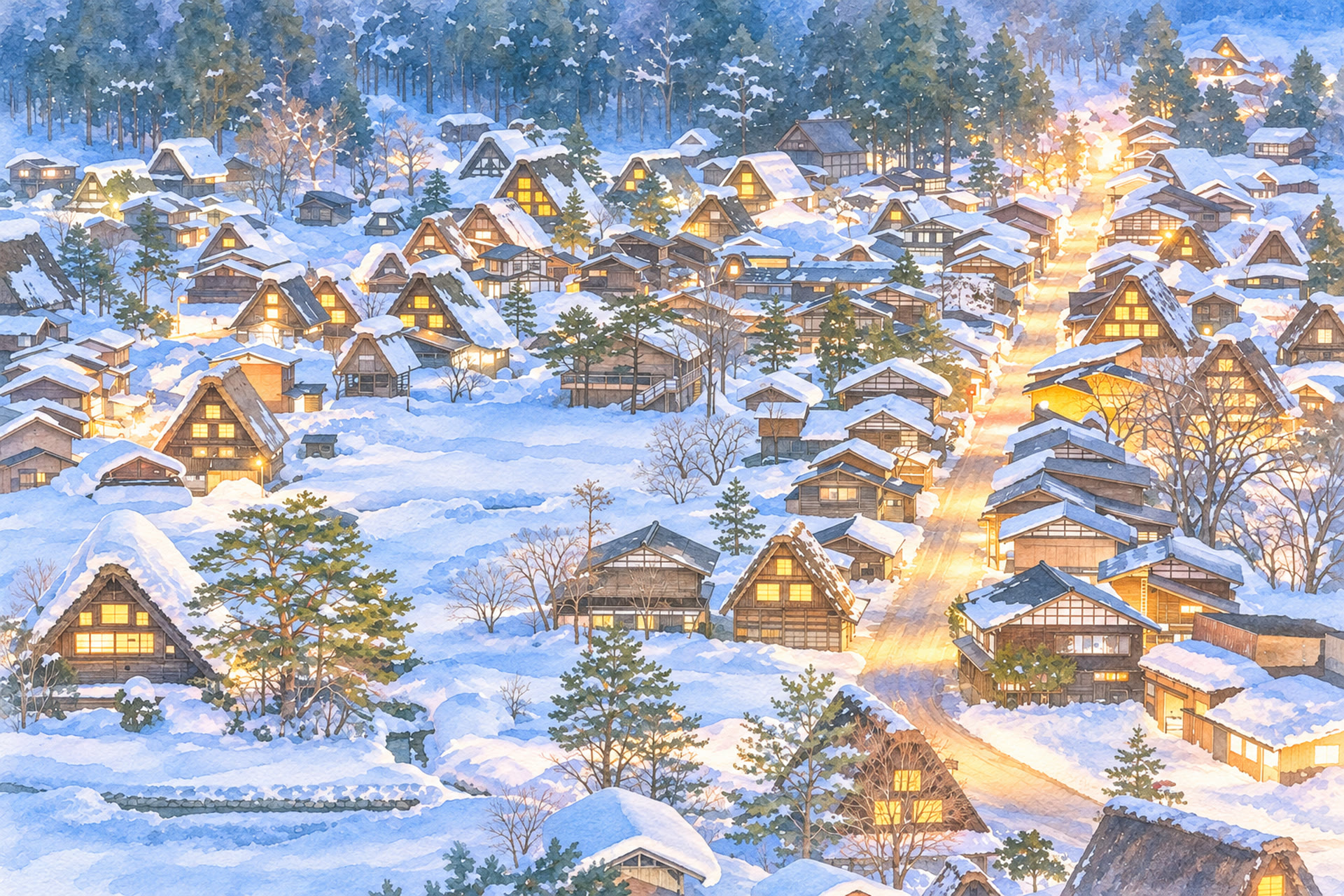
01The View from Above
The classic picture of Shirakawa-gō is taken from a small lookout on a wooded spur at the north end of Ogimachi village. Below, the Shō River bends through its valley, and on the flat ground along the east bank stand dozens of enormous thatched roofs. Nearly all of them face the same way, gable ends pointing north and south, their steep sides rising like books stood on end. In summer they sit among rice paddies and cedar forest. In winter the snow can reach the eaves of the ground floor, and roof and field merge into one white slope.
Ogimachi is the main settlement of Shirakawa Village, in Ōno District at the northwestern corner of Gifu Prefecture. To the north lies Toyama Prefecture; across the mountains to the west lies Ishikawa. The name Shirakawa-gō, "the Shirakawa district," once covered the whole string of hamlets along the upper Shō River. Today, for most visitors, it means Ogimachi.
What sets Ogimachi apart from many preserved streetscapes in Japan is that people still live here. Most of the great thatched houses, known as gasshō-zukuri, are family homes. Some run inns, restaurants or shops on the ground floor, and behind them laundry hangs and small cars are parked. To make sense of the place it helps to know why this valley was so cut off, what its people believed and how they made a living, how the extraordinary roofs were built and kept up, and how the village came close to disappearing in the twentieth century before its own residents decided to save it.
02A River Valley Under Heavy Snow
The Shō River rises in the Hida highlands and flows north through Shirakawa Village, then through the Gokayama district of Toyama Prefecture, before reaching the Sea of Japan across the Tonami plain. Shirakawa-gō occupies a narrow stretch of its upper gorge, walled in by mountains, with the massif of Mount Haku to the west. Usable flat land is limited to scattered river terraces.
This is some of the snowiest inhabited country in Japan, with winter snow commonly lying around two meters deep. In the past the mountain paths closed once the snow came, leaving the valley hard to reach from Takayama, the main town of Hida, or from the plains of Etchū to the north. Politically Shirakawa-gō belonged to the province of Hida, but geographically it opened northward down the river toward Gokayama in Etchū. That split mattered: in the Edo period Gokayama was part of the great Kaga domain of the Maeda family, while Shirakawa-gō ended up under the shogunate itself. The two districts share the same kind of houses but had different masters.
03The Faith of the Valley
The religious backbone of Shirakawa-gō is True Pure Land Buddhism, Jōdo Shinshū, the school founded by Shinran in the thirteenth century. It taught that salvation comes through faith in the vow of the Buddha Amida rather than through monastic discipline, a message that suited farming communities well. Temple tradition holds that one of Shinran’s followers, Kanenbō Zenshun, came to Hida and founded a meeting hall in Shirakawa-gō, the origin of Shōren-ji, which became the leading True Pure Land temple of the province. The details of Zenshun’s life rest largely on temple lore.
In the later fifteenth century Rennyo, eighth head of the Hongan-ji, preached widely across the Hokuriku region, and the villages of Echizen, Kaga and Etchū converted in large numbers. In 1488 the organized followers of the school, known as the Ikkō sect, overthrew the military governor of Kaga, an episode remembered as the Kaga Ikkō Uprising. Shirakawa-gō, linked to Etchū by the river, lay within the same current. Village life came to center on temples and on dōjō, simple meeting halls where people gathered to recite the nenbutsu and hear sermons. These gatherings also handled village business, and the habit of collective decision and mutual help that later sustained the thatched houses grew in part from this community of faith. Myōzen-ji in Ogimachi is a living descendant of that tradition.
04The Uchigashima and the Castle the Mountain Swallowed
In the late medieval period Shirakawa-gō was ruled by the Uchigashima family. They are generally thought to have come from Shinano and to have entered Hida in the mid-fifteenth century on the orders of the Muromachi shogunate. Their stronghold, Kaerikumo Castle, stood beside the Shō River, probably in the Hokiwaki area south of present-day Ogimachi. After early clashes with the local True Pure Land communities, the Uchigashima reached an accommodation with them and ruled with their support. The valley is also said to have produced gold and silver, which made the family wealthier than its remote position would suggest.
The hill where the Ogimachi lookout stands was itself a fortress: Ogimachi Castle, held by retainers of the Uchigashima. Visitors photographing the village are standing on the enclosures of a small mountain castle, where earthen ramparts, stone walls and dry moats can still be traced.
In the 1580s national politics reached even this valley. After Oda Nobunaga’s death in the Honnō-ji Incident of 1582, Toyotomi Hideyoshi rose to dominance, and in 1585 he sent Kanamori Nagachika to subdue Hida. Uchigashima Ujiri, the head of the family, had sided with Hideyoshi’s enemy Sassa Narimasa of Etchū. Kanamori’s forces reportedly entered Shirakawa-gō while Ujiri was away on campaign. Ujiri submitted and is said to have been allowed to keep his lands.
A few months later, late on the night of the twenty-ninth day of the eleventh month of Tenshō 13, January 18, 1586, a great earthquake struck central Japan. Behind Kaerikumo Castle the mountainside collapsed, and the landslide buried the castle and the settlement around it. According to later accounts, Ujiri, his family, his retainers and the townspeople, some 300 people in all, died almost to a man, and the Uchigashima line ended that night. The exact site of the castle has never been found. Because the family was thought to be rich, a legend grew up of gold buried with the castle; it remains a legend. A memorial to the castle now stands at Hokiwaki.
05The Kanamori and the Shogun’s Land
With the Uchigashima gone, all of Hida came under Kanamori Nagachika. A former general of Oda Nobunaga who had gone over to Hideyoshi, he later sided with Tokugawa Ieyasu at Sekigahara in 1600 and kept the province. The Kanamori built a castle town at Takayama and governed Hida for about a century. When Nagachika laid out his castle town, Shōren-ji was moved from Nakano in the southern part of Shirakawa-gō to Takayama, where it became one of the town’s principal temples; its old main hall at Nakano stayed behind in the care of local followers.
In 1692 the Kanamori were transferred to Kaminoyama in Dewa Province, and Hida became shogunal territory, administered by an intendant (later raised to the rank of gundai) based at the Takayama office, the building now known as Takayama Jin’ya. Shirakawa-gō stayed under direct shogunal rule until the end of the Edo period. Shogunal administration in such remote areas was relatively light, and villages ran most of their own affairs. It was during the middle and later Edo period that the economy and the houses of Shirakawa-gō took the form visitors see today.
06Silkworms Above, Saltpeter Below
With so little rice land, farming alone could not support the valley. Two side trades became essential: silkworm raising and the production of saltpeter.
The silkworms lived upstairs. The vast roof of a gasshō house usually encloses two or three attic floors, four in the largest houses, laid with slatted boards or bamboo so that warm smoke from the open hearth below can rise through them. The smoke and heat helped the silkworms, dried the timber and kept insects out. Spring and summer were given over to the worms, and cocoons or raw silk were sold in autumn. For many households this was the main source of cash, and it goes a long way toward explaining why the roofs are so large.
The saltpeter, called enshō, was the key ingredient of gunpowder. Japan has no natural deposits, so it had to be made by hand. In Shirakawa-gō and Gokayama, families dug pits beneath the floor near the hearth and filled them with layers of soil, grasses and silkworm droppings. Over three or four years, warmed by the house and enriched by household waste, the mixture produced nitrates, which were leached out with water. The technique had come from neighboring Gokayama. Households sold the crude product to one of a few licensed refiners in the valley, who boiled it down into crystals and sold it to domains and merchants as far away as Osaka. In Gokayama the Kaga domain bought the output and treated it almost as a domain monopoly, and Kaga was also the largest buyer of Shirakawa’s saltpeter, at its peak taking more than half of the valley’s output.
The Wada family of Ogimachi served for generations as village headmen and dealt in saltpeter, which made them one of the wealthiest households in the valley. Their house, built in the late Edo period and among the largest in Ogimachi, is a national Important Cultural Property. Cheap imported saltpeter, much of it from Chile, brought the trade into rapid decline in the Meiji era; sericulture continued into the mid-twentieth century.
07How a Gasshō House Is Built
Gasshō means hands pressed together in prayer, and the name describes the roof: two sets of heavy rafters meeting at the ridge like joined palms. Similar large thatched farmhouses were once found across the mountains of Hida, Etchū and Kaga, but Shirakawa-gō and Gokayama keep the largest and best-preserved groups.
A gasshō house is really two structures. The lower part, the living quarters, is a post-and-beam frame that was usually built by professional carpenters. The roof above is a separate triangular frame of thick rafters called sasu, their lower ends shaved to a point and seated in sockets in the main beams of the lower frame, their upper ends crossing at the ridge. Horizontal poles and many smaller members complete the lattice. No nails are used in the roof; the joints are lashed with straw rope and with pliant branches such as witch hazel. The result has some give, letting it carry the heavy snow load and ride out wind, and the roof frame was traditionally raised by the villagers themselves.
The pitch is steep, close to 60 degrees where most thatched farmhouses in Japan stay at 45 degrees or less, which helps snow slide off and keeps rain from soaking in. In Shirakawa-gō most houses have their gables facing north and south, usually explained as a way to keep the long sides out of the strong winds that blow north or south along the Shō valley, while letting both slopes of the roof get an even share of sun, melting snow and drying the thatch evenly. In Shirakawa-gō the main entrance is usually on the long side of the house; in Gokayama it is often at the gable end, one of the easiest ways to tell the two apart.
The thatch is made of grasses cut on the mountainsides, laid thick, by some accounts up to about a meter. It is usually renewed every twenty to thirty years, one whole side at a time. Most of the houses standing today were built between the late Edo period and the Meiji era. Their timber frames are largely original; the thatch you see has been renewed over the past few decades.
08Big Families and Mutual Help
Shirakawa-gō is also known for a family system that once drew the attention of scholars. In the Nakagiri area of the village, a single house might shelter twenty or thirty people, by some accounts more than forty. Apart from the head of the family and his heir, younger sons usually did not set up households of their own or marry in the ordinary sense. They formed visiting unions, and their children stayed in their mothers’ homes, adding to the household’s labor.
This "large family" system is usually explained as an adaptation to scarce land: fields could not be divided further, so the family stayed together under one great roof and worked the land in common. It is generally thought to have taken shape around the eighteenth century and to have peaked in the Meiji era, when sericulture was at its height; it drew scholarly attention early, and as improved silkworm methods reduced the need for household labor it had largely disappeared by the 1930s. The former Tōyama House in Miboro, built around 1850 and lived in until 1967, a national Important Cultural Property now open as a folk museum, is the best-known example of such a house. It is worth noting that the system belonged mainly to Nakagiri and certain other hamlets, not to Ogimachi itself.
What kept the houses standing was yui, the custom of mutual aid. Rethatching a whole side of a roof takes vast quantities of grass and dozens of hands, far more than one household could supply. Each family contributed labor every year to the common thatch fields and stored grass, and when a house’s turn came the whole village turned out and could finish a side in a day or two. Help given would be returned when one’s own roof needed work. Something of this survives in Ogimachi today, where rethatching brings together residents, volunteers and professional thatchers.
09Discovered and Disappearing
In the 1930s the outside world began to take notice. In 1935 the German architect Bruno Taut, then living in Japan, visited Shirakawa-gō, including the Tōyama House at Miboro, and praised the rationality of the gasshō houses, comparing them with the farmhouses of the Swiss Alps. His comments were widely quoted afterward and are often treated as the moment the village was "discovered."
At almost the same time the houses began to vanish. Dams were one reason. The Shō River, with its heavy flow and steep fall, was harnessed for hydroelectric power from before the Second World War, and a series of dams rose along it. The largest, the Miboro Dam, built in the early 1960s (its embankment finished in 1960, with completion usually given as 1961), flooded parts of the old Shōkawa Village and of Shirakawa. Many families left the valley, and houses were demolished or moved away. The old main hall of Shōren-ji at Nakano, about to be submerged, was moved to Takayama, and in 1960 two ancient cherry trees from the grounds of Shōren-ji and Kōrin-ji were transplanted to high ground above the reservoir, where they still bloom as the Shōkawa cherries. Migration to the cities and changing ways of life were another reason: thatch was laborious to maintain and vulnerable to fire, and many families rebuilt with tin or tile roofs. Some houses were sold and reassembled elsewhere as restaurants, inns or museum exhibits. By a commonly cited estimate, the twenty-odd hamlets of Shirakawa-gō once had around 300 gasshō houses between them; by 1971 even Ogimachi had lost about half of its own.
Ogimachi was not spared. Through the 1960s some households there were tearing down or rebuilding, and the village’s character was slipping away.
10Saving Ogimachi
The turning point came in the early 1970s. In 1971 Ogimachi residents formed the Association for the Protection of the Natural Environment of Ogimachi Village in Shirakawa-gō and adopted a charter whose core was a pledge not to sell, rent out or demolish their gasshō houses. The initiative came from the villagers themselves rather than from government, and it is usually taken as the beginning of Shirakawa-gō’s preservation movement.
In 1976 Ogimachi was selected as a national Important Preservation District for Groups of Traditional Buildings. The designation protects not just individual houses but the whole landscape of the settlement: buildings, fields, irrigation channels, lanes and trees. New construction and alterations must fit the village’s appearance, and utilities are hidden where possible.
In 1995 Ogimachi, together with Ainokura and Suganuma in Gokayama, was inscribed on the World Heritage List as the Historic Villages of Shirakawa-gō and Gokayama, recognized as settlements that had developed a distinctive architecture and way of life in a harsh environment and that survive as living communities.
Inscription brought crowds. With expressways reaching the area, annual visitor numbers for the village reached about two million (as of 2024, about 2.08 million that year, with foreign visitors a majority for the first time), far outnumbering residents. Traffic, strangers wandering into private homes and the general disruption of daily life became problems the village and local authorities have tried to manage with limits on cars and other measures. The winter evening illuminations, which draw especially large numbers, have seen repeated changes to how visitors are admitted.
Fire remains the greatest threat. About sixty water cannons stand in small sheds around Ogimachi, and each autumn they are fired together in a village-wide drill, sending arcs of water over the roofs.
11A Walk Through Ogimachi
Most visitors enter Ogimachi from the parking area on the west bank of the Shō River, crossing the Deai-bashi suspension bridge, with the village and the mountains behind it ahead.
Heading north, the Wada House is the first place to stop. One of the largest gasshō houses in the village, it preserves the hearth room, the Buddhist altar room and the layout of a headman’s home on the ground floor. Upstairs the attics reveal the sasu rafters, the rope lashings and traces of silkworm raising. The timbers are blackened and glossy from generations of hearth smoke, and that coating is itself part of what preserves the wood.
In the middle of the village, Myōzen-ji has thatched roofs on its main hall, priests’ quarters and bell tower gate. The priests’ quarters is a large five-story gasshō building, and a thatched two-story bell tower gate is a rare sight at any temple. Here the place of the True Pure Land temple at the heart of the village is easy to see.
At the north end, Shirakawa Hachiman Shrine is the guardian shrine of Ogimachi. Each autumn it holds the Doburoku Festival, when unfiltered rice wine brewed by the shrine is offered to the gods and shared with worshippers in prayer for a good harvest and the safety of the village.
Several other houses, among them the Kanda House and the Nagase House, are open to visitors and show different family histories and household tools. Across the river, an open-air museum of gasshō houses brings together buildings moved from other parts of Shirakawa, some from hamlets abandoned because of the dams or depopulation, and gives a sense of older house forms.
Finally, climb to the lookout at the north end, on the site of Ogimachi Castle. From here the layout of the village reads clearly: the orientation of the roofs, the open ground left between houses, the channels of water running through the lanes, all shaped by snow, wind and the fear of fire. Ogimachi survives because people have kept living in it for centuries, and because, when it was closest to being lost, they chose to keep it.