
01A Bay Full of Islands
Some twenty kilometers northeast of Sendai, the coast of Miyagi Prefecture breaks apart. Matsushima Bay holds more than 230 islands, from inhabited ones with fields and houses to bare rocks with a single pine clinging to the top. The name Matsushima simply means "pine islands," and it describes what you see.
The islands are made of soft rock, mostly tuff, sandstone and mudstone. When the land sank and the sea flooded an old landscape of hills and valleys, the high ground was left standing above the water, and the waves have been gnawing at it ever since. Some islands have been hollowed into caves, some pierced into arches, and some worn down to a single pillar. Pale rock, dark pines and the calm water of a sheltered bay make a view that changes with every angle, whether from the shore, from a boat, or from the hills around the bay. In the Edo period four of those hills became known as the Four Great Views of Matsushima, each assigned its own adjective: grand, beautiful, secluded and majestic.
Matsushima was famous in literature long before most people could visit it. Heian-period courtiers in Kyoto rarely saw the far northern coast of Mutsu Province, yet Matsushima and the little island of Oshima within the bay were already utamakura, place names that carried a set of poetic associations. Poets used them to speak of loneliness by the sea, of fishermen’s sleeves wet with brine, and of longing for someone far away. For a reader in the capital, Matsushima was a name before it was a destination.
02One of the Three Views of Japan
Almost any description of Matsushima calls it one of the Nihon Sankei, the Three Views of Japan. The other two are Amanohashidate, a long pine-covered sandbar in northern Kyoto Prefecture, and Miyajima, the shrine island of Itsukushima in Hiroshima Prefecture. The grouping is usually traced to Hayashi Gahō, a Confucian scholar of the early Edo period and third son of Hayashi Razan, the shogunate’s adviser. In his Nihonkoku jisekikō, completed in 1643, Gahō noted Matsushima under the province of Mutsu and named it, with Amanohashidate and Itsukushima, as one of three extraordinary sights.
The idea spread through travel writing and illustrated guides, and by the later Edo period it was common knowledge. What the three share is the combination of sea and pine, and their spread across the north, center and west of the country made "seeing the Three Views" an ideal of travel. Matsushima was designated a Place of Scenic Beauty in 1923 and raised to a Special Place of Scenic Beauty in 1952, protecting the islands and the shoreline together.
03A Temple Founded by Ennin?
The great temple on the shore is Zuigan-ji, formally Matsushima Seiryūzan Zuigan Enpuku Zenji, a temple of the Myōshin-ji branch of Rinzai Zen. Its history falls into three stages: a Tendai temple, a Kamakura-period Zen temple, and the temple Date Masamune rebuilt in the early seventeenth century.
The first stage rests on temple tradition alone. According to that tradition, the monk Ennin, known by his posthumous title Jikaku Daishi, founded a Tendai temple here called Enpuku-ji in the early ninth century; the date usually given is 828. Ennin was a disciple of Saichō, the founder of the Tendai school in Japan; he later spent nine years in Tang China and wrote a famous diary of his travels there. A great many temples in northeastern Japan claim him as founder, including Risshaku-ji (Yamadera) in Yamagata and Chūson-ji in Hiraizumi. Such claims are hard to prove one by one, but together they reflect the reach of Tendai Buddhism into the north during the Heian period. Zuigan-ji’s tradition is best read the same way: a sign that this was an early Buddhist site, with later records as the only evidence for exactly who founded it and when.
The Godaidō, the small hall on an islet by the shore, is tied to the same legends. The story goes that Sakanoue no Tamuramaro, the general who led the court’s campaigns against the Emishi of the north, enshrined an image of Bishamonten here, and that Ennin later installed statues of the Five Great Wisdom Kings, carved by his own hand, the Godai Myōō, which gave the hall its name.
04The Hōjō Regents and a Zen Temple
In the mid-Kamakura period the temple became a Zen monastery. The usual account is that Hōjō Tokiyori, the fifth regent of the Kamakura shogunate and a devoted patron of Zen, sponsored its conversion to the Kenchō-ji line of the Rinzai school, with a monk named Hosshin as founding abbot. The temple’s name kept its sound but changed its characters, becoming the Enpuku-ji of "perfect fortune." The change may not have been sudden: since excavations begun in 2011, the prevailing view is that Zen and Tendai communities coexisted here for a time, and Tendai and Zen sources tell the story differently.
Hosshin’s life comes to us wrapped in legend. Later accounts say he was a man of humble birth from Makabe in Hitachi Province who was moved to become a monk after being humiliated, crossed to Southern Song China, and trained under the Chan master Wuzhun Shifan before returning to practice around Matsushima. Another story has Tokiyori, after taking Buddhist vows, wandering the provinces in disguise as an itinerant monk, meeting Hosshin at Matsushima, and then restoring the temple and inviting him to lead it. Tales of Tokiyori’s incognito travels were popular for centuries but cannot be confirmed; here they serve as the temple’s memory of its link with the Hōjō.
Medieval Matsushima was also a place for the dead. Oshima, the island joined to the shore by a short bridge, was where a holy man named Kenbutsu is said to have lived in a hermitage in the late Heian period, reciting the Lotus Sutra for years until his reputation reached Kyoto. In later centuries people carved caves into the rock of Oshima and of the cliffs near the temple, set Buddhist images in them, cut memorial inscriptions, and raised flat stone stupas called itabi to pray for the salvation of the deceased. Matsushima came to be called "the Kōya of Ōshū," a northern counterpart to Mount Kōya in Kii, where people sent the remains and memories of their dead. The rows of caves along the approach to Zuigan-ji today are what remains of that devotion; one of them, the Hosshin Cave beside the approach, is said to be where Hosshin met the disguised Tokiyori.
05Decline and the Coming of Masamune
With the fall of the Kamakura shogunate in 1333, the temple lost its most powerful patrons. It still held a respectable rank in the Muromachi period, listed among the shozan and then among the Ten Temples of the Kantō, but during the age of civil war southern Mutsu was fought over by the Date, Kasai, Ōsaki and other houses, and by the late sixteenth century the temple is generally thought to have been in a sorry state. At the end of that century it joined the Myōshin-ji branch of Rinzai Zen.
The man who changed that was Date Masamune. Born in 1567 at Yonezawa in Dewa Province, he became head of his house in his teens and fought his way to control of southern Ōshū, defeating the Ashina at the Battle of Suriagehara in 1589 and seizing Aizu. When Toyotomi Hideyoshi besieged Odawara in 1590, Masamune submitted late and lost Aizu, and was later moved to Iwadeyama. Around the Battle of Sekigahara in 1600 he sided with Tokugawa Ieyasu, and he emerged with a domain of roughly 600,000 koku (small later grants in Ōmi and Hitachi brought its official assessment to 620,000). He began building Sendai Castle on Mount Aoba and moved his seat there from 1601.
Matsushima lay just east of the new castle town. It was the most famous landscape in his domain and stood on the land and sea routes to the north. Soon after settling in Sendai, Masamune turned to rebuilding the temple. The work went on at the same time as Sendai Castle, the Ōsaki Hachimangū shrine and the Yakushidō of the Mutsu provincial temple, all projects through which a new lord stamped his authority on new territory.
06Masamune’s Zuigan-ji
In 1604 Masamune laid out the site himself and the rebuilding began. In 1608 a new bell was cast and the temple received its present name; in 1609 the main hall was completed, five years after work began. Masamune is said to have had timber cut in the mountains of Kumano on the Kii Peninsula and shipped by sea to Matsushima, and to have brought in about 130 craftsmen from Kyoto and Kii. Zuigan-ji became one of the memorial temples of the Date house.
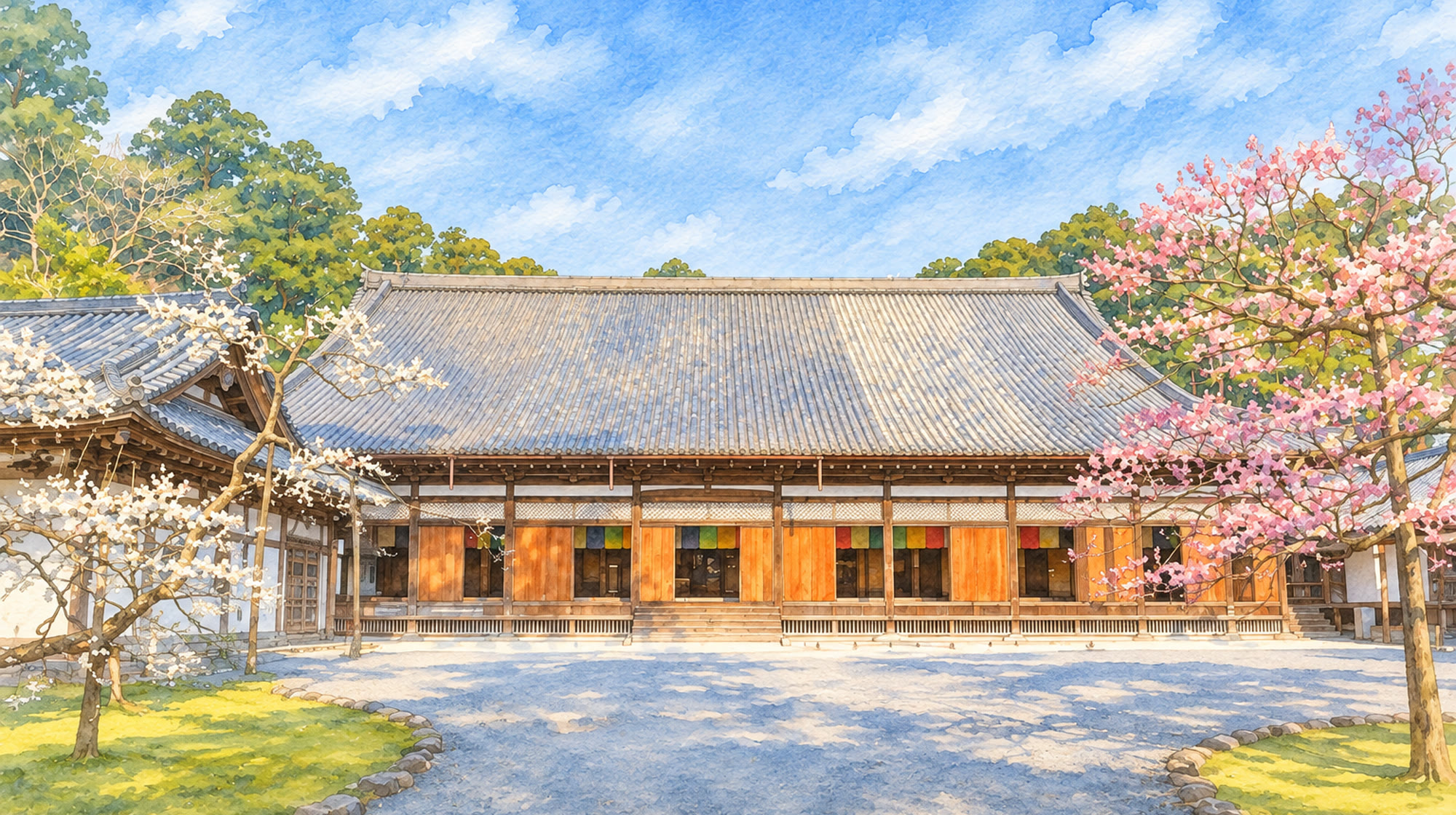
The main hall, or hōjō, the kuri (the kitchen and administrative building), and the roofed corridors joining them all survive from Masamune’s rebuilding; the main hall was designated a National Treasure in 1953, the kuri and corridors in 1959. The main hall follows the plan of a Zen abbot’s quarters: broad, heavy, and plain on the outside under a great hipped-and-gabled tile roof, and lavish within, in the style of the Momoyama period. It contains ten rooms. At the center is the shitchū, used for ceremonies and known as the Peacock Room for the birds painted on its sliding doors. There is a raised Upper Room for the lord of Sendai and an Upper-Upper Room, higher still in rank, said to have been prepared for envoys of the emperor. Gold-ground paintings of flowers, birds, pines and figures cover the sliding doors and walls. They were painted in 1620–22 by Kanō Sakyō and other painters of the Kanō school, and the 161 panels were designated Important Cultural Properties in 1980. Most of the originals have been moved to the temple’s museum for safekeeping, and reproductions made since 1985 now stand in their place.
The kuri is the temple’s most striking sight from outside, with a tall white-walled smoke tower rising from its roof and carved scrollwork in its gable. In front of the main hall grow two plum trees, one red and one white, which tradition says Masamune brought back from Korea during Hideyoshi’s first invasion and planted himself in 1609 to celebrate the raising of the main hall’s ridgepole. The story is widely told but remains a story.
Four centuries, even with a major repair in 1900–03, left the main hall with tired timbers and a settling foundation. A full conservation project on the main hall and other buildings began in 2008, continued through the 2011 earthquake, reopened the main hall to visitors in 2016, and was completed in March 2018. What you see today is the hall as restored, but its structure and most of its material are those of Masamune’s day.
07The Godaidō
A few minutes’ walk from the temple, on a rock in the water, stands the Godaidō, the picture most people have in mind when they think of Matsushima. It is a small square hall, surrounded by the sea and reached by two short vermilion bridges. Gaps are left between the planks so that you can see the water beneath your feet, and the bridges are called sukashi-bashi, "see-through bridges." The usual explanation is that looking down as you cross makes you collect yourself before worship.
The present hall, too, was rebuilt by Masamune in 1604. The temple calls it the oldest surviving Momoyama-period building in the Tōhoku region, and the prefecture’s description calls it the oldest in the Sendai area; it was designated an Important Cultural Property in 1950. Its pyramidal roof rises to a single point, and the carved brackets under the eaves show the twelve animals of the zodiac, each placed according to its compass direction; visitors like to walk around the hall looking for their own birth sign. The statues of the Five Great Wisdom Kings inside, designated Important Cultural Properties in 1995, are hidden images shown to the public only once every 33 years.
The legends of the Godaidō reach back to Tamuramaro and Ennin, but the building itself belongs to the early Edo period. Standing on the shore, you are looking at a stage Masamune built for the stories of the Heian age.
08The Date Family at Matsushima
After Masamune, Zuigan-ji and Matsushima remained important to his house. His son Date Tadamune, the second lord of Sendai, invited the eminent Rinzai monk Ungo Kiyō to serve as abbot. Ungo had been courted by several daimyo before he came north, and under him the temple revived as a place of Zen practice and teaching. When Bashō later mentions the retreat of "the Zen master Ungo" in his travel diary, it is this monk he means.
Masamune died at his Edo residence in 1636, aged 68 (70 by the traditional count), and was buried at Zuihōden in Sendai. But many of the people closest to him are remembered at Matsushima. Yōtoku-in, beside Zuigan-ji, is the memorial temple of his principal wife, Megohime, who took Yōtoku-in as her Buddhist name. Tenrin-in is the memorial temple of his eldest daughter, Irohahime, who had married Matsudaira Tadateru, sixth son of Tokugawa Ieyasu; after Tadateru was stripped of his domain she returned to Sendai, became a nun, and was buried here.
Entsū-in, just west of Zuigan-ji, was built as the memorial temple of Masamune’s grandson Date Mitsumune, Tadamune’s heir, who died in 1645 at 19 by the traditional count; Tadamune is usually named as its founder. Its mausoleum, the Sankeiden, built in 1647 and designated an Important Cultural Property in 1985, holds a statue of Mitsumune on horseback. The shrine cabinet is painted with motifs that include Western roses, along with shapes like spades, clubs and crosses, which are generally linked to what Hasekura Tsunenaga brought back from the embassy Masamune sent to Spain and Rome; this is why Entsū-in is sometimes called the Rose Temple. The details of that connection rest mainly on the temple’s own account.
Zuigan-ji also keeps a seated wooden statue of Masamune in armor, made in 1652 for the seventeenth-year memorial of his death and showing him at about 27, when he led his men to Korea; it is a Miyagi Prefecture cultural property. The usual account is that it was made according to his own wishes; another names Megohime as its sponsor. Masamune had lost his right eye to smallpox as a child and was later nicknamed the "One-Eyed Dragon," but he is said to have wished to be portrayed with both eyes. The statue has two, though the right is carved slightly narrower, a hint of how he really looked.
On the waterfront stands the Kanrantei, a pavilion in the manner of a tea house. Domain tradition says it was a building of Fushimi Castle that Hideyoshi gave to Masamune in the 1590s, that Masamune moved it to his Edo residence, and that Tadamune moved it to Tsukimizaki at Matsushima, hence its other name, the Moon-Viewing Hall; the name Kanrantei was given by the fifth lord, Date Yoshimura. It was long thought to be a Momoyama building, but a recently found plan suggests it is part of a lord’s lodge rebuilt after a fire in the 1640s or early 1650s. Whatever its origins, it was certainly where the Date received guests and admired the bay throughout the Edo period.
09Bashō Lost for Words
Of all the visitors to Matsushima in the Edo period, the most famous is Matsuo Bashō. In the spring of 1689, aged 46 by the traditional count (44 or 45 in Western terms; his birthday is unknown), he set out from his hut in Fukagawa in Edo with his companion Kawai Sora on the long walk through the north that became Oku no hosomichi, The Narrow Road to the Deep North. In the opening pages he writes that what filled his mind as he prepared to leave was the moon over Matsushima.
On the ninth day of the fifth month of Genroku 2, June 25, 1689, Bashō and Sora visited the Shiogama shrine in the morning and around noon took a boat from Shiogama across the bay to Matsushima. According to Sora’s travel diary, they landed, visited Zuigan-ji and Oshima the same day, and spent the night at an inn by the water; Oku no hosomichi places the visit to Zuigan-ji on the eleventh. Bashō’s passage on Matsushima is one of the longest in the book. He calls it the finest view in Japan and sets it beside Dongting Lake and West Lake in China, then describes the islands: some pointing to the sky, some lying flat on the waves, some piled two or three deep like a grandparent holding a grandchild. He mentions the remains of Kenbutsu’s hermitage on Oshima and the place where Ungo sat in meditation, and the gilded splendor of Zuigan-ji’s halls.
What he does not include is a poem of his own. He writes that before such a scene he could not compose, and records instead a verse by Sora, in which the little cuckoo of early summer is urged to borrow the form of a crane, as if only a larger bird could suit the view.
The verse most often linked with Matsushima, "Matsushima ya / aa Matsushima ya / Matsushima ya" ("Matsushima! Ah, Matsushima! Matsushima!"), is usually presented as Bashō’s speechless exclamation. It is not his. It is generally attributed to Tawarabō, a writer of comic verse in the later Edo period; the version in Matsushima zushi, published in 1821, reads "Matsushima ya / sate Matsushima ya / Matsushima ya," and one word changed before the verse was attached to Bashō. The misattribution caught on because it fits the story the book tells: a poet so overwhelmed that he could only repeat the name.
Bashō and Sora stayed just one night before moving on to Ishinomaki and Hiraizumi. Their visit made Matsushima a stop for later generations of poets, and stones carved with their verses still stand around the bay.
10Into the Modern Age
The Meiji Restoration was hard on Zuigan-ji. Sendai joined the Northern Alliance of domains in the Boshin War of 1868–69, was defeated, and had its territory sharply reduced; the temple lost the domain’s support and its lands, and for a time it struggled. Matsushima’s fame as scenery, on the other hand, only grew. Railways brought visitors from Tokyo, inns lined the shore, sightseeing boats threaded the islands, and a long red footbridge was built out to the island of Fukuurajima.
In 1876 the Emperor Meiji, touring the northeast, stayed a night in the Upper-Upper Room, and his gift of funds helped the temple recover. Under Japan’s cultural property laws, the Godaidō became an Important Cultural Property in 1950, and the main hall (1953) and the kuri and corridors (1959) became National Treasures; Matsushima itself became a Place of Scenic Beauty in 1923 and a Special Place of Scenic Beauty in 1952. The temple’s museum, the Seiryūden, holds the original wall paintings, Date family belongings and the calligraphy of past abbots.
11March 11, 2011
On the afternoon of March 11, 2011, a magnitude 9.0 earthquake struck off the Sanriku coast, and a huge tsunami swept over the Pacific shore of northeastern Japan. Miyagi Prefecture suffered the worst losses; in Higashimatsushima and Ishinomaki, Matsushima’s neighbors, many residents were killed.
The Matsushima waterfront was flooded as well. Water poured into the streets along the shore, damaged shops and piers, and pushed inland as far as the approach to Zuigan-ji. Yet the waves here were lower and the death toll far smaller than in the surrounding area. The common explanation is that the dense cluster of islands in the bay broke up and weakened the tsunami before it reached land. The islands themselves did not escape: rock fell from some of the smaller ones, and seawater soaked the pines.
Zuigan-ji’s main hall was in the middle of its restoration at the time, and the main buildings were not swept away. The most visible damage was to the tall cedars lining the approach. After standing in salt water, many old trees died and had to be cut down, leaving the avenue suddenly open to the sky. The Godaidō and its bridges came through. In the years that followed the temple continued its restoration while replanting cedars and repairing the approach, and visitors gradually returned. The mix of old and young trees along the path today is a record of that day.
12Walking Matsushima
From the waterfront near Matsushima-Kaigan Station, the first thing most people see is the Godaidō. Cross the see-through bridges, look for the zodiac carvings under the eaves, and turn back to take in the islands. A sightseeing boat from the nearby pier shows the sea-carved rocks up close. Farther south along the shore, the cliffs of Oshima still hold medieval caves and stone stupas, and the red bridge to Fukuurajima leads out to another island.
Walking inland through the outer gate of Zuigan-ji, you come to the long approach. On your right the rock face is lined with caves from the days when Matsushima was the Kōya of the north; the cedars on either side, old and new, recall the tsunami. At the end of the path is the middle gate. Inside rise the smoke tower of the kuri and the main hall. Moving through the Peacock Room, the Upper Room and the Upper-Upper Room, you can picture the lords of Sendai and the emperor’s envoys being received there, and the museum holds the original paintings and Masamune’s belongings.
Around the temple are the Date family memorial temples of Entsū-in, Yōtoku-in and Tenrin-in, and the Kanrantei by the water. Looking back at the bay from any of them, you can see Matsushima’s layers at once: a Heian poetic name, a medieval place for the dead, the Zen temple and tea pavilion of the Date, the view that left Bashō silent, and the islands that took some of the force of the sea in 2011.