
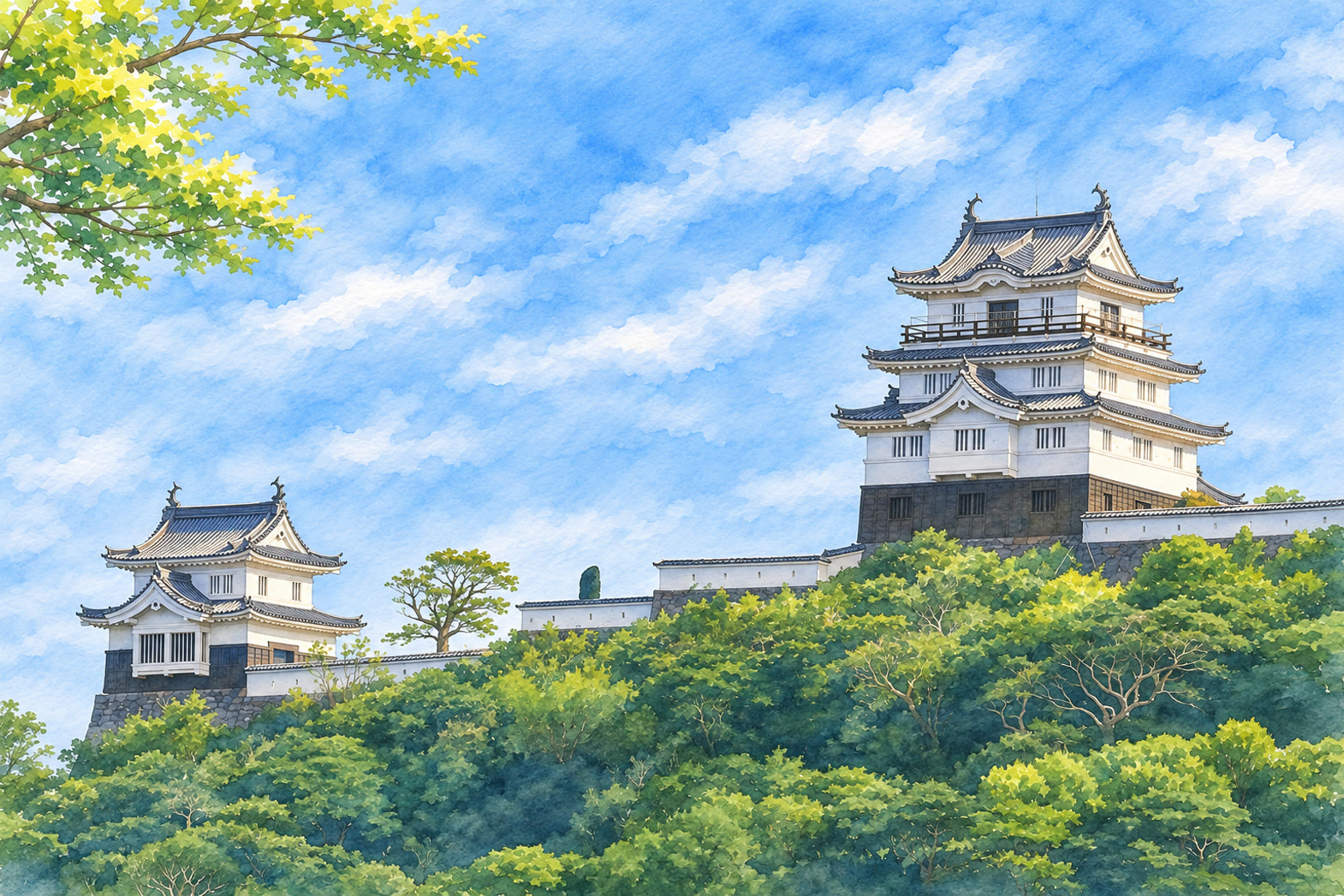
01A Harbor on the Strait
Hirado Island lies off the northwestern tip of Kyūshū, long and narrow, separated from the mainland by the Hirado Strait, which at its narrowest is less than a kilometer across. Today a red suspension bridge carries traffic over the water in a couple of minutes. In the age of sail, the strait and the sheltered harbor on the island’s east coast were a natural first landfall for ships coming up from the Chinese coast, the Ryūkyū Islands and the Korean peninsula. The harbor is small, ringed by hills that break the wind, and deep enough for large ships, and it sits right where the East China Sea routes meet the north coast of Kyūshū.
That position explains almost everything about Hirado’s history. For roughly a century, from the middle of the 16th century to 1641, this little port was one of the busiest meeting points between Japan and the outside world. Chinese merchants came first, then the Portuguese, then the Dutch and the English. When the Tokugawa shogunate moved the Dutch to Dejima in Nagasaki in 1641, that century ended, and Hirado went back to being a quiet castle town. What a visitor sees today, from the reconstructed Dutch warehouse to the church spire above the temple roofs, is the residue of those decades.
Hirado’s links to the sea are older still. In 804 the monk Kūkai sailed for Tang China with an embassy from Tanoura on Hirado Island, and local tradition says that on his way home in 806 he stopped at Hirado again and performed a fire ritual there; Saikyō-ji on the island is called the "Kōya-san of the West" for this reason. The return visit is a legend, but it shows how early Hirado thought of itself as a gateway to and from abroad.
02The Matsura
In the medieval period the coasts of northern Hizen Province were held by a loose league of small warrior houses known collectively as the Matsura-tō, the Matsura band. They lived scattered among bays and islands and were at home on the water as fighters, traders and, at times, raiders. When the Mongols attacked Japan in 1274 and 1281, Matsura warriors were among the defenders, and the coasts around Iki and Takashima suffered heavily.
The branch based at Hirado rose above its neighbors during the Sengoku period. Its key figure was Matsura Takanobu, later known by his Buddhist name Dōka, who led the house in the mid-16th century. Takanobu understood that foreign ships meant silver, silk, gunpowder and guns, and he set out to attract them. Hirado’s international century begins with that decision.
His son Matsura Shigenobu, known as Hōin, submitted to Toyotomi Hideyoshi when Hideyoshi conquered Kyūshū, led troops in the invasions of Korea, and kept his lands after the Battle of Sekigahara. Under the Tokugawa the Matsura ruled Hirado domain, assessed at about 60,000 koku, until the Meiji Restoration. They were outside lords (tozama) of modest size, and their early wealth and contacts from trade helped them survive.
03Wang Zhi and the Chinese Merchants
The first foreigners to make Hirado an international port were not Europeans but Chinese. In the 16th century Ming China banned private overseas trade, yet smuggling along its southeast coast boomed, and Japanese silver was the great attraction. Chinese records often lumped these armed merchants together with the Japanese pirates they called wakō. The most famous of them was Wang Zhi, a native of Huizhou.
Wang Zhi had run his trade from islands off the Zhejiang coast before shifting his base to Japan. According to the records, Matsura Takanobu welcomed him, and he built a residence at Hirado, commanded a large fleet and a great following, and styled himself the "King of Hui." He was effectively a power in his own right on the East China Sea. It is generally believed that he was involved with the ship that brought European firearms to Tanegashima in 1543; Japanese accounts of that event mention a Chinese passenger called Gohō (Wufeng in Chinese), usually identified with Wang Zhi.
Wang Zhi’s end came in China. The Ming official Hu Zongxian lured him home with promises of pardon, and he was arrested and executed at Hangzhou at the end of the Chinese year 1559 (January 1560). The networks he built lasted, however, and Chinese ships kept calling at Hirado, with Chinese merchants living in the town for decades. Near the harbor today is a spot identified as the site of Wang Zhi’s residence, and nearby a hexagonal well that tradition says was dug by the Chinese.
04The Portuguese and Francis Xavier
In 1550 the first Portuguese ship sailed into Hirado. Operating out of Macau, the Portuguese carried Chinese raw silk to Japan and took Japanese silver back, and their large ships, which the Japanese called nanban ("southern barbarian") ships, could carry enormous cargoes.
That same year the Jesuit missionary Francis Xavier came to Hirado from Kagoshima, where he had landed in 1549 and found preaching difficult. Hearing that a Portuguese ship had arrived at Hirado, he made his way there. Takanobu allowed him to preach, and according to Jesuit accounts a number of people were baptized in a short time. Xavier then went on to Yamaguchi and Kyoto, while companions including Cosme de Torres looked after the new converts at Hirado for a time.
Takanobu welcomed the Portuguese for the trade. The missionaries, for their part, tied trade to mission: Portuguese captains tended to sail to ports whose lords protected Christianity. From the start Hirado was caught up in this knot of commerce and faith.
In the west of Hirado Island and on neighboring Ikitsuki Island, branch families of the Matsura such as the Koteda converted, and many of the people in their lands followed. The result was a dense Christian community, whose descendants later became the Hidden Christians of the ban era.
05The Portuguese Move On
Relations were never steady. Takanobu himself did not convert, and Buddhist temples and many of his retainers resented the missionaries. In 1561 a quarrel over trade at the market in front of Shichirō Shrine by the harbor turned into a brawl that, according to the usual account, left the Portuguese captain-major, Sousa, and a dozen or so other Portuguese dead, an episode usually called the Miyanomae Incident.
The Portuguese turned to the neighboring lord Ōmura Sumitada, the first daimyo to be baptized. He opened Yokoseura to them in 1562, later Fukuda, and from 1571 Portuguese ships called regularly at the new port of Nagasaki, which grew rapidly while Hirado lost most of the nanban trade. Hideyoshi’s edict expelling missionaries followed in 1587, and in 1614 the Tokugawa banned Christianity throughout Japan. After Takanobu’s death in 1599, the Koteda, who would not renounce their faith, left the domain for Nagasaki, and the believers who remained gradually went underground.
06The Dutch Arrive
Hirado’s second boom came from Protestant Europe. In 1600 the Dutch ship De Liefde drifted ashore in Bungo. Its English pilot, William Adams, became an adviser to Tokugawa Ieyasu and took the Japanese name Miura Anjin. Through Adams, Ieyasu learned that there were European nations hostile to Portugal and Spain that were willing to trade without making mission work a condition.
In 1609 two ships of the Dutch East India Company (VOC) reached Hirado. Dutch envoys traveled to Sunpu to see Ieyasu and obtained a vermilion-seal trading permit, and a factory, as such trading posts were called, was opened at Hirado with Jacques Specx as its first head. The Matsura gave the Dutch land by the harbor. The factory began in rented houses and grew into a compound of residences, warehouses and a quay.
The Dutch chose Hirado because it already had an international harbor and a lord used to foreign traders, and because Nagasaki belonged to the Portuguese. The Netherlands was at war with Spain and Portugal, and Dutch ships preyed on Portuguese and Chinese vessels in East Asian waters; Hirado became one of their bases. In 1616 the shogunate restricted the trade of foreign ships other than Chinese ones to Hirado and Nagasaki, which made Hirado more important still.
07Ten Years of the English Factory
The English arrived four years after the Dutch. In 1613 the East India Company ship Clove, under John Saris, reached Hirado, and with Adams’ help Saris was received by Ieyasu and Tokugawa Hidetada and obtained permission to trade. When Saris sailed home, the factory was left in the charge of Richard Cocks, whose detailed diary records daily life at the post, dealings with the Matsura, business with the Chinese merchant Li Dan, and the comings and goings of the town. It is one of the liveliest windows we have onto Hirado in those years.
The English factory never prospered. English woolens sold poorly in Japan’s mild climate, the English never secured a steady supply of Chinese silk as the Dutch eventually did, the 1616 restrictions narrowed their market, and they quarreled with the Dutch in Southeast Asia. Adams traveled back and forth to Hirado in his last years and died there in 1620. A grave in Hirado is traditionally said to be his. In 1623 the company closed the factory and the English left Japan; they would have no permanent trading post in the country again until the end of the Edo period.
08Koxinga’s Birthplace
In 1624, the year after the English left, a boy was born at Hirado. His father, Zheng Zhilong, was a Fujianese maritime merchant then based at Hirado and closely tied to Li Dan’s trading network. His mother was a Hirado woman, usually called Tagawa. The child, named Fukumatsu, grew up to be Koxinga (Zheng Chenggong).
Local tradition says that his mother went into labor while gathering shells on the beach and gave birth leaning against a rock. That rock, known as the Kotan-seki or "birth stone," stands at Senri-ga-hama on the island’s west coast. The story is a later legend, but it shows how Hirado keeps its memory of Koxinga in the landscape.
Zheng Zhilong later returned to China, accepted a Ming pardon and became a power on the southeast coast. Koxinga left Hirado for Fujian at about six (seven by traditional count). After the fall of the Ming he fought the Qing in the name of the Southern Ming, whose Longwu Emperor granted him the imperial surname Zhu, giving rise to the title Guoxingye, "Lord of the Imperial Surname," which Europeans rendered as Koxinga. In 1661 he attacked Dutch-held Taiwan, forced the Dutch to surrender the next year, and died soon after in 1662. The Hirado-born son of a merchant who had once lived beside the Dutch drove them out of Taiwan.
In Japan, Koxinga became a household name through Chikamatsu Monzaemon’s 1715 puppet play The Battles of Coxinga (Kokusen’ya kassen). The Kawachi area of western Hirado Island is regarded as his birthplace and has facilities commemorating him.
09The 1639 Warehouse and the Move to Dejima
Through the 1630s the shogunate steadily tightened its control over foreign contact. After the Shimabara–Amakusa Uprising of 1637–1638, it concluded that the Portuguese were bound up with the spread of Christianity and in 1639 banned their ships. The Dutch were now the only Europeans allowed to trade in Japan, and their Hirado factory was at its height.
In 1639 the factory completed a large stone warehouse. According to the usual account, its gable bore the Western date 1639. In 1640 the shogunal inspector Inoue Masashige came to Hirado and, declaring Christian-era dates a sign of Christianity, ordered the buildings bearing them torn down. The factory head, François Caron, did not argue and had the work done at once. It is generally thought that this compliance saved the Dutch trade in Japan.
In 1641 the shogunate ordered the factory moved to Dejima in Nagasaki, the fan-shaped artificial island built for the Portuguese and left empty after their expulsion. The Dutch had spent more than thirty years at Hirado. With their departure Hirado’s career as a foreign-trade port was over; their two centuries on Dejima belong to Nagasaki’s story.
10Castle Town and Hidden Faith
After the Dutch left, Hirado’s history returned to the Matsura. Matsura Shigenobu had built a castle called Hinotake on the hill across the harbor, but in 1613 he burned it himself. Explanations differ; the usual view is that he feared shogunal suspicion of his old ties to the Toyotomi and destroyed the castle as a gesture of submission. For nearly a century the domain had no castle, and its lords lived in a residence below.
In the early 18th century the fifth lord, Matsura Takashi, received shogunal permission to rebuild on the old site. Work began in 1704 and was finished around 1718. This is Hirado Castle, also called Kameoka Castle. It is said to reflect the military science of the Yamaga school, with which the Matsura had close ties. After the castle was abolished in the early Meiji period most of its buildings were pulled down; a few, including the Tanuki Turret and the North Gate, survive. The keep on the summit today is a ferroconcrete structure built in 1962; the Edo-period castle had no keep of this kind.
Matsura Seizan, a lord of the late Edo period, was a noted man of letters whose miscellany Kasshi yawa, written in retirement, collects a vast store of political anecdote and social observation. The family’s documents and treasures are now displayed at the Matsura Historical Museum, housed in a residence the family built in the town in the Meiji period.
The other thread runs through western Hirado and Ikitsuki. After the ban, Christians there registered as parishioners of Buddhist temples while secretly keeping their faith, passing down prayers by word of mouth and guarding sacred objects through the generations. Mount Yasumandake, a mountain long revered in the area, was also a place of prayer for the Hidden Christians, and the islet of Nakaenoshima, where believers were martyred in the early years of the ban, became a holy place for them. When the ban was lifted in 1873, some returned to the Catholic Church, while others chose to keep the distinctive forms handed down from their ancestors, a tradition that has continued on Ikitsuki into modern times. In 2018 "Sacred Places and Villages in Hirado" (Kasuga village and Yasumandake, and Nakaenoshima) were inscribed as components of the World Heritage Site "Hidden Christian Sites in the Nagasaki Region."
11Walking Hirado
Start at the harbor. The large stone building on the east side is the Hirado Dutch Trading Post, a 2011 reconstruction of the 1639 warehouse based on excavation and on plans and records preserved in the Netherlands. It is not original, but it stands on the warehouse’s actual site, and the factory site as a whole is a national Historic Site. Around it are the genuinely old remains: a length of stone wall known as the Dutch Wall, said to have screened the compound from view and from fire; the Dutch well; and stone steps that once led down to the water.
Walk along the harbor into town and you can find the site of Wang Zhi’s residence with its hexagonal well, and a stone marker for the English factory, which left no buildings. The stone arch of Saiwai-bashi, popularly called the Dutch Bridge, is said to have been built in 1702 by masons who had learned stone construction from the Dutch; it is a national Important Cultural Property.
Up the slope is Hirado’s best-known view. The Hirado Xavier Memorial Church, a pale green Gothic church completed in 1931, is named for Xavier’s mission here. From the stone lane that climbs between Kōmyō-ji and Zuiun-ji, the temple roofs and the church spire overlap in a scene locals call "the view of temples and a church." It is not a 16th-century scene, since the church is modern and the temples were largely rebuilt after the Edo period began, but the layers of Hirado’s religious history are easy to read from here.
Across the harbor, Hirado Castle stands on its hill. The Tanuki Turret and the North Gate are Edo-period originals, and the 1962 keep houses exhibits on the Matsura and their domain. The Matsura Historical Museum sits on high ground above the harbor.
With more time, head for the west coast: the birth stone at Senri-ga-hama and the Koxinga memorials around Kawachi, and beyond them Kasuga village, its terraced fields running down to the sea beneath Yasumandake. Ikitsuki Island, joined to Hirado by bridge, has a museum on the Hidden Christians and the old faith some of their descendants kept. Across the strait at Tabira stands Tabira Church, a red-brick church completed in 1918 and designated a national Important Cultural Property.