
01A Monk Who Was a God
Tōdai-ji, the vast temple in Nara that houses Japan’s most famous giant Buddha, keeps a wooden statue that seems at first glance to be in the wrong place. It shows a seated monk with a shaved head, wrapped in a Buddhist robe, his face calm and a little stern. It is a National Treasure. It was carved in 1201 by Kaikei, one of the great sculptors of the Kamakura period. The figure is not a monk. It is Hachiman, a Japanese god, one of the most widely worshipped of all the kami.
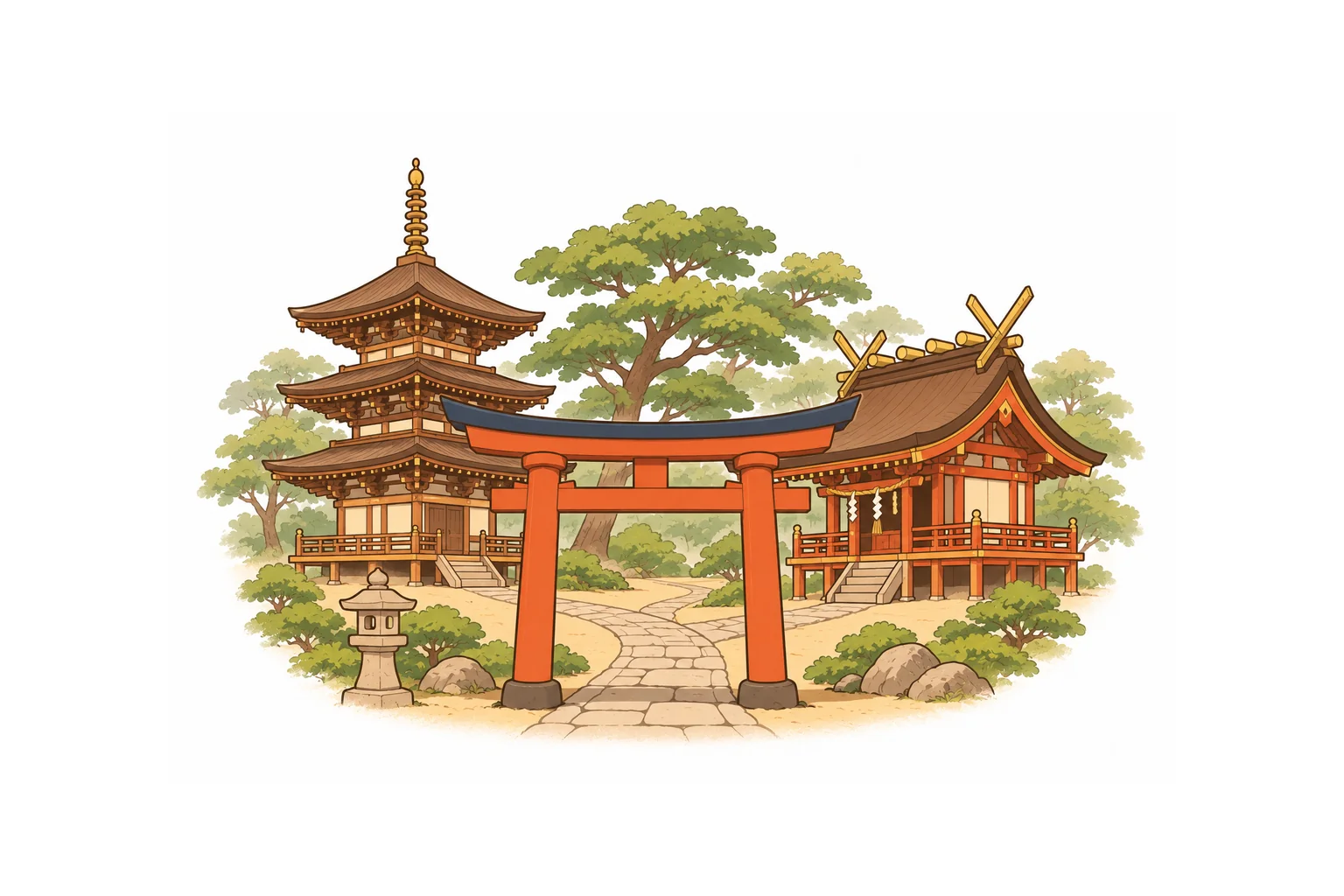
Kami is the Japanese word for the divine beings of Japan’s native religion. A kami might be a mountain, a waterfall, an ancestor, a legendary emperor, or simply a presence felt in an ancient tree. Today we call the worship of kami Shinto, and we think of it as distinct from Buddhism. Shinto has shrines, marked by the red or plain wooden gateways called torii, and priests in white and pale-colored robes who perform purification rites. Buddhism has temples, with their halls of gilded statues, incense, and monks in black. Visitors to Japan are taught early which is which, and guidebooks explain the etiquette for each: clap at a shrine, do not clap at a temple.
So why would anyone carve a Shinto god as a Buddhist monk? Kaikei was not being eccentric. For more than a thousand years, from the arrival of Buddhism in the sixth century until 1868, the line between kami and buddhas in Japan was blurred almost everywhere. Major shrines had Buddhist halls and pagodas inside their grounds. Monks recited sutras before the gods and often ran the shrines outright. Kami carried Buddhist titles such as "bodhisattva" and gongen, "provisional manifestation." Most Japanese people of the time would not have understood the question "Are you Shinto or Buddhist?"
Then, in the spring of 1868, the new Meiji government ordered the two pulled apart. Within weeks, on the 1st day of the 4th lunar month, at the Hie Shrine at the foot of Mount Hiei near Kyoto, a shrine priest and a band of some forty shrine personnel broke into the sanctuaries, hauled out the Buddhist statues, sutras, and ritual objects that had been kept there for centuries, and smashed and burned them, reportedly more than a thousand items. Similar scenes followed across the country.
Two questions sit inside this story. How did two religions with entirely different origins come to share the same sacred spaces so comfortably, for so long? And if the arrangement worked, why was it dismantled so suddenly and, in places, so violently?
02Gods Without Books
Start with what the kami were before Buddhism arrived.
Early Japanese religion had no scriptures, no founder, and no doctrine about the origin of the universe or the fate of the soul. It was a set of practices for living alongside powerful presences in the landscape. A mountain could itself be divine. The Ōmiwa Shrine in Nara still has no main sanctuary building; worshippers face Mount Miwa directly, because the mountain is the body of the god. In many places a kami was called down to a temporary sacred space for a festival and then sent back. There were no images of the gods. You could not see a kami; you could only feel its presence and make offerings.
The kami were not moral teachers. They could bless and they could curse. What they wanted was proper worship and purity. Death, blood, and disease were forms of pollution, to be cleansed with water, salt, and ritual. The important question was not "What is true?" but "How do we keep the gods content?"
Buddhism reached Japan from the Korean kingdom of Paekche in the middle of the sixth century; the traditional dates are 538 or 552. According to the Nihon shoki, an official history compiled in 720, the king of Paekche sent a gilt bronze image of the Buddha along with sutras, and Emperor Kinmei was dazzled by its radiance. His ministers split. Soga no Iname argued that all the civilized kingdoms to the west worshipped this figure and Japan should not be left behind. The Mononobe and Nakatomi clans, who held hereditary duties in military affairs and ritual, objected that Japan already had its own gods of heaven and earth, and that bowing to a foreign god would anger them.
The telling detail is how the opponents described the Buddha. They called him a banshin, a "foreign kami." Nobody in the debate argued that the Buddha was false or that his teachings were wrong. The question was which god was more powerful and which one it was safe to worship. When an epidemic broke out, the Mononobe blamed the angry native gods and threw the Buddhist image into a canal at Naniwa. When the disease continued, the Soga blamed the insult to the Buddha. Both sides were thinking in the same terms.
In 587 the Soga, allied with the prince later known as Shōtoku Taishi, defeated the Mononobe in battle, and Buddhism became the favored religion of the court. But nobody abolished the kami. The emperor continued to perform the rites that tied him to the sun goddess Amaterasu, his claimed ancestor, and the court’s Department of Divinities continued to register shrines and send offerings. From the very beginning, Japan never faced a choice between the Buddha and the gods. The Buddha was added, not substituted.
03Gods Who Wanted to Be Saved
By the eighth century, a new idea had taken hold: that the kami, too, were suffering beings in need of the Buddha’s help.
In Buddhist cosmology, all beings are trapped in a cycle of rebirth through six realms, from the heavens down through humans, animals, and hungry ghosts to the hells. Even gods live within this cycle. They enjoy long lives and great powers, but they are not liberated. Buddhism had already applied this idea elsewhere. In India it absorbed Hindu gods like Brahma and Indra as protectors of the Dharma. In China, monks told stories of mountain spirits who came to hear sermons and asked to take Buddhist vows. In Japan, the same logic was applied to the kami.
The best-known case comes from Tado, in Ise Province, in 763. A wandering monk named Man’gan was practicing near the shrine of the local god when the god spoke through a medium. Over countless ages, the god said, he had piled up heavy karma, and as a result had been reborn as a kami. Now he wished to leave his divine body forever and take refuge in the Buddha, the Dharma, and the monastic community. Man’gan built a small hall beside the shrine, installed a Buddhist image, and began reciting sutras for the god’s salvation. This became the Tado jingū-ji, or "shrine temple."
Similar stories appear in many places. At Kehi Shrine in Echizen, a powerful courtier is said to have founded a shrine temple in 715 after the god appeared in a dream asking to be released. Shrine temples rose at Usa in Kyūshū, in Wakasa, and elsewhere.
To a modern reader, a god confessing to heavy karma and begging to escape his divine form sounds like a humiliation. It probably did not seem so at the time. For a provincial clan, having their ancestral god embrace Buddhism was a mark of prestige, a sign that their god belonged to the advanced, cosmopolitan culture favored by the capital. Inviting monks and building a hall connected them to that world. For the monks, a shrine gave them a foothold in local society. Everyone gained.
A second idea ran alongside the first: that kami were guardians of Buddhism. Hachiman is again the prime example. In the 740s Emperor Shōmu set out to cast a colossal bronze Buddha for Tōdai-ji, a project that strained the country’s supplies of copper and labor. An oracle from Hachiman’s shrine at Usa announced that the god would lead all the kami of heaven and earth to help build it, even if he had to turn molten copper to water and mingle his own body with grass, trees, and earth. In the last weeks of 749, Hachiman came to Nara in the person of his priestess, Ōmiwa no Morime. According to the official chronicle, her palanquin was purple, of the same pattern as the emperor’s own. She worshipped before the Buddha in the presence of the retired Emperor Shōmu, the Empress Dowager Kōmyō, the reigning Empress Kōken, and the whole court, while 5,000 monks chanted. Hachiman became the guardian of Tōdai-ji; his shrine, first set up south of the palace, was moved in 1250 to the spot beside the temple where Tamukeyama Hachimangū still stands.
In 781 the court granted Hachiman the title of Great Bodhisattva. For centuries afterward warriors prayed to "Hachiman Daibosatsu," the god of war with a Buddhist title. And as kami acquired Buddhist identities, they also acquired faces. Under Buddhist influence, sculptors began making images of gods who had never been depicted before. The monk-shaped Hachiman at Tōdai-ji is the most vivid result.
04The Original and Its Traces
During the Heian period, roughly 794 to 1185, the relationship went a step further. Thinkers developed a full theory called honji suijaku, which might be translated "original ground and manifested traces."
The idea was this. Buddhas and bodhisattvas, out of compassion, take whatever form will best reach the beings they want to save. In Japan, before Buddhism arrived, they appeared as the local kami, speaking to the Japanese in a language they could understand. Every kami, therefore, was really a buddha or bodhisattva in local guise. The buddha was the honji, the original ground. The kami was the suijaku, the trace left on the world. The kami were called gongen, provisional manifestations.
The theory grew out of the Buddhist idea of skillful means: that the Buddha teaches different people in different ways, adapting his message and even his form. The Lotus Sutra, central to the powerful Tendai school, taught that the historical Buddha’s life on earth was itself a kind of performance by a being who had been enlightened for eons. If the Buddha could appear as a human prince, there was no reason he could not appear as a Japanese god.
Soon nearly every important kami had a matching buddha. Amaterasu, the sun goddess enshrined at Ise, was identified with Dainichi, the Great Sun Buddha of esoteric Buddhism; the connection through the sun was obvious. The god of Hie, guardian of the Tendai headquarters on Mount Hiei, was identified with Shaka, the historical Buddha. The four deities of Kasuga Shrine in Nara were paired with Kannon, Yakushi, Jizō, and other figures.
The most complete system was at Kumano, deep in the mountains of the Kii Peninsula south of Nara. The gods of its three great shrines were identified with Amida, the Buddha of the Western Pure Land; Yakushi, the healing Buddha; and the thousand-armed Kannon. Together they were the Three Gongen of Kumano. In the late Heian period Kumano came to be seen as the Pure Land on earth, and pilgrims of every rank walked for weeks over steep mountain trails to reach it. Retired emperors led great processions there; Go-Shirakawa is said to have made the journey more than thirty times. For a pilgrim kneeling before the god of the main Kumano shrine, there was no contradiction in praying to Amida at the same moment. The god was Amida.
The theory changed the look of shrines. Inside sanctuaries hung mishōtai, bronze mirrors or discs engraved with the image of the god’s original buddha. The mirror was one of the oldest sacred objects of kami worship; now a buddha appeared on its face. Pagodas, bell towers, and halls for esoteric fire rituals rose in shrine precincts. Painters produced shrine mandalas, landscapes of Kasuga or Kumano with the buddhas floating above the buildings, for worshippers to venerate at home.
The fusion was never total. The Ise Shrines, the most sacred in the land, kept Buddhism at a careful distance. Monks were barred from approaching the inner sanctuaries, and within the shrine precincts people used substitute words to avoid Buddhist vocabulary: a sutra was "dyed paper," a temple was "tiled roof," a monk was "long hair," a deliberate reversal, since monks shaved their heads. Yet even Ise felt the pull. In 1186 the monk Chōgen, charged with rebuilding Tōdai-ji after it had been burned in the civil wars, led a large party of monks to Ise to recite the Great Wisdom Sutra and pray to Amaterasu for the success of the project. They respected the rules of the shrine, but they plainly believed that the sun goddess cared about the fate of the Great Buddha.
05Monks in Charge
If kami were really buddhas, it made sense for Buddhist clergy to manage their shrines. And they did.
Many major shrines had a bettō, a monk administrator who oversaw the shrine’s affairs, and a staff of shasō, "shrine monks," who performed Buddhist rites before the gods. In many cases the hereditary shrine priests were subordinate to them.
Iwashimizu Hachimangū, on a hill south of Kyoto, became the most honored shrine in the country after Ise. In 859 Gyōkyō, a monk from the Daian-ji temple in Nara, received an oracle at Usa and brought Hachiman’s spirit to Otokoyama to protect the capital; the shrine buildings went up the next year. A monk founded it, monks administered it, and a Buddhist temple stood within its grounds.
The Tsurugaoka Hachimangū in Kamakura, the spiritual center of the first warrior government, was likewise run by a bettō. In the first month of 1219, the third shogun, Minamoto no Sanetomo, had just finished worshipping at the shrine and was descending its stone steps on a snowy night when he was cut down by his nephew Kugyō. Kugyō’s position was bettō of Tsurugaoka Hachimangū. The assassination shocked everyone. That a Buddhist monk held the top post at the warrior class’s own shrine shocked no one.
In Nara, the great temple Kōfuku-ji and Kasuga Shrine were both foundations of the Fujiwara, the dominant aristocratic clan, and in the medieval period they functioned as one institution under Kōfuku-ji’s control. When the temple’s armed monks marched on Kyoto to press demands on the court, they carried the sacred sakaki branch of the Kasuga god before them. The monks of Mount Hiei did the same with the portable shrines of the Hie god. A temple could threaten the government in the name of a kami, because temple and shrine were effectively the same household.
The deepest fusion was in Shugendō, the way of mountain asceticism. It blended the worship of sacred mountains with esoteric Buddhism and Chinese Daoist techniques, and it claimed as founder En no Gyōja, a semi-legendary seventh-century wonder-worker. Its practitioners, the yamabushi, trained on peaks such as Yoshino, Kumano, Haguro, and Hiko, standing under icy waterfalls and crossing ridges to gain spiritual power. The figure they revered at Yoshino, Zaō Gongen, was a wrathful Buddhist deity who was also the god of the mountain. Yamabushi traveled through the villages too, exorcising spirits, praying for rain, and treating the sick. They carried a religion in which buddhas and kami were inseparable into ordinary homes.
For most people, there was a simple division of labor. For a good harvest, a safe childbirth, or success in business, you went to the kami. For the dead, and for your own hope of rebirth in paradise, you went to the buddhas. Both were part of life, and very often they stood on the same mountain.
06Turning the Theory Upside Down
There were always people who wanted to rearrange the hierarchy.
After the Mongol invasions of 1274 and 1281 failed, many in Japan believed the kami had defended the land, and the idea of Japan as shinkoku, the "land of the gods," gained strength. Around the same time, priests of the Watarai family at the Outer Shrine of Ise developed a body of teaching later called Ise Shinto, which argued that the kami were the original and the buddhas were their manifestations. In the fifteenth century Yoshida Kanetomo, a priest in Kyoto, founded what he called Yuiitsu Shinto, "One and Only Shinto," claiming to transmit a pure tradition free of Buddhist mixture. He liked to quote a saying he attributed to Prince Shōtoku: Japan is the root, China the branches and leaves, and India the flowers and fruit.
Yet these thinkers built their systems largely with Buddhist tools, especially the cosmology of esoteric Buddhism. Yoshida’s rituals in many respects resembled esoteric Buddhist ones. They were arguing about who ranked first within a combined world, not calling for divorce.
Real hostility to Buddhism grew in the Edo period (1603 to 1868), for two main reasons.
The first was political. To root out Christianity, the Tokugawa shogunate required every household to register with a Buddhist temple, which certified each year that its members were not Christians. Temples became, in effect, local branches of the government’s population registry, and every family was tied to a temple that conducted its funerals and memorial services. This guaranteed temples an income, but it also earned them a reputation as complacent funeral businesses. Some domain lords acted on that resentment. In 1666 Ikeda Mitsumasa of Okayama and Tokugawa Mitsukuni of Mito closed or merged large numbers of temples in their territories; Mito alone is said to have done away with about a thousand.
The second was intellectual. Confucian scholars attacked Buddhism as otherworldly and wasteful. More influential in the long run was the school of National Learning. Motoori Norinaga spent more than three decades studying the Kojiki, the oldest Japanese chronicle, and urged his readers to strip away the "Chinese mind" and recover the pure heart of ancient Japan. His self-proclaimed successor, Hirata Atsutane, went further, mocking Buddhism and preaching an ancient way centered on the emperor and the kami. Hirata’s ideas spread widely in the nineteenth century among rural shrine priests, village headmen, and lower samurai. Many of them would push the separation of 1868.
Still, most people in the Edo period worshipped both. When Tokugawa Ieyasu, founder of the shogunate, died in 1616, he was deified the following year as Tōshō Daigongen, the Great Gongen Illuminating the East. His mausoleum shrine at Nikkō had a pagoda and a sutra library and was administered by Tendai monks. The man who founded the regime was worshipped as a provisional manifestation of a buddha.
07The Separation
The Meiji government that took power in 1868 justified itself as a restoration of direct imperial rule. The emperor’s authority rested on his descent from Amaterasu. To place him at the center of the new state, its leaders wanted a clear, unified system of kami worship with the emperor at its apex. Shrines tangled up with Buddhism looked impure, and some of the men in the new government were followers of Hirata’s teaching.
On the 13th day of the 3rd lunar month of 1868 the government proclaimed the unity of ritual and government, revived the ancient Department of Divinities, and placed all shrines under it. A series of orders followed. On the 17th, monks serving at shrines were ordered to return to lay life. On the 28th, kami were forbidden Buddhist titles such as gongen or Gozu Tennō, Buddhist images serving as the bodies of gods were to be replaced, and Buddhist statues, bells, and ritual objects removed from shrines. Later orders dropped Hachiman’s title of Great Bodhisattva and told the laicized monks to become shrine priests or leave. Taken together these became known as the orders separating kami and buddhas.
The orders called for separation, not destruction. Buddhism itself was not banned, and on the 10th day of the 4th month the government warned against using the orders as an excuse for violence. But in many places separation turned into haibutsu kishaku, a phrase meaning "abolish the Buddha, destroy Shakyamuni." The attack on the Hie Shrine came just four days after the order of the 28th. Its leader, the shrine priest Juge Shigekuni, who also held a post in the new government’s office of divinities, belonged to a priestly lineage that had lived for centuries under the domination of the monks of Mount Hiei. The order gave him his chance.
The violence varied enormously by region. It was worst where local authorities were already hostile to Buddhism. The Satsuma domain in southern Kyūshū, which had begun closing temples before the Restoration, abolished every one of its 1,066 temples by the mid-1870s and forced nearly 3,000 monks back into lay life; temple bells are said to have been melted down for cannon and coins. Even today, old temples are noticeably scarce in Kagoshima. The domains of Matsumoto and Toyama carried out sweeping closures and mergers.
Famous sites were transformed. The monks of Kōfuku-ji in Nara renounced their vows en masse and became priests of Kasuga Shrine, leaving one of the great temples of Japan nearly abandoned. A story that circulated later, with no reliable documentation behind it, says that its five-story pagoda was nearly sold for a pittance to someone who intended to burn it for its metal fittings, and that the plan fell through. The great complex of Konpira on the island of Shikoku, which had been a Buddhist temple, became the Kotohira Shrine, and its Buddhist halls and images were sold or removed. Iwashimizu was renamed Otokoyama Hachimangū in 1869 (the old name returned in 1918) and stripped of its Buddhist buildings, and Hachiman’s title of Great Bodhisattva was replaced with Great Kami. At Tsurugaoka in Kamakura the pagoda and other Buddhist structures were torn down. Nikkō was divided into three separate institutions, the Tōshōgū, the Futarasan Shrine, and the temple Rinnō-ji, which stand side by side to this day.
In 1871 the government confiscated the landholdings of temples and shrines, cutting off many temples’ income. In 1872 it abolished Shugendō, ordering the yamabushi either to join the Tendai or Shingon schools of Buddhism or to return to lay life. There were by one estimate well over a hundred thousand of them, and a tradition that traced itself back more than a thousand years was broken almost overnight.
The worst of the destruction was over by the mid-1870s. Buddhist leaders organized resistance, believers rioted in some regions, and the government recognized that it could not impose a state religion by force. But the losses were permanent. Countless statues, scriptures, and ritual objects were destroyed or scattered, and some ended up in collections abroad. In the 1880s the American scholar Ernest Fenollosa and his Japanese student Okakura Kakuzō surveyed old temples and pressed for protection of what survived. Their work fed into the Ancient Shrines and Temples Preservation Law of 1897, Japan’s first comprehensive law protecting cultural property.
08Why They Could Share, and Why They Were Split
So why could kami and buddhas live under one roof?
First, because the kami were open-ended. They had no scriptures to defend and demanded no exclusive loyalty. Every mountain and village had its own god, and one more powerful god from overseas did not threaten the others. Worshipping an additional deity meant more protection, not betrayal.
Second, because Buddhism arrived with a ready-made way of fitting local gods into its universe. It had done the same with the gods of India and the spirits of China. In Japan it moved step by step, from kami needing salvation, to kami guarding the Dharma, to kami as buddhas in disguise. The kami gained a vast cosmology they had never had. Buddhism gained roots in Japanese soil.
Third, because the arrangement served everyone. The court needed the kami to legitimate the emperor and Buddhism to protect the state. Temples extended their wealth and power by managing shrines. Provincial clans raised the prestige of their gods. Ordinary people got help with this life from the kami and help with the next from the buddhas. No one with power had a strong reason to break it up.
The split, when it came, was a political decision. A new state wanted a national religion centered on the emperor, uncontaminated by anything foreign, and the resentments built up against temples as instruments of Tokugawa rule, together with the ideas of the National Learning school, turned that decision into destruction in many places.
Some historians, most influentially Kuroda Toshio, have argued that before the modern era there was no such thing as "Shinto" as an independent religion, that kami worship existed only as part of a larger Buddhist-dominated system, and that the Shinto we know was carved out after 1868. This goes a little too far. The court rites and the shrines of Ise maintained traditions of their own and resisted Buddhist absorption. But the core of the argument is right. For most Japanese people across most of history, kami and buddhas belonged to a single religious world. The neat categories of "Shinto" and "Buddhism" that guidebooks use today were drawn by the modern state.
That means the real puzzle is not the sharing but the separation. The combined world was the norm for over a thousand years; the divided one is the exception, and a recent one.
And the separation never fully took. Japanese families still visit a shrine at New Year and bring newborns to be blessed by the kami, while funerals and graves remain the business of temples. Toyokawa Inari in Aichi Prefecture has torii gates, fox statues, and the name of a shrine, yet it is a Zen temple of the Sōtō school. Pilgrims on the Kumano trails pass shrines and temples without much concern for which is which. At Nikkō, the three legally separate institutions still share one forested hillside, and a visitor walking through has a hard time saying where the kami end and the buddhas begin. The Meiji orders changed names, property, and organization. They did not change the habit of praying to both.