
01A Mountain on Fire
In the autumn of 1571, the warlord Oda Nobunaga surrounded Mount Hiei, the long ridge that rises just northeast of Kyoto. On its slopes and in the town of Sakamoto at its foot stood Enryaku-ji, the headquarters of the Tendai school of Buddhism and, for nearly eight centuries, one of the most venerated religious sites in Japan. Its founder, the monk Saichō, had built his first hall there in the late eighth century. Generations of Japan’s most influential Buddhist teachers had trained on the mountain. Emperors had prayed through its rites.
Nobunaga’s troops set fire to Sakamoto and worked their way upward. The Konpon Chūdō, the temple’s central hall, burned. According to Shinchō Kōki, the chronicle written by Nobunaga’s retainer Ōta Gyūichi, several thousand people were killed: monks, laymen, women, and children.
The massacre is usually told as a story about Nobunaga, the ruthless modernizer who feared neither gods nor Buddhas. But it raises a stranger question about the temple itself. Nobunaga did not attack Enryaku-ji because it preached the wrong doctrine. He attacked it because, the year before, it had sheltered an enemy army on its mountain and refused his demand to stay neutral. Enryaku-ji was a participant in a war. It had land, fighters, alliances, and a political position, and it had been behaving like this for five hundred years.
Buddhism’s first precept forbids taking life. So how did some of Japan’s greatest Buddhist institutions come to keep armed men, march on the capital, burn each other’s halls, and fight a decade-long war against the most powerful man in the country? And why, after about 1600, did all of this vanish almost without a trace?
02The Emperor Who Could Not Control the Monks
The problem is far older than Nobunaga. A famous line in the first book of The Tale of the Heike, the great medieval war epic, attributes a complaint to the retired emperor Shirakawa, who dominated the court from the 1080s until his death in 1129. Three things, he is supposed to have said, would not obey him: the waters of the Kamo River, the dice in a game of sugoroku, and the monks of the mountain.
Whether Shirakawa actually said this is uncertain; the story was written down long after his death. But it captured something every Kyoto resident knew. The Kamo River flooded unpredictably. Dice were dice. And the monks of Mount Hiei, a few hours’ walk away, could descend on the city whenever they chose.
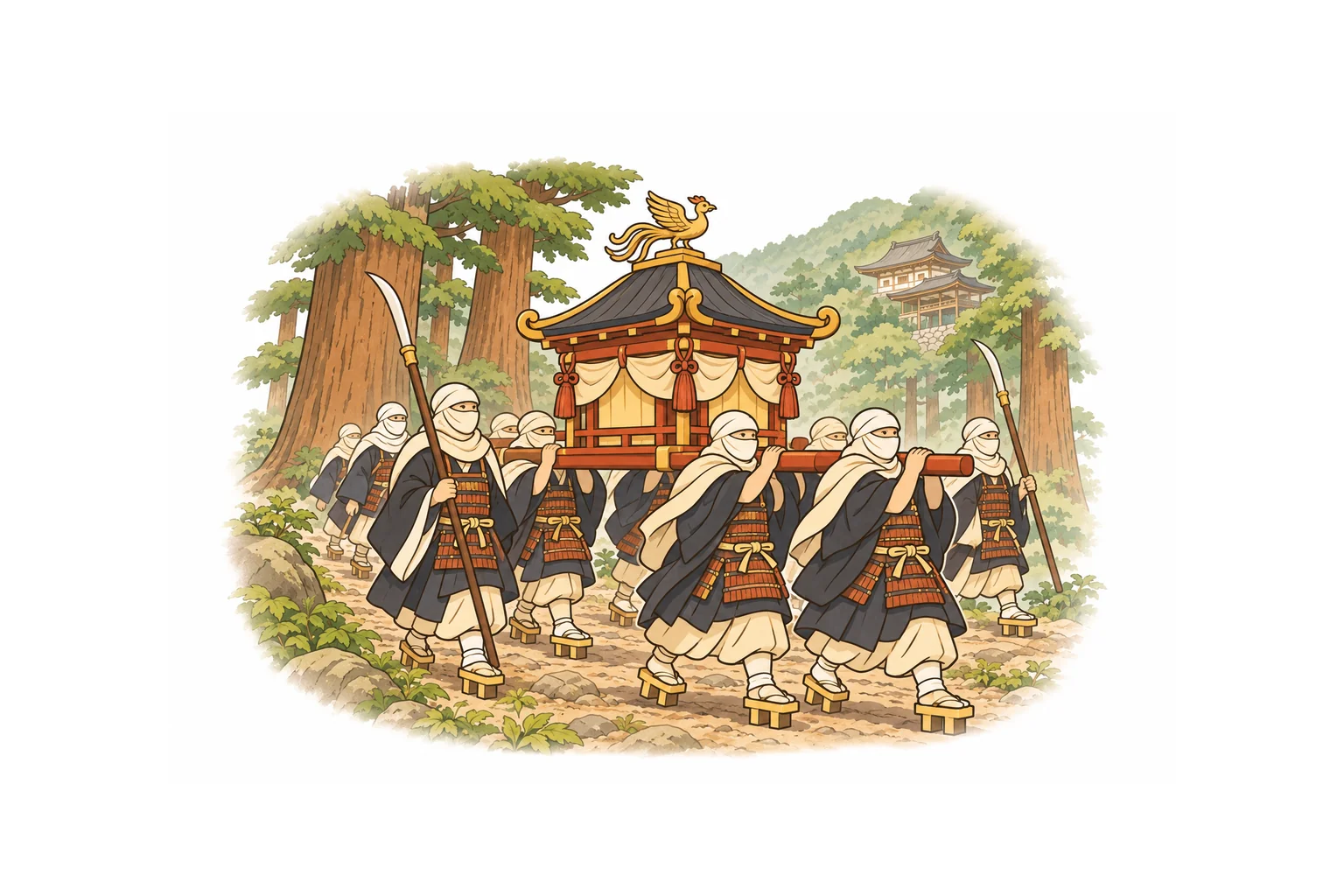
When they came, they came in a particular way. Hundreds or thousands of them would carry the sacred palanquin of the Hie Shrine, the guardian shrine of Enryaku-ji at the foot of the mountain, down into the capital and set it before the palace gates. Among the crowd were monks with their heads wrapped in cloth, carrying long curved halberds called naginata, along with shrine servants and temple dependents. They demanded that the court punish an official, dismiss a provincial governor, or decide a dispute in the temple’s favor. This practice was called gōso, "forceful appeal."
Shirakawa could appoint and dismiss the abbot of Enryaku-ji. What he could not do was control the mountain. To understand why, it helps to stop thinking of a great medieval temple as a place of retreat and see it for what it was.
03Temples as Landlords
By the eleventh century, Enryaku-ji and its great rival in Nara, Kōfuku-ji, were among the largest landholders in Japan. Kōfuku-ji was the clan temple of the Fujiwara, the aristocratic family whose members had for generations served as regents to the emperors, and it was showered with gifts. Both temples held estates called shōen scattered across many provinces. These were private domains, often exempt from taxes and closed to the officials of provincial governors. Some had been donated by nobles seeking merit. Others had been "commended" to the temple by local landowners who preferred paying a modest fee to a distant temple over being squeezed by a greedy governor.
A temple with estates in a dozen provinces needed managers, rent collectors, and people who could deal with trouble. And trouble was constant. The central government’s grip on the provinces had loosened over the Heian period (794–1185). Governors were mainly interested in revenue. Local strongmen fought over boundaries and water rights. Shipments of rice could be seized on the road. Court rulings in a land dispute were only as good as someone’s ability to enforce them.
In that world, anyone with property protected it themselves. Provincial landowning families armed their sons and retainers, and over time these armed households became the warrior class we call samurai. Noble houses in Kyoto relied on such warriors to defend their interests. The temples did the same thing, with one difference: many of their armed men were monks.
Kōfuku-ji shows how far this could go. It and the closely linked Kasuga Shrine came to control most of Yamato Province, the region around Nara. Under both the Kamakura and Muromachi shogunates, the warrior governments for the most part did not appoint a military governor for Yamato. In practice, the temple governed the province. A Buddhist monastery acting as the government of a province sounds bizarre today. To people at the time it was simply how things were.
04Who Carried the Halberds
Later writers called these fighters sōhei, "monk-soldiers," a term that became common only in the Edo period (1603–1868). Contemporaries spoke instead of the daishu, "the assembly" of monks, and sometimes of akusō, "wild monks." The word aku then meant something closer to "fierce" or "unruly" than "evil"; a twelfth-century warrior like Minamoto no Yoshihira could proudly carry the nickname "Wild Genta."
A great temple housed thousands of people, and they were far from equal. At the top were high-ranking prelates, often sons of the regent’s family or the imperial house, who held the abbacies and spent much of their time in Kyoto. Below them were scholar-monks who studied doctrine and performed the great ceremonies. Below them came the hall attendants, who maintained buildings and handled practical business, and beyond them a broad fringe of dependents, shrine servants, and agents who collected rents and ran errands in the provinces.
The armed men came mostly from these lower ranks. Many were younger sons of provincial landowning families, boys with no share in the family inheritance, for whom taking the tonsure was a career. Their brothers stayed home and became warriors; they shaved their heads and became something very similar on the mountain. They managed estates, sued neighbors, and when necessary picked up a halberd. The line between monk and warrior was thin because they were often literally from the same household.
The trend appeared early. In 970, Ryōgen, an energetic abbot of Enryaku-ji remembered as one of the mountain’s great restorers, issued a set of rules that, among other things, banned monks from carrying weapons and from going about with their faces wrapped. Rules forbid what is already happening. Ryōgen’s ban did not hold. A century later, the armed assembly of Mount Hiei was a force no one in Kyoto could ignore.
The assembly also had something no ordinary warlord’s band had: a way of making collective decisions. When a major issue arose, the monks gathered before the lecture hall with their heads and faces covered, disguised their voices when they spoke, and decided by majority whether to march on the capital. Anonymity protected the speakers and made the decision feel like the will of the whole mountain rather than any individual’s ambition. Even the abbot often could not overrule it. This is exactly what frustrated Shirakawa: he could replace one abbot, but not the mountain.
05Carrying the Gods to Court
If the temples had only fighters, they would have been one armed interest among many. What made Enryaku-ji and Kōfuku-ji so formidable was that they also carried gods.
Medieval Japan did not draw a sharp line between Buddhist temples and the shrines of the native gods, the kami. Enryaku-ji was bound to the Hie Shrine, whose deity was its protector. Kōfuku-ji was bound to the Kasuga Shrine, home of the Fujiwara clan’s ancestral gods. When Enryaku-ji’s monks marched, they carried the Hie Shrine’s palanquin, believed to hold the deity itself. When Kōfuku-ji’s monks marched, they carried the sacred tree of Kasuga: a branch of sakaki, an evergreen used in shrine ritual, hung with a sacred mirror.
This was a brilliant tactic. The court could send warriors against a mob of monks. It could not send them against a god. Nobody wanted to be the soldier who shot an arrow into a divine palanquin or spilled blood on the sacred tree. When the Kasuga tree entered Kyoto, custom required the Fujiwara courtiers, who filled most of the high offices, to shut themselves in their houses and stop attending court, so as not to offend their own clan deity. Government ground to a halt. Kōfuku-ji was, in effect, using the Fujiwara family’s piety to lock the Fujiwara out of their own government.
If the court still refused to give in, the monks could simply leave the palanquin or the tree in the street and go home. No one dared move it. The god sat there, day after day, a standing reproach to the city, until the court yielded and returned it with proper ceremony.
The two great temples also fought each other through the court. In 1113, they clashed over who would head Kiyomizu-dera, the famous temple on Kyoto’s eastern hills, and both staged forceful appeals in turn. The court had to post warriors at the city’s approaches.
Those warriors matter to the story. Shirakawa built a personal guard of provincial warriors, the "warriors of the north side" of his palace, and among them were Taira no Masamori and his son Tadamori. Again and again, the Taira were sent to block the monks. Their usefulness against the temples helped bring them into the center of court politics, and within two generations Tadamori’s son Kiyomori would dominate Japan. The temples’ armed power, in other words, helped give the samurai their opening.
But even warriors learned that force against the gods could backfire. In 1177, Enryaku-ji’s monks marched on Kyoto to demand the exile of Fujiwara no Morotaka, governor of Kaga, whose men had burned buildings at one of the mountain’s branch temples. The Taira guards at the palace gate loosed arrows, and some struck the Hie palanquin. A few monks and shrine servants were killed. The result was a reversal: hitting the god was an outrage, so the court jailed the guards who had fired, and exiled Morotaka as the monks demanded, even though his father was a close confidant of the retired emperor Go-Shirakawa.
06Temples at War with Temples
Most of the time the temples’ violence was aimed not at the court but at each other, and the bitterest feud was within a single school.
Onjō-ji, also called Mii-dera, stands on the shore of Lake Biwa on the eastern side of Mount Hiei. It too was a Tendai temple. In the late tenth century, a quarrel between the followers of two of Saichō’s successors, Ennin and Enchin, split the Tendai school. Enchin’s faction left the mountain and made Onjō-ji its base. From then on, Enryaku-ji was "the Mountain Gate" and Onjō-ji "the Temple Gate," and the two fought for centuries over the abbacy of the Tendai school and over Onjō-ji’s wish to have its own ordination platform, the right to ordain monks independently. Enryaku-ji’s monks burned Onjō-ji again and again; the usual count is seven times.
Monks of the same school burning each other’s statues and scriptures is the clearest sign that this violence had little to do with doctrine. It was about rank, privileges, revenue, and who controlled appointments, which is to say about the things any powerful institution fights over.
Once a temple was a military power, it could also be treated as one. In 1180, Prince Mochihito, a son of Go-Shirakawa, called on the Minamoto warriors to rise against the Taira. When his plot was discovered, he fled first to Onjō-ji and then toward Nara, hoping for Kōfuku-ji’s support, and was killed on the way near Uji. Both temples had chosen the losing side, for now. At the end of that year, Kiyomori sent his son Shigehira against Nara. In the fighting, fire spread through Kōfuku-ji and Tōdai-ji, the great temple of the Nara court. The hall of Tōdai-ji’s colossal bronze Buddha burned, the statue was badly damaged, and many people who had taken refuge inside are said to have died. The people of Nara never forgave the Taira. When Shigehira was later captured, he was eventually handed over to the Nara monks and executed.
07A Different Kind of Army: The True Pure Land Leagues
By the fifteenth century, temple power took on a new and far larger form, built not on monks but on ordinary believers.
The True Pure Land school, Jōdo Shinshū, traced itself to the thirteenth-century teacher Shinran. Its message was radically simple: salvation came through faith in the Buddha Amida, whose vow promised rebirth in his Pure Land to anyone, regardless of status or virtue. Shinran himself married, and his school’s clergy could have families. For two centuries it remained modest.
It exploded under Rennyo, the eighth head of its main temple, Hongan-ji, in the late fifteenth century. Rennyo wrote pastoral letters in plain Japanese that could be read aloud at village gatherings, and he encouraged believers to form local congregations that met regularly to recite the Buddha’s name and support one another. Congregations linked to local temples and meeting halls, and those linked up through the hierarchy to the head of Hongan-ji. The result was a network covering much of central Japan, from the Hokuriku coast on the Sea of Japan to the Kinai region around Kyoto and Ōsaka and the Tōkai region to the east.
This was a religious network, but in an age of civil war and grasping provincial lords it was also a ready-made organization for self-defense and resistance. The Japanese word for such a sworn alliance was ikki, meaning "of one mind." The uprisings of Pure Land believers came to be called ikkō ikki, after Ikkō-shū, "the single-minded school," a popular name for the sect.
In 1488, believers in Kaga Province, allied with local warriors, besieged the provincial military governor Togashi Masachika, who killed himself as his castle fell. For nearly a century afterward, Kaga was governed by a coalition of Hongan-ji believers, temples, and local warriors, and people called it "the province held by the peasants." In an age of warlords, a whole province ruled by a religious community was unique.
The leagues could defy even future rulers of Japan. In 1563, the young Tokugawa Ieyasu found himself fighting a Pure Land uprising in his home province of Mikawa. Some of his own retainers, being believers, took up arms against him, among them Honda Masanobu, who later became one of Ieyasu’s closest advisers. It took Ieyasu about half a year to put down the revolt. A vassal choosing his faith over his lord in open battle shows how strong Hongan-ji’s pull could be.
Nor were the Pure Land believers alone. In Kyoto, townsmen devoted to the Nichiren school formed their own armed leagues. In 1532 they joined with warlords to burn Hongan-ji’s headquarters at Yamashina, outside Kyoto, after which Hongan-ji moved its center to Ishiyama in Ōsaka. Four years later, in 1536, Enryaku-ji and its allies attacked Kyoto and destroyed twenty-one Nichiren head temples, and much of the lower city burned. Religious violence had become urban warfare.
08Ten Years Against Hongan-ji
Ishiyama Hongan-ji stood on the northern tip of the Uemachi plateau, the site of today’s Ōsaka Castle. Water surrounded it on three sides. Earthworks and moats protected it, and its temple town was full of merchants and craftsmen. It was at once a cathedral, a fortress, a commercial city, and the nerve center of a network of believers spread across many provinces.
In 1568, Nobunaga entered Kyoto with Ashikaga Yoshiaki, whom he installed as shogun, and began demanding money and cooperation from the powers around the capital, Hongan-ji included. In 1570, the eleventh head of Hongan-ji, Kennyo, called on believers everywhere to resist him. The war that followed lasted ten years.
Hongan-ji was the most stubborn member of a shifting coalition against Nobunaga that included the Asai and Asakura families, the Takeda, and later the Mōri in western Japan. Believers rose across the country. At Nagashima, in the river delta of Ise Province, they held out on islands among the channels; in 1570 they overran Kokie Castle, where Nobunaga’s younger brother Nobuoki took his own life. Nobunaga attacked Nagashima three times. In 1574 he finally starved the defenders in their stockades and burned them, and the dead were said to number around 20,000. The next year he swept through Echizen, ordering that the rebels be wiped out; the dead were reckoned in the tens of thousands.
The savagery shows how Nobunaga saw Hongan-ji. It was not a temple to be respected but a rival state, able to raise men and supplies across half the country.
Ishiyama itself never fell to assault. The Mōri navy brought rice and gunpowder through the Inland Sea and defeated Nobunaga’s fleet at the mouth of the Kizu River in 1576. Nobunaga then had Kuki Yoshitaka build large warships, said to be armored with iron plates and armed with cannon, and in 1578 they won at the same river mouth, cutting the temple’s supply line.
In 1580, with Emperor Ōgimachi acting as mediator, Kennyo agreed to leave Ishiyama and withdrew to Saginomori in Kii Province. His eldest son Kyōnyo held out for a time before he too left, and the temple went up in flames during the handover. A few years later, Toyotomi Hideyoshi built Ōsaka Castle on the site. Also in 1580, Nobunaga’s general Shibata Katsuie crushed the league in Kaga, ending the "province held by the peasants."
09Nobunaga, the Mountain, and the Debate About 1571
The burning of Mount Hiei, then, was one episode in a much larger struggle. The immediate cause was specific. In 1570, the Asai and Asakura armies threatened Kyoto, and when Nobunaga turned on them they retreated onto Mount Hiei, where Enryaku-ji took them in. Nobunaga offered terms: side with him and he would restore the temple’s lands in his domains; stay neutral and he would leave the temple alone; keep helping his enemies and he would burn the mountain. Enryaku-ji ignored him. That standoff ended in a truce. The following September, he carried out his threat.
How much was actually destroyed is debated. In 1981 the archaeologist Kaneyasu Yasuaki, who had worked on excavations on the mountain, argued that only the Konpon Chūdō and the Great Lecture Hall can be clearly shown to have burned in 1571; burned layers found elsewhere seemed to come from sites abandoned earlier, and many halls may already have moved down to Sakamoto. Some historians conclude that the image of the entire mountain engulfed in flames is exaggerated. But the excavations did not cover the whole mountain, and both Shinchō Kōki and the diary of the courtier Yamashina Tokitsugu record several thousand dead. The safest reading is that the scale of the fire and the place and number of the killings remain disputed, while Enryaku-ji’s career as a political and military power was broken for good.
Contemporaries were shocked. According to the Jesuit missionary Luís Fróis, Takeda Shingen signed a letter to Nobunaga as a defender of the Tendai faith, and Nobunaga replied with the signature "Demon King of the Sixth Heaven," a figure from Buddhist cosmology who obstructs the teaching. The exchange may be embellished or invented, but it shows how the burning was perceived. For Nobunaga himself, the logic was simpler: the temple had joined the war, and it paid the price of a combatant.
Hideyoshi finished the job. In 1585 he invaded Kii and destroyed Negoro-ji, a great temple of the Shingon school whose armed monks were renowned musketeers and had allied with his enemies. Mount Kōya, the Shingon headquarters nearby, avoided the same fate when the monk Mokujiki Ōgo negotiated its submission, and its monks gave up their weapons. The disarming of the Kii temples in 1585 was a precursor of what came next: in 1588 Hideyoshi issued his nationwide "sword hunt" edict, ordering farmers to surrender swords, spears, and firearms. After that, armed monks effectively disappeared from Japan.
10How the Swords Were Taken Away
Massacres alone did not end temple armies. What ended them was a new political order that removed every reason temples had needed armed men in the first place.
First came land. Hideyoshi’s nationwide land surveys registered each field under the farmer who actually worked it and assessed its yield in measures of rice, which the lord of the domain then collected. The old estate system, in which many layers of rights overlapped on the same field and a temple could draw rents from a dozen provinces, was swept away. What lands temples kept were now grants from the ruler, confirmed by documents bearing his vermilion seal. A temple no longer needed to defend its fields, because its income now depended on the ruler’s paper rather than its own strength.
Second came organization. The Tokugawa shogunate issued regulations for each Buddhist school and fixed a strict hierarchy of head temples and branch temples, so that the government could control the whole school through its head. In 1602, Ieyasu backed Kyōnyo, the son who had resisted leaving Ishiyama, in founding a separate Hongan-ji. The True Pure Land school has been divided into East and West branches ever since. No future head would command the united network Kennyo had led.
Third, the temples were drawn into the state itself. To stamp out Christianity, the shogunate required every household to register with a Buddhist temple, which certified each year that its members were not Christian. Temples gained a secure income and a permanent congregation. They also became, in effect, local registry offices for the government. The armed assembly had become the priest with the household ledger.
11The Answer
So why did Japanese temples have armies?
Not because Japanese Buddhism was uniquely warlike, and not because monks had forgotten their vows in some special way. Temples had armies because, for roughly five hundred years, everyone with land had an army. Medieval Japan had no central authority able to monopolize force or enforce its own judgments. Every group that held property, whether noble house, warrior family, or monastery, had to protect it with its own strength. The monk with a halberd on Mount Hiei and the warrior with a bow in the provinces were products of the same conditions, and were often brothers.
What made the temples exceptional was what they added to ordinary force. They had the gods, whose palanquins and sacred trees paralyzed a court that could not afford to offend them. They had institutions that never died out and assemblies that spoke for the whole community. By the sixteenth century, in Hongan-ji’s case, they had a network of faith that could put peasants in the field, turn vassals against their lords, and govern an entire province.
And the reason they lost their armies is the mirror image of the reason they had them. When Nobunaga, Hideyoshi, and Ieyasu built a state that did monopolize force and reassign land, each justification for temple arms was taken away. Land was guaranteed by the ruler. The great networks were divided. Religion itself became part of the government’s machinery. Nobunaga’s fire at Mount Hiei is the scene everyone remembers, but the land surveys, the sword hunt, and the Tokugawa temple regulations are what actually took the swords out of the temples. Once Japan had a ruler strong enough to disarm everyone, the temples were disarmed along with everyone else.