
01Two Pictures of the Same War
Two accounts of the Mongol invasions of Japan survive from the generation that lived through them, and they disagree about almost everything that matters.
The first is a pair of painted handscrolls traditionally dated to 1293 (though the colophon’s reliability is debated, and the scrolls were later retouched), made for a minor warrior from Higo province in Kyūshū named Takezaki Suenaga. Known today as the Mōko Shūrai Ekotoba, the "Illustrated Account of the Mongol Invasions," it shows Suenaga charging on a bleeding horse while a bomb bursts in flame beside him, Mongol archers loosing arrows from behind their shields, Japanese warriors clambering aboard enemy ships from small boats. It also shows something stranger for a war record: Suenaga kneeling in a mansion in Kamakura, arguing with an official about whether he has been properly rewarded. No gods intervene in the battles of these scrolls. Battles are won by men, horses, arrows, and a stone wall.
The second is a text called the Hachiman Gudōkun, "Teachings of Hachiman for the Simple," written in the late Kamakura period, probably the early fourteenth century, by people generally thought to be connected to the great shrine of Iwashimizu Hachiman near Kyoto. Hachiman is a war god, the patron deity of the warrior class. In this telling, the Japanese warriors fought badly. The day was saved when a band of figures dressed in white appeared in the night and shot arrows at the invaders, and when, on the second invasion, a great wind sent by the gods destroyed the enemy fleet.
Seven centuries later, it is the second story that the world remembers. The word kamikaze, "divine wind," became shorthand for Japan’s deliverance from the Mongols, then a pillar of the idea that Japan was a land protected by its gods, and finally, in 1944, the name of the pilots who flew their planes into American warships.
So two questions are tangled together here. How did Japan actually survive the largest seaborne invasions the world had seen before modern times? And how did an event that the men who fought in it understood as their own hard-won victory become, in national memory, a miracle?
02A Letter Nobody Answered
The story begins with a letter. In early 1268 envoys from Korea arrived at Dazaifu, the government headquarters in northern Kyūshū that handled Japan’s foreign relations, carrying a message from Khubilai Khan. Khubilai was the grandson of Chinggis Khan and ruler of the eastern portion of the Mongol empire. He had already made the Korean kingdom of Goryeo a dependent state, would soon marry a daughter to its crown prince, and was deep into his long war to conquer Song China.
The letter was not especially fierce by Mongol standards. It addressed the "King of Japan," observed that even the rulers of small countries had always cultivated good relations with their neighbors, and invited Japan to open friendly contact. It closed with a line that meant exactly what it seemed to mean: if it came to using troops, who would want that?
Japan at this time had two centers of authority. In Kyoto sat the emperor and the court nobility, the formal rulers of the country and the traditional voice of Japanese diplomacy. In Kamakura, in eastern Japan, sat the shogunate, the government of the warrior class, which controlled the country’s military force. The shogun himself was a figurehead; real power lay with the Hōjō family, who held the office of regent, or shikken. In the very year the letter arrived, Hōjō Tokimune, eighteen by Japanese count, became regent.
The court debated the letter and decided not to answer. In 1270, responding to a later message, it drafted a reply declaring that Japan was a land of the gods that could not be subdued by force and had no wish for relations. Kamakura would not allow even that to be sent. Over the next five years Khubilai sent envoy after envoy. One of them, Zhao Liangbi, spent more than a year in Kyūshū over two visits without ever being admitted to see the emperor or the regent, and went home with little more than intelligence about the country.
Why the silence? Part of the answer lies in who was whispering in Tokimune’s ear. Kamakura in these years was home to a number of Chinese Zen monks who had left Song China, and the Hōjō were their patrons. These men had no illusions about what Mongol friendship meant. Goryeo offered a model close at hand: it had submitted, and its kings now married Mongol princesses, sent tribute, and built ships for Mongol wars. To the warrior government, answering the letter on Khubilai’s terms meant becoming a vassal. Instead, Kamakura ordered its vassals who held land in Kyūshū to go there in person and prepare to fight.
03One Day at Hakata Bay
The invasion came in late 1274, in the eleventh year of the Japanese era called Bun’ei, which is why the Japanese call it the Bun’ei campaign. The force was a mix of Mongols, northern Chinese, and Koreans, perhaps twenty thousand or more fighting men plus several thousand sailors, carried in some nine hundred ships that Goryeo had been forced to build in a matter of months.
They struck first at Tsushima, the island halfway between Korea and Kyūshū. Its deputy governor (or, by another account, deputy steward), Sō Sukekuni, rode out with a few dozen horsemen and died with all of them. Next was the island of Iki, where the commander Taira Kagetaka held out in his fort before taking his own life. Japanese sources describe terrible treatment of the islanders, including captives strung along the sides of ships by cords passed through their hands. Such details may have grown in the telling, but the islands were certainly ravaged.
On the twentieth day of the tenth month, November 19, 1274 in the Julian calendar, the fleet entered Hakata Bay. Hakata was the main port of Kyūshū, and behind it lay Dazaifu. Warriors from across the island had gathered under the provincial governors of the Shōni and Ōtomo families.
What followed was a collision of two military cultures. Japanese warriors fought as mounted archers in small groups, each man seeking to distinguish himself and to have witnesses who could later testify to his deeds. The invaders fought in massed formations, advancing and retreating to drums and gongs, shooting short arrows in dense volleys. They also used ceramic bombs packed with gunpowder, which the Japanese called tetsuhō. The noise and flash terrified the horses. Suenaga’s scroll shows one of these bombs bursting just in front of him.
It was not a rout. Kyūshū warriors fought hard across the beaches and marshes west of Hakata, and the invaders took real losses. One of their senior commanders, Liu Fuxiang, was wounded by an arrow. By nightfall the defenders had pulled back to the Mizuki, an earthen rampart built six centuries earlier to guard Dazaifu against a feared invasion from Tang China and Silla. Behind them the town of Hakata burned, and so did Hakozaki Shrine, one of the important shrines of Hachiman.
The next morning, the fleet was gone.
04The First Wind That Probably Wasn’t
The traditional story says a storm struck that night and sank the invading fleet. This is the first "divine wind," and it is the weakest part of the legend.
Late November is well past typhoon season. In 1958 the meteorologist Arakawa Hidetoshi argued on these grounds that no typhoon ended the 1274 campaign; his critics replied that winter cold fronts and gales can wreck ships too. The Korean records tell a more plausible story. That evening the commanders held a council aboard ship. The Korean general Kim Bang-gyeong argued for pressing on. The Mongol commander Hindu disagreed: the troops were exhausted, arrows were running low, and a small army deep in enemy territory, facing reinforcements that would keep arriving, was taking a needless risk. They decided to withdraw. A storm did catch them on the way back, and many ships were wrecked on the rocks or never made it home. But the decision came first, the weather second. In Kyoto, the courtier Kadenokōji Kanenaka noted in his diary, the Kanchūki, a rumor that a sudden contrary wind had blown the enemy ships back home, which suggests there was talk of wind, but not of a fleet annihilated overnight. More recently, historians such as Hattori Hideo have also questioned the idea that the fighting lasted only one day, an impression that comes largely from the later Hachiman Gudōkun. The most cautious reading is that there probably was bad weather, but not a typhoon, and it did not drive the invaders off in a night; how much it shaped the withdrawal is still argued.
Historians still argue about why the invaders left so quickly. Some think the expedition was never meant to conquer, only to demonstrate Mongol power and frighten Japan into submission. Others think it was a real invasion that met stiffer resistance than expected and lost its nerve. The second view seems more convincing to me; nobody ships thirty thousand men across a strait to fight for a single afternoon. Either way, the first campaign was not decided by the weather. It was decided by Kyūshū warriors who made the beachhead too costly to hold.
05Twenty Kilometers of Stone
Khubilai was not finished. In 1275 he sent another embassy. Tokimune had the envoys brought to Kamakura and beheaded at Tatsunokuchi, on the coast just outside the city. A later embassy, in 1279, was executed at Hakata without being allowed to travel further. That same year the last Song loyalists were destroyed at sea off southern China. Khubilai now commanded the shipyards of the Chinese south and hundreds of thousands of surrendered Song soldiers who needed something to do.
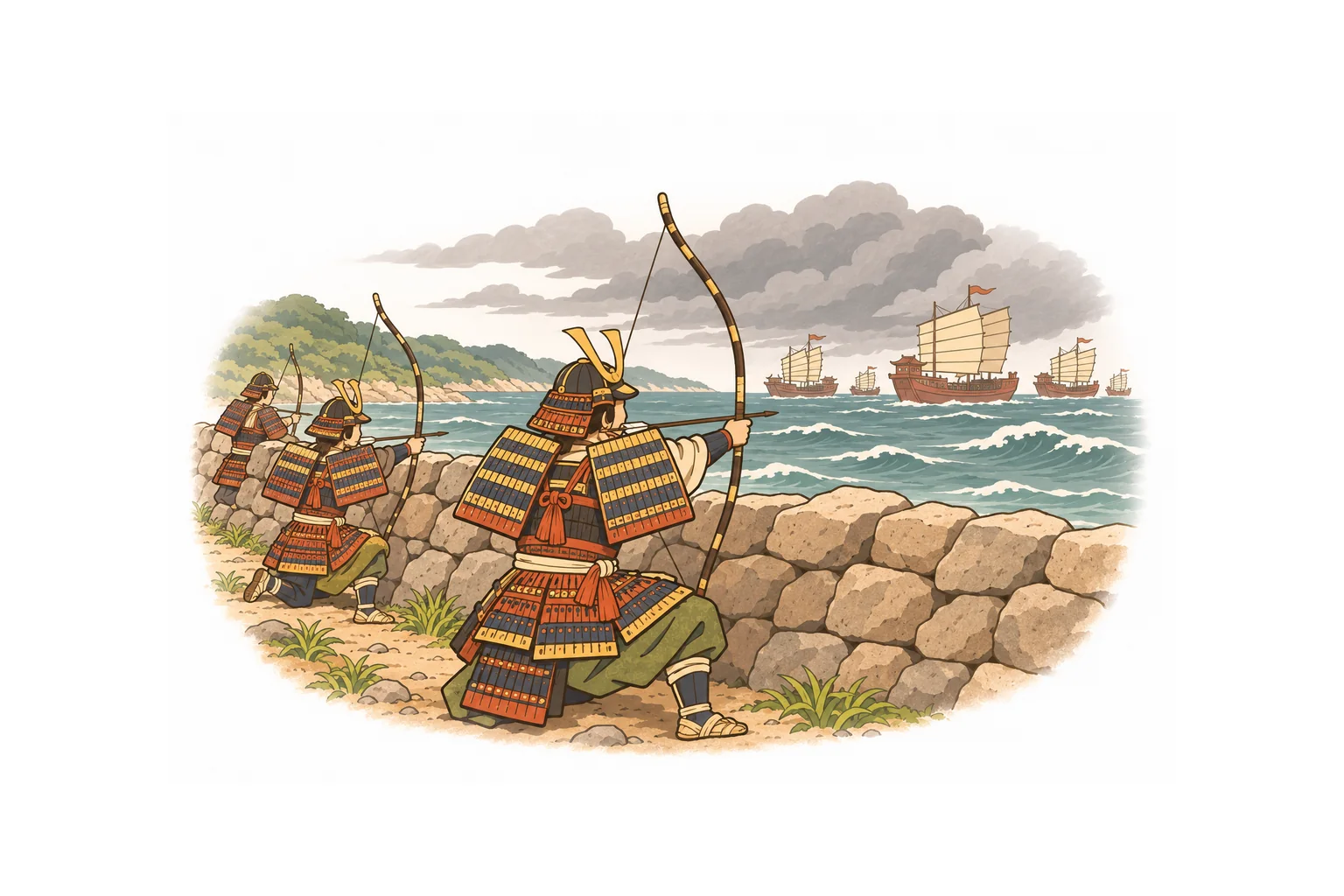
Kamakura knew the next attack would be bigger, and it prepared with a thoroughness that is easy to overlook. Starting in 1276, the shogunate ordered the provinces of Kyūshū to build a stone wall along the shore of Hakata Bay, each landholder responsible for a length proportional to his holdings. The result ran roughly twenty kilometers along the curve of the bay, about two meters high, sheer on the seaward side and, on some stretches, sloped on the landward side so that defenders could climb up and shoot down. Stretches of it survive in modern Fukuoka.
The shogunate also organized a standing coastal guard, rotating Kyūshū warriors through duty stations year after year, and for a while it even planned a counterattack on Korea before abandoning the idea as beyond its means. For the first time, Kamakura was mobilizing warriors across the whole country, including those on estates outside its usual jurisdiction, against a foreign enemy. And all of it was paid for, in the first instance, by the warriors themselves, who were expected to cover their own costs in expectation of reward.
06Two Months on the Water
The second invasion, in 1281, the fourth year of Kōan, was the largest overseas expedition anyone had attempted. It came in two parts. The Eastern Route Army, sailing from Korea, was essentially the force of 1274 again, about forty thousand men in nine hundred ships. The Southern Army, sailing from the Ningbo area of China, was far larger: around a hundred thousand men in perhaps thirty-five hundred ships, made up mostly of former Song troops and commanded by a former Song general, Fan Wenhu. The plan was for the two to meet at Iki and attack together.
The Eastern Army arrived first. It ravaged Tsushima and Iki again and, in early summer, sailed into Hakata Bay, where it found the wall and the warriors standing on it. Unable to find a decent landing, it seized the island of Shikanoshima at the mouth of the bay and anchored nearby.
Over the following weeks the Japanese did something they had not done in 1274: they took the fight to the enemy. Small boats rowed out at night, warriors climbed aboard the big ships, killed whoever they found, set fires, and slipped away. Kōno Michiari, a warrior from Iyo province on the island of Shikoku, became famous for these raids. According to a story told about him, he camped on the seaward side of the wall with it at his back as a sign that he would not retreat a step; by Japanese accounts, in one raid he was wounded by a Yuan crossbow, kept going, and captured an enemy officer. Takezaki Suenaga was out on the water too, and the second scroll of his account is mostly small boats against tall ships.
There was hard fighting on Shikanoshima as well. The Eastern Army never broke through. Cramped aboard ship in the summer heat, it was also losing men to disease, more than three thousand according to the Korean history Goryeosa. It withdrew to Iki and then moved south to the waters off Hirado and Takashima, in Imari Bay, to wait for the Southern Army.
The Southern Army was late. Its original commander had fallen ill and died just before departure, and the fleet sailed nearly a month behind schedule. By the time the two forces finally joined near Takashima, it was late summer. More than a hundred thousand men and some four thousand ships crowded the bay. Japanese warriors harassed them from land and sea, and the great combined assault never quite began.
Around the first day of the intercalary seventh month, August 16, 1281 in the Julian calendar, at the height of typhoon season, a typhoon hit Imari Bay.
07The Second Wind, and What Lies Under the Sea
This time the storm was real, and it was decisive.
The Mongol dynasty’s own official history, the Yuanshi, describes ships smashed against one another and men drowned beyond counting. Fan Wenhu and other commanders chose the soundest surviving vessels and sailed for home, abandoning tens of thousands of soldiers on Takashima. A few days later Japanese warriors landed and attacked; most of those left behind died, and twenty to thirty thousand were taken prisoner. According to the Yuanshi, the Japanese killed the Mongols, Koreans, and northern Chinese among the captives, but spared the southern Chinese, whom they called Tōjin, "Tang people," and kept them as slaves. The Yuanshi says that of a hundred thousand men, three returned. The figure is surely rhetorical, but the Southern Army was effectively annihilated.
Why did one storm do so much damage? Three things compounded each other.
The first was timing. The Eastern Army had arrived in early summer. Had the two armies met on schedule and attacked before the typhoon season, the outcome might have been different. What held them on the water into August was the Southern Army’s delay and the Japanese defense, which denied the Eastern Army a landing.
The second was position. A huge fleet sat at anchor in a semi-open bay. Later accounts say the ships were chained together as protection against night raids, which would have made them batter one another in the storm, though this detail is hard to confirm.
The third was the ships themselves. Many historians have argued that the Southern Army’s fleet was assembled in a hurry, including river craft with flat bottoms that had no business on the open sea. A bronze Yuan officer’s seal inscribed in the Phags-pa script was found on the shore at Kōzaki on Takashima. Since 1980 Japanese archaeologists have worked the seabed off the island and recovered anchor stones, hull timbers, swords, personal belongings, and the ceramic shells of tetsuhō bombs, confirming that the bombs were real. In 2011 and 2015 they found two substantial hulls, and in 2012 the area was designated the Takashima Kōzaki national historic site, the first underwater site in Japan to receive that status. Whether these ships were shoddily built is still debated; some of the remains look sturdy enough. What is not in doubt is the scale of the wreckage.
One more detail is often mentioned: the Southern Army carried farming tools and seed. Many have taken this to mean that a large part of the force was intended to settle and farm in Kyūshū, though the original source for the claim is unclear. If so, Khubilai planned a permanent occupation, and a good share of those hundred thousand men were colonists rather than seasoned fighters.
So did the wind save Japan in 1281? The wind was the immediate cause of the disaster, but it could only strike a fleet that was still at sea, and the fleet was still at sea because for two months the Japanese had refused to let it land. Without the wall, the night raids, and the fighting on Shikanoshima, a hundred-thousand-man army would have been ashore in Kyūshū well before the typhoon arrived. The storm delivered the final blow. People had kept the enemy in a position to receive it.
08Victory With Nothing to Share
Driving off the Mongols created a problem the Kamakura shogunate never solved.
The shogunate rested on a simple bargain. The shogun granted warriors land and protection, called go’on, "favor"; the warriors gave military service, called hōkō. In earlier wars between Japanese factions, victory meant confiscating the losers’ estates and redistributing them to the men who had fought. This war was different. The enemy came from overseas. Winning gained not one acre.
Suenaga had managed to extract a land grant after 1274, when the number of claimants was small. After 1281 there were thousands of claimants, and the war had not officially ended. Khubilai planned a third invasion, so the coastal guard went on, year after year, into the fourteenth century. Warriors kept paying to man the shore and maintain the wall, and the rewards did not come.
Warriors were not the only ones asking. During both invasions the court and the shogunate had ordered temples and shrines across the country to perform rituals for the defeat of the enemy. Leading monks and nobles prayed day and night. When the storm came, the religious establishment had a ready explanation: their prayers had summoned it. Temples and shrines demanded their share of the rewards, and the shogunate, short of anything to give, had to divide what little it had between swords and sutras.
Kamakura was also coming apart at the top. Tokimune died in 1284, in his early thirties. The following year Adachi Yasumori, the official who had once heard Suenaga’s petition and the leading advocate for ordinary vassals, was destroyed in a coup by Taira no Yoritsuna, chief retainer of the main Hōjō line. Power concentrated ever more narrowly in the Hōjō family and its household men. Meanwhile many vassals, their lands already shrinking through divided inheritance, mortgaged or sold holdings to pay for their service. In 1297 the shogunate issued a "virtuous government" decree allowing vassals to reclaim sold or pledged land without compensation. It brought short-term relief and long-term harm: afterwards, lenders grew wary of lending to warriors at all.
The Kamakura shogunate fell in 1333, brought down by Emperor Go-Daigo and by warriors such as Ashikaga Takauji and Nitta Yoshisada who had been part of the shogunate’s own world. Half a century separates the invasions from that collapse, and the Mongols did not destroy Kamakura directly. But the invasions hollowed out the bargain on which it stood. Warriors served and were not repaid, and their loyalty frayed accordingly.
09How a Wind Became Divine
The phrase kamikaze did not originate with the Mongols. Japan’s earliest chronicles use "divine wind" as a fixed poetic epithet for Ise, the province where the shrine of the sun goddess Amaterasu stands. It had been attached to the idea of divine protection for centuries.
During the invasions, emperors, retired emperors, nobles, and monks prayed intensely. A story holds that the retired emperor Kameyama offered a vow at Ise to give his own life in place of the country’s suffering. When news of the typhoon reached Kyoto, the court naturally read it as an answer. That interpretation fit what Kyoto already believed about the gods and Japan.
The religious establishment then wrote the story down and spread it, and the Hachiman Gudōkun is the best example. Written in plain language for ordinary believers, it makes the warriors look feeble so that the god can look magnificent. Its purpose, in part, was to establish Hachiman’s claim to credit, and thus the shrine’s claim to rewards and worshippers.
Set beside Suenaga’s scrolls, the pattern is clear. The warrior’s account was made to prove the warrior’s merit, so it shows only human combat. The shrine’s account was made to prove the god’s merit, so it shows the warriors failing and the gods prevailing. Both were arguments in the same scramble for recognition after a war that produced no spoils. The divine wind began as one side’s claim in that dispute.
It outlived the other side’s claim because it fit a larger idea that was gaining strength: shinkoku, the belief that Japan was a "land of the gods," created by them, ruled by their descendants, and under their protection. The idea was old, but the invasions seemed to supply proof. The Mongols had conquered most of the known world and had been turned back here. A little over fifty years later, in 1339, the courtier Kitabatake Chikafusa opened his history Jinnō Shōtōki, the "Chronicle of the Direct Descent of Gods and Sovereigns," with the sentence "Great Japan is the land of the gods."
10From Shrine Story to National Myth
For centuries afterward the story faded and resurfaced. In the Edo period, scholars of the National Learning school sought a Japanese identity distinct from Chinese learning and found the land-of-the-gods idea congenial. When Western warships began appearing off the coast in the early nineteenth century, the Mongol invasions suddenly felt relevant again: Japan had once repelled a foreign armada.
In the Meiji era the story was taken up by the state. From 1886 Yuchi Takeo, a former head of the Fukuoka police station, campaigned for a monument to the defense against the Mongols, and after leaving office toured the country giving lectures and raising money; the monument became a bronze statue of the retired emperor Kameyama. A popular military song called Genkō, "The Mongol Invasion," celebrated the defenders against an enemy from "the four hundred provinces" of China. The statue was completed in 1904, during the war with Russia, in what is now Higashi Park in Fukuoka. School textbooks told a tidy version: the whole nation united, high and low of one heart, the gods protecting, the mighty enemy repelled.
This version did two things at once. It turned warriors like Suenaga, who had argued bitterly over their pay, into selfless servants of the nation. And it credited victory to the gods’ special protection of Japan. The first needed heroic men; the second quietly made them unnecessary. National propaganda carried both without noticing the tension.
In October 1944, with Japan losing the Pacific War, Vice Admiral Ōnishi Takijirō organized pilots to crash bomb-laden aircraft into American ships. The unit was named the Divine Wind Special Attack Corps. The navy’s official reading of the characters was shinpū; kamikaze appeared only informally in the wartime press, but after the war it spread through English and many other languages, and even back into Japan. The meaning of the name was plain. Seven centuries earlier the gods had sent a wind to destroy an enemy fleet at the moment of greatest danger; now young men were asked to become that wind with their lives.
11The Answer
How did Japan survive the Mongol invasions? In 1274, Kyūshū warriors held the beach at Hakata for a day, and the invaders, unable to establish themselves ashore, chose to withdraw. Most of their losses came on the voyage home. The idea that a divine wind drove them off that year has little to support it.
In 1281, a typhoon did destroy most of the invasion fleet, and that blow was decisive. But the fleet was exposed to it only because the stone wall kept the Eastern Army from landing, because night raids and fighting on Shikanoshima wore it down, and because the Southern Army’s own failures delayed the attack into typhoon season.
Larger conditions mattered too. The Mongols were masters of war on the steppe, not at sea, and depended on recently conquered Koreans and southern Chinese whose loyalty was thin. Khubilai was also fighting in Vietnam and facing rebellion among Mongol princes; the third invasion was postponed again and again and died with him in 1294.
So the answer is this. Japan survived first because of Kyūshū’s warriors and the shogunate’s preparations, second because of the invaders’ own weaknesses, and finally because a typhoon delivered a crushing blow in 1281. The wind was real. The divine wind was an interpretation, and one that grew with every retelling. It began as a claim pressed by those who had prayed, in a dispute over rewards, took root in the belief that Japan was a land of the gods, and was taken up in modern times by a state that needed its citizens to believe it.
Takezaki Suenaga would probably have objected. He sold his horse and saddle to get to Kamakura precisely so that someone would know that on that day at Hakata, it was he who rode out in front.