
01A Head at Sengaku-ji
Late on the night of January 30, 1703, the fourteenth day of the twelfth month by the old calendar, forty-seven men broke into a mansion in the Honjo district of Edo, the shogun’s capital and the city we now call Tokyo. They had once been samurai of Akō, a small domain in western Japan. The domain no longer existed, and neither did their stipends. They were rōnin, masterless men. The mansion belonged to Kira Yoshinaka, until recently a senior official in charge of shogunal ceremonial. Before dawn they found him, killed him, and cut off his head.
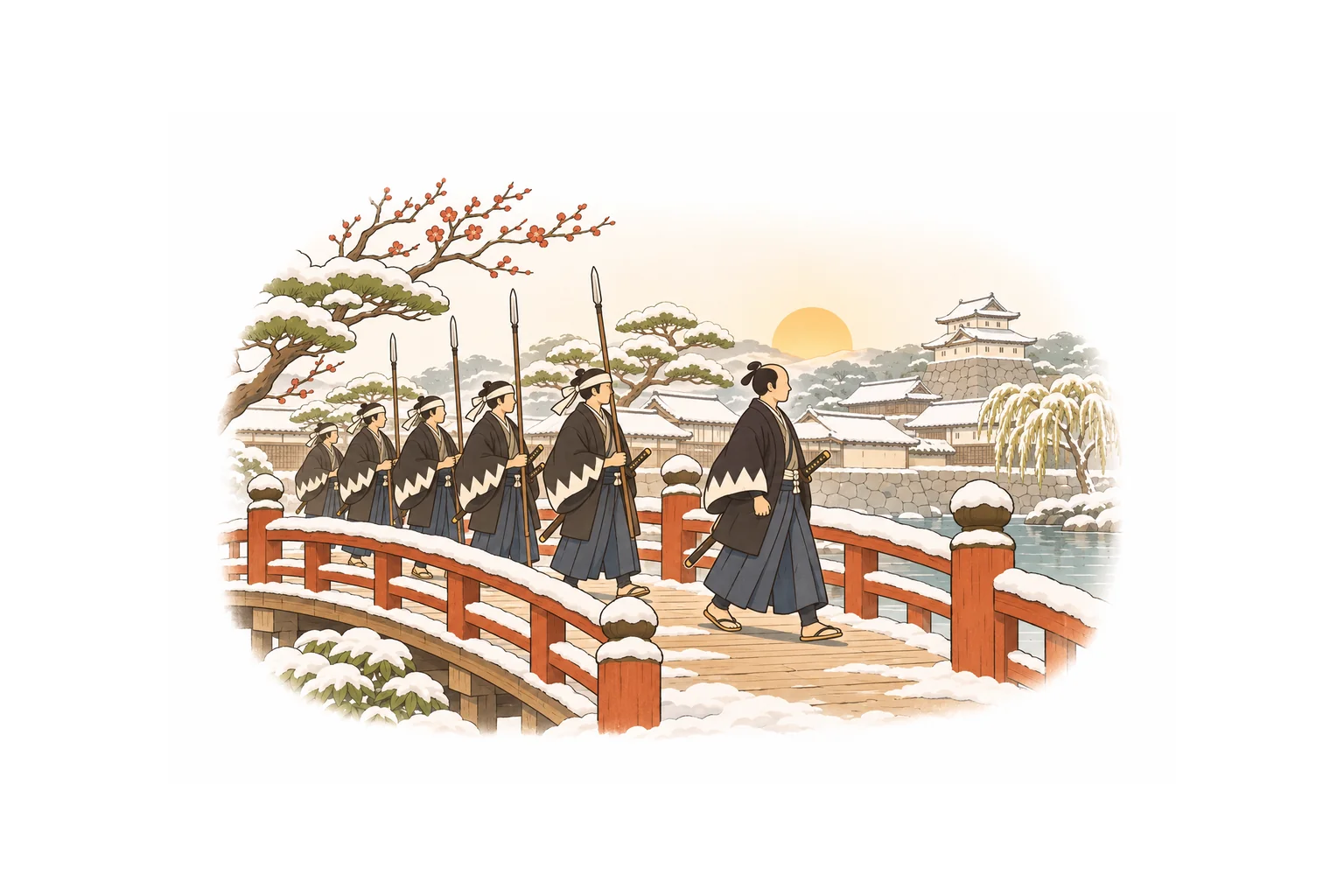
Then, instead of scattering, they walked across the city to Sengaku-ji, a temple in Takanawa, and laid the head before the grave of their former lord, Asano Naganori. Twenty-one months earlier Asano had drawn his sword on Kira inside Edo Castle. He was ordered to kill himself that same day and his domain was confiscated. Kira was not punished at all. While the others went to the temple, two of the men, Yoshida Chūzaemon and Tomimori Sukeemon, presented themselves at the residence of a shogunal inspector general and handed in a written account of what they had done. The group was divided among four great lords, the Hosokawa, Matsudaira, Mōri, and Mizuno, to be held until the government decided their fate.
That decision was agonising. In law, a band of armed men had conspired to break into a house and murder a retired official of the shogun. But the shogunate had spent decades promoting a Confucian morality in which loyalty to one’s lord was the samurai’s highest virtue, and these men had avenged their lord and then waited calmly to die for it. Edo’s townspeople cheered them. Hayashi Nobuatsu, the shogunate’s official Confucian scholar, and the scholar Muro Kyūsō called them righteous men. On the other side, the philosopher Ogyū Sorai is said to have argued that what was loyalty from the men’s own point of view was crime from the point of view of the realm, and that if private loyalty were allowed to override public law, no law could stand.
After more than six weeks the government chose an answer that tried to satisfy both. On March 20, 1703, forty-six of the men cut themselves open in the mansions of the lords who held them; the forty-seventh had left the group after the raid, for reasons still argued over. They were permitted to die as samurai rather than beheaded as criminals, which acknowledged their loyalty. They were made to die, which upheld the law.
So whom were they serving? Their lord was dead. His house had been abolished, and nobody would ever pay them again. For his sake they had defied the shogun, the man who stood, in theory, as lord over every samurai in Japan. And the shogunate’s own paralysis showed that even the rulers could not say whether a warrior’s first loyalty belonged to the master directly above him or to the shogun and the law above that.
The question was hard because samurai loyalty changed shape several times over seven centuries. Warriors bargained for land, died for their lords, and betrayed them in the middle of battles. In the end they were all told that their loyalty belonged to the emperor. The forty-seven stand somewhere in the middle of that long road. To understand them, you have to start at the beginning and watch loyalty move.
02A Bargain Written in Land
The beginning lies five centuries before the forty-seven, in the 1180s, with Minamoto no Yoritomo, the warlord who defeated the rival Taira clan and set up Japan’s first warrior government at Kamakura. Yoritomo’s followers were called gokenin, "men of the house," and the relationship between them and their lord rested on two words: go-on, the lord’s favor, and hōkō, the vassal’s service.
Favor came mostly in the form of land. Yoritomo confirmed his men’s hereditary holdings, protecting them from greedy neighbors and from the absentee aristocrats and temples in Kyoto who claimed rents from provincial estates. He also handed out new land, confiscated from defeated enemies, as a reward for service. In return his men turned out for war at their own expense, stood guard in Kyoto and Kamakura in rotation, and paid various levies.
Nobody involved thought of this as unconditional. A warrior in eastern Japan before Yoritomo had no reliable protector. His fields could be seized, and a lawsuit against a Kyoto noble was hopeless. Yoritomo offered security, and that security was the reason to follow him.
One warrior left an unusually vivid record of how the bargain looked from below. In 1274 a Mongol and Korean fleet sent by Khubilai Khan landed at Hakata Bay in northern Kyūshū. Takezaki Suenaga, a minor warrior from Higo province who had lost most of his family’s land in a lawsuit, rode at the invaders with only four companions, determined to be first into the fight, because the first to charge earned the greatest credit. Both he and his horse were wounded. When the commanders sent their lists of meritorious deeds to Kamakura, his name was missing. The next year he sold his horse and saddle to pay for the journey, rode the length of Japan, and talked his way into an audience with Adachi Yasumori, the official in charge of rewards. If my claim is false, he told him, cut off my head. He went home as steward of an estate in Higo, with a horse thrown in. Years later he paid painters to record it all in the illustrated scrolls now known as the Mōko Shūrai Ekotoba, which show not only the charge but Suenaga kneeling before Yasumori to argue his case. To him the two scenes belonged together. Service came first, reward was owed, and if it did not come, a warrior went and asked for it.
The bargain was tested in 1221. The retired emperor Go-Toba, who wanted to restore the court’s control over the warriors, declared the shogunate’s regent, Hōjō Yoshitoki, an outlaw and called on all warriors to destroy him. This was the imperial house itself summoning the realm to arms, and many gokenin hesitated. According to Azuma Kagami, the shogunate’s own chronicle, Yoritomo’s widow Hōjō Masako gathered the leading vassals and had a speech read on her behalf. Since the late lord founded the government in the east, she reminded them, the offices and incomes they enjoyed had come from him. His favor was higher than the mountains and deeper than the sea. Anyone who wished to join the retired emperor was free to leave now.
We cannot be sure the chronicle preserves her exact words, but the argument it gives her is revealing. She did not claim that the shogunate had a better right to rule than the throne. She talked about a debt. The warriors marched on Kyoto, crushed Go-Toba’s forces within a month, and sent him into exile on a remote island. Faced with a choice between the highest authority in the land and the people who had given them their estates, they chose the estates.
03When the Rewards Ran Out
A loyalty built on rewards has an obvious weakness, and the Mongols exposed it. The invasions of 1274 and 1281 were defensive wars. Japan won, largely helped by storms, but there was no conquered territory to hand out. Thousands of gokenin had fought at their own cost and received little or nothing. Suenaga was one of the lucky ones. In the decades that followed many warrior families fell into debt and sold or mortgaged their land, and the shogunate’s attempt to help them by canceling such sales only made lenders refuse to deal with them.
In 1333 the emperor Go-Daigo rose against Kamakura. The shogunate sent a great vassal, Ashikaga Takauji, a man from one of its most distinguished families, to suppress the revolt. Takauji changed sides on the march and seized the shogunate’s headquarters in Kyoto. In the east another gokenin, Nitta Yoshisada, led an army straight into Kamakura. The leaders of the Hōjō family and hundreds of their followers killed themselves in a temple as the town burned. A regime that had lasted nearly a century and a half was brought down by its own men.
Takauji then turned on Go-Daigo, set up a rival emperor in Kyoto, and founded a new shogunate of his own. Go-Daigo fled to the mountains of Yoshino, and for nearly sixty years Japan had two imperial courts. Warriors switched between them as their interests dictated, some families more than once in a single generation. Which emperor was legitimate interested them far less than which side would protect their lands.
There were exceptions. Kusunoki Masashige, a provincial warrior from near modern Ōsaka, stood by Go-Daigo from the beginning. In 1336, ordered to meet Takauji’s much larger army at Minatogawa, near modern Kōbe, he went knowing he would lose, and died there. The war chronicle Taiheiki made him a model of devotion. He was remembered precisely because men like him were rare.
04The House Comes First
By the late fifteenth century the Ashikaga shoguns had lost control, and Japan entered the age of the Warring States. For more than a century betrayal was so common that people had a phrase for it: gekokujō, "the low overthrowing the high."
To understand the warriors of this age it helps to know what they meant by ie, the house. An ie was not just a household. It was a lineage that stretched across generations, with a name, ancestral lands, and hereditary retainers. A warrior’s deepest duty was to keep it alive. Lords could be changed. The house could not.
In the summer of 1600 Japan was about to be decided between two coalitions, one led by Tokugawa Ieyasu and the other organized by Ishida Mitsunari in the name of the late ruler Toyotomi Hideyoshi’s young heir. Sanada Masayuki, lord of a small but stubborn domain in the mountains of Shinano, was marching with Ieyasu’s army when a letter arrived from Mitsunari’s side. Masayuki and his two sons talked through the night at a place called Inubushi. In the morning Masayuki and his younger son Nobushige, later famous under the name Sanada Yukimura, went over to Mitsunari. The elder son, Nobuyuki, stayed with Ieyasu. Nobuyuki’s wife was the daughter of one of Ieyasu’s leading generals; Nobushige’s wife was the daughter of one of Mitsunari’s.
Tradition says the family split deliberately so that whichever side won, the Sanada would survive. What the three men actually said that night is unknown, but that is how it worked out. Ieyasu won. Masayuki and Nobushige were exiled to a mountain temple town, and Nobuyuki kept and enlarged the domain. His descendants were still lords when the samurai era ended.
Then there was Tōdō Takatora, who began as a low-ranking warrior in Ōmi province, served a string of masters, attached himself to Hideyoshi’s brother and then to Hideyoshi, and after Hideyoshi’s death moved swiftly into Ieyasu’s camp, ending his life as a great lord and one of the Tokugawa family’s most trusted advisers. A saying attributed to him holds that a man who has not changed masters seven times cannot call himself a samurai. He probably never said it, but the line captures an attitude of the age. A lord who could not protect his men, or who was plainly heading for ruin, could not expect them to go down with him.
The arrangement cut both ways. In 1580 Oda Nobunaga, the warlord who came closest to uniting Japan before Hideyoshi, expelled Sakuma Nobumori, a veteran who had served his father, along with Nobumori’s son, writing a long letter that listed their failures in a five-year siege. Service was a relationship between people who were useful to each other, and both sides knew it.
05Honnō-ji: Whose Soldiers?
Two years after Sakuma’s dismissal, Nobunaga was dead. In the summer of 1582 he ordered one of his senior generals, Akechi Mitsuhide, to take his army west to reinforce Hideyoshi, who was fighting the powerful Mōri family. Before dawn on the second day of the sixth month, Mitsuhide’s force of around thirteen thousand turned toward Kyoto instead and surrounded Honnō-ji, the temple where Nobunaga was staying with perhaps a hundred attendants. The temple burned. Nobunaga died in the fire, almost certainly by his own hand.
Why Mitsuhide did it is one of the great unsolved puzzles of Japanese history. Theories range from personal humiliation to fear of being discarded like Sakuma, to a conspiracy involving the imperial court, to simple opportunism: Nobunaga was nearly alone in the capital and every other major general was far away. None of them can be proved. Only the year before, Mitsuhide had written in a set of regulations for his own troops that Nobunaga had raised him from obscurity and that he could never forget it.
The question that tells us more about loyalty is a different one. Why did thirteen thousand men follow Mitsuhide against Nobunaga? Nobunaga was, after all, their lord’s lord.
The answer is that, in their eyes, he was not their lord at all. Their land and stipends came from Mitsuhide, and their obligations ran to him. Nobunaga was a distant figure with whom they had no personal bond. One Akechi soldier who survived into old age left a memoir saying he had assumed the target that morning was Tokugawa Ieyasu, who happened to be visiting the region; he had no idea they were going after Nobunaga. Many of the men simply followed their commander.
Medieval Europe had a maxim for this: the vassal of my vassal is not my vassal. Japanese loyalty was layered the same way, each man bound to the one directly above him. In ordinary times that structure let a great lord command large armies through his generals. When one of those generals turned, everyone beneath him turned too.
Mitsuhide’s own fate showed the limits of the system. He could carry his own men with him, but not his peers. Hosokawa Fujitaka, whose son was married to Mitsuhide’s daughter, refused to join him. Within two weeks Hideyoshi had rushed his army back from the west and defeated Mitsuhide at Yamazaki. Mitsuhide was killed while fleeing, reportedly speared by peasants.
06The Turncoat at Sekigahara
The most famous betrayal in Japanese history came at Sekigahara, a valley in central Japan, on the fifteenth day of the ninth month of 1600. Ieyasu’s Eastern army faced Mitsunari’s Western army. The two were roughly equal in size, and the Western army held the high ground around the valley.
On Mount Matsuo, overlooking the Western army’s flank, sat about fifteen thousand men under Kobayakawa Hideaki, a young man not yet twenty. He was the nephew of Hideyoshi’s wife, had been raised in Hideyoshi’s household as a possible heir, and had then been adopted into the great Kobayakawa family. By blood and upbringing he was about as close to the Toyotomi as anyone on the field. He had also been in secret contact with Ieyasu for weeks.
As the fighting went on through the morning, Hideaki’s men did not move. The famous story is that around noon Ieyasu lost patience and had his gunners fire toward Mount Matsuo to force a decision, the so-called toi-deppō, "the questioning gunfire," and that Hideaki then led his army down the slope into the flank of his own allies under Ōtani Yoshitsugu. Both the noon timing and the gunfire come from chronicles compiled in the Edo period and later, not from letters written at the time. Historians such as Shiramine Jun, working from letters written in the days after the battle, now argue that Hideaki turned at or near the start of the fighting and that the gunfire episode was invented later. The betrayal itself is not in doubt. Four other Western commanders posted nearby to guard against just such a move changed sides with him. The Western line collapsed. Mitsunari fled, was captured a few days later, and was beheaded in Kyoto.
Hideaki had his reasons. He disliked Mitsunari; when Hideyoshi had cut his domain after the Korean campaign, Ieyasu was said to have spoken up for him; and Ieyasu was simply the strongest man in Japan. He was rewarded with a large domain in western Honshū. Two years later he was dead, in his early twenties, without an heir, and the Kobayakawa line ended. A popular legend held that the vengeful ghost of Ōtani Yoshitsugu, who died fighting him at Sekigahara, drove him mad. The legend says nothing reliable about how he died, but it says a good deal about how people saw him. He had picked the winning side and was despised for it.
A quieter betrayal took place on another hill. The Western army’s nominal commander-in-chief was Mōri Terumoto, whose troops were stationed on Mount Nangū. One of Terumoto’s senior kinsmen, Kikkawa Hiroie, had secretly agreed with Ieyasu’s side that the Mōri forces would stay out of the battle in exchange for keeping their lands. On the day, Hiroie’s troops blocked the mountain path, and the Mōri army behind them never came down. After the battle Ieyasu cut the Mōri domain to roughly a third of its former size anyway, on the grounds that Terumoto had lent his name to the enemy. The family nursed the grievance for more than two centuries. Its domain, Chōshū, led the movement that overthrew the Tokugawa in the 1860s.
Sekigahara also produced the opposite kind of story. Before the campaign, Ieyasu left an old retainer, Torii Mototada, to hold Fushimi Castle near Kyoto. Both men knew the Western army would attack it as soon as Ieyasu marched east, and that it could not be held. Tradition says they spent a last evening drinking together, and that Mototada told Ieyasu not to waste any more men on him. When the attack came, Mototada and about 1,800 men held out for more than ten days and died almost to a man. His was a real kind of samurai loyalty too: the bond of a man who had served one master since boyhood.
On one battlefield, then, four men made four choices. Mitsunari died for the house of Toyotomi. Mototada died for Ieyasu. Hiroie bargained to save the house of Mōri. Hideaki chose the winner and his own future. Calling any of them disloyal requires first deciding to whom they owed loyalty.
07Peace Turns Loyalty into Virtue
Ieyasu’s victory brought two and a half centuries of peace, and peace changed what loyalty meant.
During the seventeenth century, most samurai were moved off their lands and into the castle towns of their lords. Instead of drawing income from villages they controlled, they received fixed stipends of rice from the domain treasury according to their family’s rank. A samurai’s livelihood now depended entirely on his lord’s house. The freedom to shop for a better master largely vanished. A samurai without a lord, a rōnin, was a man without income and under suspicion.
At the same time, Confucian scholars in the service of the shogunate and the domains set out to explain why the samurai, who no longer fought, deserved to stand at the top of society. Their answer was that a samurai should be a moral example to farmers, artisans, and merchants, and that loyalty stood at the center of his virtue. What had been a bargain was rewritten as a duty that came with one’s station.
One strange result was a rise in junshi, retainers following their dead lord in suicide. It had happened in the Warring States period, but it became more frequent in the early years of peace, when a dozen or more men might cut themselves open after a lord’s death. For warriors with no battles to fight, it was one of the few ways left to prove devotion. The shogunate, worried about losing capable men and about new lords inheriting retainers loyal to the dead, banned the practice in 1663.
A ban of this kind produced a book that would later become famous. Yamamoto Tsunetomo, a retainer of the Nabeshima lords of Saga in Kyūshū, had meant to follow his lord in death in 1700. Saga had outlawed junshi in 1661, two years before the shogunate, so he became a Buddhist monk instead and lived in seclusion. From 1710 he talked about the warrior’s way to a younger samurai, Tashiro Tsuramoto, who wrote it down. The result, Hagakure, "Hidden by Leaves," completed in 1716, contains in its first book the line for which it is known: the way of the warrior is found in death. In its own time almost no one outside Saga read it. It was rediscovered in the late Meiji period and became famous in the twentieth century.
Loyalty in this period was, strictly speaking, owed to the lord’s house, the domain, more than to the man who happened to head it. When a lord was incompetent or wildly extravagant, his senior retainers sometimes confined him and forced his retirement in favor of a relative. It looks like insubordination, but they saw it as loyalty: the house had to be preserved, even from its own head.
08The Forty-Seven
The forty-seven ronin of the opening belong here, and their story makes more sense against this background.
On April 21, 1701, the fourteenth day of the third month by the old calendar, Asano Naganori drew his sword in a corridor of Edo Castle and wounded Kira Yoshinaka. Why he did it has never been established; the usual story is that Kira had insulted him while instructing him in ceremony. Drawing a blade in the castle was a grave crime, and the shogun Tokugawa Tsunayoshi ordered Asano’s death and the confiscation of his domain that same day.
Asano’s three hundred or so retainers lost their lord and their income at a stroke. The chief retainer, Ōishi Kuranosuke, surrendered the castle without resistance. His first goal was not revenge. He petitioned for Asano’s younger brother to be allowed to revive the house. Only in the summer of 1702, when the shogunate placed the brother in the custody of relatives and the hope of restoration died, did Ōishi commit himself to the other course. Half a year later came the night in Honjo.
The arguments did not end with the men’s deaths. Beyond those who praised them and those who, like Sorai, put the law first, there were harsher critics. The scholar Satō Naokata pointed out that Asano had been punished by the shogun, not by Kira, so there was nothing to avenge. Others said that true loyalists would have struck at once instead of waiting almost two years. Behind all the arguments lay the same question. Did a samurai’s loyalty run to his own lord, even a dead one whose house had been dissolved, or to the shogun and the law above him? The forty-seven answered one way. The shogunate answered both: it honored their loyalty and killed them for it.
Plays based on the affair appeared within a few years. In 1748 a puppet play called Kanadehon Chūshingura, "The Treasury of Loyal Retainers," opened in Ōsaka and was soon adapted for kabuki. To evade the ban on dramatising recent events involving samurai, the playwrights moved the story to the fourteenth century and changed the names. It became the most popular play in the repertoire, and it is still performed.
09One Lord for Everyone
In 1868 the Tokugawa shogunate fell, and within a decade the samurai ceased to exist as a class. In 1871 the domains were abolished; the lords handed over their lands and moved to Tokyo. The samurai’s stipends were first reduced and then, in 1876, converted into government bonds that soon lost much of their value. The same year, wearing swords in public was banned. The houses to which samurai had owed loyalty for centuries were gone.
The new government had an answer for where that loyalty should go: the emperor. The idea had been growing for decades. Teachers such as Yoshida Shōin of Chōshū had argued that every person in Japan was the emperor’s subject, and that shoguns and lords were merely intermediaries; many of his students became leaders of the new regime. After 1868 the idea was taught to the entire nation. The Imperial Rescript to Soldiers and Sailors of 1882 told every conscript that duty was weightier than a mountain and death lighter than a feather. Six and a half centuries earlier, Hōjō Masako had called the shogun’s favor higher than the mountains. Now the mountain belonged to the emperor. The Imperial Rescript on Education of 1890 carried the same message into every classroom.
History was rearranged to fit. Kusunoki Masashige, who had died for Go-Daigo, became the supreme model of loyalty, and in 1872 a shrine was built in his honor at Minatogawa. Ashikaga Takauji, founder of a shogunate, was recast as the arch-traitor who had defied his emperor.
The word bushidō, "the way of the warrior," came into wide use only now. Its most influential exponent was Nitobe Inazō, a Christian educator who wrote Bushido: The Soul of Japan in English, published in Philadelphia in 1900 (some catalogs give 1899). Nitobe presented a unified ethical system comparable to European chivalry, built on rectitude, courage, benevolence, politeness, honesty, honor, and loyalty. The book was a success abroad, was translated back into Japanese, and shaped how Japanese people themselves imagined their past. Its tidy code bore little resemblance to the Takezaki Suenagas, Kobayakawa Hideakis, and Sanada fathers and sons of real history.
On the evening of September 13, 1912, as the funeral procession of the Meiji emperor left the palace, General Nogi Maresuke, a former Chōshū samurai who had commanded the bloody siege of Port Arthur in the Russo-Japanese War and lost both his sons in that war, the elder at Nanshan and the younger on Hill 203 at Port Arthur, killed himself at his Tokyo home. His wife Shizuko died with him. It was junshi, the practice the shogunate had banned two and a half centuries earlier, now offered to the emperor. Some hailed Nogi as the last samurai; others thought the act an embarrassing relic. The novelist Natsume Sōseki wrote it into his novel Kokoro two years later as the moment an era ended.
10The Answer
So to whom was a samurai loyal?
For most of Japanese history, the honest answer is: to the man directly above him who protected his house and rewarded his service, and above all to the house itself.
Loyalty was personal and layered. Suenaga served the Kamakura government because it confirmed and granted his land; Akechi Mitsuhide’s soldiers served Mitsuhide, not Nobunaga. Loyalty was reciprocal. When the lord kept his side of the bargain, warriors could die for him, as Torii Mototada did. When the bargain broke, as it did for the gokenin after the Mongol invasions or for Kobayakawa Hideaki at Sekigahara, warriors walked away. And beneath every bond to a lord lay the duty to the ie. The Sanada split their family, Kikkawa Hiroie negotiated behind his own commander’s back, and Ōishi Kuranosuke tried to revive the Asano house before he thought of revenge, all for the sake of keeping a house alive.
Unconditional devotion, the readiness to die for a lord without asking anything in return, was real in some men. But for centuries it was the choice of a few, not the rule of a class. It became an official ideal only in the Tokugawa peace, when samurai had lost their land and depended entirely on their lords’ houses, and loyalty was converted from a contract into a virtue. It reached its most extreme form after the samurai had vanished, when the modern state needed every citizen to be ready to die for the emperor and assembled a timeless "way of the warrior" out of Kusunoki Masashige, the forty-seven ronin, and a forgotten book from Saga.
Historians still weigh these elements differently. Some stress the genuine personal bonds between lords and retainers and warn against reducing samurai loyalty to calculation. Others see self-interest and family survival everywhere, with talk of loyalty pasted on afterwards. Both contain truth, and in real lives interest and affection were usually tangled together. But if the question is what best explains how samurai actually behaved when the decisive moment came, the answer is the house and the reward. Takezaki Suenaga saw no contradiction between riding first into the Mongol ranks and riding a thousand kilometers to ask to be paid for it. In his world, fighting for one’s lord and securing land for one’s family were the same act.