
01A Moon Over the Sea
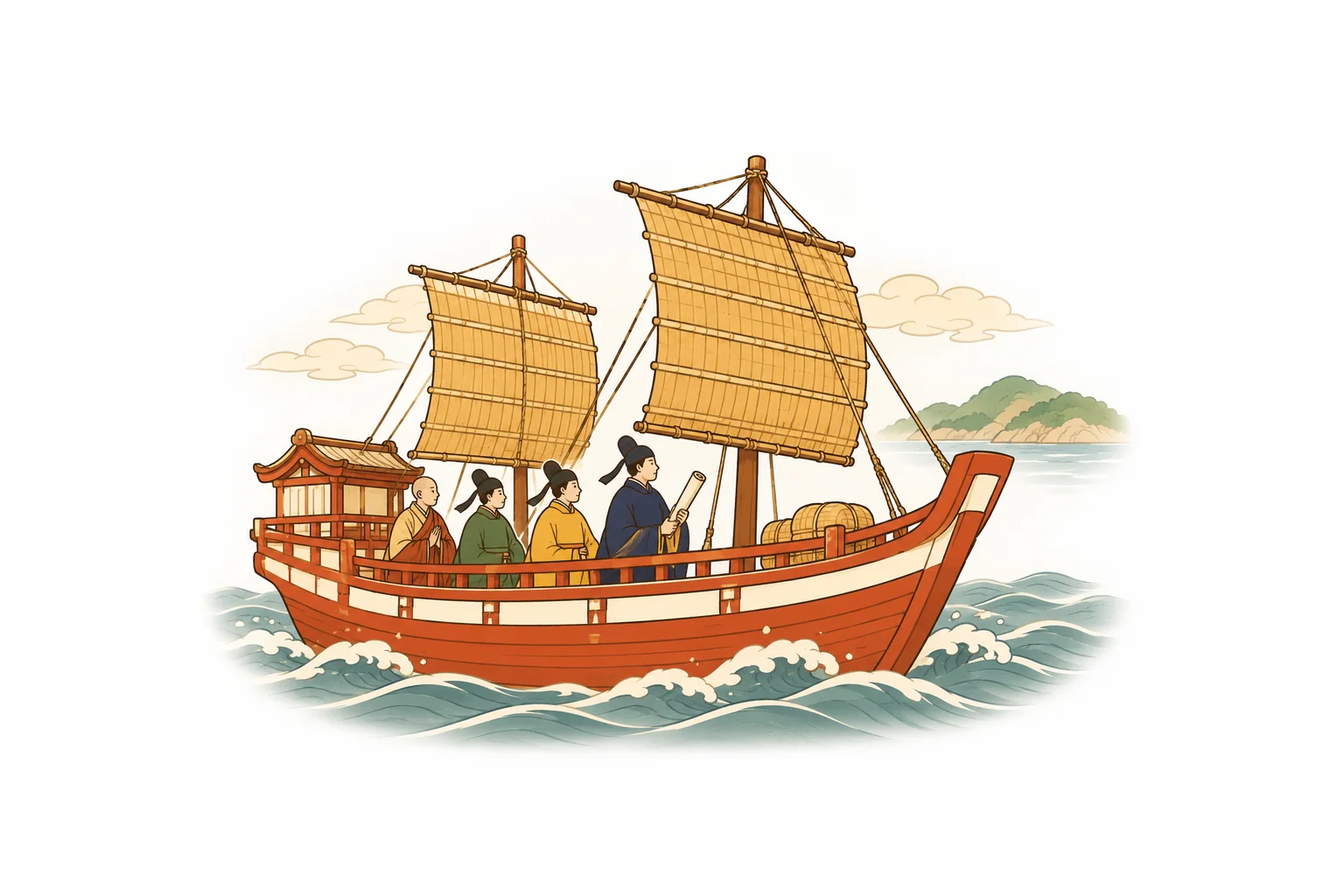
In 753, a man of about fifty-five stood on the coast of eastern China, waiting to board a ship for home. His name was Abe no Nakamaro, though in China he had been known for decades as Chao Heng. He had sailed from Japan as a student in 717, a teenager in the company of an official embassy, and had never gone back. He had studied in the Tang capital, Chang’an, then the largest city in the world, reportedly passed the examinations, entered the service of the Tang emperor, and risen to high office. He counted the poets Li Bai and Wang Wei among his friends. Now, at last, he had permission to return.
According to tradition, at a farewell banquet he looked up at the moon and composed a short Japanese poem: gazing out across the plain of heaven, he thought of the same moon rising over Mount Mikasa, the hill behind the Japanese capital at Nara. The poem is still one of the best known in the Japanese language. Whether he actually wrote it that night is the sort of thing no one can prove, but the story has been told for over a thousand years.
His ship never reached Japan. A storm drove it south to the coast of what is now Vietnam. Li Bai heard that his friend had drowned and wrote a lament for him. In fact Nakamaro survived, made his way back to Chang’an, and lived out his life as a Tang official. He died in China in 770.
Nakamaro’s life captures something about the relationship between Japan and China in its formative centuries. The Japanese wanted what China had badly enough to risk their lives crossing a sea that drowned a good share of those who tried. Yet the culture they built from what they brought home was never simply a smaller copy of China. Japan took Chinese writing, law, city planning, Buddhism, Confucian learning, calendars, coins, tea and Zen. It did not take the civil service examination, the palace eunuch, the idea that a dynasty could lose Heaven’s favor and be overthrown, or, for most of its history, the role of loyal vassal to the Chinese emperor.
That pattern is worth asking about. When a small, newly organized state sits next to the most powerful civilization in its world, the usual outcomes are absorption or imitation. Japan did something more selective. The question is how, and why.
02Fear as a Teacher
Japan did not turn to China out of idle admiration. It turned to China because it was frightened.
At the end of the sixth century, China was reunited under the Sui dynasty after nearly three hundred years of division. The Tang dynasty that followed in 618 was even stronger, and it pressed into the Korean Peninsula, where three kingdoms, Goguryeo, Baekje and Silla, were fighting for survival. The Yamato court, the ruling house of the Japanese islands, had long been close to Baekje. Baekje had sent it scholars, craftsmen and Buddhist monks, and it was through Baekje that Buddhism first reached Japan.
In 660, Tang and Silla destroyed Baekje. Baekje loyalists begged Yamato for help, and Prince Naka no Ōe, the dominant figure at court, sent a large expedition across the strait. In 663, at the mouth of the Paekchon River (the Japanese call it Hakusukinoe), the Japanese fleet met a Tang navy and was annihilated.
The defeat taught the Yamato court what a state organized on the Chinese model could do: raise armies, build fleets, move grain, and keep doing it year after year. Expecting invasion, Naka no Ōe built a long earthen barrier in northern Kyūshū and Korean-style mountain forts along the coast, and moved his capital inland. The Tang never came. But the lesson stuck.
Reform had begun even before the battle. In 645, Naka no Ōe and his ally Nakatomi no Kamatari (founder of what would become the mighty Fujiwara family) murdered the leading court strongman, Soga no Iruka, in front of the empress, and launched a program known as the Taika Reforms. After 663 the pace quickened. A brief civil war in 672 brought to power Emperor Tenmu, who, together with his consort and successor Empress Jitō, did more than anyone to turn borrowing from China into state policy. It is generally thought that it was in their time, though some scholars date it earlier and the question is unsettled, that the ruler took the title tennō, usually translated as "emperor," and the country took the name Nihon, "origin of the sun," the name we render as Japan.
From the start, then, the purpose of learning from China was clear. The goal was to build a state that could stand up to Tang and Silla. Japan wanted to know how to be strong, not how to be Chinese. That distinction would decide what was taken and what was left behind.
03Building a State from a Blueprint
The main channel for learning was a series of official missions: to the Sui court from around 600, and to the Tang court from 630 until the last mission that actually sailed in 838. Over those two and a half centuries Japan sent close to twenty embassies (counts vary). From the eighth century a typical one traveled in four ships carrying several hundred people: diplomats, students, scholar-monks, doctors, musicians, painters and artisans. The ships were not built for the open waters of the East China Sea, and wrecks were common. Students might stay in China ten or twenty years.
The mood of these missions was set by the very first contacts. The Chinese dynastic history of the Sui records that in 607 a Japanese envoy, Ono no Imoko, presented a letter that began: "The Son of Heaven where the sun rises addresses the Son of Heaven where the sun sets." Emperor Yang of Sui was offended and told his officials not to show him such rude letters from barbarians again. The Japanese had come to learn, but they addressed their teacher as an equal.
What they brought back above all was a legal system, the ritsuryō: ritsu being penal law and ryō administrative law. The Taihō Code of 701 was modeled closely on Tang codes. It divided the country into provinces and districts, set up a Council of State over eight ministries, registered the whole population in household registers, and allotted rice land to each person, to be returned to the state at death. In exchange, every household owed taxes in rice, in labor and in local products.
The state needed a stage. In 710 the court moved to a new capital, Heijō-kyō, the city we now call Nara, laid out in imitation of Chang’an. A broad avenue ran north from the main gate to the palace, splitting the city into an east and a west half, and the streets formed a checkerboard. Heijō-kyō was perhaps a third or a quarter the size of Chang’an and never had a wall around the whole city, but for a court that until recently had moved its palace with each new reign, it was an astonishing leap. Officials wore Tang-style robes colored by rank, wrote their documents in Chinese, and followed a Chinese calendar. The court minted coins and compiled an official history, the Nihon shoki, written in Chinese.
Yet the blueprint was altered from the first page. Alongside the Council of State sat a second top-level body, the Department of Divinities, in charge of the worship of the kami, Japan’s native gods. China had nothing equivalent; there, state ritual was handled by the Ministry of Rites and the Court of Sacrificial Worship among their other duties. In Japan the gods had a branch of government of their own. Even the land allotments were different: Japanese women received rice fields, two-thirds as much as men, whereas Tang law gave land to few women other than widows. The Chinese system was being bent, from the moment it arrived, to fit a society that worked differently.
04Three Things Japan Did Not Want
Three absences stand out.
The first is the examination system. Tang China was still dominated by great aristocratic families, but it had begun recruiting officials through written examinations on the classics, and under the Song dynasty, from the tenth century on, examinations became the main route into government. The Japanese knew all about this. Their own codes provided for a state academy in the capital, where students studied the Confucian classics, law, mathematics and composition, and for examinations at the end.
But the codes also contained a rule that made the examinations nearly irrelevant. Under the "shadow rank" system, the sons of officials of the fifth rank and above, and the grandsons of those of the third rank and above, received court rank automatically at twenty-one. The children of great families had no need to study for anything. The academy served lesser aristocrats, and the path it offered grew narrower over time.
A few men did rise through learning. Kibi no Makibi, who sailed to China on the same voyage as Abe no Nakamaro, came home after seventeen years with books on ritual, calendars and music, a pitch pipe and a sundial gauge, and eventually became Minister of the Right, an extraordinary career for a man of modest provincial family. Around 900, the scholar Sugawara no Michizane reached the same office. The powerful Fujiwara had him exiled to Kyūshū, where he died two years later. Japan honored learning, but it did not let learning outrank birth.
The reason is not hard to find. The Japanese court had grown out of a federation of hereditary clans, and the emperor was their chief. The reforms of the seventh century turned these clans into a ranked court aristocracy, but they did not abolish clan privilege. The point of the Chinese examination system was to let the emperor reach past the great families and recruit talent from anywhere. No Japanese emperor had the power, or the wish, to declare war on the aristocracy that kept him on the throne.
The second absence is the eunuch. From the Han to the Qing, castrated men served in the Chinese palace, and at times they ran the government. Japan never adopted the institution. The Japanese inner palace was staffed by court ladies, women from aristocratic families. Murasaki Shikibu, author of The Tale of Genji, and Sei Shōnagon, author of The Pillow Book, were both ladies-in-waiting.
Chinese emperors used eunuchs because men with no families and no heirs depended entirely on the throne, and could be used to check the bureaucrats. A Japanese emperor had no such need, because he rarely governed in person. For centuries the Fujiwara married their daughters to emperors and ruled as regents in the name of their grandsons. In that kind of court, there was no room for eunuchs and no reason to want them.
The third absence goes deepest. Chinese political thought held that the emperor ruled by the Mandate of Heaven, and that a ruler who lost his virtue lost the mandate, which justified his overthrow. Every Chinese dynasty that fell was, in theory, a dynasty Heaven had abandoned. The Japanese read the same Confucian classics but declined this lesson. Their emperors were said to descend in an unbroken line from the sun goddess Amaterasu. There was no mandate to lose.
A small detail makes the point. The Japanese imperial family has no surname. Chinese dynasties each had one (Liu, Li, Zhao, Zhu), and a change of surname on the throne meant a change of dynasty. In Japan, surnames were something the emperor granted to subjects. The great warrior houses of Minamoto and Taira began as imperial princes demoted to subject status and given a name. Standing outside the system of surnames, the imperial house stood outside the logic of dynastic change. The Fujiwara regents, the Taira, and the Minamoto, Ashikaga and Tokugawa shoguns all ruled under the emperor, never in his place.
05A Borrowed Faith Takes Root
If law was the skeleton Japan borrowed, Buddhism was the heart. It arrived from Baekje in the sixth century and was at first contested: the Soga family championed it, the Mononobe opposed it, and the dispute ended in battle and a Soga victory. Prince Shōtoku, the regent remembered as the founder of Japanese Buddhism, built Hōryū-ji and other temples.
By the eighth century Buddhism had become a project of state. Emperor Shōmu, whose reign was battered by smallpox, rebellion and famine, ordered a temple and a nunnery built in every province in 741 and, two years later, vowed to cast a colossal bronze Buddha. The Great Buddha of Tōdai-ji, the great temple of Nara, consumed enormous quantities of copper and gold. At its consecration in 752, monks from China, India and Champa in present-day Vietnam took part.
Japan still lacked something essential: a proper ordination. Under monastic law, a monk is made by a quorum of fully ordained monks, and Japan did not have one. Japanese monks traveled to Yangzhou to invite the eminent master Jianzhen, whom the Japanese call Ganjin. He agreed to go, and then failed five times: his plans were betrayed, his ships seized, and once a storm blew him all the way to Hainan Island. Somewhere in those years he went blind. His sixth attempt succeeded at the end of 753. The following year he set up an ordination platform at Tōdai-ji and ordained the retired Emperor Shōmu. He later founded the temple Tōshōdai-ji in Nara.
Over the next centuries Buddhism became Japanese. In 804 two monks, Saichō and Kūkai, sailed with an embassy to Tang. Saichō founded the Tendai school on Mount Hiei near Kyoto; Kūkai founded the Shingon school on Mount Kōya. What they brought was Chinese Buddhism, but in Japan it fused with the worship of the kami, who came to be explained as local manifestations of buddhas and bodhisattvas. China had similar blends, but nothing so thorough.
In the twelfth and thirteenth centuries, Japanese monks crossing on merchant ships brought back Zen from Song China. Eisai, who went twice, is said to have brought tea seeds as well and wrote a book praising tea as medicine. Dōgen trained in China and founded the Sōtō school of Zen. Yet in the same period, the founders of the most popular new schools, Hōnen, Shinran and Nichiren, had no Chinese teachers at all. Shinran married openly and fathered children, and his True Pure Land school let its priests marry and eat meat, something unthinkable in Chinese Buddhism. Japan had moved from receiving Buddhism to producing its own.
06Writing Japanese in Chinese Characters
Before contact with the continent, Japan had no writing. The first literate people in the islands were immigrants from Korea and China, and for centuries official Japanese writing meant classical Chinese. Laws, histories, government records and aristocrats’ diaries were all written in it.
The trouble was that Chinese and Japanese are structurally unrelated. Chinese puts the verb before the object; Japanese puts it at the end. Chinese words do not change form; Japanese is built on particles and inflected endings. Writing Japanese in Chinese was like wearing someone else’s clothes.
The Japanese found two solutions. The first was a method of reading Chinese as Japanese. Small marks beside the characters told the reader which words to move to the end of the clause, and the reader supplied Japanese endings, so that a Chinese text could be read aloud in Japanese grammar. This gave each character two kinds of reading: an "on" reading, imitating the Chinese sound, and a "kun" reading, using a native Japanese word with the same meaning. The character for mountain, for example, can be read san, after the Chinese, or yama, the Japanese word.
The second solution was to use characters purely for their sounds, ignoring their meanings. The eighth-century poetry anthology Man’yōshū is full of this sound-spelling. Over time, writing out whole characters just to represent syllables came to seem slow, and two simplified syllabaries emerged, called kana. Hiragana grew out of cursive handwriting, flowing and rounded; katakana came from fragments of characters, which monks jotted beside Buddhist texts to mark pronunciation.
Kana was long considered second-class. Men wrote formal documents in Chinese; kana was for poems, letters and women, and hiragana was even called "women’s hand." Yet it was in this supposedly lesser script that Japan’s first great literature was written. The poetry anthology Kokinshū, compiled in 905, opens with a preface in kana by the poet Ki no Tsurayuki, who later wrote a travel diary pretending to be a woman, since diaries in kana were women’s work. Around 1000, Murasaki Shikibu wrote The Tale of Genji in kana.
The result was the mixed script Japanese still uses: characters, called kanji, for words with meaning, and kana for grammatical endings and particles. Why didn’t Japan go further and drop the characters, as Korea eventually did with its own alphabet? Partly because a thousand years of borrowing had filled Japanese with Chinese-derived words that, once fitted to Japanese pronunciation, sounded alike. Kōkō can mean high school, filial piety, navigation, or the inside of the mouth. In kana they look the same; in kanji they are distinct. And partly because of the kun readings: kanji wrote native Japanese words too, so they had long since stopped being foreign.
The question was debated seriously in the nineteenth century. In 1867 Maejima Hisoka, later the father of the Japanese postal system, petitioned the last shogun to abolish kanji. In the 1870s and 1880s, reformers argued for writing only in kana or in the Roman alphabet, and the statesman Mori Arinori floated the idea of adopting English. None of it happened. Instead, Meiji scholars used kanji to translate Western ideas. Some words were new coinages, such as tetsugaku, philosophy; more often an old Chinese word was given a new meaning: keizai, economy, had meant governing the realm and relieving the people, shakai, society, a village gathering at the shrine of the earth god, and kakumei, revolution, the transfer of Heaven’s mandate from one dynasty to the next. Chinese reformers then borrowed those words back. After more than a thousand years of learning characters from China, Japan was now sending vocabulary the other way.
07Why the Embassies Stopped
The last embassy that actually reached China left in 838. The voyage was miserable; the ships were blown back more than once, and the vice-ambassador, Ono no Takamura, refused to board, claiming illness, and was exiled for it. A Tendai monk named Ennin went along and stayed in China for more than nine years. He witnessed the great persecution of Buddhism under Emperor Wuzong, and his diary of the journey is one of the best eyewitness accounts of late Tang China.
In 894 the court appointed a new embassy with Sugawara no Michizane as ambassador. Michizane recommended suspending it. Japanese monks in China reported that the Tang was collapsing into disorder, he wrote, and the sea was too dangerous to justify the risk. The court agreed. The Tang fell in 907, and no embassy was ever sent again.
Japanese textbooks often present this as a turning point: cut off from China, Japan digested what it had learned and produced a "national culture" of kana literature, native poetry and Japanese-style painting. There is something to this, but it can leave a false impression that contact stopped. It did not. Official missions ended, but Chinese merchant ships began calling regularly at Hakata in Kyūshū, selling ceramics, silk, books, incense and medicine. Heian aristocrats probably owned more Chinese goods after the embassies stopped than before. Japanese monks kept going to China on those merchant ships; one, Chōnen, was received by the Song emperor in 984.
What changed was that Japan no longer needed to send state expeditions, at heavy cost in lives, to bring home an entire system of government. The ritsuryō state had been built, Buddhism had taken root, and libraries were full of Chinese books. Merchants and monks could handle the rest. Meanwhile, the state itself was changing. The land allotment system decayed, rice land passed into private estates held by aristocrats and temples, and the Fujiwara ran the court. A government no longer interested in running a Tang-style state had little reason to keep studying the Tang.
Money tells the story neatly. Japan cast its first widely circulated coin in 708 and minted twelve official coinages in all. The last appeared in 958. For the next six hundred years Japan minted almost no official coins of its own; its markets ran on imported Chinese copper coins, above all Song coins, later joined by Ming ones. A country that had once copied Chinese currency now simply used it.
08"King of Japan"
In the fourteenth century the Ming dynasty took power in China. Its founder banned private overseas trade. Foreigners could trade with China only as tributaries: their ruler had to acknowledge the Ming emperor as overlord and accept investiture as a king, and then his envoys could bring tribute and trade goods.
In Japan, real power now lay with the Ashikaga shoguns in Kyoto. The third shogun, Ashikaga Yoshimitsu, builder of the Golden Pavilion, had ended a half-century split in the imperial line and was more powerful than any emperor. He wanted the profits of trade with China. He sent envoys in 1401, and the Ming court’s reply addressed him as "King of Japan." In 1404 a licensed trade began: the Ming issued tallies, and a Japanese ship was recognized as a legitimate tribute ship only if its tally matched the counterfoil kept in China. In letters to the Ming emperor, Yoshimitsu called himself "your subject, the King of Japan."
For the first time since the kings of Wa in the fifth century, a ruler of Japan had formally entered the Chinese world order as a vassal. Many Japanese were appalled. When Yoshimitsu died, his son Yoshimochi broke off relations, reportedly in part because his father’s submission had shamed the country. Only in 1432 did the sixth shogun, Ashikaga Yoshinori, restore the trade for the sake of its profits. It continued fitfully for another century, increasingly run by great regional lords, the Hosokawa and the Ōuchi, and the merchants allied with them. In 1523 rival Hosokawa and Ōuchi missions came to blows at the Chinese port of Ningbo and rampaged through the area. The last tally ship sailed in 1547, and the trade ended soon after the Ōuchi house was destroyed.
The diplomats who did the actual work were Zen monks from the great Kyoto monasteries. They read and wrote Chinese, composed Chinese poetry, and understood Chinese ritual. Much of what we think of as classic Muromachi culture (ink painting, rock gardens, a new style of residential architecture, the roots of the tea ceremony) came through these monks and these ships. The painter Sesshū sailed with the mission of 1467, saw real Chinese mountains for himself, and came home to paint some of the finest ink landscapes in Japanese art.
The episode shows the Japanese attitude to the Chinese order in sharp relief: take the profit and the culture, refuse the subordination. One shogun could accept the title of king for the sake of trade; Japan as a whole did not accept it. When Toyotomi Hideyoshi, the warlord who unified Japan, invaded Korea in the 1590s and then negotiated with the Ming, the Ming envoys invested him as King of Japan, as custom required. Hideyoshi, furious at the terms of the peace, went back to war. A popular story says he tore up the letter of investiture on the spot; it is a legend, since the document survives intact in Ōsaka. The Tokugawa shoguns who followed traded with China through Chinese ships calling at Nagasaki, and never again sought investiture.
09The Answer
So what did Japan take from China, and what did it leave?
Over more than a thousand years, the pattern is consistent. Japan took the tools that made rulers stronger, states better organized and spiritual life richer: writing, law, provinces and registers, a capital on a grid, Buddhism, the Confucian classics, the calendar, medicine and the arts, and later Zen, tea, ink painting and copper coins. It left behind what would have changed who held power in Japan: an examination system that would have let commoners compete for office, eunuchs that would have freed the emperor from the aristocracy, a doctrine that would have made dynasties disposable, and a tributary order that would have kept Japan permanently on its knees.
This was not a failure of understanding. The Japanese knew perfectly well how the examinations worked, what eunuchs were for, and what Mencius said about overthrowing tyrants. They left these things out because the people choosing what to import (emperors, aristocrats, and later shoguns and lords) were themselves the beneficiaries of hereditary privilege. Nobody invites in an institution designed to dig out his own foundations.
Geography gave them the freedom to choose. Korea, joined to the continent, often had to accept Chinese institutions and Chinese overlordship whether it wanted them or not. Northern Vietnam spent centuries as a Chinese province and had to win independence from inside the Chinese system. Japan was protected by a dangerous sea. Chinese armies did not reach it; Chinese institutions arrived only when Japanese ships went to fetch them. The one serious invasion from the continent, by the Mongol Yuan dynasty in the thirteenth century, failed twice. How much to take, when to take it and how to change it was always Japan’s decision.
Timing mattered too. Japan’s most intensive borrowing came in the seventh and eighth centuries, from a Tang China still governed largely by aristocrats, where examinations were only beginning to matter. By the time Song China had become a society run by examination-trained officials, Japan had stopped sending embassies and was no longer studying Chinese government systematically. The China Japan copied was already closer to an aristocratic society than the China that came after, and Japan kept that aristocratic shape into the nineteenth century.
The best answer, then, is that Japan took almost everything China had to offer except the principles by which China organized its society. What it borrowed was set into a different frame, built on hereditary families, an emperor who could not be replaced, and the protection of the sea. Chinese characters were made to write Japanese. Chinese law was made to serve a Japanese aristocracy. Buddhas moved in with the kami. Chinese coins circulated in Japanese markets for six centuries, while the Chinese emperor never governed a single Japanese village.
In the Meiji era, after 1868, Japan set out to learn from abroad again, this time from the West, and the method looked remarkably familiar: send students, translate books, rewrite the laws, rebuild the capital, reorganize the government, and declare all the while that the imperial line was unbroken and untouchable. Abe no Nakamaro, the student who never came home, would have recognized the project.