
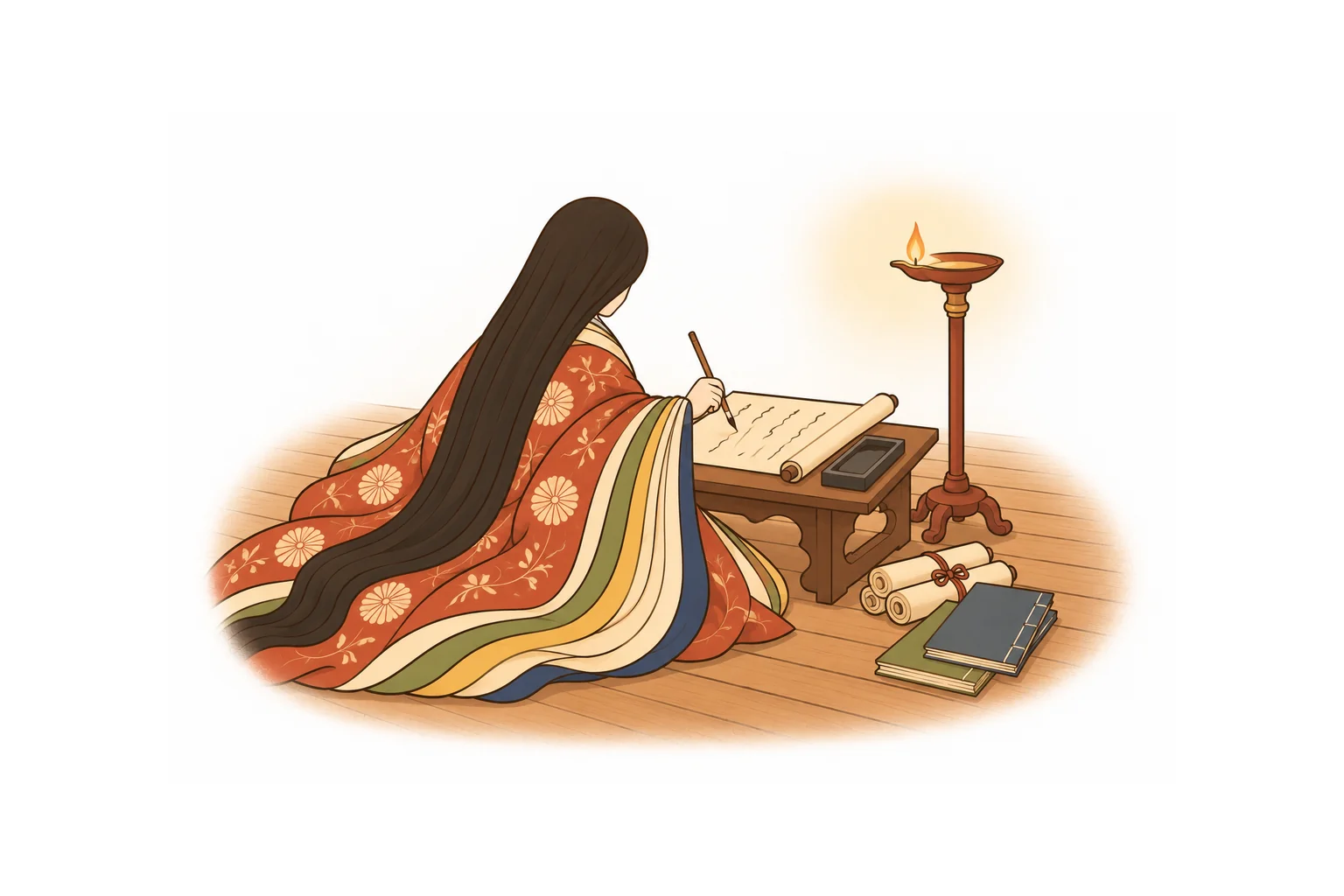
01"Is Young Murasaki Here?"
On the first day of the eleventh month of 1008, by the old lunar calendar, the most powerful man in Japan threw a party. Fujiwara no Michinaga, Minister of the Left and the real master of the imperial court in Heian-kyō (modern Kyoto), was celebrating the fiftieth day of life of his new grandson. The baby’s mother was Michinaga’s daughter Shōshi, principal consort of Emperor Ichijō, and the boy was a prince who might one day sit on the throne. That was the whole point of having a daughter at court.
By the evening the courtiers were drunk. Some tugged at the sleeves of the serving women; others sang rowdy songs. In the middle of this, one of the most refined men of the age, the poet and critic Fujiwara no Kintō, leaned toward the screens behind which the ladies-in-waiting sat and called out, with mock politeness: "Excuse me, but would Young Murasaki be anywhere around here?"
Young Murasaki was a character in a work of fiction then circulating at court: a girl whom the hero, the Shining Prince Genji, takes into his house as a child and raises to become the great love of his life. Kintō was teasing the author. The author, sitting behind the screen, did not answer. In her diary she recorded her unspoken thought: since there was nobody present who looked remotely like Genji, there was hardly likely to be a Murasaki either.
She was the woman we call Murasaki Shikibu, and the book was The Tale of Genji. Her diary entry is the earliest surviving mention of the book anywhere, which is why Japan now celebrates November 1 as Classics Day.
Almost everything needed to answer the question in the title is already in that scene. The author is a woman. She is not a princess but a lady-in-waiting, a salaried attendant. The most learned man in the room has read her book and assumes everyone else has too. And the host of the party, the man whose ambitions the whole evening served, is her patron.
02A Strange Fact About Japanese Literature
The Tale of Genji runs to fifty-four chapters. It follows Genji from birth through a long career of love affairs, political exile, triumphant return and slow, disillusioned middle age, then continues after his death with the tangled loves of the next generation. It spans more than seventy years and hundreds of characters. What makes it extraordinary is less its length than its attention: to the way people misunderstand each other, to jealousy that a character cannot admit even to herself, to the dull ache of growing old in a world that rewards youth.
Calling it "the world’s first novel" invites argument. Greek and Roman writers produced long prose romances centuries earlier, and "novel" is a word with no agreed definition. But as a vast work of realistic fiction centered on the inner lives of its characters, nothing in the world comes close to it for centuries.
What should make anyone pause is who wrote it. Around the year 1000, women writers whose names survive were rare almost everywhere. Yet in Japan, in the century between roughly 950 and 1050, nearly all the great works of prose were written by women: the bitter marriage memoir known to us as The Gossamer Years, Sei Shōnagon’s Pillow Book, Murasaki’s Genji and her diary, the diary of the poet Izumi Shikibu, and a little later the Sarashina Diary. When Japanese schoolchildren today study the prose classics of the Heian period (794–1185), they are mostly reading women.
The men of the court were writing too, constantly. Michinaga kept a diary, and his own manuscript still survives. But it is written in Chinese, and it reads like a ledger: which ceremony took place, who attended, what gifts were given. The fiftieth-day celebration gets a few lines. Murasaki’s account of the same night gives us drunken grandees, Kintō’s joke, and her own embarrassment as she slipped away to hide.
So why these women, and why then? The usual answers fall into four groups. Women had a script of their own. The politics of the imperial harem made talented women valuable. The particular social position of these women gave them an unusual angle of vision. And fiction was such a lowly genre that it left its writers free. Each deserves a hearing before we decide which mattered most.
03Men Wrote Chinese, Women Wrote Japanese
Start with writing itself. In Heian Japan the language of government, law, scholarship and serious literature was Classical Chinese. A nobleman who wanted a career had to read and compose it, quote the Chinese histories, and know the poems of Bai Juyi, the Tang poet who was the most admired foreign writer in Japan. Chinese characters were called mana, "true letters."
Over the ninth century, the Japanese had also developed a way of writing their own language by sound. They took Chinese characters, used them only for their pronunciation, and wrote them in an ever more cursive hand until they became a simple syllabary: hiragana, a script of flowing, rounded strokes. It was fast, and it could capture the particles, verb endings and shades of tone that make spoken Japanese what it is. People called it onnade, "women’s hand," while Chinese characters were "men’s hand."
The label did not mean men never used it. Men wrote Japanese poetry, the thirty-one-syllable waka, in kana, and they wrote love letters in kana to women. The first imperially commissioned anthology of Japanese poetry, the Kokinshū, ordered in 905, opens with a famous preface in kana by the poet Ki no Tsurayuki. But a man’s public identity was bound up with Chinese. Kana belonged to the private world of feeling and daily life, and that was the world assigned to women.
Tsurayuki himself demonstrated how firm this boundary was. Around 935, returning to the capital after a term as governor of Tosa province on the island of Shikoku, he wrote an account of the journey. Its first line announces that diaries are something men write, and that a woman now means to try one. Tsurayuki pretended to be a woman in his entourage, and in her voice he wrote in Japanese about the sea voyage, the pirates they feared, and his grief for a young daughter who had died in Tosa. The Tosa Diary is a charming book, but its disguise is telling. A leading man of letters who wanted to write personal prose in his own language felt he had to borrow a woman’s identity to do it.
This handed women something men lacked. A man writing prose had to work in a foreign classical language, which is a poor instrument for the rhythm of conversation or the drift of a mood. Women had neither the burden nor the privilege of Chinese. They wrote in Japanese because they were expected to, and Japanese prose grew up in their hands.
But kana explains only the medium. Hiragana was in common use by the late ninth century, a full hundred years before Murasaki. Something else had to happen for the masterpieces to come when they did.
04The Harem as a Political Arena
Heian politics, at its height, was the art of marrying off daughters. The northern branch of the Fujiwara family dominated the court by placing its daughters as imperial consorts, hoping they would bear sons who became emperors. The emperor’s maternal grandfather could then govern as regent (sesshō) for a child ruler or as chancellor (kanpaku) for an adult one. Historians call this the regency system. Under it, a minister’s fortunes depended on whether he had daughters, whether they got into the palace, and whether the emperor actually spent his nights with them.
An emperor had several consorts, each with her own apartments and household. To draw him to his daughter’s quarters, a minister needed more than a pretty daughter. Emperors were educated young men who enjoyed clever company. They went where conversation sparkled, where the women could cap a line of Chinese poetry, improvise a waka on the spot, and arrange the colors of their layered robes to match the season with exquisite taste. A consort’s household became a salon, and the reputation of its ladies-in-waiting was its advertisement.
These attendants were called nyōbō, literally "women with rooms," since they lodged in the palace. Most were daughters of middle-ranking officials, recruited and paid by the consort’s family. A minister hunting for talented women to staff his daughter’s household behaved rather like a modern club owner signing star players.
This competition peaked in the reign of Emperor Ichijō, who came to the throne as a child in 986. In 990 his uncle, Fujiwara no Michitaka, sent his eldest daughter Teishi into the palace, and she soon became empress. She was about four years older than Ichijō, quick, lively and educated in Chinese, and the young emperor adored her. Her household gathered a brilliant group of women, the most famous of whom was Sei Shōnagon.
05Sei Shōnagon and the Snow on Incense Burner Peak
Sei Shōnagon was the daughter of Kiyohara no Motosuke, a respected poet who had helped compile the second imperial poetry anthology. She entered Teishi’s service around 993, and her Pillow Book preserves dozens of moments from that household. The best known goes like this.
On a snowy day, with the lattice shutters closed, the women sat around a brazier chatting. Teishi suddenly asked, "Shōnagon, how is the snow on Incense Burner Peak?" Without a word, Sei Shōnagon had the shutters raised and rolled the blind high with her own hands. The empress smiled.
The empress had been quoting a line of Bai Juyi in which the poet, lying in his mountain hut, lifts the blind to look at the snow on Incense Burner Peak. Her question was a riddle, and Sei Shōnagon answered it with a gesture. The other women said they all knew the poem and could recite it, but it had never occurred to them to use it like that. This was exactly the kind of wit a salon valued, and stories like it traveled to the emperor’s ears and into the gossip of the senior nobles. They were part of what made Teishi’s household the place to be.
The Pillow Book itself, according to its closing pages, came out of that household. Teishi’s brother Korechika presented her with a stack of fine paper. The empress wondered aloud what they should write on it, since the emperor’s side was using theirs to copy a Chinese history. Sei Shōnagon replied that it would make a fine pillow, and Teishi gave her the paper. On it she wrote lists of "things that are delightful" and "hateful things," sketches of the seasons, and scenes from palace life. Paper was costly. Before a lady-in-waiting could write a book, someone had to give her the paper, a small fact that turns out to matter a great deal.
Teishi’s good fortune did not last. Michitaka died in 995. His son Korechika lost a power struggle with his uncle Michinaga, and in 996 he destroyed himself in a farcical scandal: believing that the retired emperor Kazan was courting the same woman he loved, he let his brother’s men shoot arrows at Kazan’s party. Korechika was exiled, and Teishi, in despair, cut off her hair. Without a powerful family behind her, she kept the emperor’s love but lost everything else.
Almost none of this darkness enters the Pillow Book. Sei Shōnagon wrote about her mistress at her brightest, witty and gracious, as if preserving her in amber. Many readers have seen the book as an act of loyalty to a fallen patron.
06Michinaga’s Answer
After Michitaka’s death, Michinaga became the dominant figure at court. In 999 he sent his own daughter Shōshi, just eleven or twelve years old, into the palace. The next year he did something without precedent: he arranged for Teishi to be styled kōgō and Shōshi chūgū, two titles that had both meant empress, so that one emperor now had two empresses at once. In the twelfth month of that year (early 1001 by the Western calendar) Teishi died, aged twenty-four, after giving birth to a daughter.
That left Shōshi without a rival, but not without a problem. Ichijō still mourned Teishi, and Shōshi was a shy, reserved girl whose household could not match the glamour of the old one. Michinaga set about recruiting talent: Izumi Shikibu, famous for passionate love poetry and a scandalous private life; Akazome Emon, a seasoned poet; and a widow who had written part of a tale that was already being passed around the capital. That was Murasaki Shikibu.
Her father, Fujiwara no Tametoki, was a scholar of Chinese who held modest posts and served as governor of Echizen province. Murasaki tells a story about her childhood in her diary. Her brother was being taught the Chinese classics and kept stumbling over them, while she, listening nearby, learned them faster. Her father sighed that it was his bad luck she had not been born a boy.
Around 998 she married Fujiwara no Nobutaka, a much older official, and had a daughter. Within three years he was dead. Most scholars think she began writing Genji in widowhood and that early chapters circulated among friends. At the very end of either the second or the third year of the Kankō era (early 1006 or early 1007 by the Western calendar) she entered Shōshi’s service.
Once she was in the palace, her working conditions changed completely. Her diary describes a scene in late 1008, shortly after Shōshi gave birth. Shōshi was preparing to return to the palace and wanted to bring the emperor a gift: a handsomely bound set of booklets, generally taken to be The Tale of Genji. Her household turned into a workshop. Women chose and matched colored papers, sent sections out to skilled calligraphers to be copied, and bound the finished quires. Michinaga himself brought fine paper, brushes and ink. He also, Murasaki complains, slipped into her room while she was away, took the draft she had hidden there, and gave it to another of his daughters.
That scene makes a practical point. A fifty-four-chapter work is not something a widow with no income dashes off by lamplight. It needs mountains of paper, copyists, and readers impatient for the next chapter. Michinaga’s wealth and Shōshi’s household made the book possible to finish, copy and circulate.
The emperor read it, or rather had it read to him. Murasaki records, with a mixture of pride and dismay, that Ichijō remarked that the author must have read the Nihon shoki, the official Chinese-language chronicle of Japan, since she was clearly learned. A rival lady promptly nicknamed her "Lady Chronicle" and spread it about that she was showing off. Murasaki says that afterward she pretended she could not even read the simplest Chinese character in public. In private, though, she was teaching Shōshi Bai Juyi’s ballads, and both were careful to keep it quiet.
Genji, in other words, was cultivated inside a political competition. Michinaga wanted the emperor to spend time with Shōshi; a tale the emperor enjoyed was excellent bait. Shōshi’s son became Emperor Go-Ichijō, and Michinaga, as grandfather of the emperor, reached the summit of power. In his long game, Murasaki’s book was a minor piece, but a useful one.
07Watching from the Edge
Patronage alone does not produce insight. Michinaga could give Murasaki paper and ink, but not her eye. That came from where she stood.
Nearly all of these women came from the same layer of society: the middle aristocracy, families whose men served as provincial governors, the zuryō. These families were literate, often prosperous, and permanently shut out of the inner circle of power. Their daughters, educated and sent to court, saw the very top of society at close range: how the great loved, quarreled, rose and fell. They were never part of it. They watched the center from the edge.
Murasaki’s diary returns again and again to her sense of not belonging. At a festive moment she compares herself to waterbirds that look carefree on the surface while struggling beneath it. She sizes up her colleagues coolly. Izumi Shikibu, she says, writes delightful poems but behaves badly. On Sei Shōnagon, who had left court after Teishi’s death and probably never met her, she is merciless: a woman insufferably pleased with herself, scattering Chinese characters about, and not so impressive if you look closely. The barb carries the scent of an old rivalry between two salons.
Heian marriage pushed women inward as well. A nobleman could have several wives, and married couples often did not share a home. The husband visited his wife at her family’s house by night and left at dawn. Whether he came, and how often, was up to him. The author of The Gossamer Years, known only as the mother of Fujiwara no Michitsuna, married Fujiwara no Kaneie, who later became regent. Her memoir covers about twenty years from his courtship in 954: the waiting, the jealousy, watching his carriage roll past her gate on its way to another woman. She says she wrote it because the old tales were full of lies, and she wanted to show what the life of a well-born wife was really like.
That book was written a generation before Genji. It shows that by the 970s a woman writing in kana could already lay bare an inner life with startling honesty. When Murasaki describes Lady Rokujō, whose jealous spirit leaves her body without her knowing and kills her rival, or the lonely silence of Murasaki, Genji’s great love, when he takes a young princess as a new principal wife in late middle age, she was drawing on a craft that women had been sharpening in their diaries for decades.
08The Freedom of a Despised Genre
One more factor is easy to overlook. Fiction had almost no prestige.
In 984 the scholar Minamoto no Tamenori compiled a collection of Buddhist stories for a princess who had become a nun. In his preface he dismissed monogatari, tales, as amusements for women, as numberless as the grasses of the forest or the sands of the shore, and full of nothing but love affairs. That was the respectable male view: tales were entertainment, beneath a serious person’s notice.
There had been tales in Japan for about a century before Murasaki. The Tale of the Bamboo Cutter tells of an old man who finds a tiny girl inside a stalk of bamboo; she grows into a beauty who turns down five noble suitors and an emperor before returning to the moon. Genji itself calls it the ancestor of all tales. The Tales of Ise strings poems together into the loose biography of a romantic hero. The Tale of the Hollow Tree is already a long, sprawling story about a family of zither players, and The Tale of Ochikubo is a Cinderella story about a girl abused by her stepmother. Their authors are unknown and were probably men, but their readers were mostly women.
Because nobody took tales seriously, they had no rules. Chinese verse and prose came with a heavy apparatus of precedent and allusion. A tale could be about love, jealousy, the fickleness of men, and the resentment of women. In the chapter called "Fireflies," Genji teases the young women of his household for their addiction to romances, then changes tack and defends them: the official histories, he says, show only one side of things, while tales record the details of how people actually live. It is hard not to hear Murasaki speaking through her hero, making the case for her own disreputable craft.
09A Book That Grew in Front of Its Readers
Finally, there were the readers. The Heian court was a tiny world, a few thousand aristocrats and their households, with an even smaller core who read tales. They all knew each other. Manuscripts passed from hand to hand, and reading was often social: one woman read aloud while others listened and looked at the illustrations.
For a long work, this was an ideal environment. When Murasaki finished a chapter, people read it, talked about it, and wanted more. Kintō’s joke at the party shows that even the most exacting male critics were following along. The book changes as it goes: the early chapters glow with Genji’s youth and success, the later ones darken, and the final ten chapters, set in the riverside village of Uji after Genji’s death, are full of hesitation, missed chances and the sense that nothing lasts. It is the work of someone who wrote for years for an audience she knew.
That audience also carried the book forward. Around 1020 a girl of twelve or thirteen, known as the daughter of Sugawara no Takasue, came back to the capital from the eastern provinces, where her father had been posted. She had heard fragments of Genji in the countryside and longed to read the whole thing. An aunt finally gave her a box containing fifty-odd chapters. In the Sarashina Diary, written decades later, she remembers lying behind her curtains reading them one after another and thinking that she would not trade the experience to become empress. Barely a dozen years after Murasaki’s time at court, the complete book was being copied and treasured by provincial governors’ daughters.
10The Answer
Set side by side, each explanation has merit, and none is enough alone.
Kana was the precondition. If Japanese women had been expected to write only in Chinese, or not taught to write at all, none of this could have happened. But kana and fiction had both existed for a century before any masterpiece appeared.
The position of these women gave them their vision. Educated, marginal, pushed inward by a marriage system that left them waiting, they had both the reason and the means to look closely at human feeling. But those conditions persisted for centuries, while the great works cluster in about a hundred years.
What lit the fire was the politics of the harem under the regency. In exactly this century, the Fujiwara strategy of ruling through their daughters reached its height, and under Emperor Ichijō the competition between two households, Teishi’s and Shōshi’s, was at its fiercest. Sei Shōnagon wrote for Teishi; Murasaki wrote for Shōshi. Their patrons gave them paper, time, readers and a reason: in that world, a woman’s wit was political capital.
The best evidence is what happened next. In 1068 Emperor Go-Sanjō came to the throne. He was the first emperor since Uda, about 170 years earlier, whose mother was not a Fujiwara: she was an imperial princess, a daughter of Emperor Sanjō. From 1086, retired emperors began ruling from their own households, an arrangement known as insei, rule by cloistered emperors. Power moved out of the consorts’ quarters, and a Fujiwara daughter was no longer the key to the state. With that, ministers no longer had a reason to spend lavishly on brilliant ladies-in-waiting. Women went on writing, and some of their diaries and tales are fine, but nothing again approached Genji or the Pillow Book. Japanese literature turned toward poetry, war tales and the essays of monks.
So the answer is this. Heian court women wrote the first great novel because, at a particular moment, a political system needed their talent. The Fujiwara turned the imperial harem into the main arena of power, and the competition there rewarded wit and literary skill in the women who staffed it. Kana gave them a tool, their position gave them a point of view, and the regency gave them an opportunity: patrons with paper, an emperor who listened, and a court full of readers. Murasaki’s genius was her own. What made it possible for that genius to fill fifty-four chapters and survive a thousand years was Michinaga’s ambition and Shōshi’s household.
It resolves a puzzle, too. In a society where women could not hold office, rarely owned their own time, and married on men’s terms, women produced its greatest literature. They were kept behind the screens, shut out of Chinese learning and public life. But behind those screens lay exactly the place on which male power most depended.