
01The Rice Cake and the Cuckoo
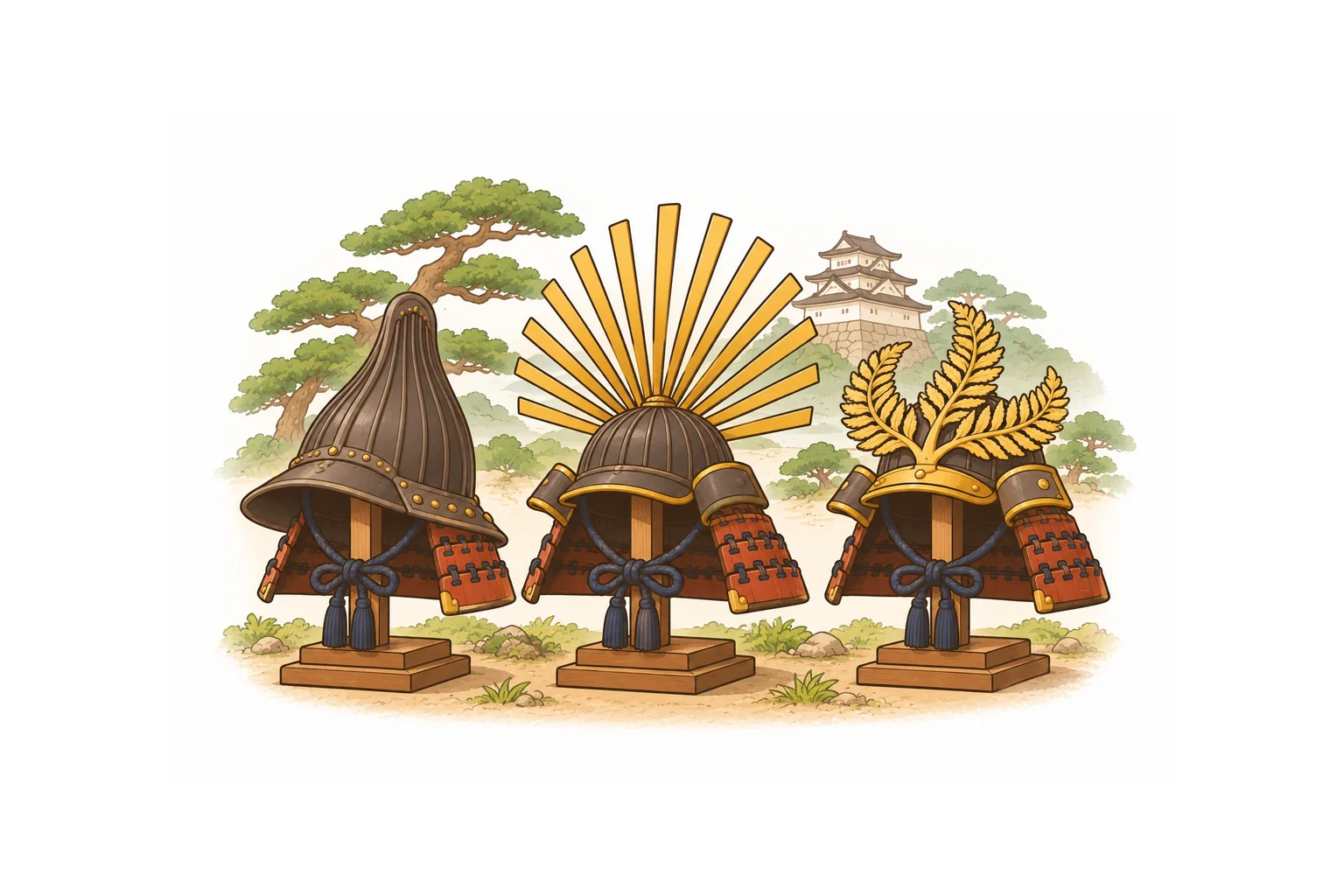
Japanese schoolchildren learn the story of their country’s reunification through a joke. In the late Edo period, a satirical verse made the rounds: Oda pounded the rice, Hashiba kneaded the dough, and Tokugawa sat down and ate the cake. Hashiba was the early surname of Toyotomi Hideyoshi. A companion saying, just as famous, imagines the three men confronted with a cuckoo that will not sing. Oda Nobunaga says, "Then kill it." Hideyoshi says, "I’ll make it want to sing." Tokugawa Ieyasu says, "I’ll wait until it does."
None of the three ever said anything of the kind. Both the verse and the cuckoo lines were made up long after they died, and they caricature as much as they explain. But they survive because they point at a real puzzle.
For roughly a century after the Ōnin War broke out in 1467, Japan had no effective central government. The shoguns of the Ashikaga house still lived in Kyoto, and the emperor still performed his rites, but real power lay with dozens of regional warlords, the daimyo, who fought each other constantly. Then, within about fifty years, from Nobunaga’s march into Kyoto in 1568 to Ieyasu’s death in 1616, three men from neighboring provinces in central Japan stitched the archipelago back together. The first two built enormous power and lost it almost as soon as they died. The third founded a dynasty of shoguns that ruled for two and a half centuries.
Why these three? And why did only the last one’s achievement stick?
02A Century Nobody Could Fix
The disorder they inherited was not just a matter of too many ambitious men. It was built into the way power worked.
Under the Ashikaga shogunate, each province had a military governor, or shugo, appointed by the shogun. Over time these governors treated their provinces as family property, and they spent much of their time in Kyoto playing court politics. In 1467 a succession dispute in the shogun’s family, tangled with rivalries inside the great governor houses, split them into two camps that fought in the streets of Kyoto for eleven years. Much of the capital burned. Both commanding generals died of illness before the fighting stopped, and nobody could say who had won.
The real damage was done in the provinces. While the governors were away, their deputies and local vassals took charge, and many never handed control back. The Asakura of Echizen were retainers who displaced their lords; Saitō Dōsan of Mino, said by tradition to have started life as an oil merchant, worked his way up and drove out the province’s governor. Contemporaries had a phrase for this: gekokujō, "the low overthrowing the high."
The warlords who emerged from this churn are known as Sengoku daimyo, after the Sengoku, or "Warring States," period. Each ran his territory like a small country, surveying land, issuing house laws, building castles, and raising armies. Takeda Shingen in Kai, Uesugi Kenshin in Echigo, the Hōjō in the Kantō plain around modern Tokyo, the Mōri in western Honshu, the Shimazu in southern Kyūshū: all were formidable.
Why didn’t one of them simply conquer the rest? Part of the answer is that a Sengoku daimyo’s power was layered and fragile. His army was really a coalition of vassals, each with his own lands and men, who followed him because he protected and rewarded them. A defeat, or even an appearance of weakness, could send them over to a neighbor. To keep his followers loyal, a lord had to keep winning new land to hand out, and every conquest made new enemies. Imagawa Yoshimoto, the most powerful lord on the Pacific coast road, marched west in 1560 with a huge army and was killed in a surprise attack by a much smaller force at Okehazama in Owari province. His house never recovered. A great domain could hang on one man and one afternoon.
The other part of the answer is distance. The strongest eastern warlords were far from Kyoto and kept one another pinned down. Shingen and Kenshin fought a series of battles at Kawanakajima over more than a decade without a decisive result. Whoever wanted to rule the realm had to hold Kyoto and the surrounding home provinces, with their emperor, their shogun, and their wealth. Being close counted for a great deal.
03Nobunaga the Breaker
The man who won at Okehazama was Oda Nobunaga, a young lord from Owari. His family was a minor branch of a deputy-governor house, nothing grand. But Owari sat on the rich Nōbi plain, astride the main roads to Kyoto, only a few days’ march from the capital. Nobunaga spent years subduing his own relatives, including a younger brother he had killed, before he could look outward.
After Okehazama he made an alliance with his eastern neighbor in Mikawa, a young lord then called Matsudaira Motoyasu, soon to rename himself Tokugawa Ieyasu. With his eastern flank covered, Nobunaga took Mino province, renamed its main castle Gifu, and began using a seal that read tenka fubu, roughly "the realm under military rule." In 1568 he escorted a wandering Ashikaga claimant, Yoshiaki, into Kyoto and installed him as the fifteenth shogun.
The partnership lasted a few years. Yoshiaki wanted to rule; Nobunaga wanted a figurehead. The shogun wrote secretly to warlords across Japan urging them to destroy his patron. In 1573 Nobunaga drove him out of Kyoto. The Ashikaga shogunate, which had existed since the 1330s, effectively ended there.
What stands out is what Nobunaga did next, which was nothing. Earlier strongmen had fought for control of the shogunate and ruled through it. Nobunaga used the institution while it was useful and then let it lapse, without bothering to find a new shogun to stand behind.
He treated other old powers the same way. The temple complex on Mount Hiei, northeast of Kyoto, had for centuries owned estates, kept armed monks, and bullied the imperial court. When it sided with his enemies, Nobunaga burned it in 1571 and slaughtered monks, laypeople, women, and children. His war with the True Pure Land sect, whose followers had once overthrown the governor of Kaga province and run it themselves, lasted a decade. He besieged their fortress-temple of Ishiyama Hongan-ji, on the site of later Ōsaka Castle, until it agreed to withdraw in 1580 through imperial mediation. At Nagashima in Ise he surrounded some twenty thousand sectarians, by contemporary accounts, in their stockades and burned them alive. The merchant city of Sakai, which had enjoyed a kind of self-government, was forced to pay a huge levy and then placed under his officials.
His armies were different too. At Nagashino in 1575, Nobunaga and Ieyasu set up wooden palisades and massed musketeers against the army of Takeda Katsuyori, Shingen’s son, and broke it. The popular picture of three ranks firing in perfect rotation is generally regarded as a later embellishment, but the scale of firepower was real, and it rested on money. Nobunaga controlled the commercial heartland around Kyoto and Lake Biwa, where guns were made and gunpowder and lead could be bought. He abolished old guild monopolies in his towns under a policy called rakuichi rakuza, "free markets, free guilds," and pulled down toll barriers on his roads so goods could move.
In 1576 he began building Azuchi Castle on the shore of Lake Biwa, crowned by a towering keep decorated inside with gold-leaf paintings. It was a fortress, but even more it was a statement about who now ruled.
He also promoted men without regard to birth. Hideyoshi had started as a foot soldier of peasant background; Akechi Mitsuhide was a masterless samurai of uncertain origin. Nobunaga gave them armies and sent them off in different directions, and he moved his generals’ fiefs around at will. To a traditional daimyo, vassals were semi-independent partners. To Nobunaga, they were field commanders he could reassign.
By the spring of 1582 he had destroyed the Takeda and controlled roughly a third of Japan. Hideyoshi was fighting the Mōri in the west, Shibata Katsuie was pushing against the Uesugi in the north, and one of Nobunaga’s sons was preparing to invade the island of Shikoku. Unification looked like a matter of time.
04One Night at Honnō-ji
In the early hours of June 21, 1582, Nobunaga was asleep at Honnō-ji, a temple in Kyoto, with only a few dozen attendants. He was on his way west to support Hideyoshi. Akechi Mitsuhide, ordered to march to the same front with more than ten thousand men, turned his army around and fell on the capital instead.
According to the chronicle written by Nobunaga’s former retainer Ōta Gyūichi, when Nobunaga learned whose troops were outside, he said only that there was nothing to be done. He fought for a while with bow and spear, then withdrew inside as the temple burned. His body was never found. That same morning his eldest son and heir, Nobutada, was trapped at a nearby residence in Kyoto and killed himself.
Why Mitsuhide rebelled is still one of the great open questions of Japanese history. Theories include personal humiliation, fear of losing his lands, sympathy for the Chōsokabe family of Shikoku whom Nobunaga was about to attack, and a hidden hand from the court or the exiled shogun. None has decisive proof. Whatever the motive, the coup exposed the flaw in Nobunaga’s system.
His generals commanded huge armies far from his eye. They obeyed because of his personal authority, his rewards, and their fear of him, and he gave them plenty of reason to fear. When the veteran Sakuma Nobumori failed to take the Hongan-ji, Nobunaga wrote him a long, cutting letter of condemnation and exiled him. Two other lords, Matsunaga Hisahide and Araki Murashige, had already turned on him; Araki’s family and household, several hundred people, were executed. A structure held together by one man’s terror tends to fly apart the moment he is gone.
Nobunaga had in fact thought about succession. At the end of 1575 he formally handed the headship of the Oda house to Nobutada, while keeping overall command himself. If only the father had died, the son might have held things together. Instead both died in the same night. Of the surviving sons, the second and third quarreled with each other, and Nobutada’s heir, a boy known as Sanbōshi, was two years old (three by the traditional count).
Mitsuhide’s moment lasted less than two weeks. Hideyoshi, besieging a Mōri castle, made a hasty peace and force-marched his army back toward Kyoto. At Yamazaki, southwest of the capital, on the thirteenth day of the sixth lunar month, he crushed Mitsuhide, who is generally said to have been killed by local peasants as he fled. Avenging his lord made Hideyoshi the leading figure among Nobunaga’s heirs.
05Hideyoshi the Builder
At a council held at Kiyosu Castle, Nobunaga’s senior vassals chose the infant Sanbōshi as heir. Hideyoshi, who by the usual account had backed him, became the child’s protector in all but name. Everyone was still officially serving the Oda; in practice the contest for the realm had begun.
In 1583 Hideyoshi defeated Shibata Katsuie at Shizugatake. Katsuie retreated to his castle and killed himself, together with his wife Oichi, Nobunaga’s sister. Her three daughters by an earlier marriage were taken into Hideyoshi’s care. The eldest, Chacha, later became his consort, better known as Yodo-dono.
Only Ieyasu held out. In 1584 he allied with Nobunaga’s second son and fought Hideyoshi’s forces at Komaki and Nagakute in Owari, winning a sharp tactical victory. But the campaign stalled, Hideyoshi made a separate peace with the Oda son, and Ieyasu was left without a cause.
What Hideyoshi did next shows his method. Instead of grinding Ieyasu down, he courted and pressured him. He married his own sister Asahi, in her forties and divorced from her husband for the purpose, to Ieyasu. When Ieyasu still would not come, Hideyoshi sent his own mother to Ieyasu’s territory as a hostage. In 1586 Ieyasu finally traveled to Ōsaka and bowed. Nobunaga’s instinct was to annihilate rivals. Hideyoshi preferred to make them submit and then keep them on, as the Chōsokabe of Shikoku, the Shimazu of Kyūshū, and the Mōri all discovered.
Hideyoshi never became shogun. The usual explanation is that the title was associated with descent from the Minamoto clan, and he was the son of nobody; a story also has him asking the exiled Yoshiaki to adopt him and being refused. These are later explanations: the adoption story comes from Edo-period writings on the Tokugawa side and has no contemporary support. What he actually did was take another route. In 1585 he had himself adopted into the Konoe, one of the five top noble houses, and became kanpaku, imperial regent, a post that for centuries had belonged only to the Fujiwara. The court then granted him a new surname, Toyotomi, and the office of chancellor. A man born in a village now outranked every warrior in Japan, by imperial appointment.
That appointment let him order the daimyo to stop fighting each other. Historians call his policy the "peace edicts": territorial disputes were to be brought to him for judgment, and anyone who made war on his own account was a rebel against the throne. On that basis he invaded Kyūshū in 1587 and humbled the Shimazu. In 1590 he surrounded the Hōjō at Odawara with an army of around two hundred thousand, and they surrendered. The lords of the far north, including the young Date Masamune, came in soon after. By the end of 1590 every daimyo in Japan acknowledged Hideyoshi.
What made this unification different from a mere string of victories was the set of institutions he laid down.
The first was a national land survey. Hideyoshi’s officials measured fields across Japan with standard units and recorded each plot’s size, quality, expected yield in rice, and the farmer responsible for its tax. Yield was expressed in koku, a measure of rice roughly enough to feed one person for a year. Before the survey, a single field might carry overlapping claims from a distant estate holder, a local steward, and a village headman. Afterward, each plot had one cultivator and one lord. A daimyo’s domain could be described by a single number, its assessed yield, and his military obligations followed from it. This also made daimyo portable: Hideyoshi could move a lord from one province to another and give him land of equal assessed value.
The second was the sword hunt of 1588, which ordered villagers to hand over swords, spears, and guns, ostensibly to supply nails and fittings for a giant Buddha statue Hideyoshi was building in Kyoto. During the Warring States, farmers had often fought in their lords’ armies or in their own leagues, and the line between soldier and peasant was blurred. In 1591 a further edict forbade warriors from becoming townsmen or farmers, and farmers from abandoning their fields for trade. Samurai increasingly moved off the land into castle towns and lived on stipends. Cut off from their villages, they could no longer raise a private following the way their grandfathers had.
The third was the transfer of great lords. After Odawara, Hideyoshi moved Ieyasu out of the provinces his family had held for generations and gave him the old Hōjō lands in the Kantō, assessed at about 2.5 million koku, making him by far the largest daimyo. It was a reward and an uprooting at once, sending him far from Kyoto.
Almost every one of these measures was later inherited by the Tokugawa. In that sense Hideyoshi, more than anyone, built the frame of the country that followed.
06Why Hideyoshi’s Realm Slipped Away
His failure had two sources, one inside his family and one overseas.
Hideyoshi had risen from nothing, which meant he had no deep bench of relatives and no hereditary vassals. His steady half-brother Hidenaga, a man many lords trusted to smooth over disputes, died in 1591. The same year his only son by Yodo-dono, Tsurumatsu, died in infancy. Believing he would have no more children, Hideyoshi adopted his nephew Hidetsugu and passed the office of regent to him, taking the title taikō, retired regent, for himself.
In 1593 Yodo-dono bore another son, Hideyori. Hidetsugu’s position became impossible. In 1595 he was accused of plotting rebellion, sent to Mount Kōya, and died there by his own hand, by the usual account on Hideyoshi’s orders, though some historians doubt Hideyoshi intended it. About two weeks later his wives, concubines, and children, more than thirty people, were executed on a riverbank in Kyoto. Hideyoshi had destroyed the only adult heir his house possessed. From then on, everything rested on a small boy.
Overseas, in 1592 Hideyoshi sent an army of well over a hundred thousand men to invade Korea, announcing that he meant to go on and conquer Ming China. The Japanese landed at Busan in the fourth lunar month and swept up the peninsula to Pyongyang by the sixth, in about two months, but Korean naval forces and guerrillas and a Ming relief army stopped them. Negotiations failed, and in 1597 he invaded again. The two campaigns brought catastrophe to Korea and exhausted Japan for no gain.
They also split Hideyoshi’s own people. Frontline generals such as Katō Kiyomasa and Kuroda Nagamasa came to loathe the administrators, led by Ishida Mitsunari, who handled supply and reported on their conduct to Hideyoshi. The generals felt they had been misrepresented and punished unfairly; the administrators accused them of disobeying orders. All of these men owed their careers to Hideyoshi. They were meant to be the pillars of his house, and now they were enemies.
In the summer of 1598, dying at Fushimi Castle, Hideyoshi tried to secure the future of Hideyori, aged five (six by the traditional count), with a collective regency: a council of five great lords, the Five Elders, headed by Ieyasu, and a board of five trusted administrators, including Mitsunari. He made them swear oaths of loyalty again and again. Then he died.
A committee bound by oaths is no match for one strong man. Ieyasu was the largest landholder, the most senior, and the most experienced of the Elders. The one figure with comparable prestige, Maeda Toshiie, died the following year. Almost at once a group of generals tried to attack Mitsunari, who was forced to retire to his castle, and Ieyasu, acting as peacemaker, began drawing the government of the Toyotomi house into his own hands.
07Ieyasu Did More Than Wait
Ieyasu’s life had begun in other men’s houses. Born in 1543 at Okazaki in Mikawa, the son of a small lord squeezed between the Oda and the Imagawa, he was sent as a hostage at the age of four (six by the traditional Japanese count), seized on the way and held by the Oda, then traded to the Imagawa, and kept for more than a decade. Only when Imagawa Yoshimoto died at Okehazama did he slip home.
For the next twenty years he was Nobunaga’s ally, at a heavy price. In 1572 he was routed by Takeda Shingen at Mikatagahara and barely escaped. In 1579, under suspicion that his wife and eldest son Nobuyasu were dealing with the Takeda, he had his wife killed and ordered his son to commit suicide. Historians disagree about whether Nobunaga demanded this or whether it grew out of a rift inside the Tokugawa house, but either way the alliance cost Ieyasu his heir.
What he did have was a core of hereditary retainers from Mikawa, families like the Sakai, Honda, Ōkubo, and Torii, whose fathers had served his. They had held Okazaki for him during his hostage years and covered his retreat at Mikatagahara. Neither Nobunaga nor Hideyoshi ever had anything like it.
After Hideyoshi’s death Ieyasu pushed steadily past the limits set for him, arranging marriages with other lords against the late ruler’s orders. In 1600 he led an army north against Uesugi Kagekatsu, one of the Elders, on charges of rebellion. As soon as he left, Mitsunari raised forces in the name of the Toyotomi, with Mōri Terumoto as nominal commander. Ieyasu turned back west.
The armies met at Sekigahara in Mino on October 21, 1600. The western side was not outnumbered and held strong positions, but many of its lords had already been in contact with Ieyasu. A Mōri kinsman, Kikkawa Hiroie, kept his troops still and blocked the large Mōri contingent behind him. Around midday, the young lord Kobayakawa Hideaki, Hideyoshi’s nephew by marriage, sent his army charging down from Mount Matsuo into the western flank. The western army collapsed in a single day. Mitsunari was captured and beheaded in Kyoto.
The battle mattered most for what came after. Ieyasu confiscated or reduced the lands of the defeated and handed them to his own vassals and allies, posting trusted hereditary retainers along the roads between Edo and Kyoto. Hideyori’s holdings were cut to about 650,000 koku around Ōsaka, making him one great lord among many. In 1603 the emperor appointed Ieyasu shogun, on the strength of a claimed descent from the Minamoto through the Nitta line, a genealogy of doubtful reliability (earlier he had at times styled himself a Fujiwara), and he established his government at Edo, the modern Tokyo.
Two years later he handed the title to his son Hidetada, and two years after that withdrew to Sunpu, still holding real power as retired shogun. The move told the country that the shogunate was a Tokugawa inheritance and would not revert to the Toyotomi, and it let the daimyo grow used to bowing to Hidetada while Ieyasu was alive to enforce it. Nobunaga had tried something similar, only to lose father and heir together. Hideyoshi never had the chance.
That left Hideyori in Ōsaka Castle: grown up now, living in the greatest fortress in Japan, sitting on Hideyoshi’s gold, and still regarded by many as the rightful heir. Ieyasu was past seventy and could not be sure Hidetada would hold on after his death. In 1614 he found his pretext in the inscription on a bell cast for the Hōkō-ji temple in Kyoto, which included the phrase kokka ankō, "peace and prosperity for the state." Ieyasu’s side claimed it split the characters of his name and therefore cursed him. It was transparently a pretext, and it was enough. The Winter Campaign of 1614 ended in a truce under which Ōsaka’s moats were filled in. In the Summer Campaign of 1615 the defenseless castle fell on the seventh day of the fifth lunar month (June 3). The next day Hideyori, aged twenty-one (twenty-three by the traditional count), and his mother killed themselves in a storehouse inside the castle, and about two weeks later his son Kunimatsu, eight by the traditional count, was beheaded in Kyoto. The Toyotomi line was gone.
08Locking the Realm
In 1615 the Tokugawa issued a run of decrees. One ordered each daimyo to keep a single castle in his domain and tear down the rest. The Laws for the Military Houses forbade daimyo to repair castles without permission, arrange marriages privately, or shelter rebels. A separate code told the emperor and court nobles to devote themselves to learning and ritual and stay out of politics. Together these closed off the three routes by which the realm had come apart before: private armies, alliances among lords, and the borrowing of imperial authority against the government. The era name was changed to Genna that year, and later generations called the end of fighting the "Genna peace."
Much of this extended what Hideyoshi had begun. The land survey, the separation of warriors from farmers, the assessed-yield system, and the practice of moving daimyo around were all kept and tightened. Lords were sorted into categories: Tokugawa relatives, among them the three senior branch houses of Owari, Kii, and Mito, which could supply an heir if the main line died out; hereditary vassals, the fudai, who held modest domains but staffed the government; and the "outside" lords, the tozama, who had submitted around Sekigahara and were often rich, like the Maeda, the Shimazu, and the Mōri, but were placed far from Edo and kept out of policymaking. Under the third shogun, Iemitsu, the system of alternate attendance required daimyo to spend every other year in Edo and leave their wives and heirs there permanently as hostages.
The deepest difference, though, was the size of the Tokugawa house itself. Shogunal lands, together with the fiefs of the shogun’s direct retainers, eventually came to around 7 million koku, roughly a quarter of the country. The shogunate also controlled Edo, Kyoto, Ōsaka, and Nagasaki and the main gold and silver mines, such as Sado. Hideyoshi’s own lands had amounted to perhaps 2 million koku, and his power had rested mainly on his ability to command others. Ieyasu’s rested first on what his own family owned. A regime survives when even an ordinary heir still holds overwhelming force, and Hidetada was ordinary. At Sekigahara he had been held up besieging Ueda Castle in Shinano and arrived after the battle was over, earning his father’s fury. With the Tokugawa estate and institutions behind him, it did not matter.
Ieyasu died at Sunpu in 1616, aged seventy-five by the traditional count, and was deified by the court as Tōshō Daigongen, enshrined at Nikkō, and worshiped by his descendants for generations. Hideyoshi too had been made a god after his death, but once the Toyotomi fell, Ieyasu had his shrine shut down. Nobunaga’s body was never found at all.
09The Answer
Why did these three men, and not Takeda Shingen or Uesugi Kenshin, end the Warring States?
Geography gave them a head start. All three came from Owari and Mikawa, the area of modern Aichi Prefecture, a rich and populous plain on the road between the east and the capital. Shingen and Kenshin were brilliant soldiers, but mountains and each other kept them in the east. Nobunaga, with Ieyasu guarding his back against the Takeda, could turn his whole attention toward Kyoto.
More important, they were not three independent heroes who happened to appear in sequence. They were successive leaders of a single expanding military enterprise. Hideyoshi was Nobunaga’s general and Ieyasu was his ally, and both learned from him how to field armies, manage subordinates, and break temples and cities. Hideyoshi could seize the moment in 1582 because he commanded the largest of the Oda armies. Ieyasu could take over in 1600 because he was the largest lord inside the Toyotomi order. It was a relay.
Each also did a different job. Nobunaga destroyed the old order, dismantling the shogunate and the great temples, concentrating force and wealth in a single pair of hands, and proving that the realm could be held by one man. Hideyoshi finished the military unification and, through the land survey, the sword hunt, the peace edicts, and the transfer of lords, turned a realm held together by war into one held together by rules. Ieyasu solved the last problem: how to make the whole thing outlive its founder.
The first two failed for different reasons. Nobunaga’s power was entirely personal, and a single coup cut off both him and the heir he had prepared. Hideyoshi had institutions but not the family or hereditary vassals to guard them; he killed his one adult heir, spent his best generals in Korea, and died with a five-year-old son, leaving behind a regency council that locked the most dangerous lord in Japan inside the government.
Ieyasu was lucky, and it would be dishonest to leave that out. He was six years younger than Hideyoshi and nine years younger than Nobunaga, and he lived into his seventies, giving him eighteen years after Hideyoshi’s death to finish the work. Had he died soon after Sekigahara, it is far from clear the Tokugawa would have outlasted the Toyotomi. But the rice-cake verse sells him short. He studied his predecessors’ failures and answered each one: he handed over power while he was alive to back it up; he refused to leave a rival heir as a rallying point, whatever it did to his reputation; he made his own house the largest landholder in Japan instead of relying on others’ obedience; and he stripped the daimyo of the means to resist.
So the clearest answer is this. Three men ended the Warring States because they came from the same rich plain closest to the capital, belonged to the same growing military coalition, and each pushed forward what the one before had left unfinished. The first two lost their realms not because they were weak but because everything they built depended on them personally. Ieyasu’s real achievement was to make himself unnecessary. Nobunaga and Hideyoshi made the cake; keeping it on the Tokugawa plate took the last sixteen years of Ieyasu’s life.