
01The Last Siege
In the spring of 1638, on the southern tip of the Shimabara Peninsula in Kyūshū, roughly 120,000 government troops surrounded a ruined castle called Hara. Inside were some 37,000 people by the usual estimate (some sources say just over 20,000): farmers, fishermen, masterless samurai, many of them secret Christians, led by a charismatic teenager known as Amakusa Shirō. They had risen the previous winter against a local lord whose taxes were ruinous in a year of bad harvests, and whose officials tortured those who could not pay or would not renounce their faith.
The siege went badly for the government. Its first commander, Itakura Shigemasa, was killed leading a failed assault. His replacement, the senior councillor Matsudaira Nobutsuna, settled in to starve the defenders out, and even asked the Dutch trading post at Hirado to send a ship to bombard the walls from the sea. When the castle finally fell, nearly everyone inside was killed. Many of the samurai who stormed it had been born after the last great battles of 1615. Their fathers had fought at Sekigahara and Ōsaka. For the sons, Hara was a first taste of real combat, and for most of them it would be the last.
The Shimabara Rebellion was the only large-scale war of the Tokugawa era. After it, for well over two centuries, no Japanese lord made war on another, and no army of tens of thousands took the field. The next time samurai killed each other in numbers was in 1864, when the Mito radicals known as the Tengu Party rose in arms and troops from the domain of Chōshū tried to seize the imperial palace in Kyoto. By then the Tokugawa shogunate had barely three years left.
Counting from the fall of Ōsaka Castle in 1615 to the outbreak of civil war in 1868, Japan enjoyed about 250 years without internal war; the shogunate itself, founded when Tokugawa Ieyasu took the title of shogun in 1603, lasted more than 260. This essay asks how.
02Why It Is a Real Question
Looked at from the end, the long peace can seem inevitable: Ieyasu won, and his heirs enjoyed the spoils. Looked at from Ieyasu’s own lifetime, nothing about it was inevitable.
Ieyasu was born in 1543, in the middle of what Japanese historians call the Sengoku, or Warring States, period. For more than a century after the Ōnin War of 1467, central authority had collapsed. The Ashikaga shoguns in Kyoto were figureheads. Regional warlords, the daimyo, fought each other for land, and their own vassals routinely betrayed them. Contemporaries had a phrase for it: gekokujō, "the low overthrowing the high."
Two men before Ieyasu had come close to ending this. Oda Nobunaga conquered central Japan and was killed by one of his own generals in 1582; his sons were quickly pushed aside. Toyotomi Hideyoshi finished the job of unification, then died in 1598 leaving a five-year-old heir and a council of regents. Within two years the regents were at war with each other, and within seventeen the Toyotomi family had perished in the flames of Ōsaka Castle. Neither unification had survived its founder.
Ieyasu’s position after his victory at Sekigahara in 1600 was not obviously stronger. Japan still had around two hundred daimyo, some of them old families with deep local roots and large armies: the Shimazu of Satsuma in the far south, the Mōri at the western end of Honshu, the Date in the northeast, the Maeda of Kaga. Some had fought for him, some against him. The country was full of castles and full of guns, and several hundred thousand samurai knew no trade but war.
To turn that society into one that stayed at peace for eight or nine generations was an unusual achievement. In the same years, Europe went through the Thirty Years’ War and China through the bloody fall of the Ming dynasty. The Tokugawa did not manage it with any single device. They built a set of interlocking arrangements: take away the hardware of war, tie the lords’ persons and purses to the shogun, freeze the armed and unarmed parts of society in place, and shut out anyone from abroad who might upset the balance. Just as important, they gave the lords reasons to like the result.
03Pulling Down the Castles
Ōsaka fell in the fifth month of 1615. Barely two months later, in the intercalary sixth month, the shogunate issued a short order: in each province he held, a daimyo could keep one castle, his residence, and must demolish the rest. The order was aimed chiefly at the outside lords of western Japan.
It is hard to overstate what this meant. A Warring States lord ruled through a web of forts and outposts, sometimes dozens of them. Under the "one province, one castle" order, some 400 castles are said to have been torn down within days. Each lord’s military power shrank from a network to a single point, and the surviving castle became less a fortress than the administrative center of a castle town.
In the seventh month, Ieyasu’s son, the second shogun Hidetada, summoned the daimyo to Fushimi and read out the Buke Shohatto, the Laws for the Military Houses. Drafted by Ieyasu’s adviser, the Zen monk Konchiin Sūden, the original text had just thirteen articles. Lords had to report any repairs to their castles and were forbidden to build new ones. They had to inform the shogunate of plots or factions in neighboring domains. They could not arrange marriages without permission.
These dry provisions closed off the three things a Warring States daimyo used to grow: fortifications, alliances, and marriages. Now all three needed the shogun’s approval.
The rules were enforced. In 1619 Fukushima Masanori, lord of Hiroshima and one of Hideyoshi’s most famous generals, repaired flood damage to his castle walls without proper approval. Although he had fought on Ieyasu’s side at Sekigahara, he was stripped of a domain worth nearly 500,000 koku (a koku is a measure of rice, roughly what one person ate in a year, and domains were rated by their assessed yield) and sent to a tiny holding in the mountains of Shinano, where he died a few years later. Every lord in Japan drew the obvious conclusion.
Confiscation, called kaieki, was the shogunate’s sharpest tool in its early decades. Under the first three shoguns, even leaving aside the settlement after Sekigahara, 131 daimyo were removed, for breaking the laws, for failing to produce an heir, for internal feuds, even for a lord’s madness. The point was made: a domain was not a family’s private property but a grant from the shogun, and the shogun could take it back.
04Arranging the Board
The shogunate also thought hard about geography. Daimyo fell into three broad groups. The shinpan were Tokugawa relatives, led by three senior branch houses (Owari, Kii and Mito) that could supply an heir if the main line failed. The fudai were hereditary vassals whose families had served the Tokugawa before Sekigahara. The tozama, or "outside" lords, were those who had submitted only around 1600, including the great houses of Shimazu, Mōri, Date and Maeda.
The arrangement was deliberately lopsided. Outside lords often held the biggest domains; the Maeda of Kaga were rated at over a million koku, the largest in the country. But they were placed mostly at the margins, in Kyūshū, Shikoku, western Honshu and the northeast, and were excluded from the shogun’s government. The fudai held smaller domains, typically tens of thousands of koku, but these sat around Edo, along the main highway to Kyoto, and near Ōsaka. It was the fudai who staffed the senior council that actually ran the shogunate. Those with land and soldiers had no say in national policy; those with a say had relatively little land. An outside lord marching on Edo would have had to fight through a belt of loyal domains first.
The shogunate kept the most valuable assets for itself. Its own lands, together with those of its direct retainers, amounted to roughly a quarter of the country’s agricultural output. It directly governed Edo, Kyoto, Ōsaka and Nagasaki, owned the great gold and silver mines at Sado and Iwami, and minted the coinage. Daimyo could tax, judge and keep soldiers within their domains, but the commanding heights of the economy were not theirs.
05Alternate Attendance
If the castle order and the Laws for the Military Houses removed the tools of war, the system called sankin kōtai, "alternate attendance," took hold of the lords themselves.
The third shogun, Iemitsu, made it formal law in 1635. Daimyo were to spend alternate years in Edo, attending on the shogun, and the other years in their domains. Their wives and heirs were to live in Edo permanently. A famous story has Iemitsu telling the assembled lords that his grandfather and father had treated them as comrades, but that he had been born shogun and would treat them as vassals; anyone who objected was free to go home and prepare for war. The story comes from later accounts and may well be embroidered, but it captures the change. The lords were no longer the shogun’s allies. They were his servants.
Alternate attendance worked in several ways at once. The most obvious was hostage-taking. With his wife and heir in Edo, a lord who rebelled would be abandoning his family. Travelers through the checkpoint at Hakone on the main highway repeated a saying about what the guards watched for: "guns coming in, women going out." Guns moving toward Edo might mean an attack; women leaving it might be a daimyo’s family slipping away.
It also changed who the lords were. A daimyo spent half his adult life in Edo, and many heirs were born and raised there, seeing their own domains for the first time as grown men. Their manners, friendships and marriages were formed in the capital. Over a few generations the intimate bond between a warlord and his land, the bond that had made Sengoku lords so dangerous, wore thin.
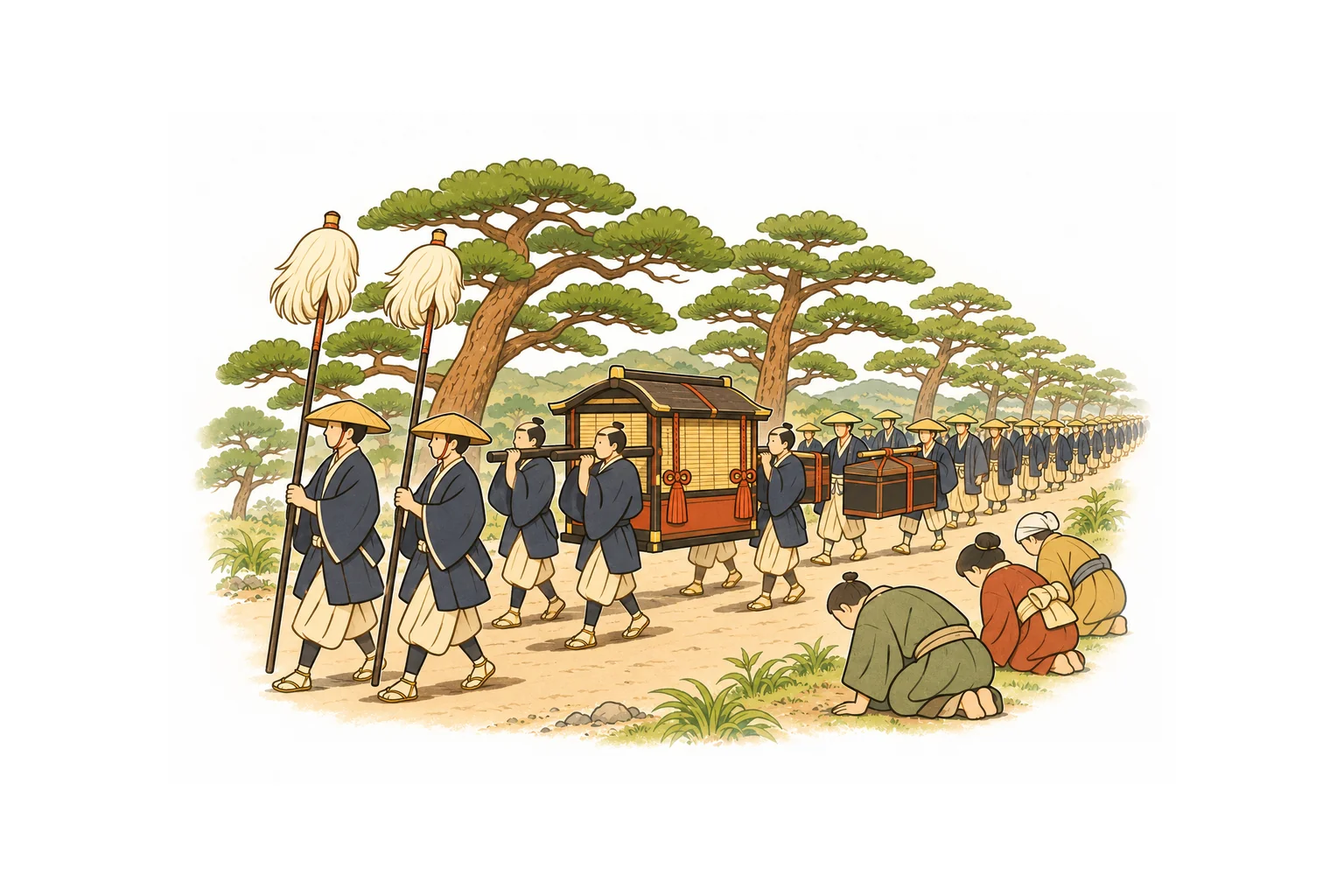
And it cost a great deal. A lord traveled with a procession of retainers, porters and horses; the Maeda of Kaga usually moved with two or three thousand people, by some accounts as many as 4,000, and the journey from Kanazawa to Edo normally took 13 days. In Edo each lord maintained several mansions, staffed by hundreds or thousands of men. For many domains, Edo became the single largest item of expenditure.
It is often said that the purpose of the system was to bankrupt the daimyo so that they could not afford to rebel. That overstates it. The shogunate never said so, its laws spoke of service and ceremony, and it sometimes ordered lords to cut the size of their processions. Much of the expense came from the lords competing with each other in display. Still, whatever the intent, by the eighteenth century most domains were deeply in debt and in no position to raise armies.
The shogunate also periodically ordered lords to pay for and supply labor on public works: Edo Castle, Nagoya Castle, river control. The best-remembered case is the Kiso river project of the 1750s, when the Satsuma domain was made to fund flood-control work on the Nōbi plain far from home. Dozens of Satsuma men died there, and the official in charge, Hirata Yukie, killed himself after its completion, traditionally to take responsibility for the enormous cost. Grudges like that had a long memory in Satsuma.
Alternate attendance had side effects nobody planned. With hundreds of processions on the roads every year, post towns along the highways flourished. Edo became a city of perhaps a million people by the eighteenth century, about half of them samurai and their households, one of the largest cities in the world. Dialects, goods and customs from every province met there and were carried home. Politically Japan was divided into more than 250 domains; culturally it was becoming one country.
06Swords for Samurai, Hoes for Farmers
The measures so far were aimed at the lords. But Warring States violence had not been confined to them. Villagers owned swords and spears and fought in the off-season. Temples kept armed monks. Leagues of True Pure Land Buddhist believers had held off great lords for decades. Local strongmen were landlords and warriors at once. Violence was everywhere, and any spark could catch.
The man who began to change this was Hideyoshi. In 1588 his "sword hunt" ordered farmers to hand over swords, spears, bows and guns, nominally so the metal could be used in a giant Buddha statue he was building in Kyoto. In 1591 he forbade samurai to become farmers or merchants and farmers to abandon their fields. Samurai moved off the land into castle towns and lived on stipends paid by their lords; farmers stayed in the villages and paid the rice tax. The Tokugawa inherited and hardened this separation.
Its effects were profound. A samurai without land had no private base and no private army. His livelihood depended entirely on his lord’s rice stipend, and a samurai who left his lord became a rōnin, a masterless man with no income. Vassals could no longer turn on their lords as they had in the Sengoku; lords could no longer mobilize whole provinces of peasants.
On top of this the Tokugawa built a hereditary status order. Samurai, farmers, artisans and merchants, along with court nobles, clergy and outcaste groups, each had their own rules about dress, residence and conduct, passed from parent to child. Later generations summed it up in the formula "warrior, farmer, artisan, merchant," though historians now point out that the real order was messier; in law, artisans and merchants were simply "townspeople." The basic principle held: you did what your family did. The road Hideyoshi had taken, from peasant foot soldier to ruler of Japan, was closed.
The samurai themselves changed. With no wars to fight, they became administrators, keeping accounts, hearing lawsuits, collecting taxes and repairing roads. The shogunate and many domains promoted Neo-Confucian teaching about loyalty and hierarchy. Under the fifth shogun, Tsunayoshi, the opening article of the Laws for the Military Houses, which had exhorted lords to devote themselves to "the arts of the bow and horse," was rewritten to stress loyalty, filial piety and proper conduct.
One crisis pushed the regime toward this gentler style. In 1651, just after Iemitsu’s death left a shogun not yet ten years old, a military teacher named Yui Shōsetsu organized a group of rōnin who planned to set fires in Edo and attack the government. The plot was betrayed and Yui killed himself. The shogunate drew a lesson: decades of confiscations had created tens of thousands of unemployed samurai, and they were the most dangerous people in the country. It relaxed the ban on deathbed adoptions, allowing a dying lord without a son to adopt an heir rather than see his domain abolished. Fewer confiscations meant fewer rōnin. The move from crushing the lords to keeping their houses alive was one of the most important decisions the regime ever made.
Farmers did not simply submit. Historians count over three thousand peasant protests in the Tokugawa period. Yet nearly all of them demanded tax relief or the dismissal of a corrupt official, not the overthrow of the lord. Protesters carried sickles and bamboo spears, and historians have noted that even when villages owned guns, protesters seldom fired them at people. Authorities usually made some concession and then punished the ringleaders. Both sides acted within unwritten rules that kept violence well short of war.
07Did Japan Give Up the Gun?
This brings us to a famous puzzle. Portuguese traders brought matchlock muskets to the island of Tanegashima in 1543, and within a few decades Japan had more firearms than almost anywhere in the world. At Nagashino in 1575, massed gunners helped Nobunaga and Ieyasu crush the cavalry of the Takeda. Yet when Commodore Perry arrived in 1853, Japanese troops were still carrying matchlocks of essentially sixteenth-century design. What happened?
In 1979 the American writer Noel Perrin published a short book called Giving Up the Gun. He argued that Tokugawa Japan deliberately turned its back on firearms and returned to the sword, because the sword embodied samurai identity and the gun let any peasant kill a nobleman. The book was widely read in the West and became a favorite example for arms-control advocates: proof that a society could choose to abandon a superior weapon.
Japanese historians have since taken the argument apart. Studies of rural communities found that Tokugawa villages were full of guns. Farmers used them for hunting and, above all, to drive off the boar, deer and monkeys that ravaged their crops. The authorities registered these weapons, most strictly under Tsunayoshi, but the goal was control, not confiscation, and licensed guns were legal. Tsukamoto Manabu and other historians have pointed out that in some domains the guns found in village inspections far outnumbered those the domain kept under its military quota. Japan after the sword hunt was not a disarmed country.
Nor did guns vanish from the samurai world. Domains kept musket units. Schools of gunnery taught their methods, and gunsmiths in centers such as Kunitomo, near Lake Biwa, and Sakai, near Ōsaka, kept working. In the 1830s the Kunitomo gunsmith Kunitomo Ikkansai built a reflecting telescope and used it to observe sunspots and the surface of the moon. The craft had not decayed.
What vanished was the reason to improve. Without war, nobody needed a faster, cheaper or more accurate gun. Gunnery became a traditional martial art like fencing or archery, taught as a lineage of secret techniques rather than tested against enemies. In Europe, constant warfare drove the shift from matchlock to flintlock and the drill and tactics that went with it; Japan stood still. In 1841 a Nagasaki gunnery expert, Takashima Shūhan, staged a demonstration of Western artillery and infantry drill on a field outside Edo, and the watching samurai saw how far the outside world had moved.
So Japan did not give up the gun. It gave up war. The gun stayed in the villages, scaring off boars, and in the samurai’s armory and practice field, but it left politics. Perrin noticed something real, the freezing of the technology, but put the cause and effect the wrong way round. A dislike of guns did not produce the peace; the peace removed any reason to make better guns. The fact that peasants owned guns and still rarely turned them on their rulers tells us more about the Tokugawa peace than any ban could. It rested less on taking every weapon away than on a shared sense of where violence stopped.
08Closing the Sea
The last layer was the outside world. In the late sixteenth century Japan was busy with foreign contact. Portuguese and Spanish ships and missionaries came and went; several Kyūshū lords were baptized, and one handed the port of Nagasaki to the Jesuits. Southern lords grew rich on overseas trade, which also brought them saltpeter and guns. For the shogunate there were two dangers here. Christianity might teach some lords and commoners to put God before the shogun. And the outside lords of the southwest might grow strong on foreign trade, or even find foreign allies.
Shimabara fused those fears. In 1639 the shogunate banned Portuguese ships altogether, and in 1641 moved the Dutch to Dejima, a small artificial island in Nagasaki harbor. Japanese had already been forbidden to travel abroad or return. Foreign contact was squeezed into four channels: Nagasaki for the Dutch and Chinese; the Sō family of Tsushima for Korea; the Shimazu of Satsuma for the Ryūkyū kingdom and, through it, China; and the Matsumae family in the far north for trade with the Ainu. Later writers called this sakoku, the "closed country," though many historians now avoid the term, since the door was never fully shut.
For the peace, the key was monopoly. Foreign goods, knowledge and weapons could enter only through channels the shogunate controlled. No lord could deal with foreign powers behind the shogun’s back.
There was also luck. Through the seventeenth and eighteenth centuries Japan faced no real external threat. The Qing dynasty, ruling China after 1644, looked inland and north rather than across the sea. Korea, devastated by Hideyoshi’s invasions in the 1590s, wanted only quiet relations. European power in East Asia was not yet strong enough to menace Japan. The sea let the Tokugawa go two centuries without a standing army facing outward. Their domestic arrangements were never tested from outside, because nobody came to test them.
09Why the Lords Went Along
All of this makes the daimyo sound like prisoners. If they had been, they would have rebelled the moment the shogunate slackened. Yet in more than two centuries no daimyo took up arms against it until the very end. Coercion alone cannot explain that. The lords also had reasons to stay.
The system gave them a great deal. The shogunate never governed their domains directly. A lord had his own retainers, his own laws, his own taxes, even his own paper currency. He did not need to fear invasion by his neighbors, and he could expect to hand his domain to his son and grandson. A Sengoku lord might lose his land to a neighbor, die in battle, or be murdered by a vassal. A Tokugawa lord who avoided serious mistakes could die in his bed. For most of them, security was worth far more than a gamble for national power.
After the mid-seventeenth century, confiscations became rare. Many domains survived intact from the early 1600s until the government of the new Meiji state abolished them all in 1871. The relationship became one of mutual dependence: the shogunate needed the lords to govern the provinces, and the lords needed the shogunate to guarantee their position.
The shogunate even had a safety valve for its own succession. When the seventh shogun, Ietsugu, died in 1716, aged 8 by Japanese count (6 by Western reckoning), and the main line ran out, the shogunate brought in Tokugawa Yoshimune from the Kii branch house. The top office changed lines without a shot being fired, something unthinkable in the Sengoku.
Time did the rest. The longer the peace lasted, the more natural it seemed. By the eighteenth century no one alive had seen a war. Samurai wore their swords to the office, where they were badges of rank rather than weapons. People came to think of peace as the normal state of things and of the Warring States as a barbarous past. An order that has become normal in people’s minds carries its own momentum.
10The End, and the Answer
The peace had costs. The status order stifled talent, and the closed sea left Japan behind in science and military technology. Samurai stipends were fixed while prices rose, and many warriors sank into debt to merchants. Peasants bore heavy taxes, and famines in the 1780s and 1830s killed huge numbers. In 1837 Ōshio Heihachirō, a former police official in Ōsaka, led his students and local farmers in an uprising against the authorities’ handling of a famine and set much of the city on fire. It was crushed within half a day, but a former government official in arms was an ominous sign.
What finally broke the peace came from outside. In 1853 Perry’s squadron entered Edo Bay, and the shogunate could not refuse its demands. To cope with the foreign powers it had to consult the daimyo and lean on them, and its monopoly of national affairs began to crack. In 1862, under pressure, it relaxed alternate attendance to once every three years for a hundred days, and let the lords’ families go home. The lords were no longer under the shogun’s eye.
The domains that brought the shogunate down were Satsuma and Chōshū, two great outside domains placed as far from Edo as the board allowed. They were distant, they nursed old grievances, and through Nagasaki and the sea they acquired Western weapons early. Fighting broke out around Kyoto and Chōshū from 1864; in 1867 the last shogun, Tokugawa Yoshinobu, returned his powers to the emperor; in 1868 civil war began. The long peace was over.
So how did it last 260 years? The Tokugawa took two or three generations to turn a society built for war into one where war was both impossible to start and not worth starting.
Impossible, because of the hardware: castles demolished, alliances and marriages policed, samurai separated from the land and peasants from the battlefield, outside lords placed at the edges and loyal vassals at the center, lords and their families tethered to Edo, and foreign help placed out of reach.
Not worth starting, because of the bargain: lords kept wide autonomy at home and the near-certainty that their houses would endure, confiscations faded after the mid-1600s, and even the shogun’s own succession had a backup.
Of the two, the second is the one more often overlooked. Popular accounts dwell on alternate attendance bleeding the lords dry, as though peace came from exhaustion. But exhausted lords are not loyal lords. What kept them quiet was a secure place in a system they had come to depend on. The early shogunate was ruthless; after the Yui Shōsetsu plot it learned restraint, moving from intimidation to maintenance. That shift is what stretched a few decades of enforced calm into more than two centuries.
All of it rested on one condition: that nobody came from outside. The architects of the system could guard against rebellious lords, rioting peasants and Christian missionaries. They did not and could not guard against a fleet of steam-driven warships. The balance held for two and a half centuries; once an outside force upset it, it came apart in fifteen years.