
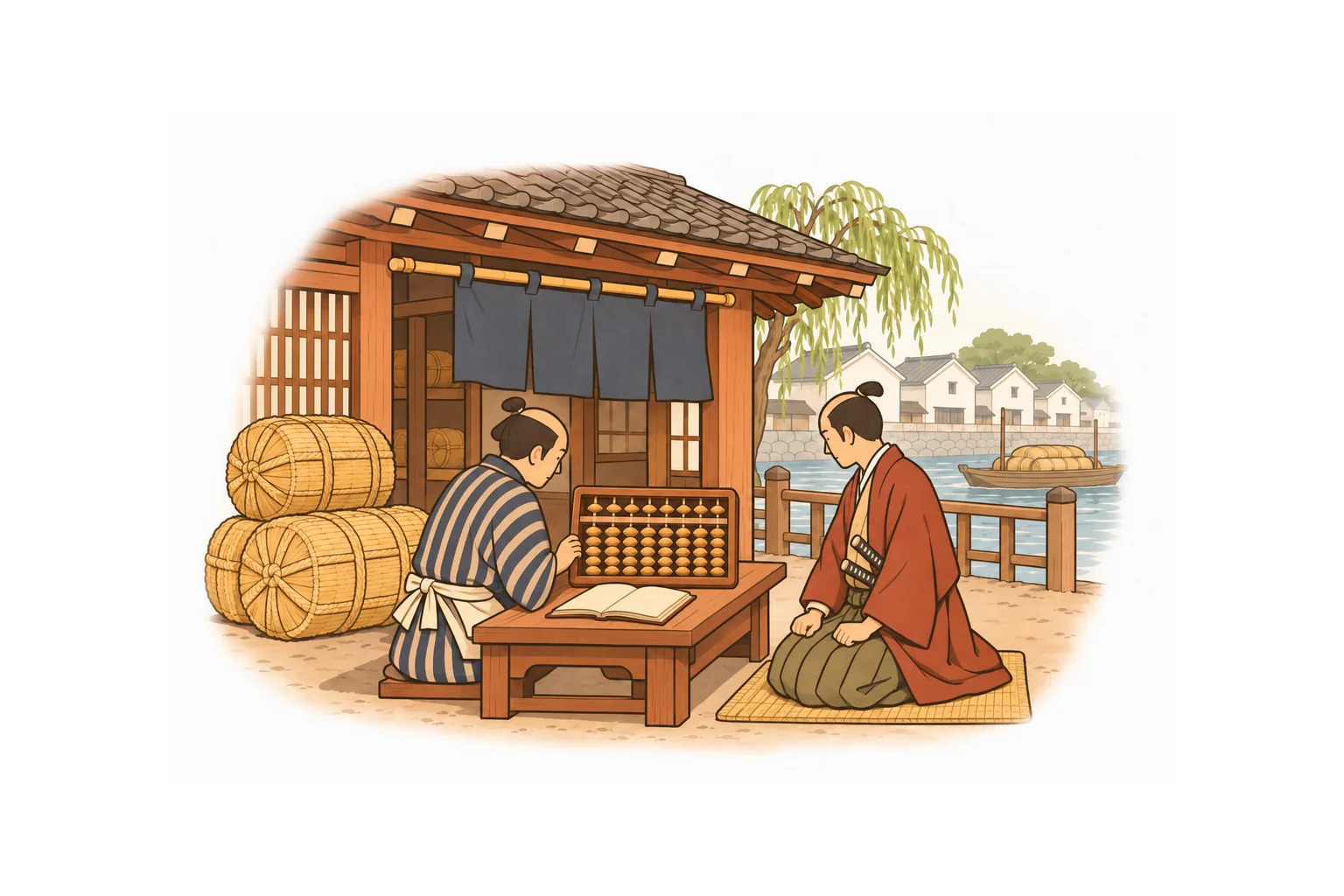
01A Swordsman Without a Job
Katsu Kokichi was a samurai, and he spent most of his life broke. Born in 1802 into the Otani, a newly established house of shogunal retainers, he was adopted into the Katsu household, which drew a stipend of 41 koku of rice a year. A koku was roughly the amount of rice one adult ate in a year, so 41 of them sounds respectable until you remember that it had to feed a family, pay servants, buy fuel and clothing, and keep up the appearances expected of a man who wore two swords. Kokichi never held an official post. He belonged to the kobushin, the pool of unemployed shogunal retainers who received their base stipend and nothing more.
Late in life he wrote a memoir, Musui dokugen (roughly "The Solitary Words of Musui"), and it is one of the most entertaining documents of the Edo period. Kokichi ran away from home twice in his youth, begged on the road, brawled in the streets of Edo, and eventually made his living as a broker of swords, buying blades from people who needed cash and selling them to people who had some. He settled neighborhood disputes for tips. His son, the future naval commander Katsu Kaishū, grew up in a house so poor that the family reportedly lacked proper bedding in winter.
Kokichi was not unusual. By the nineteenth century, a great many samurai, especially at the lower levels, lived on credit, took in piecework, and owed money to merchants they were officially entitled to look down on. Under the Tokugawa social order, samurai stood at the top and merchants at the bottom. Samurai could carry swords, use surnames, and in principle cut down a commoner who insulted them. Yet as the period wore on, the ruling class found itself in debt to the class it ruled.
That is a strange outcome. The samurai held political power for more than two and a half centuries. Why couldn’t they keep themselves solvent?
02Rulers on a Rice Salary
The answer starts with how samurai were paid, and that goes back to the end of Japan’s age of civil war in the late sixteenth century.
Before then, most warriors were landholders. A local samurai lived in his own village, supervised the farmers who worked his fields, and rode off to war with a band of retainers when his lord called. His income came from land he could see and manage.
Toyotomi Hideyoshi, who completed the unification of Japan in 1590, and Tokugawa Ieyasu, who founded the shogunate in 1603, deliberately broke that arrangement. Hideyoshi disarmed the peasantry and separated warriors from farmers. Samurai were pulled off the land and concentrated in the castle towns of their lords. Farmers stayed in the villages and paid taxes. The aim was control: a samurai who did not hold his own land could not build a private power base and rebel.
In place of land, most samurai received stipends, measured in rice. The entire economy was assessed in the same unit. Every domain had an official yield, its kokudaka, and a lord’s rank was expressed by it: a "100,000-koku daimyo" ruled lands assessed as producing that much rice a year. The lord collected a share of the harvest as tax and distributed it to his retainers according to their hereditary rank. A senior vassal might receive 1,000 koku; a foot soldier a few dozen, or simply rations for a set number of people.
The shogun ran his own household the same way. His direct retainers, the hatamoto (bannermen, who could appear before the shogun) and the gokenin (housemen, who could not), numbered over 20,000 households. A minority held small fiefs, but most collected their stipends in three installments a year from the shogunate’s rice warehouses at Kuramae, on the bank of the Sumida River in Edo.
Three features of this system matter for everything that follows. The income was fixed: stipends were hereditary and did not rise with time, so a grandson usually received what his grandfather had. It was paid in rice, not money. And samurai were forbidden to engage in trade, which was considered beneath their station. In 1600 none of this looked like a problem. Over the next 250 years, it became a trap.
03Living Like a Guest at an Inn
Moving samurai into towns turned them from producers into consumers. In the village, a warrior’s household could cut its own firewood, grow vegetables, and weave cloth. In the castle town, everything had to be bought: fuel, oil, salt, soy sauce, paper, cloth, lamp oil, repairs to the house, a doctor’s visit, a tutor for the children. All of it required cash, and the only way to get cash was to sell rice.
The Confucian scholar Ogyū Sorai saw this clearly in the 1720s. In a policy memorandum for the shogun Tokugawa Yoshimune, he wrote that samurai lived as if they were lodging at an inn, paying for every meal and every bowl. In his view, the root of their poverty was that they had been severed from the land and swallowed by the money economy of the cities. His solution, sending the samurai back to the countryside, was never seriously considered. His diagnosis was sharper than anything the shogunate actually did.
Town life also imposed the costs of status. A bannerman with a few hundred koku was expected to maintain a specified number of retainers, servants, and horses, to appear in public with attendants, and to conduct weddings and funerals in a style befitting his family’s rank. These were not optional luxuries. Rank was performed, and a family that could not perform it lost standing.
The largest performance of all was sankin kōtai, "alternate attendance." Every daimyo had to spend every other year in Edo, and his wife and heir lived there permanently as hostages. The trip between domain and capital meant marching hundreds or even thousands of retainers across the country, paying for lodging, food, porters, and horses along the way. In Edo, each lord maintained one or more large residences full of retainers who, again, had to buy everything. For many domains, Edo expenses consumed half the budget or more.
So from the shogun’s housemen to the great provincial lords, the samurai class was tied to the cities and to the market, converting rice into money in order to live. Their prosperity depended on a number they could not control: the price of rice.
04Cheap Rice, Expensive Everything Else
If rice had kept pace with other prices, the samurai might have managed. It did not. Contemporaries had a phrase for the problem: rice was cheap, and "the many goods" were dear.
Part of the cause was the success of the Tokugawa peace itself. With the wars over, domains poured effort into land reclamation and irrigation. During the seventeenth century, the area under cultivation roughly doubled, and the population grew from perhaps 12 million (estimates vary widely) to around 30 million. More rice was coming to market, and it was hard for its price to climb.
Meanwhile, the cities boomed. By the early eighteenth century Edo had around 1 million people, and Ōsaka and Kyoto several hundred thousand each. Townspeople wanted more than rice. They wanted cotton cloth, sake, soy sauce, candles, lacquerware, books, prints, and tickets to the kabuki theater. Demand for these goods pushed their prices up. For anyone whose income came in rice, each koku bought a little less each decade.
The way rice was sold made things worse. Domains shipped their tax rice to Ōsaka and sold it through merchant agents. The Dōjima rice exchange there, officially recognized by the shogunate in 1730, became the largest in the country, and its traders dealt in contracts for future delivery, an early form of futures trading. The price of rice was set in Ōsaka, not by the samurai. Every autumn, domains rushed their harvests to market at the same time and drove the price down, and samurai who needed cash had to sell when prices were lowest.
The shogunate tried to intervene. Yoshimune, who ruled from 1716 to 1745, spent years trying to prop up rice prices, ordering merchants to buy and hold rice and encouraging domains to store it. People nicknamed him the "rice shogun." But rice prices cut both ways. When they rose, townspeople went hungry. In 1733, after a spike in prices, a crowd in Edo wrecked the premises of the rice merchant Takama Denbei, whom they accused of hoarding. It is generally counted as the first large-scale riot of its kind in the city. The government was caught between the samurai, who needed rice to be expensive, and the townspeople, who needed it to be cheap.
A class with a fixed income in one commodity and expenses in everything else, with the exchange rate moving steadily against it, was not going to save its way out.
05Taxes That Could Not Be Raised
If stipends came from tax rice, why didn’t lords simply collect more tax?
They tried, and it grew harder. The official yields of most domains had been fixed by land surveys in the early seventeenth century and were rarely updated. Yet farmers kept getting more productive. Better seed varieties, purchased fertilizers such as dried sardines and oil cake, and improved tools raised harvests. Many villages also turned to cash crops like cotton, rapeseed, mulberry for silkworms, and tobacco, which they sold in town markets. Much of this new wealth slipped past a tax system built on paper yields that no longer matched reality.
The American historian Thomas C. Smith argued that although nominal tax rates in Tokugawa Japan were high, often described as forty or fifty percent of the harvest, the real burden on farmers was gradually falling, because actual output was rising faster than assessments. Historians still debate how far this held, and conditions varied enormously from region to region. But the broad pattern helps explain why village elites, sake brewers, and rural merchants grew rich in the eighteenth century while their lords stood still.
Raising taxes also invited resistance. The Edo period saw thousands of peasant protests, from petitions to large armed uprisings. Lords who tried to resurvey land or raise rates could provoke disaster. In Gujō domain, a long struggle over a new tax method that began in 1754 ended in 1758 with the lord, Kanamori Yorikane, stripped of his domain by the shogunate, and a senior councillor, a junior councillor, an inspector general, and a finance commissioner punished as well. The lesson was plain: the real ceiling on taxation was set by what villages would tolerate.
Yoshimune’s reforms included switching many shogunal lands to fixed tax quotas based on the average of past years rather than annual inspection. This raised and stabilized revenue for a time. It also locked revenue in place, so future gains in output stayed in the villages.
With income stuck and costs rising, lords did the obvious thing and passed the pain downward. Many domains "borrowed" a portion of their retainers’ stipends, a loan that was rarely repaid. In bad times, retainers might receive only half of what they were owed. The ordinary samurai was squeezed twice: once by the market and once by his own lord.
06The Lenders
So the samurai borrowed. The great lords borrowed from the merchant houses of Ōsaka, a practice known as daimyō-gashi, "lending to lords." Domains kept warehouses in Ōsaka where their tax rice was stored and sold by merchant agents, and those agents naturally became their creditors. The Kōnoike family, who started as sake brewers and moved into shipping and money-changing, ended up lending to dozens of domains. A lord would pledge next year’s rice to pay this year’s debts, and the hole deepened. By the 1800s, many domains owed sums equal to several years of their total income.
The shogun’s own retainers borrowed from the fudasashi, the rice brokers of Kuramae. Originally the fudasashi were simply agents who collected a retainer’s stipend rice from the shogunal warehouses, sold it, and handed over the cash minus a fee. Lending was the natural next step. Since every koku of a retainer’s income passed through the broker’s hands, the broker could deduct repayments and interest before the borrower saw a single coin. It was nearly riskless lending, at interest rates of around 18 percent a year, plus assorted fees.
The fudasashi grew spectacularly rich. In the late eighteenth century a group of them became famous in Edo as big spenders, patrons of kabuki actors and regulars in the Yoshiwara pleasure quarter, remembered as the "Eighteen Great Connoisseurs." Meanwhile some of their samurai clients had pledged several years of future income.
The relationship was tense on both sides. Some samurai tried intimidation, swaggering into the brokers’ shops and threatening them into making loans, and a trade grew up in hired toughs who would do this on a borrower’s behalf. The brokers in turn employed staff whose job was to handle such visitors. Sword on one side, ledger on the other: neither could do without the other.
07Three Reforms and One Misdiagnosis
The shogunate knew all this, and its three great reform programs, the Kyōhō, Kansei, and Tenpō reforms, each treated samurai finances as a central problem.
Yoshimune’s Kyōhō Reforms began in 1716. Yoshimune was famously frugal, wearing cotton and eating two meals a day, and he demanded the same of his retainers. In 1719 he ordered the shogunal courts to stop hearing lawsuits over money loans, telling the parties to settle them privately. The courts had been drowning in debt cases, and the order gave borrowers breathing room, but it also made lenders warier. In 1722 the shogunate was so short of funds that it could not pay its own retainers, and Yoshimune imposed a levy on the daimyo: 100 koku of rice for every 10,000 of their assessed yield, in exchange for halving their time in Edo. A shogun asking his lords for rice was an embarrassment to shogunal prestige. He also created a system of temporary salary supplements so that talented men from low-ranking families could hold high office without permanently raising their hereditary stipends.
The Kansei Reforms were led by Matsudaira Sadanobu, Yoshimune’s grandson, starting in 1787, in the wake of the Tenmei famine. The eruption of Mount Asama in 1783, years of crop failure, and epidemics had killed hundreds of thousands, centered on the northeast, with one estimate putting the national toll above 900,000, and rice riots had broken out in Edo and Ōsaka. Sadanobu’s most dramatic measure came in 1789. His debt-cancellation order, the kien-rei, wiped out all debts owed by shogunal retainers to the fudasashi that had been contracted in 1784 or earlier, principal and interest alike, and cut interest on more recent debts from 18 to 6 percent, to be repaid in installments. About 1.18 million ryō in loans vanished overnight.
The retainers celebrated. Then the year-end came, the season when debts were settled and cash was needed, and they discovered that the brokers had stopped lending. Having lost a fortune, the fudasashi had no reason to lend again. The shogunate ended up providing funds to the brokers so that credit could flow once more. The debts were gone, but the need to borrow was exactly what it had been.
The Tenpō Reforms of Mizuno Tadakuni, beginning in 1841, went further. Mizuno dissolved the merchant guilds, blaming them for high prices, and enforced sumptuary laws so strict that they reached women’s hair ornaments and popular theater. In 1843 he again turned on the fudasashi, ordering that old debts be repaid without interest over many years. That same year he tried to bring the lands around Edo and Ōsaka under direct shogunal control, provoking such universal opposition that he fell from office within months.
All three reforms rested on the same belief: samurai were poor because morals had decayed. People had grown fond of luxury, and merchants had taken advantage. Restore the frugality of the founders and the problem would solve itself.
That was the wrong diagnosis. Samurai were poor because of how they were paid, not because of how they behaved. As long as they lived in cities on fixed rice incomes and could not trade, thrift could only slow the decline. Attacking merchants meant attacking the only people willing to lend.
08Umbrellas, Morning Glories, and Adoptions for Sale
Reforms from above did little for the ordinary houseman, who found his own solutions.
The most common was piecework at home. In the neighborhoods of Edo where low-ranking samurai lived, households pasted umbrellas, made paper lanterns, carved toothpicks, wove bamboo, and fashioned hairpins. Some neighborhoods developed specialties. The foot guards of Okachimachi became known for cultivating morning glories; others grew garden plants or raised goldfish or singing insects for sale. Many a gokenin served in formal dress by day and pasted umbrellas by lamplight.
Another option was to sell the family name. Gokenin status passed by inheritance, and inheritance could pass by adoption. A wealthy townsman or farmer could pay a struggling samurai family to adopt his son, who would then inherit the family’s rank and stipend. The practice was technically improper and widely known. Prices followed the rank of the position, and a few hundred ryō could buy a low post. The seller cleared his debts; the buyer’s son became a retainer of the shogun.
Katsu Kokichi’s own family came from such a purchase. His grandfather was a blind man from Kariwa in Echigo who came to Edo, grew rich lending money, rose to kengyō, the highest rank open to the blind, and bought samurai status for his sons; the Otani house he acquired for Kokichi’s father was of bannerman rank. Kokichi, the grandson, was adopted into the Katsu family at the age of seven. The fortune made by a moneylender ended up supporting a household of impoverished samurai, which is a fair summary of the whole era.
09The Domains That Escaped
A few domains did find a way out, and none of them did it by thrift alone.
Uesugi Yōzan became lord of Yonezawa in 1767, inheriting a domain so deep in debt that some advisers suggested surrendering it to the shogunate. Yōzan lived plainly, but his real program was productive. He encouraged samurai households to raise silkworms and weave, promoted lacquer trees, paper mulberry, and carp farming, and built up goods that could be sold outside the domain. In effect, he put samurai to work in production. Yonezawa textiles became well known, and the domain’s finances recovered over several decades.
Satsuma, in the far south, took a harsher route. By the late 1820s it owed creditors, chiefly Ōsaka merchants, around 5 million ryō, many times its annual income. The official Zusho Hirosato, charged with fixing this, announced in 1835 that old debts to merchants in Edo, Ōsaka, and Kyoto would be repaid without interest over 250 years, 4 ryō a year for every 1,000 borrowed, a default in all but name. Ōsaka’s lenders were furious, but Satsuma was one of the largest domains in Japan, and there was little they could do. Zusho then built a monopoly on black sugar from the Amami Islands, forcing islanders to grow sugarcane and selling it at high prices in Ōsaka, and expanded trade carried on, in practice illegally, through the Ryūkyū kingdom. Satsuma went from bankruptcy to a reserve generally put at around 1 million ryō, at the cost of the Amami islanders and the Ōsaka merchants.
Chōshū, at the western tip of Honshū, restructured its debts under Murata Seifū and set up an agency that profited from the shipping passing through the Shimonoseki Strait, offering storage and loans to merchant vessels.
What these domains had in common was that they stopped relying on rice taxes and entered the commercial economy themselves, using the power of the domain to trade. It is no coincidence that Satsuma and Chōshū, with money in the bank, could buy Western rifles and steamships in the 1860s, and that they led the overthrow of the shogunate.
10The Answer
Why did the samurai go broke? The shogunate’s own answer was moral: they had forgotten the simplicity of their ancestors and been seduced by luxury and merchant cunning. That explanation shaped three major reform programs, and its failure is the best evidence against it. Generation after generation of rulers preached thrift, and the samurai only grew poorer.
The more convincing answer is structural. To secure peace and control, the Tokugawa built a system that pulled samurai off the land, gathered them in cities, paid them fixed amounts of rice, forbade them to trade, and obliged them to spend heavily on rank and on the journeys to Edo. That system worked. It took away the economic base for regional warlords and gave Japan more than two centuries without civil war.
The same system sealed the samurai’s financial fate. Peace brought land reclamation, rising yields, population growth, flourishing cities, and an expanding money economy. Japan as a whole grew richer, but the new wealth flowed to prosperous farmers, merchants, and craftsmen, not to men living on fixed rice stipends. Rice grew cheaper relative to other goods, and taxes could not be raised because assessments were frozen and villages pushed back. Samurai income was a flat line; the cost of living was a rising one. Borrowing filled the gap.
Not every samurai was poor. Senior retainers and the officials of great domains often lived comfortably. The real poverty lay among the large mass of lower samurai, and they turned out to be the most dissatisfied group in late Tokugawa Japan: literate, trained in arms, capped by hereditary rank, and unable to make ends meet. Many of the men who drove the upheaval of the 1860s came from exactly these families.
The Meiji government finally ended the problem by abolishing the stipends altogether. In 1876 it replaced them with a one-time issue of government bonds. For most former samurai the interest on those bonds was meager, and many who tried their hand at business failed so often that "samurai commerce" became a byword for incompetent trading. Some took up arms instead; the largest revolt, the Satsuma Rebellion of 1877, was crushed by a conscript army of commoners. A class that had lived on rice salaries for more than 250 years lost them in a single stroke, and with them the last of its claim to be a separate order of society.