
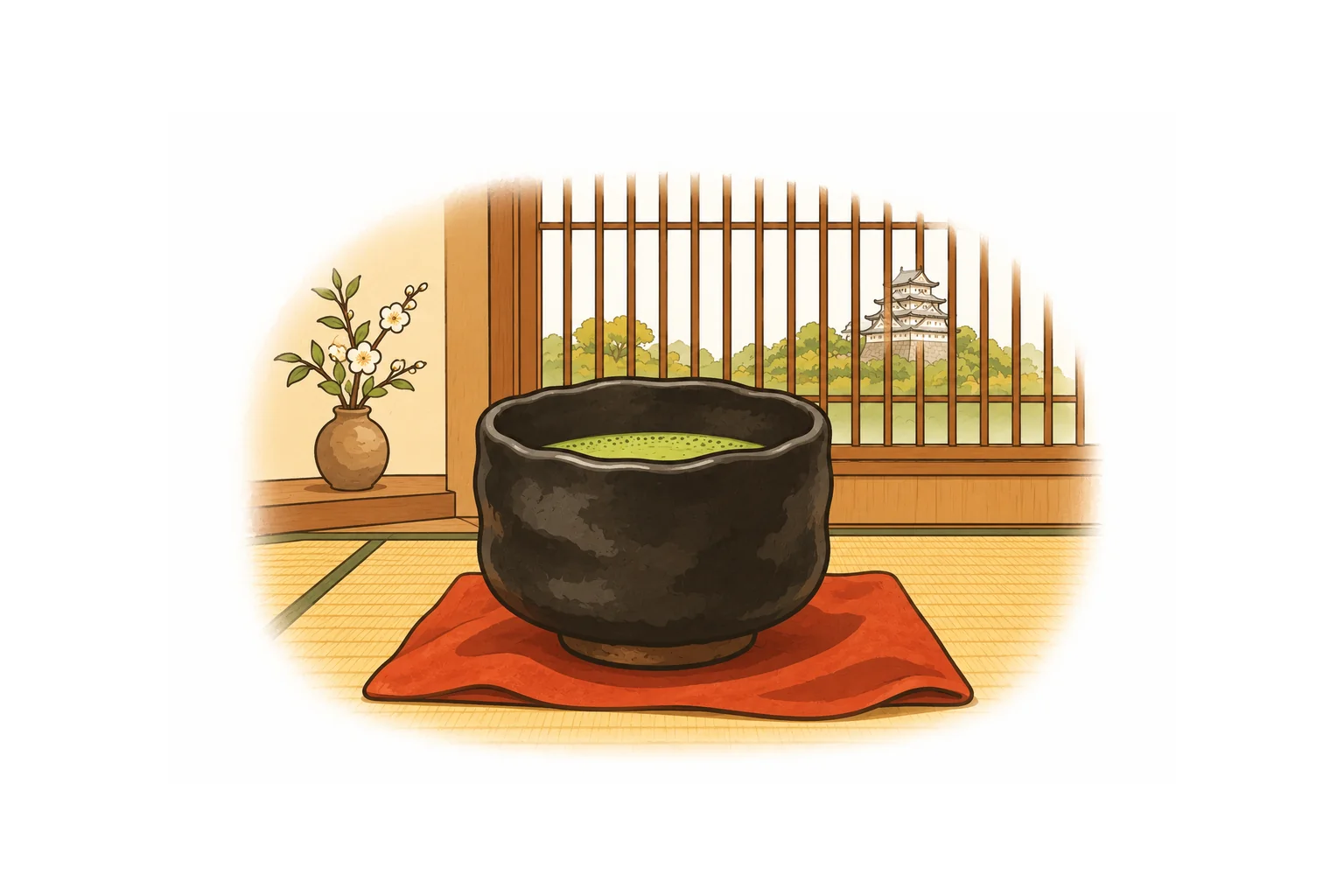
01A General Who Wanted a Jar
In the spring of 1582, Oda Nobunaga’s armies destroyed the Takeda family, the great warlords of the mountain province of Kai. When the rewards were handed out, one of Nobunaga’s veteran commanders, Takigawa Kazumasu, received the whole province of Kōzuke, part of Shinano besides, and the job of watching over the eastern plain of Kantō on Nobunaga’s behalf. For a man of modest birth, it was a spectacular promotion. He was now a lord of a province.
Kazumasu, by the account that has come down to us, was disappointed. In a letter he lamented that the blessings of tea were now lost to him. What he had really hoped for was a small ceramic jar in Nobunaga’s collection known as the Jukō Konasu, the "little eggplant of Jukō." It was a tea caddy, a lidded pot a few inches tall used to hold powdered green tea, called an "eggplant" because of its plump shape and named after Murata Jukō, the tea master who had supposedly once owned it. Being sent to a distant province meant exile from the tea gatherings of the capital. The letter is known only from later retellings, and its exact wording is hard to confirm, but the story was told and retold because people at the time understood the feeling. Preferring a jar to a province did not strike them as mad.
The period is full of such stories. When the warlord Matsunaga Hisahide submitted to Nobunaga in 1568, he sealed his surrender with a tea caddy called Tsukumo Nasu. When he later rebelled and was besieged in his mountain castle of Shigisan in 1577, Nobunaga is said to have offered to spare his life in exchange for an iron kettle called Hiragumo, the "flat spider." Hisahide refused and died as the castle fell; legend says he smashed the kettle rather than let Nobunaga have it. Araki Murashige, another of Nobunaga’s generals who turned against him, slipped out of his besieged castle in 1579, leaving behind his wife and retainers to be executed. According to the story, he took his favorite tea utensils with him.
This is worth puzzling over. The late sixteenth century was the most brutally practical moment in Japanese history, an age when men killed and died over rice fields. Yet these same men poured their passion, and their fortunes, into pots and bowls that held a few spoonfuls of tea. Understanding why tells us a great deal about how power actually worked as the age of war came to an end.
02From Chinese Treasures to a Named Pedigree
Powdered green tea came to Japan from Song-dynasty China; its introduction is traditionally credited to the Zen monk Eisai, who brought it back around 1200 and praised it as medicine. It spread from monasteries to warriors and courtiers. By the fourteenth century tea had become a party game: at "tea contests" guests tasted several brews and bet on which came from the prized fields of Toganoo near Kyoto, with sake and gambling to follow.
Alongside the rowdy contests grew something more formal. In the reception rooms of the Ashikaga shoguns, tea was served amid displays of imported Chinese art: ink paintings on the walls, celadon vases and lacquer trays on the shelves, dark-glazed tea bowls of the kind the Japanese called tenmoku. These imports were known as karamono, "Chinese things," and they stood for the highest refinement of a civilization Japan had always looked up to. They were also scarce.
The eighth shogun, Ashikaga Yoshimasa, who reigned in the late fifteenth century and built the retreat on Kyoto’s eastern hills now known as the Silver Pavilion, assembled one of the great collections. He employed connoisseurs, the dōbōshū, to catalog, rank and arrange his treasures. Objects that had passed through his hands came to be called Higashiyama gyomotsu, "the Higashiyama treasures," and that label worked like a seal of quality that never expired.
Here the essential ingredient is already present. A tea caddy’s value was not only in its glaze or its shape. It was in its story: who had owned it, who had praised it, at which famous gathering it had been used. An object with a name and a celebrated lineage became a meibutsu, a "famous thing." In that sense a meibutsu resembles an Old Master painting today, whose price rests as much on its provenance as on the brushwork.
03The Merchants of Sakai and the Taste for Imperfection
If tea had remained a matter of displaying Chinese treasures, its value would have been easy to measure: rare and beautiful imports cost a great deal. But in the late fifteenth and sixteenth centuries a different aesthetic took hold, and it changed the rules.
Tradition credits its beginnings to Murata Jukō, a Nara tea man said to have studied Zen under the eccentric monk Ikkyū. He favored small rooms, plainer utensils, and a mood of quiet restraint. A saying attributed to him holds that the moon is more beautiful half-hidden by cloud. The ideal came to be called wabi, a beauty found in the austere, the rough and the incomplete. Much of what we know of Jukō comes from later admirers, but the direction he stands for was real.
The next great figure was Takeno Jōō, a merchant of Sakai. Sakai, on the coast just south of present-day Ōsaka, was one of the richest cities in Japan, a port grown fat on foreign trade and governed by a council of its own wealthy merchants, who had even dug moats around it. Jōō dealt in leather and armor and was a master of linked verse as well as tea. He pushed wabi further, bringing in Japanese-made ceramics and humble rice bowls from Korea, and shrinking the tea room.
This shift mattered enormously. Anyone could see that a Song celadon was exquisite. But wabi tea claimed that a coarse Korean peasant’s bowl could be a supreme tea bowl, if one had the eye to see its beauty. Value was now partly in the eye of the beholder, and so the question became: whose eye? The answer was a small circle of acknowledged masters. Their power of discernment, called mekiki, could turn an ordinary object into a treasure. Whoever held that power held something real.
Sakai’s merchants, among them Imai Sōkyū, Tsuda Sōgyū, and Sen no Sōeki, later known as Sen no Rikyū (the son of a Sakai warehouse merchant, or some say a fish wholesaler), became the center of the tea world. They owned many of the finest meibutsu. They also controlled shipping, money, and the supply of gunpowder ingredients and firearms. Any warlord who wanted Sakai’s wealth and guns had to deal with these men, and much of that dealing happened over tea.
04Nobunaga Goes Collecting
The man who turned tea utensils into instruments of government was Oda Nobunaga.
In 1568 Nobunaga marched into Kyoto, installing Ashikaga Yoshiaki as shogun. Over the next two years he sent his retainers, among them Matsui Yūkan and Niwa Nagahide, to the temples and merchant houses of Kyoto and Sakai to acquire their meibutsu. Officially these were purchases; the owners were paid. But few owners were in a position to refuse the conqueror of the capital. Later writers called it meibutsu-gari, "the hunt for famous things." It was in these years that Matsunaga Hisahide handed over Tsukumo Nasu and Imai Sōkyū presented a celebrated tea-leaf jar called Matsushima and a caddy that had belonged to Takeno Jōō. For Sakai’s merchants, giving up their treasures was a way of accepting the new master. For Nobunaga, accepting them was a way of taking them under his protection.
Nobunaga genuinely enjoyed tea and had a good eye. But there was a deeper logic. The great meibutsu had been the shoguns’ things. To gather them was to inherit the cultural standing of the Ashikaga house. Nobunaga came from a provincial warrior family in Owari; to Kyoto’s courtiers, abbots and merchants he was a country upstart with a big army. By pulling the scattered treasures of the shogunate into his own storehouse, he announced that the center of civilized taste was now wherever he was.
He did not hoard them in silence. Nobunaga used tea gatherings as political theater. Whom he invited, in what order guests sat, which treasures he brought out, all carried meaning. Simply being summoned to drink tea with him was an honor people remembered.
05Tea as a License
Nobunaga’s most inventive move was to make hosting a tea gathering a privilege that required his permission.
Among his vassals, only those who had earned it could hold formal tea gatherings and display famous utensils. Permission came together with a gift of meibutsu from Nobunaga himself. Hashiba Hideyoshi, the future ruler of Japan, later recalled in a letter how, after his victories in the west, Nobunaga gave him tea utensils and allowed him to host tea, an honor Hideyoshi said he would never forget in this life or the next. In that letter, written in the tenth month of 1582, he described the arrangement with a phrase usually read as ochanoyu goseidō, roughly "governing through tea," and historians have borrowed it as a name for Nobunaga’s whole system. Akechi Mitsuhide and Nobunaga’s heir Nobutada were also licensed to host, and senior vassals such as Shibata Katsuie received famous utensils.
The effect was to give tea bowls and caddies the function of ranks and titles. A general’s standing could be read not only from the size of his lands, measured in koku of rice, but from the treasures he held and whether he could act as host.
This solved a hard problem. Warlords paid for loyalty with land, and land runs out. Every conquest had to be parceled out, and every large grant created a vassal strong enough to become a rival. Meibutsu were different. They were rare, but they took up no territory, fed no soldiers, and could not be turned into an army. Nobunaga owned more of them than anyone, and he decided which objects counted. It was as if he had founded a bank and kept the only printing press. Rewarding a commander with a tea caddy cost far less than a grant of a hundred thousand koku, and it could produce just as much gratitude.
Seen this way, Takigawa Kazumasu’s complaint makes sense. Kōzuke was large but remote, on the far edge of Nobunaga’s world. The little eggplant of Jukō was among the highest honors at the heart of it, a sign of closeness to the lord. Kazumasu wanted not a jar but the place the jar stood for.
Nobunaga’s attachment lasted to the end. In the sixth month of 1582 he lodged at the Honnō-ji temple in Kyoto, bringing dozens of his finest utensils to show off at a gathering for courtiers and merchants. Before dawn on the second day of the month, Akechi Mitsuhide attacked. The temple burned, Nobunaga died, and many of the treasures perished with him. Tsukumo Nasu, it is said, was pulled from the ashes; it survived another fire at Ōsaka Castle decades later and, repaired, still exists.
06Hideyoshi’s Gold and Rikyū’s Hut
Hideyoshi, who swiftly took Nobunaga’s place, inherited the politics of tea and pushed them to the limit.
He had more need of cultural legitimacy than anyone. Nobunaga had been a provincial lord; Hideyoshi was said to be the son of a peasant. He took Sōeki, Sōkyū, and Sōgyū into his service as tea masters, and Sōeki became his favorite. In 1585, when Hideyoshi was appointed imperial regent and served tea to Emperor Ōgimachi inside the palace, Sōeki had to attend. A merchant had no rank to enter the palace, so the court gave him a Buddhist lay name, Rikyū. It is by that name that he is remembered.
Hideyoshi’s tea had two faces. One was gold. He built a portable tea room whose walls, ceiling and pillars were covered in gold leaf, with gold utensils to match, and had it carried into the imperial palace to show the emperor, and later to his headquarters in Kyūshū. It said, without subtlety, that he owned the wealth of the realm. The other face was Rikyū’s. The tea room Taian, attributed to Rikyū, is just two tatami mats in size, with earthen walls and small windows. Guests enter through a low doorway, the nijiriguchi, on their knees; lords and merchants alike bow their heads to get in.
These look like opposites, but they served the same end. The golden room displayed Hideyoshi’s riches. The rustic hut displayed his taste, proving that the peasant’s son was not merely rich but master of the most rarefied art of his day.
Like Nobunaga, Hideyoshi used utensils as rewards and as tokens of submission. Defeated or newly allied lords offered their family treasures to him; he in turn invited them to tea and bestowed meibutsu. When the Christian lord Ōtomo Sōrin of Kyūshū came to Ōsaka Castle to seek Hideyoshi’s help in 1586, Hideyoshi personally showed him his tea rooms and collection, and Rikyū made tea.
07A Tea Party for the Whole Realm
In 1587, fresh from conquering Kyūshū, Hideyoshi staged the most extravagant tea event in Japanese history, the Grand Kitano Tea Gathering.
Notices went up in advance. Beginning on the first day of the tenth month, in the pine groves of the Kitano Tenmangū shrine in Kyoto, there would be a great tea gathering. Anyone devoted to tea, warrior, townsman or farmer, was welcome. Bring a kettle, a water jar, a bowl; if you have no tea, roasted barley will do. A mat of two tatami, or a simple straw mat, would suffice for a seat. Hideyoshi would display his entire collection of famous things for all to see. Those who did not come, the notice warned, would not be permitted even to serve roasted-barley tea in future.
On the day, by most accounts, hundreds of tea booths filled the pines. Hideyoshi, Rikyū, Sōkyū and Sōgyū each presided over a seat and served guests. The ruler’s treasures were laid out in the shrine for the crowds.
The gathering was supposed to last ten days. It ended after one. Why is unclear. A common explanation is news of a rising against the new lord of Higo province in Kyūshū; others suggest that a single day had achieved what Hideyoshi wanted.
What it achieved was a spectacle of ownership. The tea world was shown to revolve around one man. The greatest treasures of the realm belonged to him, and he generously let everyone look. The meibutsu were no longer private curiosities. They were the crown jewels of the ruler of Japan.
08The Death of Rikyū
Rikyū’s influence grew alongside his master’s. He was not merely the man who made the tea; lords seeking an audience with Hideyoshi often went through him. Hideyoshi’s half-brother Hidenaga is reported, in a letter by Ōtomo Sōrin, to have told the Kyūshū lord that public matters should be brought to Hidenaga and private ones to Rikyū.
Rikyū also held the power that mattered most in the world of tea: the power to say what was beautiful. A plain Korean bowl he admired could become priceless overnight. The black and red bowls he had a Kyoto tile-maker named Chōjirō shape by hand, without a wheel or decoration, the ware later called Raku, became objects of desire. Hideyoshi owned more famous things than anyone alive, but the standard by which famous things were judged lay in the hands of a merchant.
In the second month of 1591, Hideyoshi abruptly ordered Rikyū confined to his home in Sakai, then commanded him to commit suicide. On the twenty-eighth day of the month, Rikyū disemboweled himself at his residence in Kyoto, at seventy by the traditional count. The wooden statue of Rikyū from the Daitoku-ji gate had already been pulled down and symbolically crucified at the Ichijō Modoribashi bridge; according to the records, his head was displayed there too, placed so that the statue’s feet stood on it.
The official charges were two. The first concerned the great gate of Daitoku-ji, the Zen temple in Kyoto where Rikyū had studied. In 1589 Rikyū had paid to complete the gate’s upper story, and the grateful monks installed a statue of him there, wearing sandals. Anyone passing beneath the gate, Hideyoshi and the nobility included, would be walking under Rikyū’s feet. The second charge was that he had abused his authority as a judge of utensils, buying cheap and selling dear.
Later generations offered many more explanations: that Rikyū refused to give his daughter to Hideyoshi; that he opposed the coming invasion of Korea; that he was caught in a factional struggle, losing his protector when Hidenaga died in the first month of 1591 and falling victim to Hideyoshi’s administrators led by Ishida Mitsunari; that the two men’s tastes were incompatible, the lover of gold irritated by the master of black bowls. Most of these rest on little evidence, and the daughter story has the feel of drama rather than history.
The most convincing reading, in my view, takes the two official charges together. The statue was about rank: a merchant tea master placed above the ruler of the realm. The trade in utensils was about value: Rikyū created prices with his eye and profited from them. Both point to the same problem. In Hideyoshi’s regime, tea existed to express the authority of the ruler. Rikyū had built inside it a second authority that Hideyoshi did not control. When a tea bowl could be worth a castle, the man who decided what a tea bowl was worth wielded something close to the power of deciding who got castles. Hideyoshi could tolerate Rikyū being rich and revered. He could not tolerate someone else setting the standard. With Hidenaga dead, nobody stood in the way.
Rikyū was not the first tea man to die this way. A year earlier his disciple Yamanoue Sōji had offended Hideyoshi during the siege of Odawara and been executed, reportedly after having his ears and nose cut off. Sōji left a notebook describing the famous utensils of his day, their histories and their rankings, which remains one of the best windows into the world of meibutsu.
09Where the Value Came From, and Where It Went
So why was a tea bowl worth a castle?
Part of the answer is scarcity and pedigree. True meibutsu were few, each had a name, and each carried a chain of illustrious owners reaching back to the Ashikaga shoguns and the founding masters of tea. That history could not be manufactured, and it underpinned every price.
A larger part is political design. Nobunaga and Hideyoshi faced the same problem: too many men to reward, too little land, and the danger that every grant would breed a rival. Meibutsu became a currency of honor that only the ruler could issue. Nobunaga made hosting tea a license; Hideyoshi turned his collection into a public display of sovereignty. The extraordinary value of tea utensils was, to a great degree, raised deliberately by these two men.
A third part is the tea room itself. In that small space warlords, merchants and monks met as near-equals, negotiated, traded news, and formed alliances. Sakai’s merchants held money and guns, and the warlords needed them. Owning meibutsu and hosting tea was the ticket into that circle.
The last part is the wabi revolution in taste. By moving the measure of beauty from costly Chinese imports to what discerning masters approved, wabi tea made value something that could be created. That gave tremendous leverage to the masters who created it, and it is why Rikyū died.
None of this means the warriors were only pretending. Many of them loved these objects sincerely. It was precisely because the love was real that a tea caddy worked as a reward. Political calculation and genuine passion held each other up.
The moment did not last. Once Tokugawa Ieyasu founded his shogunate in 1603 and the wars ended, land was distributed by the shogunate’s fixed rules, not won on battlefields, and tea utensils no longer needed to substitute for it. Tea remained an essential accomplishment for a warrior; lords still treasured their meibutsu, and masters such as Furuta Oribe, Kobori Enshū and Rikyū’s own descendants founded schools that survive today. But the utensils settled back into being heirlooms and objects of connoisseurship. In the Meiji era, as many former daimyo families fell on hard times, their treasures flooded onto the market and were bought by new industrial magnates such as Masuda Takashi of the Mitsui trading house.
The answer, then, is that a tea bowl was worth a castle not because of what it was made of, but because for a few decades in the late sixteenth century three forces met in the tea room. Warlords needed a form of honor they could control; tea masters offered an aesthetic in which value could be created; Sakai’s merchants supplied the money and the connections. A famous bowl stood for the lord’s favor and a seat near the center of power, and in that age those things really were worth as much as a castle. When peace came and castles were no longer won by fighting, the bowl became a bowl again: an extremely precious one.