
01Fifty Days in Handcuffs
In 1791 the most popular writer in Edo, the city we now call Tokyo, spent fifty days at home with his wrists locked in iron cuffs. His name was Santō Kyōden. He was the son of a pawnbroker, a talented illustrator, and the author of witty little books about the pleasure quarter: who was fashionable, who was foolish, how a sophisticated man should talk to a courtesan. The shogun’s government had decided that three of these books corrupted public morals. Kyōden’s punishment was meant to humiliate rather than harm him. His publisher, a man named Tsutaya Jūzaburō, got off worse: he was sentenced to lose "half his fortune," traditionally understood as confiscation of half his property, though some historians read it as a heavy fine.
The scene is worth pausing on, because it captures an odd fact about Japan between roughly 1600 and 1868. The country was ruled by a military class, the samurai, under a hereditary military ruler, the shogun of the Tokugawa family. Official ideology, borrowed from Chinese Confucian thought, ranked society with warriors at the top, farmers next, then artisans, and merchants at the bottom, because merchants were thought to produce nothing and live off other people’s labor. Yet when people today think of the culture of this period, they think of kabuki theater, of woodblock prints like Hokusai’s Great Wave, of haiku, of comic novels and puppet plays. Almost all of it came out of the cities, and most of it was made for, and often by, the people the regime ranked lowest: the chōnin, or townspeople.
The samurai had their own culture, of course: Confucian learning, the stately Noh drama, the tea ceremony, ink painting. But it was the townspeople’s culture that filled the streets, sold in the thousands, and eventually traveled to Paris. How did people with no political voice end up defining the culture of an age? And why did a government that could handcuff its best-selling author fail to stop them?
02Rich, Crowded, and Shut Out
Chōnin literally means "people of the chō," the city blocks set aside for commoners. Tokugawa castle towns were zoned: one district for samurai, one for temples and shrines, one for merchants and artisans. Strictly speaking, only those who owned property in a commoner block counted as full townspeople with a say in neighborhood affairs. Far more people rented: shop clerks, peddlers, carpenters, day laborers packed into narrow wooden tenements along back alleys. All of them were part of the urban audience.
And it was an enormous audience. By the eighteenth century Edo had something like a million inhabitants, putting it among the largest cities in the world. About half were samurai and their servants; the other half were commoners, squeezed into a small fraction of the city’s land. Ōsaka, with perhaps 350,000 to 400,000 people, was the nation’s market, where domain lords sold the rice they collected as tax and turned it into cash. Kyoto, the old imperial capital, was the center of silk weaving, fine crafts, and printing. Together these were the "three cities."
The cities swelled because of how the Tokugawa ruled. Under the system of "alternate attendance" (sankin-kōtai), every domain lord had to spend every other year in Edo and leave his wife and heir there permanently. Thousands of samurai and retainers lived in the capital as consumers, spending their lords’ revenues. Rice flowed into Ōsaka, money flowed back out, and merchants took their cut at every stage. A century without major war meant safe roads and steady trade. Merchant fortunes grew.
Mitsui Takatoshi is the classic example. In 1673 he opened a dry-goods shop in Edo called Echigoya. The established way of selling expensive cloth was to carry samples to wealthy households, bargain, and settle accounts at the end of the year, with prices padded to cover bad debts. Echigoya sold over the counter at fixed, marked prices for cash, and would cut a length of fabric to whatever size the customer wanted. Ordinary townspeople could now afford silk. The shop flourished, and the Mitsui business that grew from it became one of modern Japan’s great conglomerates.
But no amount of money could buy a townsman political power. He could not hold office or wear swords. The shogunate issued sumptuary laws dictating what commoners could wear, how big their houses could be, how lavish their weddings were allowed to get. In 1705 it made an example of Yodoya, a dynasty of Ōsaka merchants so rich they were said to rival lords, and seized the family’s entire fortune on the grounds that they lived above their station. The lesson was clear. A merchant could get rich. He must not act as though riches made him somebody.
03The Floating World
So the money went elsewhere. In the seventeenth century a word took on a new meaning. Ukiyo had originally been a Buddhist term, written with characters meaning "the sorrowful world," this vale of tears from which one hoped to escape. Around the middle of the century, writers began using a homophone written with the character for "floating." The writer Asai Ryōi, in his Tales of the Floating World (around 1661), defined the new sense: to live only for the moment, to enjoy the moon, the snow, the cherry blossoms, wine and song, not to worry about tomorrow, to drift along like a gourd carried on the current.
That idea, the floating world, became the organizing spirit of townsman culture. The door to politics was shut; the door to pleasure was not, or at least not entirely. Ukiyo-e, the famous woodblock prints, are literally "pictures of the floating world." Ukiyo-zōshi were "books of the floating world."
04Ōsaka Looks in the Mirror
The first great flowering of this culture came in the Genroku era (1688–1704), and its center was not Edo but the older commercial cities of Kyoto and Ōsaka. Two writers from that world show what was new.
Ihara Saikaku was an Ōsaka townsman who first made his name in comic linked verse, performing feats of speed composition before audiences. In 1682 he published The Life of an Amorous Man, the picaresque story of a rich man’s son who discovers love at the age of seven and spends his life touring the pleasure quarters of Japan, finally sailing off in search of a legendary island inhabited only by women. It was cheeky, detailed, and full of the texture of city life, and it sold very well.
Saikaku’s more remarkable books are about money. The Eternal Storehouse of Japan (1688) is a collection of stories about merchants who make fortunes and lose them: one by relentless thrift, one by a clever idea, one by idling away an inheritance. Worldly Mental Calculations (1692) is set entirely on the last day of the year, when all debts fall due and creditors roam the streets while debtors hide, bluff, and scheme. Saikaku does not preach. He watches his fellow townspeople with amused, unsentimental clarity, as people for whom money is both weapon and trap.
Chikamatsu Monzaemon came from a different background. He was the son of a samurai who had left his lord’s service, and he worked for a time in the household of a court noble in Kyoto before turning to the theater. That a samurai’s son should become the great playwright of the merchant class tells us something already: this culture was never sealed off by status. Chikamatsu wrote for kabuki and, above all, for the puppet theater known as jōruri, in which large puppets act out a story chanted by a narrator to the accompaniment of the three-stringed shamisen.
In the spring of 1703, a young shop clerk named Tokubei and a courtesan named Ohatsu killed themselves together in a wood at Sonezaki in Ōsaka. In Chikamatsu’s telling, Tokubei had been cheated of money and disgraced, and the lovers saw no other way out. About a month later, at the Takemoto puppet theater in Ōsaka’s entertainment district, Chikamatsu’s The Love Suicides at Sonezaki opened. There were no lords and no armored heroes in it. The hero was a clerk in a soy-sauce shop. The audience was watching its neighbors.
The play was a sensation and is said to have rescued the theater’s finances. Chikamatsu went on to write a series of these "domestic plays," built around the collision between giri, the obligations a person owes to family, employer, and benefactors, and ninjō, personal feeling, love, and compassion. When the two cannot be reconciled, his characters die. Love-suicide plays became so popular, and real love suicides apparently so frequent, that in 1723 the shogunate banned the genre and ordered harsh treatment for couples who survived their attempts.
05The Poet and the Fishmonger
The third great name of the era, Matsuo Bashō, worked in a form that began as a townsman’s game. Haikai was a playful offshoot of classical linked verse: a group of people took turns adding lines to a chain, scoring points for puns, slang, and clever twists. Teachers earned a living by judging and correcting other people’s verses for a fee.
Bashō was born in Iga Province into a family of very low samurai rank, close to farmers. As a young man he served a lord’s son who loved poetry, and when his master died young, Bashō drifted to Edo and set himself up as a haikai teacher. For a while he also worked in administration on one of the city’s water-supply projects. Then he did something unusual: he left the comfortable center of town for a hut across the Sumida River in Fukagawa, where a disciple planted a banana plant (bashō) by the door. The poet took his name from it.
Bashō turned a parlor game into serious art. His most famous verse, about an old pond and the sound of a frog jumping in, uses no allusion and no wordplay; it simply makes the reader hear a silence by breaking it. In 1689 he set out on foot with a companion for the far north of Honshū, a journey that became The Narrow Road to the Deep North.
What matters for our question is who sustained him. His chief patron, Sugiyama Sanpū, was a fish merchant who supplied the shogun’s household; it was Sanpū who provided the Fukagawa hut. Bashō’s circle included doctors, merchants, samurai, and wealthy village headmen. Inside a verse circle, people were ranked by skill, not birth. That principle, a small world where talent and taste set the order, turns up again and again in townsman culture.
06The Bad Places
The shogunate had a blunt name for the two main stages of urban pleasure: akusho, "bad places." One was the licensed pleasure quarter. The other was the theater district.
Edo’s pleasure quarter was the Yoshiwara. In 1617 the shogunate licensed a single walled district to concentrate the city’s brothels where they could be watched. After the great Meireki fire of 1657 burned much of Edo, the quarter was moved to the rice fields north of Asakusa and rebuilt as the New Yoshiwara, enclosed by a moat with a single gate. Inside, a whole etiquette developed. Top courtesans were expected to master poetry, calligraphy, tea, and music. Meeting one took introductions through a teahouse and, by custom, several visits before any intimacy. Samurai had to check their swords at the door. A free-spending townsman who knew the rules was more welcome than a warrior who put on airs.
Out of this world came new standards of judgment. A person who knew his way around, who dressed, spoke, and spent with assurance, was tsū, a connoisseur. The opposite was yabo, boorish and clumsy. Later, Edo developed the ideal of iki: an understated chic, a plain kimono with a lining of superb silk, crisp speech, a lightness about money and love. None of these qualities had anything to do with rank. In the bad places, the people at the bottom of the official order had built a scale of value on which they could come out on top.
Kabuki began on the margins too. Around 1603 a woman known as Okuni drew crowds in Kyoto with a new kind of dance in which she dressed as a dandy visiting a teahouse. The word kabuki comes from kabuku, to lean askew, to behave outrageously. Women’s kabuki spread fast and blurred into prostitution; in 1629 the shogunate banned women from the stage. Troupes of adolescent boys took over and were banned in turn in 1652. From then on only adult men could perform, and men played the female roles, the origin of the onnagata tradition. The bans pushed kabuki away from selling bodies and toward refining craft.
By the Genroku era, the theater had regional styles. In Kyoto and Ōsaka, Sakata Tōjūrō perfected the "soft style," playing tender, lovesick young heirs. In Edo, the first Ichikawa Danjūrō created the "rough style," bursting onto the stage in bold red-and-black makeup to play superhuman heroes who smashed demons. The contrast fit the cities: the old merchant towns of the west savored nuance, while Edo, a raw capital full of single men from the provinces, wanted spectacle. Danjūrō himself was stabbed to death on the stage of the Ichimura theater by a fellow actor, Ikushima Hanroku, in 1704.
Edo allowed only three licensed theaters. A performance ran from dawn to dusk; audiences brought food and retreated to the teahouses that ringed the theaters. Actors were the city’s celebrities. The pattern on an actor’s costume would be on the streets the next week, and annual published "critiques" ranked performers like a league table. Samurai were not supposed to attend, and many went anyway in disguise.
The government’s attitude was double-edged. It considered the quarters and theaters wasteful and corrupting, especially for samurai. It also understood that a city of a million needed an outlet. Its solution was containment: license the pleasures, fence them in, and keep an eye on them. Inside those fences, townspeople found a kind of freedom.
07Woodblocks and Lending Libraries
What carried townsman culture beyond the theater walls was print.
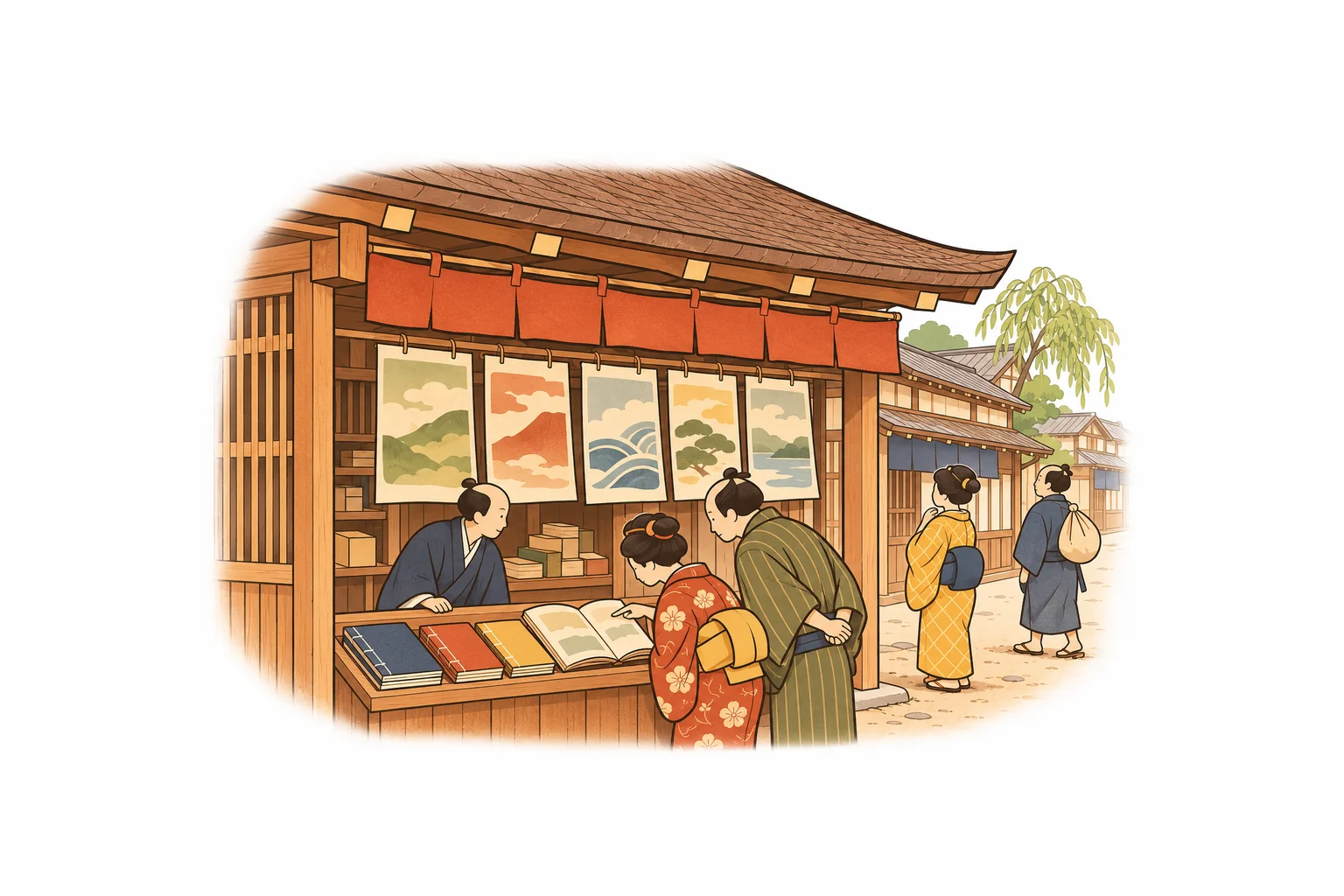
Nearly all books in this period were printed from carved wooden blocks. A single block could print thousands of sheets, far cheaper than hand copying, and text and pictures could be cut into the same block. Kyoto dominated publishing in the seventeenth century, mostly with Buddhist scriptures, Confucian texts, medical books, and classics. Ōsaka publishers led the way with entertaining fiction like Saikaku’s. By the late eighteenth century Edo had taken over, with a class of publishers specializing in local popular material: illustrated fiction, prints, theater books, guides to famous places.
There were readers for all of it. Across Japan, private schools called terakoya taught children reading, writing, and the abacus, using textbooks of letter-writing formats and commercial vocabulary. Estimates of literacy vary widely, but most city children of the commoner class could read popular books written in kana, the Japanese phonetic script, especially when the page was half pictures.
Books were still expensive, so people rented them. Lending-library peddlers walked their routes with stacks of books on their backs, dropping off new titles and collecting old ones. A record of 1808 counts more than 650 lending-library dealers in Edo. A single printed copy might pass through dozens of households.
Tsutaya Jūzaburō, the publisher who lost half his fortune in 1791, embodies this industry. Born in the Yoshiwara, he started with a small shop outside its gate selling the quarter’s guidebook, a directory of houses, courtesans, and prices, which he made clearer and more useful than his rivals’. From there he built one of Edo’s leading publishing houses. His genius was spotting talent. He published Kyōden; he made the career of the print artist Kitagawa Utamaro; and in 1794 he launched an unknown artist called Tōshūsai Sharaku with a set of twenty-eight large actor portraits. Sharaku produced around 140 prints in less than a year and then vanished. Who he was remains debated; the most widely accepted answer is a Noh actor in the service of the Awa domain. The novelists Kyokutei Bakin and Jippensha Ikku both worked for Tsutaya when they were young.
Look at the circle around Tsutaya and the line between townsman and samurai blurs. The genre of satirical picture books called kibyōshi, "yellow covers," was launched in 1775 by Koikawa Harumachi, a samurai retainer of a small domain. The leading comic poet of the 1780s, Ōta Nanpo, was a low-ranking vassal of the shogun. At the comic-verse gatherings of the day, samurai, merchants, courtesans, and actors all took joke pen names and mixed freely. Townsman culture was the culture of the city, and townspeople were its market. Its authors were often samurai.
08From Brocade Pictures to the Great Wave
Woodblock prints began as book illustrations. In the late seventeenth century Hishikawa Moronobu started issuing them as single sheets, showing courtesans and actors. Early prints were black outlines, sometimes colored by hand.
The breakthrough came in 1765, from a hobby. Wealthy Edo amateurs had taken to designing picture calendars, in which the year’s pattern of long and short months, which changed annually under the lunar calendar, was hidden cleverly in the image, and exchanging them at competitive parties. One leading organizer was a hatamoto, a direct retainer of the shogun. The artist Suzuki Harunobu designed calendars for these clubs using multiple color blocks, producing prints of a richness never seen before. Publishers are generally said to have then taken the blocks, removed the calendar markings, and sold the images commercially as nishiki-e, "brocade pictures." Full-color prints were now a consumer product.
Every print was a joint venture. The publisher chose the subject, paid for production, took the risk, and handled sales. The artist drew the design. A carver pasted the drawing face-down on a block of cherry wood and cut through it, then cut a separate block for each color. A printer brushed pigment onto each block in turn and rubbed the paper with a flat pad to transfer it. Only the artist’s signature and the publisher’s seal appeared on the print; carvers and printers usually went unnamed. The whole system ran on what would sell.
What sold were beautiful women, actors, and, later, landscapes. A standard print is usually said to have cost about 20 mon, roughly what a bowl or two of noodles did. An artisan could pin up a picture of his favorite actor; visitors from the provinces carried prints home as souvenirs of the capital.
Utamaro brought pictures of women to their peak in the 1790s with close-up portraits of the head and shoulders, every strand of hair and shift of expression rendered. Some of his subjects were famous courtesans; others were ordinary townsmen’s daughters who served tea at popular stalls, and his portraits drew crowds to their counters. Sharaku went the other way with actors, refusing to flatter: an onnagata’s masculine jaw, a middle-aged star’s sagging cheeks. His prints apparently did not sell well, which may explain his short career.
In the nineteenth century, landscape took over, riding a boom in travel, much of it in the form of pilgrimages to the Ise shrines. Katsushika Hokusai, around the age of seventy, published Thirty-Six Views of Mount Fuji, showing the mountain from every angle and in every weather. One of them, the giant wave off Kanagawa about to crash over three fishing boats, became the most famous Japanese image in the world. The series made heavy use of Prussian blue, a synthetic pigment originally from Europe, vivid and resistant to fading. Shortly afterward, in 1833–34, Utagawa Hiroshige’s Fifty-Three Stations of the Tōkaidō depicted the post towns on the highway between Edo and Kyoto: travelers hunched in a sudden shower, a village under night snow. Decades later these prints reached Europe and helped change the way Monet and van Gogh saw.
09Edo Finds Its Own Voice
By the Bunka and Bunsei eras (1804–1830), the cultural center had shifted decisively to Edo. Natives of the city now called themselves Edokko, "children of Edo," and prided themselves on quick tongues, open hands, and never keeping money overnight. The culture of this second flowering was less about rich merchants and more about everybody else.
Jippensha Ikku’s Shank’s Mare (1802 onward) follows two Edo layabouts, Yaji and Kita, down the Tōkaidō highway toward Ise, getting drunk, getting cheated, and making fools of themselves at every stop. It was so popular that Ikku kept writing sequels for some twenty years, and he is often described as one of the first Japanese authors to live from writing. Shikitei Sanba’s The Bathhouse of the Floating World is almost plotless: just the chatter of men and women in a public bath, bragging, complaining about daughters-in-law, mocking country accents.
Kyokutei Bakin took a loftier path. Beginning in 1814 he wrote The Eight Dog Chronicles, an epic of eight warriors, each bearing a jewel inscribed with a Confucian virtue, who gather to restore a fallen house. Inspired partly by the Chinese novel Water Margin, it took him twenty-eight years. Bakin went blind before finishing and dictated the last parts to his widowed daughter-in-law, Omichi, who had to learn the characters as she went. He was a samurai’s son with strict moral views, but his readers were townspeople renting volumes from the lending libraries.
Short satirical verse called senryū, named after an eighteenth-century judge who ran enormously popular competitions, poked fun at husbands, wives, doctors, and officials. Storytelling halls, yose, spread through every neighborhood, where a rakugo performer sat on a cushion and played every character in tales of broke tenants, dim shopkeepers, and know-it-all craftsmen. A carpenter renting a back-alley room could, in a single week, hear the latest play retold at the bathhouse, buy an actor print, rent a comic novel, enter a verse contest, and spend an evening at the yose. That ordinary life was the culture.
10The Shogunate’s Scissors
The more this world flourished, the more it troubled the government, and each time the shogunate launched a reform to restore frugality and order, the culture took a beating.
The Kansei Reforms, beginning in 1787 under the senior councillor Matsudaira Sadanobu, a stern Neo-Confucian, provoked the first round. Satirists mocked his slogans almost at once. In 1789 Koikawa Harumachi published a picture book lampooning Sadanobu’s call for samurai to cultivate both letters and arms. Summoned by the authorities, he pleaded illness and died soon after, possibly by his own hand. Ōta Nanpo quietly gave up comic verse and concentrated on his official career. A 1790 publishing ordinance banned commentary on current affairs and erotic content. In 1791 came Kyōden’s handcuffs and Tsutaya’s fine.
Tsutaya adapted, shifting to Utamaro’s women and Sharaku’s actors. But the pressure continued. In 1804 Utamaro himself was handcuffed for fifty days for a print showing the warlord Toyotomi Hideyoshi picnicking with his wives, a violation of the rule against depicting recent military rulers. He died two years later.
The Tenpō Reforms of the early 1840s under Mizuno Tadakuni were harsher. Luxury fabrics and fancy sweets were banned. Most storytelling halls were closed. All three Edo theaters were ordered out of the city center to Saruwaka-chō, an out-of-the-way spot north of Asakusa. The greatest actor of the day, the seventh Ichikawa Danjūrō, was banished from Edo for living too lavishly. Tamenaga Shunsui, author of romantic fiction, was handcuffed and died soon after; Ryūtei Tanehiko’s long reworking of The Tale of Genji was suppressed, and he died the same year. Prints of actors and courtesans were forbidden.
The townspeople’s response was not confrontation but evasion. Barred from portraying actors, Utagawa Kuniyoshi drew cats, goldfish, and hordes of goblins wearing recognizable actors’ faces. In 1843 he published a print of the medieval warrior Minamoto no Raikō lying ill while an earth spider and a swarm of monsters gather around him. Edo readers decided at once that Raikō was the shogun and the monsters were the people crushed by the reforms. The publisher hastily withdrew the blocks. The print had already gone around the city.
And the reforms never lasted. Sadanobu was out of office after six years; Mizuno fell after little more than two. Once the pressure eased, the theaters reopened, the books returned, the prints sold. The exiled theaters made Saruwaka-chō a lively new district. The government could punish individuals. It could not abolish a market sustained by hundreds of thousands of customers.
11So Who Made Edo Culture?
The townspeople made their own culture because three things came together.
The first was the city itself. The Tokugawa peace and the alternate-attendance system packed people, money, and information into Edo, Ōsaka, and Kyoto on a scale few places on earth could match. Without that density there would have been no full theaters every day, no six hundred-odd book-lending peddlers, no publishers hungry for a new print every month.
The second was exclusion. Barred from power and forbidden to display their wealth, townspeople put their energy into pleasure, style, and wit, areas the regime policed only fitfully. In the pleasure quarter and the verse circle, knowledge and taste counted for more than lineage. This was not rebellion; most townspeople obeyed the status order and paid their dues. But within the floating world they built a different ranking, one in which they could excel.
The third, and in my view the decisive one, was the market. Saikaku, Chikamatsu, Hokusai, and Bakin, whether born merchants or samurai, lived by selling work to townspeople. Publishers printed and theaters staged what paying audiences wanted: a neighbor’s love suicide, bathhouse gossip, faraway landscapes, the faces of stars. Because it was a market, it answered to ordinary people. And because it was a market, government bans could only hold it back for a while.
Historians have argued about what this culture meant. One school saw it as the protest of a rising bourgeoisie against feudal hierarchy: feeling defying duty in Chikamatsu’s plays, satirists mocking the regime. Another saw it as escapism, consolation for people locked out of politics, which the shogunate tolerated precisely because it kept them busy. Both see part of the picture. My own view is that it was neither a revolution nor merely a distraction. The townspeople never tried to overthrow the samurai. What they built instead was a world in which money, talent, and taste set the order, with its own stars, its own critics, and its own press, too big for the regime to destroy and too useful for it to want to.
It was also never purely theirs. Chikamatsu and Bakin were samurai sons; Harumachi and Nanpo were serving samurai; the first full-color prints came from a party game run by a shogunal retainer. It is most accurate to call it the culture of the city, with townspeople as its main audience, its main subjects, and its main paymasters. That mixing across status lines is a large part of why it was so much livelier than anything either class produced on its own.
Hokusai died in Edo in 1849, at about ninety. According to an early biography, he said on his deathbed that if heaven granted him ten more years, or even five, he might become a true painter. Whether he said exactly that cannot be confirmed. But he had reportedly moved house more than ninety times, called himself "the old man mad about painting," and made his living selling pictures to anyone who could spare a few coins. He never needed the approval of court or shogun. He needed customers, and Edo had a million of them.