
01The Castle Without a Tower
In 1657 the shogun’s councillors had to decide what to do about a pile of blackened stone. Early that year, in the first month of the third year of the Meireki era by the old calendar, a fire had started at a temple in the Hongō district of Edo, the shogun’s capital and the city we now call Tokyo. A dry northwest wind had been blowing for days, and by later accounts there had been almost no rain for some eighty days. The fire jumped from roof to roof, new fires broke out in other quarters the next day, and for two days the flames swept from the northern hills down to the bay. When it was over, most of the city was ash. Estimates of the dead, disputed from the start, range from tens of thousands to more than 100,000. Among the buildings lost was the great keep of Edo Castle, the tallest castle keep in Japan, the visible symbol of Tokugawa power.
The obvious move was to rebuild it. Hoshina Masayuki, the half-brother of the previous shogun and the uncle and senior guardian of the young shogun Tokugawa Ietsuna, argued against it. According to a later account from his own domain, he said a keep served no real military purpose and was good only for looking out over the city; the money was better spent on the people. The wording may be embellished, but the outcome is not in doubt. The stone platform was rebuilt. The tower on top of it never was. For the remaining two centuries of Tokugawa rule, the largest castle in Japan stood without its keep, while the shogunate handed out rice, set up gruel kitchens, and gave silver to townspeople so they could put their houses back up.
Hoshina’s decision is a good place to start, because it captures something about how Edo survived. This was a city that by the early 1700s held roughly a million people, which made it as large as London or Beijing at the time and quite possibly the largest city in the world. It was built almost entirely of wood, paper, and straw. It sat on reclaimed marshland where the wells ran salty. It had no sewers. And it burned, again and again, on a scale that would have finished off most cities. Yet it did not decline. Each time, it came back within months.
How? The short answer is that Edo never solved its problems. It managed them, cheaply and in a spread-out way, and it accepted heavy losses as the price of living there. The longer answer has to do with fire brigades who fought fires by tearing down houses, with a forty-kilometer aqueduct that ran on nothing but gravity, and with farmers who paid good money for the contents of city toilets.
02A City Too Big for Its Ground
When Tokugawa Ieyasu took over the area in 1590, Edo was a modest castle town with some fishing villages around it. What made it grow so fast was politics. Under the system known as sankin-kōtai, or alternate attendance, the roughly 260 regional lords, the daimyo, had to spend every other year in Edo, and their wives and heirs lived there permanently. Each lord kept several mansions in the city, staffed by hundreds or thousands of retainers. Add the shogun’s own vassals, the bannermen (hatamoto) and lesser housemen, and something like half of Edo’s population belonged to the warrior class.
Warriors, temples, and shrines took up around 85 percent of the city’s land. The other half of the population, the townspeople or chōnin who did the buying, selling, carrying, and building, were packed into what was left. In the old commercial core around Nihonbashi and Kanda, families lived in nagaya, long wooden row houses divided into single rooms a few meters wide, with a shared well, a shared toilet, and a shared rubbish heap at the end of the alley.
Three problems follow from that picture. Wooden houses jammed together will burn. A million people on salty ground need drinking water from somewhere else. And the same million people produce a great deal of waste every day. Each of these could have broken the city. Each was handled in a different way.
03The Flowers of Edo
The townspeople had a saying: fires and fights are the flowers of Edo. It was a joke, but a grim one. Over the course of the Edo period the city suffered, by different counts, anywhere from dozens to more than a hundred major fires, the kind that wiped out whole districts, and smaller fires were too common to count. A resident who lived to old age could expect to see his neighborhood burn more than once.
Part of the reason was the buildings themselves. Row houses had thin board walls and paper sliding doors. People cooked on open hearths, warmed themselves at charcoal braziers, and lit their rooms with oil lamps. Part was the weather. In late winter and early spring, the dry seasonal wind blew from the northwest across the Kantō plain, so that a fire starting in the hilly districts to the north and west was pushed straight into the crowded lowlands. The three worst fires of the period, in 1657, 1772, and 1806, all followed that pattern.
And part of the reason was people setting them. Arson was a constant fear. Some arsonists were thieves who wanted cover for looting; some acted out of grudges. The most famous case became a legend. In 1683, a greengrocer’s daughter known as Oshichi was burned at the stake for arson. The story that grew up around her, retold by the novelist Ihara Saikaku and later by kabuki and puppet playwrights, says that she had fallen in love with a young man while her family took refuge at a temple during an earlier fire, and that she set a new fire in the hope of seeing him again. How much of the romance is true is anyone’s guess, but the punishment is real, and it shows how seriously the authorities took the crime. In a wooden city, setting a fire endangered thousands of lives. The shogunate created a special police office, the hitsuke tōzoku aratame, to hunt down arsonists and armed robbers. One of its later heads, Hasegawa Heizō, became a popular hero of modern detective fiction.
There is a story about the 1657 fire too. It is said that a girl died of longing for a young man she had glimpsed once, that her long-sleeved kimono passed to two more girls who also died young, and that when a priest tried to burn the cursed garment the wind lifted the blazing sleeve onto the temple roof. That is why the disaster is sometimes called the Long-Sleeves Fire. The tale is far too neat to be anything but a later invention, but it tells us what Edo people felt about fire: that it came suddenly, out of small things, and could not be bargained with.
04Making Room for Fire
After 1657, the shogunate rebuilt Edo with fire in mind. The idea was not to stop fires, which no one believed possible, but to stop them from joining up.
Open spaces called hiyokechi, firebreak plots, were cleared and kept empty. Some streets were widened into hirokōji, broad avenues where a fire would struggle to cross; the name survives today in Ueno Hirokōji. The great lords’ mansions that had crowded inside the castle grounds were moved out. Many temples were shifted from the center to the edges of the city. The licensed pleasure quarter of Yoshiwara, which had stood near Nihonbashi, was relocated to the rice fields north of Asakusa; the move had been ordered the year before, and the fire settled it.
The most important change was a bridge. During the fire, crowds fleeing east had been trapped against the Sumida River, which had no bridge on its lower course; the only crossing was far upstream at Senju. At the Asakusa gate, according to accounts of the fire, officials who heard a rumor that prisoners had escaped shut the gate, and the people behind, unable to see what was happening, kept pressing forward until those in front were crushed or pushed into the moat. (The prisoners in question had in fact been released by the jail’s warden, Ishide Tatewaki, who let them run from the flames on the promise that they would come back afterward. Almost all of them did.) In 1659 the shogunate put the Ryōgoku Bridge across the Sumida (some sources date its formal completion to 1661). Its name means "two provinces," since it linked Musashi to Shimōsa. With the bridge in place, the marshy districts of Honjo and Fukagawa on the east bank were opened up, and Edo spread across the river. Fukagawa became home to the timber yards, which tells you what the city needed most after every fire. On the east bank, too, the shogunate founded the temple of Ekō-in to bury the unclaimed dead of 1657.
Later, under the eighth shogun Tokugawa Yoshimune in the 1720s, the government pushed townspeople toward tiled roofs and dozō-zukuri, a style of building with thick clay-plastered walls. Wealthy merchants built fireproof storehouses. When a fire approached, they locked their account books and stock inside, sealed the doors with mud, and fled. When the fire passed, they came back, opened the storehouse, and went on trading. The owners of ordinary row houses, though, could never afford that kind of construction, and most of the lowland city stayed as flammable as ever.
05Firefighters Who Pulled Houses Down
The first firefighters in Edo were samurai. In 1658 the shogunate assigned four bannermen to lead permanent fire companies, later expanded to ten. The daimyo had their own brigades; those of the Maeda lords of Kaga were famous for their fine costumes and their swagger. But warrior brigades existed mainly to protect the castle and warrior mansions. The townspeople’s quarters often had to look after themselves.
That changed under Ōoka Tadasuke, Yoshimune’s city magistrate, a man later remembered in countless stories as a wise judge. In 1718 Ōoka ordered the commoner neighborhoods to form their own fire brigades, the machi-bikeshi. In 1720 these were reorganized into companies named after the syllables of the iroha, the traditional poem used like an alphabet, with sixteen more companies for the districts east of the river; one more iroha company added later brought the iroha brigades to forty-eight. A few syllables were skipped because they sounded unlucky or rude—one sounded like the word for fire, another like a fart—and replaced with characters meaning hundred, thousand, ten thousand, and origin. The brigades were paid for by the neighborhoods they served.
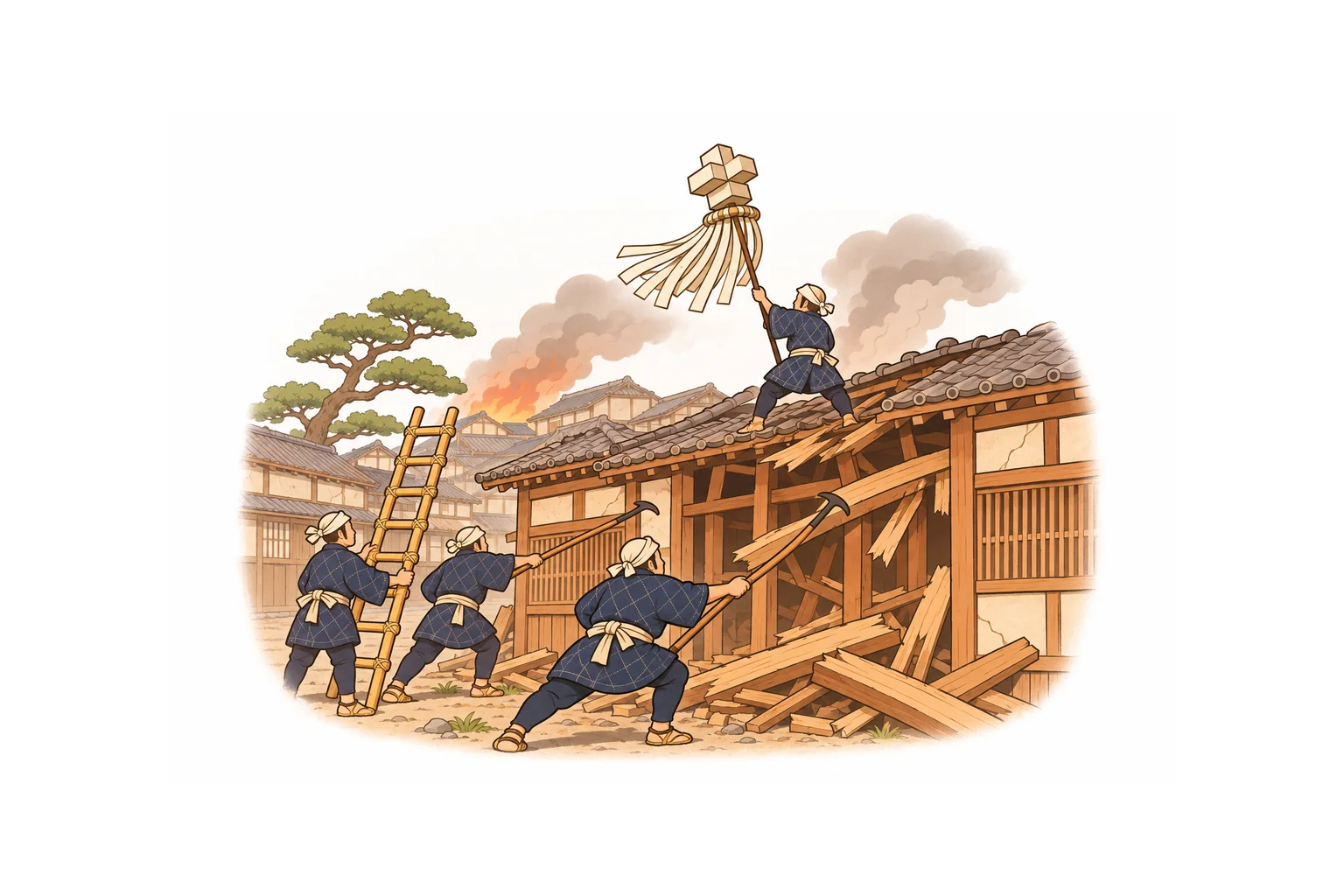
Their core members were tobi, construction laborers who put up scaffolding and were at home on rooftops. Their name came from their tool, the tobiguchi, a long pole with an iron hook on the end shaped like a kite’s beak. That hook was the most useful firefighting equipment in Edo, because Edo fought fire by demolition. There was a wooden hand pump called the ryūdosui, the "dragon spitting water," but it delivered too little water to matter against a big fire; it was mostly used to soak the men working near the flames. The real work was to get downwind of the fire and pull houses down fast enough to open a gap it could not cross. The same flimsiness that made row houses burn made them easy to tear apart.
Each company carried a standard called a matoi, a pole topped with a distinctive emblem and hung with paper streamers. The standard-bearer climbed onto the roof of the house where the company meant to stop the fire and held the matoi aloft, telling everyone that this was the line. Holding it while the fire came closer was the most honored job in the brigade and the most likely to get a man killed.
The brigades were heroes, and they were also brawlers. Companies fought each other over credit and territory. In 1805 one company got into a mass brawl with sumo wrestlers at a tournament at the Shiba Shinmei shrine, a scandal that ended up on the kabuki stage. When people said fires and fights were the flowers of Edo, these were the men they had in mind.
Rebuilding after a fire was fast, and for some people it was profitable. Carpenters, plasterers, porters, and above all timber merchants had work. Legends grew up about merchants like Kinokuniya Bunzaemon who supposedly made fortunes by cornering timber before a fire. The details are doubtful, but timber dealers were genuinely among the richest men in the city. For a tenant in a row house, a fire meant losing a few possessions and moving somewhere else while new rooms went up, which might take only days. Edo townsmen boasted that they never kept money overnight. It is usually taken as a sign of their free-spending style, but in a city where everything might burn next month, there was also not much point in saving things.
06Water from Forty Kilometers Away
Edo’s second problem was water. Much of the lowland city had been built on filled-in tidal flats, and wells there produced brackish water unfit to drink. Ieyasu is said to have had one of his retainers, Ōkubo Tōgorō, build a small channel from nearby springs as soon as he arrived. This grew into the Kanda aqueduct, fed by Inokashira Pond in the western hills. Where it crossed the Kanda River it ran over a wooden trough on a bridge, and the spot is still called Suidōbashi, "aqueduct bridge."
By the mid-1600s the city had outgrown it. In 1653 the shogunate began a new aqueduct drawing on the Tama River. The builders were two brothers, Shōemon and Seiemon, who set a weir at Hamura upstream and dug an open channel about 43 kilometers long to the Yotsuya gate on the western edge of Edo. Over that whole distance the channel dropped only about 92 meters. It had to keep a steady, gentle slope across the rolling Musashino plateau, fast enough not to stagnate, slow enough not to tear out its banks, and the brothers had nothing more advanced than simple sighting tools and lanterns to do the surveying. The story goes that they ran out of money and sold their own property to finish it, though that may be embellishment. The channel was completed within about a year, and the brothers were rewarded with the surname Tamagawa. The Tamagawa aqueduct was still supplying Tokyo in the twentieth century.
At Yotsuya, the water went underground into a network of wooden pipes, big trunk lines branching into smaller ones and then into bamboo pipes that fed square wooden basins sunk in the ground. These looked like wells and people used them like wells, lowering buckets on ropes, but they were outlets of the aqueduct. The well at the center of a row-house alley was where women washed rice and clothes and caught up on neighborhood news; Japanese still call idle gossip a "well-side meeting." Neighborhoods shared the cost of maintenance according to the width of their street frontage. There were no pumps anywhere in the system. It all ran downhill. Edo people were proud of it: a true Edoite, the saying went, was washed at birth in aqueduct water.
The system had limits. The low districts east of the Sumida were hard to reach with pipes, and people there bought water by the bucket from water sellers who brought it over by boat and on shoulder poles. The shogunate added four more aqueducts in the late 1600s, the Honjo, Aoyama, Mita, and Senkawa lines, and then in 1722 shut all four down, leaving only the Kanda and Tamagawa lines. One story has it that the Confucian scholar Muro Kyūsō argued that aqueducts dried out the ground and made fires more likely, which sounds strange now. Historians point to more practical motives: the water of three of the lines was wanted for new farmland on the Musashino plateau, where wells could serve the former customers, and the Honjo line was cut to save the shogunate money. And the water itself was untreated river water flowing through wooden pipes, not far from cesspits. When cholera reached Edo in 1858 it killed a great many people. The aqueducts gave the city enough water. They did not give it clean water.
07Selling the Toilets
In the summer of 1858, the stench from London’s sewage-choked Thames became so bad that Parliament could barely sit; the episode is remembered as the Great Stink. Edo had no sewers at all, but its rivers did not fill with human waste. This was not because Edo people were more fastidious. It was because in Edo, human waste had a price.
The villages around the city, in Musashi and Shimōsa provinces, grew vegetables for the Edo market: daikon radish, leeks, eggplant, leafy greens. Vegetables need fertilizer, and the best fertilizer available was human manure, called shimogoe. Farmers came into the city regularly to buy it, carried it home by shoulder pole or by boat along Edo’s canals, let it ferment, and spread it on their fields. The vegetables they grew went back into the city to be sold. The famous radishes of Nerima were grown this way. A leafy green from the Komatsugawa area came to be called komatsuna; legend says Yoshimune named it while out hunting.
In a row house, the shared toilet belonged, in effect, to the landlord. Day-to-day management was in the hands of the ōya, the building manager who collected rents and settled quarrels on behalf of the owner, and the sale of the toilets’ contents was one of his most reliable sources of income. It is often said that a row house’s manure brought in enough that some managers would keep rents low to attract more tenants. The exact figures are hard to pin down, but the fact that manure was a landlord’s asset is not in doubt.
There was even a grading system. Waste from daimyo mansions, where people ate better, fetched the highest price. Ordinary townspeople’s came next. Waste from prisons and the poorest quarters was cheapest. Particular villages held long-term contracts for particular mansions, and boats from Kasai on the east side of the city carried loads out along the waterways.
Where there is a market, there are disputes. In the late eighteenth century, prices for manure rose sharply, and the farmers felt squeezed. In 1789, early in the Kansei era, villages around Edo joined together across domain boundaries to petition the shogunate’s finance magistrates to bring prices down; at its peak the movement counted 1,016 villages. The dispute dragged on until 1792, when the shogunate refused to fix prices but barred townspeople from the collection trade and confirmed the farmers’ control of it. Some villages had meanwhile bargained prices down on their own. A city where the price of excrement became a matter for official negotiation was a city where excrement had become a real commodity.
Other waste was handled the same way. In 1655 the shogunate ordered that household rubbish be carried by boat to Eitaiura, at the mouth of the Sumida, rather than dumped in the canals; the rubbish became landfill. But much of what would be garbage elsewhere never became garbage in Edo. Used clothes went to secondhand dealers. Waste paper was collected and pulped into new paper. Broken umbrellas were bought and repaired. Even the ash from cooking fires was bought by ash collectors and sold to dyers and farmers. Tinkers mended pots; coopers rebound barrels. The logic was the same as with manure: if something could be sold, somebody would come to collect it.
08Why It Worked, and What It Cost
It is tempting to look back at Edo as an ecological model, a city of perfect recycling living in harmony with its surroundings. There is something to that, but it gets the cause wrong. Edo recycled its waste because farmers needed fertilizer, because the farms were close, and because the canals made transport cheap. When those conditions changed, the system changed with them. In the decades after the Meiji Restoration of 1868, as Tokyo grew outward and chemical fertilizers arrived, human waste slowly went from being a product to being a problem the city had to pay to get rid of. Edo’s thrift was economics, not philosophy.
Another temptation is to credit the shogunate’s good government: Hoshina’s relief, Ōoka’s fire brigades, the Tamagawa aqueduct, the rubbish rules. These were real achievements. But the shogunate never tried to build a city that would not burn. What it did was lay down rules, clear firebreaks, finance a few large works, and then leave the daily running of the city to the people who lived in it. Neighborhoods paid for their fire brigades and their water pipes. Farmers and landlords bargained over manure. Hundreds of small traders made a living out of other people’s leftovers.
So here is the answer. Edo kept going because it accepted loss and spread the cost of it. It did not try to prevent every fire; it tried to keep fires from joining up, to give people a way out, and to make houses quick to pull down and quick to put back. It had no clean piped water, but it moved enough water by gravity alone to reach hundreds of thousands of people. It had no sewers, but it turned waste into something people would come to the door to buy. None of these arrangements was elegant, and the city paid for its fragility in great fires every few years and in the cholera dead of 1858. But because the arrangements were simple, cheap, and run from the bottom up, a burned city could be full of noise and trade again within months.
Hoshina’s empty keep platform still stands in the grounds of the Imperial Palace. Around it, after 1657, the townspeople put up new row houses, reconnected the pipes, called in the farmers to empty the toilets, and went back to work. The city burned dozens more times and was rebuilt dozens more times before, in 1868, it was given a new name: Tokyo.