
01The Ladle Carriers
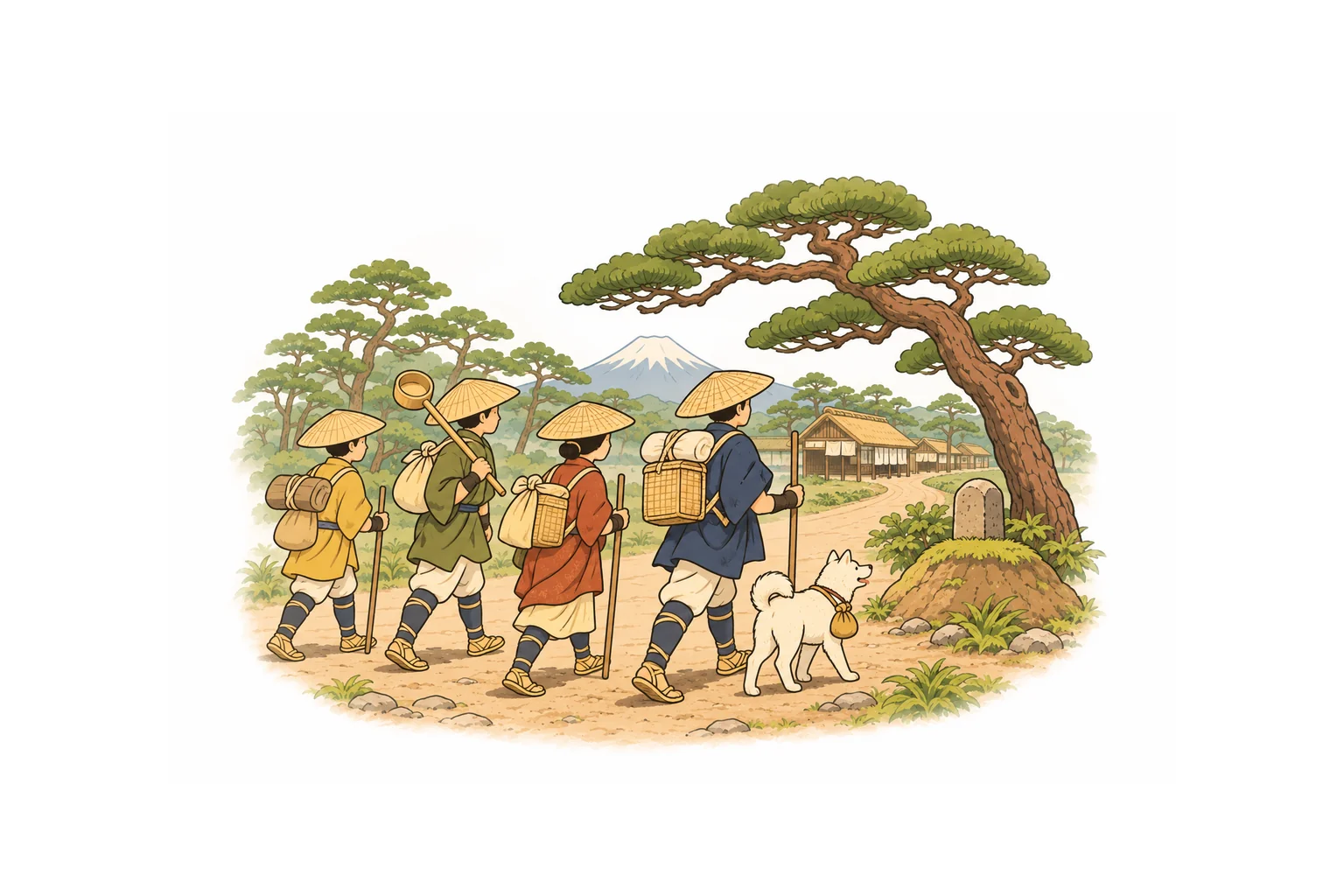
In the spring of 1830, children in Awa province, on the island of Shikoku, began walking away from home. They did not ask their parents. Apprentices slipped out of shops, farmhands left the fields, and young wives set off with babies on their backs. Many carried nothing but a wooden ladle, its handle inked with the name of their home village, which they held out at doorways along the road for rice, coins, or a fresh pair of straw sandals. They were all heading the same way: east, toward the Grand Shrine of Ise on the Kii Peninsula.
The movement spread from Shikoku to the cities around Ōsaka and Kyoto and then outward in both directions along the highways. By the time it burned itself out late that summer, a contemporary count kept at the Miyagawa ferry crossing near the shrine put the number of pilgrims at about 4.28 million, and some estimates run close to five million. Japan’s population was then around thirty million. In a matter of months, roughly one person in seven had made the journey or was on the road.
People called this an okage mairi, a "pilgrimage of thanks" or "pilgrimage by the grace of the gods." The unauthorized departure of servants and children had its own name too: nuke mairi, "slipping-away pilgrimage." Wealthy households along the route set up cauldrons of rice gruel in front of their gates and handed out tea, sandals, and hats. Some merchants paid for whole inns so pilgrims could sleep for free. When a runaway apprentice came home, his master was generally expected to take him back without punishment, provided he could show he had really been to Ise.
The 1830 surge was not a freak. Great waves had swept the country before: in 1705, when about 3.62 million people reportedly reached Ise in under two months, and in 1771, when about 2.08 million came. Even in ordinary years, hundreds of thousands of pilgrims arrived. A saying of the period held that everyone should visit Ise at least once in a lifetime, and for a great many people in the Edo period (1603–1868) this was a real ambition, not a pious phrase.
That is the puzzle. The Tokugawa shogunate, the military government that ruled Japan for over two and a half centuries, was not in the business of encouraging commoners to wander. Peasants were supposed to stay on their land and pay their rice tax. Highways were dotted with checkpoints. Leaving one’s village required papers. Ise lay some 450 kilometers from Edo, the shogun’s capital (modern Tokyo), and much farther from the northeast. A round trip took a month or two on foot and could swallow years of a farm family’s savings. Why did so many people want to go, and why Ise in particular?
02A Shrine That Once Refused Ordinary Worshippers
The irony is that for most of its history, Ise did not want ordinary visitors at all.
The Grand Shrine is really two main shrines about five kilometers apart. The Inner Shrine (Naikū) enshrines Amaterasu, the sun goddess, whom the imperial family claimed as its ancestor. The Outer Shrine (Gekū) enshrines Toyouke, a goddess of food who, according to shrine tradition, was brought to Ise to prepare Amaterasu’s meals. Since the late seventh century, the main sanctuaries have been dismantled and rebuilt on an adjacent plot every twenty years, a ritual called shikinen sengū.
In ancient times, Ise was the emperor’s shrine and nobody else’s. A court rule known as the prohibition on private offerings forbade anyone but the emperor from presenting gifts to Amaterasu. Even the empress and crown prince needed the emperor’s permission. The shrine was supported by households and rice fields assigned to it by the court, and an unmarried imperial princess, the saiō, lived nearby to serve the goddess on the emperor’s behalf. A farmer walking up to pray for a good harvest would have been unthinkable.
That arrangement depended on a strong court, and the court did not stay strong. From the late Heian period onward, warriors and estate holders whittled away the lands that fed the shrine. By the fifteenth century, after the Ōnin War had wrecked Kyoto and the shogunate’s authority alike, there was no money for the twenty-year rebuilding. The Inner Shrine went more than 120 years, from 1462 until 1585, without a renewal, and the Outer Shrine went from 1434 to 1563. The sanctuaries decayed.
The shrine survived by turning to the public. Itinerant Buddhist nuns, most famously Seijun and her successor Shūyō of the Keikō-in temple, traveled from lord to lord collecting donations for the rebuilding. Seijun brought about the Outer Shrine’s renewal in 1563; Oda Nobunaga pledged funds, and after Toyotomi Hideyoshi donated gold and rice, both shrines were renewed in the same year, 1585. A shrine that had once forbidden private gifts was rescued by them. And over the same period, Ise developed the people who would turn it into the most visited sacred site in Japan.
03The Oshi: Ise Comes to Your Door
They were called oshi (in Ise, usually pronounced onshi): lower-ranking shrine priests who performed prayers on behalf of patrons. Over the medieval centuries their role expanded into something that looks, to modern eyes, like a cross between a parish priest, a traveling salesman, and a tour operator.
Each oshi held a territory of patron households, called a danna-ba, scattered across the provinces. A given village might belong to a particular oshi house for generations. Every year, toward the end of the year, the oshi’s agents walked their territory and delivered to each household a paper amulet from the shrine, the jingū taima, to be placed on the family’s kami shelf. With it often came an Ise calendar, printed at the shrine, showing the seasons, the farming year, and lucky and unlucky days. For a farmer this was genuinely useful. Small gifts went along too: dried abalone strips, dried bonito, Ise face powder, fans.
In return, the household gave a modest offering of coins or rice. Repeated every year, this exchange tied millions of families to particular oshi. By the eighteenth century, Ise amulets were reportedly reaching the great majority of households in Japan, and a single large oshi house might count tens of thousands of patron families. The two shrine towns, Uji beside the Inner Shrine and Yamada beside the Outer, held several hundred oshi establishments, over 700 in the early eighteenth century. The grandest were sprawling compounds with dozens of rooms.
The annual visit also served as a recruiting call. Who in the village would be coming to Ise this year? When? A pilgrim who arrived was not a stranger looking for a bed. He went straight to the house of his own oshi, whose men might meet him on the road outside town. He was given a bath and fresh clothes. In the oshi’s private hall he could commission a daidai kagura, the most elaborate form of sacred performance, with shrine maidens dancing to drums and flutes. Then came a banquet: sea bream, abalone, spiny lobster from Ise Bay, more food than a tenant farmer might see in a year, followed by thick new bedding. The next morning a guide led him to the Outer Shrine and then the Inner Shrine, explaining each sacred spot along the way.
None of this was cheap, but it changed the nature of the journey. The pilgrim was visiting someone his family had known all his life, whose amulet hung in his house, whose men knocked on his door every winter. The oshi turned a remote national shrine into a personal relationship.
04The Ise Confraternity: Saving Up Together
Even with an oshi waiting at the other end, the cost was daunting. Lodging, meals, ferry fares, worn-out sandals, the kagura fee, and gifts for the oshi added up to a sum few peasant households could raise on their own.
The answer was the Ise-kō, an Ise confraternity. A kō was a voluntary association, common in Japanese villages for all sorts of purposes. Members of an Ise-kō paid small regular contributions into a common fund. When enough had built up, the group drew lots, and the winners, usually a few people, went to Ise as representatives of the whole association, their expenses covered by the pool. This was called daisan, proxy pilgrimage. The representatives carried everyone’s prayers, obtained amulets for every member household, and brought them home. The next round, another set of names came out of the hat. Over the years, nearly every member could expect a turn.
The kō converted an impossible individual expense into a manageable collective one, and it turned the trip into a village event. Neighbors walked the departing pilgrims to the edge of the village, sometimes all the way to the next one. On their return, the village came out again to meet them at the boundary, and there was a welcome-home party. The travelers handed out amulets, calendars, and souvenirs, and then the stories: how big Kyoto was, what the crowds in Ōsaka looked like, where you got the best view of Mount Fuji. Those stories could circulate for years.
The kō did one more thing. A farmer who announced he wanted to spend two months sightseeing would get nowhere with his lord or village headman. A farmer chosen by lot to pray at Ise on behalf of the entire community was performing a public duty. The confraternity made private wanderlust respectable.
05Checkpoints and Passports
The shogunate did restrict movement, but how it did so matters.
There were about fifty checkpoints, or sekisho, on the main roads. The most famous were Hakone and Arai on the Tōkaidō highway. Their main concern was summed up in a phrase: "guns coming in, women going out." The shogunate wanted to stop weapons from reaching Edo, and it wanted to stop the wives of the regional lords, the daimyo, from leaving it. Daimyo families were required to live in Edo as hostages to their lords’ good behavior; a wife slipping home could signal rebellion. So women were examined closely and needed a special pass from the shogunate describing their appearance, and older women were employed at the checkpoints to inspect them.
Ordinary men had it far easier. A man needed an ōrai tegata, a travel permit issued by his village headman or by the Buddhist temple where his family was registered. It gave his name, home, religious affiliation, and purpose, and asked officials along the way to let him pass. Many such permits included a line asking that, should the bearer die on the road, he be buried according to local custom without troubling to inform his home village. Travel was not without its dangers, and everyone knew it.
The stated purpose was what counted. Travel for trade or family visits could invite questions. Two purposes, however, were almost always accepted: pilgrimage to a temple or shrine, and taking the waters at a hot spring for one’s health. A government that justified itself with Confucian morality could hardly forbid people from honoring the gods, least of all Amaterasu. "Going to Ise" became, in effect, the all-purpose reason to leave home.
Enforcement was also looser in practice than on paper. Many checkpoints waved pilgrims through after a glance at their papers. Women who lacked the right documents often skirted the checkpoints by mountain paths. Evading a checkpoint was a capital crime in law, but local guides made a living leading travelers around them, and officials frequently looked away. In 1855 Kiyokawa Hachirō, later a prominent activist in the movement against the shogunate, took his mother on a long tour from their home in Shōnai, in the far north, to Ise, Kyoto, Shikoku, and Edo. His travel diary records the back roads they took to get her around the checkpoints. A middle-aged provincial woman crossed most of the country this way.
During the okage mairi years, the rules simply collapsed. Hundreds of thousands of people with no papers and no money surged down the roads holding their ladles, and no daimyo wanted to be known as the man who blocked the people from worshipping the sun goddess.
06The Road Itself
For many travelers, the road was as memorable as the destination.
From Edo, the usual route ran west along the Tōkaidō, the "Eastern Sea Road," about 490 kilometers from Nihonbashi bridge in Edo to Sanjō bridge in Kyoto, with fifty-three post towns where travelers could eat, sleep, and hire horses and porters. Pilgrims left the Tōkaidō near Yokkaichi and turned south onto the Ise road. A man walking about forty kilometers a day reached Ise from Edo in twelve or thirteen days.
Under the long Tokugawa peace the roads were well kept. Pine trees shaded long stretches, earthen mounds marked each ri (just under four kilometers), and the larger rivers were crossed by ferry or on the shoulders of hired porters. Post towns had honjin, grand inns for daimyo and their retinues, and many hatago, commoners’ inns that included supper and breakfast. Cheaper still was the kichin-yado, where you brought your own rice and paid only for firewood. Highway robbery was rare enough that a couple, or a group of women, could contemplate a long journey.
A booming publishing industry fed the appetite. In 1802 Jippensha Ikku published the first installment of Tōkaidō-chū Hizakurige, usually rendered as Shank’s Mare, a comic novel about two Edo layabouts, Yajirobē and Kitahachi, who set off for Ise on the pretext of pilgrimage and spend the whole way eating, drinking, chasing women, and getting into scrapes. It was a runaway success, and Ikku kept writing sequels for some twenty years. "Yaji and Kita" are still shorthand in Japan for a pair of bumbling travelers.
Around 1833, Utagawa Hiroshige produced his woodblock series The Fifty-Three Stations of the Tōkaidō, one print for each post town: the procession leaving Nihonbashi at dawn, the steep pass at Hakone, travelers running through a downpour at Shōno, snow at Kanbara. Single prints were cheap, and people who had never left their province could follow the route on paper. Practical guidebooks multiplied too. One from 1810, Ryokō Yōjinshū ("Precautions for Travelers"), advised readers on what to pack, how to tie sandals to avoid blisters, and, on reaching an inn, to get one’s bearings, check how the doors fastened, and note the layout in case of fire or thieves. Illustrated gazetteers of famous places described what to see and eat in every region.
Pilgrims themselves kept diaries, recording distances walked, inns, expenses, and meals, and an enormous number survive. Ordinary farmers and townspeople evidently felt that a journey to Ise was worth writing down day by day.
07After the Prayers: Furuichi
Once the pilgrim had worshipped at both shrines, his religious obligation was done. The trip was not.
On the ridge between the Outer and Inner Shrines lay Furuichi, one of the most famous licensed pleasure quarters in Japan, ranked with Yoshiwara in Edo and Shimabara in Kyoto, with, by common accounts, dozens of brothels, a theater, and at its height perhaps a thousand courtesans and entertainers. Here pilgrims indulged in shōjin otoshi, "dropping the abstinence." Before visiting the shrine one was supposed to purify oneself, avoid meat, and abstain from sex; afterward, those restrictions lifted. The great houses of Furuichi staged the Ise ondo, a lavish group dance, for their guests. In 1796 a local doctor, Magofuku Itsuki, ran amok with a sword at the Aburaya house there, cutting down several people, and about two months later the incident had been turned into a kabuki play, Ise Ondo Koi no Netaba, which is still performed.
The juxtaposition of shrine and brothel struck few people in Edo Japan as strange. Reverence came first, and celebration followed. The oshi’s banquet, the seafood, and the dancing at Furuichi were all part of what people remembered about Ise.
Many then kept going. From Ise it was a short walk to Nara, with its great temples, and on to Kyoto and Ōsaka. For travelers from the northeast or the Kantō plain, Ise often served as the anchor of a grand tour: the Great Buddha at Nara, Kiyomizu-dera and the Gion district in Kyoto, the theaters of Dōtonbori in Ōsaka, perhaps a sea crossing to the Konpira shrine on Shikoku, and a return by way of Zenkō-ji temple in the mountains of Shinano. Such trips could last three months and cover well over a thousand kilometers.
Geography helps explain why Ise outdrew its rivals. Kumano, Mount Fuji, Zenkō-ji, and Konpira all had devoted followers and confraternities of their own. But Ise sat between the populous east and the old capital region, so a pilgrimage there opened onto the greatest cities and sights of the country.
08Waves of Grace
The okage mairi were ordinary Ise pilgrimage pushed to an extreme.
The great waves came at intervals of roughly sixty years: 1650, 1705, 1771, 1830. Some people associated them with the sixty-year cycle of the traditional calendar and expected a wave when the time came. Each began in a similar way, with rumors that Ise amulets had fallen from the sky somewhere, or that someone had received a revelation in a dream, followed by a sudden departure that spread from village to village.
The participants were disproportionately those who could least easily leave in normal times: apprentices, servants, women, and children, bound the rest of the year to masters, parents, and husbands. The okage mairi offered a reason nobody could decently refuse. And those who gave alms along the way believed they shared in the merit, so the generosity was real. A person with nothing could walk to Ise and back on charity.
A favorite story of these years concerns the okage-inu, the pilgrim dogs. A sick householder who could not travel, it was said, would tie a pouch with money and a note to his dog’s collar and send it off. People along the road fed it and pointed the way, and at Ise someone obtained an amulet, hung it on the dog, and sent it home. Accounts and pictures of such dogs appear in sources of the period. How many really made the round trip is anyone’s guess, but the stories show how far the idea of helping a pilgrim had spread.
The last wave took a different shape. In the late summer and autumn of 1867, starting in the provinces east of Nagoya, rumors of falling amulets again set crowds in motion. This time people danced in the streets, cross-dressed, burst into the houses of the rich to demand food and drink, and chanted "Ee ja nai ka" ("Isn’t it fine?" or "Why not?"). The frenzy spread along the Tōkaidō and through the Kyoto-Ōsaka region just as the last shogun, Tokugawa Yoshinobu, was surrendering his authority to the emperor. Some contemporaries suspected anti-shogunate agents of scattering amulets to spread chaos. Most historians see it chiefly as a release of pent-up anxiety in a society coming apart. Either way, the old pattern of the okage mairi was recognizable in it.
09So Why Ise?
Historians have offered three broad explanations.
The first is faith. Amaterasu was the sun and a guardian of rice, and for farming people a prayer for good harvests at her shrine made perfect sense. After the Meiji Restoration of 1868, nationalist writers added the claim that pilgrims had been expressing reverence for the imperial ancestor. That last part is anachronistic: most Edo-period farmers thought of Amaterasu as a bringer of harvests and good fortune, and the emperor himself barely figured in their lives. More to the point, faith alone does not explain why Ise pilgrimage became a mass phenomenon in the Edo period specifically, or why Furuichi did such brisk business.
The second is fun. On this view, pilgrimage was a cover story, the one legal way for people tied to land and status to see the world. Yaji and Kita are the patron saints of this interpretation. There is a lot of truth in it, but it goes too far. People did not spend large sums on kagura, carry amulets home to every family in the village, and keep them on their kami shelves for generations as a pretext.
The third is organization. Without the oshi’s nationwide network, the confraternities that spread the cost, and the oshi houses that fed, lodged, and guided pilgrims at Ise, piety and curiosity would have carried very few farmers that far. Kumano, in the mountains southwest of Ise, had built a similar system of guides in the Middle Ages and drawn pilgrims in such numbers that people spoke of "the ants’ pilgrimage to Kumano." In the Edo period Ise left it far behind, with denser networks and a better location.
My own answer is that the third explanation does the most work, but only in combination with the other two and with the peculiar politics of Tokugawa Japan. Faith supplied legitimacy: in a society that restricted movement, worship of Amaterasu was a reason no authority could comfortably refuse. The oshi and the kō supplied feasibility: they made a long, costly, dangerous journey into something with a host, a budget, and a guide. Peace, good roads, and a print culture full of travel books and landscape prints supplied the conditions and the longing. And the pleasures of the road, from Hiroshige’s views to Ōsaka’s theaters to Furuichi’s dancers, made it the trip of a lifetime.
Edo people did not see these motives as competing. The same traveler who bowed in silence before the Inner Shrine could be watching the Ise ondo that evening, and no one thought him a hypocrite.
The system did not survive the new regime. In 1871 the Meiji government abolished the oshi. From the following year the shrine amulets were distributed centrally by the Jingū administration, and Ise was elevated to the summit of a centralized national Shinto. The great oshi compounds of Uji and Yamada closed one after another. Railways soon reached Ise, so the trip no longer took weeks or required a confraternity’s savings. Pilgrimage to Ise continued, increasingly in the form of school trips and state ceremony. What vanished was the Edo pattern: villages saving together, drawing lots, sending neighbors down the Tōkaidō with everyone’s prayers, and millions of runaways holding out their ladles at strangers’ gates.