
01A Warning Delivered a Year Early
In the summer of 1852, a new Dutch trade chief stepped ashore at Nagasaki carrying a document he had been instructed to hand to the Japanese authorities. It said that the United States was preparing to send a squadron of warships to Japan to demand the opening of its ports. It named the commander, Matthew Perry, and gave details of the ships. Interpreters translated the report into Japanese, and the Nagasaki magistrate sent it on to Edo, the shogun’s capital, where it was read by the senior councillors of the Tokugawa government.
The following July, Perry’s black-hulled steamships anchored at the mouth of Edo Bay. In the popular memory of Japan, and in most Western retellings, this was a thunderclap: a sealed country, ignorant of the world for two centuries, suddenly confronted with steam and cannon. Yet the men at the top of the government had been told it was coming, with the commander named, a full year before.
That small fact opens up a larger question. From the 1630s to the 1850s, the Tokugawa shogunate forbade Japanese people to travel abroad, expelled Catholic missionaries, banned the Portuguese, and allowed only a tiny number of Europeans to live on Japanese soil, penned on an artificial island in Nagasaki harbor. This is the era usually called sakoku, the "closed country." So how did such a country know anything about the outside world? What did it know, and who got to know it? The answer matters, because it explains why Japan, once it was forced open, could transform itself with such startling speed.
02A Door with Four Keyholes
Begin with the word itself. No one in seventeenth-century Japan described the country as "closed." The term sakoku was coined in 1801 by Shizuki Tadao, a Nagasaki interpreter of Dutch, when he translated an essay by the German physician Engelbert Kaempfer, who had lived in Japan in the 1690s. Kaempfer had argued that Japan was wise to shut itself off. Shizuki titled his translation Sakoku-ron, "On Closing the Country." The very name for the policy, in other words, entered Japanese through a European book.
What the shogunate actually built was not a wall but a set of controlled gateways. Historians often speak of the "four mouths." Nagasaki, run directly by the shogunate, received Dutch and Chinese ships. The island domain of Tsushima, between Kyūshū and Korea, handled relations with the Korean kingdom; it kept a trading post in Busan staffed by several hundred Japanese, and Korea sent twelve embassies over the period, most of which traveled all the way to Edo; the last, in 1811, was received on Tsushima. The southern domain of Satsuma had conquered the Ryūkyū kingdom (today’s Okinawa) in 1609, and since Ryūkyū continued to send tribute missions to China, Satsuma gained a side door into the Qing empire. In the far north, the Matsumae domain traded with the Ainu, the indigenous people of Hokkaidō, who in turn traded with peoples of Sakhalin and the lower Amur; Chinese silk brocades reached Japan along this chain and were known as "Ezo brocade."
Each mouth had an assigned gatekeeper, and that is the key to the whole subject. Information kept arriving. What the system controlled was where it landed and who was permitted to hear it.
There is a lively scholarly argument about whether "closed country" is even the right description. Some historians prefer to speak of "maritime prohibitions" and point out that Tokugawa Japan had regular relations with Korea, Ryūkyū, China, and the Netherlands, much like neighboring states that also restricted sea traffic. Others reply that banning one’s own subjects from leaving, under pain of death, and admitting only one European nation, was unusual enough to deserve the stronger word. Both sides have a point. For the question here, the useful distinction is between people and information. The system was very good at keeping foreigners out and Japanese in. It was never designed to keep knowledge out, and it did not.
03Dejima, the Window
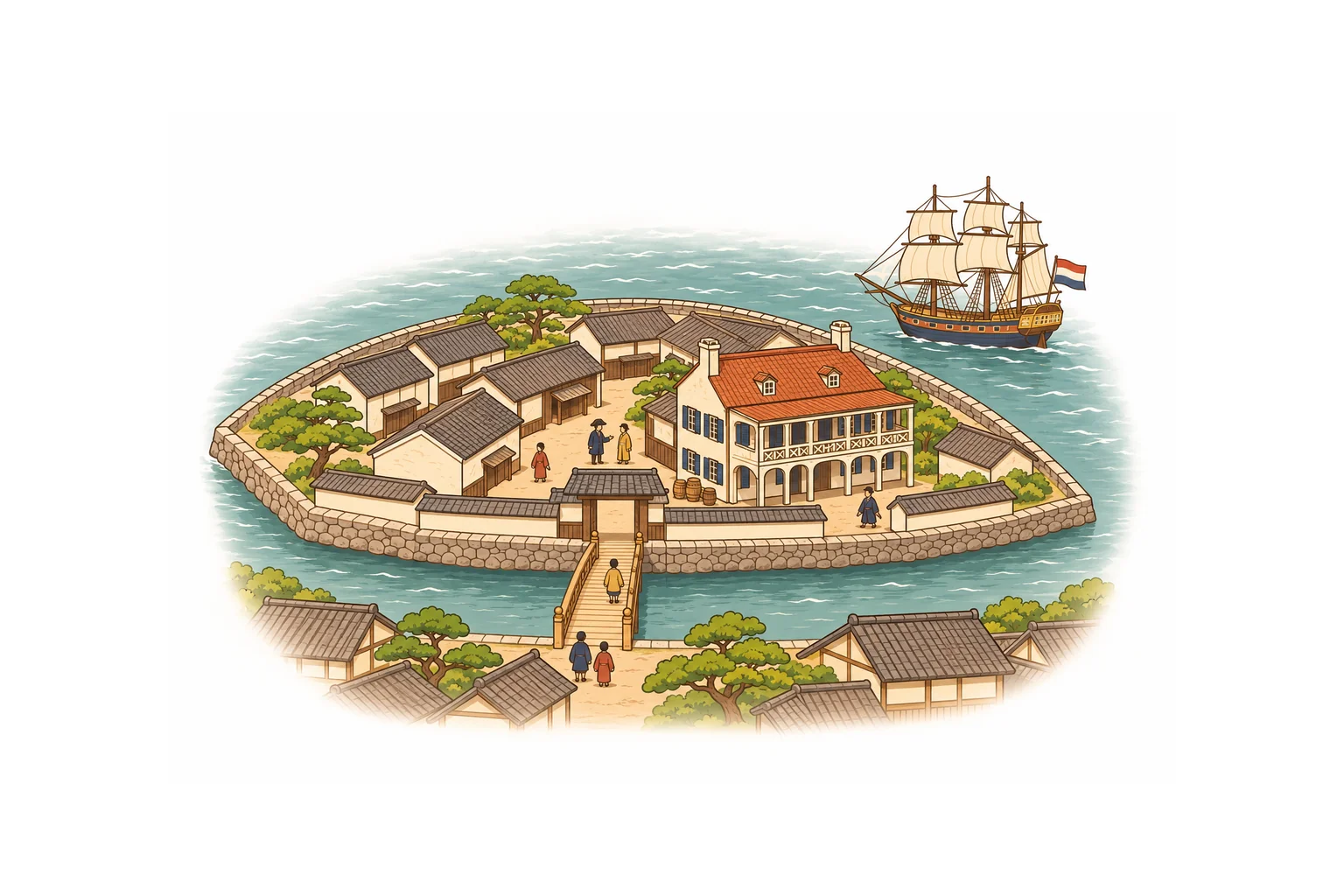
The center of the story is Dejima, a fan-shaped island of landfill in Nagasaki harbor, completed in 1636 and roughly the size of two football fields. It was built to confine Portuguese merchants. After a large rebellion in the Shimabara peninsula in 1637–38, in which many of the rebels were Christians, the shogunate expelled the Portuguese altogether. In 1641 it ordered the Dutch East India Company to move its trading post from the port of Hirado onto the empty island. For more than two hundred years, Dejima was the only place in Japan where Europeans could legally live.
The Dutch got the privilege because they were Protestants who wanted trade and had no interest in converting anyone. They had also proved their usefulness during the Shimabara uprising, when a Dutch ship bombarded the rebels’ castle at the shogunate’s request.
Life on the island was cramped and supervised. A dozen or so Europeans lived there at a time. A guarded bridge connected them to the city, and the only Japanese allowed across were officials, merchants, servants, interpreters, and licensed courtesans. Each summer one or two ships arrived from Batavia (modern Jakarta), bringing Chinese silk, sugar, dyewood, European textiles, and curiosities, and leaving with Japanese copper, camphor, and lacquerware.
Between this enclave and Japanese society stood the tsūji, the hereditary interpreters of Nagasaki. Families such as the Motoki, Yoshio, Narabayashi, and Shizuki passed the job, and the language, from father to son. At first their Dutch was a practical trade jargon, learned by ear. By the eighteenth century some had become serious scholars. Yoshio Kōgyū ran a school of Dutch medicine that drew physicians from across the country. Shizuki Tadao, the man who coined sakoku, read Newton’s followers in Dutch and wrote a treatise explaining gravitation and planetary motion to Japanese readers.
Dejima also had a road to Edo. Periodically the Dutch chief traveled to the capital to pay respects to the shogun, a journey of a month or more each way; it was annual until 1790 and every four years after that. This was the only time Europeans crossed Japan, and daimyo, scholars, and the curious along the route sought them out. Kaempfer, who made the journey in 1691 and 1692, recorded strange audiences with the shogun Tokugawa Tsunayoshi. In 1691 the Dutch were told, from behind screens, to take off their cloaks, walk, compliment each other, dance, jump, play the drunkard, speak broken Japanese, and sing; Kaempfer added a German love song to his dance. The next year they were made to kiss one another like man and wife, to the evident delight of the court ladies. In Edo the delegation lodged at an inn called the Nagasakiya, which became a place of pilgrimage for Japanese students of Western learning.
04The Shogun’s Intelligence Briefings
If Dejima was a window, the person with the best view through it was the shogunate itself.
Whenever a Dutch ship arrived, the trade chief was required to report the news of the world. Interpreters wrote down and translated what he said, and the document went by express courier to Edo. These were the fūsetsugaki, literally "written rumors." They covered European wars and treaties, changes of rulers, events in the colonies of Southeast Asia, and above all any sign that Catholic missionaries or Iberian ships might be heading for Japan. The practice ran, with few breaks, from the 1640s to 1859.
Chinese ships filed reports too, and Chinese ships were far more numerous than Dutch ones. In peak years of the late seventeenth century well over a hundred junks came into Nagasaki, until the shogunate, worried about the outflow of silver and copper, capped them at thirty a year in 1715. Chinese reports were often more urgent to Japan’s interests than Dutch ones. During the long collapse of the Ming dynasty and the Manchu conquest, the news came in junk by junk, and the shogunate’s Confucian scholars, Hayashi Gahō and his son Hayashi Hōkō, compiled it into a huge collection titled Ka’i hentai, roughly "The Civilized Turned Barbarian," a title that tells you what they thought of the Manchus.
These reports were secret, read by senior officials and a handful of others. Their value showed in the 1840s. During the Opium War between Britain and China, the Dutch began supplying special, more detailed reports on the fighting and on British power. The news of China’s defeat shook Edo. In 1842 the shogunate quietly withdrew its 1825 order to fire on any foreign ship approaching the coast, and replaced it with instructions to give stranded ships food and water and send them on their way. Then came the 1852 warning about Perry.
So the government was not ignorant. What it did with its knowledge is another matter. Edo made limited preparations and did not share the warning widely, and most samurai and townspeople really were astonished when the black ships appeared. That gap, between a well-informed center and an uninformed country, is the defining feature of how Tokugawa Japan knew the world.
05Books on Every Ship
People were kept out; books came in by the crate. For most of the period the most important foreign books were Chinese, hundreds of titles a year, from classics and poetry to medical texts and novels. An official in Nagasaki inspected every shipment and banned anything that mentioned Christianity. That caused an unintended loss. In late Ming and early Qing China, Jesuit missionaries had written dozens of works in classical Chinese on astronomy, geography, and mathematics, and because these naturally referred to God, the whole body of Western science in Chinese was barred.
The change came under the eighth shogun, Tokugawa Yoshimune, a practical ruler who wanted a better calendar and cared about agriculture and medicinal plants. In 1720 he relaxed the ban: Chinese translations of Western books could be imported as long as they did not preach Christianity. He also ordered two scholars, Aoki Kon’yō and Noro Genjō, to study Dutch. Aoki is better remembered as the "Sweet Potato Master" who promoted the crop as famine insurance. Neither man got far with the language, but for the first time the government itself had told people to learn a European tongue.
Before Yoshimune, one Japanese had glimpsed Europe through an extraordinary accident. In 1708 an Italian priest, Giovanni Battista Sidotti, landed alone on the island of Yakushima, south of Kyūshū, dressed as a samurai, hoping to revive the forbidden mission. He was caught at once and brought to Edo, where he was questioned by Arai Hakuseki, the leading scholar-adviser of the day. Hakuseki found him learned and used the interrogations to quiz him at length on world geography, the nations of Europe, and their customs. He then wrote two books from the material, one a record of their conversations and the other a world geography. His verdict proved durable: Westerners excelled at concrete knowledge such as astronomy and geography, but their religion was nonsense. Sidotti died a few years later in confinement in Edo. Hakuseki’s split judgment, admiring Western technique while dismissing Western ideas, would shape Japanese attitudes for the next century and a half.
06The Morning at Kotsukappara
The moment Western learning became a movement can be dated precisely. On a spring day in 1771, three physicians went to Kotsukappara, an execution ground on the northern edge of Edo, to watch the dissection of an executed woman. They were Sugita Genpaku, physician to the Obama domain; Maeno Ryōtaku, an older doctor from the Nakatsu domain; and their colleague Nakagawa Jun’an. Physicians did not cut bodies themselves. The work fell to members of an outcaste group, and that day the man assigned was ill, so his ninety-year-old grandfather took his place, naming organs as he went.
Sugita and Maeno had each brought a copy of the same book, a Dutch translation of an anatomical atlas by the German physician Johann Adam Kulmus. Neither could read the text. But they could compare the plates with what lay in front of them, and lungs, heart, liver, and intestines matched the Dutch drawings exactly. They matched nothing in the traditional Chinese charts of the body that Japanese doctors had relied on for centuries. Walking home, the three men agreed they had been practicing medicine without knowing what a human body looked like. The next day they met at Maeno’s house and started translating.
They had no proper dictionary. Maeno knew a few hundred words; Sugita was starting from the alphabet. Decades later, in his memoir Rangaku kotohajime (The Beginnings of Dutch Learning), Sugita said that at first a single line could take a whole day. He told a story about the word verheffend, used in the description of the nose. Their only clue was a note saying that the word described the swelling where a branch had been cut off, or a pile of swept-up dust. After long thought they understood: raised, protruding. The nose was the raised part of the face. Sugita compared his joy to receiving a priceless jewel. He was an old man writing about his youth, and the story may be polished, but the labor was real.
Many concepts had no name in Japanese or Chinese, so they invented words. For the fine cords that carry sensation through the body, they combined characters meaning "spirit" and "channel" to create shinkei, "nerve." The word later traveled to China, where it is still the standard term. The translation, Kaitai shinsho (New Book of Anatomy), appeared in 1774, with illustrations copied by the painter Odano Naotake. Sugita’s name was on it. Maeno, who had done more of the translating than anyone, declined to be credited, either because he thought the work imperfect or because he disliked attention; Sugita later wrote that without him nothing would have been accomplished.
What followed was rangaku, "Dutch learning," a field with teachers, schools, and a sense of itself. Sugita’s student Ōtsuki Gentaku wrote a primer of the Dutch language and opened a school in Edo. On the first day of 1795 by the European calendar, he invited friends to a Western-style "Dutch New Year" dinner, which became an annual gathering. His student Inamura Sanpaku spent years producing the first Dutch-Japanese dictionary. Others pushed in every direction. The inventor and showman Hiraga Gennai repaired a Dutch electrostatic generator and gave shocks to amazed daimyo. The painter Shiba Kōkan taught himself copperplate etching and promoted the idea that the earth goes round the sun, which the interpreter Motoki Ryōei had introduced in translation. In 1811 the shogunate set up its own translation bureau inside the office of astronomy, headed by the shogunate astronomer Takahashi Kageyasu. Dutch learning had gone from a private enthusiasm of a few doctors to something the government relied on.
07Measuring the Country on Foot
By the late eighteenth century the world was no longer just sending books. It was knocking, and from the north. Russia had expanded across Siberia to Kamchatka and the Kurile Islands, and in 1792 the envoy Adam Laxman sailed into Nemuro in eastern Hokkaidō to ask for trade. He brought back a Japanese castaway, the ship captain Daikokuya Kōdayū, whose vessel had been wrecked in the Aleutians a decade earlier. Kōdayū had crossed Siberia, reached St. Petersburg, and obtained permission from Catherine the Great to go home. In Edo he was questioned before the shogun, and the physician Katsuragawa Hoshū turned his account into a detailed book on Russia.
In the same year, the shogunate punished Hayashi Shihei of Sendai for publishing a treatise arguing that Japan, an island nation, was exposed on every side and needed coastal defenses. The sea, he wrote, ran without a break from Edo’s Nihonbashi bridge to the Netherlands. The authorities confiscated his printing blocks and confined him to his home for discussing national defense without authority. He took the pen name "Six Nothings": no parents, no wife, no children, no printing blocks, no money, and no wish to die.
The northern threat produced the most remarkable achievement of the age. Inō Tadataka was a successful merchant from Sawara, east of Edo. At forty-nine, in 1794, he handed the business to his eldest son; the next year he moved to Edo and became the student of Takahashi Yoshitoki, the shogunate’s astronomer, who was nineteen years his junior. Inō wanted to know the length of one degree of latitude, from which the size of the earth could be calculated, and that required measuring a long north-south distance. In 1800, at fifty-five, he won permission to survey the coast of Hokkaidō, which the government badly needed mapped. Over the next sixteen years he made ten survey expeditions from Hokkaidō to Kyūshū, pacing and measuring the coastline by day and fixing latitude by the stars at night. The total distance he walked is often put at roughly the circumference of the earth. His value for a degree turned out to agree closely with the figure in a French astronomical work by Jérôme Lalande that reached Japan in Dutch, to his teacher’s delight.
Inō died in 1818 with the map unfinished. His team kept his death quiet and completed the work, presenting the full set of coastal maps to the shogunate in 1821. Their accuracy later startled European navigators. It was a European method, carried out entirely by Japanese surveyors on Japanese feet. Around the same time, the explorer Mamiya Rinzō confirmed that Sakhalin was an island, separated from the mainland by a narrow strait.
08Siebold and the Forbidden Map
Inō’s maps soon became evidence in a criminal case. In 1823 a young German doctor, Philipp Franz von Siebold, arrived at Dejima as physician to the Dutch post. A popular story says that when the interpreters noticed his odd Dutch accent, he claimed to be a "mountain Dutchman." The Netherlands has no mountains, and the tale is probably embroidered, but it says something about how closely the gatekeepers listened.
Siebold was a gifted doctor and an eager teacher, and the authorities made an exception for him: he was allowed to run a school at Narutaki, outside Nagasaki, where he treated patients and taught Western medicine and natural history to students from across Japan, among them Takano Chōei and Itō Genboku. In return he had his students write essays in Dutch on Japanese plants, animals, customs, and history. Each side of the window was studying the other as hard as it could.
In 1826 Siebold joined the trip to Edo and met Takahashi Kageyasu, head of the translation bureau and son of Inō’s teacher. Kageyasu wanted Siebold’s copy of the Russian explorer Krusenstern’s voyage and his up-to-date maps of the world. Siebold wanted a map of Japan. They traded, and Kageyasu handed over a copy of a map based on Inō’s surveys. Giving maps of Japan to foreigners was strictly forbidden.
In 1828, as Siebold prepared to leave, the forbidden items in his baggage came to light. The traditional account holds that a typhoon drove his ship aground and the cargo was searched. But researchers checking the Dutch chief’s diary found that Siebold’s baggage had not yet been loaded when the ship grounded, and the stronger view now is that officials in Edo found their way to Kageyasu first by other routes. Either way, Kageyasu was arrested and died in prison in 1829. His body was preserved in salt until the verdict came down, and then the corpse was sentenced to beheading. Siebold was interrogated for months and expelled for life, and many of his interpreters and students were punished. He left behind a daughter, Kusumoto Ine, born to a Nagasaki woman named Kusumoto Taki; his students looked after her and trained her in medicine, and she became one of Japan’s first women doctors of Western medicine. Back in Europe, Siebold published a monumental multi-volume work, Nippon, and named a hydrangea after Taki. When Japan opened three decades later, he came back.
09The Price of Saying Too Much
The Siebold affair showed that knowledge had boundaries. A decade later another case drew them even more sharply.
In 1837 an American merchant ship, the Morrison, sailed to the entrance of Edo Bay carrying several shipwrecked Japanese sailors, hoping to use their return to open contact. Under the 1825 order, the shore batteries opened fire and the ship withdrew. When the story spread, a circle of scholars interested in the West, mockingly called the "barbarian society," reacted with alarm. Watanabe Kazan, a senior retainer of the small Tahara domain and one of the finest painters of his time, and the physician Takano Chōei, Siebold’s former student, each wrote essays arguing that Britain and America were powerful and that firing on their ships invited disaster. The essays circulated only privately.
In 1839 the shogunate arrested them for criticizing state policy. Watanabe was confined in Tahara and, two years later, took his own life to spare his lord embarrassment. Takano was sentenced to life imprisonment. When the prison caught fire in 1844 he escaped, burned his face with acid to avoid recognition, and lived as a fugitive, translating Western military books under false names, until officers cornered him in Edo in 1850 and he died.
Within a few years the Opium War had proved them right, and the government itself softened the firing order. The purge was not aimed at Dutch learning as such. Edo still needed translators of medicine, gunnery, and astronomy. It was aimed at scholars who used foreign knowledge to judge their own rulers. Technique could be borrowed; the right to criticize could not. That was the line the Tokugawa system drew, and Arai Hakuseki had sketched it a century earlier.
By then, though, the number of students was too large to stop. In 1838 the physician Ogata Kōan opened a school called the Tekijuku in Ōsaka, and over the next quarter century well over a thousand students passed through it. They fought over the school’s single copy of a Dutch dictionary, kept in a special room where, the story goes, a lamp burned all night. Its graduates included Ōmura Masujirō, later the architect of Japan’s modern army; Hashimoto Sanai, a reformer in the Echizen domain; and Fukuzawa Yukichi.
10Fukuzawa in Yokohama
Fukuzawa came from the same Nakatsu domain as Maeno Ryōtaku. At the Tekijuku he became head student and considered his Dutch excellent. In 1859, shortly after the treaty port of Yokohama opened, he went to see the foreigners. He could not read the shop signs or understand a word anyone said. In his autobiography he described his dismay: the language he had worked so hard to master was not the language the world was now using. That was English. He started over the next day.
The scene captures both the success and the limit of how Tokugawa Japan learned. The country knew a great deal. Its government read regular foreign news, heard about the Opium War as it happened, and was warned about Perry. Its scholars translated anatomy, astronomy, physics, chemistry, and gunnery, and invented a technical vocabulary that China would later borrow. Its surveyors mapped the coast with Western methods and an accuracy that impressed Europeans. But nearly everything came through a single filter, the Dutch, who had been the great maritime power of the seventeenth century and were a minor one by the nineteenth. The world outside had changed, while Japan was still looking through the same window.
11What Came Through the Narrow Window
So how did closed Japan learn about the world? Through Nagasaki above all: Dutch and Chinese ships brought goods, books, and reports, and the Dutch on Dejima were living sources. Through Tsushima, Satsuma, and Matsumae, which brought news of Korea, Ryūkyū, China, and the north. And through accidents, a stray missionary, a returned castaway. Of all these channels, books mattered most. People could be kept out; books came in by the shipload and were turned, word by word, into Japanese.
The knowledge that resulted had a distinctive shape. It was filtered, because the government decided which books came in and who could read the foreign news. It was concentrated, because the people who truly understood the outside world were a few senior officials, the Nagasaki interpreters, and some hundreds of Dutch scholars, while most Japanese knew it only by rumor. It was practical, favoring medicine, astronomy, geography, and gunnery while suppressing political and religious ideas, a pattern that ran from Arai Hakuseki to the late-Tokugawa slogan of Sakuma Shōzan, "Eastern ethics, Western science." And it was dangerous, as Hayashi Shihei, Takahashi Kageyasu, Watanabe Kazan, and Takano Chōei learned.
The verdict, then, is fairly clear. Tokugawa Japan closed itself to people, not to knowledge. What limited its understanding of the world was not a shortage of information but rules about who was allowed to know and what they were allowed to say about it. And because the window was so narrow, those who stood at it looked with unusual intensity: a doctor holding a book he could not read beside a corpse at an execution ground, a retired merchant taking up astronomy at fifty, students fighting over a dictionary through the night. When the door was finally forced open in 1853, Japan did not start from nothing. It already had a cadre of people who could read foreign languages, understood Western science, and had followed the world’s affairs for decades. The speed of Meiji Japan’s transformation owed a great deal to those two centuries at the window.