
01A Woman at the Altar
On March 17, 1865, a little after noon, a French missionary named Bernard Petitjean was working inside a newly finished church on a hillside above Nagasaki harbor. The building, which the Japanese called Ōura Tenshudō, Ōura Church, had been dedicated only a few weeks earlier. Officially it existed to serve the small community of foreign merchants and diplomats who had settled in Nagasaki after Japan signed trade treaties with the Western powers. Christianity was still illegal for Japanese subjects, and had been for two and a half centuries. Local people called the building "the French temple" and came to gawk at its Gothic windows.
That afternoon a group of about fifteen men and women, farmers by the look of them, lingered at the door. Petitjean let them in and knelt to pray. A middle-aged woman came up beside him and said something quietly. In the letter he wrote to his superiors afterward, Petitjean rendered her words as: "The hearts of all of us here are the same as yours." Then she asked, "Where is the image of Santa Maria?"
He led them to a side altar where a statue of the Virgin held the infant Jesus. The visitors looked at it and one of them said: yes, it is Santa Maria, see, she holds her son. They told him they came from Urakami, a farming village just north of the city, and that most of the households there believed as they did. In that visit and in the weeks that followed, believers put a few pointed questions to him. Did he have a wife and children? Was he sent by the great chief in Rome?
The woman’s name was Sugimoto Yuri; her baptismal name was Isabelina. The visitors’ questions were not idle. They were a test, handed down from her ancestors. A true priest would be celibate and would answer to the pope. Petitjean passed, and in doing so he became the first Catholic priest in more than two hundred years to be recognized by Japanese Christians as one of their own.
News of the "discovery of the Christians" reached Europe within months, and Pope Pius IX was said to have called it a miracle of the Orient. It is easy to see why. Catholicism is a religion that runs on priests. Only a priest can say Mass, hear confession, or perform most of the sacraments. In Japan, every priest had been killed, expelled, or forced to renounce the faith by the 1640s. Every Japanese household was required, every year, to prove that it was not Christian. Being found out meant torture and death, often for one’s family and neighbors as well. Under those conditions, how did a foreign faith survive for seven generations in a handful of villages? And what exactly had survived?
02A Promising Mission
Christianity reached Japan in August 1549, when the Spanish Jesuit Francis Xavier came ashore at Kagoshima, at the southern tip of Kyūshū. The Jesuits were a young Catholic order, famous for discipline, learning, and missions to the far corners of the world. Xavier had been guided to Japan by a Japanese man called Anjirō, who had fled abroad, possibly after killing someone, and been baptized in Malacca.
Xavier stayed a little over two years. He went to Kyoto hoping to meet the emperor, found a city wrecked by civil war and a monarch with no real power, and left disappointed. He had better luck in Yamaguchi, in western Honshū, where he put on fine clothes, presented letters from the Portuguese authorities in India and the bishop of Goa, along with a clock and other European curiosities, to the local warlord, Ōuchi Yoshitaka, and was given permission to preach. The lesson stuck with the Jesuits who followed him: in Japan, which was then split among dozens of rival lords known as daimyo, you began with whoever held power.
What made those lords listen was trade. Portuguese ships sailing from Macao carried Chinese silk to Japan and Japanese silver back out, at enormous profit. Every daimyo on the coast of Kyūshū wanted the great ships in his harbor, and the Portuguese captains tended to go where the missionaries told them. Faith and commerce traveled together.
In 1563 Ōmura Sumitada, lord of a domain near what is now Nagasaki, became the first daimyo to be baptized. He tore down Buddhist temples, had his subjects baptized en masse, and in 1580 handed the port of Nagasaki itself over to the Jesuits. Other lords followed: Ōtomo Sōrin in Bungo, Arima Harunobu on the Shimabara Peninsula, and in central Japan the soldier Takayama Ukon, whose devotion was so complete that he later gave up his lands rather than his faith. Oda Nobunaga, the warlord who began the reunification of Japan, despised the armed Buddhist temples and was happy to let the Jesuits build in Kyoto.
By around 1600 there were perhaps 300,000 Japanese Catholics, possibly more, out of a population of somewhere over ten million. The proportion was small, but the believers were heavily concentrated in northwestern Kyūshū, around Nagasaki, Ōmura, Arima, Hirado, and the Amakusa islands. That geography would matter later.
03From Tolerance to Terror
The mood changed with Toyotomi Hideyoshi, Nobunaga’s successor. In 1587, fresh from conquering Kyūshū, he discovered that Nagasaki was effectively a Jesuit possession, that Christian lords were forcing conversions and destroying temples, and that Portuguese traders were buying Japanese people as slaves. He ordered all missionaries out of the country within twenty days. Behind the specific complaints lay a larger fear: here was an organization whose members might owe a higher loyalty to someone other than himself, backed by foreigners with cannon-armed ships.
The order was loosely enforced, and the trade went on. Then, in 1596, a Spanish galleon, the San Felipe, washed up on the coast of Shikoku. According to a story that has never been confirmed, its pilot boasted to Japanese officials that the king of Spain conquered countries by sending missionaries first and soldiers after. Whatever was said, Hideyoshi struck. In February 1597, twenty-six Christians, foreign Franciscans and Japanese laymen among them, were crucified on a hill at Nishizaka in Nagasaki. The youngest, a boy called Louis Ibaraki, was twelve.
Tokugawa Ieyasu, who took power after Hideyoshi’s death, at first tolerated the missionaries for the sake of trade. But by the 1610s the Dutch and English had arrived. They were Protestants who wanted only to trade and who were happy to warn the shogun about Catholic ambitions. Ieyasu no longer needed the priests. A bribery scandal in 1612 involving two Christians, one of them the daimyo Arima Harunobu, gave him the occasion. A nationwide ban followed in 1614, and that autumn more than a hundred missionaries and leading Japanese Christians, Takayama Ukon among them, were shipped off to Macao and Manila. Takayama died in Manila within weeks of arriving.
Dozens of priests stayed behind in hiding or slipped back in, and the next two decades brought the worst of the killing. In 1622, fifty-five people were executed at Nishizaka in a single day, priests alongside the families who had sheltered them, children included. The authorities soon noticed that public martyrdom made saints, so they shifted from killing to breaking. Prisoners were scalded with water from the volcanic springs of Mount Unzen. The most notorious method was the pit: the victim was hung upside down over a hole filled with filth, a small cut made behind the ear so that blood dripped slowly, and left there until he gave the signal of renunciation.
In 1633 the Portuguese Jesuit Cristóvão Ferreira, one of the senior missionaries in Japan, gave the signal after five hours in the pit. He took a Japanese name, Sawano Chūan, married, and spent the rest of his life helping the authorities interrogate captured priests. His story inspired Endō Shūsaku’s novel Silence. By the mid-1640s the last priests at large in Japan had been caught. A lone Italian, Giovanni Battista Sidotti, landed on the island of Yakushima in 1708, was arrested almost at once, and died in custody in Edo without ever meeting a Japanese believer.
04Shimabara
One more event shaped everything that followed. In late 1637 the peasants of the Shimabara Peninsula and the Amakusa islands, both former Christian domains, rose up. The new lords there had squeezed them mercilessly. Matsukura Shigemasa of Shimabara and his son Katsuie set taxes far beyond what the land could yield, and those who could not pay were reportedly wrapped in straw raincoats and set alight, a punishment locals grimly called the "straw-coat dance." Famine and the persecution of Christians did the rest.
The rebels rallied around a teenager known as Amakusa Shirō, about sixteen years old, the son of a former retainer of the executed Christian daimyo Konishi Yukinaga. Legends gathered around him: that a dove laid an egg in his hand containing a scripture, that he could walk on water. Whatever the truth, the rebels were waiting for a savior, and they fought under banners bearing crosses and the names of Jesus and Mary.
Some twenty or thirty thousand people, women and children among them, held the abandoned Hara Castle at the tip of the peninsula for months against a shogunal army that grew to over a hundred thousand. The shogunate even asked the Dutch to bombard the castle from a ship, and the Dutch obliged. In April 1638 the castle fell and nearly everyone inside was killed. Matsukura Katsuie was later beheaded; disgraced daimyo were normally allowed to commit seppuku, and he is generally said to be the only one in the Tokugawa era executed this way.
The uprising had as much to do with taxes and hunger as with faith, but the shogunate treated it as a Christian rebellion. In 1639 Portuguese ships were banned from Japan altogether, leaving only the Dutch and Chinese to trade at Nagasaki under tight control. Christianity was now officially synonymous with treason and foreign invasion. For any believers who remained, Shimabara taught one plain lesson: open resistance meant annihilation. The communities that survived were precisely those that had not risen and had not been exposed.
05The Machinery of Proof
After Shimabara the Tokugawa shogunate built one of the most thorough systems of religious surveillance the premodern world ever saw.
Every Japanese person was required to register as a parishioner of a Buddhist temple, and the temple certified that he or she was not Christian. Each village compiled an annual register listing every household, every person’s age, and the temple to which they belonged. These registers became, in effect, the census of Tokugawa Japan. Moving house, marrying, or traveling required a temple’s paperwork. When someone died, a Buddhist priest had to inspect the body and conduct the funeral, to make sure no Christian rite was involved. Households were grouped into five-family units that were held collectively responsible for one another’s crimes. Notice boards in every town offered large rewards in silver for information about priests, catechists, and ordinary believers.
Then there was the fumie, the "stepping picture." Officials laid down a small plaque bearing an image of Christ on the cross or the Virgin and Child, and each person in turn had to step on it. Those who hesitated, trembled, or flushed were taken aside for questioning. The practice began in Nagasaki around the late 1620s, and the Nagasaki magistrate later had a set of brass plaques cast and lent them out to neighboring domains. In Nagasaki and parts of Kyūshū it became an annual New Year ritual. Whole families filed past; mothers pressed the feet of their babies to the metal. It continued until the late 1850s.
The system worked. Most of Japan’s Christians gave up the faith, some sincerely and some simply by forgetting it within a generation or two. In central Japan, in the northeast, and across most of Kyūshū, Christianity vanished. When hidden groups were discovered, the consequences were brutal: in the Ōmura domain in 1657, more than six hundred people were arrested and around four hundred executed.
But the system had a seam. It checked behavior: which temple you belonged to, whether you stepped on the plaque, who buried your dead. It could not see what you said behind a closed door at night. The hidden Christians lived inside that seam.
06A Church Without Clergy
The Jesuits had seen the end coming. From the 1590s onward they had organized lay confraternities, small brotherhoods led by respected laymen who gathered the faithful for prayer, cared for the sick, and urged backsliders to return. They also deliberately taught believers two things that Catholic doctrine allowed without a priest.
The first was baptism. In an emergency, the Church holds, any person may baptize, provided they use water and the correct words. That meant each new generation could still be brought into the faith.
The second was perfect contrition. Ordinarily a Catholic needs a priest’s absolution to be forgiven for serious sin, but the Church also teaches that sorrow arising from pure love of God, when no confessor can be found, brings forgiveness on its own. In 1603 the Jesuit press in Nagasaki printed a short Japanese guide to making such an act of contrition. Copied by hand and memorized, it became one of the most precious texts the hidden Christians owned. Every year, after stepping on the fumie, they went home and recited it, asking God to forgive their feet.
Around these two rites the surviving villages organized themselves. Names and details varied from place to place, but on the Sotome coast and in Urakami, near Nagasaki, the pattern was roughly this. At the top was the chōkata, the keeper of the calendar, who worked out each year’s dates for Easter, Christmas, the fast days, and the feasts of saints, and told everyone which days to abstain from meat or heavy work. Below him was the mizukata, the "water official," who baptized newborns and had to know the formula word-perfect. Messengers carried word between households. These posts often passed down within particular families.
The calendar was the backbone. In Sotome the believers kept a calendar attributed to a Japanese catechist named Bastian. According to local tradition he was the disciple of a foreign priest, carried on alone after his teacher left, and was captured in the mid-seventeenth century; tradition says he was tortured in prison for more than three years and executed in 1659. Before he died, the story goes, he left four prophecies: that the believers would be his children for seven generations; that after that, confessors would come on black ships and they would be able to confess every week; that they would be able to sing their prayers aloud in the streets; and that when they met an unbeliever on the road, the unbeliever would give way. No one can say whether Bastian existed. But his prophecy gave the hidden Christians of Sotome and Urakami a horizon. By 1865, seven generations had more or less passed, and the questions put to Petitjean were a way of checking whether the confessor on the black ship had finally arrived.
The prayers, called orasho from the Latin oratio, were Japanese versions of the Our Father, the Hail Mary, the Creed, and the act of contrition, studded with Latin and Portuguese words. Passed from mouth to ear for two centuries, the foreign words drifted until those reciting them no longer knew what they meant, only that not a syllable could be changed. They were whispered, or in some places said silently.
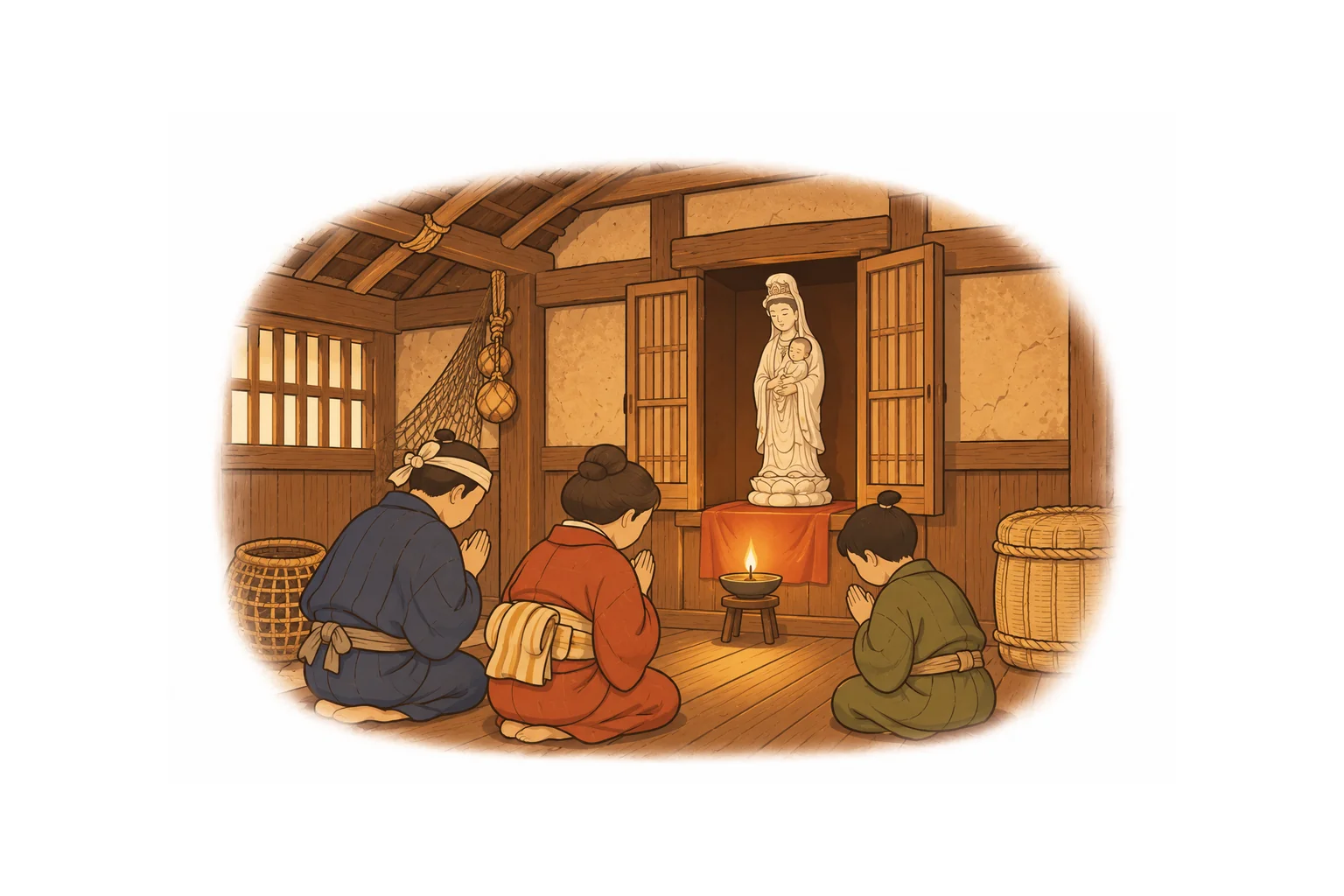
Families also kept sacred objects: crucifixes, rosaries, medals, painted images, many of them worn to fragments, wrapped in cloth and hidden in storerooms or behind the panels of Buddhist altars. And they learned to disguise their faith. The best-known example is the "Maria Kannon." Kannon, the Buddhist bodhisattva of mercy, was often shown in white Chinese porcelain holding a child, as a giver of children to the childless. To a magistrate’s inspector, that was an ordinary Buddhist statue. To the family kneeling in front of it, it was the Virgin and the infant Christ.
07What the Faith Became
A religion transmitted for two hundred years without scripture, clergy, or any outside authority does not stay the same, and the hidden Christians’ did not.
In the Sotome and Gotō areas, believers copied a manuscript known as Tenchi Hajimari no Koto, "The Beginning of Heaven and Earth." It tells the biblical story from creation to the crucifixion, and many familiar episodes are there: Adam and Eve, the Flood, the birth of Jesus, the three kings, Herod’s massacre of the innocents. But the whole has been recast as Japanese folk tale. Mary is a beautiful maiden from Luzon who refuses a king’s proposal, summons snow in midsummer as a sign, and is taken up to heaven. Jesus goes to his death partly to atone for the infants Herod killed on his account. Doctrinally it is far from Rome. Emotionally it says something the villagers clearly felt: guilt, repayment, sacrifice, and a merciful mother.
On Ikitsuki, a small island off Hirado, families kept their inherited images and holy objects in a storeroom closet and called them nando-gami, "closet gods." Over the generations the pictures were repainted again and again, and the saints gradually acquired Japanese faces and clothing. Holy water had to be drawn from a tiny islet where martyrs had died, and the person fetching it, it is said, could not speak on the way. On Ikitsuki the center of gravity shifted toward guarding these objects and honoring the ancestors who had handed them down.
There is a real debate about how to read these changes. One view holds that over two centuries the hidden Christians’ faith merged so thoroughly with Buddhism, Shinto, and ancestor veneration that it became a Japanese folk religion wearing Christian clothing. The other holds that the core held: they baptized their children, kept the Church’s calendar, prayed for forgiveness, believed in judgment and mercy, and waited for the priests to return. The speed with which many of them embraced orthodox Catholic teaching after 1865 suggests the frame was still there.
I think both views are right, but about different communities. In Urakami and Sotome, the calendar and the prophecy kept people pointed outward, toward a Church they expected to rejoin, which is why they recognized Petitjean so quickly. On Ikitsuki and in parts of the Gotō islands, faith turned inward, toward preserving exactly what the ancestors had left. For them, doing what one’s grandparents did was itself the point.
One more factor is often overlooked: the authorities frequently preferred not to find them. Discoveries still happened. In 1790 someone in Urakami denounced his neighbors, the first of four Urakami "collapses," as such exposures were called. In 1805, in Amakusa, officials uncovered more than five thousand believers at once. This time there was no massacre. The people were classified as merely "misguided," made to express repentance, and sent home. The reason is not hard to guess. Admitting to thousands of Christians would have shamed the local lord and his officials for their negligence, and executing thousands of tax-paying farmers helped nobody. The Urakami cases, too, were mostly closed with vague verdicts about a "strange sect" rather than Christianity.
That tacit bargain gave the believers room to breathe. They stayed registered at Buddhist temples and let Buddhist priests conduct their funerals; once the priest had gone, they said their own prayers over the body, in some places a rite meant to cancel the effect of the sutras. They stepped on the plaque and went home to recite their contrition.
The faith also traveled with people. In the late eighteenth century Ōmura’s Sotome coast had too many people and not enough land, while the Gotō islands to the west needed settlers. The two domains agreed to move about three thousand people. Many of the migrants were hidden Christians, and they carved out new villages on steep slopes and remote coves that nobody else wanted. The many churches that dot the Gotō islands today trace back to that migration.
08The Long Journey
The 1865 discovery was not a happy ending. Over the following months, believers from Urakami, Sotome, and Gotō contacted Petitjean in secret, heard sermons for the first time, and learned what their inherited prayers actually meant. In 1867 some Urakami families, emboldened, refused to have Buddhist priests bury their dead and openly declared themselves Christian. The Nagasaki magistrate arrested them in large numbers.
The shogunate fell the next year, but the new Meiji government kept the ban. In 1868 it posted fresh notices across the country forbidding the "evil sect," and it was busy building a state centered on Shinto and the emperor. Then it made an extraordinary decision: the entire Christian population of Urakami, around 3,400 people, was deported in batches to twenty domains scattered from Kanazawa to Kagoshima, to be pressured into renouncing their faith.
The believers called their exile the tabi, "the journey." They were packed into cold huts, underfed, and set to hard labor; some were plunged into icy water or confined in tiny cages. In Tsuwano, in western Honshū, a man named Yasutarō was kept in an open cage through the winter; according to the story the believers later told, he said before he died that a beautiful lady in blue came to comfort him each night. By the time the exile ended, more than six hundred had died far from home, and some had given in.
What ended it was diplomacy. Between 1871 and 1873 a large Japanese mission led by Iwakura Tomomi toured the United States and Europe, hoping to revise Japan’s unequal treaties. Everywhere they went, newspapers and officials asked about the persecuted Christians of Urakami. Religious freedom was a mark of civilization in Western eyes, and a country that jailed Christians would not be treated as an equal. In 1873 the government quietly took down the notice boards banning Christianity. The exiles returned to find their houses collapsed and fields overgrown. They rebuilt, and over the following decades raised Urakami Cathedral, completed in 1925 after thirty years of work and billed as the largest church in East Asia. On August 9, 1945, the atomic bomb dropped on Nagasaki exploded about half a kilometer away and destroyed it.
Not all of the hidden Christians came back to the Church. Most did, but a substantial minority chose to keep the faith the way their ancestors had kept it. Scholars now usually distinguish between senpuku kirishitan, the "concealed Christians" of the ban era, and kakure kirishitan, the "hidden Christians" who stayed apart from the Church after 1873. On Ikitsuki, in Gotō, and in Sotome, such groups survived well into the late twentieth century, reciting prayers nobody understood and tending their closet gods. Their reason for staying out was simple. The priests wanted them to give up their sacred objects and learn new prayers, and to do so would betray the ancestors who had suffered to preserve them. Most of these groups have since dissolved as young people moved to the cities; in some places the last calendar keepers handed their treasures to museums.
09Why They Endured
So how did the hidden Christians keep their faith for two hundred and fifty years without a single priest?
"Strong faith" is the usual answer, and it is not wrong, but it is not enough. There is no reason to think believers in Kyoto or northeastern Japan were less devout than those in Urakami, yet they disappeared. Faith needed conditions to survive.
The first was the toolkit the Jesuits left behind: lay baptism, perfect contrition, a church calendar, prayers in Japanese, and a model of lay leadership. Catholicism is centered on the priest, but its doctrine contains a few doors that do not need one, and the missionaries walked their converts up to those doors before they were expelled. Without lay baptism, the faith would have died with the first generation.
The second was geography and kinship. The survivors lived in steep coastal villages and on outlying islands around Nagasaki, where whole hamlets were Christian and linked by marriage. There, the shogunate’s system of collective responsibility turned inside out: if your neighbors were all believers, nobody would denounce you. The faith was not an individual conviction but a secret held by a community.
The third was compromise. The hidden Christians registered at temples, accepted Buddhist funerals, stepped on the image, and bowed before Kannon. Those who refused to bend were mostly dead by the 1640s. The ones who survived were the ones willing to stoop, and they recited their act of contrition every time. The guilt became part of the faith.
The fourth was official indifference. By the eighteenth century, local lords and magistrates cared more about quiet and tax revenue than about digging up a scandal that would embarrass them. The Amakusa case of 1805 shows how gladly they looked away.
The fifth, and deepest, was that the faith became an inheritance. By the third or fourth generation most hidden Christians could not have explained Catholic doctrine in any detail. They baptized, prayed, and kept the feasts because their parents had, and their grandparents, and the ancestors who died at Nishizaka, in the pit, at Hara Castle. In rural Japan, keeping faith with one’s ancestors was the most natural obligation in the world. Christianity survived by attaching itself to that obligation.
That same loyalty explains the split at the end. In 1865 it sent the people of Urakami running toward the Church their ancestors had told them to wait for. After 1873 it kept others, on Ikitsuki and in Gotō, from joining that Church, because it would have meant abandoning what their ancestors had left them. One group was loyal to the person the ancestors awaited; the other to the things the ancestors had kept.
The answer, then, is not a miracle. It is a set of rites that did not need priests, close-knit and isolated villages, a willingness to bend outwardly, officials who preferred not to look, and above all the transformation of a sixteenth-century conversion into a family duty passed down for seven generations. What survived had changed, in places beyond what a priest from Rome could recognize. But it descended in an unbroken line from the Jesuit who stepped ashore at Kagoshima in 1549, and it was kept, with no outside help whatever, by farmers and fishermen. That is what Sugimoto Yuri meant when she told Petitjean that their hearts were the same as his.