
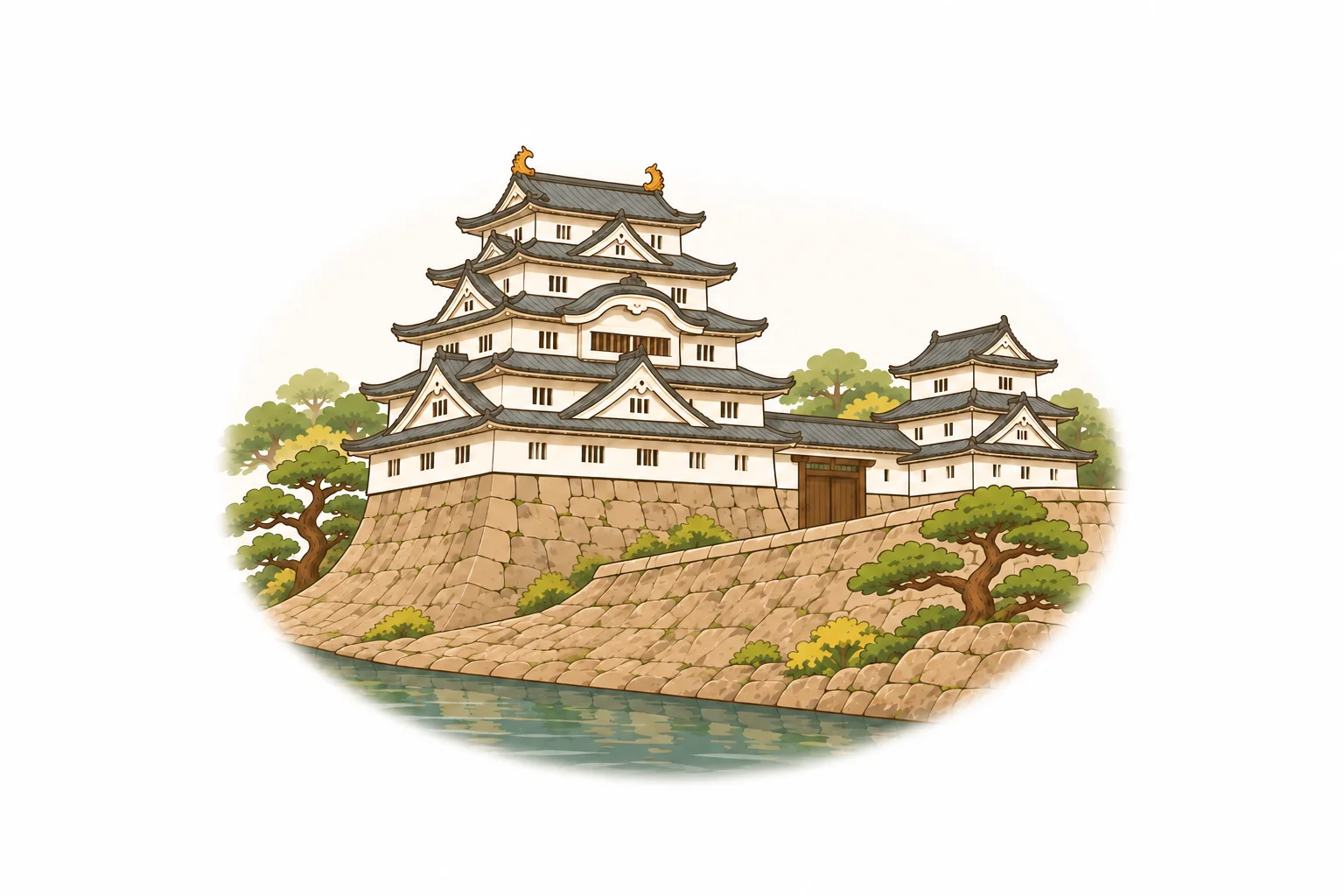
A castle is warrior power made visible. Sengoku lords built on mountaintops to hold a province. Oda Nobunaga and Toyotomi Hideyoshi raised towering keeps so that the whole realm would look up at them. The Tokugawa turned castles into instruments of order, where who built, who lived inside and whether a keep was rebuilt at all said something about rank. And in the last civil wars of the 1860s and 1870s, castles were attacked, defended and handed over one final time.
The ten castles below run roughly in time order: from the mountain stronghold Nobunaga captured in 1567, through the short-lived tower at Azuchi and the layered fortress of Ōsaka, to two surviving keeps at Inuyama and Himeji and a Ryūkyūan castle burned by Satsuma troops. The last stretch covers Edo without its keep, Nijō where the shogunate began and ended, Matsumae on the northern coast, and Kumamoto, which held out in 1877.
01Gifu Castle: Nobunaga’s Mountain
Gifu Castle and Mount Kinka rise to about 329 meters on the south bank of the Nagara River, overlooking the Nōbi Plain. In the early sixteenth century Saitō Dōsan made the castle here, then called Inabayama, his seat, rebuilt it and laid out a town at its foot on his way to becoming master of Mino.
In 1567 Oda Nobunaga took Inabayama, renamed the town below it Gifu, and began using a seal reading tenka fubu. The next year he set out from here to bring Ashikaga Yoshiaki to Kyoto. The Jesuit Luís Fróis visited in 1569 and described a lavish four-story residence at the foot of the mountain; excavations have turned up great boulders and gold-leafed roof tiles that fit his account.
The end was telling too. Before the Sekigahara campaign of 1600, Nobunaga’s grandson Oda Hidenobu sided with the western forces, and in the eighth month the castle fell to the eastern army in a single day. It was abandoned soon after. The HO Guide to Gifu Castle tells the longer story.
02Azuchi: The Keep as a Statement
In 1576 Nobunaga ordered Niwa Nagahide to build a new castle on Mount Azuchi, on the east shore of Lake Biwa, then surrounded on three sides by inner lagoons. The tower, completed in 1579, is recorded as five stories outside and six floors plus a basement inside, with paintings by Kanō Eitoku’s workshop and a gilded top floor. A soaring keep, stone walls throughout and tiled buildings were combined here on a new scale, which is why the Azuchi Castle Ruins are often treated as the starting point of early modern castles. The straight main approach, about six meters wide, seems designed more for display than defense.
After the Honnō-ji Incident in the sixth month of 1582, the castle briefly fell to Akechi Mitsuhide. Soon after his defeat at Yamazaki, the tower and main enclosure burned; who set the fire is still unknown. The tower had stood for only about three years. The HO Guide to Azuchi covers the debates over its reconstruction.
03Ōsaka: One Ruler Buried Beneath Another
Ōsaka Castle stands on the former site of Ishiyama Hongan-ji. In 1583 Toyotomi Hideyoshi began building here, assigning the work to the daimyo. His keep, finished about two years later, was five stories outside and decorated with gold leaf. In his later years he added an outer enclosure and a perimeter defense that took in the town itself.
After his death his son Toyotomi Hideyori lived in the castle with his mother, Yodo-dono. In the winter campaign of 1614 and the summer campaign of 1615 Tokugawa Ieyasu besieged it twice; when it fell, Hideyori and Yodo-dono took their own lives, and the Toyotomi house was destroyed.
The Tokugawa did not repair the old castle. From 1620 they had the daimyo bury Hideyoshi’s walls under fresh earth and raise larger ones on top, a project largely complete by about 1629. The new order was literally built over the old one. The Tokugawa keep burned after a lightning strike in 1665 and was not replaced. See the HO Guide to Ōsaka Castle.
04Inuyama: A Front Line and a Private Owner
Inuyama Castle sits on a small hill above the Kiso River, guarding a crossing between Owari and Mino. It is usually dated to 1537, when Nobunaga’s uncle Oda Nobuyasu moved his seat here; the common account has Nobunaga taking it in 1564 (some say 1565).
When the Komaki–Nagakute campaign broke out in 1584, Ikeda Tsuneoki, a former lord of the castle, went over to Hideyoshi and seized it in a surprise attack, and Hideyoshi used it as his base against Ieyasu at Komaki. Tree-ring dating published in 2021 indicates that the four floors of the keep were built continuously between 1585 and about 1590, with the curved gables and top-floor balcony added around 1620. It is one of 12 surviving keeps built before or during the Edo period and one of 5 castle keeps designated National Treasures.
From 1617 the Naruse, senior retainers attached to the Owari domain, held the castle until the Meiji Restoration. In 1895 Aichi Prefecture handed it to Naruse Masamitsu, and for over a century it was the only privately owned castle in Japan, passing to a foundation in 2004. See the HO Guide to Inuyama Castle.
05Himeji: Holding the West after Sekigahara
Around 1580 Kuroda Yoshitaka handed the hill at Himeji to Hideyoshi, who built a three-story keep there as his base in the west. The castle seen today is mainly the work of Ikeda Terumasa, who received all of Harima, worth 520,000 koku, after Sekigahara. Terumasa, a son of Ikeda Tsuneoki and Ieyasu’s son-in-law, had led the eastern vanguard that took Gifu in 1600.
Placing a son-in-law at Himeji had a clear purpose: Hideyori still held Ōsaka, many western daimyo had once served the Toyotomi, and Himeji commanded the San’yōdō road into the capital region. Terumasa’s rebuilding began in 1601 and produced, by about 1609, a five-story main keep linked to three smaller keeps. Hideyoshi’s keep was taken down.
Lords changed often afterward, and from 1749 the Sakai held the castle until the Meiji Restoration. The keeps escaped both Meiji demolition and the air raids of 1945, and in 1993 Himeji became one of Japan’s first two World Heritage sites. The HO Guide to Himeji follows the families who held it.
06Nakijin: A Ryūkyūan Castle and Satsuma’s Fire
The Nakijin Castle Ruins in northern Okinawa are a gusuku, the Okinawan word for a fortified site. In the fourteenth century, when Okinawa Island was divided among Hokuzan, Chūzan and Nanzan, this was the seat of the kings of Hokuzan. Its curving walls run about 1.5 km and reach about 8 meters. In 1416 (some sources give 1422) Shō Hashi of Chūzan attacked with northern lords, the last northern king Han’anchi was killed, and Hokuzan came to an end. The court at Shuri then kept a royal warden here to govern the north.
Two centuries later, warrior power from the main islands crossed the sea. In 1609 Satsuma invaded Ryūkyū; its troops landed at nearby Unten harbor and burned the castle, then moved on to Shuri, where King Shō Nei surrendered. He was taken to Kagoshima, met Ieyasu at Sunpu and Shogun Hidetada at Edo in 1610, and returned home only in 1611. The last warden left for Shuri in 1665, but the castle’s sacred groves are still places of worship. See the HO Guide to Nakijin.
07Edo: The Keep That Was Never Rebuilt
Edo Castle began with Ōta Dōkan’s fortress of 1457. Ieyasu made Edo his base in 1590, and after founding the shogunate in 1603 he mobilized daimyo across the country to enlarge it. Over three generations, through Hidetada and Tokugawa Iemitsu, it grew into a vast castle ringed by a spiraling outer moat. The keep was built three times; Iemitsu’s version, about 58 meters high including its base, was the tallest keep in Japanese history. Three shoguns building three keeps shows how much the tower meant as a symbol.
The Great Fire of Meireki in 1657 destroyed the keep and the main palace. A new stone base was built the following year, but Hoshina Masayuki reportedly argued that the money should go to relief and rebuilding the city, and the keep was never restored. A shogun’s castle without a keep suggests that power in a settled age no longer needed a tower to prove itself. In 1868, after negotiations involving Katsu Kaishū, the castle was handed peacefully to the new government and later became the emperor’s residence. See the HO Guide to Edo Castle.
08Nijō: Where the Shogunate Began and Ended
Nijō Castle never saw a battle. Its purpose was to make the Tokugawa visible in Kyoto. Ieyasu celebrated his appointment as shogun here in 1603 and met Hideyori here in 1611. Under Iemitsu it was greatly enlarged for a visit by Emperor Go-Mizunoo, who stayed several days in 1626.
The Ninomaru Palace is a staggered chain of buildings, from the waiting rooms through the Grand Hall to the inner Shiro-shoin. The closer a visitor came to the shogun, the more private and exalted the rooms became, and the raised upper floor and its decoration made rank plain at a glance. The keep burned after a lightning strike in 1750 and was not rebuilt.
When the shoguns returned to Kyoto in the 1860s, Nijō became a political stage again. In the tenth month of 1867 Tokugawa Yoshinobu summoned senior retainers of the domains then in Kyoto to the Grand Hall for consultation, and the next day returned governing authority to the court, formally ending the shogunate. See the HO Guide to Nijō Castle.
09Matsumae: One of the Last Castles
Matsumae Castle, formally Fukuyama Castle, was the seat of the Matsumae domain in southern Ezo. In 1604 Ieyasu recognized the Matsumae monopoly on trade with the Ainu. The domain grew almost no rice and lived on that trade, and terms that worked against the Ainu formed the background to conflicts such as Shakushain’s War in 1669.
Around the time of Perry’s arrival, northern coastal defense became a pressing concern. In 1849 the shogunate ordered Matsumae Takahiro to build a castle, finished in 1854 with gun batteries facing the sea. It is usually described as one of the last Japanese-style castles ever completed, and its expected enemy was no longer a neighboring lord but foreign ships.
Yet it fell in a civil war. In the eleventh month of 1868, during the Hakodate War, the former shogunate forces of Enomoto Takeaki sent Hijikata Toshizō against it, and it fell quickly. The present keep is a concrete reconstruction after a fire in 1949; the inner-citadel gate is original.
10Kumamoto: The Last Siege
Kumamoto Castle was built by Katō Kiyomasa and is usually said to have been largely complete by 1607. Its stone walls rise gently at the base and almost vertically near the top. After two generations the Katō were removed, and from 1632 the Hosokawa ruled Higo until the Meiji Restoration.
In early Meiji the castle became the headquarters of a government garrison. In the second month of 1877 Saigō Takamori led the Satsuma army north, and the Satsuma Rebellion began. A few days before the siege, the main keep and palace burned in a fire of unknown origin. Under Tani Tateki the garrison, largely conscripted commoners, held out for about 50 days until relief arrived in the fourth month. The failure blunted the Satsuma offensive, and in the ninth month Saigō was wounded at Shiroyama in Kagoshima, where Beppu Shinsuke acted as his second.
A castle built for a daimyo was finally held by a modern conscript army against a former samurai leader. Repairs after the 2016 earthquake are still under way. See the HO Guide to Kumamoto Castle.
11Closing
From Gifu to Kumamoto, the castle kept changing its job: a mountain stronghold for holding a province, a keep for display to the realm, a settled seat of walls, palaces and rank, and finally a military post and a heritage site. Keeps burned and stayed unbuilt, old castles were buried under new ones, and owners changed from daimyo to retainers, a private family and a foundation. Those changes are themselves a record of warrior power rising, settling and leaving the stage. Nakijin is a reminder that Ryūkyū had castles and kings of its own, and that Satsuma’s fire there belongs to the same story.