
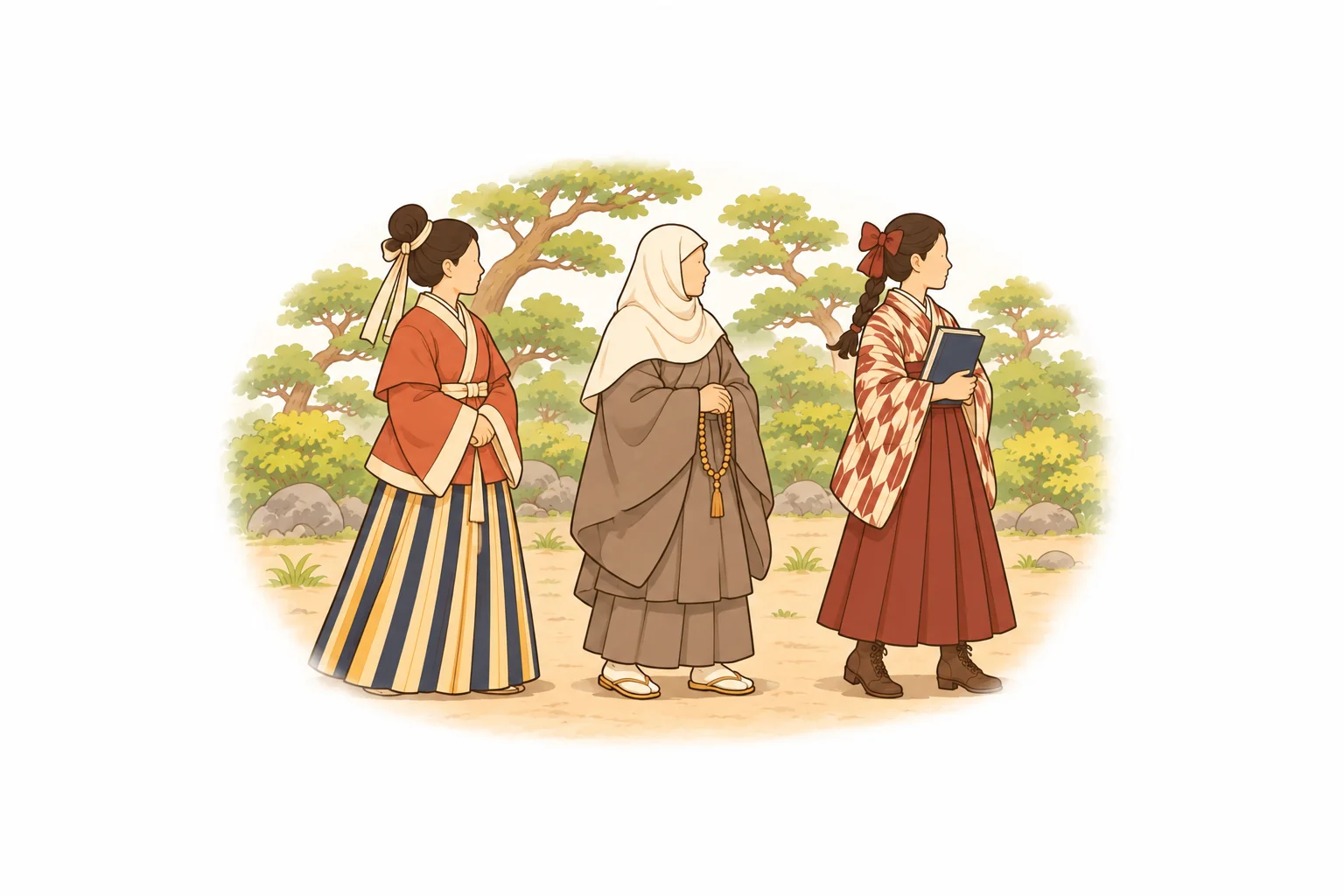
Women are a minority among the people of Japanese history, but they tend to appear at turning points: when a throne stood empty, when a shogun’s line died out, when a new kind of writing or a new kind of learning was just beginning. Here are ten of them, in order of birth, from a sovereign enthroned in 593 to a novelist who died in Meiji Tokyo at twenty-four. The first half held power, some on the throne itself, others through their position as empress, widow, shogun’s wife or wet nurse. The second half includes a poet, the author of The Tale of Genji, a woman who trained as a doctor when there was no path for women to do so, an educator, and a writer of the Tokyo poor.
A common thread is the evidence. Much of what we know about these women was written by others, grew up as legend centuries later, or comes from diaries they shaped themselves. Each section separates the record from the later story as far as it can; the full accounts are on the individual pages.
01Empress Suiko: The First Woman on the Throne
Princess Nukatabe, later known as Empress Suiko, was born in 554, a date worked out from her age at death in the Nihon shoki. She was the daughter of Emperor Kinmei and a granddaughter of Soga no Iname. As widow of Emperor Bidatsu she gave the order in 587 under which Soga no Umako had Prince Anahobe killed. After Umako had Emperor Sushun murdered in 592, she was enthroned early in 593 at the Toyura Palace in Asuka, aged thirty-nine by East Asian count: the first woman listed as a reigning sovereign in the official histories. Her thirty-six-year reign saw Buddhism win royal backing, the move to the Oharida Palace and the twelve cap ranks, and missions to the Sui. Later tradition credited all this to Prince Umayado, but the chronicle points to a partnership of three, and in 624 she refused Umako’s request for Kazuraki district. She died in 628, seventy-five by East Asian count, without naming an heir.
02Empress Kōmyō: Dispensary, Shelter and Treasure House
Empress Kōmyō, born Asukabe-hime in 701, was the daughter of Fujiwara no Fuhito and Agatainukai no Michiyo. In 716 she entered the household of Prince Obito, the future Emperor Shōmu. In 729, after the fall of Prince Nagaya, she became empress, the first born a subject rather than a royal if the legendary Iwanohime is set aside, and Fujiwara empresses later became the norm. In 730 her household office opened the Seyakuin dispensary, with the Hiden’in shelter for the poor founded around the same time; her residence, Fuhito’s old mansion, became Hokke-ji. After Shōmu died in 756, she dedicated more than six hundred of his belongings to the Great Buddha of Tōdai-ji, along with sixty kinds of medicine to be given to the sick when needed. These gifts form the core of the Shōsōin treasures. She died in 760, aged sixty by traditional count. The Hokke-ji bathhouse story, in which a sufferer she cleanses turns out to be the Buddha Akshobhya, is later legend.
03Ono no Komachi: Eighteen Poems and a Legend
Ono no Komachi was active around the middle of the ninth century; her birth, death, parents and court post are all unknown. What survives with reasonable security are eighteen poems in the Kokinshū, commissioned by Emperor Daigo around 905. Its compilers, among them Ki no Tsurayuki, named her in both prefaces as one of six notable poets of the previous age, and she is the only woman among the six. Her dream poems are her most distinctive: had I known it was a dream, I would not have woken. Her poem on faded blossoms uses the pivot words furu and nagame to describe spring rain and a life passing at once, and Fujiwara no Teika later chose it for the Hyakunin isshu. The Captain of Fukakusa, the ruined old age and the skull on the moor are legends that grew up centuries later. Reading her today means keeping the poems and the legend apart.
04Murasaki Shikibu: A Tale Read While It Was Written
Murasaki Shikibu left no personal name; she was born sometime between about 970 and 978, often given as around 973. Her father, Fujiwara no Tametoki, was a scholar of Chinese, and she learned the classics by listening to her brother’s lessons. She married Fujiwara no Nobutaka in the winter of 998 or early 999; he died in the epidemic of 1001, and she is generally believed to have begun her tale as a widow. Early in 1006 or 1007 she entered the service of Fujiwara no Shōshi, Emperor Ichijō’s empress, probably because her writing was already known. At a banquet in 1008, Fujiwara no Kintō asked whether "young Murasaki" was present, the earliest firm evidence that The Tale of Genji was being read. Its fifty-four chapters of kana prose explored inner lives as nothing before had. In her diary she judged her fellow writers, most harshly Sei Shōnagon. The last secure record of her dates to 1013.
05Hōjō Masako: The Widow Who Held Kamakura Together
Hōjō Masako, born in 1157 to the Izu warrior Hōjō Tokimasa, took the name Masako only in 1218, when she received court rank. Around 1177 she joined the exile Minamoto no Yoritomo against her father’s wishes. When Yoritomo died in 1199 she became a nun, and over the next quarter century she stepped in at each of the shogunate’s worst moments. In 1205 she and her brother Hōjō Yoshitoki took the shogun Sanetomo out of their father’s hands and forced Tokimasa to retire. When Sanetomo was murdered in 1219, ending Yoritomo’s line, she brought the infant Mitora to Kamakura and handled the shogun’s functions from behind a blind, the origin of the later title "nun shogun," which is not attested in her lifetime. In the Jōkyū War of 1221 she rallied the wavering housemen, though her exact words cannot be recovered. She died in Kamakura in 1225, aged sixty-nine by the Japanese count. Most of what we know of her comes from the Azuma kagami, a chronicle compiled under the Hōjō.
06Hino Tomiko: Head of the Shogun’s House in a Collapsing Age
Hino Tomiko was born in 1440 into a court family whose daughters had long married Ashikaga shoguns, and in 1455 she became the principal wife of the eighth shogun, Ashikaga Yoshimasa. In 1464 Yoshimasa named his half-brother Yoshimi as heir; a year later Tomiko bore a son, Yoshihisa. When the Ōnin War broke out in 1467 she stayed with the Eastern side. The war chronicle Ōninki blames her appeal to Yamana Sōzen for the conflict, but no other record contains it, and contemporary diaries point instead to the Hatakeyama and Shiba succession disputes. After her brother Katsumitsu died in 1476 she held real power, building a fortune from loans, rice trading and Kyoto tolls, and in 1477 she helped broker the Western withdrawal from the capital. As a widow she backed the Meiō Coup of 1493, which deposed her nephew Yoshiki. She died in Kyoto in 1496, at fifty-seven by the traditional count. Her "evil woman" image comes largely from later popular writing.
07Kasuga no Tsubone: A Rebel’s Daughter Who Ran the Ōoku
Kasuga no Tsubone was born Saitō Fuku in 1579, the daughter of Saitō Toshimitsu, a senior retainer of Akechi Mitsuhide. After the Honnō-ji coup of 1582 her father was executed, and she grew up as a rebel’s daughter. In 1604 she was appointed wet nurse to Takechiyo, the future third shogun Tokugawa Iemitsu. Tradition says she secretly appealed to Ieyasu to secure Takechiyo’s place as heir, but no reliable contemporary source confirms it. After Iemitsu’s mother Gō died in 1626, Fuku effectively ran the shogun’s women’s quarters, fixing ranks and duties and sealing them off from the outer palace. In 1629 she was received at the imperial court and given junior third rank and the title Kasuga no Tsubone. In her last years she sought consorts for the heirless Iemitsu, whose son Ietsuna was born in 1641. She died in Edo in 1643, aged sixty-five by the traditional count. The Ōoku she organized endured for more than two centuries.
08Kusumoto Ine: Siebold’s Daughter Becomes a Doctor
Kusumoto Ine was born in Nagasaki in 1827, the daughter of Philipp Franz von Siebold, physician to the Dutch post on Dejima. After the Siebold Incident her father was banished in 1829, and she grew up with her mother, set on studying medicine. Women then had no regular route into medicine, so she learned through her father’s former students: obstetrics with Ishii Sōken in Okayama, training with Ninomiya Keisaku at Unomachi, then obstetrics and pathology under the Dutch doctors Pompe and Bauduin in Nagasaki, some twenty-five years in all. She met her returning father in 1859, at thirty-two. In the early Meiji years she opened an obstetric practice in Tsukiji, Tokyo, and in 1873 she was summoned to attend the delivery of Hamuro Mitsuko, a court lady of the Meiji emperor. The label "Japan’s first woman doctor of Western medicine" needs care: the first woman licensed under the modern system was Ogino Ginko, in 1885. Ine died in Tokyo in 1903, aged seventy-six.
09Tsuda Umeko: Sent Abroad at Six
Tsuda Umeko was born in Edo in 1864, the daughter of Tsuda Sen, an English-speaking former shogunal retainer. In 1871, aged six, she sailed with the Iwakura Mission as one of five girls sent by the Hokkaidō Development Commission to study in America, and she lived for about ten years with the Lanman family. When she returned in 1882 she could barely speak Japanese, and no post awaited her. She lived for a time in the household of Itō Hirobumi as tutor and interpreter, taught at the Peeresses’ School from 1885, and from 1889 studied biology at Bryn Mawr College, raising a scholarship fund to send Japanese women to study in America. In 1900 she gave up her government posts and founded the Joshi Eigaku Juku with ten students; from 1905 its graduates could receive English teaching licenses without examination. She died in Kamakura in 1929, aged sixty-four. Her school became Tsuda College, and since 2024 her portrait has appeared on the 5,000-yen note.
10Higuchi Ichiyō: The Miraculous Fourteen Months
Higuchi Ichiyō was born Higuchi Natsu in Tokyo in 1872. She finished top of her class in 1883 and was then kept at home because her mother thought girls needed no more schooling. She became head of the household at fifteen, and after her father’s death in 1889 three women lived by sewing. Seeing a classmate paid for fiction, she sought instruction from Nakarai Tōsui in 1891 and published her first story the next year. In 1893 and 1894 she kept a small shop beside the Yoshiwara, and the children of that neighborhood went into Takekurabe. From December 1894 she published Ōtsugomori, Takekurabe, Nigorie and Jūsan’ya in what came to be called her "miraculous fourteen months," and in 1896 Mori Ōgai and Kōda Rohan praised her lavishly. She died of tuberculosis that November, aged twenty-four. For more on the Tokyo she wrote about, see Higuchi Ichiyō: The Writer Who Saw Tokyo from the Edge of the Pleasure Quarter. Her portrait appeared on the 5,000-yen note from 2004 until Tsuda Umeko replaced her in 2024.
11Closing
These ten lives span some thirteen hundred years, and each woman reached the record by a different door. Suiko was the candidate every faction could accept. Kōmyō, Masako, Tomiko and Kasuga no Tsubone worked through the positions of empress, widow, shogun’s wife and wet nurse. Komachi, Murasaki and Ichiyō left their mark in writing. Ine and Umeko found their own routes before institutions had made room for women. What survives of them varies just as much: eighteen poems, speeches placed in their mouths by chroniclers, a carefully kept diary. Separating the contemporary record from what later readers imagined is the best way to see each of them clearly.