
01A Mountain Above the River
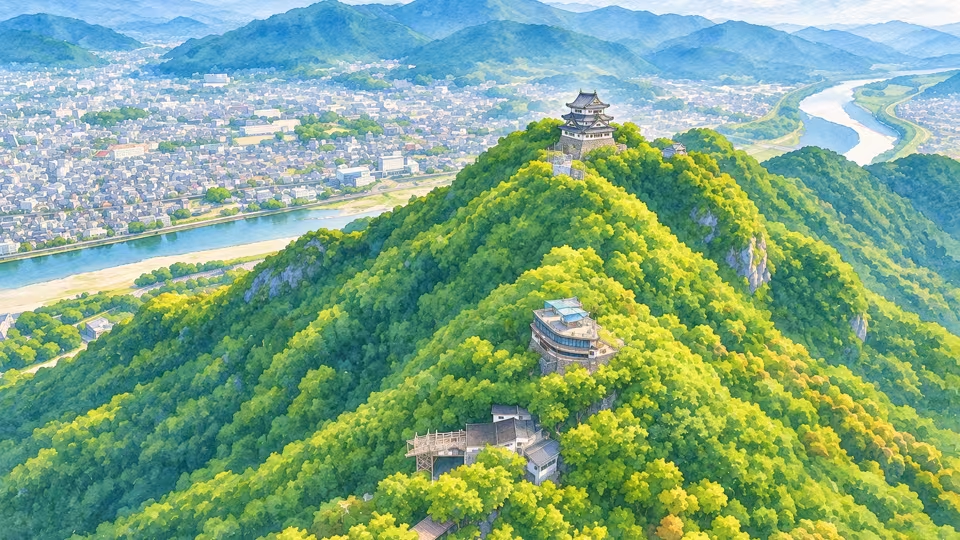
Mount Kinka rises abruptly from the north edge of the city of Gifu, a steep, wooded ridge of hard chert 329 meters high, with the Nagara River bending around its northern foot. On the summit stands a small white three-tiered keep. The mountain is not high by Japanese standards, but it stands alone on the edge of the Nōbi Plain, the broad lowland shared by the old provinces of Mino and Owari. From the top you can see the Kiso, Nagara and Ibi rivers fanning across the plain, Mount Ibuki to the west, and on a clear day the towers of Nagoya to the south.
Whoever held this mountain controlled central Mino and the road that ran from Owari toward Ōmi and Kyoto. That is why it mattered so much in the sixteenth century, the age of warring states known as the Sengoku period, and why it is tied to two of the most famous names of that age: Saitō Dōsan, the "Viper of Mino," and Oda Nobunaga, the warlord who began the unification of Japan.
The mountain used to be called Inabayama, and the castle was Inabayama Castle. The name Kinka, "golden flower," is usually explained by the pale yellow blossoms of the chinquapin trees (tsuburajii) that cover the slopes; in late spring the whole mountain takes on a golden tint. The name Gifu itself came later, and Nobunaga chose it.
02A Fortress Before the Famous Lords
Castle histories begin the story in the early thirteenth century. According to tradition, Nikaidō Yukimasa, an administrator of the Kamakura shogunate, built a fort on Inabayama in the Kennin era (1201–1204). Little is known about this early phase, and it survives mostly as the opening line of local histories.
By the fifteenth century the province of Mino was governed by the Toki family, who held the office of shugo, or military governor. Real power often rested with their deputies, the Saitō family, who held the post of shugodai. Saitō Toshinaga built or strengthened defenses on Inabayama in the mid-1400s. Even so, Inabayama was a deputy’s stronghold; the Toki governors had their own residences elsewhere on the plain.
03The Viper of Mino
The man who made Inabayama the center of Mino was Saitō Dōsan.
Dōsan’s legend is one of the great rags-to-riches stories of the Sengoku period. In the version told for centuries, he began as a monk at the Myōkaku-ji temple in Kyoto, left the priesthood to sell lamp oil, and then talked and schemed his way into the service of the Toki, eventually overthrowing his masters. He became the classic example of gekokujō, "the low overthrowing the high."
Historians now think this career belonged to two men, not one. A letter by the Ōmi warlord Rokkaku Yoshikata, rediscovered in the twentieth century, describes Dōsan’s father, Nagai Shinzaemon-no-jō, as a former monk of Myōkaku-ji who came from Kyoto and rose in the service of the Nagai family, senior retainers of the Saitō. Dōsan inherited that position and pushed further, taking the Saitō name and, finally, control of the province. The oil-seller story is best understood as a merging of father and son into a single legend.
From the 1530s Dōsan made Inabayama his base. He rebuilt the mountain fortress and laid out a castle town at its foot, moving the Inaba Shrine down from the mountain to make room. Around 1542 he drove the governor Toki Yorinari out of Mino (some sources place the final expulsion in 1552), and from then on he was the province’s master in all but title.
Dōsan spent years fighting Oda Nobuhide of Owari, but the two eventually made peace, and around 1549 Dōsan married his daughter to Nobuhide’s heir, the young Nobunaga. She is remembered as Nōhime, "the lady from Mino," though almost nothing reliable is known about her life. According to Shinchō Kōki, the chronicle of Nobunaga’s life written by his retainer Ōta Gyūichi, Dōsan once met his son-in-law at the Shōtoku-ji temple in Tomita. Nobunaga, notorious as "the great fool of Owari," arrived dressed like a ruffian but leading a well-drilled force armed with long pikes and firearms. Afterward, the story goes, Dōsan remarked that his own sons would one day tie their horses at that fool’s gate.
04Death by the Nagara
Dōsan handed the headship of the family to his son Yoshitatsu, but father and son soon became enemies. In the fourth month of 1556 Yoshitatsu raised an army against him. Dōsan, badly outnumbered, met him on the banks of the Nagara River at the foot of the mountain and was killed. Nobunaga marched to help his father-in-law but arrived too late. Dōsan’s grave mound, the Dōsan-zuka, still stands in the city.
Tradition holds that before the battle Dōsan wrote a letter bequeathing Mino to Nobunaga. Its authenticity has long been debated, but the idea gave Nobunaga a claim he would later press.
Yoshitatsu died of illness in 1561, still in his thirties, and his young son Saitō Tatsuoki inherited a weakened domain. Nobunaga began attacking almost immediately.
05Sixteen Men Take the Castle
The most famous episode of Tatsuoki’s rule shows how fragile his hold had become. In 1564 one of his retainers, Takenaka Hanbei Shigeharu, together with his father-in-law Andō Morinari, seized Inabayama Castle from within. By the usual account Hanbei entered with only about sixteen followers, on the pretext of visiting his sick younger brother, a hostage in the castle, and drove Tatsuoki out.
Hanbei held the castle for about half a year and then returned it to his lord and withdrew. He later served Kinoshita Tōkichirō, the future Toyotomi Hideyoshi, and became a favorite figure of later storytellers as the ideal strategist. Stories that Nobunaga offered him half of Mino in exchange for the castle come from later accounts.
06Nobunaga Takes Inabayama
Nobunaga’s conquest of Mino took about seven years. He moved his base from Kiyosu to Mount Komaki, closer to the border, and built forward forts. One of them, at Sunomata, is the setting of the famous tale of Hideyoshi’s "one-night castle," though the details come largely from later and doubtful sources.
The turning point came when three powerful lords of western Mino, Inaba Ittetsu, Ujiie Bokuzen and Andō Morinari, changed sides. In the eighth month of 1567 Nobunaga advanced on Inabayama, burned the town below, and surrounded the mountain. Tatsuoki fled by boat down the Nagara River to Nagashima in Ise. Some older accounts date the fall to 1564, but 1567 is now the generally accepted year.
A popular legend says that Hideyoshi led a small party up a hidden path on the back of the mountain and broke in from behind, signaling with a gourd; the gourd supposedly became the origin of his famous gourd battle standard. It is a legend, not history.
07Gifu and "Tenka Fubu"
Nobunaga moved his headquarters from Komaki to Inabayama and renamed the town at its foot, then called Inokuchi, as Gifu. The name is usually credited to his former teacher, the Zen monk Takugen Sōon. It joins the first characters of Qishan (Gi in Japanese), the mountain from which King Wen of Zhou rose to power, and Qufu (Fu), the birthplace of Confucius: a place from which a virtuous ruler sets out to bring order to the realm. The name had appeared occasionally in earlier writings by Zen monks, but Nobunaga made it official.
At about the same time Nobunaga began using a seal reading tenka fubu, often translated "rule the realm by force of arms." In the usage of the time tenka often meant the capital region around Kyoto rather than all of Japan, and historians debate how much the phrase announced. What is clear is that Gifu was the base from which Nobunaga reached for Kyoto.
He also issued a decree to the market at Kanō, just south of the castle town, declaring it a free market, exempt from the usual dues and guild restrictions. The wooden placard bearing this 1567 order survives at the Entoku-ji temple in Gifu and is the oldest surviving free-market placard in Japan, now designated an Important Cultural Property.
In 1568 Nobunaga marched from Gifu to Kyoto escorting Ashikaga Yoshiaki, who became shogun. For the next several years Gifu was the heart of the Oda regime, the base from which Nobunaga fought the Azai and Asakura, the Ikkō sectarians of the Hongan-ji, and the Takeda.
08The Palace Fróis Saw
The most vivid picture of Nobunaga’s Gifu comes from Luís Fróis, a Portuguese Jesuit missionary, who visited in 1569. In his letters and later in his History of Japan, he described Nobunaga’s residence at the western foot of the mountain: a great stone wall at the entrance, a palace of four stories, rooms beyond counting, gilded screens, and gardens with ponds and fine stones. Shibata Katsuie then led him up to the castle on the summit, where he was entertained in a richly decorated room and Nobunaga himself brought him his meal. Fróis noted that Nobunaga’s wives and children lived on the summit and that few others were admitted.
Nobunaga also entertained guests with cormorant fishing on the Nagara River, in which fishermen working from boats at night use trained cormorants to catch sweetfish (ayu). The practice continues on summer nights today, and the master fishermen hold an honorary title as officials of the Imperial Household Agency.
Excavations at the site of the residence, in what is now Gifu Park, began in the 1980s. They have uncovered stone walls built of huge boulders, an entrance passage, garden remains with ponds, and roof tiles decorated with gold leaf. These finds match Fróis’s account remarkably well. Surveys on the summit have also found stone walls and gold-leaf tiles of Nobunaga’s time.
09From Nobutada to Hidenobu
At the end of 1575 Nobunaga handed the headship of the clan and Gifu Castle to his eldest son, Oda Nobutada, and in 1576 began building Azuchi Castle on Lake Biwa, where he moved. Nobutada governed Mino and Owari from Gifu. In 1582, at the Honnō-ji Incident, both Nobunaga and Nobutada died in Kyoto, Nobutada at the Nijō Palace.
Gifu then changed hands several times. Nobunaga’s third son, Oda Nobutaka, held it until he fell out with Hideyoshi and was forced to kill himself in 1583. The castle passed to Ikeda Motosuke and then to his brother Ikeda Terumasa, and later to Toyotomi Hidekatsu, Hideyoshi’s nephew, who died on campaign during the invasion of Korea in 1592. That same year the castle went to Oda Hidenobu, Nobunaga’s grandson, who as the child Sanbōshi had been named Nobunaga’s heir at the Kiyosu Conference of 1582. He held a domain of about 130,000 koku.
Before the Battle of Sekigahara in 1600, Hidenobu sided with the Western army. On the twenty-third day of the eighth month, Eastern forces under Ikeda Terumasa and Fukushima Masanori stormed the castle and took it in a single day. Terumasa, a former lord of the castle, knew its paths well. Hidenobu surrendered and was sent to Mount Kōya, where he died a few years later. The fall of Gifu opened the campaign that ended at Sekigahara less than a month later.
10Abandonment and Reconstruction
After Sekigahara, Tokugawa Ieyasu chose not to keep a fortress on the mountain. In 1601 he had a new castle built on the flat land to the south at Kanō, and gave it to his son-in-law Okudaira Nobumasa. Materials and stones were carried off from Gifu, and tradition says Gifu’s keep was moved to become the three-story turret of Kanō Castle. Through the Edo period Mount Kinka was a forest managed by the Owari domain, with no castle on it.
In 1910 local people built a wooden mock keep on the summit, the first modern Gifu Castle. It burned in 1943. The present keep, three tiers outside and four floors inside, was built of reinforced concrete in 1956 and was renovated in 1997. According to the city of Gifu, its design was based on a conjectural restoration drawing made by the architectural historian Kido Hisashi in 1937; it is not a reconstruction of what stood here in Nobunaga’s day, which no reliable image records. In recent years the keep has been undergoing major earthquake-proofing work.
In 2011 the remains on the summit and at the foot of the mountain were designated a National Historic Site as the Gifu Castle Ruins.
11Walking the Mountain
Most visitors take the ropeway from Gifu Park, but several hiking trails climb the mountain, including the gentle and much-used Nanamagari trail and the steep Umanose trail, which scrambles over bare rock and gives a good sense of how defensible the summit was.
Begin at the excavated residence site in Gifu Park. The boulder-built walls and entrance passage are displayed, and a reconstructed gate marks the approach Fróis would have used. The Gifu City Museum of History, also in the park, displays finds from the Saitō and Oda periods and a model of the castle town.
On the summit path, watch for fragments of old stone walling among the newer retaining walls. The keep houses exhibits of armor and documents related to the Saitō and Oda, and its top-floor lookout is the best viewpoint on the mountain: the Nagara River curling below to the north, the Sekigahara gap to the west, the Mino hills to the east. Nearby stands the Gifu Castle Archives, housed in a turret-style building put up in 1975.
Back at the bottom, the Nagara River is a short walk away, the Dōsan-zuka is in the city, and Entoku-ji keeps Nobunaga’s market placard. On a summer evening, from a cormorant-fishing boat, you can look up at the lit keep on the summit, a view that sums up the mountain’s history: the castle above, the river below, and the town of merchants and fishermen in between.