
01A Ridge Between Two Rivers
Kanazawa Castle occupies the tip of the Kodatsuno plateau, a tongue of high ground pushing northwest between two rivers: the Asano to the east and the Sai to the west. Anyone holding this ridge could watch the plain toward the Sea of Japan and the roads running along the coast. That geography explains why the site was fortified, and why the city of Kanazawa grew around it.
For almost three centuries, from 1583 to the Meiji Restoration of 1868, this was the home castle of the Maeda clan, lords of Kaga domain. The Maeda were the richest daimyo (regional lords) in Japan after the Tokugawa shoguns themselves. Their assessed income was over a million koku—a koku being the amount of rice thought to feed one person for a year—and the phrase Kaga hyakumangoku, "Kaga of the million koku," still serves as shorthand for the city’s wealth and refinement.
02The Temple That Came First
Before the castle there was a temple. In the late fifteenth century, Kaga province became the stronghold of the Ikkō-ikki, leagues of believers in the Jōdo Shinshū (True Pure Land) Buddhist sect organized around the Hongan-ji temple. In 1488 they besieged and defeated the provincial governor, Togashi Masachika, who took his own life. For nearly a century afterward Kaga was run by a coalition of temples, local warriors, and villagers—a province "held by the peasants," as a contemporary phrase had it.
In 1546 the Hongan-ji established a branch temple on this ridge, the Kanazawa Midō, also called the Oyama Gobō. It became the administrative and religious center of Ikkō rule in Kaga. Merchants and artisans settled around it, forming a temple town that was the first seed of the later castle town. The old name Oyama survived: the early Maeda castle was sometimes called Oyama Castle, and the shrine to the clan founder today is Oyama Shrine.
03Oda Nobunaga’s Generals
The Ikkō leagues were among the most stubborn enemies of the warlord Oda Nobunaga. His general Shibata Katsuie was charged with conquering the Hokuriku region along the Sea of Japan coast, and in 1580 Katsuie’s nephew Sakuma Morimasa captured the Oyama Gobō. That same year the Hongan-ji leader Kennyo made peace with Nobunaga and abandoned his fortress-temple at Ishiyama in Ōsaka. Ikkō rule in Kaga was over.
Morimasa built a castle on the temple site, but he held it only briefly. After Nobunaga’s death at Honnō-ji in 1582, Katsuie and Hashiba (later Toyotomi) Hideyoshi fought for control of the Oda legacy. At the battle of Shizugatake in 1583, Morimasa led Katsuie’s vanguard, pushed too far ahead, and was caught by Hideyoshi’s counterattack. Katsuie’s army collapsed; Katsuie killed himself at Kitanoshō Castle in Echizen, and Morimasa was captured and executed.
04Maeda Toshiie Takes Over
Maeda Toshiie came from Arako in Owari province and rose as one of Nobunaga’s retainers, famous in his youth as a spearman. He and Hideyoshi had served together under Nobunaga and were friends. Under Nobunaga, Toshiie received Noto province, with his base at Nanao. At Shizugatake he was nominally on Katsuie’s side, but he withdrew his troops without engaging Hideyoshi and afterward submitted to him. That choice made the Maeda fortune.
In 1583 Hideyoshi added two districts of northern Kaga to Toshiie’s holdings, and Toshiie moved into Kanazawa Castle. He rebuilt it and, according to tradition, called on Takayama Ukon, a Christian daimyo with a reputation for fortification, to help with the design. Ukon lived in Kanazawa as a guest of the Maeda after Hideyoshi banned Christianity; how much of the castle’s stonework and moats is really his work is not clear from the records.
Toshiie rose steadily in Hideyoshi’s government and in its final years served as one of the Five Elders, the council of great lords set up to govern on behalf of Hideyoshi’s young heir. He was the only figure with the standing to balance Tokugawa Ieyasu. When Toshiie died in Ōsaka in 1599, that balance broke, and the Battle of Sekigahara followed the next year.
05Lady Matsu and the Million Koku
Toshiie’s death left his son Maeda Toshinaga exposed. Ieyasu accused the Maeda of plotting against him, and Toshinaga defused the threat by sending his mother, Toshiie’s widow Matsu (known in religious retirement as Hōshun’in), to Edo as a hostage. She remained there for well over a decade. The episode is remembered in Kanazawa as the moment the family secured its survival under the new order.
At Sekigahara in 1600 Toshinaga sided with Ieyasu and was rewarded with southern Kaga. With Kaga, Noto, and much of Etchū, the Maeda held about 1.2 million koku, the largest domain in Japan outside Tokugawa hands. The third lord, Maeda Toshitsune, later carved out branch domains for two sons at Toyama and Daishōji, leaving the main Kaga domain at roughly 1.02 million koku.
Toshinaga had no son. He adopted his younger half-brother Toshitsune, handed over the headship in 1605, and retired to Etchū, where he built a new castle at Takaoka and later died. His wife Eihime, a daughter of Oda Nobunaga, then returned to Kanazawa Castle and lived in its western enclosure. She took the Buddhist name Gyokusen’in, and after her death the enclosure was renamed Gyokusen’in-maru, the name the restored garden there still carries.
The Maeda remained careful. A well-known story, of later origin, holds that Toshitsune let his nose hair grow long and played the fool so the shogunate would not see him as a threat. Whether or not that anecdote is true, the domain poured its resources into crafts, scholarship, and gardens rather than military display, and Kanazawa’s reputation for lacquer, gold leaf, Kaga dyeing, and Noh theater grew from that policy.
06The Lost Keep and the Fires
Toshiie built a main keep (tenshu) around 1586–87. No reliable record of its appearance survives; some accounts describe it as five stories tall. In the tenth month of 1602 lightning struck it and it burned. It was never rebuilt; a three-story turret was later raised in the Hon-maru to serve as a lookout. That is why Kanazawa Castle has no keep today, and why the Hon-maru, the innermost enclosure, is now a wooded hill.
Fire was the castle’s recurring enemy. In 1631 a blaze that started in the town spread into the castle and destroyed most of its buildings, including the Hon-maru palace. Toshitsune used the rebuilding to shift the lord’s residence and government offices to the Ni-no-maru, the second enclosure, where a large palace was built. At the same time the domain commissioned Itaya Hyōshirō, an engineer from Komatsu, to build the Tatsumi Canal. It draws water from the upper Sai River through tunnels and channels more than ten kilometers long and uses an inverted siphon to lift the water up onto the castle heights.
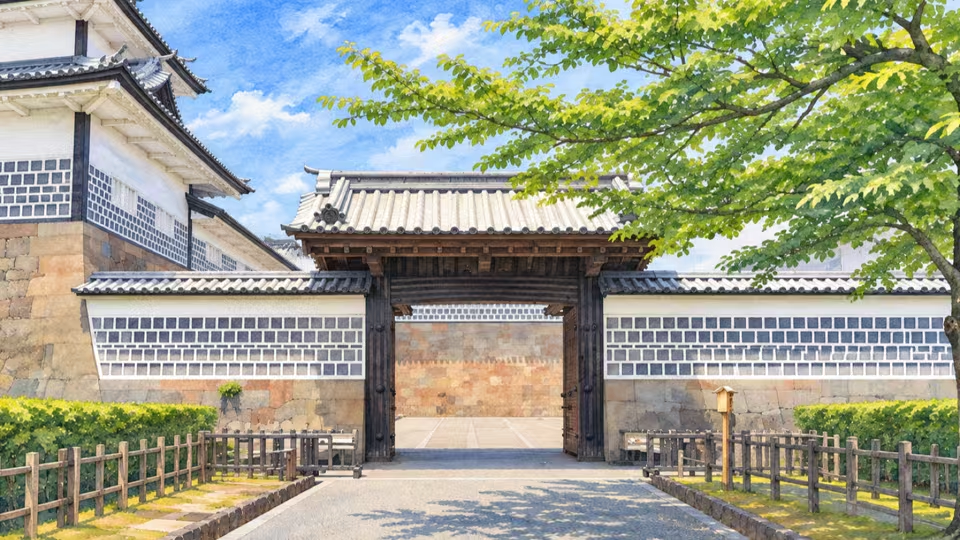
In 1759 another great fire destroyed most of the buildings in the Hon-maru and Ni-no-maru, including the Ishikawa Gate. The gate you see today was rebuilt in 1788. A further fire in 1808 burned the Ni-no-maru palace and the Hishi Yagura, which were rebuilt within a few years.
07Lead Roofs and Stone Walls
A few features mark Kanazawa’s buildings at a glance. The roof tiles are lead: wooden cores sheathed in lead plates that oxidize to a pale gray-white, so the roofs look dusted with snow. Explanations vary—durability in the snowy climate is one; the idea that the lead could be melted into bullets in a siege is a popular story without firm evidence. The lower walls are faced with flat tiles whose joints are covered with raised white plaster, a checkered pattern called namako-kabe, "sea-cucumber walls." Projecting bays with openings in the floor, ishi-otoshi, allowed defenders to drop stones on attackers.
The castle’s stone walls are often called a museum of stonework. The Maeda kept a hereditary group of masons, the Anō, who built and rebuilt the walls over three centuries. You can see rough walls of unworked stone (nozura-zumi), walls of partly dressed stone (uchikomi-hagi), and walls of precisely cut blocks that fit almost seamlessly (kirikomi-hagi). Around the Gyokusen’in-maru garden the walls become decorative, with stones of different colors arranged in patterns meant to be looked at rather than defended.
08Army, University, Park
In 1869 the fourteenth and last lord, Maeda Yoshiyasu, left the Ni-no-maru palace when the domains were surrendered to the new government. After the domains were abolished in 1871 the castle passed to the military, and from the next year it served as army barracks. In 1881 an accidental fire destroyed the Ni-no-maru palace and most gates and turrets, leaving only the Ishikawa Gate, the Sanjikken Nagaya, and the Tsurumaru Storehouse. The Kahoku Gate was taken down soon after, and the Nezumita Gate burned in 1884. In 1898 a headquarters building for the Imperial Army’s 9th Division was built on the Ni-no-maru site.
After the Second World War the castle grounds became the campus of Kanazawa University, founded in 1949, and for more than four decades students attended classes inside the old walls. By 1995 the university had moved to a new campus at Kakuma, and in 1996 Ishikawa Prefecture acquired the site to develop it as Kanazawa Castle Park. The castle ruins were designated a National Historic Site in 2008.
09What Survives and What Has Been Rebuilt
Only three Edo-period buildings survive, all designated Important Cultural Properties: the Ishikawa Gate (rebuilt 1788); the Sanjikken Nagaya (rebuilt 1858), a long two-story tamon yagura (wall turret) that, despite a name meaning "thirty bays," is about 48 meters long; and the Tsurumaru Storehouse (completed 1848), a fireproof earthen storehouse built for armor and weapons and later used by the army for uniforms, one of the largest castle storehouses surviving in Japan.
Most of what dominates the view is reconstruction. In 2001, when Kanazawa Castle Park opened, the Hishi Yagura (Diamond Turret), the Gojikken Nagaya, and the Hashizume-mon Tsuzuki Yagura were completed using traditional timber joinery, based on old plans and photographs—one of the largest wooden castle reconstructions in postwar Japan. Since then the Kahoku Gate (2010), the Hashizume Gate and the Gyokusen’in-maru garden (2015), and the Nezumita Gate with its bridge (2020) have also been rebuilt. Reconstruction of the Ni-no-maru palace is under way.
10Kenroku-en, the Lords’ Garden
Across from the Ishikawa Gate lies Kenroku-en, the garden that grew out of the castle’s outer grounds. It is counted among Japan’s "three great gardens," alongside Kōraku-en in Okayama and Kairaku-en in Mito.
The garden began in 1676, when the fifth lord, Maeda Tsunanori, built a pavilion and garden on the slope outside the castle, known as the Renchi garden. Tsunanori was the most scholarly of the Maeda lords; he collected rare books and compiled reference samples of crafts, and the family’s library survives today as the Sonkeikaku Bunko. The garden declined after the 1759 fire and was later restored.
The twelfth lord, Maeda Narinaga, built the Takezawa Palace in the garden in the Bunsei era (1818–30) and asked Matsudaira Sadanobu, a former senior councilor of the shogunate, to name the garden. Sadanobu did so in 1822. He borrowed from a Song-dynasty Chinese text, Li Gefei’s Record of the Famous Gardens of Luoyang, which says that a garden can rarely combine six qualities—spaciousness and seclusion, artifice and antiquity, flowing water and broad views. This one did, so he called it Kenroku-en, "the garden combining six." The thirteenth lord, Maeda Nariyasu, removed the palace, enlarged the Kasumi Pond around 1837, and gave the garden its present shape. In 1863 he also built the Seisonkaku, a residence for his mother Shinryūin, which still stands at the garden’s edge.
Kenroku-en opened to the public in 1874. It was designated a Place of Scenic Beauty in 1922 and raised to a Special Place of Scenic Beauty in 1985.
11A Walk Through the Castle
From Kenroku-en, cross the Ishikawa Bridge to the Ishikawa Gate. It was the castle’s rear gate, though it is now its most photographed. Notice how it works: an outer gate leads into a square courtyard, the masugata, and you must turn a right angle to pass through a second, heavier gate beneath a turret. Attackers caught in the square would be exposed on three sides.
Through the gate is the broad San-no-maru lawn. Facing you is the reconstructed Gojikken Nagaya, joined at either end to the Hishi Yagura and the Hashizume-mon Tsuzuki Yagura. The Hishi Yagura is not square in plan but rhomboid, with corner angles of 80 and 100 degrees, which made its carpentry unusually demanding. You can go inside and see the timber frame.
To the north is the Kahoku Gate, generally regarded as the castle’s working main gate in the Edo period. From there the route toward the Ni-no-maru passes the Hashizume Gate. Much of the Ni-no-maru is open ground for now, the footprint of the vanished palace.
The Hon-maru is woodland, with no trace of the keep, though the site of the Tatsumi Turret can be found among the trees. From the Hon-maru annex you can see the Sanjikken Nagaya, and the Tsurumaru Storehouse stands in the adjoining Higashi-no-maru annex.
To the west, the Gyokusen’in-maru garden is a reconstructed stroll garden whose backdrop of tiered, decorative stone walls shows the masons’ craft at its most theatrical. Beyond it, the Nezumita Gate and bridge lead to Oyama Shrine, founded in 1873 to enshrine Maeda Toshiie. Its gate mixes Japanese, Chinese, and Western styles, with stained glass in the top story, which is said to have once served as a lighthouse.