
01A Corridor Through the Mountains
Sekigahara is a small town in the far southwest of Gifu Prefecture, and the first thing a visitor notices is how tight the land is. Mount Ibuki rises to the north, Mount Nangū to the south, and to the west the hills close in again toward Ōmi Province, the region around Lake Biwa. The basin is only a few kilometers across. Yet this narrow gap has always been one of the main doors between western and eastern Japan. The Nakasendō, the inland highway linking Kyoto and Edo, ran straight through it. A road branched north toward the Hokuriku coast, and another branched south toward Ise. Today the Tōkaidō Shinkansen, the Meishin Expressway and the JR Tōkaidō Line squeeze through the same corridor.
Armies have used this door for as long as there have been armies in Japan, and the name of the place itself comes from an ancient checkpoint. Sekigahara means roughly "the plain by the barrier."
02The Fuwa Barrier and the Jinshin War
In 672, after the death of Emperor Tenji, his brother Prince Ōama and his son Prince Ōtomo fought over the throne in what is called the Jinshin War. Ōama slipped out of his retreat at Yoshino, crossed into Mino Province and seized the road at Fuwa, cutting the court in Ōmi off from the soldiers of the east. From here he marched west and defeated the court army; Ōtomo took his own life, and Ōama became Emperor Tenmu.
Afterwards the court built a fortified barrier on this road, the Fuwa no Seki. With the Suzuka barrier in Ise and the Arachi barrier in Echizen it formed the "Three Barriers," which could be closed to stop rebels from escaping east if trouble broke out in the capital. The barriers were formally abolished in 789, but the word seki, barrier, stayed in the landscape. The site of the Fuwa barrier lies on the western side of town, where excavations have traced its earthen walls and a small museum explains them.
Local tradition ties several places to the Jinshin War. One is Momokubariyama, "the hill where peaches were handed out," where Ōama is said to have shared peaches with his troops. More than nine centuries later Tokugawa Ieyasu set up his first headquarters on the same hill, a coincidence storytellers have always enjoyed.
03After Hideyoshi
The battle of 1600 grew out of a succession problem. Toyotomi Hideyoshi, the warlord who had reunified Japan, died at Fushimi Castle in the autumn of 1598, leaving a son, Hideyori, who was only five years old by Western reckoning. Hideyoshi tried to protect the boy with two councils: five senior lords, the Council of Five Elders, and five administrators, the Five Commissioners, who ran day-to-day government.
The Elders were Tokugawa Ieyasu, Maeda Toshiie, Mōri Terumoto, Ukita Hideie and Uesugi Kagekatsu. Among the Commissioners the most energetic was Ishida Mitsunari, an administrator from Ōmi who had risen in Hideyoshi’s service through his skill with logistics and paperwork rather than on the battlefield.
Ieyasu, lord of the Kantō plain with lands rated at about 2.5 million koku (a measure of rice yield used to rank domains), was far stronger than any other Elder. Within months he was arranging marriages between his family and other great houses, which Hideyoshi had forbidden without approval. The one man who could hold him in check inside the Toyotomi camp was Maeda Toshiie, and Toshiie died in the spring of 1599. Almost at once a group of seven generals, including Katō Kiyomasa, Fukushima Masanori and Kuroda Nagamasa, moved against Mitsunari. Ieyasu brokered a settlement that sent Mitsunari into retirement at his castle of Sawayama in Ōmi.
The quarrel had deep roots. During Hideyoshi’s invasions of Korea in the 1590s, the generals fighting overseas came to resent the commissioners who inspected and reported on them. Kiyomasa and Masanori had grown up in Hideyoshi’s household and saw Mitsunari as a desk man who had slandered them. Ieyasu, who had sent no troops to Korea, stood outside the feud and knew how to use it.
04Two Armies Form
In 1600 Ieyasu accused Uesugi Kagekatsu, the Elder whose domain lay at Aizu in the northeast, of building fortifications and refusing to come to the capital. In the sixth month he led an army out of Ōsaka, nominally on behalf of the Toyotomi government, to punish him.
With Ieyasu gone east, Mitsunari acted. Together with his friend Ōtani Yoshitsugu he persuaded Mōri Terumoto to enter Ōsaka Castle as supreme commander of what became the Western Army. Ukita Hideie joined, and the Commissioners issued a formal list of Ieyasu’s offenses. The Western Army first attacked Fushimi Castle, which Ieyasu had left in the care of his old retainer Torii Mototada. Mototada held out for more than ten days with about 1,800 men before the castle fell and he was killed.
Ōtani Yoshitsugu’s role has become one of the best-loved parts of the story. He was ill, apparently with a disease that disfigured him, and tradition says he first tried to talk Mitsunari out of the war and then chose to follow him anyway out of friendship. The outline is old, but many of the details come from later retellings.
News of the rising reached Ieyasu at Oyama in Shimotsuke Province. On the 25th day of the seventh month he gathered the lords marching with him, in what is remembered as the Oyama council. Fukushima Masanori declared for Ieyasu first, and the other former Toyotomi generals followed. The army turned around and headed west. Ieyasu himself went back to Edo for about a month, writing a stream of letters to lords across the country, while his son and heir Tokugawa Hidetada led the main Tokugawa force, traditionally put at about 38,000 men, west along the Nakasendō.
05Gifu, Ōgaki and a Missing Army
Ieyasu’s vanguard moved fast. On the 23rd day of the eighth month Fukushima Masanori and Ikeda Terumasa stormed Gifu Castle, held by Oda Hidenobu, the grandson of Oda Nobunaga. They then crossed the rivers of the Nōbi plain and camped at Akasaka, northwest of Ōgaki Castle, where Mitsunari and the main Western force had gathered.
Ieyasu left Edo on the first day of the ninth month and reached Akasaka on the 14th, setting up his headquarters on a hill called Okayama, later renamed Katsuyama, "victory hill." That same day Mitsunari’s chief retainer Shima Sakon lured part of the Eastern Army into an ambush on the Kuise River and won a small skirmish.
Hidetada’s army never arrived in time. In Shinano Province it besieged Ueda Castle, held by the wily Sanada Masayuki, failed to take it, and then lost more time on the road. It reached the front after the battle was over, and Ieyasu was furious. The practical result was that the Eastern Army at Sekigahara was made up largely of former Toyotomi lords such as Fukushima, Kuroda, Hosokawa Tadaoki and Tōdō Takatora, rather than Tokugawa vassals.
06The Night March
On the rainy night of the 14th, the Western Army left Ōgaki Castle and moved west into the Sekigahara basin. Why it did so is still discussed. One view is that Mitsunari feared Ieyasu would bypass Ōgaki and drive straight for Sawayama and Ōsaka, and he had to block the road. Another is that the West had already prepared positions on the hills around Sekigahara, notably Mount Matsuo, and always meant to fight there. Ieyasu, hearing of the move, ordered his own army to follow.
By dawn on the 15th the two sides faced each other across the basin. The West held the high ground on the western and southern edges. Ishida Mitsunari was on Sasaoyama, a hill on the northern side. South of him stood Shimazu Yoshihiro and Konishi Yukinaga, then the large force of Ukita Hideie. In the southwest, near the village of Yamanaka, was Ōtani Yoshitsugu. On Mount Matsuo to the south sat Kobayakawa Hideaki with one of the largest contingents on the field. Further east, on Mount Nangū behind the Eastern Army’s rear, were Mōri Hidemoto and Kikkawa Hiroie, with Ankokuji Ekei, Chōsokabe Morichika and Natsuka Masaie nearby.
On a map this looks like a trap closing around the Eastern Army from three sides. A popular story says that Klemens Meckel, a Prussian officer who advised the Japanese army in the 1880s, looked at the deployment and declared that the West must have won. No contemporary source for the anecdote has been found.
The East lined up along the Nakasendō. Fukushima Masanori stood at the front facing Ukita; Kuroda Nagamasa, Hosokawa Tadaoki and Katō Yoshiaki faced Mitsunari on Sasaoyama; Tōdō Takatora and Kyōgoku Takatomo faced Ōtani. Ieyasu’s headquarters was at the back, on Momokubariyama. The East is usually credited with about 75,000 men and the West with about 80,000, but these figures come from later chronicles and should be treated as rough.
07The Fifteenth Day of the Ninth Month
The battle took place on the 15th day of the ninth month of Keichō 5, which was October 21, 1600. Fog filled the basin in the morning. When it began to lift, Ieyasu’s fourth son Matsudaira Tadayoshi, accompanied by his father-in-law Ii Naomasa, rode past Fukushima’s troops and opened fire on the Ukita force, taking the honor of the first shot. The traditional time is around eight in the morning. Fukushima’s men threw themselves at Ukita’s, while Kuroda and Hosokawa attacked Sasaoyama, where Mitsunari’s retainers Shima Sakon and Gamō Satoie fought hard.
For hours the fighting was even. The Western Army looked strong on paper, but only Ishida, Ukita, Konishi and Ōtani were really engaged. Shimazu Yoshihiro held his men back, reportedly unhappy with Mitsunari’s leadership. On Mount Nangū, Mōri Hidemoto wanted to come down but found his path blocked by Kikkawa Hiroie, who had secretly agreed, through Kuroda Nagamasa, to keep the Mōri forces out of the fight in exchange for a promise that the Mōri lands would be spared. The units behind them could not move either. A well-known tale says Hidemoto put off messengers by saying his men were eating lunch; it later became a joke about "the Councillor’s empty lunchbox."
The decisive figure was Kobayakawa Hideaki on Mount Matsuo. Hideaki was a nephew of Hideyoshi’s wife and had once been adopted by Hideyoshi himself before being passed to the Kobayakawa family. He was about eighteen years old by Western count. He had already been in secret contact with the East but did not move. In the familiar version, around noon an impatient Ieyasu ordered his gunners to fire toward Mount Matsuo, and the startled Hideaki finally sent his troops down against Ōtani Yoshitsugu. This "prodding volley" is famous but appears only in later accounts. Some historians, reading letters written just after the battle, argue that Hideaki turned on the West almost at the start and that the fighting was over much faster than the chronicles say. The question remains open.
Ōtani had expected treachery and at first drove the Kobayakawa troops back. Then four smaller units posted in front of him, under Wakisaka Yasuharu, Kutsuki Mototsuna, Ogawa Suketada and Akaza Naoyasu, also changed sides. Attacked from front and flank, Ōtani’s force broke, and Yoshitsugu killed himself. According to tradition he asked his retainer Yuasa Gosuke to hide his head so that the enemy would not display it.
With Ōtani gone, the Ukita and Konishi units collapsed, and finally Mitsunari’s own troops on Sasaoyama gave way. By the afternoon the Western Army was in full retreat. Mitsunari, Ukita Hideie and Konishi Yukinaga each fled into the mountains toward Mount Ibuki.
08The Shimazu Breakout
Shimazu Yoshihiro, who had barely fought, now found himself surrounded with perhaps a thousand men. Instead of retreating into the hills behind him, he went forward, straight through the Eastern lines, and then south along the road to Ise. Rearguard groups stayed behind one after another to hold off the pursuit. His nephew Shimazu Toyohisa was killed, as was the senior retainer Chōjuin Moriatsu, who is said to have drawn the enemy away by posing as Yoshihiro. Ii Naomasa, chasing the Shimazu, was hit by a bullet; the wound never fully healed and he died in 1602. Matsudaira Tadayoshi was also wounded.
Yoshihiro eventually reached Satsuma with only a few dozen men. The retreat, known as the "Shimazu no noki-guchi," became a source of pride in the domain for the rest of the Edo period. The Shimazu later negotiated with Ieyasu and kept their lands intact.
09Heads, Executions and a New Order
In the usual account Ieyasu had already moved his headquarters forward from Momokubariyama to Jinbano, in the middle of the basin, by late morning. After the fighting he inspected the heads of enemy commanders, the customary formal ending of a battle. This spot is his "final position." The local lord Takenaka Shigekado, son of Hideyoshi’s famous strategist Takenaka Hanbei and holder of a small domain at nearby Iwate, was ordered by Ieyasu to bury the dead. The two head mounds near Sekigahara Station, the East and West Kubizuka, mark these burials; when the railway was laid, large quantities of bones were found around the western one.
Mitsunari hid in the mountains but was caught on the 21st near the village of Furuhashi in Ōmi by men of Tanaka Yoshimasa. On the first day of the tenth month he was beheaded at Rokujō-gawara in Kyoto, together with Konishi Yukinaga and Ankokuji Ekei, and their heads were displayed at the Sanjō bridge. Ukita Hideie escaped to Satsuma, was eventually handed over, and was exiled to the island of Hachijōjima, where he lived for about half a century.
Mōri Terumoto left Ōsaka Castle without a fight, trusting the arrangement Kikkawa Hiroie had made. Instead the Mōri domain was cut from about 1.2 million koku to two provinces, Suō and Nagato, rated at first at about 300,000 and later at about 370,000. Uesugi Kagekatsu was reduced to Yonezawa with 300,000. Ieyasu used the settlement to confiscate and redistribute land on a vast scale, placing relatives and trusted vassals at strategic points. In 1603 he was appointed shogun and opened his government in Edo. The Toyotomi family survived in Ōsaka as a wealthy but isolated house until it was destroyed in the summer campaign at Ōsaka in 1615.
The battle also shaped the social map of the next two and a half centuries. Lords whose families had served the Tokugawa before Sekigahara were fudai, insiders; those who submitted only afterward were tozama, outsiders, often kept away from power in the shogunate.
10What You See Today
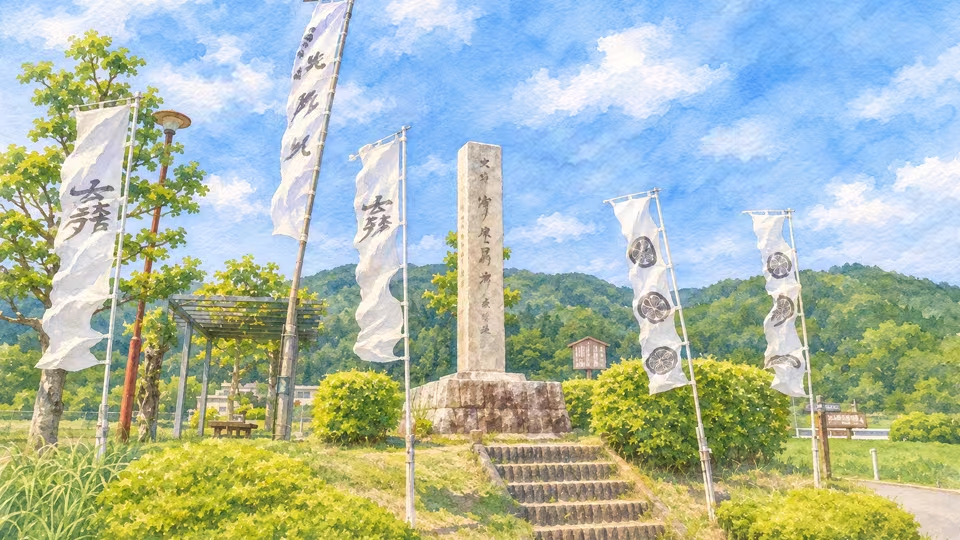
The battlefield was designated a National Historic Site in 1931. The designation covers the western part of the basin, where the battle opened and was decided, together with Ieyasu’s first and final positions, Mitsunari’s position, the beacon site on Okayama, Ōtani Yoshitsugu’s grave and the East and West head mounds. There are no buildings left from 1600. What stands on the field are memorial stones, many set up in the Edo period or since the Meiji era, position markers and banners placed for visitors, and paths and lookouts restored in recent decades.
The best starting point is the Gifu Sekigahara Battlefield Memorial Museum, opened in 2020. Its exhibits and films explain the campaign, and the top-floor observation deck gives a view across the basin: Mount Matsuo to the south, Sasaoyama to the northwest, Mount Nangū to the southeast. From up here the distances between the camps make sense in a way no map quite manages.
11Walking the Field
From Sekigahara Station, the East Kubizuka is a short walk away, a small mound with a shrine and old trees. Near the museum is Jinbano, Ieyasu’s final position, the square where he inspected the heads. The earthen banks and the raised platform in the middle were built in 1841 by the Takenaka family on the shogunate’s orders.
About a kilometer to the northwest is the stone marking the "decisive battlefield," where some of the heaviest fighting took place. Behind it rises Sasaoyama. A climb to Mitsunari’s position on top gives a sweeping view, and it is easy to look south toward Mount Matsuo and think about what he could see that morning.
Just south of Sasaoyama is the Shimazu position, by the Shinmei shrine in the old village of Koike. A little south of it, among the fields, a stone marks the place where the battle is usually said to have opened, with the Ii and Matsudaira shots at Ukita’s troops and Fukushima’s volley. Further south is Tenmanyama, where Konishi and Ukita stood.
To the southwest, in Yamanaka, are Ōtani Yoshitsugu’s camp and his grave, a stone memorial about a meter high put up soon after the battle by the Tōdō family, whose troops had fought Ōtani that day. A smaller grave for Yuasa Gosuke stands beside it. Looking up from here you can see Mount Matsuo. On its summit the Kobayakawa camp still preserves earthworks of a mountain fort, and from up there Ōtani’s position lies in plain view below, which explains better than anything why Hideaki’s choice mattered so much.
With more time you can head east to Momokubariyama and Ieyasu’s first position, or south to the foot of Mount Nangū and Nangū Taisha, the leading shrine of Mino Province. To the west are the site of the Fuwa barrier and its museum, which tell the story of a fight for the throne nine centuries before Ieyasu’s.