
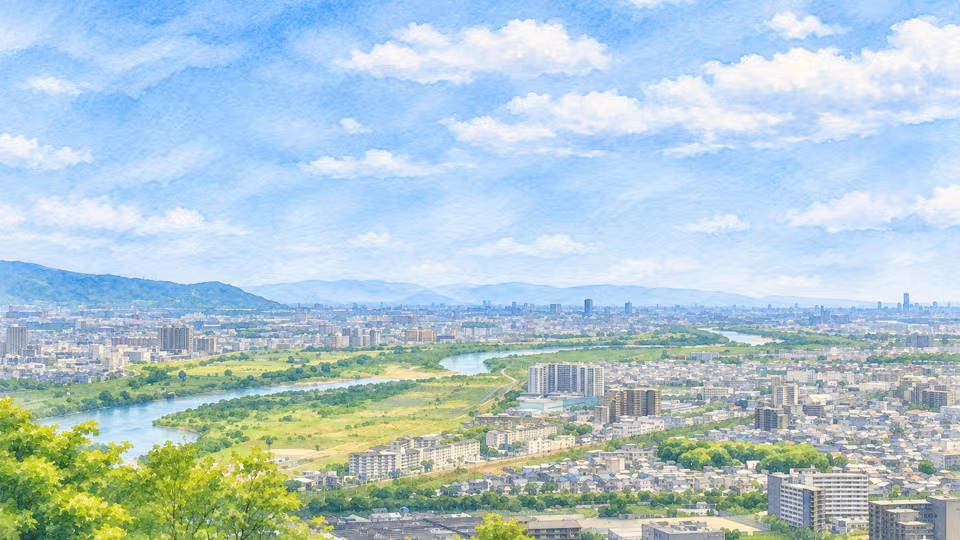
01A Gap Between Mountain and River
From the slopes of Mount Tennōzan you look down on a narrow strip of flat land and, beyond it, the broad Yodo River. Three rivers, the Katsura, the Uji and the Kizu, meet here to form the Yodo, which runs on to Ōsaka Bay. Across the water rises Otokoyama, the hill crowned by the great shrine of Iwashimizu Hachimangū. Tennōzan is only about 270 meters high, but together with Otokoyama it pinches the route between the Kyoto basin and the Ōsaka plain into a bottleneck. That bottleneck is Yamazaki.
For centuries this was the border between Yamashiro Province, the home province of the capital, and Settsu Province to the southwest. Anyone traveling from western Japan to Kyoto, by boat up the Yodo or overland along the road later called the Saigoku Kaidō (the "Western Provinces Highway"), passed through it. The corridor is still crowded: the JR Tōkaidō Line, the Hankyū Kyoto Line, the Tōkaidō Shinkansen and the Meishin Expressway all squeeze between the mountain and the river. Seen from above, it is obvious why an army marching on Kyoto from the west and an army defending the city would meet here.
The mountain takes its name from Gozu Tennō, the "Ox-Headed Heavenly King," a protective deity identified in premodern Japan with the god Susanoo. He was worshiped near the summit at a shrine known before the modern era as the Yamazaki Tennō shrine, today’s Sakatoke Shrine, and the mountain became "Tennō’s mountain."
02Yamazaki Before the Battle
Yamazaki’s importance long predates 1582. Tradition credits the eighth-century monk Gyōki with building a bridge across the Yodo here. In the early ninth century Emperor Saga kept a detached palace at Yamazaki, the Kayō-no-miya, and the short-lived capital of Nagaoka-kyō (784–794) lay just to the north. The river port of Yamazaki was where goods shipped from the west were transferred on their way to the capital.
In the medieval period the town of Ōyamazaki grew rich on oil. Its merchants, attached as sacred servants to Iwashimizu Hachimangū, formed a guild that controlled the purchase and sale of egoma (perilla) oil, used for lamps, across much of central Japan. Rikyū Hachimangū, the shrine near the station, was the guild’s center; its name, "Detached Palace Hachiman," recalls the tradition that it stands on the site of Emperor Saga’s palace. By the sixteenth century Ōyamazaki was a largely self-governing town, and like other wealthy communities it protected itself by obtaining written prohibitions (kinzei) from whichever warlord’s army was passing through, forbidding his troops to loot.
On the mountainside stood Hōshaku-ji, a temple said to have been founded by Gyōki. It was popularly known as Takara-dera, the "Treasure Temple," because of a magic mallet, an uchide no kozuchi, that was believed to grant wishes. In the summer of 1582 it would become Hideyoshi’s headquarters.
03Honnō-ji and the Race from the West
Early on the morning of the second day of the sixth month of Tenshō 10 (June 21, 1582, in the Julian calendar), Akechi Mitsuhide, one of Oda Nobunaga’s senior commanders, surrounded the Honnō-ji temple in Kyoto, where Nobunaga was staying with a small escort. Nobunaga died in the burning temple. His heir, Oda Nobutada, was killed the same day at the Nijō palace. Mitsuhide then occupied Nobunaga’s castle at Azuchi and set about winning over the imperial court, the Kyoto temples and the warlords of the region.
Hashiba Hideyoshi, the man later known as Toyotomi Hideyoshi, was far to the west in Bitchū Province, besieging Takamatsu Castle, a fortress of the Mōri clan. He had flooded the castle by building a dike to divert a river, and a Mōri relief army stood nearby. When news of Nobunaga’s death reached him, generally dated to the night of the third, he kept it secret and concluded a hasty peace with the Mōri, whose terms included the suicide of the castle’s commander, Shimizu Muneharu, on the fourth. Within a couple of days Hideyoshi was marching his army back east through heavy rain. He reached his own castle at Himeji on the seventh, rested his troops briefly, handed out the treasury’s gold and silver to his men, and pushed on toward the capital. This forced march, about 200 kilometers in roughly a week, is remembered as the Chūgoku Ōgaeshi, the "Great Return from the Chūgoku Region." The exact daily stages differ between sources.
As he advanced, Hideyoshi gathered allies. The lords of the Settsu region, Nakagawa Kiyohide of Ibaraki, Takayama Ukon of Takatsuki and Ikeda Tsuneoki, had served alongside Mitsuhide, yet all chose Hideyoshi. Nobunaga’s third son, Oda Nobutaka, and the veteran Niwa Nagahide, who had been gathering troops near Ōsaka for an invasion of Shikoku, joined as well. Nobutaka was the nominal commander; Hideyoshi held real control.
Mitsuhide, meanwhile, found that the allies he had counted on would not come. Hosokawa Fujitaka, whose son was married to Mitsuhide’s daughter, shaved his head in mourning for Nobunaga and stayed away. Tsutsui Junkei of Yamato wavered and in the end sent no troops. A later story has Junkei sitting on the pass at Horagatōge, watching to see which side would win before committing himself, and "Horagatōge" became a Japanese byword for fence-sitting. The story is not true: it was Mitsuhide who went to Horagatōge hoping Junkei would join him, while Junkei stayed in his castle.
04Lines Along a Small River
Mitsuhide chose to make his stand north of the Yamazaki bottleneck. He placed his headquarters at Onbōzuka, a low rise southwest of Shōryūji Castle, a small lowland fortress that served as his base. The exact site of Onbōzuka is uncertain; two old burial mounds, Igenoyama in Nagaokakyō and Sakaino No. 1 in Ōyamazaki, are the leading candidates. Between the two armies ran a stream then called the Enmyōji River, roughly today’s Koizumi River, flowing from the hills down to the Yodo. Mitsuhide’s idea seems to have been to let Hideyoshi’s larger army come through the narrow gap and meet it as it emerged.
The numbers in the sources vary widely. A common estimate gives Hideyoshi around 40,000 men and Mitsuhide around 16,000. On the Akechi side the leading commander was Saitō Toshimitsu, Mitsuhide’s senior retainer, with Ise Sadaoki, Matsuda Masachika, Namikawa Yasuie and Tsuda Nobuharu among the others. On Hideyoshi’s side, Takayama Ukon led the vanguard into Yamazaki village, with Nakagawa Kiyohide beside him. Hideyoshi’s brother Hashiba Hidenaga and his strategist Kuroda Kanbei (Kuroda Yoshitaka) held the foot of Tennōzan. Ikeda Tsuneoki and Katō Mitsuyasu took the riverside flank along the Yodo. Hideyoshi himself was at Hōshaku-ji, with Nobutaka and Niwa Nagahide behind him.
05The Battle of the Thirteenth
The battle was fought on the thirteenth day of the sixth month (July 2, 1582, Julian), in the rain. It began in the late afternoon, around four o’clock.
The Akechi army struck first, at Takayama and Nakagawa, who had pushed through Yamazaki village. Saitō Toshimitsu’s men pressed them hard, and for a time the vanguard was in trouble until Hideyoshi sent reinforcements under Hori Hidemasa. At the foot of the mountain, Matsuda Masachika and Namikawa Yasuie attacked Hidenaga and Kuroda in the wooded lower slopes. The decisive blow came on the river side. Ikeda Tsuneoki and Katō Mitsuyasu worked their way along the bank, crossed the stream, and fell on Tsuda Nobuharu’s troops, with Oda Nobutaka and Niwa Nagahide following up. When that flank broke, the Akechi line began to come apart, and the center gave way under the weight of Hideyoshi’s numbers.
The fighting lasted perhaps two or three hours. By nightfall the Akechi army had collapsed; Ise Sadaoki and Matsuda Masachika were among the dead. Mitsuhide fell back into Shōryūji Castle, but it was too small and too exposed to hold. After dark he slipped out with a handful of followers, heading east toward his own castle at Sakamoto on Lake Biwa.
Later military chronicles of the Edo period, such as the versions of the Taikōki (the life of Hideyoshi), turned the battle into a race for the summit of Tennōzan: whoever held the peak would command the field. Most historians now regard the contest for the summit as an embellishment. The battle was decided on the flat ground and along the river, though the lower slopes of the mountain were certainly part of the battlefield.
06The End of Mitsuhide, and a Figure of Speech
On his flight, Mitsuhide was attacked near Ogurusu, in what is now Fushimi Ward of Kyoto, by local villagers hunting fugitives from the beaten army. He was wounded by a bamboo spear and took his own life with a retainer’s help; accounts differ, and some say he was killed outright. A thicket there is still known as Akechi-yabu. His head was brought to Hideyoshi and exposed at the ruins of Honnō-ji. Saitō Toshimitsu was captured at Katata on Lake Biwa and executed on the riverbank at Rokujō in Kyoto on the seventeenth. At Sakamoto, Mitsuhide’s son-in-law Akechi Hidemitsu set fire to the castle and died in it.
Only eleven days had passed between Honnō-ji and Yamazaki. In Japanese, mikka tenka, "ruling the realm for three days," became the phrase for a brief seizure of power, and it was coined with Mitsuhide in mind. For Hideyoshi, victory made him the leading voice in settling Nobunaga’s succession. At the Kiyosu conference later that month he backed Nobutada’s infant son, Sanbōshi, as heir, outmaneuvering the senior Oda general Shibata Katsuie, whom he then defeated at Shizugatake the following year.
The battle also gave Japanese a third expression. "Tennōzan" means the decisive moment, the turning point that settles everything. Sports pages routinely call a crucial late-season game a "battle of Tennōzan." The phrase comes straight from the legend of the fight for the summit.
07Yamazaki Castle
Hideyoshi did not leave Yamazaki immediately after the battle. A fort had stood on the summit of Tennōzan since the fourteenth century; on that site he built Yamazaki Castle, also called Tennōzan Castle or Takaradera Castle, and for the next year it was his base. From here he managed the aftermath of Nobunaga’s death, a period that included the grand funeral he staged for Nobunaga at Daitoku-ji in Kyoto in the tenth month of 1582. The castle sat between Kyoto and Ōsaka and controlled traffic on the Yodo, which suited a man taking over central Japan.
In 1583 Hideyoshi began building Ōsaka Castle on the site of the former Ishiyama Hongan-ji, and his center of gravity moved south. The diary of the Kyoto priest Yoshida Kanemi records that the "keep of Yamazaki" was pulled down in the third month of 1584, and the castle was abandoned. Hideyoshi’s castle had lasted little more than a year, and nothing certain is known of the keep’s size or appearance.
What survives on the summit today are earthworks: leveled enclosures, earthen ramparts, turret platforms, the base of the keep, dry moats, the traces of wells, and scattered stones. The site is not a designated historic site and has seen little excavation. No buildings have been reconstructed. The castle is a shape in the forest.
At the foot of the mountain, the small temple of Myōki-an holds a reminder of Hideyoshi’s time at Yamazaki. Its tea house, Taian, is attributed to the tea master Sen no Rikyū and is regarded as the oldest surviving tea room in Japan, designated a National Treasure. Temple tradition says Rikyū built a two-mat tea room in Hideyoshi’s camp at the time of the battle and that it was later moved here; another view traces it to Rikyū’s own residence nearby. The tea room itself measures just two tatami mats.
08Hōshaku-ji: Headquarters and the "One-Night Pagoda"
Hōshaku-ji sits partway up the mountain path, a ten-minute walk or so from the stations. Its gate, rebuilt in the early Edo period, houses a pair of guardian kings (Kongō rikishi), and the main hall enshrines a standing Eleven-Headed Kannon; documents found inside the statue date it to around 1233. A small hall dedicated to Enma, king of the underworld, contains five seated Kamakura-period statues of Enma and his attendant judges and recorders, vivid and fierce, brought here from the nearby temple of Nishi-Kannon-ji after the anti-Buddhist upheavals of early Meiji. These statues are all national Important Cultural Properties.
The temple’s most striking building is its three-story pagoda. Legend says Hideyoshi had it built in a single night to celebrate his victory, and it is known as the "One-Night Pagoda." That is a story. The pagoda dates from the Momoyama period; one view places it around 1584. It is a national Important Cultural Property.
There is also a stone known as the Shusse-ishi, the "Stone of Success." Hideyoshi is said to have sat on it to direct the battle, and since he rose to become imperial regent, visitors sit on it in hope of advancement. This too is a later story. The magic mallet that gave the temple its nickname is said to have been given to Emperor Shōmu by a dragon god in a dream, and is kept in a small shrine in the grounds. The temple also worships Daikoku, a god of good fortune, and is the first stop on a Kyoto pilgrimage to six Daikoku temples.
09The Banner Pine and Sakatoke Shrine
Above Hōshaku-ji the trail climbs the eastern face of the mountain. Partway up is the Hatatate-matsu, the "Banner Pine," where Hideyoshi is said to have raised his standard during the battle to show his army that Tennōzan was in their hands. The tree there now is a later replacement. The spot has a viewing platform looking over the confluence of the three rivers and across to Otokoyama, and it is the best place to understand the lie of the land. Along the trail the town has set up a series of ceramic panels illustrating Hideyoshi’s life, and the one at the Banner Pine shows the Battle of Yamazaki.
Past the graves of the Seventeen (see below) is Sakatoke Shrine. Its main deity is the mountain god Ōyamazumi, with Susanoo enshrined alongside. Before the modern era it was known as the Yamazaki Tennō shrine and worshiped Gozu Tennō. In 1877 it was officially identified with an ancient shrine listed in the tenth-century register of shrines, the Engishiki, and took that shrine’s name. The shrine preserves a Kamakura-period storehouse for its portable shrines, built in the azekura style of interlocking timbers, a rare survival among shrine buildings and an Important Cultural Property.
Beyond the shrine lie the castle ruins and the summit.
10The Seventeen of 1864
Tennōzan returned to history in the 1860s. In 1864, the Chōshū domain, expelled from Kyoto politics the previous year, sent troops into the capital to try to regain its position. They fought the forces of Aizu, Satsuma and other domains around the imperial palace in what is called the Kinmon Incident or the Hamaguri Gate Rebellion, and lost. Maki Izumi (Maki Yasuomi), a Shinto priest of the Suitengū shrine in Kurume who had been one of the leaders, fell back to Tennōzan with his comrades. On the twenty-first day of the seventh month, seventeen of them, Maki included, killed themselves on the mountain.
They were first buried at the foot of the mountain and reburied in 1868 at the place where they died. Their graves, the Tomb of the Seventeen Patriots, lie on the trail between the Banner Pine and Sakatoke Shrine. After the Meiji Restoration they were honored as loyalist martyrs. For many walkers, Tennōzan is both the mountain of Hideyoshi’s victory and the mountain where these men died.
Four years later, at the start of 1868, during the Battle of Toba-Fushimi, the Tsu domain troops manning the Takahama battery across the river went over to the new government and fired on the retreating shogunate army, which fell back toward Ōsaka. Once again the Yamazaki gap saw fighting that decided who would rule Japan.
11Walking the Site
The sites line up neatly from JR Yamazaki Station or Hankyū Ōyamazaki Station. Near the stations is Myōki-an, which holds the Taian tea house. A short walk away is Rikyū Hachimangū, where a monument recalls the oil guild; most of the shrine burned in the fighting of 1864, when Chōshū troops were quartered there, and only its gates survived.
The mountain trail starts behind the stations. First comes Hōshaku-ji, with its gate, pagoda and Enma hall, and the Stone of Success. Continue up to the Banner Pine viewpoint, look out over the rivers, and compare the ceramic battle scene with the land below. Then the graves of the Seventeen, Sakatoke Shrine and its storehouse, and finally the castle ruins at the top. The round trip takes two to three hours, and parts of the trail are steep.
Near the start of the trail is the Asahi Group Ōyamazaki Villa Museum of Art, a hillside villa built in the Taishō and early Shōwa periods by the businessman Kaga Shōtarō.
To see where the main fighting took place, go north from the mountain. The Koizumi River area is now houses and parks; in Tennōzan Yume Hotaru Park, under the elevated Kyoto Jūkan Expressway, a stone marks the battlefield. Further north, in Nagaokakyō City, is the Igenoyama burial mound, one candidate for Mitsuhide’s headquarters, and beyond it Shōryūji Castle Park, the site of Mitsuhide’s last stronghold, with replica gates and turrets. Looking south from there toward Tennōzan, you can see what Mitsuhide hoped to do: use the stream and the gap to hold off the army coming from the west. On that rainy evening the line held for two or three hours.