
01Where You Are Standing
The Battle of Nagashino is one of the best-known fights in Japanese history, and one of the most misremembered. Most people picture a single scene: ranks of Oda Nobunaga’s musketeers firing in rotating volleys behind a wooden fence while the famous Takeda cavalry charges to its destruction. That scene is real in part and invented in part, and the ground here helps you sort out which is which.
There are two places to see. Nagashino Castle sits on a cliff where two rivers meet, in what is now Shinshiro City in the hills of eastern Aichi Prefecture. A few kilometers to the west lies Shitaragahara, a narrow valley where the decisive field battle was fought on a single day in 1575. The castle siege came first and caused the battle; the battle is what everyone remembers. Locals often call the whole event the Battle of Nagashino–Shitaragahara to keep both halves in view.
02A Castle on a Point of Rock
Nagashino Castle occupies the tip of a plateau between two rivers: the Kansa River (today counted as the upper Toyokawa) coming from the north and the Ure River (once called the Ōno River) from the northeast. Below their confluence they become the Toyokawa, which runs down to the sea at Toyohashi. On the south and west the castle is protected by sheer cliffs dropping to fast water. Only the northern side faces level ground, and there the builders dug dry moats and raised earthen ramparts.
Tradition says the castle was founded in 1508 by Suganuma Motonari, head of a local warrior family then allied to the Imagawa. In the sixteenth century this hill country, called Okumikawa (inner Mikawa), lay on the fault line between three powers: the Matsudaira (later Tokugawa) of Mikawa to the west, the Imagawa of Suruga and Tōtōmi to the east, and the Takeda of Kai and Shinano to the north. The small mountain lords here, among them the Okudaira of Tsukude and two branches of the Suganuma, survived by changing sides. Nagashino passed back and forth with them.
In the early 1570s the great Takeda warlord Takeda Shingen pushed west, and most of the Okumikawa families went over to him. Then in 1573 Shingen died on campaign. Tokugawa Ieyasu, then a regional lord allied to Oda Nobunaga, moved quickly to retake ground, and captured Nagashino that year. At about the same time the Okudaira, Sadayoshi and his son Sadamasa, deserted the Takeda for Ieyasu. The Takeda executed the hostages the Okudaira had left with them, three in all, among them Sadamasa’s wife Ofū and his younger brother. Whatever else the siege of 1575 was, for the defenders it was personal.
03Okudaira Sadamasa and Takeda Katsuyori
By 1575 Ieyasu had given Nagashino to Okudaira Sadamasa to hold. Born in 1555, he was about twenty. It was the most exposed post on his eastern frontier, and Sadamasa had nowhere to go if it fell.
Across the border, Shingen’s son Takeda Katsuyori had taken over. He was aggressive and, at first, successful: in 1574 he captured Takatenjin Castle in Tōtōmi, a fortress his father had failed to take. In the spring of 1575 he led a large army into Mikawa. He seems first to have counted on a plot among Ieyasu’s own retainers to open the way to Okazaki, Ieyasu’s home castle. When the plot was discovered, he turned on Nagashino instead.
The Takeda army is usually estimated at around 15,000 men. Inside the castle were perhaps 500. The Takeda turned toward Nagashino late in the fourth month of Tenshō 3 by the Japanese calendar and closed in on the castle early in the fifth (June 1575 in the Western calendar). Katsuyori set his headquarters on the hill behind Iō-ji temple north of the castle, and his men attacked from the north and from across the rivers. To guard against a relief army, the Takeda built a chain of small forts on Mount Tobinosu, the ridge across the Ure River south of the castle, which also overlooked the river crossing.
The garrison held the walls, but, by the usual account, it lost its storehouse and food ran short. They could last only if help came, and they had no way of knowing whether it would.
04Torii Suneemon
Someone had to get a message out. The man who went was Torii Suneemon, an ashigaru, a foot soldier of low rank, serving the Okudaira. On the night of the fourteenth day of the fifth month, according to the usual account, he slipped out through the castle’s drainage outlet and got across the river underwater, past the Takeda guards. Next morning he lit a smoke signal on Mount Ganbō to tell the garrison he had got through, and by that afternoon he was at Okazaki.
There he found not only Ieyasu but Oda Nobunaga, who had just arrived with his army. He was told that relief would come within days. Instead of staying behind in safety, Suneemon headed straight back to carry the news to the garrison. On the sixteenth, at Ariumi village on the far bank opposite the castle, he was captured by the Takeda.
What followed is the reason his name survives. The Takeda offered to spare and reward him if he would call out to the defenders that no help was coming and that they should surrender. He agreed. Brought before the walls, he shouted instead that the relief army was on its way and that they need only hold out a few more days. The Takeda killed him on the spot; the usual account says they crucified him where the garrison could see, though one early version has him cut down. He was thirty-six by Japanese reckoning, according to later tradition.
The story is not in the Shinchō Kōki, the most reliable chronicle of the campaign (more on it below). The earliest detailed telling comes some fifty years later in Oze Hoan’s Shinchōki, followed by the Mikawa Monogatari and other works. Suneemon himself is generally accepted as real, but the details of his last words, and the death poem attributed to him, have been polished by later writers.
A warrior named Ochiai Saheiji Michihisa is said to have been so struck by Suneemon’s courage that he had the scene painted on the banner he wore on his back in battle: a man in a red loincloth, bound spread-eagled to a wooden cross. The banner survives and is held by the Historiographical Institute of the University of Tokyo. Almost every image of Suneemon you will see around Nagashino descends from it. The traditional story makes Ochiai a Takeda retainer who saw the execution; some historians point out that he was already serving Ieyasu by 1575 and may not have witnessed it.
Suneemon’s first grave was at Shinshō-ji temple in Ariumi, which still has a gravestone for him, and Kansen-ji temple in the Tsukude district of Shinshiro has another, said to have been built on Nobunaga’s orders. A memorial stone in Ariumi marks where he is said to have died. A small station on the JR Iida Line nearby is named Torii after him.
05The Allies Arrive
Nobunaga left his base at Gifu on the thirteenth, joined Ieyasu at Okazaki on the fourteenth, and reached Shitaragahara on the eighteenth. He set his headquarters first on Gokuraku-ji hill and later moved to Chausu-yama; Ieyasu took Danjō-yama (also called Takamatsu-yama), further forward. Nobunaga’s army is usually estimated at about 30,000, Ieyasu’s at about 8,000.
Shitaragahara lies about four kilometers west of the castle. It is a long, narrow strip of low ground running north to south, with a small stream, the Rengo River, down the middle and low hills on either side. Nobunaga did not march straight on to relieve the castle. He drew up his army along the hills west of the Rengo, with many units hidden behind the ridges so that the Takeda could not see their full strength.
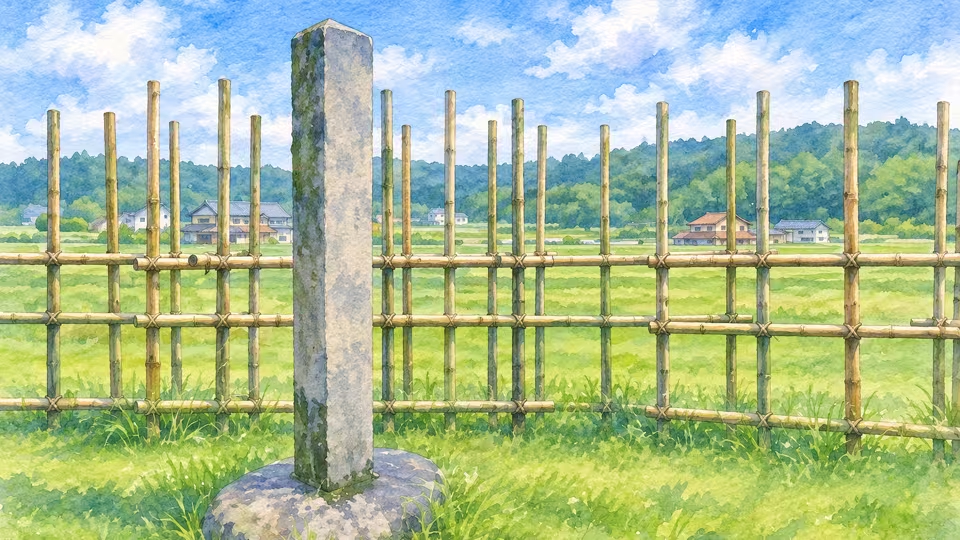
He also built a fence. According to Ōta Gyūichi’s Shinchō Kōki (The Chronicle of Lord Nobunaga), the most reliable contemporary account, Nobunaga had his troops carry timber and rope with them from the start of the march. Along the west bank of the Rengo they raised a palisade, known in Japanese as bōbasaku, literally "horse-stopping fence". It was not one continuous wall but a line with layers and gaps, behind which stood the musketeers, archers and spearmen. The idea was simple: let the stream, the slope and the fence break up any attack, and meet it with concentrated fire.
06Katsuyori’s Choice
Faced with the allied army, Katsuyori had to decide whether to fight or withdraw. Later Takeda chronicles, chiefly the Kōyō Gunkan, say his veteran generals Baba Nobuharu, Yamagata Masakage and Naitō Masatoyo urged retreat and he overruled them. That account was written decades later and casts Katsuyori as the reckless heir, so it should be read with care. What is certain is that he left a holding force at the castle, crossed the Taki River with his main army, and advanced onto the hills on the eastern side of Shitaragahara, facing Nobunaga across the valley. A letter he is generally thought to have written on the eve of battle suggests he believed the enemy was hesitant.
On the night of the twentieth, Ieyasu’s senior retainer Sakai Tadatsugu led a detached force of about 4,000, reinforced by musketeers from Nobunaga, on a long march over the mountains to the south. At dawn on the twenty-first they fell on the Takeda forts on Mount Tobinosu. Katsuyori’s uncle Kawakubo Nobuzane, who commanded there, was killed and the forts fell one after another. The siege of Nagashino was broken, and the garrison sallied out to join the attack.
Now Katsuyori’s main army had enemies behind it as well as in front. It could retreat in the face of a much larger army or attack. It attacked.
07The Twenty-first Day of the Fifth Month
The battle was fought on the twenty-first day of the fifth month of Tenshō 3, which is June 29, 1575 in the Julian calendar. It began in the early morning and went on into the afternoon.
The Takeda came on in successive waves against the fence along the Rengo. The Shinchō Kōki says Nobunaga picked out about a thousand muskets and put them under five commanders, Sassa Narimasa, Maeda Toshiie, Nonomura Masanari, Fukutomi Hidekatsu and Ban Naomasa. Unit after unit of the Takeda advanced, was driven back by fire, and advanced again. Yamagata Masakage, attacking the Tokugawa sector, was shot and killed. The brothers Sanada Nobutsuna and Sanada Masateru, Tsuchiya Masatsugu, Hara Masatane and Naitō Masatoyo all died.
By early afternoon the Takeda army had broken. Baba Nobuharu commanded the rearguard that covered Katsuyori’s escape and, by tradition, was killed at Suzawa on the Toyokawa. Katsuyori got away with a handful of men and made his way back to Shinano. Estimates of Takeda losses vary wildly, from a few thousand to more than ten thousand, and none can be trusted. What is clear is that a large part of the senior commanders who had served Shingen died in a single day.
08The "Three-Row Volley" and Other Myths
The famous image of Nagashino is of 3,000 muskets in three ranks: the first rank fires and steps back to reload, the second steps forward and fires, then the third, in a continuous rolling volley that mows down the Takeda horsemen. For much of the twentieth century this was taught in Japanese schools as a military revolution.
The trouble is that the best source does not say it. Ōta Gyūichi’s Shinchō Kōki speaks of "about a thousand" muskets. Scholars still disagree on whether the true figure was one thousand or three. The Shinchō Kōki says nothing at all about firing in three rotating ranks.
The three-thousand-guns, three-row story is generally traced to the Shinchōki, a popular retelling written in the early seventeenth century by Oze Hoan. Hoan wrote well and was widely read, but he embellished freely. In the Meiji period the Imperial Army General Staff adopted his version in its official history of the battle, complete with formation diagrams, and from there it passed into textbooks.
From the 1980s historians, notably Fujimoto Masayuki, attacked the story. Spread along a front of two kilometers or more, a thousand or even three thousand matchlocks could not have been coordinated into neat rotating ranks; a matchlock needs room, and men packed three deep with burning cords and loose powder would endanger each other. Others have answered that "three" might describe groups of gunners taking turns rather than literal ranks, which was perfectly feasible. The famous "Takeda cavalry" has also been questioned: Japanese horses of the time were small, mounted warriors often fought on foot, and the Takeda also carried firearms.
A cautious summary today runs like this. Nobunaga brought far more guns than the Takeda, along with the powder and lead to keep them firing, and fought from a prepared position of stream, fence and hillside. Katsuyori, with his rear cut off, attacked that position head-on. Numbers, ground and supply decided the day, not a miracle drill. Lead bullets from the period have been dug up around the battlefield. Lead-isotope analysis of some of them by Hirao Yoshimitsu and colleagues points to lead brought from overseas, and Hirao has argued that Nobunaga was deliberately importing lead and gunpowder.
09After the Battle
The castle had held. By the usual account, Nobunaga rewarded Sadamasa with one character of his own name, and he became Okudaira Nobumasa. The next year Ieyasu married him to his eldest daughter, Kamehime, as had been promised when the Okudaira changed sides. The family became Tokugawa in-laws and survived through the Edo period as daimyo, later at Nakatsu in Kyūshū.
Nagashino Castle itself had been badly damaged. Soon after the battle Nobumasa built a new castle, Shinshiro ("new castle"), to the southwest, and when he moved there in 1576 Nagashino was abandoned. The modern city takes its name from that new castle.
For the Takeda, the defeat began a decline rather than an immediate collapse. Katsuyori held on for seven more years until the Oda and Tokugawa invaded Kai in 1582 and he took his own life at Tenmokuzan. The Takeda house ended with him.
10Nagashino Castle Today
The castle site was designated a National Historic Site in 1929. No buildings survive. What you see is ground and earthwork: the level main enclosure (honmaru), well-preserved earthen ramparts and dry moats on the northern side, and the cliffs at the meeting of the rivers. The JR Iida Line cuts right through the site, separating the main enclosure from the Yagyū enclosure to the north; the station is called Nagashinojō, "Nagashino Castle".
Beside the main enclosure is the Nagashino Castle Preservation Museum, which displays finds from the site, arms and armor, and material on the battle and on Torii Suneemon. From the southern tip of the enclosure you look down on the confluence and across to the ridge of Mount Tobinosu. This is the water Suneemon swam.
North of the castle, the hill behind Iō-ji temple was Katsuyori’s siege headquarters, and a stone in the temple grounds marks it. The temple pond grows reeds with leaves on only one side. Local legend says the spirit of the reeds came to Katsuyori in a dream on the eve of battle, in the form of an old man, to warn him off; Katsuyori cut at him with his sword, and next morning the reeds had lost their leaves on one side.
11The Battlefield Today
The field battle was fought around what are now the Takehiro and Ōmiya districts of Shinshiro. The Rengo River still runs through the valley, now among rice fields and houses. On its west bank a stretch of the palisade has been reconstructed from posts and cross-rails. The original ran for about two kilometers, and the Oda and Tokugawa sections are said to have placed their openings differently. The reconstruction is a short stretch on an estimated line, but it shows how the fence followed the stream and where gaps were left. Stand in front of it and look east, and you see what the Takeda had to do: cross the water, climb the slope, and reach the fence under fire.
Nearby, the Shitaragahara History Museum, opened by the city in the 1990s, holds material on the battle and is known for its large collection of matchlock guns. It is the best place on site to think about the gun debate with the objects in front of you.
The valley is dotted with mounds and graves. The best known are the Shingen-zuka, a large mound and a small one, where local villagers are said to have buried the dead of both sides. Despite the name, Shingen himself had died two years before the battle. Local legend says swarms of bees later rose from the mounds and stung people, which villagers took as a sign of restless spirits, and they began a fire ritual to console them. The ceremony, called hi-ondori, is held on the night of August 15, during the Bon festival of the dead: participants swing torches two or three meters tall to the beat of gongs and drums. It is designated an intangible folk cultural property of Aichi Prefecture. Around the fields are grave markers and memorial stones for Takeda commanders, including Yamagata Masakage, Tsuchiya Masatsugu and Naitō Masatoyo; Baba Nobuharu’s grave, said to hold his head, is near the Nagashino Bridge, some distance from where he fell. Most were raised long after the battle and do not necessarily mark actual burials, but together they trace where the Takeda units came on.
12A Walk Through Both Sites
If you have time, see both. Get off at Nagashinojō Station and walk into the main enclosure. Look at the ramparts and dry moats on the north side, then go to the cliff edge above the confluence and imagine five hundred men holding out for half a month. In the museum, look for the material on Suneemon. Then cross to Ariumi on the far bank, find the marker for Suneemon’s execution, and turn round to look at the castle. You will see how close the garrison was when he called out to them.
Then go west to Shitaragahara. Start at the history museum, walk down to the Rengo River and along the reconstructed fence, then cross the stream to the east and visit the Takeda graves and the Shingen-zuka mounds. From the low hills on the east side, looking west, you have the Takeda view of that morning: a narrow stream, a fence, a gentle slope, and behind it an enemy whose numbers you could not see.
Commemorations held around May often include demonstrations of matchlock firing, and the sound carries along the river valley.