
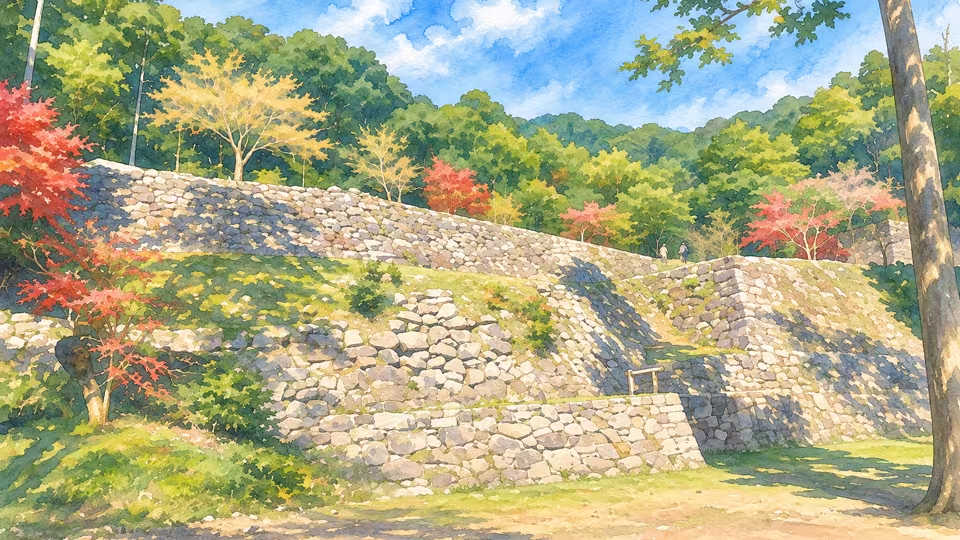
01What You Are Standing On
Azuchi Castle was in use for less than a decade, and its great tower stood for only three years. Yet when Japanese historians divide their country’s past into periods, the half-century that began with the unification wars is often called the Azuchi-Momoyama period, and the first half of that name comes from this hill. The castle that gave its name to an era is now a wooded slope of stone steps and foundation stones in Ōmihachiman, Shiga Prefecture (the site extends into neighboring Higashiōmi), on the eastern side of Lake Biwa.
The man behind it was Oda Nobunaga (1534–1582), the warlord from Owari Province (western Aichi today) who did more than anyone to end the long civil wars of the Sengoku, or "Warring States," era. By 1576 he had occupied Kyoto, driven out the last Ashikaga shogun, burned the great monastery on Mount Hiei, and defeated the Takeda army at Nagashino. He had also handed his old headquarters at Gifu, together with formal headship of the Oda house, to his eldest son Nobutada. He wanted a new seat, and he chose Mount Azuchi.
Look around from the foot of the hill and you see flat rice fields. In Nobunaga’s day much of this was water. Mount Azuchi was almost surrounded by inner lagoons of Lake Biwa, so that boats could come right up to its base. Those lagoons were drained and turned into farmland after the Second World War, which is why the castle now seems oddly placed, a lone hill in a plain rather than a promontory on a lake.
02Why Here
The site made sense on a map. Azuchi lay on the Tōsandō, the main inland road from Kyoto to the east, and on Lake Biwa, which in the sixteenth century was a busy waterway carrying people and goods between the capital and the provinces to the north and east. From Azuchi, Nobunaga could reach Kyoto in a day by boat across the lake, yet he did not have to live inside the capital and its tangle of court and temple politics. Roads ran from here to his home provinces of Mino and Owari and north toward the Hokuriku coast, where his generals were fighting.
Construction began in the first month of Tenshō 4, early 1576. The general in charge of the works was Niwa Nagahide, one of Nobunaga’s most trusted senior retainers. Labor was drawn from many provinces, and carpenters, stonemasons, metalworkers and painters were summoned from Kyoto, Nara and Sakai. Ōta Gyūichi, a retainer who later wrote Shinchō Kōki (the Chronicle of Lord Nobunaga), the main Japanese account of Nobunaga’s life, describes huge stones being hauled up the hill. One of them, called the Jaishi or "Serpent Stone," supposedly needed more than ten thousand men pulling for three days.
03The Tenshu
The heart of the castle was the tower that the records call the tenshu, written with characters meaning "lord of heaven." Later castle keeps were normally written with a different character, meaning "heaven’s defense," and pronounced the same way. Whether the Azuchi spelling carried a religious or political meaning is still argued over.
Nobunaga himself moved to Azuchi in the second month of 1576, only weeks after work began, and lived at first in temporary quarters. The tower was finished in the fifth month of Tenshō 7 (1579), and he moved into it that month. Ōta Gyūichi gives a floor-by-floor description. The tower rose on a high stone base; outside it showed five roofs, but inside it had seven levels, one of them a basement within the stone base. The rooms were decorated with paintings by Kanō Eitoku, the leading painter of the age, and his workshop: birds and flowers, landscapes, and scenes from Chinese history and legend.
The top two floors were the most striking. The second-highest was octagonal, painted inside with the Buddha preaching and his ten great disciples. The highest was square and gilded inside and out, its walls showing Chinese sage-kings, the disciples of Confucius, and other worthies of Chinese tradition. A Buddhist level topped by a Confucian one, the whole thing crowned with gold: scholars have read this as Nobunaga’s statement about order, rule, and his own place in the world. He left no explanation of his own.
The roof tiles were partly covered in gold leaf, and excavations have turned up gold-leaf tiles to prove it. The Jesuit missionary Luís Fróis, who saw the castle, wrote that it could compare with the finest buildings in Europe, and described a tower whose stories were finished in different colors and that could be seen from far away.
Nobody knows exactly what the tenshu looked like. The best-known reconstruction is by the architectural historian Naitō Akira, who in the 1970s used a set of plans preserved by a family of carpenters in Kanazawa. His version has a tall open atrium rising through the middle of the building, with a Buddhist pagoda at its base. It is an arresting idea, but many specialists doubt that the plans really show Azuchi, and other scholars have produced quite different reconstructions. Estimates of the height vary, but most fall somewhere between about thirty and forty-five meters from the bottom of the stone base.
04A New Kind of Castle
Earlier Japanese castles were mostly earthwork forts on hilltops, with wooden palisades and buildings meant for war, not for show. Nobunaga’s own earlier seats at Komaki and Gifu had already moved toward something grander, with stone walls and impressive residences. Azuchi took the step fully. It was walled in stone throughout, roofed with ceramic tiles, crowned with a tall, painted, gilded tower, and laid out as much to be seen and visited as to be defended.
The castle became the model for those built over the next few decades by Nobunaga’s successors and former followers. Toyotomi Hideyoshi’s Ōsaka Castle, and later the great keeps of the Tokugawa period such as Himeji, belong to the line that starts here. That is why the period of Nobunaga and Hideyoshi is named after Azuchi and after Momoyama, the hill at Fushimi where Hideyoshi built his last castle.
05The Town Below
Nobunaga built a town at the foot of the castle, and he wanted people to move to it. In the sixth month of Tenshō 5 (1577) he issued a set of thirteen regulations for the town. They declared it a free market, with no guild (za) monopolies and exemption from many taxes and services. Merchants traveling the main road were required to stop and lodge in Azuchi, and newcomers were promised the same treatment as old residents. This is the most famous example of the policy known as rakuichi rakuza, "free markets, free guilds." Nobunaga did not invent the idea, and he had used it at Gifu, but the Azuchi document is complete and has survived, and it has come to stand for the whole policy. The original is kept in Ōmihachiman.
Nobunaga also pressed his retainers to live in Azuchi with their families, rather than on their own lands. When a fire broke out in a retainer’s house in early 1578 and it turned out the man had left his wife and children back in Owari, Nobunaga reportedly had the homes of a group of such retainers in Owari burned to force them to move. Historians often point to this as an early step toward separating warriors from the land, something Hideyoshi later pursued systematically.
06Debates, Missionaries and Festivals
Azuchi was not only a fortress and a market town; it was also the stage for some of the most famous events of Nobunaga’s later years.
In 1579 a dispute between preachers of the Jōdo (Pure Land) and Nichiren schools of Buddhism led to a public debate held at the temple of Jōgon-in in the town. Nobunaga arranged it and appointed the judges. The Jōdo side was declared the winner, and the Nichiren side was punished and made to sign a pledge not to attack other schools again. This Azuchi Debate is generally seen as a deliberate move to humble the Nichiren school, which was powerful among the merchants of Kyoto.
Nobunaga also built a temple within the castle grounds, Sōken-ji, assembling it partly from buildings moved from elsewhere in Ōmi Province. Fróis wrote that Nobunaga placed a stone there and ordered people to worship it as his own embodiment. That claim appears only in Jesuit sources and is treated cautiously by Japanese historians.
The Jesuits themselves were welcome at Azuchi. In 1581 the Visitor of the Jesuit mission in Asia, Alessandro Valignano, came to the castle and was received by Nobunaga. A year earlier, with Nobunaga’s permission, the missionaries had opened a seminary in the town, where the sons of samurai families studied Latin, music and other subjects. Nobunaga gave Valignano a pair of folding screens depicting Azuchi Castle and its town, said to have been painted by Kanō Eitoku. The screens were carried to Rome and presented to Pope Gregory XIII. They have since disappeared, and people still search the Vatican collections for them from time to time.
Festivals filled the calendar too. At the New Year of 1581, Nobunaga staged a sagichō, a fire festival, with himself and his kinsmen and vassals riding in fine costume through crowds of spectators. That summer, at the Bon festival for the dead, he had lanterns hung on the tenshu and Sōken-ji, while retainers in boats lit torches on the water below. Shinchō Kōki records the scene, and it is often described as the night Azuchi looked most beautiful. At the New Year of 1582 so many people came to pay their respects that a stone wall collapsed under the crowd, killing some of them.
07The Last Spring
In the spring of 1582 Nobunaga’s armies destroyed the Takeda house. In the fifth month, Tokugawa Ieyasu, Nobunaga’s ally in the east, came to Azuchi to give thanks for the province of Suruga, which he had received as his share of the Takeda lands. Akechi Mitsuhide, one of Nobunaga’s leading generals, was put in charge of entertaining him. Partway through, Mitsuhide was ordered to leave and prepare to reinforce Hashiba (later Toyotomi) Hideyoshi, who was fighting the Mōri clan in western Japan. Later stories say Nobunaga shamed Mitsuhide over spoiled fish served to Ieyasu, but these come from writings of the Edo period and are not reliable.
On the second day of the sixth month (June 21, 1582 in the Julian calendar), Mitsuhide turned his army against Nobunaga, who was staying at the temple of Honnō-ji in Kyoto. Nobunaga died there at the age of forty-eight by Western reckoning.
08The Fire
Azuchi was being held by Gamō Katahide, lord of Hino Castle in Ōmi. When the news from Kyoto arrived, he concluded the castle could not be defended and withdrew to Hino, taking Nobunaga’s wives and household with him. The Akechi forces took Azuchi without a fight. Mitsuhide entered the castle on the fifth day of the sixth month and distributed its treasures among his men, then left his son-in-law Akechi Hidemitsu in charge.
On the thirteenth, Hideyoshi, who had rushed back from the west, crushed Mitsuhide at the Battle of Yamazaki, and Mitsuhide was killed while fleeing. Hidemitsu abandoned Azuchi. Around the fifteenth, the tenshu and the main enclosure burned.
Who set the fire is still unknown. Fróis blamed Nobunaga’s second son, Oda Nobukatsu, and described him as a fool. Other accounts point to Hidemitsu’s retreating troops, and some historians suggest looters or a fire that spread from the town. Excavation has confirmed that the summit buildings were destroyed by fire, but it cannot say whose hand lit it.
09Abandonment and the Temple That Stayed
The castle’s lower enclosures remained in use for a short time. After the meeting at Kiyosu in 1582 where Nobunaga’s senior retainers settled the succession, his infant grandson Sanbōshi, the future Oda Hidenobu, was lodged at Azuchi for a period. But in 1585 Hideyoshi’s nephew Hashiba Hidetsugu was given lands in Ōmi and built a new castle on Mount Hachiman a few kilometers to the west. The townspeople of Azuchi were moved there, and their new town grew into the old center of Ōmihachiman. Azuchi Castle was abandoned.
Sōken-ji stayed. Through the Edo period the temple looked after the hill and kept the memory of Nobunaga. In 1854 a fire destroyed its main hall and many other buildings. Two survived, and they are now the oldest structures on the mountain: a three-story pagoda built in 1454, which Nobunaga had moved here from Chōju-ji temple in Kōka, and a two-story gate built in 1571, also brought from Kōka. Both are Important Cultural Properties. The main hall was never rebuilt; the temple now operates from a site lower on the hill that tradition identifies as the residence of Tokugawa Ieyasu.
In the second enclosure stands a memorial mausoleum for Nobunaga. Tradition says Hideyoshi built it on the first anniversary of Nobunaga’s death and buried some of Nobunaga’s belongings there, such as a sword and court robes; his remains were never found.
10Digging Azuchi
The ruins were designated a national Historic Site in 1926 and a Special Historic Site, the highest category, in 1952. From 1989 Shiga Prefecture carried out a twenty-year program of excavation and restoration that changed how the castle is understood.
The biggest surprise was the main approach. Instead of a winding defensive path, the excavators found a straight stone stairway about six meters wide running some 180 meters up the hill from the main gate on the south side, lined with walled residential compounds. Such a broad, straight avenue is almost unheard of in a castle of the period, and it is usually explained as a road for display and ceremony. Two of the compounds beside it have long been called the residences of Hashiba Hideyoshi and Maeda Toshiie, and the site signs keep those names with the word "traditionally," because there is no proof.
On the summit, the excavators found the foundations of a large palace building in the main enclosure. Some researchers noted that its plan resembles the Seiryōden, the emperor’s residential hall in the Kyoto palace, and suggested that Nobunaga was preparing to receive the emperor at Azuchi. The idea is attractive, and much debated.
Many of the stones in the stairways are recycled Buddhist images and gravestones. Some see in them Nobunaga’s contempt for religious authority; others note that castle builders of the time often used whatever stone was at hand.
In recent years the prefecture has begun a new long-term research program, and work around the tenshu base continues.
11Seeing the Tower Today
There is no reconstructed tower on the hill. To get a sense of the tenshu, visit the two facilities near the foot of the mountain. The Shiga Prefectural Azuchi Castle Archaeological Museum displays finds from the site, including gold-leaf tiles, along with models. Nearby, the Nobunaga no Yakata ("Nobunaga’s Hall") houses a full-size reconstruction of the top two floors of the tenshu, made for the Japan pavilion at the 1992 Seville Expo and brought back afterward. It follows Ōta Gyūichi’s description and Naitō Akira’s reconstruction, gold walls and all. It shows one scholar’s interpretation rather than the building itself, but it gives a vivid idea of what the chronicle describes.
12A Walk Up the Hill
Start at the restored main gate area on the south side and climb the great straight stairway. The steps are steep and uneven, and the climb is harder than it looks. Partway up, on either side, are the walled compounds traditionally linked to Hideyoshi and Maeda Toshiie, with the outlines of their buildings marked out. Watch the treads: some of the stones are carved Buddhas, and signs point them out.
Where the straight stairway ends, the path begins to zigzag. It passes the site traditionally linked to Tokugawa Ieyasu, where Sōken-ji’s present temporary hall stands, and then the Kurogane Gate ruins, where some of the castle’s best-preserved stone walls survive. Above that is the second enclosure with Nobunaga’s mausoleum, then the main enclosure with its rows of palace foundation stones.
The last flight of steps brings you onto the tenshu base. Rows of foundation stones remain, with a gap at the center that Naitō Akira took for the position of the pagoda inside the atrium; others read it differently. Look north. Where you see fields, Nobunaga saw water, and on a clear day you can still see the open lake in the distance.
On the way down, take the path past the site of Sōken-ji’s lost main hall. Below it stand the three-story pagoda and the gate, both older than the castle and both carried here at Nobunaga’s command. They are the only wooden buildings on the hill that Nobunaga himself would have known.