
01Where You Are Standing
Kawagoe sits about thirty kilometers north-west of central Tokyo, on the north-eastern lip of the Musashino Plateau. Below the plateau’s edge runs low, wet ground threaded by rivers, the Iruma and the Shingashi, that eventually drain toward Tokyo Bay. High dry ground for defense, water routes for trade: that combination explains most of what happened here. In the medieval period Kawagoe was a fortress fought over by the rival powers of the Kantō, the great eastern plain. Under the Tokugawa shoguns it became a castle town guarding the northern approach to Edo (the city that became Tokyo) and a supply depot feeding the capital.
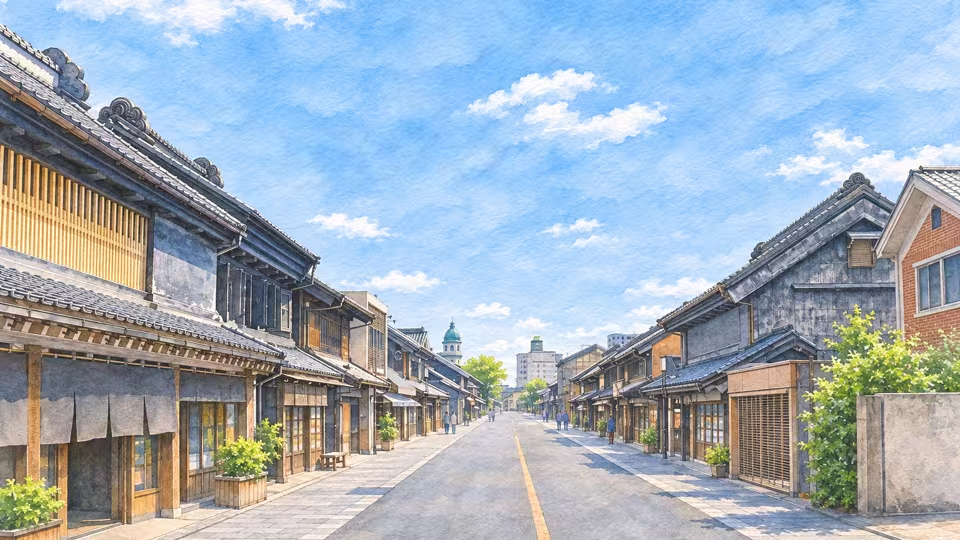
Most visitors today come for one street. Along Ichibangai, rows of heavy black-walled merchant houses face each other, and just off the street rises a wooden bell tower. The town markets itself as Ko-Edo, "Little Edo," and the label is fair in one sense: for more than two centuries Kawagoe’s merchants lived on trade with Edo, copied its fashions, and staged a festival modeled on its own. But almost none of the black merchant houses date from the Edo period. Most were built after a fire in 1893. Kawagoe is a town of layers, and the fun of walking it is sorting them out.
02The Kawagoe Warriors
The place name was originally written 河越, "beyond the river." In the late Heian period, a branch of the Chichibu clan, part of the warrior network of eastern Japan known as the Bandō samurai, took control of an estate here and adopted its name. The Kawagoe family rode with Minamoto no Yoritomo, founder of the Kamakura shogunate, and Kawagoe Shigeyori married his daughter to Yoritomo’s brother, Minamoto no Yoshitsune. When the brothers fell out, Shigeyori was caught on the wrong side and executed. The family recovered in the fourteenth century, then was crushed in a regional revolt in 1368 and faded away.
The family’s residence lay not in today’s old town but several kilometers to the north-west by the Iruma River. The excavated site, the Kawagoe-yakata ruins, is a National Historic Site, and it is worth knowing that it exists, though few tourists go.
03Ōta Dōkan Builds a Castle
By the mid-fifteenth century the Kantō had collapsed into a long civil war. The Kamakura kubō, the shogun’s deputy in the east, Ashikaga Shigeuji, broke with the Uesugi family who were supposed to serve as his chief ministers. Shigeuji relocated to Koga, north of the Tone River, and became known as the Koga kubō. The Uesugi themselves were split into two lines, the Yamanouchi and the Ōgigayatsu.
In 1457 the Ōgigayatsu Uesugi chief, Uesugi Mochitomo, ordered his house steward Ōta Sukekiyo (better known as Dōshin) and Sukekiyo’s son Ōta Dōkan to fortify Kawagoe. That same year Dōkan built the first castle at Edo. Kawagoe, Edo and Iwatsuki together formed a defensive line against the Koga kubō. Edo would become the seat of the Tokugawa shoguns, but in the late fifteenth century Kawagoe was the more important of the two, the headquarters of the Ōgigayatsu Uesugi.
Dōkan is remembered as a brilliant general, a castle builder and a poet. His success made his lord nervous: in 1486 Uesugi Sadamasa had him murdered at a bathhouse in his residence at Kasuya in Sagami.
04The Night Battle of Kawagoe
In the sixteenth century a new power pushed north out of Izu and Sagami: the Later Hōjō, based at Odawara. In 1537 Hōjō Ujitsuna captured Kawagoe Castle from Uesugi Tomosada of the Ōgigayatsu line. The Hōjō installed Hōjō Tsunashige, a ferocious commander adopted into the family, as its keeper.
In 1545 the two Uesugi lines, which had long fought each other, joined forces. Uesugi Tomosada and Uesugi Norimasa of the Yamanouchi line, with the Koga kubō Ashikaga Haruuji as an ally, surrounded Kawagoe with an army that later chronicles put at 80,000. Inside, Tsunashige was said to have about 3,000 men. The young Hōjō Ujiyasu, who had recently succeeded his father, was fighting the Imagawa in Suruga at the same time.
Ujiyasu made peace with the Imagawa and marched to relieve the castle. On the night of the twentieth day of the fourth month of Tenbun 15 (May 19, 1546, in the Julian calendar), he struck the besiegers’ camps with roughly 8,000 men. According to the later war tales, he had first sent humble peace overtures to make the allies complacent, and he told his troops to strip off heavy armor, wear white markings to recognize each other, and not stop to take heads. When the attack hit, Tsunashige sallied from the castle. The allied army broke. Uesugi Tomosada was killed, and the Ōgigayatsu Uesugi line ended with him. Norimasa fled to Kōzuke and later sought refuge with Nagao Kagetora of Echigo, the man who became famous as Uesugi Kenshin. Ashikaga Haruuji retreated to Koga, and the Koga kubō drifted into dependence on the Hōjō.
The engagement is known as the Night Battle of Kawagoe and is often listed with Itsukushima and Okehazama as one of Japan’s "three great surprise attacks." The troop numbers and the colorful tactics come from Edo-period war chronicles; modern historians consider the 80,000 figure greatly inflated, and some doubt there was a night attack at all. A letter from Uesugi Norimasa himself confirms that a battle was fought at Kawagoe on the twentieth, and the result is not in doubt: the battle made the Hōjō masters of the southern Kantō for the next forty years.
05Gateway North of Edo
In 1590 Toyotomi Hideyoshi besieged Odawara and destroyed the Hōjō. Kawagoe surrendered without a fight. Tokugawa Ieyasu was moved to the Kantō and made Edo his base, and he gave Kawagoe, with an income of 10,000 koku of rice, to his hereditary retainer Sakai Shigetada. Kawagoe domain was born.
Being only a day’s march from Edo, Kawagoe was treated as a key post on the capital’s northern flank, and its lords were usually men at the center of shogunal government. Sakai Tadakatsu, lord of Kawagoe from 1627 to 1634, was already a senior councilor (rōjū) and later became great elder (tairō). After him came Hotta Masamori, Matsudaira Nobutsuna, Yanagisawa Yoshiyasu and Akimoto Takatomo, all powerful figures in Edo. The domain changed hands among many families over the period, a sign of how much the shogunate cared who held it.
06Tenkai and Kita-in
The other center of early Edo-period Kawagoe was Kita-in, a Tendai Buddhist temple east of the castle. The temple’s own tradition says it was founded in 830 by the monk Ennin. It had declined badly by the late sixteenth century when, in 1599, the monk Tenkai became its abbot.
Tenkai was one of Ieyasu’s closest religious advisors, a long-lived and politically shrewd churchman who would later shape the Tokugawa cult of the deified Ieyasu. The temple’s name, originally written 北院 ("North Temple"), was changed to the homophone 喜多院, Kita-in. From 1612, with Ieyasu’s backing, Tenkai spent about three years rebuilding its halls, and it became the leading Tendai temple of the Kantō. When Ieyasu died, his remains were moved in 1617 from Kunōzan in Suruga to Nikkō, and the procession halted at Kita-in for four days while Tenkai conducted rites. Tenkai then established a shrine to the deified Ieyasu beside the temple, the Senba Tōshōgū; sources date its founding either to 1617 or to 1633.
In early 1638 a fire swept Kawagoe and destroyed the shrine and nearly all of Kita-in except its gate. The third shogun, Tokugawa Iemitsu, ordered them rebuilt and had buildings dismantled from the Momijiyama compound of Edo Castle and re-erected here. Today’s visitors walk through a room traditionally identified as the one where Iemitsu was born and another said to have been the dressing room of Kasuga no Tsubone, his formidable wet nurse. Since virtually nothing of Edo Castle’s palace buildings survives in Tokyo, these rooms, designated Important Cultural Properties, are one of the very few places to stand inside the shogun’s residence. The Tōshōgū was rebuilt under the supervision of Hotta Masamori, then lord of Kawagoe, and its halls, gate and stone torii are Important Cultural Properties too.
Beside the temple are the Gohyaku Rakan, the "Five Hundred Arhats." A local man named Shisei launched a fund-raising campaign for them in 1782; he fell ill after a few years, monks of Kita-in carried on, and the set was finished in 1825. Over 530 survive, each with its own face, laughing, weeping, dozing, gossiping. A popular belief holds that if you feel the stone heads in the dark, one will be warm, and it will be the face of someone you have lost.
07Matsudaira Nobutsuna Lays Out the Town
In 1639 the shogunate gave Kawagoe to Matsudaira Nobutsuna, a senior councilor nicknamed "Chie Izu," "Clever Izu," for his sharp mind. He had just commanded the shogunal army that crushed the Shimabara Rebellion in Kyūshū. Coming to a town gutted by the fire of the previous year, he rebuilt it on a plan.
Nobutsuna enlarged the castle and reorganized the townspeople’s quarter into ten merchant and artisan wards plus four temple-gate wards, the "ten towns and four gate-fronts." The street grid around Ichibangai still follows his layout. He improved the Kawagoe Road to Edo and, more importantly, organized shipping on the Shingashi River, which according to tradition had first been used in 1638 to bring timber for rebuilding Kita-in. Flat-bottomed boats carried rice, wheat, timber and later sweet potatoes downstream to the Asakusa area of Edo, and brought back manufactured goods. River traffic remained important until railways took it away around the turn of the twentieth century.
He also dug the Nobidome Canal, which drew water from the Tamagawa Aqueduct across the dry Musashino Plateau and opened large areas to new farming.
The Kawagoe festival traces its origin to him as well. In 1648 Nobutsuna donated two portable shrines, a lion head and a drum to Kawagoe Hikawa Shrine, and within a few years the shrine’s festival was formally established. Over the following generations the merchants added floats, and by the late Edo period these had grown into tall, gorgeous towers built in the style of the great Tenka Matsuri festivals of Edo itself. This, more than anything, is why Kawagoe came to be called Little Edo: goods, culture and even the festival flowed in from the capital, and the town’s merchants grew rich on that traffic.
08The Later Domain
In 1694 Yanagisawa Yoshiyasu, favorite of the fifth shogun Tsunayoshi, received Kawagoe. Under him the domain developed the Santome New Fields, three villages whose land was laid out in long strips with the house at the front, crops in the middle and woodland at the back. The pattern is still visible in the countryside south of Kawagoe.
In 1767 Matsudaira Tomonori, of a branch of the Echizen Matsudaira, transferred in from Maebashi, and his line ruled Kawagoe for roughly a century. It was not a comfortable century. The domain was chronically short of money and was repeatedly assigned to coastal defense around Edo Bay, and in the 1850s it garrisoned one of the new Shinagawa gun batteries. Lord Matsudaira Naritsune lobbied to be transferred to the richer domain of Himeji and failed.
In 1848 Naritsune rebuilt the palace in the castle’s inner bailey. In 1866 the Matsudaira returned to Maebashi and Matsudaira Yasuhide of the Matsui Matsudaira family became the last lord of Kawagoe.
09The Honmaru Palace
At its height Kawagoe Castle had several concentric baileys. It never had a keep; a corner tower called the Fujimi Yagura, "Mount Fuji–viewing tower," served in its place. After the Meiji Restoration the castle was dismantled and the grounds became schools, parks and housing.
What survives is part of the 1848 Honmaru Goten, the palace of the inner bailey: the grand entrance with its massive curved gable and the large reception hall behind it. After 1868 the building served as the Iruma prefectural office, a county office, a tobacco factory, a martial-arts hall and a school, and it was altered many times. A senior retainers’ office that had been moved away was later brought back and reattached. Only two castles in Japan, Kawagoe and Kōchi, preserve the palace buildings of their inner bailey. The Kawagoe palace is a Saitama Prefecture Tangible Cultural Property and has been extensively restored in recent years.
Next door is Miyoshino Shrine. It stood inside the castle grounds, and commoners were let in to worship only on certain days. Local tradition says that the children’s song Tōryanse, about a narrow path to a shrine where the way in is easy and the way out is frightening, was born here; several other places make the same claim. South of the palace a section of the Naka-no-mon moat survives, showing how the approach to the castle was bent to slow attackers.
10Fire and the Warehouse Town
After the Restoration, Kawagoe domain became Kawagoe Prefecture, then in 1871 was folded into Iruma Prefecture with its office in Kawagoe. Two years later Iruma merged with Gunma to form Kumagaya Prefecture, and in 1876 the area joined Saitama. Kawagoe lost its political role but remained the commercial capital of western Saitama.
In March 1893 a fire destroyed about 1,300 of the town’s roughly 3,300 houses. Some shops built in the dozō-zukuri, or "storehouse," style came through. These had thick earthen walls plastered black, massive tiled roofs and heavy fireproof shutters on the upper windows. The most famous survivor was the Ōsawa house, built in 1792. The merchants drew the obvious conclusion, and with money from a booming trade they rebuilt in the same style, taking cues from the storehouse shops of Nihonbashi in Tokyo. They added their own flourishes: towering ridge ornaments, ornamental onigawara end tiles, and the occasional gilded detail.
So the Ichibangai you see is mostly a late-Meiji creation, built between the 1890s and the 1900s, in a style that was by then disappearing from Tokyo. The Ōsawa house, plainer and lower than its neighbors, is the oldest surviving storehouse building in Kawagoe and a nationally designated Important Cultural Property.
11The Bell Tower and the Bank
The Toki no Kane, "Bell of Time," was first put up by Sakai Tadakatsu in the 1620s or 1630s to tell the town the hour. The present tower, the fourth, was built in 1894 after the great fire. It is a three-story wooden structure about sixteen meters tall, and it still rings several times a day.
In the early twentieth century Western architecture arrived too. The former head office of the Eighty-Fifth Bank, designed by Yasuoka Katsuya and completed in 1918, long served as the Kawagoe branch of Saitama Resona Bank and has recently been turned into a commercial space. It puts a white facade and green-domed tower amid the black storehouses. Just south, Taishō Roman Yume-dōri preserves the look of a shopping street of the 1910s and 1920s.
In 1922 Kawagoe became the first city in Saitama Prefecture. Railways reached it in stages, and as they did the boats on the Shingashi River disappeared. Kawagoe became a commuter town of greater Tokyo.
12Saving the Street
Kawagoe escaped serious bombing in the Second World War, so its storehouse district survived intact. The danger came afterwards, as business drifted toward the train stations and the old street decayed. From the 1970s and 1980s residents, merchants and scholars campaigned to save the buildings, and the city adopted townscape rules. In 1999 the area was designated a national Important Preservation District for Groups of Traditional Buildings.
The festival was protected too. The float parades of the Kawagoe Hikawa Festival were designated an Important Intangible Folk Cultural Property in 2005, and in 2016 they were inscribed by UNESCO as part of "Yama, Hoko, Yatai, float festivals in Japan." On the third weekend of October more than a dozen towering floats roll through the storehouse streets. When two meet, they turn to face each other and their musicians try to outplay one another in a contest called hikkawase.
13A Walk Through the Layers
Coming from Hon-Kawagoe or Kawagoe-shi station, walk north up the main street. Past the Renjaku-chō area, Taishō Roman Yume-dōri opens to the left. Keep north past the Nakachō intersection and you are on Ichibangai. Look for the Ōsawa house on the east side; its modesty is the giveaway that it is a century older than the neighbors.
Halfway along Ichibangai, a lane to the east leads to the bell tower. North of it lies Kashiya Yokochō, "Confectioners’ Alley," where small workshops made cheap sweets from the early twentieth century; after the 1923 earthquake they helped supply Tokyo. Kawagoe is also known for sweet potatoes, sold with an old pun claiming they are better than chestnuts.
A fifteen-minute walk east brings you to the Honmaru Palace and Miyoshino Shrine. Then head south through the residential streets to Kita-in, the Senba Tōshōgū and the Five Hundred Arhats, where the Edo Castle rooms wait. Just south is Naka-in, a Tendai temple that originally stood where the Tōshōgū is now and was moved to make room for it.
With more time, visit Kawagoe Hikawa Shrine, home of the festival, and walk down to the Shingashi River to picture the boats leaving for Edo. The Kawagoe-yakata ruins, where the story began, are farther out and best reached by bus or taxi.