
01Silk, and a Problem of Quality
When the port of Yokohama opened to foreign trade in 1859, Japan discovered that the world wanted its raw silk. The timing was no accident. Across France and Italy, a silkworm disease called pebrine was wiping out the European crop, and the silk weavers of Lyon were desperate for thread. Japanese raw silk, and Japanese silkworm eggs, sold as fast as they could be shipped.
Demand outran quality. Most Japanese silk was still reeled by hand in farmhouses, using simple wooden reels. The thread was uneven in thickness, and some sellers padded their bales with moisture or inferior material. Within a decade, Japanese silk had a poor reputation abroad, and prices fell.
Foreign merchants in Yokohama pressed for permission to build their own mechanized reeling mills in Japan. The new Meiji government, which came to power in 1868, was wary of letting foreigners control the country’s most valuable export. Its answer was to build a mill itself: a state-run model factory that would use Western machinery, produce silk good enough for European buyers, and train workers who could carry the new methods back to every silk district in the country.
Among the officials who planned the project was Shibusawa Eiichi, later known as the father of Japanese capitalism. Shibusawa had grown up on a silk-raising farm in Musashi Province, near today’s Fukaya, and had just returned from Europe, where he had seen the Paris Exposition of 1867. In the government’s finance ministry he was put in charge of setting up the mill.
02Paul Brunat
The government needed a foreign expert, and it found one in Paul Brunat, a young Frenchman from the silk country of southern France who was working for a silk trading house in Yokohama. Brunat knew both sides of the trade: what Lyon wanted, and what was wrong with Japanese thread. In 1870 he signed a contract with the Meiji government to design, build, and manage the new mill.
Brunat toured the silk districts of the Kantō region before choosing Tomioka, a small town in Kōzuke Province, now Gunma Prefecture. The site had several advantages. The surrounding villages raised silkworms in quantity, so cocoons could be bought nearby. There was a large plot of open land. The Kabura River supplied water, which reeling consumes in enormous amounts. Lignite, a soft coal, could be mined near Takasaki to fuel the steam engine. And the local people agreed to have a foreign-run factory in their midst, which was not something every town would accept in 1870.
03Building in Brick
The plans were drawn by Edmond Auguste Bastien, a French draftsman who had worked at the Yokosuka ironworks, the naval shipyard the French had helped build for the shogunate. The construction itself was carried out by Japanese workers under Odaka Atsutada, a scholar from Shibusawa’s home village who was Shibusawa’s cousin and former teacher. Odaka became the mill’s first director.
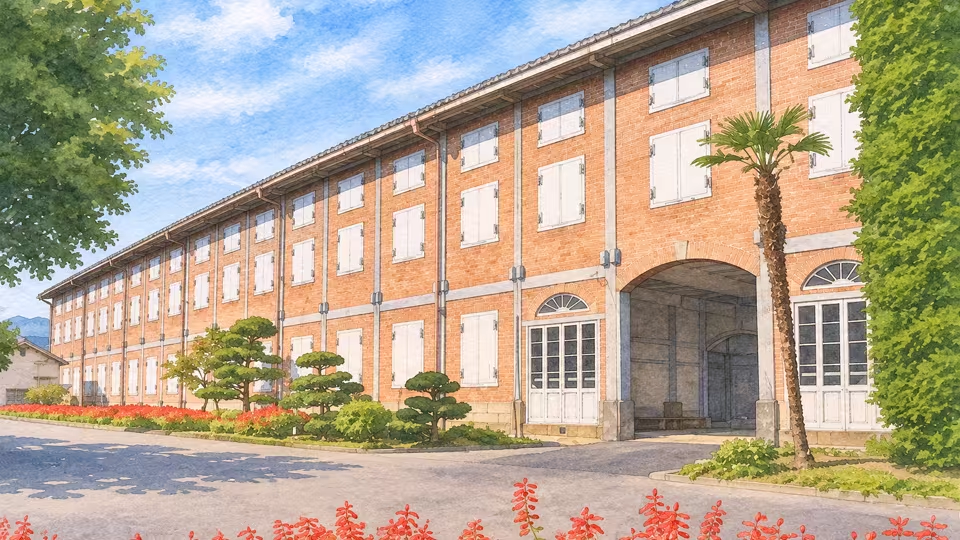
The buildings use a method called timber-framed brick construction. Carpenters first raised a wooden frame of posts and beams, and masons then filled the spaces between the posts with brick. Brick was almost unknown in Japan at the time, and there were no brickworks to supply it. The task fell to Nirazuka Naojirō, a man from Shibusawa’s home district, who gathered roof-tile makers, built kilns near Tomioka, and worked with the French engineers through repeated trial firings of Japanese clay until the bricks met the standard. The bricks were laid in Flemish bond, with long sides and short ends alternating in each course, and the joints were filled with lime plaster (shikkui) rather than cement mortar, using lime from the Shimonita area. Timber came from local forests and stone from local quarries. The design was French; the hands and most of the materials were local.
Construction began in 1871, and the main buildings were finished by the summer of 1872. The mill formally opened on November 4, 1872.
04The Reeling Hall
The heart of the complex is the reeling hall, a single long building about 140 meters in length. Its roof is carried on wooden trusses, a Western technique that allowed the interior to span its full width without a single column. Skylights run along the roof, and the walls are lined with large iron-framed windows glazed with glass imported from France. Reeling silk means following filaments finer than a hair, and natural light mattered.
When the mill opened, the hall held 300 reeling basins with French-made reeling equipment, making it one of the largest mechanized silk reeling mills in the world at the time. Brunat adjusted the French machines for Japanese conditions, among other things lowering the working height to suit the smaller stature of Japanese women. A steam engine drove the reels, and steam heated the water in which the cocoons were softened before reeling.
Flanking the reeling hall are two long brick warehouses, the East and West Cocoon Warehouses, each about 104 meters long and two stories high. Dried cocoons bought at the end of each season were stored on the upper floors, enough to keep the mill running for a year. Over the central arch of the East Cocoon Warehouse, the keystone is carved with the date Meiji 5, the year 1872.
05Recruiting the Workers
The buildings were ready, but the workers did not come. The government sent recruitment notices to the prefectures, and few families responded. A story told ever since holds that rumors spread through the countryside that the foreigners drank blood, a misunderstanding of the red wine the French drank, and that girls who went to the mill would have their blood taken. Whether or not the rumor was as widespread as later accounts say, the fear of foreigners and of the strange machines was real enough.
Odaka Atsutada set an example by sending his own daughter, Odaka Yū, then about fourteen, who became the first registered worker. The government also leaned on former samurai families to send their daughters, and many early workers came from such households. The mill opened short of workers, but numbers grew in the following years, and recruitment spread from a few nearby prefectures to the whole country.
What they found was a working regime imported from France. The working day is generally put at around eight hours. Sunday was a day off, and there were holidays at New Year and in summer. The women lived in dormitories, ate in a dining hall, and were treated free of charge by doctors at the mill’s clinic. Workers were ranked by skill, with wages tied to their grade. French women instructors taught reeling at the basins. Later accounts of Japanese silk mills, with their long hours and exploitation, describe a very different world; in its early years Tomioka was a training school as much as a factory.
06Wada Ei and the Tomioka Diary
The fullest picture of life at the mill comes from one of those workers. Yokota Ei, later known by her married name Wada Ei, was the daughter of a samurai of the Matsushiro domain in Shinano, today’s Nagano Prefecture. In the spring of 1873, aged fifteen (seventeen by the traditional Japanese count), she went to Tomioka with a group of girls from Matsushiro. Her father, Yokota Kazuma, was responsible for recruiting workers locally, and he sent his own daughter first.
Ei stayed a little over a year and rose to the top grade of reeler. In 1874 she returned home to become an instructor at a new reeling mill set up by former Matsushiro samurai, later known as Rokkōsha. Decades later, completing it in 1913, she wrote a memoir of her time at Tomioka, known as the Tomioka Diary (Tomioka nikki). It records her astonishment at the size of the buildings and the machinery, the rivalry among girls from different domains, the pride of reaching the first grade, and the daily rhythms of the dormitory. It remains one of the most important sources for the mill’s early years, and the most human one.
Women trained at Tomioka went home to teach in new mills in their own regions, and the methods spread with them.
07Brunat’s House and the Foreigners’ Quarters
Besides the production buildings, the mill had several residences. The largest is the Director’s House, usually called Brunat House, where Brunat lived with his family. It is a raised, single-story building of timber-framed brick surrounded by a broad veranda, a style common in European colonial buildings in hot, humid parts of Asia. After Brunat left, the house was put to other uses, serving for a time as a place where the workers were taught.
Two smaller houses with similar verandas stand nearby: the Inspectors’ House, built for the French male engineers, and the French Women Instructors’ House, built for the women who taught reeling.
Brunat’s contract ran for five years. It expired at the end of 1875, and he left Japan early in 1876; the other French staff left over the same period, and from then on the mill was run entirely by Japanese managers and workers. Odaka Atsutada also stepped down as director in 1876.
08From State Factory to Private Hands
Tomioka silk was of high quality and well regarded abroad, but as a business the mill lost money. Its purpose was to spread technique, not to make a profit, and its equipment and foreign staff were expensive. In the 1880s the government began selling off its state-run factories, and Tomioka was offered for sale, but the asking price was high and no buyer came forward for years.
In 1893 the mill was sold to the Mitsui family. Mitsui held it for less than a decade before selling it in 1902 to Hara Gōmei, the trading company of the Yokohama silk merchant Hara Tomitarō, better known as Hara Sankei, whose garden, Sankeien, is still one of Yokohama’s sights. Under Hara the mill continued to modernize and worked on improving silkworm breeds.
In 1938 the mill was spun off from Hara as an independent company, and in 1939 it was merged into Katakura Silk Reeling and Spinning, then the largest silk company in Japan and later known as Katakura Industries. Katakura brought in new generations of machinery, first multi-end reeling machines and, after the Second World War, automatic reeling machines.
09Closing, and Keeping
After the war, Japanese silk went into a long decline, squeezed by synthetic fibers and cheaper imported silk. In March 1987, the Tomioka mill reeled its last thread, 115 years after it opened.
What happened next is the reason there is anything to see today. Katakura did not demolish the buildings or sell the land. The company kept the empty mill maintained at its own expense, under a policy often summarized as "do not sell, do not lend, do not demolish." In 2005 Katakura donated the buildings to the city of Tomioka, which opened them to the public.
Recognition followed. The site was designated a National Historic Site in 2005, and the main buildings became Important Cultural Properties in 2006. In June 2014, "Tomioka Silk Mill and Related Sites" was inscribed on the UNESCO World Heritage List. The same year, the reeling hall and the two cocoon warehouses were designated National Treasures, the first modern industrial buildings in Japan to receive that status.
The World Heritage listing includes three other places in Gunma. The Tajima Yahei sericulture farm in Isesaki is the home of a breeder who developed a well-ventilated method of raising silkworms. The Takayama-sha sericulture school site in Fujioka trained silkworm raisers in a method balancing ventilation and warmth. The Arafune cold storage in Shimonita used cold air flowing from rock crevices to store silkworm eggs. Together with the mill, they cover the whole chain from egg to thread.
10What You See Today
The main buildings at Tomioka are originals from the founding period around 1872: the reeling hall, both cocoon warehouses, Brunat House, the Inspectors’ House, and the French Women Instructors’ House. They were used, altered, and repaired for over a century, and then preserved after the mill closed.
The interiors have changed more than the exteriors. The machines in the reeling hall are not the original French equipment but the automatic reeling machines installed in the Katakura era, left as they stood when production stopped in 1987. The original French steam engine has also long since left the site.
A heavy snowfall in February 2014 brought down the drying house, a Taishō-era addition to the complex. In the years that followed, the West Cocoon Warehouse underwent a major conservation project, in which a steel and glass structure was inserted inside the old building to strengthen it while leaving the brick and timber visible. Other buildings have also been under repair in recent years.
11A Walk Through the Mill
You enter through the main gate and face the East Cocoon Warehouse. Look up at the central arch to find the keystone with its carved date. Then look at the walls: the alternating long and short faces of the bricks are the Flemish bond, and the dark timber posts set into the brickwork are the frame that actually holds the building up. The ground floor of the East Cocoon Warehouse now holds exhibits on the mill’s history.
Pass through and turn toward the reeling hall. Inside, look first at the roof, where the triangular trusses span the whole width without a column. Light falls from the skylights and windows onto two long rows of automatic reeling machines. In 1872 the same space held 300 young women at 300 steaming basins.
South of the reeling hall stands Brunat House, wrapped in its veranda, with the smaller Inspectors’ House and French Women Instructors’ House nearby. To the west is the West Cocoon Warehouse, whose restored interior can be visited.
Elsewhere on the site is a large riveted iron water tank that stored water for the mill, and nearby are parts of the old drainage system. They are easy to pass by, but a silk mill ran on water as much as on steam.
Outside the gate, the streets of Tomioka still have some older shops and houses. This small town was where the mill’s young women lived while they learned their trade.