
01A Bridge Under a Highway
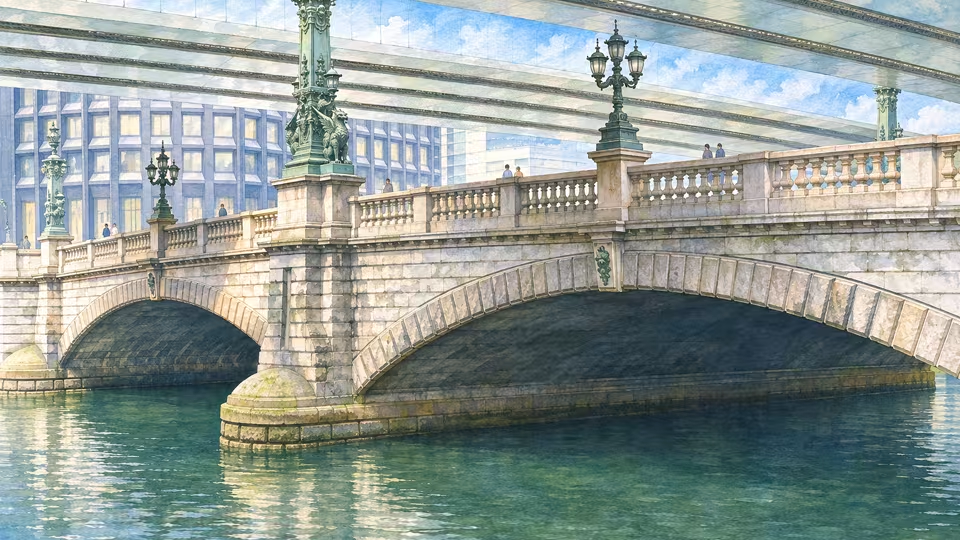
Stand in the middle of Nihonbashi and the first thing you notice is not the bridge but what is above it. The elevated lanes of the Shuto Expressway, Tokyo’s urban toll highway, run directly overhead, so close that the bronze lamp posts on the bridge almost touch the concrete. Below you is a granite bridge of two shallow arches over a dark, slow river, the Nihonbashi-gawa. Office towers and department stores line both banks.
It is an odd setting for what is officially the starting point of Japan’s national road network, and the oddness is the story. For four centuries this crossing has sat at the busiest point in the city. It was the front door of Edo, the shogun’s capital; then the heart of modern Tokyo’s banking and retail; then a casualty of the rush to build highways before the 1964 Olympics. Each of those eras left something you can still see from where you are standing.
02Ieyasu’s Wooden Bridge
The first bridge here was built in 1603. That year Tokugawa Ieyasu was appointed shogun, the military ruler of Japan, and Edo became the seat of his government. The town was being remade on a vast scale: a hill was leveled, a shallow inlet of Edo Bay was filled in, and new canals were cut to bring boats into the heart of the city. Nihonbashi was a wooden bridge thrown across one of those new channels.
Nobody is quite sure how it got its name, which means simply "Japan Bridge." One explanation holds that the first crossing was nothing more than two logs laid side by side, a nihon-bashi or "two-log bridge," and that the characters were later changed to the grander "Japan." Another says the name came from the sunrise visible from the bridge. A third says it was so named because it was the point from which the whole country was measured. All three are later explanations rather than recorded fact.
In 1604 the shogunate made the bridge the starting point for its main roads. Five great highways, the Gokaidō, radiated from here: the Tōkaidō along the Pacific coast to Kyoto, the Nakasendō through the mountains to the same destination, and the Kōshū Kaidō, Nikkō Kaidō and Ōshū Kaidō to the west and north. Mounds called ichirizuka were raised along the roads at intervals of one ri, about four kilometers, so travelers could count their progress, and all distances were reckoned from Nihonbashi.
03The Front Door of Edo
For a traveler leaving Edo, Nihonbashi was the place to start, and the place to start early. A well-known folk song begins with leaving Nihonbashi at "the seventh hour," which in the old time system meant roughly four in the morning. Setting out in the dark let walkers clear the city and reach the first post station at Shinagawa and beyond before the day was half gone. The trip to Kyoto by the Tōkaidō took around two weeks on foot.
Daimyo, the regional lords, crossed here too. Under the system of alternate attendance, sankin-kōtai, lords spent every other year in Edo and traveled back and forth with large retinues. Their processions passed over the bridge in formal order, and townspeople had to clear the way.
The bridge was also where the government spoke to the public. At the south end stood a kōsatsuba, a board where official edicts and prohibitions were posted on wooden placards. Nearby was a spot where certain offenders were displayed in public as punishment. Boats loaded with goods from the provinces crowded the riverbanks. From the top of the bridge, which arched up steeply, you could see Edo Castle to the west and, on a clear day, Mount Fuji beyond.
Artists loved the view. The first print of Utagawa Hiroshige’s famous series The Fifty-three Stations of the Tōkaidō shows Nihonbashi at dawn: the head of a daimyo procession is just starting across, while fish sellers with baskets on poles come off the bridge toward the viewer. Katsushika Hokusai drew it too. A long painted handscroll called Kidai Shōran, now in a Berlin museum, records the street running up to Nihonbashi around 1805 in remarkable detail, shop by shop, with hundreds of people going about their business.
04Fire and Rebuilding
Wooden bridges burn, and Edo burned often. The Great Fire of Meireki in 1657 destroyed much of the city, including the bridge. Between 1603 and the end of the Meiji era the bridge was rebuilt nearly twenty times after fires and decay; in the Edo period the work was paid for by the shogunate. It is generally said to have been about 50 meters long, with railings capped by bronze ornaments called giboshi, onion-shaped finials normally reserved for temples, shrines and bridges of high rank.
05The Fish Market
The north bank of the river, between Nihonbashi and the next bridge downstream, was Edo’s fish market, the uogashi. According to tradition, when Ieyasu came to Edo he brought fishermen from Tsukuda, a village near Ōsaka. They supplied fish to the shogun’s household and were allowed to sell the surplus on the riverbank here. A family led by a man named Mori Magoemon became central figures in the market.
People in Edo said there were three places where a thousand gold ryō were spent in a single day: the fish market, the Yoshiwara pleasure quarter, and the theater district. The fish market fed the city every morning and stayed on this spot for about three hundred years. After the Great Kantō Earthquake of 1923 destroyed the neighborhood, the market moved to Tsukiji, where the new Tokyo Municipal Central Wholesale Market formally opened in 1935. A monument on the north bank marks where the old market stood.
06Echigoya and the Merchant Revolution
The streets around the bridge formed Edo’s main commercial district, packed with dealers in cloth, medicines, books and lacquerware. The most famous of them was Echigoya, the dry goods shop founded by Mitsui Takatoshi.
Mitsui came from a merchant family in Matsusaka, in Ise Province, and opened his Edo shop in 1673. At the time, big cloth merchants mostly sold by taking samples to the homes of samurai and wealthy clients, then billing them once or twice a year. Prices were negotiated person by person and padded to cover the risk of unpaid debts. Echigoya did things differently. Customers came to the shop; prices were fixed and marked; payment was in cash, with no credit; and the shop would cut cloth to whatever length a customer needed. The slogan was genkin kakene nashi, "cash, no markup." Rival merchants were furious, but ordinary townspeople flocked to the store. In 1683 Echigoya moved to Surugachō, a few minutes’ walk north of the bridge, and also began money changing.
That shop became the root of the Mitsui business empire. In the Meiji period the cloth business was separated out as Mitsukoshi, which in 1904 announced it would become a department store modeled on Harrods of London, a declaration usually counted as the beginning of the department store in Japan. The Mitsukoshi Nihonbashi flagship still stands on the Surugachō site. The street in front of it was aligned so that Mount Fuji appeared at its end, a view both Hiroshige and Hokusai painted.
07Gold, Banks and Stocks
A short walk west of the bridge was the Kinza, the shogunate’s gold mint, run by the Gotō family, which produced the oval gold coins called koban. After the Meiji Restoration the mint was abolished. In 1896 the Bank of Japan opened its new head office on the site, a stone building designed by Tatsuno Kingo, one of the first generation of Japanese architects trained in Western design. The bank describes it as the first full-scale Western-style building of the Meiji era designed by a Japanese architect, and it was designated an Important Cultural Property in 1974.
The district around the bridge became the center of Japanese finance. The Tokyo Stock Exchange was founded in 1878 at Kabutochō, just southeast of the bridge, with the industrialist Shibusawa Eiichi among its founders, and the First National Bank, which he led, had been established in Kabutochō in 1873.
08The Bridge of 1911
After the Meiji Restoration, the old bridge was replaced in 1873 by a Western-style wooden bridge. It soon proved inadequate. Streetcars were coming to Tokyo, and the city decided to build a permanent bridge in stone.
The present Nihonbashi opened on April 3, 1911. It is a twin-arch bridge of granite, about 49 meters long and 27 meters wide. The structure was designed by Yonemoto Shin’ichi, an engineer with the Tokyo city government, and the decoration by the architect Tsumaki Yorinaka, who had studied in Germany and designed many government buildings. The result is a European Renaissance-style bridge with Japanese motifs worked in.
The bronze sculptures are what most visitors remember. In the center, on each side, sits a kirin, a mythical beast of East Asian lore. Kirin are not normally shown with wings, but these carry wing-like fins on their backs, popularly said to express the idea of flying out from the nation’s starting point to every corner of Japan. At the ends of the bridge stand bronze lions holding the crest of the city of Tokyo. The models were made by the sculptor Watanabe Osao, and the casting was done by a team that included the metalworker Okazaki Sessei. The name plates on the end posts, in Chinese characters and in hiragana, reproduce the calligraphy of Tokugawa Yoshinobu, the last shogun, who was then living quietly in Tokyo; he died in 1913.
At the opening ceremony, following custom, the first people to cross were a family in which three generations of married couples were still living. Crowds filled the streets to see the new bridge.
09Earthquake and Air Raids
Twelve years later, on September 1, 1923, the Great Kantō Earthquake struck. Fires swept the neighborhood, but the stone bridge stood and was repaired afterward. In 1945 American incendiary raids burned the area again, and firebombs fell on the bridge itself. Look closely at the granite balustrade and the end posts and you will see dark stains; these are burn marks from the war.
Much of what surrounds the bridge today was built in the reconstruction that followed the earthquake. The Mitsukoshi main store, the Mitsui Main Building and the Takashimaya Nihonbashi store all date in their present form from the late 1920s and 1930s.
10The Highway Overhead
In 1963, as Tokyo raced to prepare for the 1964 Olympic Games, the Shuto Expressway was built over the Nihonbashi River. Land in central Tokyo was expensive and hard to acquire; the airspace over rivers and canals was public and available. The elevated road went straight over the bridge.
Even at the time there were complaints, and over the following decades restoring the sky above Nihonbashi became a long-running local cause. In 1999 the bridge was designated an Important Cultural Property by the national government. In the late 2010s the national and Tokyo governments and the expressway company agreed to move this section of the highway underground. Construction is under way, and once the tunnel is open the elevated structure above the bridge is to be removed.
The streetcars that justified the stone bridge are long gone. When the tram line was removed in 1972, a bronze plate reading "Zero Point of Japan’s Roads," in the calligraphy of Prime Minister Satō Eisaku, was set into the roadway at the center of the bridge. Seven national routes, including Route 1 to Ōsaka and Route 4 to Aomori, still measure their distances from it.
11A Walk Around the Bridge
Start on the north side. At the northwest corner is a small plaza with a replica of the zero-point plate, since the original sits in the middle of the traffic lanes. Next to it is the old Tokyo City road marker of 1911, which once stood in the middle of the bridge and doubled as a pole for the streetcar wires; it was moved here in 1972 and is protected along with the bridge. There is also a post showing distances from here to cities across Japan.
At the northeast corner is the monument to the fish market, topped with a figure of Otohime, the princess of the undersea palace in Japanese folklore.
On the bridge itself, look at the winged kirin and the calligraphy on the end posts. Run your eye along the granite balustrade for scorch marks.
Cross to the south bank, where the shogunate’s notice board once stood. The small plaza at the southwest corner has a stone inscribed with a history of the bridge, and at the southeast corner is a modern boat landing on the river.
From the bridge, walk north along Chūō-dōri for a few minutes to reach Mitsukoshi, with its pair of bronze lions at the entrance, ordered from England in 1914 and modeled on the lions in London’s Trafalgar Square. Behind it to the west are the Mitsui Main Building and the Bank of Japan. Heading south instead, you reach Takashimaya. Between them they tell the story of how a bridge built for a new shogun’s capital became the commercial center of modern Japan.