
01A Temple Under the Tower
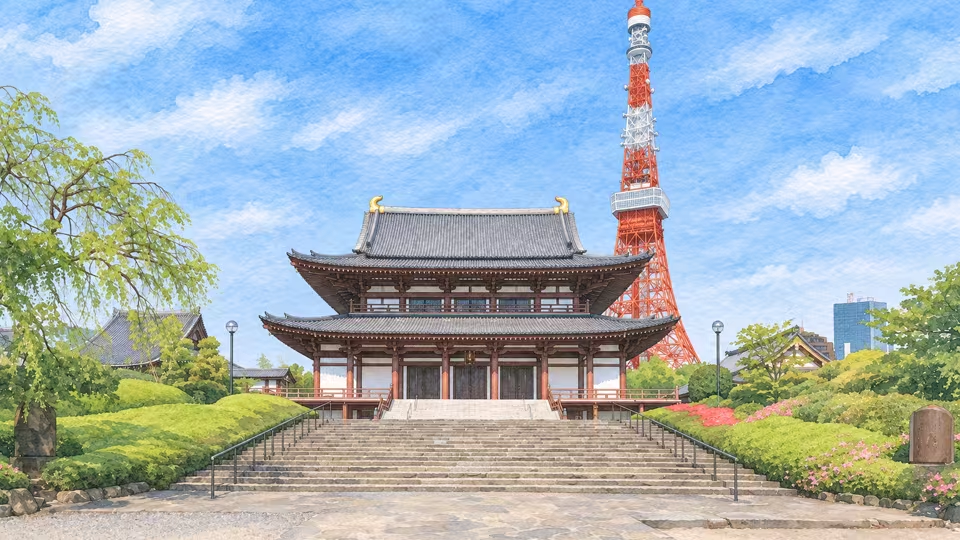
Most photographs of Zōjō-ji are taken from the same spot: the dark tiled roof of the main hall in the foreground, and Tokyo Tower rising directly behind it in red and white. The pairing looks like a deliberate collision of old and new, but the tower is not an intruder. The ground it stands on once belonged to the temple. For most of the Edo period (1603–1868), Zōjō-ji was a sprawling religious complex of halls, dormitories, sub-temples and mausoleums that covered much of what is now Shiba Park and the streets around it.
Zōjō-ji belongs to the Jōdo, or Pure Land, school of Buddhism, which teaches that sincere recitation of the name of Amida Buddha leads to rebirth in his paradise. It is one of the head temples of that school. Its place in Japanese history, though, comes from a family connection. Zōjō-ji was the bodaiji, the family funerary temple, of the Tokugawa shoguns who ruled Japan for over two and a half centuries. Six of the fifteen Tokugawa shoguns are buried here.
Almost everything you can see today was rebuilt after the Second World War. The great exception is the vermilion gate at the front, built in 1622. To make sense of Zōjō-ji, it helps to keep two pictures in mind at once: the modest temple in front of you, and the much larger one that stood here until 1945.
02Beginnings Before Edo
The temple’s own tradition traces its origins to the ninth century, when a disciple of the monk Kūkai is said to have founded a temple called Kōmyō-ji in the Musashi region, belonging to the Shingon school of esoteric Buddhism. That account is a temple tradition and cannot be checked in detail.
The firmer date is 1393. In that year a Pure Land monk named Yūyo Shōsō converted the temple to the Jōdo school and renamed it Zōjō-ji. Some accounts date the conversion to 1385 instead. Shōsō was an energetic teacher and organizer in eastern Japan, and he is usually treated as the temple’s real founder. At that time Zōjō-ji stood in Kaizuka, roughly in the area of today’s Hirakawa-chō and Kioi-chō in Chiyoda Ward, close to where Edo Castle would later rise.
For the next two centuries Zōjō-ji was a respectable regional temple. What turned it into one of the most powerful religious institutions in Japan was the arrival of Tokugawa Ieyasu.
03Ieyasu Chooses a Temple
In 1590 the warlord Toyotomi Hideyoshi defeated the Hōjō family and transferred their lands in the Kantō plain to Ieyasu, who made the small castle town of Edo his base. According to temple tradition, as Ieyasu passed Zōjō-ji on entering Edo, the abbot Gen’yo Zon’ō, twelfth head of the temple since 1584, came out to greet him, and the two men struck up a relationship that led Ieyasu to adopt the temple as his family’s funerary temple. Whether or not the meeting happened quite like that, the trust between Ieyasu and Zon’ō is well documented.
Ieyasu already had strong ties to the Pure Land school. His family, the Matsudaira of Mikawa province, had long patronized the Pure Land temple Daijū-ji. In 1598 Zōjō-ji was moved from Kaizuka to its present site at Shiba, south of the castle and near the start of the Tōkaidō highway to Kyoto. A large temple complex on that approach could serve as a buffer on the city’s southern edge, and the shogun could reach it easily.
Ieyasu endowed the temple with lands and gave it a collection that it still treasures: three complete editions of the Buddhist canon, printed in Song and Yuan dynasty China and in Goryeo Korea, which he gathered and donated between 1609 and 1613. All three are Important Cultural Properties, and in 2025 they were inscribed on UNESCO’s Memory of the World register. In 1608 the temple was named an imperial prayer temple, and in 1610 Zon’ō was honored by the imperial court with the title Fukō Kanchi Kokushi, "National Teacher."
04The Last Wishes of Ieyasu
Ieyasu died at Sunpu (modern Shizuoka) in 1616, aged seventy-five by the Japanese count. Before his death he left instructions that shaped the rituals of his family for generations. His body was to be buried at Mount Kunō near Sunpu; his funeral was to be held at Zōjō-ji; his memorial tablet was to be placed at Daijū-ji in Mikawa; and after a year a small shrine was to be built at Nikkō, where he would be worshipped as a god.
The result was a division of labor. As the deity Tōshō Daigongen, Ieyasu passed to the shrine at Nikkō and to the care of Tenkai, a Tendai monk who became the shogunate’s leading religious adviser. Zōjō-ji kept the Buddhist side of the family’s mourning. It also kept Ieyasu’s personal image of Amida Buddha, known today as the Kuro-honzon, or "Black Image." Tradition holds that Ieyasu carried it with him and that it protected him in battle; its dark color is said to come from centuries of incense smoke.
05The Sangedatsumon
The gate you pass through to enter the temple grounds is the Sangedatsumon. According to the temple, the first gate was built with shogunal funding in 1611, blown down in a storm in 1621 and rebuilt the following year; the present structure dates from that 1622 rebuilding, though some accounts give 1605. Its name means "Gate of Liberation from the Three Afflictions," the three being greed, anger and ignorance in Buddhist teaching. Walking through it symbolically leaves those behind.
It is a two-story gate about 21 meters tall, with three passageways. The upper story houses statues of the Buddha Shaka (Śākyamuni) with two attendants and the Sixteen Arhats, his enlightened disciples; it is not normally open to visitors. The heavy timber frame and bracketing combine the Zen-influenced style with older Japanese temple architecture.
The gate survived fires in the Meiji era and the air raids of 1945 that destroyed almost everything else. It is the oldest building at Zōjō-ji, one of the few large early-Edo wooden structures left in central Tokyo, and a designated Important Cultural Property of Japan. It has recently been undergoing a major conservation repair.
06A University for Monks
In the Edo period Zōjō-ji was more than a burial temple. The Pure Land school ran eighteen seminaries in the Kantō region, known as danrin, and Zōjō-ji was the first among them and the administrative center of the school. Zon’ō did much to establish this seminary system. At its height the temple is said to have housed some three thousand student monks, with forty-eight sub-temples and rows of dormitories around the main hall.
The abbot of Zōjō-ji ranked among the most senior clergy in the country and appeared at shogunal ceremonies. The precincts covered more than 80 hectares, some fifteen times the area of the temple today.
One relic of that era can still be heard. The great bronze bell in the belfry was cast in 1673. Weighing about fifteen tons, it was counted among the three great bells of Edo, and townspeople are said to have used its strokes to tell the time.
07The Shogunal Mausoleums
When the second shogun, Tokugawa Hidetada, died in 1632 he was buried at Zōjō-ji. His mausoleum, known by his posthumous Buddhist name Taitoku-in, was among the most lavish buildings in Japan: a complex of worship hall, main hall, gates and corridors covered in carving, lacquer and gold leaf, often compared with the shrine at Nikkō.
The next generations broke the pattern. The third shogun, Iemitsu, was close to Tenkai, who in 1625 founded Kan’ei-ji, a Tendai temple in Ueno on the northeastern side of the city. Iemitsu was buried at Nikkō, and the fourth and fifth shoguns at Kan’ei-ji. Zōjō-ji lost its role until the sixth shogun, Ienobu, was buried here in 1712. From then on the shogunate generally alternated between the two temples.
In the end six shoguns were laid to rest at Zōjō-ji: Hidetada (2nd), Ienobu (6th), Ietsugu (7th), Ieshige (9th), Ieyoshi (12th) and Iemochi (14th). Six more lie at Kan’ei-ji. Ieyasu and Iemitsu are at Nikkō, and the last shogun, Yoshinobu, was buried with Shinto rites in Yanaka Cemetery. Zōjō-ji also became the resting place of several shoguns’ wives and consorts, five official wives in all, among them Hidetada’s wife Sūgen-in (Gō) and Princess Kazunomiya, the imperial princess who married Iemochi in 1862 as part of an attempt to reconcile the court and the shogunate.
Before the war, the mausoleums of Hidetada, Ienobu and Ietsugu were designated National Treasures under the old preservation law.
08The Meiji Upheaval
The fall of the shogunate in 1868 cost Zōjō-ji its patron and most of its lands. The new government promoted Shinto and ordered the separation of Shinto and Buddhism, and Buddhist institutions across Japan suffered.
In the early 1870s the government’s Great Teaching Institute, a body set up to spread state ideology, was based at Zōjō-ji, and Shinto deities were enshrined in the main hall. At the end of 1873 the hall was destroyed by arson (some sources give 1874). It was rebuilt, and burned again in 1909.
In 1873 a government decree created Japan’s first public parks, and Zōjō-ji’s precincts became Shiba Park, alongside Ueno, Asakusa and others. Over the following decades, parcels of former temple land were carved off for hotels, schools and other uses.
A small reminder of Meiji diplomacy stands between the gate and the main hall: a large tree known as the Grant Pine, generally said to have been planted by the former American president Ulysses S. Grant during his visit to Japan in 1879.
09Fire, Excavation and Reburial
The American air raids of 1945 destroyed the main hall and most of the mausoleums, including the National Treasure halls of Hidetada and Ienobu. Very little of the old Zōjō-ji survived.
After the war, part of the mausoleum grounds was sold for redevelopment. Beginning in the summer of 1958, before the graves were moved, the national Committee for the Protection of Cultural Properties carried out an excavation, and researchers including the anthropologist Suzuki Hisashi opened the tombs and studied the remains of the shoguns and their wives. Their work produced an unusual body of evidence about the physical features, health and lifestyle of the Tokugawa elite; Suzuki noted, for example, the narrow, refined faces of later shoguns, which he associated with an aristocratic diet and way of life.
The best-known story from the excavation concerns Kazunomiya. A small glass-plate photograph of a young man was reportedly found in her coffin. Researchers speculated it might show her husband Iemochi, or Prince Arisugawa Taruhito, to whom she had been engaged before her political marriage. The image is said to have vanished after exposure to light, so the question can never be settled. The story, told in Suzuki’s writings, is best treated as an anecdote.
After the study, the remains were cremated and reburied together in a single cemetery behind the main hall, the Tokugawa Shogun Family Cemetery, where thirty-eight people now lie. Hidetada’s wooden tomb pagoda was lost, and his remains share a tomb with Sūgen-in. The entrance is the Inukimon, a cast-bronze gate that originally stood before the tomb pagoda in Ienobu’s mausoleum and survived the bombing.
10What Stands Today
The present main hall, the Daiden, was completed in 1974 in reinforced concrete, following traditional temple forms. Beneath it is a treasure gallery, whose star exhibit is a model of Hidetada’s Taitoku-in mausoleum.
The model was made at one-tenth scale for the Japan–British Exhibition in London in 1910. After the exhibition it was presented to the British royal family and spent the following century in the Royal Collection, largely forgotten. Rediscovered and restored by Japanese craftsmen, it came back to Zōjō-ji on long-term loan and went on display when the treasure gallery opened in 2015. With the original destroyed in 1945, it is the clearest view anyone can now have of what the mausoleum looked like.
To the right of the main hall is the Ankokuden, named after Ieyasu’s posthumous Buddhist name, Ankoku-in. It houses the Black Image. The first Ankokuden, completed in 1617, was Ieyasu’s memorial hall here; the present one was rebuilt in 2010, ahead of the 800th anniversary in 2011 of the death of Hōnen, founder of the Pure Land school. The Black Image is normally kept hidden and shown only on certain days of the year.
11A Walk Through the Grounds
Approach from Hamamatsuchō Station along Daimon-dōri. The gate you pass first, the Daimon, marks the old outer entrance of the temple and gave the neighborhood its name; the present structure is a later rebuilding. Ahead is the Sangedatsumon. Take time to look at its timbers; it is the one building here that Ieyasu’s son would have recognized.
Through the gate, the main hall lies ahead with Tokyo Tower behind. On the right is the belfry with the 1673 bell. To the left of the main hall are rows of small stone jizō statues, the Sentai Kosodate Jizō, dressed in red caps and bibs and decorated with pinwheels, dedicated by parents praying for children or mourning those who died young. The Grant Pine stands near the gate.
Visit the Ankokuden, then walk behind it to the shogunal cemetery, entering through the Inukimon. The tombs of the six shoguns and their consorts stand in a row; Kazunomiya’s bronze pagoda stands beside Iemochi’s stone one.
Finally, step outside the temple to find surviving fragments of the old complex. The Sōmon, the only part of Hidetada’s mausoleum still in Shiba, stands in Shiba Park 4-chōme and is an Important Cultural Property; several other gates from the mausoleum were moved after the war to Sayama Fudō-ji in Tokorozawa, Saitama. The Nitenmon, a gate from Ietsugu’s mausoleum, stands on Hibiya-dōri beside the Tokyo Prince Hotel and is also an Important Cultural Property. The Onarimon, the gate used by the shogun on his visits, gave its name to the nearby district and subway station; it was moved to its present spot in the Meiji period. The Kuromon, or Black Gate, from the abbot’s quarters, is preserved within the grounds and designated by Minato Ward. Trace these gates on a map and you have the outline of the temple that once stood here.