
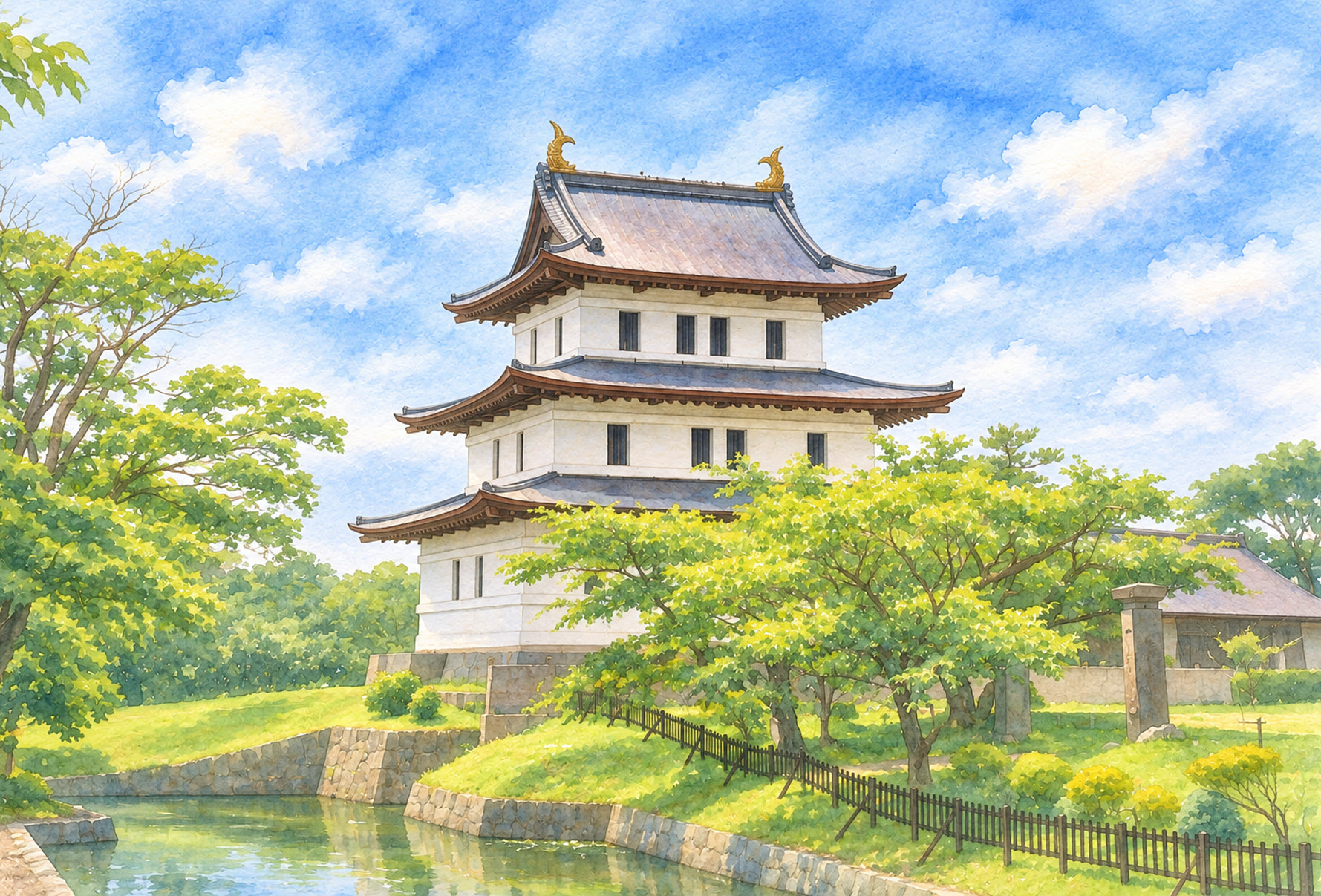
Matsumae Castle, formally Fukuyama Castle, stands in the town of Matsumae, Matsumae District, Hokkaidō. It was the seat of the Matsumae domain, which governed the southern part of Ezo in the Edo period. The castle in its present form was built between 1850 and 1854 and is usually described as one of the last Japanese-style castles ever completed. It is also usually described as the only castle in Hokkaidō with a traditional keep, though the present keep is a reconstruction.
01The Matsumae and the Ainu
From the fifteenth century, Wajin (ethnic Japanese) crossing from Honshū set up trading and fortified posts along the southern coast of the Oshima Peninsula. Trade with the Ainu went together with recurring conflict. In 1457 the Ainu leader Koshamain rose against the Wajin and was defeated by Takeda Nobuhiro. Nobuhiro’s descendants, the Kakizaki, gradually brought the posts under their control and later took the name Matsumae. In 1604 a black-seal document from Tokugawa Ieyasu recognized their monopoly on trade with the Ainu. The domain grew almost no rice and lived on its control of that trade, and terms that worked against the Ainu formed the background to conflicts such as Shakushain’s War in 1669. In 1606 the Matsumae built a residence, the Fukuyama-kan, on the site of the present castle. From the late eighteenth century, as Russian activity spread south, the shogunate twice placed Ezo under its direct rule, and in 1807 the Matsumae were moved to Yanagawa in Mutsu, returning to Matsumae only in 1821.
02A castle for coastal defense
Around the time of Matthew C. Perry’s arrival, northern coastal defense became a pressing concern for the shogunate. In 1849 it ordered Matsumae Takahiro to build a castle. The old residence was enlarged, and the work was finished in 1854, with gun batteries facing the sea. In the eleventh month of Meiji 1 (late 1868), during the Hakodate War, the former shogunate forces of Enomoto Takeaki sent Hijikata Toshizō against the castle, and it fell quickly.
03What can be seen today
Most of the buildings were taken down after the Meiji Restoration, but the keep and the main gate of the inner citadel survived, and in 1941 both were designated National Treasures under the prewar system. In 1949 a fire that started at the nearby town office spread to the keep and destroyed it. A reinforced-concrete keep reproducing the old exterior was completed in 1960 and opened as a museum the following year, which is why some sources date the rebuilding to 1961. The inner-citadel gate is original and is an Important Cultural Property. The castle grounds are a national Historic Site, and the surrounding Matsumae Park is known for its cherry trees.