
01A Castle Built for Ceremony
Nijō Castle sits on flat ground in the middle of Kyoto, ringed by a broad moat and steep stone walls. It looks like a fortress, and in a sense it is one. Yet in more than two and a half centuries under the Tokugawa shoguns, no army ever attacked it. Its real job was political theater.
Kyoto was the seat of the emperor and the court aristocracy, the place from which every title of legitimate authority flowed. After Tokugawa Ieyasu won the Battle of Sekigahara in 1600, he held real power across Japan, but he still needed the emperor’s formal appointment and a dignified base in the capital from which to deal with the court. Nijō Castle was that base: a residence for the shogun when he came to Kyoto, a hall for receiving nobles and lords, and a stage for the ceremonies that turned military victory into lawful rule.
Two moments frame its history. In 1603 Ieyasu, newly appointed shōgun (the emperor’s military deputy and, in practice, ruler of the country), set out from Nijō Castle to give formal thanks at the imperial palace. In 1867 Tokugawa Yoshinobu, the fifteenth and last shogun, had senior retainers of the domains called to the castle to hear his plan to return governing authority to the emperor, and submitted it to the court the next day. The shogunate’s first and last great acts in Kyoto both happened here.
02Ieyasu’s Kyoto Headquarters
Ieyasu ordered construction to begin in 1601, southwest of the imperial palace. Like many building projects of the period, the work was imposed on the daimyo, the regional lords, who supplied labor and materials as a demonstration of loyalty. Itakura Katsushige, the Tokugawa governor of Kyoto, oversaw much of the work. The castle was substantially complete by 1603.
On the twelfth day of the second month of 1603 the court appointed Ieyasu shogun, an appointment he received at Fushimi Castle. He then moved into the newly finished Nijō Castle, made his ceremonial procession from there to the palace, and hosted court nobles at the castle in celebration. When his son Hidetada succeeded him as shogun in 1605, Kyoto and Nijō again provided the setting.
The name can be confusing. Earlier residences in Kyoto, including the palaces of the Ashikaga shoguns Yoshiteru and Yoshiaki and a mansion Oda Nobunaga later gave to the crown prince, were also called Nijō Castle or Nijō Palace. They stood to the east of the present site and are not the same place. When people say Nijō Castle today, they mean the Tokugawa castle.
The early castle was much smaller than what you see today, roughly corresponding to the area now called the Ninomaru, or second enclosure. It had a palace complex and, from around 1606, a keep. That first keep did not survive at Nijō; it was later dismantled and moved to Yodo Castle south of the city when the site was rebuilt.
03The Meeting of 1611
The most dramatic scene in the castle’s early history took place in 1611.
Toyotomi Hideyori, son of the great unifier Toyotomi Hideyoshi, still held Ōsaka Castle with its enormous wealth and prestige. Many lords privately wondered whether the Toyotomi might yet recover their position. When Ieyasu came to Kyoto for the abdication of Emperor Go-Yōzei and the accession of Emperor Go-Mizunoo, he asked Hideyori to come and meet him at Nijō Castle.
Hideyori’s household at Ōsaka feared for his safety. Former Toyotomi vassals such as Katō Kiyomasa and Asano Yoshinaga helped persuade them, and accompanied the young lord. Hideyori traveled up the Yodo River and was received at Nijō. Ieyasu was then about sixty-eight by Western reckoning; Hideyori was about seventeen.
The meeting was courteous and brief. Its message was not subtle: the heir of Hideyoshi had come to Ieyasu, not the other way around, and most observers took it as a sign of who now stood above whom, though historians still debate whether the ceremony amounted to Hideyori’s submission or preserved a show of equality. A popular story holds that Ieyasu, seeing that Hideyori had grown into an impressive young man, resolved then and there to destroy the Toyotomi. That is later storytelling rather than recorded fact, but the outcome is not in doubt. Within a few years a dispute over an inscription on a temple bell provided the pretext for war. Ieyasu used Nijō as his base in Kyoto during the Ōsaka campaigns of 1614 and 1615, and in the summer of 1615 Ōsaka Castle fell. Hideyori and his mother Yodo-dono died in the burning castle, and the Toyotomi line came to an end.
The castle then served the next stage of Tokugawa policy toward the court. In the seventh month of 1615 the shogunate issued at Nijō the Kinchū narabini kuge shohatto, a code of regulations for the emperor and the court nobility that set out, in writing, the limits of their role. Five years later, in 1620, Hidetada’s daughter Kazuko left Nijō Castle in procession to enter the palace as a consort of Emperor Go-Mizunoo; she was later made empress.
04Rebuilding for an Emperor
The castle took its present size under the third shogun, Tokugawa Iemitsu, and his father Hidetada, who had retired as shogun but still held power as ōgosho (retired shogun).
The occasion was a visit by Emperor Go-Mizunoo. His empress, Kazuko, was Hidetada’s daughter, so the imperial and Tokugawa houses were now joined by marriage. Persuading the emperor to come in person to the shogun’s castle would display to the whole country how closely court and shogunate were tied, and on whose terms.
Beginning around 1624, the castle grounds were extended westward. A new inner enclosure, the Honmaru, was built with its own palace, and a five-story keep brought from Fushimi Castle rose at its southwest corner. The older area became the Ninomaru, and its palace was extensively remodeled. Kobori Enshū, a daimyo celebrated as a tea master and garden designer, served as one of the commissioners of works, and the garden beside the Ninomaru Palace was reshaped at the same time. A separate palace was built in the Ninomaru specifically to house the emperor during his visit, along with quarters for the empress and her ladies.
In the ninth month of 1626, Go-Mizunoo processed from the imperial palace to Nijō Castle and stayed for five days. There were performances of court music and dance, poetry gatherings, and Noh. The emperor is said to have climbed the keep to look out over the city. The visit was the high point of early Tokugawa relations with the court and the most splendid moment in the castle’s life.
The special buildings put up for the visit were later taken down or moved away. What remains from this campaign is the remodeled Ninomaru Palace and its garden.
05The Ninomaru Palace
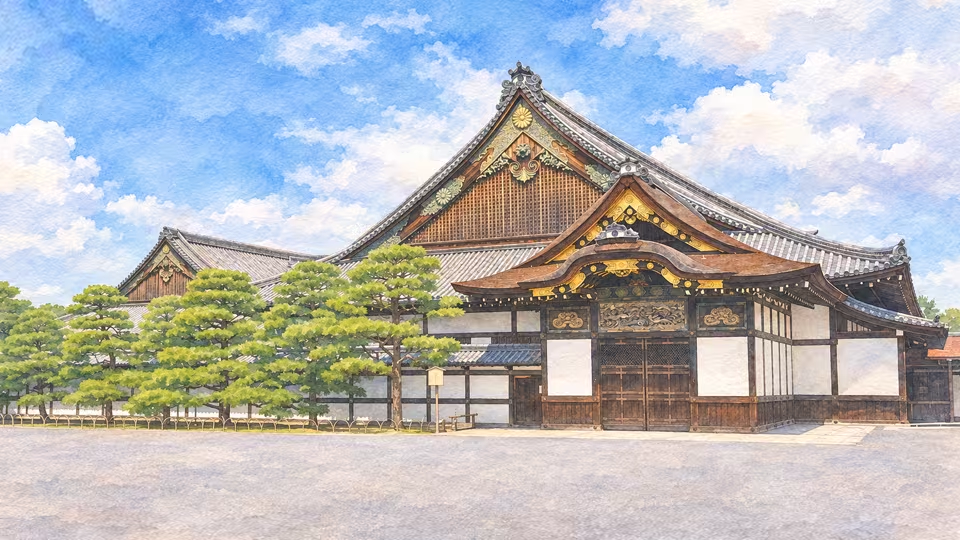
The Ninomaru Palace is the reason most visitors come. It is one of the very few castle palaces of the early Edo period to survive intact, and it is designated a National Treasure.
It consists of six connected buildings arranged diagonally, each set back from the one before, like a flight of geese: the Tōzamurai (reception rooms), the Shikidai (formal entrance hall), the Ōhiroma (great audience hall), the Sotetsu-no-ma, the Kuro-shoin (inner audience hall), and the Shiro-shoin (the shogun’s living quarters). Together they contain more than thirty rooms. The plan is a physical map of hierarchy. The farther a visitor was allowed to go, the closer he came to the shogun, and the more private and exclusive the space.
Visiting lords waited first in the Tōzamurai, where the walls show tigers and leopards prowling through bamboo. These rooms are often called the Tiger Rooms. The painters had probably never seen a live tiger, but the intended effect, a sense of power that met every guest at the door, is clear enough.
In the Shikidai, the shogun’s senior councilors received lords and accepted their gifts. Beyond it lies the Ōhiroma, where the shogun gave formal audiences. He sat on the raised jōdan-no-ma, the upper level, while the lords knelt in rows on the lower level. The difference was marked not only by the step in the floor but by the ceilings and decoration. Giant pine trees spread across the gold-ground walls behind the shogun’s seat.
The Kuro-shoin was used for meetings with lords closer to the Tokugawa house, and its paintings are somewhat gentler. The Shiro-shoin, the deepest room, was the shogun’s private space, and its walls are painted in ink landscapes in a quiet, restrained manner.
06Paintings, Carvings and Singing Floors
The interior decoration is largely the work of the Kanō school, the official painters to the shogunate. For the 1626 renovation, the main rooms were painted under the direction of Kanō Tan’yū, then still in his twenties and already the leading painter of the family. His brother Kanō Naonobu and other members of the workshop also took part.
The program follows the hierarchy of the building. The public rooms blaze with gold and strong colors: pines, tigers, peacocks, hawks. The private rooms move to lighter color and finally to ink. Reading the walls tells you how the palace was meant to work.
Most of what you see in the rooms today is a careful reproduction. The originals, 1,016 of which are designated Important Cultural Properties, have been progressively removed for conservation and are kept in a storage and exhibition hall on the grounds, where selections are shown in rotation.
As you walk the corridors, you will hear the floor chirp underfoot. These are the uguisubari, or "nightingale floors." Guides often explain them as an alarm against intruders. The sound actually comes from the nails and clamps under the boards rubbing as the wood flexes, and whether it was designed deliberately as a security device is doubtful; it may simply be the voice of an old building.
Look up, too, at the carved transoms between rooms, and at the gilded metal fittings on doors and beams. The Karamon, the ornate gate in front of the palace, is covered in carvings of lions, dragons, cranes, pine, bamboo and plum blossom. Its restoration was completed in 2013, and its colors are bright again.
07Two Centuries of Quiet
After the imperial visit, shoguns seldom came to Kyoto. In 1634 Iemitsu marched to the capital with an enormous retinue, often put at 300,000 men, and stayed at Nijō. It was the last visit by a shogun for more than two centuries.
The castle was left in the care of garrison officers and gradually lost buildings to disaster. In 1750 lightning struck the keep and it burned down. It was never rebuilt, and only its stone base remains. In 1788 a great fire swept across Kyoto and destroyed the Honmaru Palace and several turrets.
When you climb the keep base today, you stand on the foundations of the tower from which, according to the accounts, Emperor Go-Mizunoo looked out over the city.
08The Shoguns Return
In the 1850s the arrival of Western ships and the question of opening the country turned Kyoto back into the center of national politics. The imperial court, long marginal, became a power to be courted. Activists calling to "expel the barbarians" flooded into the city, and the shogunate had to engage with the capital again.
In 1863 the fourteenth shogun, Tokugawa Iemochi, traveled to Kyoto, the first shogun to do so since Iemitsu’s visit 229 years earlier. He stayed at Nijō Castle and called on Emperor Kōmei. Iemochi came to Kyoto again in later years, and the castle was busy with shogunal officials.
Iemochi died at Ōsaka Castle in 1866, and Tokugawa Yoshinobu, from the Hitotsubashi branch of the family, succeeded him. Yoshinobu had already spent years in Kyoto representing the shogunate there, and in the twelfth month of 1866 he received his appointment as shogun in the Ninomaru Palace itself. He governed from the city. Nijō Castle became the command center of a regime struggling against the domains of Satsuma and Chōshū and an increasingly assertive court.
09Returning Power to the Emperor
By 1867 the shogunate’s position had become untenable. Yamauchi Yōdō, the former lord of Tosa domain, acting on proposals from his retainer Gotō Shōjirō, urged Yoshinobu to hand governing authority back to the emperor voluntarily. The hope was that the Tokugawa could keep a leading role in whatever council of lords replaced the shogunate.
On the thirteenth day of the tenth month of 1867, senior retainers of some forty domains then in Kyoto were summoned to the Ninomaru Palace and asked for their views on the plan. Most said they had nothing to add and left; six men from five domains, Satsuma, Tosa, Aki, Bizen and Uwajima, stayed, and Yoshinobu received them in person. On the following day he submitted his formal petition to the court, which accepted it on the fifteenth. This act, the taisei hōkan ("return of governing authority"), ended the Tokugawa shogunate in name.
In the Ōhiroma today, mannequins show Yoshinobu on the upper level with retainers seated below. The popular picture of Yoshinobu announcing the return of power in this hall is generally traced to displays like this one and to a later commemorative mural; the participants’ records say he received only the six who stayed. The room, though, is the room. Ieyasu had begun the shogunate’s ceremonial life in Kyoto at this castle; Yoshinobu closed it in the same palace.
Events then moved faster than Yoshinobu had planned. In the twelfth month, a coup at the palace proclaimed the restoration of imperial rule and demanded that he give up his offices and lands. Yoshinobu left Nijō for Ōsaka. In the first month of 1868 fighting broke out at Toba and Fushimi, south of Kyoto, beginning the Boshin War. The castle never returned to Tokugawa hands.
10Imperial Palace and Public Monument
After the Meiji Restoration, the new government used the castle as an office, and from 1871 it housed the Kyoto prefectural government. In 1884 it was transferred to the Imperial Household Ministry and became the Nijō Detached Palace.
In 1893–94 the ministry moved a palace that had belonged to the Katsura-no-miya, a princely house, from a site just north of the Kyoto Imperial Palace to the empty Honmaru. This is the Honmaru Palace you see today. It dates from the nineteenth century and has no connection to the Tokugawa palace lost in 1788. In 1915 the castle served as one of the banquet venues for the enthronement of Emperor Taishō.
In 1939 the imperial household gave the castle to the city of Kyoto, and it opened to the public the following year under the name Moto-rikyū Nijō-jō, "Former Detached Palace Nijō Castle." In 1994 it was inscribed on the UNESCO World Heritage List as part of the Historic Monuments of Ancient Kyoto.
11Walking the Grounds
Enter through the Higashi Ōte-mon, the great east gate. Inside, pass the guardhouse and you will soon reach the Karamon, with the Ninomaru Palace behind it. The route through the palace leads you in order from the Tiger Rooms through the Ōhiroma, where the 1867 scene is staged, to the Shiro-shoin, with the nightingale floors singing all the way.
Leaving the palace, turn west into the Ninomaru Garden, a pond garden with three islands and dramatic arrangements of large rocks, designated a Special Place of Scenic Beauty. It was laid out to be viewed from the Ōhiroma, the Kuro-shoin and the vanished imperial visit palace.
Cross the inner moat into the Honmaru to see the Katsura-no-miya palace, reopened to visitors in 2024 after a long restoration, and climb the keep base in the southwest corner for a view over the castle and the city.
In the northern part of the grounds lies the Seiryū-en, a garden made in 1965 that incorporates buildings and stones from the former residence of the early Edo merchant Suminokura Ryōi. In spring the castle’s many cherry trees draw large crowds.
On the way out, look back across the moat at the stone walls. They never faced a siege. What they enclosed was a stage on which the Tokugawa first claimed the country and finally gave it back.