
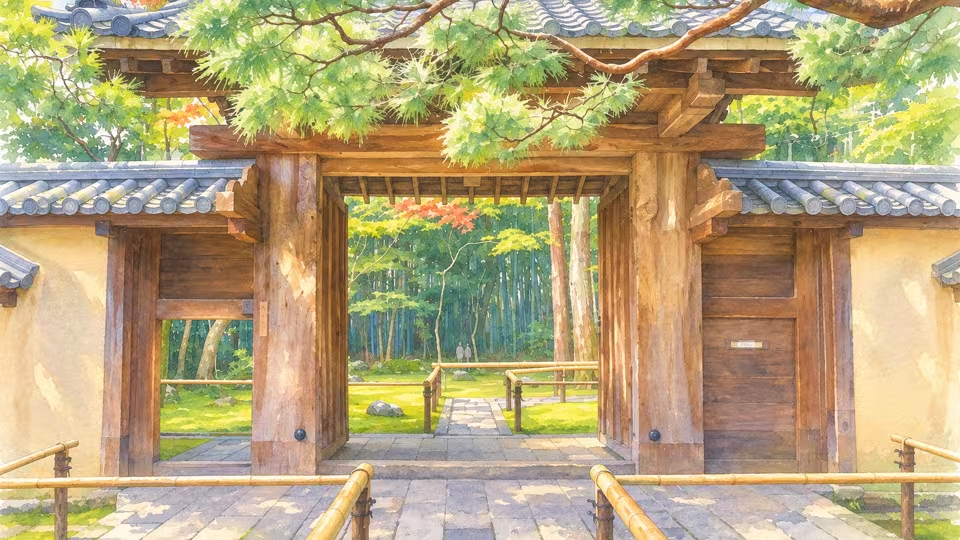
01A Walled Town of Temples
Daitoku-ji sits in Murasakino, the "purple fields" in the north of Kyoto, just above Kitaōji Street. It does not feel like a single temple. Walk in from the east gate and you find a grid of stone paths shaded by pines, with the great halls standing in a line from south to north and, on every side, earthen walls enclosing smaller temples. These are tatchū, sub-temples, and there are more than twenty of them still active today. Together they make Daitoku-ji one of the largest Zen precincts in Japan, and in 2016 the whole precinct was designated a national Historic Site and Place of Scenic Beauty.
Daitoku-ji is the head temple of the Daitoku-ji branch of Rinzai Zen, the school of Zen that trains monks through kōan, the paradoxical questions set by a teacher. Its fame rests on a handful of people and moments. Its founder, Shūhō Myōchō, built a reputation for uncompromising practice. The eccentric monk Ikkyū Sōjun rebuilt it after civil war burned Kyoto. Merchants from the port of Sakai paid for that rebuilding, and with them came the culture of tea. Toyotomi Hideyoshi staged a vast funeral here for his murdered lord, Oda Nobunaga. And a statue of the tea master Sen no Rikyū, placed inside the temple’s main gate, became the official reason for Rikyū’s forced suicide in 1591.
02The Founder Under the Bridge
Shūhō Myōchō was born in 1282 in Harima Province, in what is now Hyōgo Prefecture. After early training at Manju-ji in Kamakura, he became the disciple of Nanpo Shōmyō, a Japanese monk who had spent years in Song-dynasty China and brought back a rigorous line of Rinzai teaching. Nanpo’s line passed from him to Shūhō, and from Shūhō to Kanzan Egen, who later founded Myōshin-ji. These three are known together as Ō-Tō-Kan, from one character in each of their titles or names, and nearly every Rinzai lineage active in Japan today traces back through them.
After Nanpo died in 1308, Shūhō spent years living quietly at a small hermitage in the Higashiyama hills of Kyoto. The best-known story claims he lived for twenty years among the beggars under the Gojō Bridge. When Emperor Hanazono wanted to find him, the story goes, his messenger brought melons to the bridge and offered one to any beggar who could take it without using his hands. One beggar replied, "Then hand it to me without using yours," and so the master was found. This is a legend that grew up well after Shūhō’s lifetime, but it captures how later generations imagined him: a monk indifferent to rank and sharp in exchange.
Around 1315 (some sources say 1319) Shūhō built a small hermitage at Murasakino, with backing from the warrior Akamatsu Norimura of Harima. By about 1324 it had become a temple named Daitoku-ji, and in 1325 the retired Emperor Hanazono made it an imperial prayer temple. Hanazono, who studied Zen under Shūhō, gave him the title Daitō Kokushi, "National Teacher of the Great Lamp," the name by which he is still known; Emperor Go-Daigo honored him as well.
03From the Top Rank to Going It Alone
Go-Daigo’s support went further than any other emperor’s. After the fall of the Kamakura shogunate in 1333, during his brief restoration of direct imperial rule (1333–34), Go-Daigo placed Daitoku-ji at the head of the Five Mountains (Gozan), the state-sponsored ranking of Zen temples, and set it at the highest level beside Nanzen-ji. He also decreed that the abbacy would pass only within Shūhō’s own lineage. Shūhō died at the end of 1337 by the Japanese calendar (early 1338 in Western reckoning), aged fifty-six by Japanese count.
The restoration collapsed within a few years. The Ashikaga shoguns who replaced Go-Daigo favored a different Zen line, that of Musō Soseki, and Daitoku-ji’s close ties to the defeated emperor counted against it. In 1386 the shogunate ranked it only ninth among the second-tier "Ten Temples." In 1431 it withdrew from the official system altogether.
That decision put Daitoku-ji among the temples called rinka, "beneath the trees," as opposed to the official Gozan. Gozan monks were known for Chinese poetry, scholarship, and diplomatic work for the shogunate. Rinka temples such as Daitoku-ji and Myōshin-ji emphasized seated meditation and koan training, and they depended on provincial warriors and townsmen for money. Without shogunal patronage, Daitoku-ji had to find new friends. In the late fifteenth century it found them among the merchants of Sakai.
04Ikkyū and the Merchants of Sakai
The Ōnin War, which broke out in 1467 and dragged on for a decade, reduced much of Kyoto to ash. Daitoku-ji, already badly damaged by a fire in 1453, lost most of its buildings.
In 1474 Emperor Go-Tsuchimikado appointed Ikkyū Sōjun as the forty-seventh abbot (some lists count him the forty-eighth). Ikkyū was eighty-one by Japanese reckoning. He was born in 1394 and was widely believed to be an unacknowledged son of Emperor Go-Komatsu. Trained in Daitoku-ji’s lineage under the austere master Kasō Sōdon at Katata on Lake Biwa, he became the most notorious monk of his age: he drank, visited brothels, wrote poems about love and sex, and called himself Kyōun, "Crazy Cloud." His collection of Chinese verse is titled Kyōunshū. Much of his scorn was aimed at his senior fellow disciple Yōsō Sōi, whom he accused of selling enlightenment to wealthy lay followers.
Ikkyū spent little time at Daitoku-ji itself and continued to live mostly at Shūon-an, a hermitage south of Kyoto now known as Ikkyū-ji. But his name raised money. Sakai, the great trading port near Ōsaka, was rich from commerce with China, and its merchants were drawn to Zen. Their donations rebuilt the Dharma Hall and abbot’s quarters. Ikkyū died in 1481, aged eighty-eight by Japanese count. A Sakai merchant, Owa Sōrin, then founded the sub-temple Shinju-an in his memory, and it still stands inside the precinct.
The cheerful boy-monk "Ikkyū-san" known to Japanese children comes from Edo-period storybooks and a 1970s television cartoon. It has little to do with the old man of the poems.
05Tea Enters the Zen Temple
Among the people around Ikkyū was Murata Jukō, regarded as the founder of wabi-cha, the style of tea that prizes simplicity, rough materials, and small rooms. Tradition says Jukō studied Zen with Ikkyū and received from him a piece of calligraphy by the Chinese master Yuanwu Keqin as proof of his understanding. The details come from later tea writings, but the idea that "tea and Zen share one taste" took shape in this circle, and hanging a Zen monk’s calligraphy in the alcove of a tea room became standard practice.
The connection deepened over the next century. Takeno Jōō, the Sakai tea master who taught the next generation, studied Zen with Daitoku-ji monks. So did Sen no Rikyū, born Yoshirō to the Tanaka family of Sakai, who received his Buddhist name Sōeki from the Daitoku-ji abbot Dairin Sōtō. Rikyū’s relationships with the abbots Shōrei Sōkin and Kokei Sōchin were close and lifelong. The name Rikyū itself was a lay title granted by Emperor Ōgimachi in 1585, when Hideyoshi held a tea gathering at the imperial palace. Daitoku-ji abbots wrote the scrolls that hung in tea rooms and gave tea men their names. Calligraphy by Daitoku-ji abbots is still the most common thing you will see hanging in a tea room in Japan today.
06The Sub-Temples of the Warlords
In the sixteenth century the sub-temples multiplied. A tatchū began as a small cloister built by disciples beside a master’s grave, but by this time warlords were founding them as family memorial temples. A Daitoku-ji sub-temple brought prestige, a link to the imperial court, and a seat in the tea world.
Daisen-in, founded in 1509 by the abbot Kogaku Sōkō, has one of the oldest surviving abbot’s halls in Japan, now a National Treasure, and a famous dry landscape garden in which rocks and raked gravel represent a waterfall, a river, and the open sea. Later foundations read like a list of the period’s great houses. The Christian daimyo Ōtomo Sōrin of Kyūshū founded Zuihō-in. Oda Nobunaga founded Ōbai-in for his father. Miyoshi Yoshitsugu founded Jukō-in for his adoptive father, Miyoshi Nagayoshi. Hosokawa Tadaoki founded Kōtō-in. Lady Matsu, widow of Maeda Toshiie, founded Hōshun-in. Ishida Mitsunari, Hideyoshi’s administrator, is linked with Sangen-in.
07Hideyoshi Buries Nobunaga
On the second day of the sixth month of 1582, Oda Nobunaga died at Honnō-ji in Kyoto, attacked by his own general Akechi Mitsuhide. His body was never found. Hashiba Hideyoshi, later known as Toyotomi Hideyoshi, defeated Mitsuhide at Yamazaki eleven days later and moved quickly to turn that victory into leadership of the Oda coalition.
In the tenth month of 1582 he held Nobunaga’s funeral at Daitoku-ji. Modeled on the funerals of Ashikaga shoguns, the rites ran for seven days, with the main ceremony on the fifteenth day, led by the Daitoku-ji abbot Kokei Sōchin. With no body to cremate, Hideyoshi had two statues of Nobunaga carved from fragrant aloeswood; one was burned in the coffin and the other kept for worship. The procession is said to have numbered some three thousand people, and crowds lined the streets. The chief mourner was Hideyoshi’s adopted son Hidekatsu, one of Nobunaga’s own sons, but everyone knew who was in charge.
The politics were plain. Nobunaga’s heir had died with him, the senior Oda retainer Shibata Katsuie stayed away, and by organizing the funeral Hideyoshi presented himself as Nobunaga’s true successor. Within a year he had destroyed Katsuie at the Battle of Shizugatake.
In 1583, in time for the first anniversary of Nobunaga’s death, Hideyoshi founded the sub-temple Sōken-in as his memorial temple, named after Nobunaga’s posthumous Buddhist name. Its principal image is a seated wooden statue of Nobunaga in court dress, about 115 centimeters tall and an Important Cultural Property; an inscription dates it to 1583 and names the sculptor Kōsei. The temple identifies it as the statue that was not burned. Graves of Oda family members stand in its grounds.
08The Statue in the Gate
Daitoku-ji’s main gate is called Kinmōkaku, "Pavilion of the Golden-Haired Lion." Its lower story was completed in 1529 with money raised by the linked-verse poet Sōchō and others, but the upper story was never finished. In 1589 Rikyū paid to complete it, reportedly in memory of his father on the fiftieth anniversary of his death. The upper story’s ceiling and pillars carry colorful dragons and celestial beings painted by Hasegawa Tōhaku. In gratitude the temple placed a wooden statue of Rikyū in the upper story, showing him in sandals.
Two years later this statue was named as Rikyū’s crime. Imperial envoys and Hideyoshi himself passed beneath the gate; to set a sandaled image of a tea master above them was to make them walk under his feet. On the thirteenth day of the second month of 1591 Hideyoshi ordered Rikyū to leave Kyoto and confine himself in Sakai; about ten days later he summoned him back and ordered him to kill himself. Rikyū performed seppuku at his residence in Hideyoshi’s Jurakudai palace complex on the twenty-eighth day of the second month of 1591, at the age of seventy by Japanese reckoning. According to contemporary accounts, the statue was dragged out and displayed at Ichijō Modoribashi, a bridge in central Kyoto, as if it were a crucified criminal, with Rikyū’s severed head beneath it.
Whether the statue was the real reason has been argued ever since. Other explanations include charges that Rikyū profited by selling tea utensils at inflated prices, a clash of taste between him and Hideyoshi, factional politics after the death of Hideyoshi’s brother Hidenaga in early 1591, who had been Rikyū’s protector, and a story that Rikyū refused to give his daughter to Hideyoshi as a concubine. The last is generally treated as later invention. What is certain is that the statue was the stated charge; what lay behind it remains unknown. Hideyoshi is said to have threatened Kokei Sōchin and other Daitoku-ji monks with punishment before the affair was settled. The statue of Rikyū in the gate today is generally said to be a Meiji-period gift.
09Purple Robes and Takuan
Under the Tokugawa shogunate Daitoku-ji faced a different kind of pressure. Emperors had long granted purple robes, the highest honor for a Zen abbot, to Daitoku-ji and Myōshin-ji monks. In 1613 the shogunate ruled that such grants needed its prior approval, and it repeated the rule in 1615. Emperor Go-Mizunoo kept granting them anyway, and in 1627 the shogunate declared his grants void.
Daitoku-ji monks led by Takuan Sōhō protested in writing. In 1629 the shogunate exiled Takuan to Kaminoyama in the far north and his colleague Gyokushitsu Sōhaku to Tanagura. The affair was one reason the humiliated emperor abdicated soon afterward in favor of his young daughter. The Purple Robe Incident showed how far the shogunate’s authority now reached into the court’s own business. Takuan was later pardoned and became a trusted adviser to the third shogun, Tokugawa Iemitsu. Popular tradition credits him with inventing takuan, the yellow pickled radish, though there is no evidence for it.
The early Edo period also gave Daitoku-ji most of the buildings on its central axis. The abbot’s quarters were rebuilt in 1635–36 with funds from the Kyoto merchant Gotō Masukatsu, the Dharma Hall in 1636 with funds from Inaba Masakatsu and his son Masanori, lords of Odawara, and the Buddha Hall in 1665 with funds from the merchant Nawa Jōyū.
10Jukō-in: Miyoshi, Kanō Eitoku, and the Grave of Rikyū
Of all the sub-temples, Jukō-in has the deepest ties to tea. Miyoshi Yoshitsugu founded it in 1566 for Miyoshi Nagayoshi, the warlord who dominated Kyoto and the shogunate in the decade before Nobunaga, and its first abbot was Shōrei Sōkin, Rikyū’s Zen teacher. The name comes from Nagayoshi’s posthumous Buddhist name.
The forty-six sliding-door paintings of its abbot’s hall are by Kanō Shōei and his son Kanō Eitoku, and they are a National Treasure. Eitoku’s Birds and Flowers, with a giant plum tree spreading across several panels, was painted when he was in his early twenties and anticipates the bold style of the Momoyama period’s great castle interiors. The originals are now kept elsewhere for conservation, and high-quality reproductions stand in their place.
Rikyū’s grave is at Jukō-in, and the three houses of the Sen family descended from him (Omotesenke, Urasenke, and Mushakōjisenke) bury their heads here, so the temple serves all three. The dry garden in front of the hall, called Hyakuseki-tei, is a Place of Scenic Beauty traditionally associated with Rikyū. Its tea rooms Kan’in-seki and Masudoko-seki are Important Cultural Properties. Kan’in-seki, a dim, spare room of only three mats, is generally said to have been donated by Joshinsai, seventh head of Omotesenke, for Rikyū’s 150th memorial; Masudoko-seki next to it has four and a half mats. A study hall completed in 2013 holds waterfall paintings by the contemporary artist Senju Hiroshi. Jukō-in is normally closed and opens only during special viewing periods.
11Walking Daitoku-ji Today
Most visitors enter from Kitaōji Street. The first major structure is the Chokushimon, the Imperial Messenger Gate, traditionally said to have been moved from the imperial palace and set here in 1640; it is an Important Cultural Property. Behind it rises the vermilion Sanmon, Kinmōkaku, with its lower story of 1529 and Rikyū’s upper story of 1589. Then come the Buddha Hall of 1665 and the Dharma Hall of 1636, both Important Cultural Properties. The Dharma Hall’s ceiling carries a coiling dragon painted by Kanō Tan’yū; clap beneath it and the echo is said to make the dragon cry. Farther north are the abbot’s quarters and their entrance hall, both National Treasures, with a garden designated a Special Place of Scenic Beauty and Historic Site, and a richly carved Karamon gate, also a National Treasure, said, though not proven, to have come from Hideyoshi’s Jurakudai palace. The main compound is usually closed and opens only in special seasons.
Several sub-temples are open all year. Daisen-in has its celebrated dry garden. Ryōgen-in has one of the smallest stone gardens in Japan. Zuihō-in’s garden includes a rock arrangement said to hide a cross, a nod to Ōtomo Sōrin’s Christian faith. Kōtō-in is famous for maples and for the graves of Hosokawa Tadaoki and his wife Gracia. Ryōkō-in, which holds one of the three surviving yōhen tenmoku tea bowls and the National Treasure tea room Mittan, never admits the public.
Before you leave, look for Daitoku-ji nattō, salty fermented and dried soybeans that began as a temple preserved food and are still sold near the gate.