
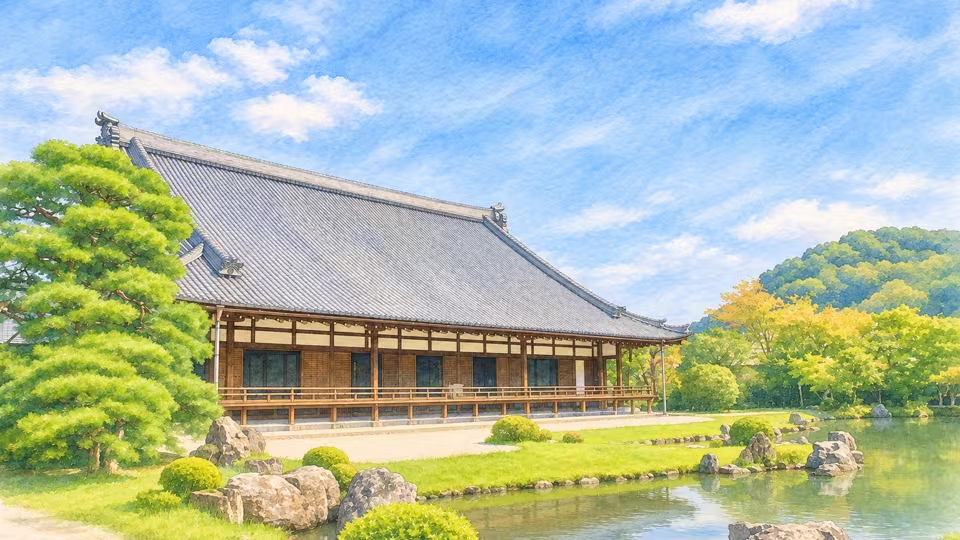
01Where You Are Standing
Tenryū-ji sits at the foot of Arashiyama, the wooded hills on Kyoto’s western edge. Behind the temple rises a low, rounded hill called Kameyama, "Turtle Mountain." In front, a short walk to the south, the Ōi River (the upper Katsura River) flows under the Togetsukyō Bridge. The temple’s formal name is Reikizan Tenryū Shiseizen-ji, and today it is the head temple of the Tenryū-ji branch of Rinzai Zen, one of the main schools of Japanese Zen Buddhism.
Most visitors come for the garden, and they are right to. But the temple exists because of a political and spiritual crisis in the fourteenth century: a warrior who had driven an emperor from his capital needed to make peace with that emperor’s spirit.
02An Imperial Landscape Before the Temple
Long before Tenryū-ji, this ground belonged to the imperial family. In the Jōwa era (834–848), Tachibana no Kachiko, empress to Emperor Saga, founded a temple here called Danrin-ji. She invited a Chinese monk, Yikong (Gikū in Japanese), to teach meditation, and Danrin-ji is often remembered as one of the first places in Japan where Chan, or Zen, was taught. The temple did not survive, and the land eventually returned to fields.
In the mid-thirteenth century, the retired emperor Go-Saga built a country palace here, the Kameyama-dono, named after the hill behind it. His son, Emperor Kameyama, inherited it and took his posthumous name from it. The tombs of both Go-Saga and Kameyama still lie inside the temple grounds, in the northwest corner, maintained by the Imperial Household Agency.
The palace mattered politically. After Go-Saga’s death the imperial family split into two rival lines that were supposed to alternate on the throne. Kameyama founded one of them, the Daikaku-ji line. His grandson was Emperor Go-Daigo, the man whose ghost Tenryū-ji was built to console. According to the temple, Go-Daigo studied at the Kameyama palace as a young man.
03Go-Daigo and Ashikaga Takauji
Go-Daigo was an unusual emperor. He wanted to rule in fact, not just in name, and that meant destroying the Kamakura shogunate, the military government that had controlled Japan for more than a century. In 1333 he succeeded, with the help of powerful warrior houses. The most important of them was led by Ashikaga Takauji, a general from a branch of the Minamoto clan. Takauji had been sent by Kamakura to crush Go-Daigo’s supporters, but he switched sides and captured the shogunate’s headquarters in Kyoto.
Go-Daigo’s new government, known as the Kenmu Restoration, quickly alienated the warriors who had brought it to power. By 1335 Takauji had broken with the emperor. In 1336 he took Kyoto, placed a rival prince from the other imperial line on the throne as Emperor Kōmyō, and set up a new military government, the Muromachi shogunate. Takauji was formally appointed shogun in 1338.
Go-Daigo escaped south to Yoshino, in the mountains of Yamato province, and declared that he was still the true emperor. For the next fifty-six years Japan had two courts: the Northern Court in Kyoto, backed by the Ashikaga, and the Southern Court in Yoshino. This is the Nanboku-chō, or "Northern and Southern Courts," period.
On the sixteenth day of the eighth month of 1339, Go-Daigo died at Yoshino, aged fifty-two by the traditional count. The fourteenth-century war chronicle Taiheiki gives him a famous deathbed wish: though his bones might lie buried in the southern hills, his spirit would always long for the northern capital. Whether or not he said it, the line captured exactly what people in Kyoto feared. His tomb behind Nyoirin-ji at Yoshino is said to face north, toward Kyoto, unlike other imperial tombs.
04Musō Soseki and the Idea of a Memorial Temple
In medieval Japan, it was widely believed that a person of high rank who died with a grievance could become an angry spirit, an onryō, and bring disaster on the living. Go-Daigo had died in exile, at war with the men now ruling Kyoto. His spirit was a real concern.
The person who proposed a solution was Musō Soseki, the most respected Zen master of his day. Musō was also a skilled garden designer and a political survivor: Go-Daigo had honored him, and so did Takauji and his brother Ashikaga Tadayoshi, who ran much of the shogunate’s civil administration. Over his life Musō received the title kokushi, "National Teacher," from seven different emperors.
Musō was born in Ise province in 1275. He studied with Yishan Yining (Issan Ichinei in Japanese), a Chinese monk who had come to Japan as an envoy of the Yuan court, and inherited the teaching line of the Japanese master Kōhō Kennichi. For years he avoided the powerful, moving between small hermitages in Kai, Mino, Tosa, and Kamakura, and almost everywhere he went he shaped the landscape around him into gardens. In 1325 Go-Daigo ordered him to Kyoto to head Nanzen-ji, and from then on he was never far from the center of power. In 1339, the same year work on Tenryū-ji began, he also restored Saihō-ji, the temple now known as the Moss Temple.
Tenryū-ji was one of several memorial projects Musō proposed. He also persuaded the Ashikaga brothers to establish a temple and a pagoda in every province, the Ankoku-ji and Rishō-tō, to pray for all who had died in the civil war. Tenryū-ji was the grandest of these, built for the highest-ranking casualty of the conflict.
Musō urged the Ashikaga brothers to build a Zen temple to pray for Go-Daigo’s peace in the afterlife. Doing so was an act of religious caution, but it was also good politics. By honoring the dead emperor, the new regime presented itself as the legitimate guardian of the imperial tradition. In the tenth month of 1339, the retired emperor Kōgon of the Northern Court issued the formal order to convert the Kameyama palace into a temple, and Musō was named its founding abbot.
05A Name, a Dragon, and a Quarrel with Mount Hiei
The temple was first named Ryakuō Shiseizen-ji, after the era name then in use, Ryakuō. This immediately caused trouble. Enryaku-ji, the great Tendai monastery on Mount Hiei northeast of Kyoto, objected that the right to name a temple after an era belonged to established institutions like itself, not to an upstart Zen foundation.
In 1341 the name was changed to Tenryū Shiseizen-ji, "Heavenly Dragon." The temple’s own tradition explains the new name with a dream: Tadayoshi saw a golden dragon rise from the river beside the site and fly into the sky. Musō read it as a good omen. Dragons appear throughout the temple today, most dramatically on the ceiling of the Dharma Hall.
06Paying for It: The Tenryū-ji Ships
Building a major monastery was expensive, and the new shogunate was still fighting a civil war. Income from several estates was assigned to the temple, but it was not enough. Musō and Tadayoshi turned to overseas trade, reviving voyages to China that had lapsed since the Mongol invasions of Japan in the 1270s and 1280s.
In 1342, on Musō’s recommendation and with Tadayoshi’s approval, a Hakata merchant named Shihon was put in charge of a trading voyage to Yuan-dynasty China, on the condition that on his return he pay Tenryū-ji 5,000 kan of cash whatever the outcome of the venture. These "Tenryū-ji ships" were a forerunner of the later official trade between the Ashikaga shoguns and Ming China. They also show how closely Zen monasteries were tied to the sea routes linking Japan and China: many Zen monks had studied on the continent, and Chinese monks taught in Japan.
07The Dedication of 1345
The main halls were completed within a few years. The dedication ceremony was held on the twenty-ninth day of the eighth month of 1345, timed for the seventh anniversary of Go-Daigo’s death.
Enryaku-ji protested again, this time more fiercely. Its monks demanded that the retired emperor not attend and that Musō be banished, and threatened to carry their sacred palanquins into the capital, a tactic Mount Hiei had used for centuries to intimidate the court. A compromise was reached: the retired emperor stayed away from the main ceremony. On the day itself, Takauji and Tadayoshi led a long procession of armed retainers to the temple, a display of the shogunate’s commitment to Zen. According to the Taiheiki and other accounts, the retired emperor Kōgon made his visit the following day instead.
The men who built Tenryū-ji did not enjoy their partnership for long. Within a few years Takauji and Tadayoshi fell out, and their quarrel, known as the Kannō Disturbance, became open war. Musō died at Rinsen-ji in Kyoto in 1351, aged seventy-seven by the traditional count. Tadayoshi died in Kamakura early in 1352, poisoned according to rumors recorded in the Taiheiki. Takauji died in Kyoto in 1358, the same year Tenryū-ji suffered its first great fire.
08First Among the Five Mountains
The Ashikaga organized the leading Zen monasteries into a ranked system called the Gozan, or "Five Mountains," modeled on a similar system in Song-dynasty China. Tenryū-ji was placed second in the ranking of 1342, behind Engaku-ji in Kamakura. In 1386 the third shogun, Ashikaga Yoshimitsu, fixed the ranking that lasted: Nanzen-ji was set above the system altogether, and Tenryū-ji was named first of the five Kyoto temples, followed by Shōkoku-ji, Kennin-ji, Tōfuku-ji, and Manju-ji.
After Musō’s death his disciples dominated the Gozan for generations. One of them, Shun’oku Myōha, a former abbot of Tenryū-ji, was appointed by Yoshimitsu in 1379 as the first registrar of monks, overseeing appointments across the Zen establishment, and Tenryū-ji became the home base of Musō’s lineage.
At its height, Tenryū-ji is said to have controlled a precinct about ten times its present size, with around 150 subtemples. It was a center of Gozan literature, the Chinese-language poetry and prose written by Zen monks. In the sixteenth century, the Tenryū-ji monk Sakugen Shūryō traveled twice to Ming China as part of official missions and left detailed diaries of his journeys.
09Eight Fires
Tenryū-ji is famous for burning. The temple counts eight major fires in its history: 1358, 1367, 1373, 1380, 1447, 1468, 1815, and 1864. The first came barely a decade after the dedication. The fire of 1447 and the burning of 1468, during the Ōnin War that wrecked much of Kyoto, did the worst damage.
The temple recovered slowly. Only in 1585, when Toyotomi Hideyoshi granted it land, did real restoration begin, and rebuilding continued through the Edo period until another fire in 1815.
The last disaster was political. In 1864, during the violent final years of the Tokugawa shogunate, troops from the Chōshū domain tried to seize control of the imperial palace in what is called the Kinmon (Forbidden Gate) Incident or Hamaguri Gate Incident. Some of the Chōshū forces had camped at Tenryū-ji. After their defeat, the temple burned almost completely; the fire is usually blamed on Satsuma troops pursuing them.
The Meiji government then confiscated most of the temple’s land in the 1870s, leaving about a tenth of the old precinct. In 1876 Tenryū-ji became head temple of its own branch of Rinzai Zen. Rebuilding began under the abbot Gasan Shōtei: the Dharma Hall, the main abbot’s quarters, and the kitchen were finished in 1899, and by about 1935 the temple had taken roughly its present shape. What you see today is a much smaller precinct, and nearly all its buildings date from the late nineteenth century or later.
10The Buildings You See Today
The oldest structure is the Chokushi-mon, the "Imperial Messenger Gate," near the main entrance. It is generally dated to the Keichō era (1596–1615), is said to have come from Fushimi Castle, and was moved here in 1641.
The Hattō, or Dharma Hall, was moved here in 1899; it was originally the meditation hall of Ungo-an, a subtemple that had survived the fires. It enshrines a Shaka triad along with wooden statues of Musō Soseki and Ashikaga Takauji. Its ceiling carries the Unryū-zu, "Dragon in the Clouds," painted by Kayama Matazō in 1997 to mark the 650th anniversary of Musō Soseki’s death and the centenary of the hall’s relocation. The dragon is painted so that its eyes seem to follow you wherever you stand. An earlier ceiling dragon, painted by Suzuki Shōnen in 1899, had deteriorated badly and was replaced.
The Kuri, the temple’s kitchen and administrative building, built in 1899, is the usual entrance to the interior. Inside the entry hangs a large painting of Bodhidharma, the founder of Zen, by a former head abbot, Hirata Seikō; it has become the temple’s emblem. Beyond lie the Ōhōjō (Large Abbot’s Quarters), rebuilt in 1899, and the Kohōjō (Small Abbot’s Quarters), rebuilt in 1924. The Ōhōjō houses the principal image, a seated Shaka (the historical Buddha) dating to the late Heian period, older than the temple itself, which survived the fires and is an Important Cultural Property.
Behind the abbot’s quarters, reached by a covered corridor, is the Tahōden, built in 1934 and said to be modeled on the main hall of Go-Daigo’s palace at Yoshino. It enshrines a statue of Go-Daigo and stands, according to the temple, where the Kameyama palace once was. The weeping cherry in front was transplanted from Yoshino, where he died. Of all the buildings, it is the one most directly tied to the reason Tenryū-ji exists.
11The Sōgenchi Garden
The Sōgenchi Garden, west of the abbot’s quarters, is Musō Soseki’s work and the one part of Tenryū-ji that keeps its fourteenth-century form. It is a stroll garden built around a pond, and it "borrows" the scenery beyond it: Kameyama and the hills of Arashiyama become part of the composition.
The name means "Pond of the Source of Sōkei." According to temple tradition, when Musō dredged the pond he found a stone inscribed with the phrase Sōgen itteki, "one drop from the source of Sōkei," a Zen expression referring to the teachings handed down from Huineng, the Sixth Patriarch of Chinese Zen.
Across the pond, look for a dry waterfall of tall upright stones, the Ryūmon-baku, or Dragon Gate Falls. It illustrates a Chinese legend in which a carp that swims up the falls at the Dragon Gate turns into a dragon, a metaphor for a monk’s struggle toward enlightenment. A stone set beside the flow rather than at the foot of the falls, the Rigyo-seki or "carp stone," shows the fish in the act of becoming a dragon. In front of the falls, a bridge of natural stone slabs crosses the water.
The garden was designated a Historic Site and Place of Scenic Beauty in the Taishō era and later raised to Special Place of Scenic Beauty; the temple describes it as the first garden in Japan to hold both titles. Parts of the shoreline were altered over the centuries, and the stone revetments were repaired in 1983. In 1994 Tenryū-ji was inscribed on the UNESCO World Heritage List as part of the Historic Monuments of Ancient Kyoto.
12A Walk Through the Grounds
Enter through the main gate from the street and look for the Chokushi-mon on your right. Walk up the approach past the subtemples to the Dharma Hall; it is not always open, but if you can go in, stand at the center and then walk around the dragon to see its eyes follow you.
Enter the abbot’s quarters through the Kuri, pass the Bodhidharma painting, and sit on the veranda of the Ōhōjō facing the pond. This is the view Musō composed. Pick out the Dragon Gate Falls on the far shore, then the hills rising behind it.
Follow the garden path north past the Tahōden and through the Hyakkaen, a flower garden laid out in 1983 with plantings for every season. The north gate opens directly onto the Sagano bamboo grove. From there, Nonomiya Shrine is a few minutes’ walk, and the Ōkōchi Sansō villa and Jōjakkō-ji are a little farther on.
If you have time, look into the subtemples along the approach. About a dozen survive, a small remnant of the hundred and more that once surrounded the main temple. Two of them, Hōgon-in and Kōgen-ji, open to the public in spring and autumn; Hōgon-in’s garden is traditionally attributed to Sakugen Shūryō, the monk who sailed to Ming China.