
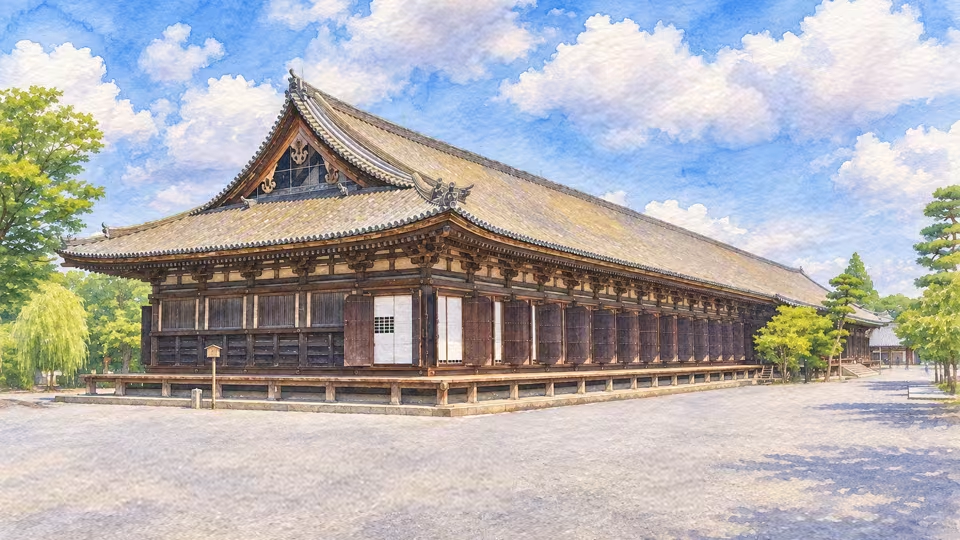
01The Long Hall
The first thing anyone notices about Sanjūsangen-dō is its length. The hall faces east and runs roughly 120 meters from north to south, under a single low tiled roof, while it is only about 20 meters deep. Its name means "Hall of Thirty-Three Bays": between the pillars along the inner front there are thirty-three spaces. The number was not chosen for convenience. In the Lotus Sutra, Kannon (Avalokiteśvara, the bodhisattva of compassion) takes thirty-three different forms to rescue living beings, and the hall was built to house Kannon in overwhelming numbers.
The building’s formal name is the Main Hall of Rengeō-in, "the Temple of the Lotus King." It belongs today to Myōhō-in, a Tendai-school temple a short walk to the north that was traditionally headed by imperial princes. Inside stand 1,001 statues of the Thousand-Armed Kannon (Senju Kannon), a large seated figure in the center flanked by a thousand standing ones, with twenty-eight guardian deities and the gods of wind and thunder in front. It is one of the most celebrated interiors in Japan.
To understand why anyone would build a hall like this, you have to go back to the 1160s and to the man who commissioned it, the retired emperor Go-Shirakawa.
02Go-Shirakawa and His Palace
In the late Heian period (794–1185), real power at court often lay not with the reigning emperor but with his retired father or grandfather. Abdicated emperors governed from their own households, a system known as insei, "cloistered rule." Go-Shirakawa abdicated in 1158 in favor of his son, Emperor Nijō, and remained a force in politics, with interruptions, for more than thirty years.
A retired emperor needed a palace of his own. Go-Shirakawa chose land east of the Kamo River around Shichijō, the seventh of the capital’s great east–west avenues. An old temple called Hōjū-ji had stood there since the late tenth century, founded by the courtier Fujiwara no Tamemitsu, and the new residence took its name: Hōjūji-dono, "the Hōjū-ji Palace." Go-Shirakawa first moved in during the fourth month of 1161. His consort Taira no Shigeko, mother of the future Emperor Takakura, lived there too and built a chapel of her own within the grounds. The compound grew into a sprawling complex of residential halls, chapels, and gardens taking in roughly the ground now occupied by Sanjūsangen-dō, Hōjū-ji, and the Kyoto National Museum.
Go-Shirakawa was an unusual ruler. He was devoted to Buddhism, took monastic vows, and made dozens of pilgrimages to the Kumano shrines in the far south of the Kii Peninsula. He was also passionately fond of imayō, the popular songs of his day, sang them so obsessively that, by his own account, he lost his voice more than once, and compiled an anthology of them, the Ryōjin hishō. As a politician he was a survivor who kept playing rival warrior houses against each other; Minamoto no Yoritomo, the eventual founder of the Kamakura shogunate, is said to have called him the greatest tengu (a trickster goblin) in Japan.
03Kiyomori Builds the Hall
The hall itself was built for Go-Shirakawa by Taira no Kiyomori. Kiyomori had come out of two short, violent conflicts in the capital, the Hōgen Disturbance of 1156 and the Heiji Disturbance of 1159, as the leading warrior at court. His clan was rich from provincial governorships and trade, and paying for temple construction on behalf of a retired emperor was one of the standard ways a rising family turned wealth into rank and favor. Kiyomori paid for Rengeō-in from his own resources, and according to the chronicle Gukanshō he was rewarded with the governorship of Bizen Province.
Rengeō-in was dedicated on the seventeenth day of the twelfth month of Chōkan 2, at the very start of 1165 by the Western calendar. The story is told that Go-Shirakawa hoped his son Emperor Nijō would attend the dedication, and that Nijō did not come. Nijō wanted to rule in his own right, and the cold relationship between father and son was a constant undercurrent in the politics of those years; he abdicated and died later in 1165.
Rengeō-in was more than one building. A five-story pagoda was added in 1178, along with other halls, and the temple had a treasure house where Go-Shirakawa kept the scrolls, books, and objects he collected. The painted handscroll of court ceremonies known as the Nenjū gyōji emaki is traditionally associated with his commission.
04Why a Thousand Statues
Late Heian aristocrats measured religious merit partly in quantity. To make one image of a buddha earned merit; to make a thousand earned more. A generation earlier, Kiyomori’s father, Taira no Tadamori, had built a hall called Tokuchōju-in for Go-Shirakawa’s father, Retired Emperor Toba. It housed a thousand life-size statues of Kannon, it too was a hall of thirty-three bays, and the reward Tadamori received for it, the right to enter the emperor’s private quarters, is told in the first book of the Tale of the Heike. Rengeō-in followed that model on an even grander scale.
The Thousand-Armed Kannon already contains the idea of a thousand. In scripture the bodhisattva has a thousand hands, each with an eye in its palm, to see and reach every suffering being. Sculptors usually show forty arms plus the two hands joined in prayer, each of the forty standing for twenty-five worlds of existence: forty times twenty-five makes a thousand. The statues at Sanjūsangen-dō follow this convention. A thousand life-size figures in rows needed a building of exceptional length, and that is the reason for the hall’s shape.
A well-known legend explains the temple’s name. Go-Shirakawa, it is said, suffered from chronic headaches. He learned in a dream that in a previous life he had been a monk called Rengebō, whose skull lay in a river with a willow tree growing through it; whenever the wind moved the willow, the emperor’s head ached. The skull was recovered and placed inside a Kannon image, the willow was cut for the hall’s timber, and the headaches stopped. This is a later tale, but it lives on in the temple’s January rite in which worshippers are touched with sacred water using a willow branch, said to protect against headaches.
05The Battle at Hōjūji-dono
The most dramatic day in the palace’s history came in the winter of 1183.
That summer Minamoto no Yoshinaka, often called Kiso Yoshinaka after the mountain valley where he grew up, had swept down from the north and driven the Taira out of the capital; they fled west taking the child emperor Antoku with them. Yoshinaka was among the first Minamoto commanders to enter Kyoto, and he was welcomed at first. But his troops plundered the city, he quarreled with Go-Shirakawa over who should be the next emperor, and the retired emperor began looking to Yoritomo in Kamakura instead. Go-Shirakawa gathered warrior monks and soldiers at Hōjūji-dono.
Yoshinaka struck first. On the nineteenth day of the eleventh month of Juei 2 (January 3, 1184, in the Julian calendar), his men attacked the palace. The defenders broke quickly. Myōun, the head of the Tendai school, and Go-Shirakawa’s own son, Prince En’e, were among those killed, and Go-Shirakawa was taken into Yoshinaka’s custody. The palace was set on fire. Yoshinaka, holding the retired emperor, had himself appointed shogun early the next year; the title is traditionally given as seii taishōgun, though some historians now argue it was seitō taishōgun.
He did not last. Yoritomo sent his brothers Noriyori and Yoshitsune west, and in the first month of 1184 Yoshinaka was defeated near the Uji River and killed at Awazu on the shore of Lake Biwa. Hōjūji-dono was later rebuilt with Yoritomo’s help but never recovered its former splendor. The long hall of Rengeō-in survived the attack and stood for another sixty-five years.
06The Emperor’s Grave
Go-Shirakawa lived through the whole Genpei War and saw the Taira destroyed in 1185. He died in Kyoto in 1192, aged sixty-six by the traditional Japanese count, and was buried in a Lotus Hall he had built just east of Rengeō-in. Across the road from the east side of Sanjūsangen-dō is the small temple of Hōjū-ji, and beside it the Imperial Household Agency maintains his tomb, the Hōjū-ji Mausoleum. The giant hall and the quiet tomb are the two main survivors of his palace.
07Fire and Rebuilding
The hall you see is not the one Kiyomori built. In 1249 a great fire spread through the city and destroyed the main hall of Rengeō-in. Part of the statuary was carried out of the flames: 124 of the standing Kannon figures are Heian-period originals that survived.
The rebuilding was sponsored by Retired Emperor Go-Saga. Work began in 1251, and the new hall, completed in 1266, reproduced the original scale and plan. That 1266 building is the one standing today, more than seven and a half centuries later, and it is a National Treasure.
Replacing the lost statues was one of the largest sculpture projects of medieval Japan. Workshops of the Kei, In, and En schools of Buddhist sculptors all took part. The great seated Kannon at the center was made under the direction of Tankei, the eldest son of the famous sculptor Unkei, begun in 1251 and finished in 1254; an inscription records that Tankei was then eighty-two. It is 355 centimeters tall and is a National Treasure in its own right.
The hall has been repaired many times since: a thorough restoration under the sixth Ashikaga shogun, Yoshinori, in the fifteenth century, work under Hideyoshi and his son Hideyori around 1600, repairs in 1649–1651, and further work in the 1930s. Its survival through centuries of earthquakes is credited by the temple to its construction: the ground beneath was built up in layers of sand and clay that absorb tremors, the bays are tied by paired tie-beams, and the walls are mostly wooden boards slotted into grooved pillars rather than heavy plaster, so the frame sways like a raft on waves instead of resisting rigidly.
08The Statues
Inside, the thousand standing Kannon are arranged five hundred on each side of the central figure, in ten stepped rows. Each is about 165 centimeters tall, roughly human height, carved from Japanese cypress in the joined-block technique (yosegi-zukuri, in which a statue is assembled from several pieces of wood) and covered in gold leaf. Of these, 124 are Heian originals; the remaining 876 were made over sixteen years in the thirteenth-century rebuilding, and about 500 of them carry the names of their makers. Their faces and robes vary slightly, and a popular saying holds that among the thousand you can always find one that resembles someone you long to see.
The statues were repaired several times in the twentieth century. The latest restoration began in 1973 and finished at the end of 2017, and in 2018 the full set was designated a National Treasure; statues that had been on deposit at national museums returned, so that all thousand stand together again. In the same year the temple restored the twenty-eight attendants and the wind and thunder gods to what it believes was their original arrangement, based on a Kamakura-period print and recent scholarship. With the central seated figure already on the list, all 1,001 Kannon are now National Treasures.
In front of the ranks stand the Twenty-Eight Attendants, protective deities drawn from Indian and Chinese tradition, mostly carved in the Kamakura period with vivid realism: a gaunt old sage, armored generals, a figure with a bird’s head. At the two ends of the hall are the Wind God, carrying a bag of wind over his shoulders, and the Thunder God, ringed by drums. These thirty figures are also National Treasures. The famous seventeenth-century folding screens of the Wind and Thunder Gods by the painter Tawaraya Sōtatsu are generally thought to have drawn on these sculptures.
09Archery on the Veranda
In the Edo period (1603–1868) Sanjūsangen-dō was famous above all for archery. The veranda along the hall’s west side is about 120 meters long. Archers knelt at the south end and shot toward the north; an arrow counted only if it flew the full length under the low eaves without touching them. This contest was called tōshiya, "arrows that pass through."
Legend places its origins in the twelfth century; the first reliable records come from the early seventeenth, such as an Owari retainer, Asaoka Heibei, passing fifty-one arrows in 1606. It soon became a fierce competition between domains. The premier event was the ōyakazu, in which an archer shot continuously for twenty-four hours, from evening to evening. The houses of Owari and Kii, both branches of the Tokugawa family, were great rivals. In 1669 Hoshino Kanzaemon of Owari shot 10,542 arrows and passed 8,000 of them through. In the fourth month of 1686 Wasa Daihachirō of Kii shot 13,053 arrows and passed 8,133, a record never broken. A later story says Wasa faltered partway and that Hoshino, watching, advised him to have blood let from his swollen hand, after which he went on to beat Hoshino’s mark.
Arrow scars are still visible on the timbers of the west side, and iron plates were fitted to protect parts of the structure. Today the tradition continues in the Ōmato Taikai, held on the Sunday nearest January 15, the same day as the willow rite, when some two thousand archers, among them young people celebrating their coming of age in kimono, shoot at targets sixty meters away on the grounds west of the hall.
10Hideyoshi’s Wall and the Great Buddha
In 1586 Toyotomi Hideyoshi began a colossal Great Buddha hall at Hōkō-ji just to the north, modeled on Nara’s Great Buddha, and both Sanjūsangen-dō and Go-Shirakawa’s tomb were enclosed within its grounds. Two structures survive from that era. The Taikō-bei, "the Regent’s Wall," is a timber-framed earthen wall on the south side of the precinct, 5.2 meters high and about 92 meters long; some tiles are inscribed as made in 1588 for the Great Buddha hall, and the eave tiles carry the Toyotomi paulownia crest. The Nandaimon, the great south gate, was built as Hōkō-ji’s southern gate; an inscription on a beam dates it to 1600, and it is generally attributed to Hideyoshi’s son Hideyori. Both are Important Cultural Properties. After the Toyotomi fell in 1615, Rengeō-in passed to Myōhō-in. The Kyoto National Museum across the street also sits on former Hōkō-ji land.
11Walking the Site
Visitors enter from the east and reach the hall through a corridor. Inside it is dim, and the route runs from north to south along the front of the statues.
Begin at the north end with the first of the two weather gods. Walk slowly south with the thousand Kannon rising in tiers on your right and the guardian deities standing one by one in front of them. Stop at the center before Tankei’s seated Kannon, the heart of the hall, then continue to the south end and the other weather god.
Outside, walk around to the west side. This is the archery veranda: stand at the south end and look north to feel the full distance, then look for arrow marks on the pillars. To the south are the Taikō-bei wall and, beyond it, the Nandaimon.
If you have time, cross the road to the east to Hōjū-ji and Go-Shirakawa’s tomb. From there, looking back at the long roof, you are standing where the retired emperor lived, worshipped, and was taken prisoner, and where he chose to be buried.